Showing posts with label Scottish brewing. Show all posts
Wednesday, 23 November 2011
Scotland for sale!
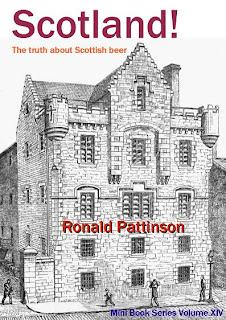
Or rather "Scotland!" for sale. Yes, it's that time of year again. The nights are drawing in, the turkey's getting nervous and I'm trying to hawk another book.
If you've read this blog anytime in the last three months you might have noticed a bit of a theme going on. A Caledonian one. It seemed a shame to let all those words just leak off into cyberspace. That's why I squeezed them into a book.
And just in time for the biggest book-buying bonanza of the year. What a happy coincidence.
It's packed with my trademark long quotes and number-packed tables. Along with a few feeble jokes and the odd kick thrown in the direction of my less assiduous colleagues.
The best book ever written about Scottish beer*. Not that there's a great deal in the way of competition.
In short, a book every Scottish beer-lover and every lover of Scottish beer should own. Buy a copy now!
* Ian Donnachie's excellent book is about the Scottish brewing industry, not Scottish beer.
If you've read this blog anytime in the last three months you might have noticed a bit of a theme going on. A Caledonian one. It seemed a shame to let all those words just leak off into cyberspace. That's why I squeezed them into a book.
And just in time for the biggest book-buying bonanza of the year. What a happy coincidence.
It's packed with my trademark long quotes and number-packed tables. Along with a few feeble jokes and the odd kick thrown in the direction of my less assiduous colleagues.
The best book ever written about Scottish beer*. Not that there's a great deal in the way of competition.
In short, a book every Scottish beer-lover and every lover of Scottish beer should own. Buy a copy now!
* Ian Donnachie's excellent book is about the Scottish brewing industry, not Scottish beer.
Saturday, 25 April 2009
Scotch Ale in the 1920's and 1930's
Whereas the massively strong Edinburgh Ales that brought fame to Scottish brewing in the 19th century had been pale beers, brewed from 100% pale malt, by the 1920's they had become dark and had a more modest gravity.

So that explains what No.3 was: a Burton-like Strong Ale. I drank the stuff many times and always wondered what the hell type of beer it was. I seem to remember it occasionally being called a "dark Bitter", whatever that means.
Here are some details of Younger's Scotch Ales:

That's me about done with Scotch Ale. For the time being, at least. I wonder what will attract my attention next?
"Scotch Ale. A brown beer rather resembling Burton. In the London pubs the term almost invariably stands for Youngers Scotch Ale, in bottle or on draught, which is a genuine Scottish brew. As this is a very popular drink it is often found in free houses, where it usually replaces a Burton, though there are a few pubs that sell both. Younger's Scotch Ale is their No.3. Their No.1 is a really strong brew."
"The Younger Centuries", by David Keir, 1951, page 88.
So that explains what No.3 was: a Burton-like Strong Ale. I drank the stuff many times and always wondered what the hell type of beer it was. I seem to remember it occasionally being called a "dark Bitter", whatever that means.
Here are some details of Younger's Scotch Ales:
That's me about done with Scotch Ale. For the time being, at least. I wonder what will attract my attention next?
Saturday, 18 April 2009
Scotch Twopenny
I've waited a long time to get some details on that ancient Scottish drink, Twopenny. So I'm sharing them with you straight away. You must have been waiting as impatiently as me.
I think I've still got a couple of thins to tell you about Scotch Ale. Exciting, isn't it?
Of Scotch Twopenny.
At and previous to the beginning of the eighteenth century, every publican in Scotland (being every man who chose to embark in the trade) brewed his own ale; and the resort to his house depended on the quality of his liquor; which, when thunder or witchcraft did not interfere, was generally excellent. The strong ale was reserved for holidays and the tables of the great; but the twopenny (so called because it was sold at twopence the Scotch pint*) was so much esteemed as a national beverage, that it was inserted by name, and guarded by peculiar privileges, in one of the Articles of the Union. Another Article, however, in the same Act, secured to the Scottish brewery an Exchequer Court; and this, conjoined with the enormously increased malt duties, so lessened the exhilarating qualities of this ancient ale, that it has now lost its fame. In its stead, a kind of small drink is brewed; but it is destitute of all the qualities which were so often celebrated in Scottish song, and is scarcely superior to the trash termed table-beer in the workhouses of the metropolis.
When the Scotch twopenny was the boast of the nation, saccharometers were unknown, and thermometers had not been heard of by the brewer. Reshaped his course by habit, and with surprising accuracy, as blind men are often known to do. When we first knew the article it had much degenerated; but even then it must have weighed from fourteen to sixteen pounds per barrel, as far as we could judge from the lengths which they drew. The quantity of hops seldom exceeded two pounds and a half to the boll of malt, or about three pounds to a quarter. This was forty years ago, and the old tapsters were then accustomed to tell tales of how they managed to brew ale without hops in their youth.
The boiled worts were usually cast into what were then called half-barrel casks, for few had coolers **; and the gyle-tun (which was often the mash-tun also) was first started, or pitched, at about blood heat. This was done with a single half barrel, or less, for the purpose of chipping the worts ; and the tun was afterwards filled up, by half-barrels at a time, when they had cooled to the requisite degree. The heat of the fermentation was regulated by the appearance of the yeasty head, and great care was taken that it should neither be1 scalded nor chilled. When the smell of the tun became strong, the ale was cleansed into half-barrels, and discharged its yeast into tubs. But the whole brewing was never so fermented; for a great part, often one half, was preserved (in the casks in which it had been thrown from the copper) in the state of worts.
On reading this account of turning the worts boiling hot into the casks, and allowing them to remain there for several days, the modern brewer will immediately exclaim that the ""ale must have been foxed, a term which he gives to an incipient stage of putrefaction, which is supposed to be atl ended with a smell like that of the animal whose name it bears. We can assure him, however, that this accident was very rare, although it would probably be an inevitable consequence of the same practice in many other breweries. The, great preventive was .cleanliness. The casks were repeatedly washed and steamed with hot water before every brewing; and, in order.that not a speck of dirt should be left, the bungholes were cut square, and large enough to allow the brewer to put in his arm, and scour them completely with a heather rinse. The large size of the holes, as well as the hignly fermenting state of the liquor, rendered it inconvenient to use corks ; and, therefore, when the ale was sent out in casks, it was kept in the barrels by means of covers made of clay. " It is in allusion to this practice that Shakespeare speaks of tracing the dust of Alexander till it be found stopping a bunghole." *
After that part of the ale which was cleansed had discharged the greater portion of its yeast, a pailfull was drawn from every cask, into other casks, and the vacancy in each was replaced by a pailfull of the reserved wort. The fermentation was thereby renewed, and the operation was repeated once a day until all the reserved worts were expended; and those were so proportioned as to keep the fermentation alive until the succeeding brewing. This operation was called handling ; and it was in this slowly fermenting state that the ale was sent out to the customers, in casks, or sold in flaggons. We have seen ale preserved, by this means, for nearly a fortnight, in summer weather, without the least perceptible tendency to acidity. Ale, in Scotland, whether strong or weak, was always bottled. In the kind of which we now speak, the cask was allowed to be undisturbed, before drawing off, for twenty-four hours, or perhaps twice that period, according to the length of time which it was to remain in the bottles before ripening. It was generally expected to be very brisk in the course of a week.
With respect to unlawful ingredients, we have already said that the Scotch are less to be complained of than their brethren of the South. The legislature, however, has, it seems, always thought otherwise; for, in addition to the caveats which are addressed to the whole island, there are some which are peculiarly directed against the brewers of Scotland. The following extraordinary prohibition, for example, is still in the Statute Book, and is regularly promulgated under the authority of the Excise:— "
" In Scotland.—By the Act Will., Parl. 1. Sess. 6. c. 43. no salt shall be made use of in brewing beer or ale, whether in washing and seasoning of vessels, or any other way whatever, under pain of confiscation of looms and vessels, with the liquor found therein, attour the loss of his freedom, if the transgressor be a burgess, and the being incapable to use the trade of brewing thereafter. The looms and vessels shall be given to the informer, who shall be free from the said penalty, albeit he have been a servant or accessory."
To prevent ale or beer from foxing, we are convinced that no cleansing material could be better than salt.
* The old ale pint was nearly two English quarts.
** They held about sixteen English ale gallons.
"The Art of Brewing", by David Booth, 1834, pages 57-58.
I think I've still got a couple of thins to tell you about Scotch Ale. Exciting, isn't it?
Friday, 17 April 2009
David Booth's description of Scotch Ale
It seems to have become Scotch Ale week here at Barclay Perkins. I hope you don't mind. There's no particular reason for it, other than that I'm currently reading a history of Wm. Younger.
The passage below neatly details all the main identifying features of Scotch Ale: high gravity, pale colour, modest hopping, high striking heat, single mash, long, cool fermentation. And definitely no effing peated malt nor roast barley in the grist.
These are the examples of Scotch Ale brewing Booth gave:

There will probably be more Scotch Ale fun tomorrow. Unless something else distracts me. You know what I'm like.
The passage below neatly details all the main identifying features of Scotch Ale: high gravity, pale colour, modest hopping, high striking heat, single mash, long, cool fermentation. And definitely no effing peated malt nor roast barley in the grist.
David Booth's description of Scotch Ale
"The distinguishing characteristics of Scotch ale, are paleness of colour, and mildness of flavour. The taste of the hop never predominates, neither in its stead do we discover that of any other ingredient. It is perhaps more near to the French pale wines, than any of the other ales that are brewed in this country. Like them, too, it is the result of a lengthened fermentation.
The low heat at which the tun is pitched, confines the brewing of Scotch ale to the colder part of the year. During four or five of the summer months, the work (except perhaps in some houses for table beer) is completely at a stand, the utensils are limed down, and the greater part of the workmen discharged. No strong ale is either brewed or delivered.
The Edinburgh brewer is particularly nice in the choice of his malt and hops. The former is generally either English, or of his own making from English barley; and the latter Farnham, the finest East Kent, or a mixture of both. The yeast (or store, as it is termed) is carefully preserved, and measured into the gyle-tun, in the proportion of about three gallons to twenty barrels of wort.The Scotch practice is to take only one mash, and that pretty stiff for strong ale, making up the quantity of wort (length) by eight or ten subsequent sprinklings of liquor over the goods, which are termed Sparges. These sparges trickle successively through the goods, and wash out as much more of the saccharine from the mash, as may suffice for the intended strength of the ale. In this manner, specific gravities may be obtained much higher than could be done by a second mash, which always requires a certain portion of liquor before the goods can be made sufficiently fluid. If we suppose this necessary portion of liquid in a particular mash to be fifteen barrels, it would be found, on trial, that these fifteen barrels, when drawn from the mash- tun, would not contain nearly so much saccharine matter as might have been extracted by ten successive sparges of a barrel each. The reason of this will be obvious, if we recollect that the grains always remain wetted with wort equivalent in strength to that of the wort last drawn off, and that the quantity remaining on the goods is about three- fourths of a barrel to a quarter of malt. The gravity of this imbibed wort will, in the one case, be equal to that of the second mash; but in the other, will be reduced to that of the tenth sparge, or washing. Mr. Richardson, so often quoted, condemns this practice ; but, in doing so, we know that he labours under a mistake. " What power," says he, " or what time, has a fluid to extract, which is sprinkled over the surface of the materials, and immediately trickles out below, without being allowed a stationary moment for infusion ?" We answer, that in malt (and it is only of malt brewings that we now speak) the infusion, if properly conducted, is. finished with the first mash,; and thaf. nothing more is necessary than to-draw out from the goods, in a pure state, that saccharine matter which the first infusion has set free. But the question with us does not depend on theory. We have brewed strong ale for years, without following it either with table beer or returns, and we have, in all cases, drawn as much from the malt as we could have done by repeated mashings. The only objection to the sparging system is the loss of time.
The first part of the process is to mash with liquor heated to 180° at least, and generally to 190°, varying with the dampness of the malt. According to Dr. Thomson, the best brewers take the lower heats, but this is doubtful. After mashing from twenty minutes to half an hour, that is, until every particle of the malt is in contact with the liquor, -the tun is covered, and the whole allowed to infuse about three hours, when it is drained off into the under back, or (what is far better) into the wort copper.
After the first wort is run off, a quantity of liquor (generally a barrel), at the heat of 180°, is sprinkled equally over the surface of the goods. To prevent the liquor from dashing on one part, it is usually received upon a circular board, about three feet diameter, which is swung over the centre of the mash-tun; and, being perforated with small holes, allows the water to descend in a shower. The board being hung on cords, is moveable by the hand over every part of the surface of the tun. When, as generally happens, the cock of the liquor-copper is not high enough to carry the liquor to the board, a separate cock is inserted in the side for that use only. Other means may be adopted to answer this purpose of sprinkling, the object being to spread the liquor, equably, in a shower over the whole surface of the goods, as if from the rose of a watering-pan.
When the barrel (or other quantity) of liquor is thus let in upon the goods, the cock of the mash-tun is opened, so as to let it off, as in the case of an ordinary mash. Some brewers, instead of the common outlet of the mash-tun, have three or four small cocks inserted in different parts of the bottom, from the fear that a single cock might draw the filtrating liquor to one point, and thereby create a crack in the goods, instead of leaving the whole of the liquor to descend in one horizontal stratum.
When the first sparge is run off, or nearly so, which may be in twenty or five and twenty minutes, another of equal quantity is put on the goods, in the same manner, and thus, successively, until the whole of the sparges, when mixed with the first mash worts, show that gravity which is desired. The strong ale worts are then completed, and a mash is made to search the goods either for table beer, or a return, as the trade requires. This mash, however, is not necessary as a saving of extract; for the whole of the saccharine matter of the malt may be exhausted, as well as any required gravity of wort produced, by means of sparges alone; but there is an opinion, probably not ill founded, that the last weak extracts are less fitted for fine ale. The making up of strengths from the coolers formerly explained, is here anticipated, being regulated by the saccharometer in the under back, or wort-copper; for practice soon teaches the increase that, is produced by the boiling. It may be here noticed, that after the first sparge at 180°, it is customary with some brewers to reduce the others gradually, so that the last is perhaps 175° or 170°.
All rankness of flavour being carefully avoided in this species of ale, the quantity of hops seldom exceeds four pounds to the quarter of malt; and the bitter thus created being too slight to cover the taste of ruder ingredients, we believe that the Edinburgh brewers have been less the prey of travelling druggists than their brethren of the south. A little honey to add to the sweet, and a few coriander seeds or other aromatics to assist the flavour, are, as far as we have learnt, the amount of the sins of which they have been accused.
The manner of boiling the worts does not differ from the directions of Mr. Richardson; but when they arrive at the gyle-tun, the process of brewing is no longer the same. The first heat of fermentation, in the Scotch method, is as low as possible, consistent with the action. The favourite heat is 50°, a point at which chemists have generally asserted that the vinous fermentation could not exist, but 45° and 46° are by no means uncommon in the manuscript brewing-books that now lie before us. Even in the coldest weather, the lowness of heat is not to be feared, provided the brewery be in full work. The fermentation sometimes continues for three weeks, and a fortnight would be a pretty fair average. Were the brewings made three times a week, seven or eight working-tuns would thus be generally in play; and these being in the same room, some of them at 12 or 15° of increased heat, would create an atmosphere for themselves.
The quantity of yeast formerly mentioned is generally sufficient, but, in some cases, an addition is made a day or two after, if, in the judgment of the brewer, it appears necessary. The least quantity that will carry forward the fermentation to the required point is always preferred; and, to assure that purpose, the tun is roused twice a day (morning and evening) to prevent its becoming too languid. This rousing is continued until the ale is nearly ready for cleansing.
The rule for cleansing differs from that given by Mr. Richardson. It is an application of his saccharometer, of which he himself was not aware. The attenuation is attended to daily, and, towards the close of the operation, twice a day. While the heat is increasing, the attenuation proceeds; that is, the weight of the worts continues to diminish. After a certain time, the heat has reached its highest point, and begins to lessen. It is here that we are directed by Mr. Richardson to trust* to the smell; but this smell merely informs us that carbonic acid continues to be evolved, and the same circumstance is, in consequence, indicated by the sac- pharometer: for as long as any such evolution of gas exists, so long will the weight of the worts continue to diminish. When the progress of the attenuation is so slow as not to exceed half a pound in twenty-four hours, it is prudent to cleanse, especially if the attenuation is already low; for it might otherwise happen, that the gas being too weak to buoy up the now close head of the tun, the yeast might partially or wholly subside, and the ale would become yeast- bitten : it would receive that disagreeable taste which the head had acquired by too long exposure to the atmospheric air.
When the ale is cleansed, the head, which has not been disturbed for two or three days, continues to float on the surface, till the whole of the then nearly pure liquid is drawn off into the casks ; and this is considered as a preservative against the admission of the atmospheric air: for (he Scotch do not skim their tuns as the London ale brewers so generally do. The ale thus cleansed does not require to be placed on close stil- lions. It throws off' little or no yeast, and a tub placed so as to catch any little overflow of the scum that arises is quite sufficient. The fermentation is almost finished in the tun ; and it is not the wish of the brewer that it should proceed much farther.
The strength of Scotch ale, when it deserves the name, ranges between thirty-two and forty-four pounds weight to the imperial barrel, that is, of a specific gravity between 1089 and 1122, according to the price at which it is meant to be sold. The general mode of charge is by the hogshead (about a barrel and a halQ, for which five pounds, six pounds, seven pounds, or eight pounds are paid, as the quality may warrant; the strength for every additional pound of price being increased by about four pounds per barrel of weight.
In a good fermentation, there seldom remains above & fourth of the original weight of the wort at the period of cleansing. Between that and a third is the usual attenuation. If above a third remains, the taste is generally mawkish, and it is to be feared that the acetous fermentation will commence, before the time in which the ale might be expected to improve. Of the less sensible process of attenuation which goes on afterwards in the casks, we have already spoken when treating generally of the "Vinous fermentation." Scotch ale soon becomes fine, and is seldom, racked, at least for the home market."
"The Art of Brewing", by David Booth, 1834, pages 52-55.
These are the examples of Scotch Ale brewing Booth gave:
There will probably be more Scotch Ale fun tomorrow. Unless something else distracts me. You know what I'm like.
Monday, 13 October 2008
Scotch Ale 1815-1850
Back to book extracts. I have a feeling that the 1815-1850 chapter will need some serious editing. It's currently almost 25% of the total book. And I want to add more to it. There are just too many sources for the period.
Scotch Ale. A topic I've already covered several times. But what the hell, there's still plenty to discuss. In the first half of the 19th century, there were significant differences in the way Scottish and English brewers worked. What were they? Try reading the text below.
Scotch Ale
Scotch Ales in the 1820's
Price__OG______FG______ABV
£4__1080-86____1032-35__6,625
£5__1090-95____1036-39__7
£6__1100-1108__1040-44__7,75
£7__1110-1116___1045-47__8,375
£8__1120-1125___1048-50__9,25
Source:
"Scottish Ale Brewer", WH Roberts, Edinburgh, 1847, page 117
Scotch Ales in the 1840's
Price__OG______FG______ABV
£3__1080-86____1032-35__6,625
£4__1090-95____1036-39__7
£5__1100-1108__1040-44__7,75
£6__1110-1116___1045-47__8,375
£7__1120-1125___1048-50__9,25
Source:
"Scottish Ale Brewer", WH Roberts, Edinburgh, 1847, page 117
The Scottish system of brewing
The main difference with England was that Scottish brewers mashed just once. One and a half to one and three quarter barrels of water were used per quarter of malt. The striking heat was between 175º and 185º F. Mashing took about 45 minutes, follwed by a period of standing between 2 and 3 hours. After this time the first wort was run off and the goods sparged with hot water.
For strong Ales, of over 1100, between 4 and 10 pounds of hops per quarter were used. In winter the average was about 6 pounds, in summer 8 pounds. (Source: "Scottish Ale Brewer", WH Roberts, Edinburgh, 1847, page 149.) That's a little less than in England, where stronger Ales had 8 to 10 pounds of hops per quarter.
Roberts described how he hopped Ales when brewing.
OG________season___hops/qtr__1st addition__2nd addition____length of boil
1095-1100__Jan-Mar__10 lbs____4 lbs, 0 mins__6 lbs, 20 mins__60 mins
1085-1090__Jan-Mar__8 lbs_____4 lbs, 0 mins__4 lbs, 15 mins__60 mins
1070-1080__Jan-Mar__7 lbs_____2 lbs, 0 mins__5 lbs, 15 mins__60 mins
Source: "Scottish Ale Brewer", WH Roberts, Edinburgh, 1847, pages 89-90
When a Table Beer was made with the weaker runnings, the hops from the strong Ale were re-used, being boiled 2 to 3 hours. (Source: "Scottish Ale Brewer", WH Roberts, Edinburgh, 1847, page 91.)
Yeast was pitched 53º F in winter, 51º F in summer. Around 2 pounds of yeast per barrel was pitched. During fermentation, the temperature of the wort increased by 12º to 15º F. (Source: "Scottish Ale Brewer", WH Roberts, Edinburgh, 1847, page 149.)
"Scottish brewers make no use of isinglass for finings; nor do I believe they have any occasion to employ such agents as flour and salt in order to stimulate fermentation ." (Source: "Scottish Ale Brewer", WH Roberts, Edinburgh, 1847, page 150.)
Roberts gives an example of a £5 (100/-) Ale. Twenty quarters of malt were added to 32 barrels of water at 180º F. It was mashed with oars for 45 minutes then covered and left to stand for 2 hours 45 minutes. The tap was opened to run off the wort and at the same time sparging began with 32 barrels of water at 190º F. The wort run off was at 148º F. After 3.5 hours 48 barrels of wort at 1083º had been collected and the tap was closed. Another 15 barrels of water were sparged to make Table Beer. (Source: "Scottish Ale Brewer", WH Roberts, Edinburgh, 1847, pages 149-150.)
160 pounds of East Kent hops were added to the wort in the copper and boiled briskly for 90 minutes. After cooling, 36 barrels of wort at 1103.5 were put into the gyle tun. It was pitched at a temperature of 50º F with 8.5 gallons of yeast. The wort remained in the tun for 13 days, the temperature rising to 63º F. It was then let down into the square at a gravity of 1043 and left there for 24 hours before cleansing into hogsheads. (Source: "Scottish Ale Brewer", WH Roberts, Edinburgh, 1847, page 150.) By my calculation, that's about 8% ABV and 58% apparent attenuation.
10 barrels of Table Beer with a gravity of 1040º were also produced. (Source: "Scottish Ale Brewer", WH Roberts, Edinburgh, 1847, page 151.)
There are a couple of major differences between the method Roberts describes and the practice in English breweries. There was just a single mash, as opposed to three or four. The volume of the water used to sparge was much greater. The yeast was pitched colder, 50º F rather than 60º F, which was more typical in England. The fermentation, at two weeks, was much longer. In England it rarely lasted even as long as seven days. From the mention of moving the wort from a tun to a square, it sounds as if Roberts was employing the dropping system of fermentation.
Scotch Ale. A topic I've already covered several times. But what the hell, there's still plenty to discuss. In the first half of the 19th century, there were significant differences in the way Scottish and English brewers worked. What were they? Try reading the text below.
Scotch AleScotch Ales in the 1820's
Price__OG______FG______ABV
£4__1080-86____1032-35__6,625
£5__1090-95____1036-39__7
£6__1100-1108__1040-44__7,75
£7__1110-1116___1045-47__8,375
£8__1120-1125___1048-50__9,25
Source:
"Scottish Ale Brewer", WH Roberts, Edinburgh, 1847, page 117
Scotch Ales in the 1840's
Price__OG______FG______ABV
£3__1080-86____1032-35__6,625
£4__1090-95____1036-39__7
£5__1100-1108__1040-44__7,75
£6__1110-1116___1045-47__8,375
£7__1120-1125___1048-50__9,25
Source:
"Scottish Ale Brewer", WH Roberts, Edinburgh, 1847, page 117
The Scottish system of brewing
The main difference with England was that Scottish brewers mashed just once. One and a half to one and three quarter barrels of water were used per quarter of malt. The striking heat was between 175º and 185º F. Mashing took about 45 minutes, follwed by a period of standing between 2 and 3 hours. After this time the first wort was run off and the goods sparged with hot water.
For strong Ales, of over 1100, between 4 and 10 pounds of hops per quarter were used. In winter the average was about 6 pounds, in summer 8 pounds. (Source: "Scottish Ale Brewer", WH Roberts, Edinburgh, 1847, page 149.) That's a little less than in England, where stronger Ales had 8 to 10 pounds of hops per quarter.
Roberts described how he hopped Ales when brewing.
OG________season___hops/qtr__1st addition__2nd addition____length of boil
1095-1100__Jan-Mar__10 lbs____4 lbs, 0 mins__6 lbs, 20 mins__60 mins
1085-1090__Jan-Mar__8 lbs_____4 lbs, 0 mins__4 lbs, 15 mins__60 mins
1070-1080__Jan-Mar__7 lbs_____2 lbs, 0 mins__5 lbs, 15 mins__60 mins
Source: "Scottish Ale Brewer", WH Roberts, Edinburgh, 1847, pages 89-90
When a Table Beer was made with the weaker runnings, the hops from the strong Ale were re-used, being boiled 2 to 3 hours. (Source: "Scottish Ale Brewer", WH Roberts, Edinburgh, 1847, page 91.)
Yeast was pitched 53º F in winter, 51º F in summer. Around 2 pounds of yeast per barrel was pitched. During fermentation, the temperature of the wort increased by 12º to 15º F. (Source: "Scottish Ale Brewer", WH Roberts, Edinburgh, 1847, page 149.)
"Scottish brewers make no use of isinglass for finings; nor do I believe they have any occasion to employ such agents as flour and salt in order to stimulate fermentation ." (Source: "Scottish Ale Brewer", WH Roberts, Edinburgh, 1847, page 150.)
Roberts gives an example of a £5 (100/-) Ale. Twenty quarters of malt were added to 32 barrels of water at 180º F. It was mashed with oars for 45 minutes then covered and left to stand for 2 hours 45 minutes. The tap was opened to run off the wort and at the same time sparging began with 32 barrels of water at 190º F. The wort run off was at 148º F. After 3.5 hours 48 barrels of wort at 1083º had been collected and the tap was closed. Another 15 barrels of water were sparged to make Table Beer. (Source: "Scottish Ale Brewer", WH Roberts, Edinburgh, 1847, pages 149-150.)160 pounds of East Kent hops were added to the wort in the copper and boiled briskly for 90 minutes. After cooling, 36 barrels of wort at 1103.5 were put into the gyle tun. It was pitched at a temperature of 50º F with 8.5 gallons of yeast. The wort remained in the tun for 13 days, the temperature rising to 63º F. It was then let down into the square at a gravity of 1043 and left there for 24 hours before cleansing into hogsheads. (Source: "Scottish Ale Brewer", WH Roberts, Edinburgh, 1847, page 150.) By my calculation, that's about 8% ABV and 58% apparent attenuation.
10 barrels of Table Beer with a gravity of 1040º were also produced. (Source: "Scottish Ale Brewer", WH Roberts, Edinburgh, 1847, page 151.)
There are a couple of major differences between the method Roberts describes and the practice in English breweries. There was just a single mash, as opposed to three or four. The volume of the water used to sparge was much greater. The yeast was pitched colder, 50º F rather than 60º F, which was more typical in England. The fermentation, at two weeks, was much longer. In England it rarely lasted even as long as seven days. From the mention of moving the wort from a tun to a square, it sounds as if Roberts was employing the dropping system of fermentation.
Subscribe to:
Posts (Atom)