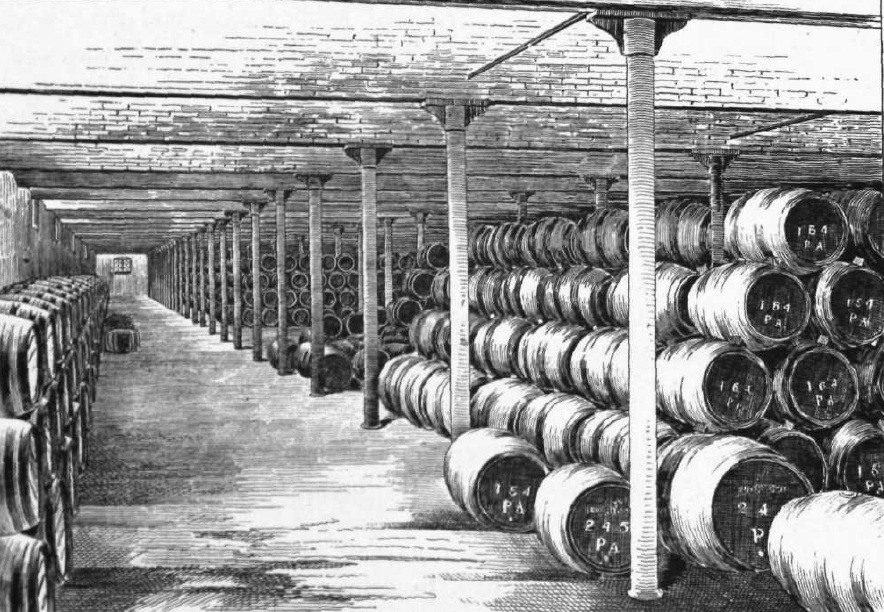
Showing posts with label Barnard's Noted Breweries. Show all posts

Tuesday, 30 July 2019

Brewing at William Younger in the 1880’s (part two)

Let's allow Alfred Barnard to take our hand again and guide us through not one, but two, William Younger breweries in Edinburgh.

Holyrood Brewery

"Leaving this place, we passed down some steps into another building, devoted to the fermenting operations, and first entered the square room, which measures 140 feet by 50 feet, and contains twenty-eight fermenting squares. It was here that we saw the beer in active, or as the brewer designated it lively, fermentation, and were treated to a sniff of carbonic acid gas, much to the amusement of our guide. Crossing this floor we found ourselves in another and much larger room, which covers an area of 6,000 square feet. The floor is laid with asphalte, and it contains 160 union casks. Descending a stair, we passed through the rooms below this and the adjoining buildings, all of which are used as racking floors and store cellars. In one of them there are twenty cleansing squares or settling backs, each of an average content of 120 barrels."
"Noted Breweries of Great Britain and Ireland vol. II", by Alfred Barnard 1889, page 19.

Next Barnard visited Younger’s newer brewery, Holyrood, which had been specifically built to brew Pale Ale.

"Here there are three mash-tuns, each capable of mashing forty quarters of grist at one time, over which are the hoppers referred to, and each vessel contains gun-metal stirring gear and draining plates, manufactured by Messrs. Stewardson & Hodgson of Edinburgh."
"Noted Breweries of Great Britain and Ireland vol. II", by Alfred Barnard 1889, page 27.

The mash tuns remained of a modest size in the new brew house. A big London brewery had much larger mash tuns. Barclay Perkins had ones capable of holding 130 quarters . Even after the introduction of the Steel’s masher, mash tuns still often had internal rakes. Rakes were useful for preventing a stuck mash and, for brewers adding extra, hotter water to their mash, a way of mixing it through the grain.

This is an interesting remark about the way wort was boiled.

"In the old brewhouse, at the back of the tuns, there are two other wort coppers of 120 barrels content. The ale wort is kept boiling, with the hops in the coppers for about two hours, and the great object of the operator now is to preserve the delicate aroma of the hops. The flavour of the ale partly depends upon a careful attention to the process at this stage, as, if kept too long boiling, the fine aroma, which now so pleasantly greeted us as we approached the coppers, being evanescent, flies off with the vapour, if not carefully watched."
"Noted Breweries of Great Britain and Ireland vol. II", by Alfred Barnard 1889, page 28.

Scottish brewers seemed very keen on retaining delicate hop aroma. Presumably another reason why their boils were so short earlier in the century.


The above is an extract from my book on Scottish beer:


http://www.lulu.com/shop/ronald-pattinson/scotland-vol-2/paperback/product-23090497.html 

Sunday, 28 July 2019

Brewing at William Younger in the 1880’s (part one)

Alfred Barnard. What a great bloke. I’d like to shake his hand. For the service he did to history grubbers like me by recording so many classic breweries of the late 19th century. He might have been vague on the beers. I can fill that information in from brewing records. Barnard noted the nuts and bolts of breweries. The mash tuns, coolers, coppers, fermenters and cleansers.


Luckily for us, Barnard dropped by William Younger on his travels. After a couple of chapters on Younger’s extensive maltings, he gets onto the useful stuff, the Abbey Brewery. Kicking off with the mashing stage.

"At one corner of the place a pair of mill rollers were actively at work crushing the malt as it fell from a receptacle above, and we saw the grist "Jacobed " as they call it here—i.e., lifted by an elevator to an immense hopper fixed in the centre of the house, to be ready for the first process. From the apex of this hopper protrudes a large-size Steel's mashing machine, which serves two mash tuns, each of which holds forty quarters. They are both constructed of wood, lined with copper, and possess gun-metal draining plates."
"Noted Breweries of Great Britain and Ireland vol. II", by Alfred Barnard 1889, pages 18 - 19.

A Steel’s masher is a large screw in which water and malt are mixed on their way into the mash tun. Invented by a Mr. Steel in the 1850’s, it proved immensely useful and popular. Older British breweries like Fullers and Harveys still use them. It’s a very simple and effective way of getting a mash with a good consistency from the minute it enters the tun.

A tun of forty quarters could mash enough wort for around 160 barrels of 1056º beer. However, looking at Younger’s records for 1888, they weren’t mashing at full capacity every time. Or even any time. Mostly it was just 20-odd quarters per brew. The largest I can find was just 35 quarters.

The wort would have flown from the mash tun to the underback.

"The next object that attracted our attention was the underback, also a copper vessel of some ten barrels capacity, which is placed in the basement of the building, and from which the wort is pumped direct into the coppers."
"Noted Breweries of Great Britain and Ireland vol. II", by Alfred Barnard 1889, page 19.

A ten barrel underback seems very small to contain wort from a 40-quarter mash tun. That’s enough to produce around 160 barrels of beer at 1055º and 80 barrels even at a gravity of 1100º.

“Returning to the mashing floor we were shown the two coppers, wherein the wort is boiled with the hops. These are of cylindrical form, and rise from the floor of the house to a great height. They are also constructed of copper, and their tops are reached by means of a gangway protruding from the second stage. We noticed in close proximity another vessel called the heating tank, which supplies the hot water to the mash tuns, etc. The hot wort is conveyed from the coppers in pipes, stretching across the western corner of the building to the hop-back, which is placed on a long gallery overhead. From this vessel the strained liquor runs by gravitation to the coolers placed on the floor of the next building."
"Noted Breweries of Great Britain and Ireland vol. II", by Alfred Barnard 1889, page 19.

Cooling was performed the classic late 19th-century way, with a combination of large, open, shallow coolers and heat-exchanging refrigerators:

"Pursuing our investigations, we next ascended a stair to the first stage, and by a doorway entered the cooling or cooler room. It is a large apartment, with latticed sides, measuring 90 feet by 40 feet, and contains two open coolers of large dimensions, and two of Morton's refrigerators."
"Noted Breweries of Great Britain and Ireland vol. II", by Alfred Barnard 1889, page 19.

The initial stage in the coolers wasn’t just for cooling purposes. These shallow vessels were also perfect for dropping out a lot of the gunk in the wort.

A Morton’s refrigerator is like a washboard of copper pipes through which brine is circulated. The wort runs over these pipes, cooling quickly. And presumably oxidising nicely at the same time.


This is an excerpt from my excellent book on Scottish brewing, Scotland! vol. 2:


http://www.lulu.com/shop/ronald-pattinson/scotland-vol-2/paperback/product-23090497.htm

Sunday, 17 January 2016

How modern breweries differ

From older ones. It's really striking. And I'm surprised no-one else has mentioned it.

Or maybe it's just obvious to me. Because of my odd background.

I've spent many hours poring over Barnard's "Noted Breweries of Great Britain and Ireland", paying particular attention to the brewing kit he describes. Why? Because he visited many of the breweries whose brewing records I have. It provides context for the numbers.


You may have noticed that I've travelled a bit recently. And dropped by a stackload of breweries. Not just that, I'm a nosy bastard. And interested in - frankly pretty dull stuff - like the size and configuration of brewing kit. There are some advantages to being a sad, sad, obsessive.

A classic tower brewery and a modern one are configured in a totally different way. It's all to do with the relationship between the size of the mash tun and the fermenters. Old breweries had a mash tun with a capacity way larger than their fermenters. One mash was distributed over dozens of fermenting vessels. New breweries have a brewing kit with the same capacity as a fermenter at best. More common is to have fermenters double the size of the brew length. It's a huge change.

Mind, if these youngsters parti-gyled they wouldn't have to piss around this way.

Why is this? In the old days breweries churned out large volumes of just a couple of beers. Modern breweries tend to produce loads and loads of beers, each in realtively small quantities.

A Victorian brewer would find a modern brewhouse totally crazy. As I do. But I'm still living in 1913, at least in my head.

Wednesday, 7 May 2014

The Red Lion Brewery (part two)

We're back with Barnard's description of Hoare's Red Lion Brewery. This time it their water supply and mash tuns being discussed.

Barnard must have forgotten to take his photographer along because the only illustration of the brewery is a reproduction of a painting. It's really annoying because I'm struggling to find any images of the brewery.


Red Lion Brewery in 1869
But first here's something I missed last time:

"Retracing our steps to the brewery, we made our way to the top of the malt warehouses, to witness the arrival of some malt from the railway waggons. The sacks are lifted therefrom by a powerful steam hoist, by which they are drawn up to the different loophole doors on the various floors, when they are wheeled away to the bins."
"Noted Breweries of Great Britain and Ireland, vol. 3", Alfred Barnard, 1890, page 55.

So they did have a hoist for malt. But only for supplies arriving by rail. Why didn't they use it for the malt arriving by boat?

Now on to water. I knew London brewers didn't use Thames water for brewing. Given the state of the river in the 19th century, you wouldn't want its foul water anywhere near your mash tun. But it did have a use:

"There is no district in England in which springs and wells are exhibited in a more instructive manner than the London Basin. Nearly the whole of Middlesex and other districts surrounding the Metropolis are contained in an immense bowl of chalk, many miles in extent, in the interior surface of which there is a thick lining of sand, supporting a deep bed of clay, called the London blue clay. Above this, in most places, is another bed of gravel and vegetable mould, and on this latter the Metropolis is built. The interposition of this bed of clay has a remarkable effect on the mode in which water accumulates beneath the soil of London, for its texture is so dense that very little water can penetrate it; that which accumulates above it must remain there, while that beneath it is unable to force a passage upwards. The quality of the water beneath the clay is said to be very fine, especially for brewing. Many wells of vast depth have been sunk by the London brewers, piercing through the entire mass of clay and sand into the chalk beneath. The noted well at Messrs. Hoare's brewery is one of these. It is sunk 100 feet, and to that depth is 5 feet in diameter, being lined with cast-iron curbs; after that there are two bore-holes, 12 inches and 9 inches respectively, 300 feet down to the chalk. There is an unfailing supply from this well, the water therefrom being alone used for brewing Hoare's celebrated porter and ales. Near to this there is a land spring 8 feet in diameter and 53 feet deep; and beneath the vaults are six tube wells, all used in connection with each other. This water is drawn from above the London clay, and is only used in the summer, when the Thames water is not cold enough, for supplying the refrigerators. From this point of the brewery there is a ladder stair leading to the topmost roof (over which, on a pedestal, is the effigy of the Red Lion, lifesize, the trade mark of the firm), from whence we obtained an extensive view of the shipping in the Thames, the Tower, St. Paul's, and a distant view of the Crystal Palace.
"Noted Breweries of Great Britain and Ireland, vol. 3", Alfred Barnard, 1890, pages 56 - 57.
"As a matter of fact, in this, the oldest brewery in London, Thames water was never used, the supply from the wells being considered superior for mashing, and in preserving the intrinsic quality of the article."
"Noted Breweries of Great Britain and Ireland, vol. 3", Alfred Barnard, 1890, page 58.
All the London breweries seem to have had their own wells. Clearly there was a difference in quality between the water from above and below the clay. 400 feet is pretty deep. Presumably it was worth digging that far to get clean, pure water for brewing. Refrigerators were used for cooling the wort. They were a network of copper pipes through which cold water was passed. The wort flowed over the pipes and was cooled. In this period they were used in conjunction with the older large shallow coolers (the things people insist on calling coolships nowadays). Coolers were useful not just for cooling wort, but also getting a lot of the gunk out of it. Because they were very shallow, solids quickly fell to the bottom.

It would have been safe to use Thames water in the refrigerators because it never came into contact with the wort. I wonder if they also used it in their attemperators?

The Lion Brewery in Lambeth wasn't the only brewery in London with a lion on top of it.

"After this we made our way downstairs, to see the pumping machinery connected with the deep well, and then directed our steps to the brewhouse. Of the great brewhouse itself, to which we had now arrived, it is difficult to give a description. It is a massive and lofty building, constructed principally of iron and brick, with louvred walls, and exits for steam in the open and extensive roof. On ascending the iron staircase, leading to the mash tun stage, the first effect on our minds was a state of bewilderment; the brewing vessels and utensils seemed so large and massive, and the pumps, pipes and rods so numerous, that for a while the whole seemed a mass of confusion. Nor was it until we had followed the brewing processes in their regular order that the whole assemblage assumed its proper shape and order."
"Noted Breweries of Great Britain and Ireland, vol. 3", Alfred Barnard, 1890, page 57.

I'm surprised that Barnard was so awe-struck by the scale of Hoare. This is volume three of his book and he'd already been around Guinness, Bass, Allsopp, Truman and Barclay Perkins in volume one. Those were all considerably larger than Hoare.

Now let's look at the mash tuns:

"Running through the enormous buildings are five chimney shafts, connected with the boilers and coppers; and, from the first floor to the lofty roof, the view upwards is uninterrupted by distinct floors or partitions, except where stages or platforms occur at various heights, forming the support of the various vessels. The principal part of the floor, which is laid all over with iron plates, is occupied by three mash tuns, of enormous dimensions, and three coppers, the latter rising from the floor to a height of 20 feet. Two of these mash-tuns are constructed of cast iron, the other of oak, and all of them have domed covers. One of them, mashing 220 quarters, manufactured by Spence, of Dublin, is the most remarkable mash tun that we have seen in our travels. This massive vessel, which is used for porter brewing, weighs twenty and the dome-cover ten tons, together thirty tons of cast iron, and this without taking into consideration the weight of the slotted draining-plates and ponderous mashing apparatus, or the porcupine machinery, which they all contain. One of them is commanded by a Steel's mashing machine, and the mashing capacity of the three is 450 quarters. Before leaving the mashing-stage, our guide pointed out the numerous appliances for extinguishing fire, such as main-pipes, hose, stand-pipes, etc ; also the valves at the bottom of the mash tuns, by which the grains are released therefrom. The valve-traps communicate with shoots connected to a Jacob's ladder, by which they are conveyed direct into the grains contractors' vats. This method is a saving both of time and labour, as the largest tun can be emptied in one hour and twenty minutes.
"Noted Breweries of Great Britain and Ireland, vol. 3", Alfred Barnard, 1890, pages 57 - 58.

A mash tun with a capacity of 220 quarters was pretty big, even for a London brewer. Whitbread's seem to have taken no more than 100 quarters and they would use two, three or four mash tuns for a single brew. Barclay Perkins also regularly used multiple mash tuns for a single batch. 220 quarters was enough to brew around 900 barrels of standard-strength Porter. The other two mash tuns must have been considerably smaller because combined they only had a capacity of 230 quarters.

By "porcupine machinery" I assume he means internal rakes, the earliest form of mashing machine. It's odd that only one mash tun had an external Steel's masher. These were pretty standard by 1890, having been first developed in 1853. And dead useful devices. They mixed the grain with water as it was going into the tun and was a good way of making sure the two were thoroughly mixed. Having tried to mix malt and grain with a paddle while brewing at Colonial Williamsburg, I can vouch for how tricky it is to remove any clumps of malt manually.

Next time we'll be looking at the black malt backs, amongst other things. There's something I've not come across before.

Saturday, 3 May 2014

The Red Lion Brewery

Time for some more about the history of the Red Lion Brewery. Latterly know as Hoare and Co.

The brewery stood just to the east of St. Katharine's Docks, which were constructed in the 1820's. Luckily the brewery escaped the destruction need to construct them:

"The total cost of St. Katharine's Docks amounted to £1,700,000, and 1,252 houses (besides the hospital) had to be pulled down and removed to make room for that great undertaking. Hoare's brewery, although but fifty yards distant, was, however, spared from the wholesale demolition that then took place, and still stands as a relic of the most ancient brewhouse in England. As far back as the end of the fifteenth century there existed on this very spot a public brewhouse, where the citizens of London could bring their malt and raw material, and for a fee, or license, paid to the Government, brew therein their own ales. Pennant, referring to this building, says : "Below St. Catherine's, on the river side, stood the great breweries, or Bere Houses, as they are called in the map published in the first volume of the 'Civitates Orbis.' They were subject to regulations as early as the reign of Henry VII., who, in 1492, licensed John Merchaut, a Fleming, to export fifty tuns of ale called Berre. And in the same reign, one Geffry Gate, probably an officer of the king's, spoiled the brewhouses at St. Catherine's twice, either for sending too much abroad unlicensed, or for brewing it too weak for their home customers." He further states that the demand for this article, from foreign parts, increased to a high degree, and that in the reign of Queen Elizabeth 500 tuns were exported at once. At this time there seems to have been a free exportation, except when checked by proclamation, for fear of enhancing the price of corn by excess of brewing in scarce times; but even then it was permitted by the royal license."
"Noted Breweries of Great Britain and Ireland, vol. 3", Alfred Barnard, 1890, page 52.
Red Lion Brewery in 1746

It really was probably the oldest brewery in Britain. At the time of its closure in the 1930s it was noted that it was one of the oldest businesses in London. Given its very central location, it's probably more surprising that it lasted as long as it did.

I should also point out that back in Tudor times it was outside the City of London, which ended at the Tower.

"Entering beneath a broad archway from Lower East Smithfield, we found ourselves in a spacious courtyard engirt on one side by a lofty brewhouse, tun rooms and cask sheds ; on the other by a handsome semicircular block of buildings, lofty offices, etc. We were received by one of the partners, who introduced us to the head brewer, Mr. E. J. Tabor, by whom we were conducted through the works.

On the opposite side of the road in front of the brewery on the river Thames, is the firm's wharf, where sailing barges from the east coast deliver malt for the manufacture of Hoare's celebrated porter and ales. Thither we walked, accompanied by our guide, who at once drew attention to the means by which the malt is conveyed to the great malt warehouses in the brewery buildings. This is done by a string of sturdy porters, each carrying from the barge a large sack on his back. We counted forty of these men, who followed each other pretty closely, each one bringing his sack of malt (weighing about one-and-a-half hundredweight) from the barge and depositing the contents in the warehouse. Each one carries his sack of malt into the warehouse up several flights of stairs, and empties the contents into one of a series of enormous bins or boxes. At every second flight of steps there are halting-places, with shelves whereon the men deposit their loads for a few moments, to rest themselves before climbing higher. The bins, which are sixteen in number, are of such extraordinary dimensions, especially in height, that they will hold from 500 to 2,000 quarters each — as a matter of fact, they will hold together upwards of 15,000 quarters of malt. They are formed entirely of wood, and are supplied with malt till full, the earlier portions of the supply being introduced at a door half-way up the bin, afterwards closed up."
"Noted Breweries of Great Britain and Ireland, vol. 3", Alfred Barnard, 1890, pages 54-55.

At this time many breweries still had maltings in the brewery complex. Not in London, though. Land was presumably too dear for that by the end of the 19th century.

Red Lion Brewery in 1802

I'm amazed that they were still manually unloading malt at this late stage. The process had been mechanised at Barclay Perkins much earler. OK, I can understand that, not being directly on the river, they might have to carry the sacks to the brewery, but having porters carry them up to the top of the building? Hadn't they ever heard of a hoist? In a typical tower brewery - Holes is a good example - there's a special doorway with a beam above it for placing a pulley next to the malt store. It's the thing with the wooden surround here:


One-and-a-half hundredweight is 168 lbs, or around 75 kg. I wouldn't want to be carting that weight up several flights of stairs. Literally back-breaking work.

As a quarter of malt is 3 hundreweight, or two sacks, filling all the malt bins would require 30,000 trips up the stairs. A staggering amount of physical labour. Even at a time when labour was relatively cheap, that still sounds an expensive way of shifting malt about. A steam-powered lift would surely have been cheaper and more efficient.

Sunday, 6 April 2014

Charrington's Burton Brewery (part two)

We're going to take a look inside Charrington's Burton Brewery today.

First the brewery yard:
"Entering the brewery yard, through a noble gateway, we had on one side of us the porters' lodge, and on the other the general offices. Confronting us was the lofty brewhouse adjoining the fermenting rooms, the whole forming a range of buildings, which, by reason of the various roofs being broken up into different heights—surmounted by tall chimney stacks—present a strikingly picturesque appearance.

At the bottom of the long yard, there is a loading-out platform, abutting on to the railway track, and to the left of the enclosure is to be seen one of the engine and boiler houses. Next to them appears an important block of buildings, in which is contained hop and malt stores, a fermenting room, ale stores, and cellars. Farther on, and still more to the left, is the cask-washing yard and adjacent cooperages, and, finally, the offices, comprised in a neat two-storeyed building, which have a frontage in Abbey Street."
"The Noted Breweries of Great Britain and Ireland, vol. 1" by Alfred Barnard, 1889, page 328.
It sounds very pretty, but was it practical? I'd expect a pretty much brand new brewery to be more rationally organised.

I'm going to skip most of the bits about the maltings. Descriptions of malting equipment don't thrill me the same way brewing equipment does. I'm only including the parts about ale stores and cask banks.

"The entire basement of the No. 2. malt house, and subsidiary buildings, is utilized for ale stores, as also is that on the No. 1 malt store. Some idea of the capacity of these extensive cellars may be imagined when we state that they will hold nearly 4,000 barrels of beer.


From the yard the ale stores are reached by some stone steps, leading down to a wide corridor, in which is placed a ponderous barrel-lifting machine worked by steam power. We found this cellar like the No. 1, afterwards visited, well-ventilated and drained, also well-lighted by means of sunken windows in the area.

We were much struck with the size and extent of the cask-banks, covered by many thousands of barrels of beer, stacked up in neat rows, encircled and intersected as it is by several railway tracks. In the centre of the large open space there is a circular detached office of handsome appearance for the use of Mr. Matthews, the foreman of the department, and the loading-out clerks. This office is in direct communication, by telephone, with the brewhouse and public offices in Abbey Street The engine shed and turnstile (for the firm's own powerful locomotive) arc situated on these premises, and within the enclosure arc to be found mess rooms for the storekeepers and maltmen, and houses for general stores. There areas many as sixty men and foremen employed the stores and makings, and most of them are members of the sick club, which is managed by themselves and is entirely self-supporting."
"The Noted Breweries of Great Britain and Ireland, vol. 1" by Alfred Barnard, 1889, page 330.

I can remember when I used to go past Tetley's on the bus they had a yard piled up with casks. Thousands of the things. It was an impressive sight. Though they were empty casks. The ones here were full, following that quaint Burton practice of leaving Pale Ale out in the yard for months on end.

Friday, 6 December 2013

Hole's new brewery

It was really weird finding this. A description of the new Holes brewery, written before construction started. Why so weird? Because it's describing one of the first places I worked.

Not much seemed to have changed in the 80-odd years between its construction and when I worked there. Though, to be honest, I don't think I ever set foot in the brewhouse itself.

I like how the article makes clear that malting came first in Newark and brewing only later. At least brewing on a large scale. It also confirms that Jamea Holes was oirginally a maltsters which diversified into brewing. All in all, an extremely informative article.


"BREWERY ENTERPRISE AT NEWARK.
MESSRS. JAMES HOLE CO.'S NEW BREWERY.

The Newark Advertisor, Wednesday, says:- "We have had the pleasure to describe from time to time the additions which have been made through private enterprise and public effort to the architectural features of our town, and to-day we give an account of another block of buildings about to be erected, which will constitute an important accession to the business premises devoted to the commodity for which Newark is becoming famous. For years past Newark ales have been winning their way to public favour, and the prediction that in the not far distant future Newark would take rank as another Barton seems on the high road to fulfilment. The town is admirably situated for the development of an industry of this kind. Not only does it possess ample facilities for the transit goods by rail and river, but it has natural advantages which equal those of any other locality. The water possesses all the properties essential to the production of the finest ales, and the town being one the greatest malting centres in England — producing malts of unrivalled quality, it always has the staple material at its doors. It is not surprising, therefore, that the great brewing industry should flourish in our midst, and that under the direction of enterprising firms the ales of Newark should be sent far and wide for public consumption in ever-increasing quantities.

A splendid new brewery is new about to be erected by the well-known firm of Messrs. James Hole and Co., the partners in which are Mr. Alderman Hole (ex- Mayor of Newark) and Councillor S. K. Marsland. It was in February, 1885, that Messrs. Hole became the proprietors of the Castle Brewery, and devoted their energy and their capital to its development. The firm had long occupied a high position as maltsters, and it was confidently believed by all who know them that success would soon be won in the kindred trade. Results have happily exceeded the most sanguine anticipations. Starting with a comparatively small brewery at the back of palatial offices, of which they became the purchasers, the growth of their business necessitated additions to the brewing plant. By degrees every inch of accommodation which the premises afforded was utilised, and it was seen that the time was rapidly approaching when the erection of a new brewery would become imperative. All the alterations which were made were arranged, therefore, with this object in view. A new boiler-house, with its lofty chimney, was constructed that it could, if occasion required, form part of a new establishment, and other additions were shaped that they would not interfere with the erection of a commodious brewery, whenever the growth trade made this enterprise desirable.

The time for taking the matter in hand was not long in arriving. At the outset, the firm made a speciality of beer for family consumption, and determined to place before the public a pure, wholesome, exhilarating beverage adapted for constant use at the table. Experience showed that the water at the Castle Brewery was admirably suited for the production light dinner ale the kind of which the public taste required, and to this commodity the firm devoted special attention. Their "A.K." was placed in the market, and that it has met the wants of consumers is shown by the fame which it has achieved, and the rapid and continuous growth of the family trade. By its own intrinsic merits, and by judiciously bringing its qualities to the notice the public, the "A.K." has become one of the best known ales in the Midlands, and it is used daily with ever-increasing satisfaction in hundreds homes in Notts, and in the adjoining counties. It is also finding its way gradually but surely into more remote localities, as we have reason believe that the firm have customers for it not only in London and Edinburgh, but as far south as Devonshire. A great additional impetus was given to its consumption, and to the use of all Messrs. Hole and Co.'s ales, by the success gained last year at the Paris Exhibition. As our readers will be aware, the firm were awarded the Gold Medal for their ales, with special mention of their A.K. luncheon ale, and the verdict of the jurors has been fully endorsed by that of the public. We know for a fact, that within the last six months, the output at the Castle Brewery has increased to the extent of 27 per oent. Many tied houses have been judiciously acquired during the last five years, and the firm has branch offices at Hull, Leicester, Nottingham, Grantham, Lincoln, Mansfield, Spalding, and other towns.

Under these circumstances, Messrs. Hole and Co. have determined to enter upon the construction an entirely new brewery, which shall be abundantly large and commodious, and fitted with all modern appliances. It will be erected on the site of the existing premises at the rear of the offices, and the front will seen through the large iron entrance gates, while the roof will tower above the handsome brewery offices which the firm now occupy. It may naturally occur to some that it would have been wise to have secured a site in proximity to a railway station, but the proprietors have been influenced by a consideration more important than cheap carriage, and that is water supply. At the Castle Brewery, they possess a tap of the highest quality, and no consideration would induce them to sacrifice the many advantages which this beautiful water affords.

The new brewery is so designed that the whole of the present producing part will be left intact until the new premises are completed, so as not to interfere with the brewing operations. Advantage has been taken by so arranging the new buildings that they should work in with the present boiler-house, chimney shaft, and the remaining part of the present beer stores, which will be connected with the new beer cellars.

The buildings will have a very pleasing elevation, and will be faced throughout externally with red local bricks, enriched by moulded brick cornices, panels, string courses, &c., and the greater portion internally faced with white glazed bricks, ensuring perfect cleanliness and a neat appearance. The roof will be covered with Broseley tiles.

The construction throughout will of the most substantial character; girders, columns, and concrete arches, paved with asphalt, being used throughout. The window frames are of wrought-iron, with swing casements, and the stairs and copper side stage of cast-iron. The roof over the copper and brewhouse will have wrought-iron framed principals, with large louvred cupolas for ventilation.

The copper-house will contain two steam jacketted wort-coppers, with a cast-iron hop back and pumping back, conveniently placed to suit both coppers. The three throw wort-pumps are by the side of the pumping back, and on the copper side stage are placed the wort safes to take the spend pipes from mash tuns.

The brewhouse is a tower building in the centre, next to copper-house, and contains the ground floor horizontal steam engine, spacious entrance lobby, and mill-room. This latter contains a strong set of double rolls to crush large and small malt, provided with a Nalder's revolving screen in connection with fan and stive chamber. The elevator rests on this floor, and conveys the grist to the grist case on the third floor.

On the first floor is situated the brewers' room, laboratory, and stive chamber.

The second floor contains cast-iron mash tuns, with internal rakes, and gun-metal slotted false bottoms, copper spargers, and copper covers, also grains doors and shoot, taking the grains to a grain tank outside the building. A copper Steel's machine, with copper reversible shoot, is also provided to supply both tuns. On the floor is placed a wrought iron malt hopper, with the malt stores above the fermenting-house.

On the third floor is placed the cast iron hot liquor tank, with powerful steam coil, together with wrought iron grist case and vertical refrigerators.

The top floor this building will be entirely occupied by a large copper cooler. The range of buildings to the left of the brewhouse comprises the fermenting house, and have a large cellar under the entire length. These cellars are also taken under the brewhouse and copperhouse, and are connected to the present beer stores, before mentioned.

The ground floor is the racking room, which contains large slate racking backs, and leads direct on to spacious loading-out stage in the yard, with heist, cask lowerer, and rolling way to cellars.

On the first floor are the oak fermenting tuns, fitted with copper coil attemperators, and parachute skimming apparatus.

The third floor, and a floor in the roof, are arranged as malt shop stores. A portion this building next to the brewhouse is carried above the roof, in which is placed large cast iron cold liquor tank, which commands the whole of the buildings. In this part also placed the sack hoist and tackle.

Ventilation has been carefully provided for in the fermenting house by suitably placed hit-and-miss gratings, and the windows will have shutters to exclude the sun on the south side of the building.

The plans throughout will be the best and most modern construction, and the whole of the work will be earned oat from the designs, and under the superintendence of, Mr. William Bradford, Charlton Chambers, 13, Regent-Street, London, S.W.."
Grantham Journal - Saturday 22 February 1890, page 4.
I wish I could find an image of the original brewery. Barnard only has a couple of internal views, a drawing of the then unfinished new brewery and a photo of the offices.

I noticed something when I just went to check the images in Barnard. He describes the new brewery in some detail. And using exactly the same words as in the newspaper article. From the paragraph which begins "The new brewery is so designed" to the end of the article is identical to the passage in Barnard. So who was plagiarising whom?

It's in volume III of Barnards's "Noted breweries of Great Britain and Ireland" which has no publication date, but has a foreword dated June 12th 1890. Several months after the article was published. Does that mean Barnard cribbed the newspaper article? Or perhaps there's a common source both used.

It's great that AK gets a mention. As I keep reminding you, it was the brewery's flagship product right up until its closure. It's described as a "luncheon ale", which means a light Pale Ale. Light being a relative term. Its gravity was probably around 1050º

I'm surprised that Holes sold beer as far away from Newark as Edinburgh. But at least there's a direct railway connection between the two towns. That they sold beer as far away as Devon has me gobsmacked.

I had to look up "stive chamber". It's some sort of dust testing box, I believe.

I'm interested in the history of the Castle Brewery before 1885. I'll have to see what I can unearth in the newspaper archive.

Monday, 18 February 2013

Inside the Dorchester Brewery (part four)

Wow. I've just looked to see how long ago this series about Eldridge Pope's Dorchester Brewery began. Too long ago. Much too long ago.

You may remember that we had just visited the fermenting room with its lovely rounds. Next comes the racking cellar.

"Our progress downward next brought us to the great racking cellar, which covers two-thirds of the entire ground floor of the brewhouse. It contains three slate racking or settling tanks, each holding 200 barrels,from which the beer is racked into the casks; also four vats of great capacity for receiving running ales. We found the floor, which is asphalted throughout, strewn with hundreds of barrels, either filled or in the process of being filled; and waiting  outside  was a train, composed of an engine and some eight or ten trucks, ready to convey them to their respective destinations. In the centre of this cellar there is fixed an endless chain barrel elevator, for lifting the stock ales from the cellars below to this level, to be rolled away on to the loading-out stage, which runs parallel with this room. The forwarding clerks' office is situated at the entrance to the loading-out department ; and opposite is the yeast store-house, containing a Johnsons press.

Through an archway we reached the vat-house, a spacious building 85 feet long and 45 feet high, used for storing old ales. Here, rising to a great height, are to be seen sixteen store vats, the two largest among them holding some 400 barrels each, and all containing old Dorchester beer, so much approved of in the West of England."
"Noted Breweries of Great Britain and Ireland, vol III", by Alfred Barnard, 1890, pages 138 - 139.
I'm a bit confused as to the purpose of the settling tanks and the vats for running ales. I don't understand why you would need both. Surely the settling tanks would be filled with running ales from the fermenters immediately before they were racked.


Pale ale cellar.

Time for some brewhouse maths. Assuming an average vat size of 300 barrels, that would give a storage capacity of 4,800 barrels. Quite an amount. But without knowing how long they stored the beer for before sale, it's hard to estimate how much Old Ale they were selling.

Time to move on again.
"Descending by a lift to the basement, we walked through two spacious paved cellars, one used for storing stock ales, the other for running beers, and then reached a sunken passage leading to a tunnel 200 feet in length, which gives access to the largest cellar on the premises. It is situated beneath the malthouse, is 140 feet long, 50 feet broad, and contained about 3,000 barrels of pale ale.  The roof of this cellar is very remarkable, as it is arched with tiles "three deep," set in cement The cellar itself is dug out of the solid chalk, with a natural floor of hard chalk, and forms one of the most perfect pale ale stores we have ever inspected.

The sampling and bottling cellars, afterwards visited, are beneath the counting-house. We tasted several of the firm's brews during our visit, among them being the Dorchester pale ale, the "A.K." and the "Crystal" ale. The Dorchester pale ale is of great merit, and challenges comparison. It is an exhilarating beverage, and possesses all those characteristics which insure its keeping sound. The "Crystal" ale suited our tastes for a general drink, it being light, delicate, and sparkling; as also did the Burton ale, a nourishing, hop-flavoured, sound beverage, as clear as champagne. All of them compare favourably with the ales of London and Edinburgh, and the demand for them in the former city is sufficient proof of their popularity. Near the sampling room there is a large wine and spirit store, for supplying the firm's numerous hotels and public-houses, and their private trade in the town and district. It contains seven large spirit vats, and a row of wine bins 50 feet in length; also a cellar for storing wines in the wood, and every convenience for bottling. In close proximity is a bottle-washing yard, 100 feet square, covered with a corrugated iron roof and laid with Staffordshire bricks."
"Noted Breweries of Great Britain and Ireland, vol III", by Alfred Barnard, 1890, pages 139 - 140.
Our patience has been rewarded with a quick description of some of Eldridge Pope's beers. It's a bit confusing when he talks about AK and Crystal as separate beers, but I think I understand it. If you remember the details of the beers from previous posts you'll know that Crystal was a form of AK. BAK, or bottling AK, to be precise.

I've repeated my table of Eldridge Pope beers from the 1890's for your reference. Looking at the stronger beers, I wonder which is the old Dorchester beer and which the Burton. XXXX looks the right gravity for  a Burton. To be honest, it looks to weak to be the Old Ale. But if it isn't, which beer is?

Eldridge Pope beers in 1896-1897
Year Beer Style OG FG ABV App. Atten-uation lbs hops/ qtr hops lb/brl boil time (hours) boil time (hours) boil time (hours) Pitch temp max. fermentation temp length of fermentation (days)
1896 AK Pale Ale 1048.5 1011.6 4.87 76.00% 7.33 1.50 2.5 2.5 2.5 60º 71.25º 8
1896 AK Pale Ale 1048.5 1011.9 4.84 75.43% 7.03 1.44 2.5 2.5 2.75 59.5º 69º 8
1896 BAK Pale Ale 1048.5 1011.9 4.84 75.43% 7.03 1.44 2.5 2.5 2.75 59.5º 69.75º 8
1896 PA Pale Ale 1057.6 1014.4 5.72 75.00% 10.50 2.56 2.5 2.75 59.5º 70.25º 7
1896 XX Mild 1049.0 1011.6 4.95 76.27% 4.36 0.91 2.5 2.75 60º 70.5º 7
1896 S Stout 1061.5 1026.9 4.58 56.31% 9.43 2.50 2.5 59º 70.5º 8
1896 LTS Stout 1051.2 1019.4 4.21 62.16% 10.37 2.23 2.5 60º 70º 8
1897 XXX Mild 1065.1 1018.6 6.16 71.49% 6.25 1.75 2.5 2.5 2.75 60º 74.25º 9
1897 XX Mild 1048.8 1013.9 4.62 71.59% 6.25 1.31 2.5 2.5 2.75 60º 69º 8
1897 XXXX Strong Ale 1074.8 1023.8 6.74 68.15% 8.95 2.82 2.5 2.5 2.5 60º 74º 9
1897 KK Pale Ale 1051.5 1014.1 4.95 72.58% 6.81 1.50 2 2.5 60º 69.5º 4
1897 XX Mild 1049.6 1012.5 4.91 74.86% 6.23 1.33 2 2.5 60.25º 70.5º 4
Source:
Eldridge Pope brewing records

Why are Eldridge Pope's beers compared with those of London and Edinburgh? Because those two towns were renowned for the quality of their Ales.

Tuesday, 12 February 2013

Inside the Dorchester Brewery (part three)

Here's another series of posts I'd forgotten to continue. I really don't know what's happening to me.

We're moving on from the mashing stage to the coppers. I'll have something to say about the equpment there later.

"We next bent our steps to the copper stage, situated in a portion of the boiler-house, where there are two large coppers, heated by steam, and from whence we had a fine view of the engines and great steam boilers. Following the process, we next proceeded to the cooling house, situated on the left side of the brewhouse, and adjoining the hop stores. It is 104 feet in length, and contains four open coolers, commanding one another, all resting on iron columns and joists of massive construction ; also two vertical refrigerators, of the most modern pattern, cooling at the rate of sixty barrels per hour. This is a very cool place, even in the summer time, as the walls are louvred on all sides, and a box louvre fixed along the centre of the roof.
"Noted Breweries of Great Britain and Ireland, vol III", by Alfred Barnard, 1890, pages 136-137.

The cooler is a stupidly simple piece of equipment. Yet it's use has come to be almost totally misunderstood. A cooler is a large, extremely shallow, square vessel. It was located high up in the building in a room with louvred windows to allow the floww of air over the wort. Its primary function was to cool wort, but it also helped clear the wort of debris. Being very shallow, anything suspended in the wort would quickly fall to the bottom, forming "cooler sludge".

If I tell you the German name of this piece of equipment, you'll probably guess what the modern misunderstanding of it is. The German word is Kühlschiff, often incorrectly translated into English as coolship. The real English word is cooler. For some reason, people havbe got it into their heads that coolers are connected with the brewing of sponrtaneously fermented beer. Some even that think they are fermentation vessels. They aren't. They're just a way of cooling wort.

Let's make this very clear: every brewery in Britain had a cooler. They didn't start disappearing until well into the 20th century. Even after the development of paraflow coolers like the Morten's refrigerator and artificial refrigeration, breweries continued to use coolers. Nothing to do with spontaneous fermentation.


Eldridge Pope's fermenting room in the 1890's.
"After cooling, next follows fermentation, which is conducted in a separate building.

There are several methods or systems of attenuation, such as the London, Burton, Yorkshire and Edinburgh systems, all of which lead to one result. At the Dorchester Brewery, that known as the skimming system, as practised in London and elsewhere, is the one adopted, or rather that has been in use since the brewery was founded.

We were charmed with the lightness and cleanliness of the tun room, its white walls and ventilating windows. This lofty room, measuring some 80 feet square, contains sixteen fermenting rounds, with a total capacity of nearly 2,000 barrels. Three of them, recently manufactured and erected by Wilson, of Frome, which hold about 160 barrels each, are of English oak, and well worthy of admiration. On the floor, between each pair of vessels, are ten shallow but capacious yeast-backs, constructed of slate, for receiving the yeast from the "fermenting rounds" which is skimmed from the top of the beer to an outlet on the side of each vessel. All the "rounds" have attemperators, either fixed or movable, for cooling the beer during the process of fermentation. Here, on this level, overlooking the tun room, is the brewer's office and laboratory, most pleasantly situated, with a bay window having a full command of the yard. Both are most completely fitted up and furnished; and the latter contains many scientific instruments, including Mr. Crouch's useful brewers' microscope. Here we found the head brewer, and his able assistant, busy testing yeast for the day's pitching. The former stated that a change of yeast has not occurred for two years, as the present sample retains its working
purity."
"Noted Breweries of Great Britain and Ireland, vol III", by Alfred Barnard, 1890, Page 137-138.

The skimming system was one of the methods of cleansing, rather than fermentation per se. Like Burton unions, the dropping system or pontos, it was basically a method of removing yeast from the wort. Whereas the latter three all required extra vessels, skimming was performed in the fermenter. Yeast was removed from the the wort by skimming it from the top, often using a parachute - a cone which  floated on the top of the surface. Yeast was pushed into it by a plank moved across the surface of the wort. In this case, it sounds like there was no parachute but something attached to the side of the fermenter. The skimmings were moved to slate yeast backs, where presumably any wort skimmed off with the yeast was recovered.

The yeast backs were arranged between the fermenting vessels in an arrangement like this:


the circles are the round fermenters, the rectangles the yeast backs.


I believe that you can also see the end of a yeast back behind the fermenter in the foreground in the illustration taken from Barnard. The hatch on the left of the fermenter is presumably connected with skimming off the yeast.

The presence of a laboratory and the use of a mircoscope to check the yeast is a sign that the Dorchester Brewery was modern and well-equipped. Microscopes first came into use in breweries in the 1870's. Whitbread bought theirs immediately after Pasteur had visited the brewery in 1871 and used a microscope to highlight problems with their yeast.

Just the vat-house to go then we'll be onto descriptions of Eldridge Pope's beers themselves.
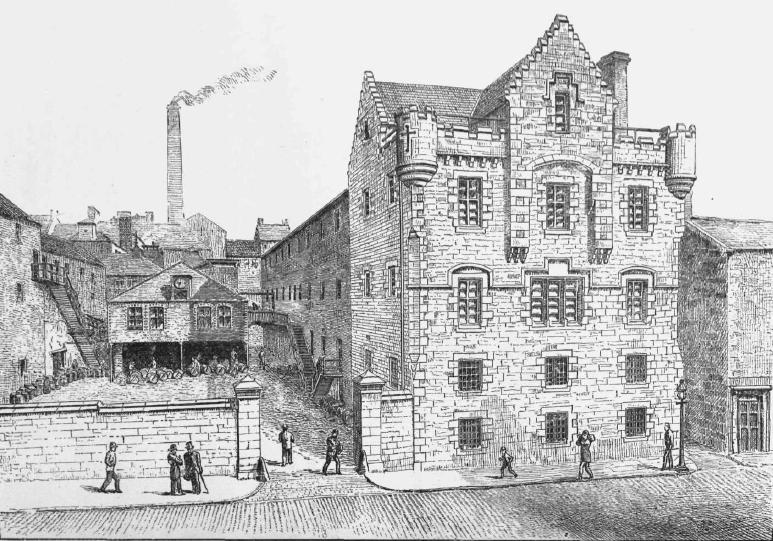
Saturday, 26 January 2013

Inside the Dorchester Brewery (part two)

This time we'll be looking at that most crucial brewing operation: mashing. And the bits of equipment needed to carry it out. It's going to be fun. If reading a long technical description is your idea of fun. It is mine, but I suspect I'm not 100% typical of the human race.

I'm very disappointed in Barnard. There are no illustrations of either the mash tuns or coppers at Eldridge Pope. You'll have to use your imaginations. I lost mine years ago. I now rely on occasionally borrowing my son Alexei's. He's more than enough for two.

Come to think of it, Barnard doesn't seem to have spent a great deal of his visit to Dorchester inside the brewery. His Eldridge Pope sandwich is sadly lacking in meat. The first chapter is mostly general bullshit about Dorchester, literary quotations and a visit to Mr. Pope's country house. Maybe by the third volume he was getting fed up of hanging around in brew houses.

"Leaving the mill room behind us, we came to the sub-floor of the mashing stage, where is fixed the shafting that drives the grains conveyor, and the safes for setting taps, through which the wort runs to underback.

After this we ascended half-a-dozen steps to the noble mashing stage, open to the roof, and lighted by a dozen windows. Six of them are very lofty ; the others are smaller. Along one side there is a handsome gallery, reached by two staircases, which gives access to the hop rooms, cooling chamber, and the liquor-backs. On this spacious floor stand two cast-iron mash tuns—splendid vessels, each lagged with felt, and encased in pine-wood staves. Both have covers, lifted up and down by compensating weights ; also perforated iron draining plates; and their mashing capacity is twenty-four and forty-five quarters respectively. Each tun is commanded by a Steel's mashing machine, fed from the grist-case above, and has a three-armed sparger for sprinkling the goods. The grains are discharged from the tuns by an endless chain-belt, fitted into a cylinder, which conveys them to an iron tank, erected on massive columns, in the east courtyard.  From thence, when required, they are passed through an automatic busheller, or measurer, into the railway trucks or farmers' carts. By the side of each tun there is a standard valve, to enable the brewer to work the underlets from this stage; and outside each vessel is a thermometer, to mark the temperature of its contents.
"Noted Breweries of Great Britain and Ireland, vol III", by Alfred Barnard, 1890, pages 132 - 133.
I can't fault his description of the mash tuns. Nicely insulated, cast-iron tuns with lids. I can picture them exactly. The Steel's masher must important innovations in brewing equipment of all time. It's still a standard piece of kit in British breweries.

As I've seen some of Eldridge Pope's brewing records from just a handful of years after Barnrds's visit, I've some idea of how they were used. Most of the beers seems to have been mashed in the large mash tun. With a charge of 30-odd 60 quarters of malt. Larger batches, of 47 to 60 quarters, used both mash tuns.

Only the Double Stout and LTS were mashed solely in the smaller tun. There the charge was only 11 quarters. Its indicative of a relatively small demand for these beers that they were brewed in batches of just 50 to 60 barrels. The brew lengths of Mild and Pale Ale were much greater, 200 to 250 barrels, though usually not of one single beer. Mostly two or three were parti-gyled together.

Barnard makes a big deal of having got up early for the first mash of the day. Perhpas that's why his illustrator didn't tag along.
"Yesterday we followed the malt to the hopper, or twin grist-case, where it rests until required for mashing ; to-day we pursued its course therefrom until it became the ale of commerce. Here, let us add, early as was the hour, some of the men, whose duty it is to heat the mashing liquor, had already been at work a long time before we put in our appearance.

The mashing operation commenced immediately we appeared on the scene, and was performed, in the first instance, by passing the ground malt and water through the Steel's masher, referred to in the previous chapter, whereby the malt is saturated at a mixing heat of 150º or thereabouts, according to the lightness or heaviness of the beer required to be brewed. The general proportions are about one-and-a-half to two barrels of water to a quarter of malt, finishing with a little more water of a higher temperature.

From the Steel's mashing machine the mixture, in its saturated condition, falls into the mash tun, when the revolving rakes are set going until the goods rise to the proper heats, the object of the operator being to prevent coagulation, or setting of the "goods;" hence the rakes are kept going until the goods are seen to touch the line of saccharification.

With good water, good malt, and proper mash heats, good beer should follow as a matter of course. We did not wait to see the conclusion of the operation, which lasts from five to six hours, but our guide informed us that the draining of the wort from the goods (or grain) takes place about two hours after the mashing operations are completed.

The draining is accomplished slowly at first, by several cocks, placed in the bottom of the mash tun, and the wort is carried to the coppers, through main pipes constructed of copper and lined with tin."
"Noted Breweries of Great Britain and Ireland, vol III", by Alfred Barnard, 1890, Page 136.

Barnard is about right with the mashing temperature. The tap heats were between 150º F and 154º F. But he's wrong about the water to malt ratio. It was over two barrels to a quarter of malt. As this table shows:


quarters malt barrels water (initial) barrels water (second) barrels water to a quarter malt (just initial) barrels water to a quarter malt
AK 39 85 5 2.18 2.31
BAK and AK 34 74 5 2.18 2.32
PA and XX 32 72 5 2.25 2.41
S 11 23 3 2.09 2.36
LTS 11 20 4 1.82 2.18
XX and XXX 47 103 8 2.19 2.36
XXXX 60 129 9 2.15 2.30
KK and XX 30 66 5 2.20 2.37
Source:
Eldridge Pope brewing records

The second dose of a small quantity of hotter water reminds me of the underlet mashing method London brewers loved. That's where 20-30 minutes after the initial infusion a small amount of hotter water was added via the underlet. It's a very simple type of step mash. The second addition followed more quickly at Eldridge Pope after just 5 to 15 minutes.

It's interesting that they kept the internal rakes revolving until the mash hit saccharification temperature. When using a Steel's masher, you don't normally need to do that. The grain and hot water are already mixed as they enter the tun. Breweries did keep their internal rakes, but only used them in specific circumstances, such as after an underlet or when a mash threatened to get "stuck".

I hope this hasn't been too technical for you. There will be more of the same next time. That's a thromise.

Thursday, 24 January 2013

Inside the Dorchester Brewery (part one)

We're going to follow Barnards inside Eldridge Pope's Dorchester Brewery. And a fine. modern affair it sounds.

Starting with that the supplier of the most important ingredient of beer, the well.

"One of the first essentials of a brewery is a supply of the purest water, and this important element is copiously afforded by a wonderful well on the premises of Messrs. Eldridge, Pope & Co., sunk down into the water-bearing strata, from whence it is pumped to a covered reservoir in the roof of the brewhouse, capable of containing 500 barrels. The brewery also has the advantage of an unlimited supply direct from the town main. Accompanied by the head brewer, Mr. Wright, we made a circuit of the premises, following the brewery processes in every stage.

The plant is a seventy-quarter one, and, with the building, has been so arranged that ample room is left for future extension. Judging from the progress made, and the great increase in the trade during the last few years, it cannot be long before these contemplated additions will have to be carried out.

We were first taken to see the noted well, situated beneath the courtyard., which separates the makings from the brewery. It was sunk through the chalk to a depth of 600 feet, and is 8 feet in diameter to a depth of 120 feet; and was then bored some 500 feet. This well contains an inexhaustible supply of water, which is raised to a great tank or cistern over the mashing stage by a set of powerful three-throw pumps. This water, we were told, on account  of its great  purity and  freedom  from  organic matter, is most favourable for brewing those light, delicate, fine-flavoured ales, for which Dorchester is so justly famous. The hot-liquor room is over the mashing stage, and to reach it from the courtyard we passed through the copper-house at the back of the brewery. Here are to be seen two hot-liquor backs, both heated by steam coils; and there is a third, placed on a gangway, also over the mashing stage. They contain from eighty to a hundred and twenty barrels each, and all of them are lagged with a patent composition.
"Noted Breweries of Great Britain and Ireland, vol III", by Alfred Barnard, 1890, pages 131 - 132.


A 70-quarter brewery would have a maximum capacity of around 85,000 barrels a year. A pretty decent size for a brewery in a relatively small provincial town. And one in a rural county.


600 feet? That's a pretty impressive well.


A liquor back, in case you were wondering, is a water tank. For some reason tanks are called backs within breweries. As in hop back and underback. A wonderful thing, the English language.

"We next made our way to the mill room, over the engine-house, where we were first shown the Archimedean screw which conveys the malt hither from the stores, which has, at its extremity, a set of squirrel cleaning cages for finally screening the malt. This chamber contains two pairs of steel malt-rolls, each pair enclosed in a mahogany case, over which is the feeding hopper. The malt is crushed between these rollers at the rate of thirty quarters per hour, and is conveyed to the twin grist hopper in the brewhouse by a Jacob's ladder.
"Noted Breweries of Great Britain and Ireland, vol III", by Alfred Barnard, 1890, page 132.
"Squirrel cage". That's a new term to me. It conjures up an image, though I'm not sure it's the correct one. I'm not the only person to be confused by it. I found this article in an 1892 newspaper:


"Dorchester Ales.
The Railway Supplies Journal devotes over page of last week's to a description of the large establishment of Messrs Eldridge Pope and Co., the well-known firm of Dorchester brewers, and the method adopted to ensure the production an exceptionally article. 

. . . . . .

The water used for the purpose of brewing is obtained from a wonderful well nearly 600 feet deep, and is, account of its purity and freedom from organic matter, peculiarly adapted to the brewing of those light, delicate, fine-flavoured ales for which Dorchester is justly famous. The enormous capacity of some of the vessels used is a very striking feature of the business in the eyes of a stranger, There are two hot liquor backs over the mashing stage containing upwards of 120 barrels each, and a third is placed on a gangway also over the mashing stage. These are heated by steam coils, and lagged with a patent composition. The malt used is conveyed from the stores by an Archimedean screw which has at its extremity set of squirrel cleaning caps for finally screwing it to the mill room, where it crushed between two pair of steel rollers, each pair being enclosed in a mahogany case. Taunton Courier, and Western Advertiser - Wednesday 01 April 1891, page 2.
Railway Supplies Journal - it sounds like a guest publication on Have I Got News for You. I wonder if my newsagent could get it for me?

The aticle is clearly ripped off from Barnard, though some of the details seem to have been lost in translation, so "squirrel cages" have become "squirrel cleaning caps". I'm not so sure that last sentence makes sense at all.

I'm not really intrigued by the Railway Supplies Journal article. I wonder if it is credited to an author? Assuming that isn't Barnard, it seems a clear case of plagiarism.

More from inside the brewery in the instalment.