Showing posts with label Camden Brewery. Show all posts

Monday, 17 February 2014

Camden Brewery's independence under threat

After their jitters and near-bankruptcy on the eve of WW I, Camden Brewery seem to have emerged from the war with their finances in decent order.

By 1923, they were making a decent profit:

"Camden Brewery Co., Ltd., report that during the twelve months to September 30th, the profit including rentals, interest, etc.. was net £149,177, as against net £32,375 in the preceding year. After providing for income tax, etc., interest on mortgages and debenture stocks, the net balance is £21,658. The balance brought forward was £96,032, making, with certain adjustments, the present balance of £130,422. The time has now arrived when the directors are able to make for this year a payment to the Income Bondholders, and they propose to make a distribution during January of 2s. 8d. in the £ on the full redemption value of the income bonds. This sum has been provided partly out of the surplus profits of the year under review and partly from provisions made in past years for risks which in the directors' opinion have now run off and are available for release. The above distribution must not be taken as a basis for possible future payments of this nature. The directors have recently learned that a substantial block of shares acquired in the names of two nominees, are for the account of a competitive London Brewery, and they have received a request that upon the footing of this purchase one of the directors of the Camden Brewery Co., Ltd., should retire in favour of a representative of the brewery referred to. The only directors eligible for retirement are Messrs. Whitaker and Grimwood, two of the original proprietors of the business, and they represent a shareholding which at one time was of the Value of £100,000. Their colleagues are unanimously opposed to sacrificing either of these gentlemen, who desire, and offer themselves for, re-election. The present directors, who have conducted the business during the difficult times following the reconstruction to its present strongly improved position, do not view with favour the admission to intimate knowledge of their business of a representative of a rival concern except on a mandate from the general body of shareholders."
"The Brewers' journal, 1923", page 63.
If you remember, Camden's profits were around £40,000 at the end of the 1890's. The price of standard Mild had about trebled in the meantime, meaning that £149,177 was the equivalent of around £50,000 in 1890's prices.

The Mr. Whitaker and Mr. Grimwood referred to must have been the original owners of the limited company (founded 1889) rather than the brewery (founded 1859). A Whitaker and a Grimwood had been among the initial partners, but they surely must have been long dead by 1923. I assume the Whitaker and Grimwood were from a generation or two later.

The "at one time was of the Value of £100,000" is significant. Because after the company's restructuring they were worth considerably less. At one time the value of the £10 shares was as low as 6d.

The competitive London brewery was Courage. Had they got hold of some ordinary shares? If so, from Whom? The Ordinary Shares were all held privately by the family of the original partners.

Courage didn't give up trying to get a seat on Camden's board:

"The Camden Brewery.
Some light is thrown upon the rise the shares of Courage and Co. in the directors' report of the Camden Brewery Co. This report recommends in the first place a distribution to the income bondholders during January of 2s 7d in the £ the original redemption value of the Income Bonds. The report further states that arrangements have been made for the sale of the company's licensed properties to Courage and Co., and that the latter have secured a large interest in the capital of the Camden Brewery, which makes it desirable that they shall have a representative on the board of the latter company. The Ordinary capital of the Camden Brewery is privately held, but the 1,100,000 Ordinary shares of Courage and Co. are officially quoted, and stand at around 1.75."
Aberdeen Journal - Tuesday 18 December 1923, page 11.

If they'd decided to sell the pubs to Courage, they must already have decided to get rid of the brewery. Without the pubs, there was no point - and no money - in having the brewery.

Wednesday, 29 January 2014

Camden Brewery's 1898 prospectus

Let's see what we can learn from another Camden Brewery prospectus from a couple of years later.

Just three years after raising £150,000 Camden Brewery was looking to get another £200,000. You'll see the reason why they needed the extra dosh in the prospectus: to pay off loans they'd taken out to buy pubs and to finance a further extension of their tied estate.

"The SUBSCRIPTION LIST will be OPENED on TUESDAY, the 13th December, 1898, and CLOSED at or before four o'clock on the Following Day.

THE CAMDEN BREWERY COMPANY (Limited). (Incorporated under the Companies Acts, 1862 to 1890.)

ISSUED CAPITAL.

12,000 Ordinary Shares of £10 each £120,000
15,000 £5 per cent. Cumulative Preference Shares of £10 each 150,000

£270,000

In addition to which there is

£4.25 per cent. 1st Mortgage Debenture Stock 150,000

£420,000


ISSUE of £200,000 £4.25 PER CENT. B DEBENTURE STOCK, at £103 per £100 Stock, payable:
10 per cent, on Application,
20 „ „ on Allotment,
23 „ „ on 14th January, 1899 (to include premium),
50 „ „ on 6th April, 1899.

The B Debenture Stock will become payable at par on the 1st day of March, 1940, but is redeemable at the Company's option and on six months' notice, on or after the 1st day of March, 1920, at £110 for each £100 Stock, and the like premium will he given in case of payment off for any other reason beiore the 1st day of March, 1940.

The Interest on the Debenture Stock will be paid half-yearly, on the 1st March and the 1st September in each year.

Interest on the instalments from dates of payment will be paid on 1st March next.

TRUSTEES FOR THE B DEBENTURE STOCKHOLDERS.
William Stacey, Montacute House Tunbridge Wells.
Montague Wootten, The Bank, Oxford.
The Right Hon. Viscount Ebrington, Exmoor, South Molton, Devon.
DIRECTORS.
THOMAS WHITAKER, Chairman.
John Whitaker.
Herbert E. Wootten.
Thomas R. Grimwood.
Harry Brown.

Bankers — Parr's Bank, Bartholomew-lane, London, E.C.
Brokers- Steer, Lawford and Co., 3. Drapers-gardens, E.C.
Solicitors— Routh, Stacey, and Castle, 14, Southampton-street, Bloomsbury, W.C.
Auditors— Broads, Paterson. and Co., 1, Walbrook, London, E.C.
Secretary— Lindsay H. Chittenden.
Registered Office— Camden Brewery, Hawley-crescent, N.W.

PROSPECTUS.
The Company was incorporated in the year 1889 for the purpose of acquiring and carrying on the well-known Brewery business established in 1859 by the late firm of Garrett, Whitaker, Grimwood, and Co., at Hawley-crescent, Camden-town. Since the Company's incorporation the business has largely increased, and additional capital is now sought for the repayment of temporary loans on premises recently acquired, and for the purchase of other licensed properties and the further extension of the business.


The freehold Brewery premises, the freehold and leasehold properties, loans on mortgage, stocks, book debts, cash and other assets (exclusive of goodwill), stand in the books of the Company, as certified by the auditors, subject only to the 1st Mortgage Debenture Stock, at £657,815
To which should be added amount of present issue 206,000
Making £863,815


Deducting the amount of the 1st Mortgage Debenture Stock of £150,000
And temporary loans secured on properties recently purchased, to be repaid out of this issue 114,100

£264,100

There is left as a security for the present issue of £200,000    £599,715

The profits earned by the Company show a satisfactory increase. The certificate of the auditors of the Company, who for many years regularly audited the books of the Brewery, showed the average profit of £21,319 per annum during the four years ended June 30th, 1895, and they now further report the results of the trading as follows:—

1, Walbrook, E.G.. 5th December, 1898.
GENTLEMEN.— We hereby certify that we have examined the books and accounts or the Camden Brewery Company (Limited), and find the profits, without charging interest and Directors' salaries and fees, but after providing for wear and tear of every description, for bad and doubtful debts and depreciation of leaseholds, &c., have been: —

For the year ended 30th June, 1896    £33,643 17 6
Do. do. 1897     £41,488 1 10
Do. do. 1898    £43,766 4 0

The details and adjustments are shown in the schedules attached to the accompanying report.
BROADS, PATERSON, and CO.

To the Directors of the Camden Brewery Company (Limited). The amount necessary to pay interest on the £150,000 Four-and-a-quarter per cent. First Mortgage Debenture Stock and the present issue of £200,000 Four-and-a-quarter per cent. B Debenture Stock only amounts to £14,875 per annum.

The present issue will be secured by a trust deed charging all the present freehold and leasehold property of the Company subject only to the 1st Mortgage Debenture Stock, and creating a floating charge on all the Company's other assets subject only to such 1st Mortgage Debenture Stock.

No part of the Debenture Stock now offered for public subscription has been underwritten.

Prospectuses and forms of application can be obtained from Parr's Bank, Bartholomew-lane, and its branches, the brokers, and at the offices of the Company.

Application will be made in due course to the Committee of the Stock Exchange for an official quotation of the present issue.
London. 7th December, 1898."
Morning Post - Monday 12 December 1898, page 8.
I love those redemption dates of 1920 and 1940. The company had ceased to exist before even the earlier date.

What have we learned? That the directors were still Thomas Whitaker, John Whitaker, Herbert E. Wootten, Thomas R. Grimwood and Harry Brown. The same as in 1895. And that profits were increasing.

Most interesting for me is the valuation of the brewery and pubs. Remember it was £195,472 in 1895. Meaning that in three years the valuation had gone up by £463,000, or more than trebled. I don't think they had altered the brewery to any great extent, so the increase must be due to the extra pubs that they had bought.

Unfortunately, this prospectus doesn't mention how many tied houses they had. In 1895, they had 84. Either they had bought a couple of hundred pubs - fairly unlikely - or the value of licensed property had shot up. I'm pretty sure it's the latter. But its frustrating not to know how many they owned in 1898. That figure would have told me so much.

I like the way they say the interest on the 4.25% Debentures will "only" be £14,875 per annum. that's getting quite close to the total profit of a few years previously. And they seem to have forgotten the 5% Preference Shares, which cost another £7,500 each year. That's s total of £22,375. That's also before paying any dividend on the Ordinary Shares. Is it me, or were their fixed costs getting perilously high compared to their profits?

Monday, 27 January 2014

Camden Brewery profits

The 1890's were one of the best decades ever for British brewers. It was a time of optimism and increasing profits. It didn't last.

The new century saw the Boer War and an increased tax on beer to help finance it. On top of that the price of a brewing licence was greatly increased. Many breweries - including some big names like Allsopp - got into financial difficulties. But let's not get ahead of ourselves.

Camden's decision to raise more capital 1895 to enable it to buy more pubs seems to have paid off. Profits had been flat at around £20,000 a year in the early 1890's, but in the second half of the decade began to rise, more than doubling to over £40,000.

Camden Brewery profits 1892 - 1898
Year Profit
1892 £20,099 19 3 
1893 20,051 11 9 
1894 20,016 17 4 
1896 £33,643 17 6
1897 £41,488 1 10
1898 £43,766 4 0 
Sources:
London Standard - Wednesday 20 March 1895, page 8.
Morning Post - Monday 12 December 1898, page 8.

Investors saw the benefit of these profits. Even when the brewery wrote off a considerable sum in 1896, a 10% dividend was paid on their Ordinary Shares:


"The Camden Brewery Company have declared a dividend on the Ordinary Shares amounting, with the interim dividends, to 10 per cent, for the year ending June 30 last. The sum of £7197 is written off for depreciation, £5000 is placed to reserve account, and £1578 carried forward."
London Standard - Saturday 01 August 1896, page 8.

"Camden Brewery Company, a dividend on the ordinary shares amounting, with the interim dividend, to ten per cent, for the year ended 30th June last."
Dundee Courier - Saturday 01 August 1896, page 2.
Though it's worth remembering that the Ordinary Shares had all been retained by the original partners in Garrett, Whitaker, Grimwood, and Co. The Preference Shares - the ones sold to ordinary punters - had a fixed return of 5%. Still not bad in age before inflation. And there was still enough profit to keep some back each year for a rainy day.


"At the annual meeting Camden Brewery Company, held Monday, the profits were reported at £39,133 for the year ended June 30. After paying prior charges, it was resolved place £7,500 to reserve, to pay 10 per cent, upon the ordinary shares, and carry forward £4,338."
Sheffield Daily Telegraph - Wednesday 28 July 1897, page 9.
In the final years of the century the brewery was able to pay a 12.5% dividend on its Ordinary Shares


"The Camden Brewery Company made a net profit for the year ended June 30th of £41,171. The Ordinary Shares receive a dividend for the year of 12.5 per cent.; £7500 is transferred to reserve, and £5188 carried forward."
London Standard - Tuesday 19 July 1898, page 9.
"The report of the Camden Brewery Company states that after paying the dividend on the Preference Shares up to December 31 last, and interim dividends on the Ordinary Shares, and transferring £7,500 to reserve, the sum of £17,467 was available. Out of this sum the 5 per cent. dividend on the Preference Shares up to June 30 amounts to £3,750, and it is proposed to pay £6,000 on the Ordinary Shares, making the dividend thereon for the year 12.5 per cent., and paying a bonus of £681 to the Managing Directors and office staff, leaving to be carried forward to next year £7,036."
Morning Post - Monday 24 July 1899, page 8.

Which meant the original partners got to divvy up £15,000 between them. That's in addition to the salary they would earn, if they were directors. Life must have seemed grand. So where did it all go wrong? We'll be finding out soon.

Saturday, 25 January 2014

Camden Brewery's 1895 prospectus

A few years ago I couldn't have imagined anything duller than a company prospectus from more than a century ago. That was before I noticed what a good source of information they could be.

This is a good case in point. It's the prospectus published by the Camden Brewery when they issued extra shares to raise capital to buy more pubs in 1895. See if you can spot the useful information.

"ISSUE of £150.000 £4.25 PER CENT. FIRST MORTGAGE DEBENTURE STOCK and £150,000 FIVE PER CENT. CUMULATIVE PREFERENCE SHARES at par.

The SUBSCRIPTION LISTS will OPEN on THURSDAY, the 21st March. 1895 and will CLOSE for Town and Country at or before Four o'clock on the Same Day.

THE CAMDEN BREWER COMPANY (Limited), Incorporated under the Companies Acts. 1862 to 1890, £4.25 per Cent. first Mortgage Debenture Stock, £150,000. SHARE CAPITAL.

15.000 Five per Cent. Cumulative Preference Shares of £10 each    £150,000
(10.000 only of which it is proposed to issue at the present time, the remaining 5,000 being reserved for future issue, and ranking pari passu With the present one.)
12,000 Ordinary Shares of £10 each     120,000
(All of Which were issued as fully paid up on the incorporation of the Company, and are all held by the original shareholders.)

PARR'S BANKING COMPANY and the ALLIANCE BANK (Limited). 4. Bartholomew-lane. E.C, and its London Branches, are authorised to RECEIVE APPLICATIONS for the Debenture Stock and Preference Shares.

The Debenture Stock will become payable on the 1st day of March. 1940. at par, but is redeemable, at the Company's option, on or after the 1st day of March. 1920, at £110 for each £100 Stock.

The interest on the Debenture Stock is payable half yearly, on the 1st March and the 1st, September in each year; and the dividends on the Preference Shares are also payable on the same dates for the periods ending respectively the 30th June' and the 31st December. The first payment of interest and dividends, calculated from the due dates of the instalments, will be made on 1st September, 1895.

The dividends on the Preference Shares are cumulative, and the Memorandum and Articles of Association of the Company provide that the Preference Shares shall have priority over all other Shares of the Company, both as regards dividend and capital.

The Preference Shares are to be paid for as follows : —
On Application    £1 per Share.
On Allotment     2     "
On 1st May, 1895    2     "
On 4th June, 1895     5     "

The Debenture Stock, is to De paid for as follows: —
On Application    £10 per cent.
On Allotment     20     "
on 1st May, 1895    20     "
On 24th June, 1895    60     "

Payment in full may be made on Allotment, subject to discount at the rate of £2 10s. per cent, per annum.

Trustees for the Denture-holders.
William Stacey. Montacute House, Tunbridge Wells.
Montague Wootten, The Bank, Oxford.

Directors.
THOMAS WHITAKER, Chairman.
John Whitaker, Herbert E. Wootten, Thomas R. Grimwood, Harry Brown.

BROKERS.- Steer, Lawford. and Co.. 3. Drapers-gardens, E.C.
SOLICITORS.— Routh. Stacey. and Castle. 14, Southampton-street. Bloomsbury. W.C.
Auditors.— Broads. Paterson, and Co., 1, Walbrook, London, E.C.
SECRETARY.— Lindsay H. Chittenden.
Registered Office — Camden Brewery. Hawley-crescent. NW.
BANKERS.— Parr's Banking Company and the Alliance Bank (Limited).

ABRIDGED PROSPECTUS
The Company was formed in the year 1889, with a view to facilitate family arrangements, and then acquired the valuable and well-known Brewery business established in 1859 by the late firm of Garrett, Whitaker, Grimwood, and Co., with the extensive Brewery premises situate in Hawley-crescent, Camden Town, where the Company have since carried on the business. The books of the Brewery have been regularly audited by Messrs. Broads, Paterson, and Co., chartered accountants, and their certificate is as follows: —

"1. Walbrook. London. E.C.. 21st February. 1885.
"To the Directors of the Camden Brewery Company (Limited), Hawley-crescent, Camden Town, N.W.
"Gentlemen. — "We have audited the books and accounts of your Brewery for many years past, and certify that the profits for the three years ended 30th June, 1894, without charging interest and Directors' salaries and fees, but after providing for wear and tear of every description, for bad and doubtful debts, and depreciation of leaseholds and buildings, have been :—

"1891-92    £20,099 19 3
"1892-93    20,051 11 9
"1893-94    20,016 17 4
    £60,168 8 4
"Being an average of    £20,058 2 9

"The details and adjustments are shown in the schedules attached to the accompanying Report.
"Yours faithfully.
"BROADS, PATERSON, and Co."

The Freehold and Leasehold Properties and fixed plant belonging to the Company have been valued by Messrs. Mason and Son at    £195,472 0 0
The loans on mortgage and advances to customers are    95,940 4 2
And the stock, book debts, rents, cash at bank, and other loose assets are    37,007 14 2
Total, exclusive of goodwill    £328,419 18 4

Messrs. Mason and Son's report is as follows :—

"To the Directors of the Camden Brewery Company (Limited).
"Gentlemen. — We have personally inspected the properties of the Camden Brewery Company (Limited), consisting of the Leasehold Brewery situate in Hawley-crescent, Camden Town, with the fixed plant, the Leasehold maltings at Fulham, and the 84 Freehold and Leasehold public and beer houses and other property, as set forth in the schedule annexed hereto, and we value the same at the sum of one hundred and ninety-five thousand four hundred and seventy-two pounds (say £195,472). This sum does not include any amount for the general goodwill attaching to the business.
"Yours faithfully, MASON and SON.
"61, King William-street, E.C, March 6, 1895."

A copy of the memorandum and articles of association of the Company, of the form of the Debenture Stock Certificate now proposed to be issued, the form of the trust deed, and the form of the certificate of the Preference Shares, as well as the auditors' and valuers' reports referred to, can be seen at the Offices of the Company, or at the offices of Messrs. Routh, Stacey, and Castle, the Solicitors to the Company, 14, Southampton-street, Bloomsbury.

Prospectuses and forms of application can be obtained there, and at the offices of tho Solicitors and Brokers to the Company.

Besides the contracts entered into on the formation of the Company which have been already carried out, and for placing the present issue, the only contracts of the Company are contracts such as have been made in the course of the Company's business. All subscribers shall be deemed to have notice of all the above, and to have waived the necessity for specifying in the Prospectus the dates and names of the parties or the particulars of any such contracts.
London, 19th March, 1895."
London Standard - Wednesday 20 March 1895, page 8.

Let's see how many you spotted.

First is who the directors were. Amongst the names are two Whitakers and one Grimwood. remember that the firm was originally called Garrett, Whitaker, Grimwood, and Co. It's clear that the firm was still mostly in the hands of the families who founded it in 1859.

I'd love to know who Herbert E. Wootten and Harry Brown were. They could well have been relatives of the other families, just with different surnames. That's most likely the case as, if you remember, the original partners took all the Ordinary Share on flotation.

Next we discover that they didn't own the freehold on their Hawley Crescent site. Not so unusual in London, where large swathes of the city are leasehold. We also learn that they had their own maltings in Fulham. Odd place to have maltings, but London was way more industrial back then. I must see if I can find them on the large-scale OS map.

And isn't this handy: they tell us that they owned or leased 84 tied houses. Which along with the brewery were worth just shy of  £200,000. It's a shame the pubs aren't valued separately. I'd love to know what they were worth on average. We also learn that the whole business was worth £328,419.

There's also the company's profits for the preceding three years. Another handy thing to know.

Thursday, 23 January 2014

Camden Brewery raises capital

I've managed to track down details of the Camden Brewery's transformation into a public company. The exact when and how much. It turns out 1889 was the correct date.

"Parr's Banking Company and the Alliance Bank, Bartholomew-lane, and its London branches, are authorised to receive applications for 1st Mortgage Debenture Stock and Preference Shares in the Camden Brewery Company, the former to the amount of £150,000, bearing 4.25 per cent. interest, and the latter to the extent of £100,000, carrying a dividend of 5 per cent. The Debenture Stock will become payable on the 1st day of March, 1940, but is redeemable, at the Company's option, on or after the 1st day of March, 1920, at £110 for each £100 Stock. The interest on the Debenture Stock is payable half yearly, on the 1st of March and the 1st of September in each year, and the dividends on the Preference Shares are also payable on the same dates for the periods ending respectively the 30th of June and the 31st of December. The first payment of interest and dividends, calculated from the due dates of the instalments, will be made on the 1st of September, 1895. The dividends on the Preference Shares are cumulative, and the memorandum and articles of association of the Company provide that the Preference Shares shall have priority over all other shares of the Company, both as regards dividend and capital. The Company was formed in the year 1889, and acquired the brewery business established in 1889 by the late firm of Garrett, Whitaker, Grimwood, and Co., with the premises situate in Camden-town, where the Company have since carried on the business. Particulars as to the profits and properties are given in the prospectus. The share capital of the Company is 15,000 5 per Cent. Cumulative Preference Shares of £10 each, £150,000, 10,000 only of which it is proposed to issue at the present time, the remaining 5,000 being reserved for future issue, and ranking pari passu with the present one ; and 12,000 Ordinary Shares of £10 each, £120,000 (all of which were issued as fully paid up on the incorporation of the Company)."
Morning Post - Tuesday 19 March 1895, page 6.

The company was established with a capital of £120,000. Though, based on other brewery flotations, the 12,000 ordinary shares were probably divided up amongst the partners and wouldn't actually have brought in any cash. Raising another £250,000 just six years later implies that the business was doing well. Investors certainly did, as this issue was massively over-subscribed:

"Letters of allotment and regret in the Camden Brewery Company (Limited) have been posted. The total amount applied for was, it is stated, upwards of £1,750,000."
Pall Mall Gazette - Tuesday 26 March 1895, page 5.

It seems those 5,000 Preference Shares which were held back were issued, because in 1899 the capital was already £420,000 when they attempted to raise a further £200,000:

"The Camden Brewery Company, with a share capital of £270,000 and £150,000 4.25 per Cent. 1st Mortgage Debenture Stock, announces an issue of £200,000 4.25 per Cent. B Debenture Stock, at £103 per £100 Stock, which will become payable at par on the 1st day of March, 1940, but is redeemable at the Company's option and on six months' notice, on or after the 1st day of March, 1920, at £110 for each £100 Stock, and the like premium will be given in case of payment off for any other reason before the 1st day of March, 1940. The prospectus states: "The Company was incorporated in the year 1889 for the purpose of acquiring and carrying on the well-known brewery business established by the late firm of Garrett, Whitaker, Grimwood, and Co., at Hawley-crescent, Camden-town. Since the Company's incorporation the business has largely increased, and additional capital is now sought for the repayment of temporary loans on premises recently acquired, and for the purchase of other licensed properties and the further extension of the business.""
Morning Post - Saturday 10 December 1898, page 7.

That they wanted the money to invest in tied houses as no surprise. Most brewers were frantically buying pubs in the 1890's, especially in London. Eventually almost all London pubs were tied to a brewery.

£620,000 is a lot of capital compared to most of the Scottish breweries I've looked at. But a brewery based in London would need more dosh because pubs in the capital cost more money.

The Camden Brewery made healthy profits in the 1890's, as we'll be seeing soon.

Wednesday, 22 January 2014

Tied House Concerts

Here's another weird libel case, this time featuring one of Camden Brewery's tenants as plaintiff.

A local resident wasn'tkeen on the noise from a beerhouse and wrote to the Camden Brewery to complain. He should perhaps have been more careful in his choice of language.

"TIED HOUSE CONCERTS.
In the Queen's Bench Division on Tuesday, before Mr. Justice Lawrance and a jury, Alfred Bellinger, a licensed victualler, sought to recover damages for an alleged libel contained in a letter written by the defendant, David Smith, to his landlords, a firm of brewers.

Counsel, in opening the case for the plaintiff, said it was one quite out of the ordinary class of libel actions. The plaintiff was the occupier of a tied beerhouse, known as the Elephant's Head, situated in the Lower Clapton-road, under a lease granted to him by the Camden Brewery Company. The plaintiff was a member of one or two athletic clubs. He soon got several clubs to make his house their rendezvous, and they met in the club-room and occasionally held social evenings there. At some of these concerts were given, and it was in respect of these musical evenings that the defendant, who lived in a semi-detached house immediately opposite the Elephant's Head, had thought proper to write to the Brewery Company and complain. The letter which contained the alleged libel was dated July 18, 1895, and was as follows:-

I must draw your attention to the disgraceful concerts or "sing-alongs" which take place at the Elephant's Head several times a week, and which are a curse to the neighbourhood as well as to the house. It is quite bad enough to have our garden made into a public urinal to accommodate your disgusting beerhouse - a rendezvous for drunken boys and girls - without having our brains split from nine p.m. until 12.30 a.m., and frequently two a.m., with a lot of drunken yelling brutes. Unless this nuisance is stopped, and that at once I must advise my neighbours to take drastic measures to put down this annoyance and disgrace.

The brewery company at once communicated the contents of this letter to the plaintiff, which was the first intimation he received from the defendant that he disapproved of the way in which he carried on his business. In further correspondence the defendant refused to retract his statements, and complained that he was also disturbed by the noise of the beer-engine in the bar, and desired that the windows should be kept closed.

Alfred Bellinger, the plaintiff, then gave evidence in support of his counsel's opening statement.

Cross-examined: Witness said there were generally from sixty to seventy young fellows, all members of their respective clubs, at these social gatherings, which were always orderly.

Re-examined: Very few women were served in the bar at any time. It was quite untrue to say that factory girls or women crowded into the bar on the nights that concerts were given.

Dr. Bremner, who lived at 12, Lower Clapton-road, stated that the concerts were of constant occurrence, and that the noise was often kept up until half past twelve. He had seen on concert nights men, but never women, after going in the defendant's garden, return to the public-house. He had never heard "shouting and yelling," but the acclamations and applause were of a very hearty description.

Mr. David Smith, the defendant, who described himself as a brewers' agent, gave evidence to the effect that the persons who attended these concerts were a very rowdy lot, and that there was a great deal of yelling and shouting. They could hear the concerts distinctly in the house, even with the windows closed. So many persons used the garden that it was in a filthy state the morning after a concert, and servants left rather than keep the place clean.

Cross-examined: Witness said that his statement in the letter that the noise was frequently continued until two a.m. was incorrect. On one occasion that was so. With this one correction he declined to withdraw any statement contained in the letter, and added, "the letter is the plain and unvarnished truth, and I glory in having written it."

The jury found that the letter had been written with the view of injuring the plaintiff, and assessed the damages at £150. Judgment for the plaintiff accordingly.
Reynolds's Newspaper - Sunday 17 May 1896, page 2.
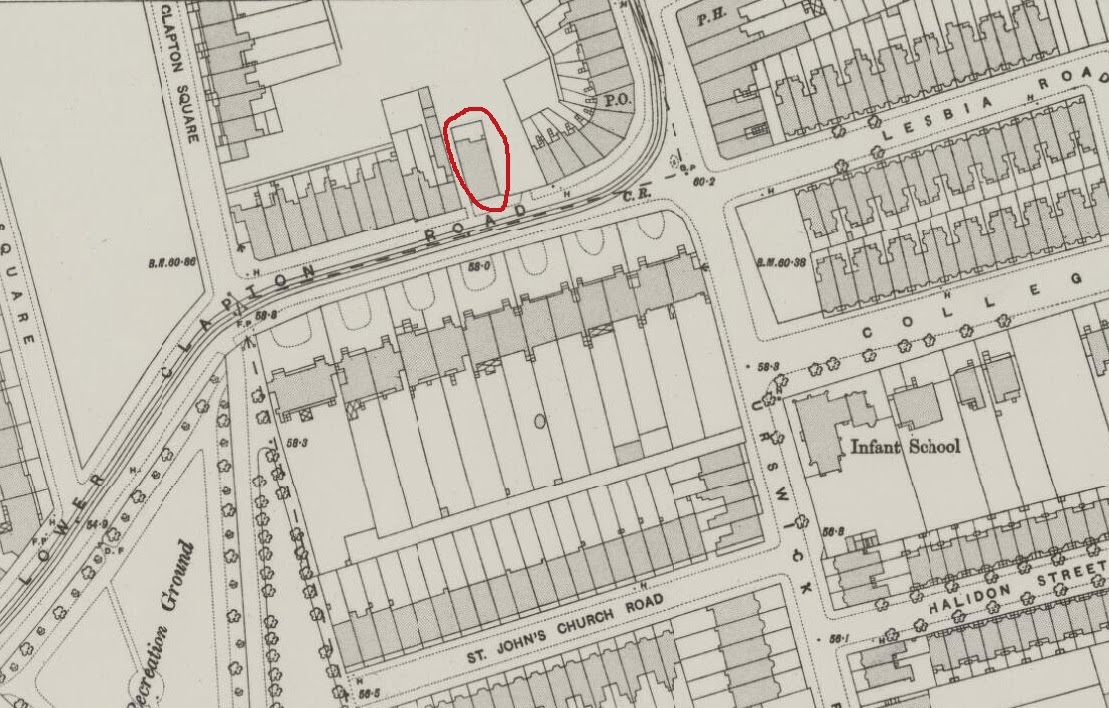
I'm pretty sure that I've identified where all this happened. The doctor's address was a big help. Plus there are/were few semi-detached housed on Lower Clapton Road. I've circled in red what I think was the beerhouse:


I think I can understand some of the cause of the argument. This part of was an odd mix in the 1890's. There were some grand older semis which were being surrounded by much smaller new terraced houses. The inhabitants of the different types of houses must have been from very different social classes. The doctor Mr. Smith lived in the posh houses on the south side of the street.

Here's what the pub looked like in the 1970's (I think, could be early 1980's). As you would expect, it was a Courage pub.


And here it is today - renamed Fitzgerald's and closed:


And this is what the posh side of the street opposite looks like:


There are several weird things about this case. That someone who described himself as a brewer's agent should complain about the noise of a beer engine. How he could hear across a road with a tram running down it I can't understand.

I'm surprised that Dr. Bremner was so unsupportive. He lived on the posh side, too, and must have been subjected to a similar level of nuisance. I suspect that it was his testimony that swayed the jury.

In the late 19th century, the middle classes made a big deal of women going to pubs and drinking. They were a bit obsessed by it, much the way the tabloid press is today. How often do stories about binge drinking show a woman sprawled drunkenly on the pavement?

I had to smile when Smith said that the mess in his garden was so bad that he couldn't hang on to servants. He didn't have to clear it up himself. I can sympathise with him on having his garden used as a urinal. Didn't the pub have a toilet? And why didn't he just lock the gates?

£150 is a huge amount to have to pay. The equivalent of several years' wages for most people.

Sadly, Lesbia Road no longer exists.

Sunday, 19 January 2014

Camden Brewery and world history

Weird things you find in the newspaper archive.  I netted this on one of my regular trawls.

I don't generally adhere to the idea of individuals determining history. But there are exceptions.

After reading this, I couldn't help thinking; "How would the world be now, had the crash been a little more serious?".


"MR CHURCHILL IN MOTOR SMASH.
Car Collides With Brewer's Dray.
Windows Smashed; Wheel Broken.

Mr Winston Churchill had a narrow escape this morning in a motor accident. His car had just left the War Office, and was proceeding down Whitehall towards Trafalgar Square, when a brewer's dray belonging to the Camden Brewery Company collided with it.

The wheel of the car was broken off, and the window nearest to where Mr Churchill was sitting was smashed.

Mr Churchill, although considerably shaken, was able to continue his journey in another car."
Evening Telegraph - Wednesday 25 February 1920, page 1.

Churchill would have been remembered as a failure. And there'd have been no Special Brew.

"What happened to the driver?" Andrew just asked me. He could have been killed. They wouldn't have thought his fate worth reporting.

Friday, 17 January 2014

The Camden Brewery (part one)

I'm starting a new series today on London breweries. Not the famous ones like Whitbread, Courage or Watney, but the smaller breweries they gobbled up.

Annoyingly, different sources give a different founding date. "A Century of British Brewers plus" (by Norman Barber, 2005, page 81) gives it as 1849 1859, as does "A Draught of Contentment" ( by John Pudney, 1971, page 34), while "The Brewing Industry: a Guide to Historical Records" (edited by Leslie Richmond and Alison Turton, 1990, page 91) has it as 1849. The brewery was located on Hawley Crescent, just off the Camden Road, and backed onto the Regent's Canal.


Camden Brewery on an 1896 OS map
 The men behind the business were Richard Garrett, Abram Garrett, Thomas Whitaker and George A. Grimwood and it traded as Garrett, Whitaker, Grimwood and Co. until 1889, when it became a limited liability company called Camden Brewery Co. Ltd. The sources again disagree about the date about the date the business became a limited company, "The Brewing Industry: a Guide to Historical Records" stating it was 1899. Luckily I have evidence that this can't be true. Here's a statement of the dividend paid to shareholders in 1896:

"Camden Brewery Company, a dividend on the ordinary shares amounting, with the interim dividend, to ten per cent, for the year ended 33th June last.
Dundee Courier - Saturday 01 August 1896, page 2."

According to "The Brewing Industry: a Guide to Historical Records" when the original company was first formed, it had 30 pubs. Some of the money to set up the business came from Richard Garrett III, a relative of Richard Garrett and Abram Garrett:

"DEATH OF MR. RICHARD GARRETT.
The deceased, Mr. Richard Garrett, was born at Leiston, Feb. 1st, 1807. His father and grandfather before him conducted there a business which was destined afterwards to assume world-wide operations. Like most men who are to take active part in life he bore the weight of responsibility very early. At a time when most young men are beginning to be initiated into business he was already conducting and enlarging that of the Leiston firm. When an opening presented itself he threw himself into it with an ardor of enterprise which could not be surpassed. At a comparatively early age his labors, which had brought him wealth, had also begun to tell upon his constitution, and he left the more immediate superintendence of the immense business about ten years since to his sons. In addition to this he invested some spare capital in connexion with some relatives in a new firm London, and the amazing success of the Camden brewery in a few years justified the expectations which his sagacity had formed of it."
Chelmsford Chronicle - Friday 06 July 1866, page 10.

The firm referred to was Richard Garrett & Sons of Leiston in Suffolk who manufactured agricultural machinery. The firm operated from the late 18th century until 1932.

Breweries and fires seem to go together like, er, Mild and Bitter or Black and Tan. For once, it wasn't in the brewery that the fire started:

"Fire. —At about half-past two o'clock on Saturday morning a fire occurred in Camden-road. A portion of the lower part of the malthouse attached to the Camden Brewery has been converted into two small shops, one occupied by Mr. Ballard, shoemaker, and the other by Mrs. Darby, dressmaker. The fire originated in one of these workshops, and the contents of both apartments were destroyed. The ceiling of the rooms gave way and a quantity of malt fell into the fire below, and a great deal of damage was also done to the malt in the lower portion of the building by water. The dressmakers' room contained in addition to three sewing machines, &c, some dresses which were being made up, and as we hear Mrs. Darby is uninsured, her loss will be a heavy one. About twenty canaries in the shoemaker's shop were burnt. The Fire Brigade was quickly in attendance, and the fire was subdued in about an hour."
Whitstable Times and Herne Bay Herald - Saturday 17 July 1875, page 3.

By the 1870's, the business was already of a reasonable size, if you consider that there were more than 100 people employed:

"TRADE EXCURSION.—On Wednesday week about 100 of the men employed at the Camden Brewery, London, paid Herne Bay a visit on the occasion of their annual excursion. Dinner was provided for them at the Brunswick Hotel, and general satisfaction was expressed at the style in which the repast was served. The men were accompanied by Mr. Whitaker, a member of the firm, who presided at the dinner."
Whitstable Times and Herne Bay Herald - Saturday 21 July 1877, page 4.

There's lots more to learn about the Camden Brewery. Especially the strange circumstances of its takeover.