Showing posts with label brewing logs. Show all posts

Tuesday, 31 January 2023

How to interpret brewing records - part twelve: Scottish format page 2 dry hops, cleansings and remarks

We're going to finish off page 2 today. Starting with dry hops.


 Lbs.
2313 running annual total.
75 lbs dry hops in this brew.

Quality and Proportion

This is for the type of hops. It hasn't been filled in.


Cleansings
I don't know why it's called that as it shows racking details.

Date
Not filled in

Butts
Butts: 0.

Hhds
Hogsheads: 40.

Barrels
Barrels: 64.

1/2 barrels
Half barrels: 10.

1/2 Hhds

half Hogsheads: 0.

1/4 Hhds
quarter Hogsheads: 0.

Ale
Beer type: XXP.

What you can also glean from these columns is whether a beer was mostly bottled or draught. Beer for bottling mostly went into hogsheads and half hogsheads. Draught beer into barrels and half barrels.


Remarks

1st column
standard gallons
Running total: 140,856 gallons
This brew: 4,568 gallons

A standard gallon is a gallon of beer with an OG of 1055º. The tax was based on this number.

2nd column
Barrels racked
Running total: 38,285 barrels
This brew: 119 barrels 

Right. There's that done. Anyone still up for more?

Monday, 30 January 2023

How to interpret brewing records - part eleven: Scottish format page 2 pitching and attenuation

You must be getting so excited at the prospect of a second page of William Younger's brewing records. Well, I won't delay the fun any longer.

Pitching details first.

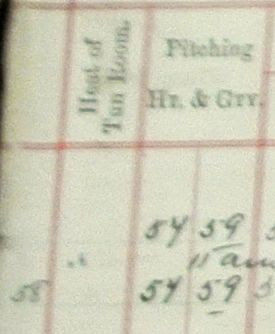
Heat of Tun Room
Pretty explanatory: 58º F.

Pitching Heat and Gravity
57º F and 1059º.

Now the really enthralling stuff - attenuations.

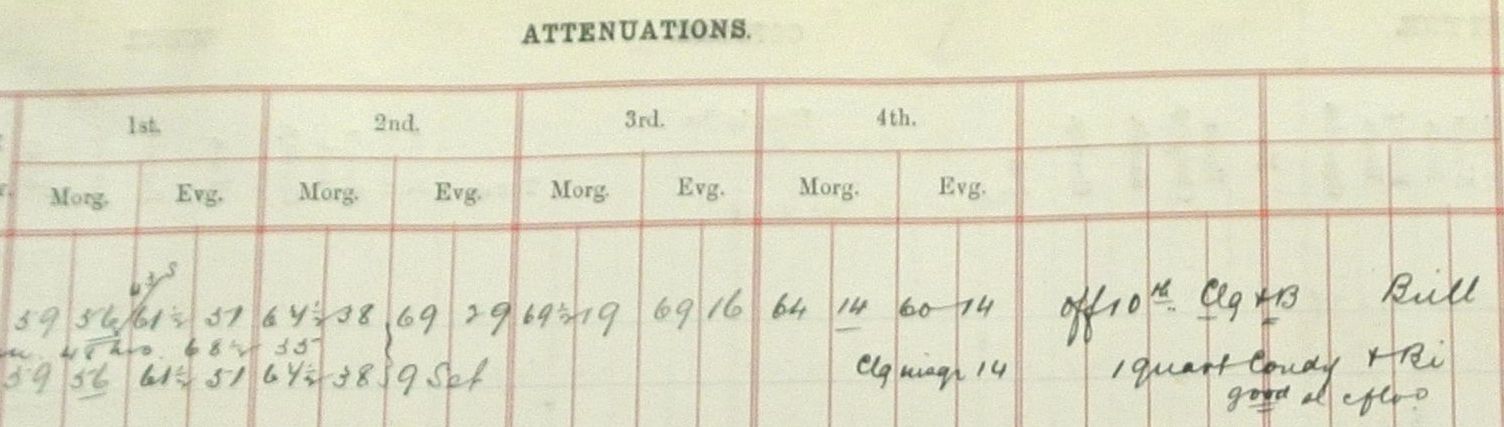
This is the fermentation record, with six columns, one for each day. And each day has in its turn columns for the morning and evening.

The two columns under morning and evening have the temperature of the wort, followed by the gravity. So:

1st day morning

59º F, 1056º.

!st day evening
61.5º F, 1051º.

On the evening of the second day, the worts in the two fermenters were combined into something called "9 Set".  I'm pretty sure they're being transferred to a union set. I know Holyrood had unions and the beer in question was an IPA/Pale Ale.

The fermentation is quite typical in that the temperature rises initially until around the middle of the fermentation and then is reduced, using attemperators. At the end of fermentation, the temperature is close to the pitching heat. The racking gravity was 1014º.

I'm not totally sure what the notes at the end mean. "off 10th" is I think when the beer was removed from the unions.

"Brill" I think just means bright.

"1 quart Condy" is, I think is Condy's Liquid. Something that sounds very much like a con. I need to investigate more.

"Bi" probably Bisulphate of lime.

"Good at cflow" good at counterflow, I think.

Not far to go now. Thankfully.


Sunday, 29 January 2023

How to interpret brewing records - part ten: Scottish format page 2 overview

And here we are at page 2 of William Younger's brewing records. Where all the magic happens. Because this is mostly taken up with a record of the fermentation. Lots of handy information for me. Especially if you want to prove that Scottish beer wasn't fermented at near Lager temperatures.

Here's the full page:

It's divided into five sections: pitching, attenuation, dry hops, cleansings and remarks. Though the last contains proper information rather than just remarks.

As well as the fermentation record, there are also details of the containers into which it was racked. A piece of information which is way more useful than you might think. But we'll get to that in a while.


Friday, 27 January 2023

How to interpret brewing records - part nine: Scottish format wort and yeast

We get to finish page 1 today. Hasn't this been fun? Probably not. I get the impression everyone got bored halfway through my explanation of the Barclay Perkins record.

Wort and yeast. Not the most exciting, but still important.


 Pretty simple.

Tuns
The fermenting vessels the wort was transferred to: tuns 19 and 20.

Barrels
Volume of the combined worts: 177 barrels.

Gravity
Gravity of the combined worts:1059º.

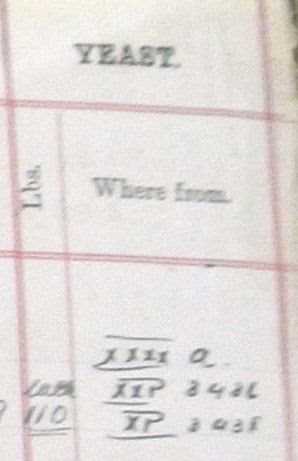
Now the yeast.


 Lbs.
Quantity of yeast: 110 lbs.

Where from.
The brews the yeast was harvested from: XXXX, XXP and XP. Not sure what the number is. I'd expect it to be a gyle number, but 3426 and 3438 are far too high.

Anyone interested in page 2? Anyone still reading?


Thursday, 26 January 2023

How to interpret brewing records - part nine: Scottish format boiling

This cool. Or rather hot, as it refers to the boiling process. It's great because I'm totally confident about all the entries. For once.


No.
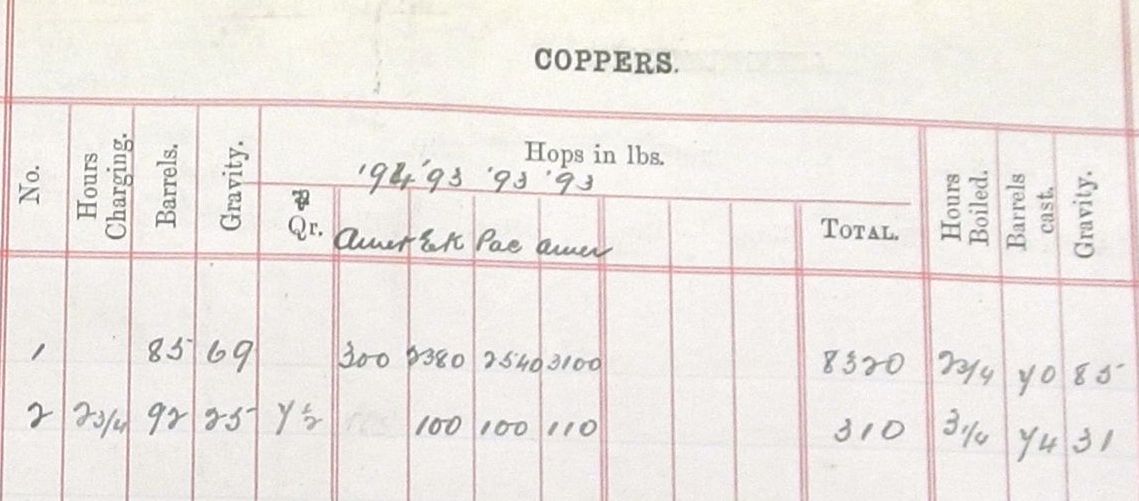
Number of the copper. In this case, coppers 1 and 2.

Hours Charging
Time it took to fill the coppers: 2.75 hours.

Barrels
Volome of the worts: 85 and 92 barrels.

Gravity
Gravity of the worts pre-boil: 1069º and 1025º.

Hops in lbs.
I think that's pretty explanatory.

Per Qr.
Pounds of hops per quarter of malt: 7.5 lbs.

The next columns list the different types of hops. The first row is the totals carried forward.

Amer. '94
American hops from the 1894 harvest. Zero used in this brew.

EK '93
East Kent hops from the 1893 harvest. 100 lbs this brew.

Pac. '93
Pacific, i.e. West Coast USA, hops from the 1893 harvest. 100 lbs this brew.

Amer. '93
American hops from the 1893 harvest. 110 lbs this brew.

Total
Total amount of hops in this brew: 310 lbs.

Hours Boiled
Boiling time of the two worts: 2.75 hours and 3.25 hours.

Barrels Cast
Number of barrels post-boil: 70 barrels and 74 barrels.

Gravity
Gravity of the worts post-boil: 1085º and 1031º.

That was all pretty simple, wasn't it? 

We're almost done with page 1. Just a couple of columns to go.

Tuesday, 24 January 2023

How to interpret brewing records - part eight: Scottish format mashing

Today we're looking at the meat of the process, mashing.

Scottish mashing schemes were way simpler than those in London. With just a single infusion and a sparge. Or maybe two sparges.


Let's go through column by column.

Mashing Heat
"63" Strike heat: 163º F
"52" Initial heat: 152º F
".4" don't know what this is.

Hours stood

"2" Time mash left to rest: 2 hours
"19" Not sure what this is. Could be a vessel number.

Inches in Tun
An inch measurement is the distance from the brim of a vessel to the surface of the liquid in it. I think these are tap temperatures for the mash. So 157.6º F, 146º F, 144º F and 135º F.

Sparge heats
Pretty self explanatory: 163º F and 160º F.

Falling heats
Tap temperatures for the sparge: 149.1º F, 153º F, 155º F and 157º F.

Gravities
"94" Gravity of the first wort: 1094º.
"2" Gravity of the last wort: 1002º. 

We'll be looking at what happened in the copper next.

Monday, 23 January 2023

How to interpret brewing records - part seven: Scottish format general and malt

Here we are looking at a lovely Scottish brewing record. You've no idea how much time I've spent staring at William Younger records. I've still not managed to work everything out.

This particular record is from the Holyrood Brewery, which mostly brewed Pale Ales. While at the Abbey Brewery they produced Scotch Ales, Mild Ales, Stout and the odd Pale Ale.

Here we go with the general crap:

Date and Brewing
Friday 5th October, gyle number 66

Weather
dull, occasional showers.

Ale
XXP - Younger's IPA.

Qtrs.
923 quarters carried over from previous page.
33 quarters this brew.
8100 and 7688 lbs sugar carried over. (DM, sacc., candy.)

Extract
Gross: Gravity points this brew
P Qr.
Extract per quarter (not filled in)

I've a better image for the malts themselves.

These are all types of pale malt. Let's go through them in order:

"C. Smy" not sure what the C means, but this is malt from Smyrna, i.e. Turkish.

"M.P. Cali" Californian barley.

"A Moldn." I think Moldovan barley.

"Kirky Chev" Cheviot, i.e. Scottish barley.

"H Hung" Hungarian barley.

"H. Ushak" Turksih barley again.

"H. Marmora" more Turkish barley.

"H. new Ushak" yet more Turkish barley.

See how only one of the eight malts was made from British barley. All the rest were imported, but malted in the UK. It's typical of Scottish beers of this period to use almost all imported ingredients. Often only the water and yeast were Scottish.

That's why Scottish brewers used so little malt. Because it all had to be imported from abroad. Unlike hops, which they could get from England. But was that really the case? We'll see in a later post.

Sunday, 22 January 2023

How to interpret brewing records - part six: Scottish format page 1 overview

After the overwhelmingly tepid response to my series looking at a Barclay Perkins record, I've decided to plough ahead with another style of brewing record. What I call Scottish format because, well, it\s the type of record used by most Scottish brewers. And a few English ones, too. Such as Boddington, for example.

Really I just need a few posts I can bash out without interrupting my work on "Stout!" too much. I need to set my priorities. And number one at the moment is getting that book finished. I'm eighty recipes in and haven't got past the 1850s.

Getting back to the topic, Scottish format records gave their pros and cons. Biggest pro is that you get more beers per photo. This period of Younger's records have eight beers per double-page spread. Which means you get four beers per photo. Biggest con is that everything is rather cramped and often in tiny handwriting.

I'll kick off by going through the first page. Which looks like this:

You'll need to click on the image to be able to read anything.

Working from left to right, first is some general information:

I think that's pretty easy to understand.

Next we come to information about the malts:

Here's one of the first challenges: reading the tiny handwriting describing each type of malt. We'll be getting back to this in a later post.

The mashing details follow, logically enough.

Quite a large section follows with everything connected to the copper.


Just two short sections left. First the wort.

And finally, the yeast.

Next time we'll start looking at these sections in detail.

Sunday, 8 January 2023

How to interpret brewing records - part five: gyling and fermentation

We'll be finishing off this Barclay Perkins record today. With all things fermentation related.

First up are the gyling details.


Pretty simple this.

Column 1:
Volumes of the wort in barrels, firkins and gallons.

Column 2:
Gravity of the worts in SG. Obviously, with the 1000 missed off.

The three worts combined were 113 barrels, 2 firkins and 1 gallon at 1077º.

Fermentation record is next.


Column 1: Day
Day of the week

Column 2: Time
Time of day. "E" = PM, "M" = AM.

Column 3: Saccr.
"Saccharometer". The gravity in SG.

Column 4: Therm.
"Thermometer". The temperature in Fahrenheit.

Each row records a stage in the fermentation. It's not a full record, covering the first two days and then jumping to racking time. the beer was racked at 22:00 on 12th October with a gravity of 1027º and at 59º F.

Now onto yeast details.


Column 1:
Date and time pitched.

Column 2:
The temperature in Fahrenheit.

Column 3: yeast
lbs of yeast, beer it was harvested from, that beer's gyle number.
For example: 30lbs of yeast from SDP, gyle number 113.

Finally, one I'm not 100% sure about. I think it's details of when the beer was cleansed. That is, when is was moved from a round fermenter to pontos for the yeast to be removed.


First row:
Date and time; "ins." inches - distance from the brim of the vessel to the surface of the liquid; "Heat" the temperature of the wort in Fahrenheit.

Second row:
"Hrs." Time in hours between pitching and cleansing; "Sacc." gravity of the wort in SG.
 

That was fun. Anyone up for more punishment? I could run through what I call "Scottish format" brewing records. If anyone could be arsed enough to read it.

Friday, 6 January 2023

How to interpret brewing records - part four: remarks and boil

I'm still going with this. I thought I might as well get all the way through explaining this record.

Here we go, then.


First bit is easy.
"3 gallons 6 pint of caramel"

No need to explain that. Not a huge amount across 113 barrels.

Onto the next column "Remarks".
19 cwts Garton's No. 3 Sacc."
That's No. 3 invert sugar. 18 cwts = 9.5 quarters. It appears as "Sacc" in the ingredients.

"Company's liquor treated with 3 oz Kainit per Brl of liquor used; not quite boiled $ allowed to cool down to mshing heat"

Kainit is some sort of potassium salt.


Next column "Tap Samples".
I'm guesssing this is the gravity at the start and end of runoff.

"Time of boiling"
2 hours for each wort.

Next unheaded column: "inch" pre-boil.
For both worts: 21. This is the distance from the top of the liquid to the rim of the vessel in inches.

Next unheaded column: volume pre-boil.
For both worts 79.5 barrels.

Next unheaded column: "inch" post-boil.
This time different for each wort.

Next unheaded column: volume post-boil.
For both worts 70.75and 60 barrels.

The bottom row shows the combined volume of the two worts pre- and post-boil.

Wasn't that fun? No, you're right. It wasn't. Gyling and fermentation next time.

Tuesday, 3 January 2023

How to interpret brewing records - part three: mashing

It seems I am continuing this series. At least for the time being, It's turning out to be less work - and less distracting - than I had feared.

Now we've looked at the ingredients, it's time to move on to the process. Starting with the most vital of them: mashing.

This is an area where there is a big variation between breweries as to what was recorded. Some record little more than the strike and tap temperatures, with nothing about how long it was mashed and left to stand.

I've chosen a Barclay Perkins log as an example because it's clear and informative.


1st column "Time of Standing"
Though it tells us a lot more than that. It also says what the operation was.

"1m 1/2 hr" first mash stood for 30 minutes
"M UM 1 1/2 hrs" underlet mash stood for 90 minutes
"2M" second mash
"S" sparge

An underlet mash is when water is added to the mash from the bottom and the rakes spun a few times to mix it thoroughly with the grain. The idea is to raise the temperature of the mash by a couple of degrees. It's a simple form of a step mash.

2nd column "L"
Standing for liquor, or water. Volumes in barrels. The underlet, the second row, was always a relatively small volume.

3rd column "H"

Standing for heat. The temperature of the water in Fahrenheit.

4th column "T"
Tap temperature in Fahrenheit. That is, the temperature of the wort when drawn off the mash tun.

5th and 6th Columns "Grist"
The quantity in quarters and the type of malt. This was necessary when a brew was split over more than one mash tun and the quantities used weren't the same in all of them.

7th column "Weight per bushel"
Multiply by 8 to get the weight of a quarter. Note that none of them - not even white malt - manages to reach the nominal weight of a quarter of 336 lbs.

The two numbers in pencil underneath the table are, I believe, the initial heats after the first infusion and the underlet.

Are you still having fun? I wonder who will get bored first, me or you?

Monday, 2 January 2023

How to interpret brewing records - part two: header and ingredients

Not sure how long I'll be arsed to do this. If you want me continue you'd best be really enthusiastic. Even better, donate some money. That's the best way to incentivise me to continue.

We'll start with a really easy bit. You should be able to work out the header without my help.


 Working from left to right:

The date: Wednesday 7th October 1891

The weather: A (atmosphere) 49º (F) Fine

The beer: BS (Brown Stout) 26 (brew number of Brown Stout, i,e this is the 26th brew of it this brewing year) 

The gyle number: No. 122

That was pretty simple. Next it's the turn of the grist.


 First are the malts, measured in quarters of 336 lbs and bushels of 42 lbs.. There are five of them:

1 quarter 2.5 bushels C (crystal malt)

3 quarter 2 bushels HB (Hertfordshire brown malt)

7.5 bushels of HA (Hertfordshire amber malt)

2 quarters 3 bushels of roasted malt

22 bushels and one bushel of W (white malt)

Total 28 quarters 4 bushels and 30 quarters.

Why are there two totals? Not totally sure, but I think the one on the left is weight quarters, i.e. 336 lbs, and the one on the right is volume quarters. Because a quarter was originally a volume measure. There were big differences in the weight of a quarter. In this brew, they varied between 268 lbs and 320 lbs, with the roasted malts being the lightest.

Finally there's the sugar:

Sacc 9.5 quarters

Note that a sugar quarter was 224 lbs.

Now the hops.

Four types of hops:

EKs /91 (East Kent, 1891 harvest) 1.24 (1 quarter of 28 lbs, 24 lbs: total 52 lbs)
EKs /91 (East Kent, 1890 harvest) 1.24 (1 cwt, 2 quarters, 14 lbs: =112+56+14, total 182 lbs)
EKs /91 (East Kent, 1889 harvest) 1.24 (1 quarter of 28 lbs, 24 lbs: total 52 lbs)
EKs /91 (East Kent, 1886 harvest) 1.24 (1 quarter of 28 lbs, 24 lbs: total 52 lbs)
Total 3.0.2 (3 cwt 0 quarters 2 lbs) 338 lbs = 3.0 b (3 lbs per barrel)
Peckham, Jenner, Harnett, Tompsett (names of the growers)

The growers are in the same order as the hops. That is, EKs /91 are from Peckham.

That wasn't too hard, was it?


Sunday, 1 January 2023

How to interpret brewing records - part one: general layout

What better way to start the year than reluctantly?

Against my better judgement, here's the start (possibly) of a series of posts on how to interpret brewing records.  Depending on the degree of apathy with which this post is greeted, I'll decide whether to continue.

A couple of people suggested I put together a pamphlet on the topic. Perhaps this is the start of that. Just not sure that I need yet another book project when I already have four unpublished manuscripts.

Right, let's go, shall we? I'm using as an example a Barclay Perkins Brown Stout log from 1891.

I'm using Barclay Perkins because their records are nicely laid out and contain lots of information.

Starting at the top, there's a header with basic information about the beer. Most of this stuff is pretty easy to understand.

At the top left are the mashing details:

All sorts of useful information there. Which I'll explain in detail in a later post.

To the right of that is space for details of a second mash tun and a column of remarks. In this case, there's also a remark in the second mash tun area.

Top right are boiling details:

On the left are some of the most important details, the grist:

Below are the hops:

Next along are the gyling details:

To its right, fermentation details:

Further along are the yeast pitching details:

Finally, I think these are cleansing details:

That's a quick run through the different elements of the log.

Let me know if you can make any sense out of these. And if you'd like me to continue. (Please say no.)

If there's enough demand, I'll explain each of the sections in mind-numbing detail. If you really want me to continue, maybe consider donating some money. That's an excellent way of encouraging me.

Monday, 23 November 2020

Yule Logs!!!!!!

Thanks to unemployment, I've had time this year to produce my traditional Christmas book of brewing logs. Unlike 2019, when to be perfectly honest, I couldn't be arsed.

 The same format as always: no words, just photos of brewing records. Just like every other year, I don't expect to sell fuck all copies. But, you know, I still like the put this nonsense out there.

Support independent publishing: buy this book on Lulu.

Feel free to prove me wrong by buying a copy:

http://www.lulu.com/shop/ronald-pattinson/yule-logs/paperback/product-23425089.html

If you order quickly (by November 26 at 11:59 PM UTC) - either this or any of my other wonderful Lulu print books - you'll get 10% off with this code:

FRIENDS10


Sunday, 23 February 2020

Obsession

Overenthusiasm has its upsides. I'd never have got where I am today without it.

Transcribing yet more tranches of numbers from brewing records this week, I wondered about how many hours I'd spent on such tasks. A fuckload is the simple answer. The long one, I don't really want to think about it.

Take my most recent archive trip. 650 photos in about four hours. Transcribing about half them, another forty. Turning them into recipes - a load more. A couple of weeks out of my life for a few dozen recipes.

Had I known hopw much work this would be, would I have ever started? I'm not sure.

When I started, I was only really interested in Porter and Mild Ale in the 19th century. It didn't look like a never-ending project. Unfortunately, my focus widened as I realised how little I really knew about brewing in the first half of the 20th century.

I suppose that's the definition of obsession. Not being able to let go. Even though I understand that I don't need to know every little detail, I can't help looking. Assembling as much data as I can. I really can't stop.

The information I've put together is amazingly useful. Giving me an amazing overview of UK brewing over the last 200 years. Was it worth the dozen years I've invested in it? I think so.

But then I'm an obsessive.

A result of my obsessive research is the many recipes in my book Let's Brew!


And I've recently created a Kindle version of the book.


https://www.amazon.com/dp/B08348M2D7

Sunday, 26 November 2017

Yule Logs!!!!

It's that time of year again. When I release my Christmas book.

It's the same format as every year: no words, just photos of brewing records. I can'y say that it's ever been a big seller. I'm not really sure why I bother. Other than that it's a tradition now.

Support independent publishing: buy this book on Lulu.

Feel free to prove me wrong by buying a copy:

http://www.lulu.com/shop/ronald-pattinson/yule-logs/paperback/product-23425089.html

Or to buy one of my other books, for example the award-winning Scotland! Vol. II:


Wednesday, 26 November 2014

Yule Logs!!

The season of gluttony and excess is almost upon us - time for my December-only, different every year, Yule Logs!!

Yes, I know it isn't quite December. I was trying to be ahead of the game this year. It was a dreadful rush last time, with Andrew nagging in my ear: "Daaad, just finish it. Don't have another Abt, get on with it. It won't be ready until January at this rate."

I hope the five extra days will boost sales into triple digits*. For anyone wanting to make fortune (in the unlikely event of me being collectable at some point), this is the book to invest in. My set will be Dolores's widow's pension. The illegible 2012 edition - I've the only copy - should see both kids through college.

Ramble, wander, ramble. You can tell I've already broken the seal on the floor (I'd call it my beer cellar, but that would be pretentious and not strictly true), the words are tumbling out like rats from a sewer.  I'm supposed to be convincing you to buy another of my wordless books.

It's odd that, as someone who thinks he knows his way around a sentence, two of the books I'm most proud of contain none. Sentences, I mean. And precious few words.

Yule Logs!!, my annual tribute to Norse responsible consumption, has a total of 249 words. (I said to Dolores: "My payment per word has just shot up. You won't believe how much I getting for this book.") I'm now going to bollox that up by giving them away for free:


Yule Logs!!
by
Ron Pattinson

Copyright © 2014 Ronald Pattinson

The right of Ronald Pattinson to be identified as the author of his work has been asserted by him in
accordance with the


COPYRIGHT, DESIGNS AND PATENTS ACT OF 1988

All rights reserved. No part of this publication may be reproduced, stored in a retrieval system, or transmitted, in any form or by any means without the prior written permission of the publisher, nor be otherwise circulated in any form other than that in which it is published and without a similar condition being imposed upon the subsequent purchaser.

3rd edition

Published in  December 2014 by

Kilderkin
171 hs Warmondstraat, Amsterdam, Noord- Holland

ISBN 978-94-90270-23-0


Contents


1805 Barclay Perkins BST
1813 Whitbread Table Stout
1826 Truman Keeping
1832 St. Stephens X
1848 William Younger sheet 1
1848 William Younger sheet 2
1858 Tetley XX 4 top
1858 Tetley XX 4 bottom
1868 Medway Porter and X
1870 Simmonds XX sheet 1
1870 Simmonds XX sheet 2
1886 Hodgson XX sheet 1
1886 Hodgson XX sheet 2
1890 Hodgson Bitter Ale sheet 2
1899 Fullers AK sheet 1
1899 Fullers AK sheet 2
1904 Whitbread IPA
1906 Barclay Perkins KK
1917 Kidd LPA
1915 Drybrough sheet 1
1915 Drybrough sheet 2
1922 Camden PA
1930 Russell 6d Ale
1939 Maclay SA and PA 6d
1941 Barclay Perkins IBS and LS
1954 Whitbread DB
1962 Barclay Perkins Export Lager
1965 Beasley IPA
1964 Truman P1 and P2
1972 Whitbread Final Selection

I can see I'm not really selling the book. Which is the idea, if I want Dolores to have a merry widowhood.

If you have to, purchase my rubbishy, word-free book sometime over the next five weeks, if you can be arsed.


* I'm an assembler programmer. My digits are binary.

Saturday, 30 November 2013

Yule Logs

It's almost Krimble. Time for Yule Logs.

Only availabe in December. Totally different from last year's.

Buy it while you can.

Friday, 11 January 2013

Blame Drybrough

If I've been a little light on Scottish tables of late, there's a good reason. Drybrough. And their  eccentric brewing records.

A snapped a whole load of during my last commado raid on the Scotttish Brewing Archive. I grabbed 700+ photos of their records, getting every year from 1906 to 1970. It's a great set. And I would have gone through them as soon as I got back. But . .

Very first record of the first year and I can't understand it. Some, but not this:


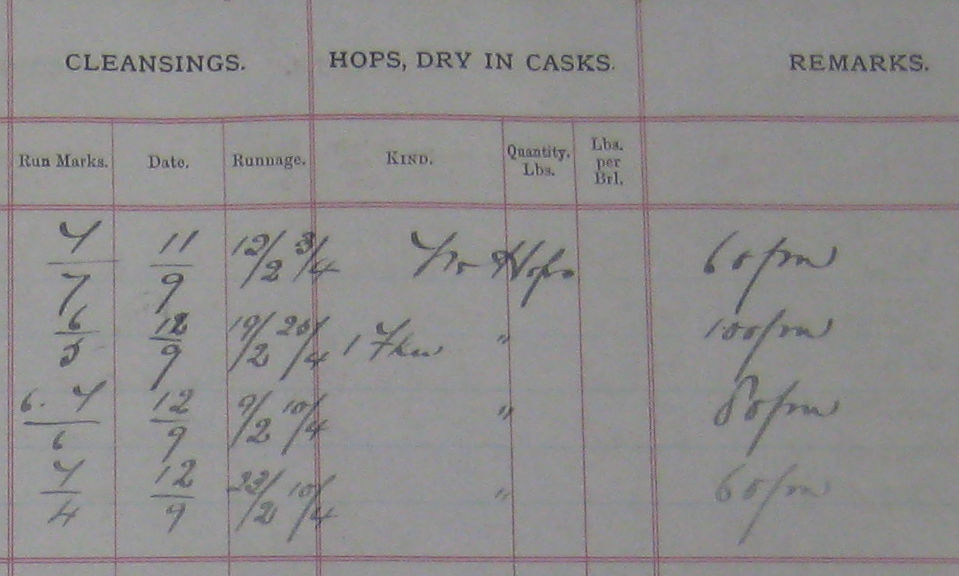
That column heading "Runnage" - what the hell is that?

It was enough to make me scratch my head, scratch a few less-mentionable bits, and then move on to something I could understand. Being intensely lazy, I naturally seek the line of least resistance. Robert Younger's and Maclay's records may have been as dull as December, but at least I could understand them.

Drybrough's records are frustrating in many ways.

There are three or four different formats. each of which omits some really handy piece of information. Between them, everything you need is there. Just never all on one record. In some the boil times are missing. Others the pitching temperature. Or even the FG.

Then there are the beers that appear from nowhere in the last columns, conjured from who know's where.

Over Christmas I forced myself to look at Drybrough again. Starting with the less weird later records and working backwards. It's not a great deal of fun. They belonged to the one recipe school of Scottish brewing.

I've done most of the 1950's. It was a bit like hammering a nail through your big toe, but without the thrill of an ambulance ride to casualty.

The 1930's were a weekend in Bamberg in comparison. Slight exaggeration. A year in Swindon. That's it. Like a year in Swindon.

I'm on WW I now. And I've tipped over my comprehension horizon. I'm recording stuff I don't understand. I really hate that.

I'll be busy for weeks, whatever my level of understanding. It'll be worth it in the end. For the 64-year arc of a Scottish 60/-.