Showing posts with label Russian Stout. Show all posts

Tuesday, 18 January 2022

Imperial Stout in Scotland in the 19th century

I'm going to drag this out for much, much longer. Unless I get bored, of course. Not much sign of that yet.

Dipping my toes into the shallow end of the 19th century, much the same Imperial Stouts were knocking around Scotland.  Which means Combe and Barclay Perkins.

COMBE & COY.'S LONDON STOUTS.
HIGHLY RECOMMENDED BY THE MEDICAL FACULTY.
IMPERIAL STOUT    Yellow Label.
DOUBLE    Do.    Green Do.
INVALID Do.    Red Do.
A TRIAL SOLICITED. ONCE TRIED, ALWAYS PREFERRED
TO BE HAD, IN SPLENDID CONDITION, FROM
A. JACK. Grocer and Wine Merchant, 16 HIGH STREET; DINGWALL.
North Star and Farmers' Chronicle - Thursday 31 August 1899 , page 7.

Combe being well established as a Stout brand in Scotland while still an independent brewery explains why Watney persisted with the brand well into the 20th century.

Barclay Perkins likewise had more than just their Imperial Stout on offer:

ELFERT'S. BARCLAY, PERKINS’ LONDON IMPERIAL STOUT, in fine condition, 2s 3d doz, pints. BARCLAY, PERKINS’ BROWN STOUT, 1s 9d per doz. pints.
Aberdeen Press and Journal - Friday 03 April 1891, page 2.

As mentioned in a previous post, at 2.25d per bottle, those have to be reputed pints rather than Imperial pints.

The same applies to this advert: 


{BASS ALE. 

{ALLSOPP'S ALE.  
2/3 per dozen {BARCLAY PERKINS' IMPERIAL STOUT. 

{COMBE'S STOUT. 

{GLENLIVET No. 1 ALE. 


{ALLSOPP’S STOUT. 
1/9 per dozen {BARCLAY PERKINS' BROWN STOUT 

{YOUNGERS TABLE BEER (Quarts). 

These are Bottled on the Premises, and are Guaranteed PURE and in Sparkling Condition.
LEITH & CO., 212 GALLOWGATE, ABERDEEN.
Aberdeen Press and Journal - Tuesday 12 July 1898, page 1.


At least one Scottish brewery was in the Imperial Stout business:

THE CASTLE BREWERY, MARYHILL, GLASGOW.
The Celebrated "CASTLE" PALE ALES sad IMPERIAL STOUT always in Splendid Condition.
G. & J. MACLACHLAN, Town Office - 26 and 27 ST. ENOCH SQUARE GLASGOW.
Hamilton Herald and Lanarkshire Weekly News - Friday 27 May 1898, page 2.

Finally, another English Imperial Stout. And a rather odd Malt Wine:

COLEMAN'S CROWN IMPERIAL INVALID STOUT
Is a specifically brewed INVALID STOUT from Malt and Hops of the finest quality, and will be found to invigorate the system without leaving any sign of heaviness  dulness behind after drinking as is the case of most Stouts. 

Important unsolicited Testimonial from DR. A. BALFOUR.
29, Abercorn Terrace, Portobello,
April 2nd, 1890.
Gentlemen.- I beg to thank you sincerely for your kind gift of "Invalid Stout," sent to me through Mr. Carmicheal. I have already found it beneficial to my wife, who is just now convalescent from a long illness, and I will recommend it to my patients in suitable cases.
I am, Gentlemen, Yours very truly,
ANDREW BALFOUR, MD.

Recommended by the Medical Faculty as being the most nourishing Stout obtainable. 

Sold in Champagne Pint Bottles at 2/9 per dozen. Bottles charged, but allowed for when returned. 

Sole Proprietors:

COLEMAN & CO., LIMITED, 1 , NORWICH & LONDON. 

We are also Sole Proprietor of the Celebrated COLEMAN'S EXTRACT OF MEAT & MALT WINE.
Montrose, Arbroath and Brechin review; and Forfar and Kincardineshire advertiser. - Friday 20 March 1891, page 8.

A few pints of Imperial Stout tend to leave me feeling rather dull. Maybe the meaty malt wine would help liven me up. The Victorians did like to put meat into alcoholic drinks, the weird buggers. Given all the weird shit being thrown into beer nowadays, I'm surprised no-one has started adding meat.

Sunday, 16 January 2022

Yet more Imperial Stout in Scotland

Continuing to move back in time, we're now before WW I. I see now why Watney was using the Combe brand for Stout in Scotland in the 1920s.

It's simply historical. Combe had clearly established a trade in Stout north of the border before the merger with Watney and Reid. As this advert from 1900 reveals:

COMBE & COY.'S LONDON STOUTS.
HIGHLY RECOMMENDED BY THE MEDICAL FACULTY.
IMPERIAL STOUT    Yellow Label.
DOUBLE    Do.    Green Do.
INVALID Do.    Red Do.
A TRIAL SOLICITED. ONCE TRIED, ALWAYS PREFERRED
TO BE HAD, IN SPLENDID CONDITION, FROM
A. JACK. Grocer and Wine Merchant, 16 HIGH STREET; DINGWALL.
North Star and Farmers' Chronicle - Thursday 13 December 1900, page 7.
Note that, at this point, Imperial Stout was Yellow Label and Invalid Stout Red Label. It looks like they changed the label colours to fit in with Barclay Perkins.

Another advert reveals the prices for various beers, including Barclay Perkins Imperial Stout.

BARCLAY PERKINS & CO.’s IMPERIAL STOUT, 2/6 per doz.
ALLSOPP’S INVALID STOUT,    1/9 per doz.
TENNENTS LAGER BEER,    2/6 per doz.
BASS & CO.’S PALE ALE,    2/3 per doz.
PRESTONPANS BEER,    1/2 per doz, pints.
„    ,,        2/3 per doz. quarts.
M‘EWAN’S THREE GUINEA ALE,    1/2 per doz. pints.
„    „    ,    2/3 per doz qts.
SCOTCH PORTER,     2/- per doz. quarts.
JEFFREY’S SUPERIOR TABLE BEER,     1/6 per doz. quarts.
WILLIAM BURNS,
42 DUNNIKIER ROAD, KIBKCALDY.
Fife Free Press, & Kirkcaldy Guardian - Saturday 31 August 1907.

Unfortunately, no bottle size is specified. It's obviously not an Imperial pint. It works out to 2.5d per pint. To put this into context, a pint of draught Mild cost 2d at the time. The ones where a size of a pint is mentioned also seem too cheap. I think I have an explanation, though.

First, let's look at another advert.

MY PRICES.
Bass & Co.’s Pale Ale    2.5d per Pint.
„    „ No. 1 Ale    3d per Pint
Barclay Perkins' Imperial Stout,    2.75d per Pint
Lochside Pale Ale,    2d per Pint.
North Port Pale Ale,    2d per Pint.
Lager Beer    2.5d per Pint.
Table Beer (Bitter or Sweet), 2.25d per Quart Bottle.
All in Fine Condition.
Fine Old Scotoh Whisky, 3s and 3s 6d per Bottle.
Grand Value in Teas, 1s 6d, 1s 8d, ls 10d, and 2s per Lb.
ALL GROCERIES OF BEST QUALITY AT KEEN PRICES.
ALEXANDER M'LEAN,
25 MURRAY STREET.
Prompt and Careful Attention to all Orders.
Montrose, Arbroath and Brechin review; and Forfar and Kincardineshire advertiser. - Friday 11 February 1910, page 4.
Here a bottle size is specified, and it's a pint. But 2.75d is way too cheap. Simple explanation: it's not an Imperial pint, but a reputed pint. Which is two thirds of an Imperial pint. Making the price for a full pint 4.125d, which does sound about right. If you remember the last Scottish price list I posted, that specified reputed pints.

Though, as it's cheaper than Bass No. 1, which had an OG over 1100º, the implication is that it's weaker. Again, I'm pretty sure I have an explanation.

Remember that I mentioned I didn't have any Barclay's Imperial Stout brewing logs from this period? Well, they aren't the only source of information in the archives. There are also documents called "Gyle Summaries". They list each brew, giving barrels brewed and the costs. The column for OG mostly isn't filled in. But, as both bulk and standard barrels are listed, it's easy to work out the gravity.

I'd assumed That the two version of IBS was a post-WW I thing. It wasn't. The Gyle Summaries list both IBS and IBS ex. At 1100º and 1108º, respectively. Not a huge difference, really. It makes you wonder why they bothered.

Thursday, 13 January 2022

Imperial Stout in Scotland again

We're between the wars now. Sorry if it's all Imperial Stout. You know what I'm like when I get started on a topic.

It seems that Barclay Perkins wasn't the only London brewery flogging Imperial Stout in Scotland. Not even the only one with a Red Label Stout.

I say brewery. Brand, would be more accurate. The Combe brewery closed almost immediately after the formation of Watney, Combe, Reid in 1899. The same fate befell Reid's plant. What's odd, is that in London the Combe name was only used for Brown Ale. Their Stouts were branded as Reid.

Combe's Stout might have been called Red Label, but was it really comparable to the Barclay Perkins beer? After all, it's also billed as "Nourishing Stout" which could mean something pretty weak.

 These minimum prices agreed by the publicans of Aberdeen suggest that they were of a similar strength:

I.—SALES BY LICENSED GROCERS AND OTHERS FOR CONSUMPTION OFF THE PREMISES.

Per Dozen Reputed Pints. Per Dozen Imperial Half Pints. Per Dozen Splits.
Bass. Allsopp and Worthington Beers 7/- 6/- 4/6d
No. 1 Bass 15/- - 7/6d
No. 2 Bass  - - 7/-
Barclay Perkins, Combe’s and Guinness' Stout 8/- 5/-
Source:
Aberdeen Press and Journal - Thursday 17 September 1931, page 1.


II.— SALES FOR PUBLIC BARS ON CONSUMPTION, i.e., IN PUBLIC BARS.

Per Reputed Pint. Per Imperial Half Pint. Splits.
Bass, Allsopp and Worthington Beers  8.5d 6.5d 5.5d
Bass No. 1 1/3d - 9d
Bass No. 2 - - 7d
Barclay Perkins & Combe's Imperial Red Label Stout 9d - 5.5d
Brown Stout and Guinness Stout  8.5d 5.5d
Draught Beer  7d per pint; 3.5d per half pint    
Source:
Aberdeen Press and Journal - Thursday 17 September 1931, page 1.

As the two cost the same, it's safe to assume that they were of roughly similar strength. Also, a bit stronger than Bass Pale Ale. But nowhere near as strong as Bass No. 1, which was a round the same gravity as the the export version of Barclay Perkins Imperial Stout.


Wednesday, 12 January 2022

Let's Brew Wednesday - 1924 Barclay Perkins IBS Export

Continuing with my Imperial Stout theme, I thought I'd throw in an interwar recipe.

It seems to have taken a couple of years after WW I before Barclay Perkins brought back their powerful Imperial Stout. But, unlike the rest of their range, it returned at full strength.

I would tell you exactly how it differed from the version of 1914. Except I don’t have any brewing records of it from that period. Which is a bit irritating.

As you would expect, the grist is packed with roasted malts, three in total: brown, amber and black malt. At this point, Barclay Perkins Stouts, unlike their Ales, contained no flaked maize. Though that would have changed by the 1930s.

At 16 lbs per quarter (336 lbs) of malt, the hopping is very heavy. Which makes sense in a beer which wouldn’t be consumed for several years. All were from East Kent: Golding Varieties from the 1924 harvest, Cobbs and Goldings from 1923. The latter two had been cold stored. So, all pretty fresh hops.

I’ve reduced the FG from the 1040º racking gravity based on analyses of the beer when sold. A couple of years of a Brettanomyces secondary fermentation knocked it down considerably.


1924 Barclay Perkins IBS Export
mild malt 12.00 lb 53.33%
brown malt 2.75 lb 12.22%
amber malt 3.75 lb 16.67%
black malt 1.50 lb 6.67%
No. 2 invert sugar 2.50 lb 11.11%
Goldings 135 mins 4.50 oz
Goldings 90 mins 4.50 oz
Goldings 30 mins 4.50 oz
Goldings dry hops 1.50 oz
OG 1103.5
FG 1022
ABV 10.78
Apparent attenuation 78.74%
IBU 132
SRM 49
Mash at 146º F
After underlet 154º F
Sparge at 170º F
Boil time 135 minutes
pitching temp 58º F
Yeast Wyeast 1099 Whitbread ale


Tuesday, 11 January 2022

Barclay Perkins Imperial Stout in Scotland (again)

I'm going to gradually move back in time as I dig deeper into Imperial Stout. Which logically means that we're starting at the end.


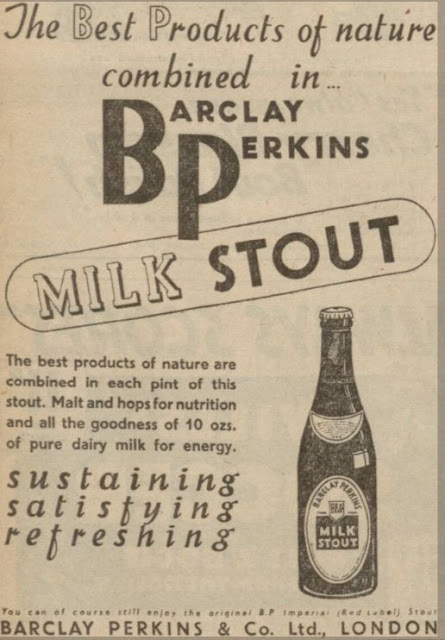
"The Best Products of nature combined in...
BARCLAY PERKINS
Milk Stout

The best products of nature are combined each pint of this stout. Malt and hops for nutrition and ail the goodness of 10 ozs. of pure dairy milk for energy. 

sustaining
satisfying
refreshing 

You can still enjoy the original B.P. Imperial (Red Label) Stout
BARCLAY PERKINS & Co. Ltd., LONDON "
Dundee Evening Telegraph - Thursday 07 March 1940, page 4.

From the way this advert is worded, it's obvious that Milk Stout had replaced the older Imperial Stout and reduced it to a footnote. This doesn't seem to have lasted long, as a few years after the war Imperial Stout was being advertised on its own:

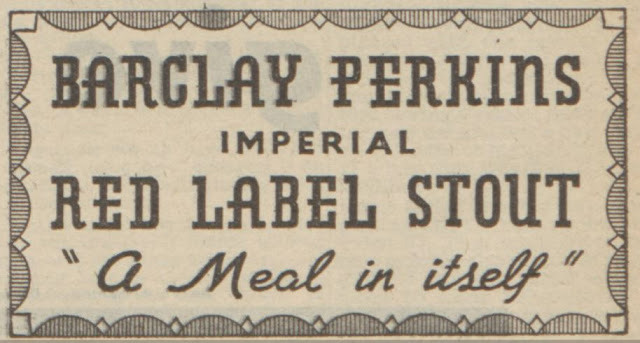
"BARCLAY PERKINS IMPERIAL RED LABEL STOUT

"A Meal in itself"
Dundee Evening Telegraph - Wednesday 14 December 1949, page 3.

Just the sort of meal I like. A liquid one.

This is the last advert I can find for Imperial Stout. It's just a couple of years before the merger with Courage.

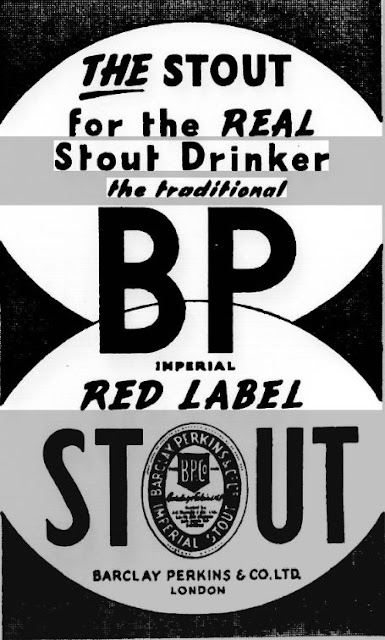
"THE STOUT for the REAL Stout Drinker the traditional
BP
IMPERIAL RED LABEL STOUT
BARCLAY PERKINS & Co. Ltd., LONDON "
Aberdeen Evening Express - Saturday 11 April 1953, page 5.

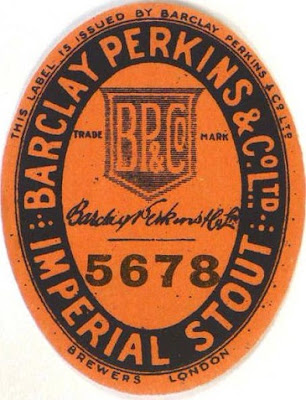
The label surprised me. That's the style they used before WW I. It looks awfully old-fashioned.And very different from the label on the full-strength version.

I'll leave you with some more analyses. Just making sure I get at least a few numbers in.

Weak Imperial Russian Stout 1925 - 1937
Year Beer OG FG ABV App. Atten-uation Price size package
1925 Imperial Stout 1060.3 1016.1 5.75 73.30%   pint bottled
1925 Imperial Stout 1060.3 1020.6 5.14 65.84% 8d pint draught
1935 Imperial Stout 1061.8 1014.2 6.20 76.97% 6d to 9d pint bottled
1937 Imperial Stout 1061.2 1010.1 6.69 83.50% 6d & 7d half pint bottled
Source:
Whitbread Gravity book held at the London Metropolitan Archives, document number LMA/4453/D/02/001.

Monday, 10 January 2022

Barclay Perkins Imperial Stout in Scotland

Time to give my few remaining readers a relief from all the WW II and and Dutch stuff. What could I write about? I know: Imperial Stout.

Not a totally random choice. There's the obvious Barclay Perkins connection. I've spent quite a bit of time looking at their legendary Imperial Stout. They weren't the only ones by any means to have a beer of that name. Truman and Courage, for a start. Others who, like Whitbread might have not called it Imperial Stout in the brew house, had a beer sold under that name.

I love that Courage brewed two Imperial Stouts at different tines with completely different heritages. Their own and, after Barclay Perkins closed, the granddaddy of the style.

After banging in "Imperial Stout" search in the newspaper archive, I started off looking far back for the first mention of the term. Nothing in the 18th century. I wasn't that surprised, as Britain only became "imperial" in the 19th century.

A comment on the weediness of Barclay Perkins Russian Stout of the 1940s reminded me adverts for it in Scottish newspapers from that time. All for a weaker version - "Red Label". After the war a weak version was specifically identified as being for Scotland.

How far did this "Red Label" go back? Was it always weaker than the classic version? If so, how did they achieve that? Have I missed it in the brewing records? 

The first spotting I have (in the brewing books) of a weak Russian Stout is in 1921. Though I haven't seen a brewing log, just a Whitbread analysis, a full-strength version was on sale in 1922. Both beers were brewed right through the interwar years. 

The strong Russian Stout is identified as IBS ex in the logs. Indicating an export beer. But was it really only exported? Or just a name to distinguish it from its weedy sibling? 

I'll leave you with a table. I wouldn't want to disappoint. 

Weak Imperial Russian Stout 1921 - 1947
Year Beer OG FG ABV App. Atten-uation colour
1921 IBS 1061.3 1020.0 5.46 67.37%  
1922 IBS 1061.1 1019.0 5.57 68.90%  
1924 IBS 1061.0 1020.0 5.42 67.21% 340
1924 IBS 1061.4 1021.0 5.34 65.80% 280
1928 IBS 1060.8 1020.0 5.40 67.12% 260
1929 IBS 1060.7 1022.5 5.05 62.93% 290
1936 IBS 1060.4 1020.0 5.34 66.88% 360
1936 IBS 1060.5 1020.0 5.36 66.94% 360
1937 IBS 1060.8 1021.0 5.26 65.44% 330
1940 IBS 1055.4 1022.5 4.35 59.36% 280
1941 IBS 1055.6 1022.0 4.45 60.45% 290
1946 IBS (Scot.) 1043.8 1019.5 3.21 55.48% 310
1947 IBS (Scot.) 1043.5 1021.0 2.98 51.72%  
Sources:
Barclay Perkins brewing records held at the London Metropolitan Archives, document numbers ACC/2305/01/608, ACC/2305/01/611, ACC/2305/01/614, ACC/2305/01/621, ACC/2305/01/623, ACC/2305/01/624 and ACC/2305/01/627.

Come with me as I dig further into the questions I've raised. After a little research - a couple of hours this afternoon while vaguely watching football - the story is mildly interesting. Who could ask for more than that? The tiniest scrap of excitement.

Monday, 7 September 2020

Dodgy crown corks


Court case often give a brief glimpse into one aspect of the brewing industry. This article provides several insights. I'll explain exactly what later. 

First read the article:

"DUNDEE FIRM
CLAIMS CORKS SPOILED BEER
 
Alleged faulty corks, resulting in beer being spoiled, are the subject of action by Dundee firm against the cork suppliers in the Court of Session.

Alexander Graham Dunn, bottler, sole partner of Messrs William Smith, bottlers, 160 Nethergate, claims £475 12s 2d from the Defiant Crown Cork Co., Thames Iron Works, Lewisham, London.

Dunn states that in September 1948 customers said bottled beer he supplied was defective, because it had musty smell and flavour, and was undrinkable. They rejected the beer.

On inspection the corks were found to defective, and the beer was spoiled. Beer returned was as follows:—290 dozen bottles Guinness, valued at £159 10s; 25 dozen bottles Barclay Perkins Red Label stout, valued at £15; and 172 dozen half pints of bottled Bass beer, valued at £107 10s.

He alleges that the defective state of the corks was due to breach of contract by the London firm. The corks after use were discoloured, blackened, with musty smell. Dunn believes and avers that the corks were of inferior quality and contained pitted holes when delivered. It is also believed that the holes contained bacteria which were invisible to inspection, but which caused mould and caused the bad taste.

Dunn also states that his suppliers did not sterilise or pasteurise the corks before delivery, the normal and proper practice. Had they done so the corks would not have become mouldy and discoloured.

NOT IN DAMP

It is denied that the cases of corks were deposited on the floor of a damp cellar. They were stored in a dry cellar. Other corks from the same suppliers, stored in the same cellar, were perfect for at least year. In any event, the corks were not damp when put in the bottles, and would not have been used had they been damp. Prior to being used in the bottles they were clean and normal in colour, and had no visible defect or bad smell.

The sum claimed represents the value of the beer and stout returned, cost of carriage of the bottles to and from the customers, and loss of profit.


The Defiant Crown Cork Co., who deny liability, state that corks returned to them by Dunn were affected by mould, caused by the corks being stored in damp conditions. Corks in a full and unopened case also returned were in perfect condition. They explain that cork is a natural product, and all corks contain pitted holes which are inherent in their nature. When the corks were delivered to Dunn they did not contain bacteria.

The corks underwent a heat treatment in manufacture, and were thoroughly sterilised. These corks form only a small fraction of a batch made on the same day, and no complaints have been received from other users. If the contents of the bottles became unusable it was not caused by any defect in the corks.

It is also denied that any discoloration, blackening or mustiness arose in the corks only after use in the bottles. The case of corks complained of was at least six months old and cases sent to Dunn after the one complained of had been used, before it.

CASE ON FLOOR
When examined by their Glasgow agent, the case was deposited on the floor of a damp cellar, and appeared to have been there for some time. It was lying opposite a wide door through which dampness could come.

The defect in their condition was due to being kept in the damp cellar since February 1948. Dunn knew that corks should be stored in a dry place, and that dampness encouraged the growth of various moulds. Moreover, he failed to use the corks in the order in which they were sent to him. Further, he or his servants ought to have inspected the corks within a reasonable time after delivery, and in any event prior to using them.

It is believed that any discoloration or blackening was due to iron sulphide and iron tannate, and could not have communicated a foreign odour or flavour to the contents of the bottles, but the presence of such discoloration or blackening should have attracted their attention prior use, and have caused them to make the further simple examination by smelling them. This would have revealed at once that the corks had a musty smell.

Proof will be heard on October 31."
Dundee Courier - Wednesday 04 October 1950, page 3.

 Where to start? With the beers themselves.

Guinness and Bass are exactly the type of beers you'd expect to be seeing bottled by a third party. But Barclay Perkins? Unlike Bass and Guinness, it wasn't a brewery which got its beers into lots of other breweries pubs. And Scotland is an awfully long way away from their usual London market.

But I'd already found several advertisements for Barclay's Stout in Scottish newspapers.  I expect that they had to pull out of it due to zoning during WW II. Only a select few brewers - such as Bass and Guinness - were allowed to distribute nationally. Everyone else was only allowed to sell beer within a certain distance of the brewery. Distant tied houses were supplied by brewers closer by.

Clearly, Barclay's Scottish trade did return after the end of zoning. Though I could have surmised that from their brewing records. As one of their post-war beers had the brew house name of IBSt Sc. That is a version of Russian Stout especially for the Scottish market. In 1950, weak enough to count as a session beer.

We also get to see what the wholesale price of the three beers was. I'll spare you the maths, but the Guinness works out to 11 shillings per dozen, Barclay's Stout 12 shillings and Bass 12 shilling and sixpence. It says something of its perceived quality that Barclay's was more expensive than Guinness, itself not a cheap beer.

Third-party bottlers - companies whose sole business was bottling other breweries' beers. It was quite a big thing in the first half of the 20th century, but slowly petered out in the 1960a and 1970s.

This case illustrates the danger for a brewer. By farming out bottling to another company they lost control of the quality. You could end up with undrinkable beer through no fault of your own. That's probably one of the main reasons the practice died out.

Wednesday, 17 June 2020

Let's Brew Wednesday - 1937 Barclay Perkins IBS Export

I felt I owed you this one after last week's watery version. Here’s the full-strength Russian Stout. Brewed to the same gravity as in the 19th century.

You might have expected it to be just a scaled-up version of the weak one. But it isn’t. In reality, the recipe is very different. The percentage of roasted malts is higher and black malt than roast barley. The grist is, in fact, adjunct-free. And there’s only one sugar, rather than four. Rather surprisingly, it’s No. 2 invert and not the No.  3 or No. 4 you would expect.

I wouldn’t pay much attention to the FG. That’s the gravity when the beer was transferred from the primary fermenter to the maturation vessel. Not sure exactly what that was at this point it may have been a vat or it could have been a tank. Whatever the vessel was, there would be a long, secondary fermentation with Brettanomyces. That would knock down the FG considerably.

There were a shitload of hops. At over 15 lbs per quarter (336 lbs) of malt it was hopped at about double the rate of the weaker version. The hops themselves were Mid-Kent Fuggles from the 1936 harvest, East Kent Goldings from 1935 and Mid-Kent Goldings also from 1935. All had been cold stored. The type and age of the dry hops weren’t listed on the brewing log.


1937 Barclay Perkins IBS Export
mild malt 12.00 lb 52.75%
brown malt 3.00 lb 13.19%
amber malt 3.50 lb 15.38%
black malt 1.50 lb 6.59%
No. 2 invert sugar 2.50 lb 10.99%
malt extract 0.25 lb 1.10%
Fuggles 210 mins 4.00 oz
Goldings 90 mins 4.00 oz
Goldings 30 mins 4.00 oz
Goldings dry hops 1.50 oz
OG 1104.5
FG 1041.5
ABV 8.33
Apparent attenuation 60.29%
IBU 121
SRM 50
Mash at 146º F
After underlet 154º F
Sparge at 170º F
Boil time 210 minutes
pitching temp 59.5º F
Yeast Wyeast 1099 Whitbread ale

Saturday, 13 June 2020

Let's Brew - 1946 Barclay Perkins IBS (Scotland)

This is beer to set the heads of style Nazis spinning: an Imperial Stout that’s weak enough to classify as a session beer.

Before the war Barclay Perkins brewed two versions of IBS (Imperial Brown Stout): a domestic version at around 1060º and an export version at the full 1100º gravity. Brewing of both was stopped a couple of years into the war. Though supplies of the stronger version would have lasted a while longer, as it was usually aged for at least two years before bottling. At least that’s what old labels claim.

After the war, IBS returned, but initially only in this much weaker form. Given the name, I assume that it was brewed for the Scottish market. A full-strength version appeared a few years after the end of the war.

The basic grist is much the same as pre-war: base malt plus amber and brown malt and roast barley. In this example, the base is 50% pale malt, 50% SA malt. I’ve substituted mild malt for the latter.

To account for the primings, which increased the effective OG by 1.5º, I’ve added and extra 0.25 lbs of No. 3 invert.

There were three types of hops: two of Mid-Kent Fuggles from the 1944 and 1945 harvests and Brewer’s Gold from 1945. Barclays really seemed to have got a taste for Brewer’s Gold just after the war. During the hostilities they had used almost exclusively Fuggles, Goldings and Goldings Varieties. Other than the occasional dab of Saaz.


1946 Barclay Perkins IBS (Scotland)
pale malt 2.50 lb 26.10%
mild malt 2.50 lb 26.10%
brown malt 1.00 lb 10.44%
amber malt 1.00 lb 10.44%
roast barley 1.00 lb 10.44%
No. 3 invert sugar 1.25 lb 13.05%
caramel 1000 SRM 0.33 lb 3.44%
Brewer's Gold 90 mins 1.00 oz
Fuggles 60 mins 1.00 oz
Fuggles 30 mins 1.00 oz
OG 1045
FG 1019
ABV 3.44
Apparent attenuation 57.78%
IBU 40
SRM 39
Mash at 144º F
After underlet 149º F
Sparge at 165º F
Boil time 90 minutes
pitching temp 60.5º F
Yeast Wyeast 1099 Whitbread Ale

Monday, 28 October 2019

Bismarck drank Russian Stout

Time for another Barclay's Russian Stout advert. With some more interesting claims.

The oddest being that Bismarck liked Russian Stout. Especially as the advert is from just after WW I, when there was still considerable anti- German feeling.


"Bismarck knew and appreciated the full-bodied, seductive qualities of
BARCLAY'S
RUSSIAN STOUT
Matured at least a year in bottle

Its rich, creamy flavour, its warming goodness, distinguish it from any other stout you have tried. This stout was originally brewed nearly 150 years ago for export to Russia, to meet the demand of the old Russian aristocracy for a really choice, full-bodied stout. It continued to be exported up to the time of the War.

The finest winter drink
BARCLAY, PERKINS & Co.,
SOUTHWARK, LONDON, S.E.

Barclay's Southwarke Old Ale will also repay acquaintance."
Pall Mall Gazette - Monday 23 October 1922, page 5.

Another claim is that it was matured for at least a year after bottling. That's on top of the time spent maturing in a vat, which I think wqas two years. So you were looking at a beer that was probably at least three years old by the time it was drunk.

"Nearly 150 years" putd the date of the first brew probably in the early 1780s. Which is usually about the date claimed. Not sure how correct that is. I've learned not to trust brewery marketing materials. I've often found the claims - specifically ones about dates - to be inaccurate.

Wednesday, 23 October 2019

Let's Brew Wednesday - 1941 Barclay Perkins IBS

Between the wars, Barclay Perkins produced two versions of their Russian Imperial Stout. IBS Ex was brewed to the classic strength of 1102º OG. While straight IBS was just 1060º. During the war, only the latter version seems to have been brewed.

And even that was rationed. Pubs were allowed a certain allocation of the beer and no more. I’m surprised that they continued to brew it at all, even at was effectively half strength. As in the case of this example.

The full-strength version reappeared sometime around 1950, when brewing restrictions were starting to be lifted and it was practical to brew very strong beers again.

The grist is similar to the classic 19th-century Porter recipe, but with a few variations. Roast barley has been used instead of black malt. I’m guessing to hit the percentage of non-malted grains required by the government. And mild malt has been used in place of straight pale malt. There’s also amber and crystal malt which must have made the beer quite full-bodied for its strength. Which I suppose was the idea.

The hops were all Mid-Kent Fuggles from the 1938 and 1940 harvests, the former having been kept in a cold store.


1941 Barclay Perkins IBS
mild malt 8.25 lb 61.43%
brown malt 0.75 lb 5.58%
amber malt 1.25 lb 9.31%
crystal malt 60 L 0.75 lb 5.58%
roast barley 1.50 lb 11.17%
No. 3 invert sugar 0.75 lb 5.58%
caramel 1000 SRM 0.18 lb 1.34%
Fuggles 120 mins 1.25 oz
Fuggles 60 mins 1.25 oz
Fuggles 30 mins 1.00 oz
OG 1056.5
FG 1019
ABV 4.96
Apparent attenuation 66.37%
IBU 40
SRM 39
Mash at 143º F
After underlet 149º F
Sparge at 165º F
Boil time 120 minutes
pitching temp 60º F
Yeast Wyeast 1099 Whitbread ale

Tuesday, 8 October 2019

The “Doctor” Brand

 Yet more from the Brewers' Socirty advertorial in the London Evening Standard. Which also happens to be a Barclay Perkins advertisement. How could I not publish it?

Barclay Perkins were quite early in assigning all their bottled beers a single brand.It was a pretty succcessful move in giving them a common identity. But, ultimately, it didn't do the brewery that much good. Barclay Perkins output declined after WW I. As you can see from this table:


Barclay Perkins output 1908 - 1929
Year output (barrels)
1908 527,716
1909 525,854
1910 500,205
1911 549,841
1912 589,543
1913 587,547
1914 582,263
1915 511,870
1916 438,242
1917 426,170
1918 247,089
1919 325,965
1920 464,033
1921 393,045
1922 348,576
1923 293,728
1924 303,676
1925 329,464
1926 317,628
1927 306,682
1928 306,300
1929 300,569
Sources:
The British Brewing Industry, 1830-1980 T. R. Gourvish & R.G. Wilson, pages 610-611.
Barclay Perkins brewer's notebook held in the London Metropolitan Archives, document number ACC/2305/1/711/1.

To put those numbers into context, in 1929 Barclay Perkins brewed less beer than in 1821, when their output was 326,398 barrels.*

It's fascinating to see which beers Barclay Perkins was bottling , as reveled at the end of this advertisement.
"Look for this Trade Mark on your bottled beer. Look for this Trade Mark on your bottled beer.

The “Doctor” Brand means good beer, and beer that is good to drink.

The label showing the head of Dr. Johnson, who was so intimately connected with Barclay, Perkins, and Co.’s Brewery, is affixed to all the bottles containing ale and stout prodaced by this firm.

The “Doctor” Brand means good beer, and beer that is good to drink.

Brewed from the Finest Materials Procurable, and Bottled on the premises under skilled management the Stouts of BARCLAY, PERKINS, and CO., Limited, are always sound, the Ales brilliant, and free from sediment.

The “Doctor” Brand means good beer, and beer that is good to drink.
We believe these malt liquors are thoroughly genuine, and they are evidently brewed with care, judging from their excellent condition and flavour."—The Lancet.

The "Doctor” Brand means good beer, and beer that is good to drink.
The following are some of the beers sold in bottle:
PALE ALE 2/6 per dozen 
STOUT 2/6  "     "
BEST STOUT 3/6  "     "
IMPERIAL STOUT 4/6  "     "
IMPERIAL RUSSIAN STOUT 7/- "     "
BREWERS, Park Street, Southwark, S.E.
Established 1781."
London Evening Standard - Monday 19 October 1908, page 12.
They bottled four varieties of Stout and one of Pale Ale. Though I know that isn't the beer that was actually called Pale Ale within the brewery. That, at 1060º, was way too strong to retail ata mere 2.5d per pint in bottled form.** That price implies something that sold for 2d per pint on draught. I'm sure that it was really XLK, their Ordinary Bitter. That had an OG of 1050º. ***

Unfortunately, not all the Barclay Perkins records from this period have survived. Best Stout I'm pretty sure was BS in the records. Which had an OG of 1074º. **** Imperial Stout has me stumped. Based on the price, it must have had a gravity of around 1090º. I can't see anything in the records of that strength.

I am pretty certain what the beer simply called "Stout" was. It has to be the bottled form of TT, Barclay Perkins Porter. Anything called Stout in the brewing records is too strong to seel for a mere 2.5d per pint. This seems to follow a trend of not using the name Porter for bottled Porter. Some other brewers, such as Whitbread, called it Cooper.


* Whitbread brewing record held at the London Metropolitan Archives, document number LMA/4453/D/09/014.

** Barclay Perkins brewing record held at the London Metropolitan Archives, document number ACC/2305/1/602.

*** Barclay Perkins brewing record held at the London Metropolitan Archives, document number ACC/2305/1/601.

**** Barclay Perkins brewing record held at the London Metropolitan Archives, document number ACC/2305/1/602.