Showing posts with label Kirkstall. Show all posts

Sunday, 27 August 2023

Leeds!

Dave has thoughtfully cooked a pile of bacon by the time I get downstairs. And made tea. Perfect.

I construct myself a bacon sandwich. Yum.

After my bacon sarnie and builder’s tea, I head over the road to the post office. Where I post off my UK pension application. Hopefully, the bastards will start paying me soon.

The kids roll downstairs before I need to go and wake them. That’s good. Andrew, as always after rising, looks like he’s been on a three-day ether and moonshine bender. Communicating mostly in short monosyllables, reluctantly spat from his mouth.

“Do you want a cup of tea, Andrew?”

“Ugh.”

“I’ll take that as a yes.”

“Ugh ugh, dugh.”

I think that was “Shut up, Dad.” Though it could easily have been “Fuck off, Dad.” The kids have no respect. Or enunciation.

Andrew is looking fairly sprightly this morning. For him. He’s still not far off a zombie. Lexie, on the other hand, is as chipper as ever.

Andrew has a cup of tea, refusing breakfast. Alexei isn’t going to say no to bacon.

The phone rings. It’s Henry. He’s halfway to Newark on his bike, but has forgotten his tickets. Can Dave print them again? Dave doesn’t look too pleased.

“I expect Henry will turn up two minutes before the train is due to leave. That’s what he usually does.” Dave says, rather cynically. “That’s why I gave him his tickets.”

Just to prove him wrong, Henry pops up in plenty of time. Especially as the train is running ten minutes late.

Its final destination is Edinburgh. And it’s packed. Luckily, we have seat reservations. Dave turfs some interlopers out of our designated seats and away we go.

Not that it’s a long journey. Just a short 20-minute dash to Doncaster. Where we get a connection to Leeds. In all, it takes about an hour. Including the obligatory buggering around in Doncaster.

It’s quite a while since I’ve been in Leeds. I have just two request stops for this visit: the Cardigan Arms and Whitelock’s.

After a brief discussion, we decide to start in Friends of Ham. Partly, because Dave wants to eat. It is, handily, right next to the station, though.

Dave and Henry order the one cask beer. The kids go for cider. I need something to wake me up. Newbarns BA Plain Dark Beer. A warming 11% ABV. It’s evil keg. I’ll just have to put up with that. The price on the board is for a third.

“Can I get a half of the Newbarns?”

I won’t take the piss and ask for a pint. As that would be over twenty quid. It’s full of Stouty goodness, however. And will stand in nicely for lunch.

Dave has a toasted sandwich of some sort. A fancy thing, with a French name. We don’t linger, though. We venture in search of a taxi. It takes a while, the rank being carefully hidden behind the station where you would least expect it.

The others are dropped off at the Cardigan, while I continue on to the Kirkstall Brewery. Which I believe is in Kirkstall. After a bit of discussion with the driver, I realise that it’s moved. And is on the Kirkstall Road. A few hundred metres closer to town than the Cardigan. No more than 100 metres from one of the houses I lived in back in the early 1980s.

Oh, well. Got here eventually. I ask the barman for Stuart, the brewer I’ve arranged to meet.
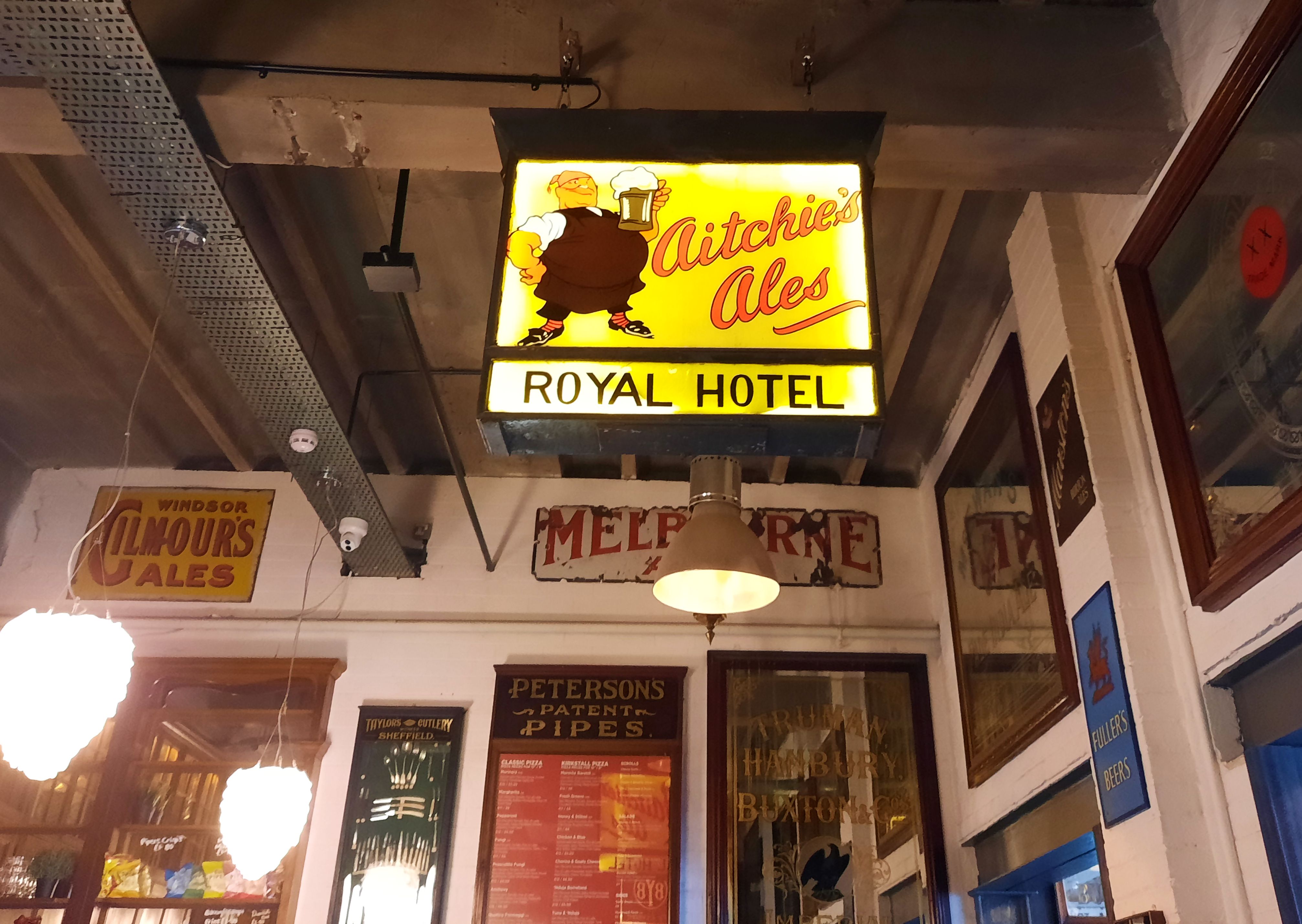
As I’m waiting for Stuart, I have a look around. The room is dead cool. With some amazing old advertising signs.

After a quick pint, Stuart shows me around the brewery. Which is full of the usual shiny things. Stuart mostly works on the older, smaller kit which was in the original premises in Kirkstall.

When we’re done, he gives me a lift to the Cardigan. The others have already moved on. I know that. But I’m not going to visit Leeds without a pint in the Cardigan, my former local. And one of my favourite pubs of all time. How many hours did I spend in the public bar?

I can’t hang around too long. Unlike in the old days. Though it’s reassuring to see how little it has changed. Only downside: no Tetley’s Mild.

When I drank here in the mid-1970s, the landlord was Irish. With several kids who took care of most of the bar-keeping duties. I’m guessing he mostly concerned himself with looking after the beer. Which was always in perfect condition. One of the most reliable pints in Leeds. When I had my Tetley’s Mild tastebuds fine-tuned. Up there with the Black Dog and Fisherman’s Hut in Cross Green.

I sit at the table me and Simon usually occupied. Next to it, that’s the one where the couple in their fifties used to sit. Pint of Mild for him, two halves for her. So many memories of this places. Though I forgot where the gents is.

I’m meeting up with the others in Whitelock's. Which means I need a taxi. Where the fuck do I get one? There’s a McDonalds over the road that seems to have some taxi activity. Let’s try there.

No luck. In desperation, I return to Kirkstall Road and, after a while, manage to flag down a cab.

“Whitelock's, please.”

“I’ll have to drop you on Park Row. Is that OK?”

I guess it will have to be. The alleyway where Whitelock's is located is off Briggate, a pedestrianised street. Which one is Park Row?

I don’t really recognise where I am when I get out. It’s been so long since I lived in Leeds. Where the fuck is Whitelock's from here? I wander in what I think is the right direction and spot signs for the Ship Inn. I know that’s off Briggate, too.

Yes! It’s just down here and on the right. What a clever boy I am. No, that was way scarier than it should have been. What a forgetful old git I am.

They’re here, which is good. And have seats, which is even better. You’ll understand if you’ve ever been held in Whitelock's incredibly narrow embrace. 

Relieved, I shovel down a pint. Not Younger’s No’3, unfortunately. That’s what I drank here back in the 1970s. When it was a rare free house in the city centre. As with many “free houses”, that meant some sort of tie to Scottish & Newcastle.

The kids look pleasantly surprised. Shocked, even, when I walk through the door.

“We thought we’d have to come looking for you.” Andrew says.

“We? I was going to let you make your own way back.” Alexei is very unforgiving.

They’re on cider again. I guess it’s a novelty for them. In Amsterdam, you only really get draught cider in Irish pubs.

Henry has already pissed off home. The lightweight.

As some of us are feeling the weight of hunger, we have one last stop before the train home: Bundobust. For some Indian street food. And beer, obviously. Handily, it’s on the way back to the station.

Dave orders some sort of combination vegetarian platter.

“What meat dishes do they have?” I ask, plaintively.

“It’s all vegetarian.” Dave says gleefully. The man who lasted a whole week as a vegetarian when he moved to Jamaica.

“Eat up, Dad. You’re always telling us to eat lots of vegetables.” Alexei says, helping to stick the boot in.

Fortunately, there’s some full-meat cask in addition to the evil keg offerings. That’s something. Though the prices are at near-Amsterdam levels.

We take a later train than planned. Dave had some crazy plan to head back around five. It’s half seven when we actually step onto a train. It’s getting on for nine when we stumble over Dave’s front door.

There’s still Dunkles. And the kids’ cider. Not finished my whisky, either.

We chill for a while in front of the TV. Then slowly peel off to bed. Dave first. Kids last. Me inbetween.


Friends of Ham
4-8 New Station St,
Leeds LS1 5DL.
https://friendsofham.com/


Kirkstall Brewery
100 Kirkstall Rd,
Leeds LS3 1HJ
Tel: 0113 898 0280
Email: info@kirkstallbrewery.com
https://www.kirkstallbrewery.com


Cardigan Arms
364 Kirkstall Rd,
Burley,
Leeds LS4 2HQ.
https://cardiganarms.co.uk/


Whitelock's Ale House
Turk's Head Yard,
Leeds LS1 6HB
https://whitelocksleeds.com/


Bundobust
6 Mill Hill,
Leeds,
LS1 5DQ,
Tel: 0113 243 1248
leeds@bundobust.com
https://bundobust.com/locations/leeds/
 

Saturday, 10 December 2022

Let's Brew - 1885 Kirkstall KKK

Strongest but one of Kirkstall’s beers was KKK. Which looks very much like a Stock or Old Ale version of the strongest Mild, XXX. Which is also what the name implies.

The grist and OG are very similar to XXX. The real difference being the hopping rate, which is 25% higher, at 10 lbs per quarter (336 lbs) of malt compared to 8 lbs. Which is exactly what you would expect for a beer meant to be aged longer.

Two malts, pale and brown, make up the grist. With double the quant5ity of the latter compared to XXX. Which means, even though there’s no caramel, the colour of KKK is slightly darker.

Three types of hops were employed: Bavarian from the 1884 harvest, and English from 1883 and 1884.

I’m pretty certain that KKK would have been aged, probably at least 12 months, possibly in a vat. Which would have left the FG lower than the one in the table. 

1885 Kirkstall KKK
pale malt 14.75 lb 91.73%
brown malt 1.33 lb 8.27%
Hallertau 150 mins 1.25 oz
Fuggles 150 mins 0.75 oz
Fuggles 60 mins 2.00 oz
Fuggles 30 mins 2.00 oz
Goldings dry hops 0.50 oz
OG 1069
FG 1017
ABV 6.88
Apparent attenuation 75.36%
IBU 62
SRM 11
Mash at 152º F
Sparge at 175º F
Boil time 150 minutes
pitching temp 58º F
Yeast Wyeast 1469 West Yorkshire Ale Timothy Taylor


Sunday, 23 October 2022

Kirkstall hops in 1885

Every beer contained at least three different types of hops. A couple had even four. Nothing unusual there. It was standard practice to use multiple types, both with base malt and hops. Presumably to minimise differences in flavour when stock of one ingredient ran out.

A majority of the hop types used – about two thirds – were English. Not many regions were specified, sadly. Three Sussex, two Farnham and one Kent. There’s a good chance that the ones where the origin wasn’t specified were also from those areas. None of the beers had all English hops.

Amongst the foreign hops, only Bavaria is specified as a source. One of the few areas outside the UK considered to have hops f a quality to rival the best English examples. The ones simply described as “foreign” probably came from less fashionable regions such as Belgium.

The 1880 Free Mash Tun Act the possibility opened the possibility of using hop substitutes. Something which not many took advantage of. Even Kirkstall didn’t show a great deal of enthusiasm, only using it in one of their beers. Not at all sure what Wylde’s was.  

Kirkstall hops in 1885
Beer Style hop 1 hop 2 hop 3 hop 4 hop 5
L Mild Bavarian 1884 Sussex 1884 Foreign 1884    
X Mild English 1883 English 1884 English 1884 Foreign 1884  
XXX Mild English 1884 Sussex 1884 Kent 1883 Foreign 1884  
AK Pale Ale Farnham 1884 English 1884 Bavarian 1883 English 1884 Wylde's hop substitute
BA Pale Ale Farnham 1884 Bavarian 1884 Sussex 1884    
PA Pale Ale Farnham 1884 Bavarian 1884 English 1883    
KKK Stock Ale Bavarian 1884 English 1883 English 1884    
IS Stout Bavarian 1884 English 1884 English 1884    
Source:
Kirkstall brewing record.

Thursday, 20 October 2022

Kirkstall grists in 1885

Moving on to the grists, they’re radically exciting for the late 19th century. In that they have more than base malts in beers other than Stout.  Brown malt – by this point unusual outside London – isn’t just in Kirkstall’s Stout, but also in two of the Milds and the Stock Ale.

Black malt also shows up in two of the Milds. In pretty small quantities, which are clearly for colour adjustments. As are the small amounts of caramel in a couple of the Milds and the Stout.

Sugar – the form of No. 2 invert – occurs in the weakest Mild and the Stout. While an unspecified type of sugar, Saccharine, is in two of the Pale Ales. What was it? Probably some form of invert.

What’s missing? Any form of adjunct. 1885 – just 5 years after the Free Mash Tun Act – is a little early. Most breweries took a few years to start taking advantage of the new rules.

Kirkstall grists in 1885
Beer Style OG pale malt brown malt black malt no. 2 sugar Sacch-arine caramel
L Mild 1049.6 80.73% 3.67% 0.92% 14.68%    
X Mild 1052.6 98.53%   1.23%     0.23%
XXX Mild 1066.2 95.43% 4.34%       0.23%
AK Pale Ale 1049.9 78.46%       21.54%  
BA Pale Ale 1055.4 100.00%          
PA Pale Ale 1060.9 85.71%       14.29%  
KKK Stock Ale 1069.3 90.91% 9.09%        
IS Stout 1071.7 66.42% 9.49% 6.33% 16.87%   0.90%
Source:
Kirkstall brewing record.


Friday, 7 October 2022

Kirkstall beers in 1885

It’s a sign of the increased popularity of Pale Ales that Kirkstall brewed three. The same as the number 0oof Mild Ales.

The brewery was a decant size, with a maximum brew length of around 150 barrels. Not quite in the same league as London or Burton. A decent size for Yorkshire, though. Where much of the beer was still brewed in pubs.

It’s a decent range, spanning eight beers in total. A Stock Ale and a Stout, in addition to the aforementioned Mild and Pale Ales. Or is that everything? An advert from a couple of years later lists three Stouts.

The Stout in the brewing records looks about the right strength for a an 18d per gallon beer. Were there other Stouts for which I have no brewing records, or did they water down some post-fermentation?

The BA and PA, which I assume were the 16d and 18d India Pale Ales in advert, seem a little overpriced for their gravity. But I guess that’s because their Pale Ales, which were often sold at a premium. While, at about 1050º, AK seems pretty good value at 12d per gallon.
It’s a shame KKK doesn’t show up in the price list. It was probably the same price as the strongest Stout, 18d per gallon.

Interesting that the hopping rate per quarter (336 lbs) of malt is highest in AK, the weakest Pale Ale. 25% more than its two stronger siblings. 

Kirkstall beers in 1885
Beer Style OG FG ABV App. Atten-uation lbs hops/ qtr hops lb/brl Pitch temp
L Mild 1049.6       5.03 1.07 58º
X Mild 1052.6 1013.3 5.20 74.74% 6.50 1.40 57.75º
XXX Mild 1066.2       8.00 2.22 57.5º
AK Pale Ale 1049.9       12.42 2.01 58º
BA Pale Ale 1055.4       10.00 2.33 58º
PA Pale Ale 1060.9       9.87 3.31 58º
KKK Stock Ale 1069.3       10.00 2.97 58º
IS Stout 1071.7       10.35 3.71 58º
Source:
Kirkstall brewing record.

1888 Kirkstall brewery advert
beer price per barrel (s) price per gallon (d)
East India Pale Ale 48 16
East India Pale Ale 54 18
AK Light Bitter Ale 36 12
Fine Mild Ale 36 12
Fine Mild Ale 42 14
Fine Mild Ale 48 16
Stout 42 14
Stout 48 16
Stout 54 18
Source:
Yorkshire Gazette - Saturday 30 June 1888, page 3


Wednesday, 5 October 2022

Let's Brew Wednesday - 1885 Kirkstall PA

Standing proudly at the top of the Pale Ale ladder is PA. It doesn’t take a genius to work out that it stands for Pale Ale. Yet I know that it was, at least sometimes, marketed as IPA. Those crazy old-timer brewers.

It looks to me like a classic Stock Pale Ale. Though, surprisingly, the hopping rate is lower than in AK, 10lbs per quarter (336 lbs) of malt compared to 12.5 lbs.

Unlike BA, there is sugar in the grist. Rather less than in AK, but still accounting for 14% of the fermentable material. For once, all the base malt is made from English barley. Quite unusual, that.

As usual, multiple hops were used: Farnham from the 1884 harvest, Bavarian from 1884 and English from 1883. That around two-thirds were Farnhams, the classiest and most expensive hops is an indication of how posh a beer this was.

Being a Stock Pale, it would have undergone a secondary fermentation of 12 months in trade casks.

1885 Kirkstall PA
pale malt 10.75 lb 86.00%
No. 1 invert sugar 1.75 lb 14.00%
Hallertau 120 mins 2.25 oz
Goldings 60 mins 2.25 oz
Goldings 30 mins 2.25 oz
Goldings dry hops 1.00 oz
OG 1061
FG 1016
ABV 5.95
Apparent attenuation 73.77%
IBU 82
SRM 7
Mash at 154º F
Sparge at 175º F
Boil time 120 minutes
pitching temp 58º F
Yeast Wyeast 1469 West Yorkshire Ale Timothy Taylor

Saturday, 1 October 2022

Let's Brew - 1885 Kirkstall BA

Next up the Pale Ale ladder is BA. Which probably stands for “Bitter Ale” A bit odd, as that doesn’t seem to be what it was marketed as. A price list from 1888 has AK and two “India Pale Ales”. Make of that what you will. I see it as a sign of the random use of the terms IPA and Pale Ale.

A difference of 5.5º in the gravity is about right for a price difference of 2d per gallon. But BA was 4d per gallon dearer than AK. Implying BA was sold at a premium. That might explain why it’s all-malt. Half from English, half from Californian barley.

No surprise that the hops are also classier than in AK. All were from the most recent season and there was no hop substitute. They were Farnham from the 1884 crop, English from 1884, and Sussex from 1884.

Was this a Stock Pale Ale? I’d say no. More likely a semi-Stock Pale Ale. Which means a relatively short secondary conditioning of, perhaps, three months.
 

1885 Kirkstall BA
pale malt 13.00 lb 100.00%
Fuggles 120 mins 1.75 oz
Goldings 60 mins 1.75 oz
Goldings 30 mins 1.75 oz
Goldings dry hops 0.50 oz
OG 1055.5
FG 1016
ABV 5.23
Apparent attenuation 71.17%
IBU 64
SRM 5
Mash at 150º F
Sparge at 175º F
Boil time 120 minutes
pitching temp 58º F
Yeast Wyeast 1469 West Yorkshire Ale Timothy Taylor


Wednesday, 28 September 2022

Let's Brew Wednesday - 1885 Kirkstall XXX

Here’s the strongest of Kirkstall’s Mild Ales, XXX. I get the definite impression some beers have been dropped. Why else jump straight from X to XXX?

In terms of strength, it’s around the same gravity as an XX Ale from a smaller London brewery, but well below that of one from a large London brewery. It’s a good bit weaker than the XXX Ale from Harvey, which was 1075º.

Brown malt is the unusual ingredient in the grist. It turns up occasionally in late 19th-century Milds, but was by no means common. Look back a page, and you’ll see that Kirkstall X was coloured with a little black malt. Why did they use brown malt here? The colour of the two beers ends up pretty similar.

No sugars or adjuncts are present, other than a little caramel. I wonder how long that lasted? I’d put money on both being present in Kirkstall’s beers by the time WW I rolled around.

Loads of different hops again: English 1884, Sussex 1884, Kent 1883 and Foreign 1884. I’ve guessed that the “foreign” were American.

1885 Kirkstall XXX
pale malt 14.75 lb 95.47%
brown malt 0.67 lb 4.34%
caramel 1000 SRM 0.03 lb 0.19%
Cluster 150 mins 0.50 oz
Fuggles 150 mins 1.00 oz
Fuggles 60 mins 1.50 oz
Goldings 30 mins 1.50 oz
Goldings dry hops 0.50 oz
OG 1066
FG 1017
ABV 6.48
Apparent attenuation 74.24%
IBU 55
SRM 10
Mash at 152º F
Sparge at 175º F
Boil time 165 minutes
pitching temp 57.5º F
Yeast Wyeast 1469 West Yorkshire Ale Timothy Taylor


Wednesday, 7 April 2021

Let's Brew Wednesday - 1885 Kirkstall AK

Another AK. And from another brewery whose beer I drank. Though by that time it was part of Whitbread and when it revived cask it did so under the brand BYB (Bentley’s Yorkshire Breweries), not Kirkstall. BYB, also taken over by Whitbread, had brewed at Woodlesford, just to the East of Leeds.

At 1050º, Kirkstall’s example of the style is at the top end of the gravity range. I’ve had to guess the FG, so it could have been either fuller or drier than the recipe shows.

The recipe is simplicity itself: just pale malt and sugar. I’ll be honest. I’ve no idea exactly what type of sugar it was. The brewing record says “Trier Maine Saccharine”. Given the quantity involved, it can’t be the artificial sweetener saccharine and must be some type of sugar. I’ve plumped for No. 1 invert.

One place where the recipe is complicated is the hopping. There are four types of hops - Farnham (1884), English (1884), English (1883) and English (1884) – plus 50 lbs of something described as “Wylde's hop substitute”. The last is very unusual. Hop substitutes were allowed after 1880, but I can’t remember seeing them in a brewing record. Only hop concentrates, and even those don’t turn up until 1944. 

1885 Kirkstall AK
pale malt 7.75 lb 77.50%
No. 1 invert sugar 2.25 lb 22.50%
Fuggles 195 mins 1.50 oz
Goldings 60 mins 1.50 oz
Goldings 30 mins 1.50 oz
Goldings dry hops 0.50 oz
OG 1050
FG 1012
ABV 5.03
Apparent attenuation 76.00%
IBU 60
SRM 7
Mash at 155º F
Sparge at 165º F
Boil time 195 minutes
pitching temp 65º F
Yeast Wyeast 1469 West Yorkshire Ale Timothy Taylor