Showing posts with label Berliner Weißbier. Show all posts

Tuesday, 26 July 2022

1980 DDR beer strength

The 1980 version of TGL 7764 doesn't list the alcohol content  of the beers. But, as it does give the OG and rate of attenuatio0n, it's pretty easy to work it out. Especially if, like me, you already have all the necessary calculations plugged into spreadsheet.

It's all much what you would expect. With Berliner Weisse around 3% ABV, Hell a bit over 4%, Pilsner around 5%, and Bock 6-6.5%. Compared to the West, the Hell and Weizenbier are slightly weaker. The other styles, however, are roughly in line with what occurred on the other side of the Inner German Border.

The bottom limit for Vollbier was lower in the DDR - in the West it was 11º Plato. A beer at the lower DDR limit of 10.5º Plato wouldn't have been allowed in West Germany, nor would extra. Beers weren't permitted to be brewed to gravities between the top limit for Schankbier (8º Plato) anf the lower limit for Volbier (11º Plato).

1980 DDR beer strength
Type min OG Plato max OG Plato app. Atten-uation min ABV max ABV
Dunkel (Einfachbier) 5.8 6.2 65 1.93 2.06
Weißbier 7 8 75 2.70 3.10
Extra 8.5 9.3 75 3.30 3.63
Hell 10.5 11 75 4.13 4.33
Edel-Bräu Hell 10.5 11 75 4.13 4.33
Dunkel (Vollbier) 10.5 11 75 4.13 4.33
Schwarzbier 11.7 12.3 70 4.32 4.56
Deutsches Pilsner 12 12.5 75 4.75 4.97
Deutsches Pilsator 12 12.5 78 4.94 5.16
Deutsches Pilsner Spezial 12 12.5 78 4.94 5.16
Märzen 13.7 14.3 70 5.11 5.36
Weizenbier 11.5 12 75 4.54 4.75
Weißer Bock or Bockbier Hell 15.7 16.3 75 6.35 6.61
Dunkler Bock or Bockbier Dunkel 15.7 16.3 72 6.10 6.35
Deutscher Porter 17.7 18.3 64 6.18 6.41
Source:
1980 TGL 7764, pages 9 - 10.


Monday, 25 July 2022

1980 DDR beer ingredients

We continue our trundle through the 1980 version of TGL 7764 with a look at the ingredients allowed.

The hopping specifications are very different owing to the introduction of hop extract.  Meaning that the hopping rate can't be given in gm/hl any more. Instead, active bitter substances are specified. Not really sure what that means. But at least the relative hopping rates are still obvious.

Several new ingredients have been added, notably amongst the adjuncts, where rice grits and maize grits have appeared. 

On the sour side, there much of interest. Dekkera bruxellensis - Brattanomyces to you and me - is specifically mentioned. Also, that it was only for Porter. Interestingly, no restriction was placed on the use of Lactobacillus. You would have thought that was only appropriate for Berliner Weisse.

What was lactic acid being used for? Was it as a souring shortcut for Berliner Weisse? Or did it have some other use?

Berliner Weisse had to have a minimum of 30% wheat malt. While Weizenbier had to include at least 20%.

1980 DDR beer ingredients
Category Type kg malt per hl Hops, hop extract expressed in active bitter substances g/hl
Alkoholfreies Bier Aubi 11 9
Einfachbier Dunkel 9 1.9
Schankbier Weißbier 11.5 4.2
Vollbier Extra 14.5 9.7
  Hell 16.2 8.5
  Edel-Bräu Hell 17.2 8.5
  Dunkel 17.2 8.5
  Doppe1-KarameIbier 10.5 1.8
  Schwarzbier 19 10
  Deutsches Pilsner 19.2 11.5
  Diabetiker-Pils 18 15
  Deutsches Pilsator 19.2 16
  Deutsches Pilsner Spezial 20.2 16
  Märzen 24 10
  Weizenbier 18 4.5
Starkbier Weißer Bock or Bockbier Hell 26 8
  Dunkler Bock or Bockbier Dunkel  26 8
  Deutscher Porter 34 22
Source:
1980 TGL 7764, page 2.

Here's the full list of permitted ingredients.

4. RAW MATERIALS AND ADDITIVES
All raw materials and additives must comply with food law regulations,
Brewing malt according to TGL 17756
Hops for brewing according to TGL 26778/01
Hop extract according to TGL 34097
Unmalted barley according to TGL 25709/01
Rice grits for brewing according to TGL 23219
Sugar (sucrose) according to TGL 3070/01
Caramel according to TGL 36604
caramel
maize grits
Saccharin according to the 2nd pharmacopoeia of the GDR (2nd AB - GDR)
brewing water

Fermentation organisms:
Saccharomyces uvarum (carlsbergensis)
Saccharomyces cerevisiae
Dekkera bruxellensis
Lactobacterium delbrückii 

Enzyme preparations:
Brewery enzyme according to TGL 29166/01
amylases
proteases
ß-glucanases

Organic acids:
Lactic acid according to TGL 24132
Adipic acid according to TGL 6964

Salts
Calcium chloride according to 2. AB - DDR
Calcium sulphate according to 2. AB - DDR
Cooking salt B according to TGL 21020/03
or rock salt according to TGL 21020/02

Stabilizing agent
tannin
silica gel preparations
tannin adsorbents
pepsin concentrate
papain
1-ascorbic acid according to TGL 20130
bentonites
1980 TGL 7764, pages 2 - 3.


Tuesday, 12 July 2022

1960 DDR shelf life of beers

As you've probably already guessed, we're back with good old TGL 7764. The 1960 version.

I am planning to do a compare and contrast with the 1980 version. Which will be fun, as the beer styles changed quite a bit.

Now, you might be rather shocked by just how short the shelf life was of most types of beer. For the weakest, not much more than a week. Even a beer as strong as Porter was good for less than a month.

This might seem far too short a time to be practical. But, most beer was sold quite close to the brewery. And stuff like beer didn't hang around in the shops very long. I can remember well the instability of Eisenach Hell. You wouldn't want to hang around too much on your way back from the shop in case it had gone off by the time you got home.

Why were they so unstable? Because they weren't pasteurised and only rough filtered. Leave a bottle a couple of weeks and it would start to throw a sediment.

Two exceptions were Doppel-Caramel and Malznährbier. Because of the large quantity of unfermented sugars in these types, leaving them unpasteurised would have been extremely dangerous, likely leading to bottle bombs.

Way out in front in terms of longevity was Berliner Weisse. For the simple reason that it was bottle-conditioned.

1960 DDR shelf life of beers in days at 20 °C
Beer type Days Features
Einfachbier Dunkel 9 Without sediment and turbidity of biological or chemical-physical origin. Likewise, taste impairments are not permitted.
Malzbier 9
Eiriachbier Hell 9
Vollbier Hell 12
Vollbier Dunkel 12
Köstritzer Schwarzbier 15
Deutsches Pilsner 15
Weisser Bock Oder Bockbier Hell 15
Dunkler Bock Oder Bockbier Dunkel 15
Deutsches Porter 24
Doppel-Caramelmalzbier 90 Pasteurized. A deposit of yeast cells inactivated by pasteurization may be present, turbidity and impairment of taste due to the action of active microorganisms is not permitted.
Malznährbier 90
Weissbier 270 Turbidity and sediment caused by microorganisms specific to the beer type may be present. Changes in viscosity and consistency caused by microorganisms are not permitted, as are impairments of taste.
Source:
1960 TGL7764 page 5.

Just one more post from 1960 and then we'll be onto 1980.

Monday, 11 July 2022

1960 DDR beer ingredients (part two)

A little more on the ingredients in East German beers.

One massive difference with West Germany was the absence of a Reinheitsgebot in the DDR. But it should be remembered that it had never been in force very long in this part of Germany. The law was only applied to the whole of Germany in 1906. Take out the two World Wars and you're only left with around 30 years.

Which doesn't mean all sorts of wacky ingredients were allowed. As we've already seen, sugar was only allowed in one type of beer, Doppel-Caramel. The non-Reinheitsgebot compliance was mostlu manifested through the use of unmalted grain.

"The barley rate refers to the exclusive use of barley malt. When using raw grain, this should be compared with the average amount of air-dried extract. The normal values ​​for the air-dry extract are 75% malt, 80% rice and 65% barley. This results in the following application factors:

Rice 0.94 = 94% of the replaced amount of malt
Barley 1.15 = 115% of the replaced amount of malt.

Up to 25% of brewing malt can be replaced by raw grain, whereby the proportion is determined by instructions from the state planning commission. Rice or a milled product made from barley is understood as raw grain.

The composition of the barley brewing malts is left up to the manufacturer. Wheat malt must be used for Weissbier.

Water must comply with the requirements of § 2 of the regulation on the treatment of foodstuffs in the food trade of August 25th, 1956 (GBL.I, 1956, page 780). The manufacturer is free to decide how much cultured beer yeast to add according to the type of beer.

In the case of "Deutsches Porter", in addition to cultured beer yeast, Saccharomyces Brettanomyces is also permitted, for wheat beer, a type of cultured beer yeast and the bacterium Delbruckii. Biological acidification - mash or wort - with bacterium Delbruckii is permitted."
1960 TGL 7764, page 2.

Important there is the "Up to 25%". From evidence I've seen from a specific small brewery, it was usually no more than 20%. In posh styles like Pilsator, less than that. And a few beers intended for export - such as Wernesgrüner and Radeberger - were brewed all-malt.

I found the grains used slightly surprising. Well, one of them: rice. Which seems a bit exotic to me. Though, quickly polling a former DDR citizen (Dolores) revealed that rice was always available in the shops. She has no idea where it came from.

The final paragraph is dead interesting. Confirming the use of Brettanomyces in Porter and Lactobacillus delbruckii in Berlier Weisse. The latter also had to include wheat malt, which wasn't the case in West Berlin. 

Almost forgot. Souring of the "mash or wort". That sounds like like souring and fermentation souring. Very interesting that kettle souring was specifically allowed.

Thursday, 30 June 2022

Berliner Weisse today

I’m going to limit myself here to versions brewed in Berlin. Yes, I know many, quite possibly hundreds, are brewed in the USA, to varying degrees of authenticity. But I’m going to stick to those brewed in the style’s home city.

Berliner Weisse is the best-known German sour beer, which is somewhat ironic given that it’s virtually extinct in its home city. There’s currently only one example really brewed on a large scale: Kindl. And that’s crap.

In 2010 just 10,180 hl of Berliner Weisse were sold in the off trade , meaning total output couldn’t have been more than 20,000 or 25,000 hl.

In the late 1980’s there had been three different Berliner Weisses brewed: East Berlin Schultheiss, West Berlin Schultheiss and West Berlin Kindl. First West Berlin Kindl bought East Berlin Schultheiss and closed it. Then West Berlin Schultheiss and Kindl merged and the Schultheiss Berliner Weisse was dropped. Which was really annoying because the Kindl was by far the worse of the two.

But . . . there are more authentic versions being brewed, albeit on a fairly small scale. Better than nothing, I say.


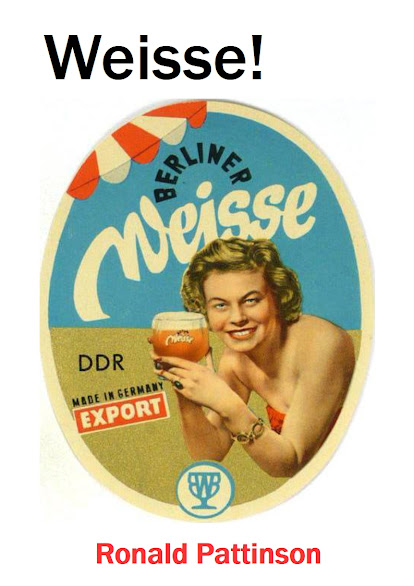
That was an extract from my recently published book on Berliner Weisse, "Weisse!"

 Buy your copy now!


Wednesday, 29 June 2022

Let's Brew wednesday - 1907 Berliner Weisse (Schankbier)

To celebrate the publication of my book about Berliner Weisse, here's one of the recipes from it.

This recipe is based on a description in "Die Fabrikation obergäriger Biere in Praxis und Theorie" by Grennell.

The book describes four different ways of brewing Berliner Weisse, this is method II. It differs considerably from Schönfeld’s procedure. For a start, half of the wort is boiled during the decoction. The hops were added during the decoction rather than to the mashing water.

As always, some time secondary conditioning is required to bring out the required Brttanomyces character. A minimum of four weeks, longer if you like your beer with more bite and funk.

1907 Berliner Weisse (Schankbier)
wheat malt 5.25 lb 75.00%
lager malt 1.75 lb 25.00%
Hallertau 30 mins 0.50 oz
OG 1032
FG 1007
ABV 3.31
Apparent attenuation 78.13%
IBU 5.5
SRM 2.5
acidity (pH) 3.63 to 3.73 
Mash single decoction  
Boil time 30 minutes
pitching temp 60º F
Yeast Wyeast 2565 Kölsch
lactobacillus delbruckii
Brettanomyces bruxellensis


 Buy your copy now!

Tuesday, 28 June 2022

Weisse! has just been published

Yes, after a couple of weeks of not really all that intensive work it's done. My book about Berliner Weisse is finished and published.

99 pages of Berliner Weisse fun, tracing the history of the style from the 18th century to today. Including a look at Weisse from both sides of the Berlin wall. As an extra special bonus there are 19 historic recipes hand crafted by me.

It's easily the best book in English about Berliner Weisse*

 Buy your copy now!

 * I'm pretty sure it's the only one.

Monday, 27 June 2022

Brewing Berliner Weisse between the wars

The Berliner Weisse book is coming along nicely. I just need to finish off the recipes and write the section on the current situation

I've learnt quite a bit. Enough to change my opinions on some topics. Or at least have a more nuanced approach. The level of sourness being a big one. You'll need to buy the book if you want to learn all the details.

In the meantime, here's  a description of the brewing process at one Berlin brewery between the was.

In the kettle, the malt was doughed in with water at 30º C. The temperature was slowly raised to 53º-54º C where it was held for 30 minutes for a protein rest.

The temperature was raised to 75º C by which time saccharification should have occurred.

A third of the wort was transferred to the lauter tun and the remainder of the wort in the kettle brought to the boil. 

After boiling for 30 minutes, it was mixed with the other third of the wort in the lauter tun, making sure the temperature didn’t exceed 76º C. The mixture was left to stand for 40 minutes before running off.

The clear wort was returned to the kettle and brought to 95º C for 15 to 20 minutes. Then immediately cooled to 18º C.

The wort was pitched at 16º C and after four days the temperature rose to 20º C. When it had dropped back down to 16º C, primary fermentation was done. 

1º to 1.25º Plato gravity needed to be left for bottle conditioning. If not, Frischbier needed to be added to raise the gravity to the required level.
"Die Herstellung obergärige Biere und die Malzbierbrauerei Groterjan A.G. in Berlin" by A. Dörfel, 1947 pages 12 - 14.


Sunday, 26 June 2022

Berliner Weisse in the 1880s and 1890s

The internet is wonderful for research. Sometimes you come across wonderful information in the oddest of places. Like the stuff that follows.

I found it in a book about the architecture of Berlin. There's a section on breweries which has some dead useful information. For me, at least.

In the late 1880s and early 1890s, around two thirds of Berlin’s breweries were top fermenting, but they only produced one third of the beer. The table below lists all top-fermenting breweries which did not all necessarily brew Weissbier.

Intriguing that more new top-fermenting breweries were arriving than bottom-fermenting ones: 27 compared to 8. Though that’s probably due to Lager breweries operating on a larger scale and requiring more capital to set up.

It’s hard to see any trends in the production figures.

Remember that there were several other top-fermenting styles in Berlin: Braunbier, Porter, Bitterbier. The quantity of Weissbier brewed was lower than the number in the table, which is for all types of top-fermented beer.

There’s no discernible shift from top to bottom fermenting that I can see. The proportion is always around one third to two thirds. Though it’s clear that the bottom-fermenting breweries were on a larger scale.

The difference in scale only became larger over time.

The average output of a top-fermenting brewery remained rooted at 20,000 hl. While that of bottom-fermenting breweries increased by more than 50%.

Number of Berlin breweries 1872 - 1894
Year Bottom fermenting Top fermenting Total
1872 21 43.75% 27 56.25% 48
1888/89 26 36.62% 45 63.38% 71
1889/90 26 34.67% 49 65.33% 75
1890/91 27 36.00% 48 64.00% 75
1891/92 27 35.53% 49 64.47% 76
1892/93 29 38.16% 47 61.84% 76
1893/94 29 34.94% 54 65.06% 83
Source:
Berlin und seine Bauten, Architecten-Verein zu Berlin, Wilhelm Ernst & Sohn, Berlin, 1896, page 648.


Output of Berlin breweries 1872 - 1894
Year Bottom fermenting Top fermenting Total
1872         898,049 62.89%        530,000 37.11%     1,428,049
1888/89      1,858,530 64.21%     1,036,058 35.79%     2,894,588
1889/90      1,891,693 63.95%     1,066,378 36.05%     2,958,071
1890/91      1,939,023 64.66%     1,060,001 35.34%     2,999,024
1891/92      1,936,987 67.62%        927,678 32.38%     2,864,665
1892/93      2,116,979 67.95%        998,661 32.05%     3,115,640
1893/94      1,988,179 63.87%     1,124,491 36.13%     3,112,670
Source:
Berlin und seine Bauten, Architecten-Verein zu Berlin, Wilhelm Ernst & Sohn, Berlin, 1896, page 648.


Average output of Berlin breweries 1872 - 1894
Year Bottom fermenting Top fermenting
1872           42,764           19,630
1888/89           71,482           23,024
1889/90           72,757           21,763
1890/91           71,816           22,083
1891/92           71,740           18,932
1892/93           72,999           21,248
1893/94           68,558           20,824
Source:
Berlin und seine Bauten, Architecten-Verein zu Berlin, Wilhelm Ernst & Sohn, Berlin, 1896, page 648.


Saturday, 25 June 2022

Let's Brew - 1834 Berliner Weisse

This is based on the description in Johann Heinrich Moritz Poppe ‘s "Die Bierbrauerei auf der höchsten Stufe der jetzigen Vervollkommnung"

I’ve had to make a few guesses. Such as the OG and FG. Which I’ve based on the ingredients and analyses. I could be wrong.

What I am certain about is the proportion of wheat and barley malt. Which was three to one. Though I wouldn’t be surprised if it varied from brewery to brewery

Altmark hops were specified. I don’t think they exist anymore. So, I’ve plumped for Hallertau. Given the low level of bitterness, it probably doesn’t matter so much which type of hops you use.

How sour should it be? That probably depends on how long you age it. Bottle-conditioning for at least a couple of weeks is the way to go.

1834 Berliner Weisse
smoked wheat malt 7.50 lb 75.00%
lager malt 2.50 lb 25.00%
Hallertau 15 mins 1.25 oz
OG 1045
FG 1021
ABV 3.18
Apparent attenuation 53.33%
IBU 13
SRM 3
Mash single decoction  
Boil time 15 minutes
pitching temp 66º F
Yeast Wyeast 2565 Kölsch
Lactobacillus clausenii
Brettanomyces clausenii


action temperature time (minutes)
Mashed in 100º F 30
first rest 133º F 30
deoction with hops   15
mash out 167º F  


Friday, 24 June 2022

Another way of mashing Berliner Weisse in 1845

Here's the method recommended Gumbinner. It's main point of difference is the absence of a decoction. Something Gumbinner seemed to have a particular aversion to.

He was keen that Berlin brewers adapted his method, which he claimed produced a better and more stable beer, so they could see off the threat of Bavarian beer, i.e. Lager. He can't have had much success, as Berlin brewers were still decocting their Berliner Weiss 150 years later.

Mash in 2,887.5 kg wheat malt and 412.5 kg barley malt with 2,404.5 litres of water at 45º to 50º C.

While the water and malt were being mixed, water was brought to the boil in the kettle. This was slowly mixed into the grains in the mash tun, every five minutes adding more water. The temperature was taken regularly to see if the mixture had reached 65º to 67.5º C, which should occur when almost all the water from the kettle. In total, 3,206 litres of boiling water.

In winter, the mash was left to stand for 30 minutes, covered. In summer, 60 minutes, uncovered.

The mash tun was tapped and, when the wort began to run clear, it was pumped to the kettle. When the kettle was half full, between 122 gm and 176 gm of hops per 55 kg of malt were added. By the time it came to the boil, the kettle was full.

The wort was boiled for 20 to 30 minutes, then was filtered through a hop basket into the cooler.

More water (3,206 litres) was brought to the boil and slowly mixed with the grains. When all the boiling water had been added, the mash should be at 63.75º to 65º C. It was stood for 30 minutes in summer, 60 in winter.

It was drawn off and boiled in the same way as the first wort, that is, for 20 to 30 minutes. After which it went to the cooler. 

Recommended was to have two coolers allowing both worts to be cooled at the same time and blended together when the yeast was pitched. Though in winter, you could just throw the second wort into the cooler with the first wort.

There was a third charge of cold water, stood for 30 to 60 minutes, for Kovent.
"Handbuch der praktischen Bierbrauerei" by Dr. Julius Ludwig Gumbinner, 1845, pages 234 - 237.

All this and much more, will be in my book "Weisse!", which should be available soon. I just need to finish writing it.

Tuesday, 21 June 2022

Cooling and fermenting Berliner Weisse in 1845

I've started the week a fun way - reading my way through an old German brewing text. It's so much fun. Really.

We've bot past the mashing section and are now looking at the remainder of the process. This time there are some temperatures given. Even though the brewery in question didn't seem to believe in them, relying instead on the ever-so-reliable finger method.

After standing, the wort began to be drawn off. At first the tap was only opened a little and the wort returned to the top of the filter tub until it began to run clear. The tap was then opened wide and the wort run off into the grant and from there pumped to the cooler. When the wort started to become cloudy again the tap was closed.

Meanwhile the kettle had been refilled with water and brought to the boil. This was now poured over the grain bed in the filter tun. This was left to stand without being touched for around 30 minutes.

The kettle had meanwhile been refilled and brought to the boil again. The boiling water was added to the filter tub and left to stand for another 30 minutes.

The first wort was now returned from the cooler to the cleaned mash tun and the second wort transferred to the cooler.

When the first wort reached a temperature of 27.5º to 30º C, some of it was drawn off and mixed with yeast. The yeast mostly came from a previous brew, but twice in the week yeast shipped from Cottbus was used.

After about an hour this wort started to ferment and it was mixed with the first wort in the mash tun, which was now about 22.5º C.

When fermentation of the first wort had kicked off, after 6 to 8 hours, the second wort was added. This new mix started to ferment after around an hour. It was then filled into barrels and immediately shipped out to publicans. 

What little fermenting wort remained was transferred to barrels in the fermentation cellar. Fermentation was completed in 18 to 20 hours.

A third addition of cold water was poured over the grain bed and left to stand for between 30 and 60 minutes. This was drawn off, pitched with yeast and sold to the poorer classes as Koventbier. Fermentation was completed in their home. To make it more palatable, it was often mixed with some strong Weisse before bottling.
"Handbuch der praktischen Bierbrauerei" by Dr. Julius Ludwig Gumbinner, 1845, pages 225 - 230.

Once again, the wort was pitched in the mash tun. Note that the majority of even the primary fermentation was performed by publicans. Only a small amount was fermented in the brewery itself.

Sunday, 19 June 2022

Mashing Berliner Weisse in 1845


We're back with Berliner Weisse again. With yet another description of the brewing process.

 It's quite different from another description I have from just a couple of years earlier. Why is that? Because every brewery seemed to have their own process. This is just a description of one of them.

It's quite a complicated mashing scheme with three decoctions.All of the thick mash.

Seven parts wheat malt to one part barley malt was used. The malt having been dried on an English style malt kiln using indirect heat at a low temperature to keep the colour as pale as possible. The brewery whose process was being described kept their malt for at least a year before brewing with it.

The kettle was filled with water, once it had been brought to the boil, it was transferred to the mash tun. Cold water was added until the mixture was lukewarm. The brewer judged when the correct temperature had been reached with his finger.

The grain was added to the mash tun and mixed with the water for around 30 minutes until it had a smooth, even consistency.

The kettle was refilled while the mash was being stirred and when it had boiled was gradually added to the mash tub. The mixture was stirred with mash paddles until the consistency was even.

The mash was left to rest for 30 to 45 minutes while another lot of water came to the boil in the kettle. This was gradually mixed into the mash, except for around 20%, which was left in the kettle.

Between 122 gm and 176 gm of hops per 55 kg of malt were added to the water left in the kettle and boiled for around 10 minutes.

Some of the mash was transferred to the kettle and brought to the boil. When it started to boil, more mash was added. This was boiled for around 10 minutes.

The boiled mash and hops was mixed back into the main mash in the mash tun. After a good mix, some mash was transferred back to the kettle and brought to a boil again.

This second decoction was returned to the mash tun and mixed in. After which, some more mash was moved to the kettle and boiled.

After boiling it was transferred to the filter tub at the same time as the main mash and the two were mixed. Meaning mashing out happened here and not in the mash tun.
"Handbuch der praktischen Bierbrauerei" by Dr. Julius Ludwig Gumbinner, 1845, pages 217 - 225.

Once again, mash out was in the filter tub rather than the mash tun.


Friday, 10 June 2022

The triumph of Lager

I came across some dead handy information about the spread of Lager to North Germany. I had thought that it only really kicked off in the second half of the 19th century. It seems I was out by several decades.

By 1845, Lager (in the quotes called "Bavarian beer") was already popular in Berlin and breweries had been set up to produce it in the Prussian capital.

"It is absolutely and undeniably certain that the brewing of beer is a chemical process of such robustness that one can always produce the same product with the same material. This truth and the importance of the established scientific rules are well known in England and Bavaria, and all breweries of some importance are subject to them. On the other hand, in Prussia, where distilling has risen so completely on the basis of chemistry, brewing has still been carried on in a sorry and careless manner. This alone is the reason why we have not, so far, despite all the attempts made, been able to produce Bavarian beer - which is so universally valued for its advantages - which is the equal, either in terms of taste and quality, or in terms of durability, strength and price, of that from Bavaria. Many Bavarian breweries were established in Berlin and elsewhere; but they are far from doing the right thing. Every admirer knows how to distinguish genuine Bavarian beer from Berlin, so that the latter begins to fall more and more into discredit and many an entrepreneur is threatened with his downfall if he does not decide to accept those basic kegs. So it is with imitation English beers. Instead of sticking to the point, people think they can produce the same product by using all sorts of additives, to which they never resort in England, but results shows how badly they were mistaken."
"Handbuch der praktischen Bierbrauerei" by Dr. Julius Ludwig Gumbinner, 1845, pages 128 - 129.


I wonder why they couldn't get Lager right in Berlin? Was it the brewing process? The ingredients? Lagering? It's impossible to say without more details.

What were the additives used to mimic English beers? Obviously, English brewers couldn't use the. Not unless they fancied a spell in jail. I'm guessing that English beers had arrived in Berlin before those from Bavaria.

The new-fangled beer from Bavaria was, like any invasive species, already driving natives to extinction:

"It will therefore do you good to look around for the means that can help the art of brewing, which has fallen so much in northern Germany. Foreign beverages have supplanted older domestic products because they taste better and in some cases are healthier, when the price has not been taken into account. Many types have disappeared completely, others are only in very insignificant demand, and if you want to exclude Berliner Weissbier, for example, its conspicuous peculiarity assigns it an independent position, Bavarian beer has triumphed over all others. From this it is clear that one must focus on its production and in such a way that one produces a cheap domestic product for the masses of the people who, because of the high price, have until now only had to rely on imitations. Some of the material used for these imitations is just as good as in Bavaria; and it can only be due to the company and the lagering if an equally good product does not come to light."
"Handbuch der praktischen Bierbrauerei" by Dr. Julius Ludwig Gumbinner, 1845, page 132. 

Ironic that Berliner Weisse is mentioned as an exception to the slumping popularity of older styles. Given its now very tenuous existence.


Tuesday, 7 June 2022

Brewing Berliner Weisse in the 1840s

The proportions of wheat and barley malt varied through time. At this point, the quantity of wheat malt was higher than usual.

There’s a fairly brief description of how Berliner Weisse was brewed in a book published in 1842.

Berliner Weisse was brewed from 5 parts wheat malt to one part barley malt. 

The malt was mashed in with water at 35º C, 35.35 litres per 55 kg of malt. Another 80 litres of boiling water were added to the mash and mixed in. 

Some of the thin mash was transferred to the kettle and brought to a boil with 0.234 kg of Altmark hops per 55 kg of malt. The hops had been soaked in water or very thin mash for 30 minutes beforehand. 

The boiled mash was returned to the mash tun, raising the temperature to 72.5º C. The mash was left to stand for 30 minutes, then pumped to the cooler.

45.8 to 57.25 litres per 66 kg of malt of boiling water were poured over the goods in the mash tun to form the second wort. This was mixed with the first wort and when, the temperature had fallen to 18.75º C, yeast was pitched. The next day the beer was already delivered to pubs. 

The author makes this interesting comment about wheat beers in general:

"all wheat beers, especially in the summer, easily turn sour and sometimes even sour during the brewing process." 

And, finally, there’s a mention of smoke. Zimmermann recommends that those still using an old-fashioned smoke kiln should use dry oak, beech or coke as fuel, as these gave off relatively little smoke.