Showing posts with label van Vollenhoven's Stout. Show all posts

Wednesday, 1 September 2021

Let's Brew Wednesday - 1956 Heineken (van Vollenhoven's) Stout

Just for a change, here’s another Heineken Stout recipe. This time, it’s one with the standard production grist. Rather than the weird one with mild malt and roast barley.

As this comes from one of the detailed pilot brewery records, I’ve exact details about the process. Which is always nice.  But let’s kick off with the grist.

Many of the elements are the same as in their dark Lagers: caramel mout, kleur mout and “donker”, which I assume means dark Munich malt. Though there’s quite a bit more roasted malt than you’d find in the Lagers. There’s also a bit of sugar which was added in the copper.  I’ve no idea what it specifically was. But I do know that they had played around with CDM (caramelised malto-dextrose) so I’ve plumped for something dark, in the form of No. 3 invert.

There was just a single type of hops: Saaz from the 1953 harvest. Quite a lot of them. And, unlike with their Lagers, more were added at the start of the boil rather than at the end.

The beer was lagered for three weeks. In the tank there was a bag with half a kilo of hops per hectolitre. Which is an awful lot.  More than I can recall ever seeing in a British Stout.

I’m pretty sure this was marketed as van Vollenhoven’s Stout. A beer originally produced by one of Heineken’s Amsterdam rivals which they took over and closed in the 1940s.

1956 Heineken Stout
Munich malt 20 L 6.50 lb 40.00%
pilsner malt 3.50 lb 21.54%
crystal malt 60 L 3.75 lb 23.08%
carafa III 1.00 lb 6.15%
No. 3 invert sugar 1.50 lb 9.23%
Saaz 150 mins 2.50 oz
Saaz 90 mins 1.75 oz
Saaz 30 mins 1.50 oz
Saaz dry hops 4.00 oz
OG 1073
FG 1018
ABV 7.28
Apparent attenuation 75.34%
IBU 56
SRM 45
Mash at 122º F
Raise to 154º F
Sparge at 167º F
Boil time 150 minutes
pitching temp 54º F
Yeast Wyeast 1099 Whitbread ale

Wednesday, 9 February 2011

Dutch Ale

Do Continental Ales exist? A question I often ask myself in idle moments. It beats staring out of the window blankly. But only just.

Fairness is important. Especially when you find stuff that doesn't fit your theories. (I had considered destroying the evidence but what with the internet and Google Books, that's a hopeless task.)

In that spirit, here's proof that some Continental beers were considered Ale:

Het Nieuws van den Dag, 5th April 1884


The price hierarchy there says a lot. Top of the tree are Bass Pale Ale and Extra Stout at 30 cents a bottle. Next Vollenhoven's Extra Stout at 25 cents.

Beierische Bieren. That's a general name for bottom-fermenting beer. Heineken, Amstel and Pilsener. Not sure what any of those exactly is. But at 17 and 18 cents, they're a good bit cheaper than the posh top-fermenters.

The last lot are a funny bunch. Gerstenbier and Princessen Bier are Dutch types. Not sure if they are top- or bottom-fermenters. For the more price-conscious drinker. It would help if I knew the relationship between a Kruik, a Flesch and a halve Liter.

Sunday, 12 September 2010

Help Martyn Cornell weekend

It's help Martyn Cornell weekend here at SUABP. Here's another oldDutch advert supporting his assertion that Burton Ale isn't Pale Ale.

Take a look at this:


Het Nieuws van den dag, 3rd June 1891.

See there at the bottom? Four beers from Bass, including Pale and Burton Ale. Clearly Bass didn't see them as the same thing. And, at 20 cents a bottle, Burton was more expensive than Pale Ale.

Coincidentally, a good snapshot of Heineken's products before they became a Pils-only (just about) brewer. Beijersch was a dark Lager, in case you're wondering. Intirguing that Van Vollenhoven brewed two Stouts.

Here's another slightly earlier advert, with India Pale Ale and Burton Ale clearly differentiated:

Dagblad van Zuidholland en 's Gravenhage, 10th December 1868.

Can we agree Burton Ale and Pale Ale or IPA were completely different types of beer, that just happened to both be brewed in Burton?

Friday, 18 June 2010

Warning.

Time for more advert fun. At least time for another advert. Not sure if there's much fun involved.

Take a look:


Here's what it says in English:

WARNING.
It has be shown to the undersigned that Company of J.A. OF OLFSEN, agent of the firm Van Vollenhoven & Co.., Amsterdam, living here, Haringvliet No. 83, sold its Van Vollenhoven's STOUT as DELI-EXTRA STOUT. Therefore, everyone in his own interest is warned that Deli Extra Stout has never been purchased by the company JA VAN OLFEN from the undersigned of Deli Brewery.

DELI-EXTRA STOUT, which according to Chemical Report excells over Van Vollenhoven's and BASS & Co.'s. Stout, can be obtained at major grocers, bottlers, Hotels and Cafes as well as from the Principal Agent

C.J.F DE VOS,
70 Goudschestraat,
Rotterdam

Chemical Reports are sent free on request."
Source: Het nieuws van den dag : kleine courant 25-08-1890
"That's a bit mean." Was Dolores's reaction to the advert. But there were a lot of counterfeit goods around. And companies had to protect their brands.

Funny thing is, though, I always thought Van Vollenhoven's Stout was the most highly-regarded.

Tuesday, 15 June 2010

Vollenhoven's Stout

Van Vollenhoven's Stout increases the nutritional value of the meal without you noticing.

Moreover, van Vollenhoven Stout is a contrast with various dishes, making meat and vegetables taste better. Van Vollenhoven's Stout is a drink,that has had  a well-deserved reputation for more than fifty years .

Order, on a trial basis, three bottles from your dealer and try from tomorrow Van Vollenhoven's Stout as a table beverage.

You will remain in Van Vollenhoven's Stout is "healthy glass.

Het Centrum 06-04-1927


Van Vollenhoven's Stout verhoogt de voedingswaarde van den maaltijd zonder dat ge er aan denkt.

Bovendien vormt van Vollenhoven's Stout een zeker contrast met de diverse gerechten, zodat het vlees en de groenten U beter smaken. Van Vollenhoven's Stout is een drank, die meer dan vijftig jaar een welverdiende reputatie geniet.

Bestel bij wijze van proef eens een drietal flesjes bij Uw handelaar en neem van morgen af een proef met Van Vollenhoven's Stout als tafeldrank.

U zult er bij blijven, Van Vollenhoven's Stout is "gezond met glazen".


Het Centrum 06-04-1927

Saturday, 12 June 2010

Beers!

Time for another old advert. I love these things. Tell you what was in the shops at the time. That type of stuff.

Here it is. I love the title: Beers.

Source: Het nieuws van den dag  11-02-1884


This is what it says, for the giving-a-crapply-challenged:

Bass Extra Stout and Pale Ale 15
Vollenhoven's Extra Stout 12.5
Corman's Stout 12.5c per half bottle
Noorsch Stout 25
Noordsch Ale 22.5 per whole bottle
Erlanger, Münchener 22.5 per whole bottle
Dortmunder 15 per whole bottle, 11 c per half bottle
Beiersch diverse 17
Pilsener 18 per whole bottle
Hollandsche Ale De Haan 8.5 c  per half bottle
Maastrichts Bier prima 10 c per whole bottle

Note the rather modest role played by pale Lager. Beiersch usually meant a dark Lager. Plenty of Ales and Stouts in there. Both domestic and imported.

Monday, 7 June 2010

Stout Drinkers!

They've just made 400 years worth of Dutch newspapers available online. The first word I searched for? Stout.

This was hit number two.


I don't want to incur Tandleman's wrath again, so here's a translation:

STOUT DRINKERS!
Why is an incorrect opinion often expressed about one Stout or another? Because in most cases it is not properly treated or delivered without being properly matured. The extra-Stout, as of the Brewery, has little flavor and is very insipid. Tapping (new system), the right length of maturation  and the good treatment are certainly key requirements for making Stout tasty and invigorating. Artificial methods, used to make it quickly foamy, cannot give the beer the same full and vigorous taste, it gets from maturing.

The well-matured Stout from any Brewery, the assessment is left to consumers, is more of a tonic for anemia than anything else.

Largest turnover of Vollenhoven's Extra-Stout.

VOLLH. Extra Stout 12.5 Ct.
DELI Extra Stout 12.5 Ct.
Bass Extra Stout 17.5 Ct.

Ned. Stout Bottelarij
N. Heerengracht b/d Weesperstr., Amsterdam


Van Vollenhoven's Stout has been a persistent little devil. After the brewery was purchased by Heineken it was transformed into a bottom-fermenting beer, but hung around until the 1990's. I tried it a few times. It wasn't great. Then a group bought the rights and contracted De Schans to brew a version based on old recipe. Now that's a great beer. Just frustratingly hard to find.

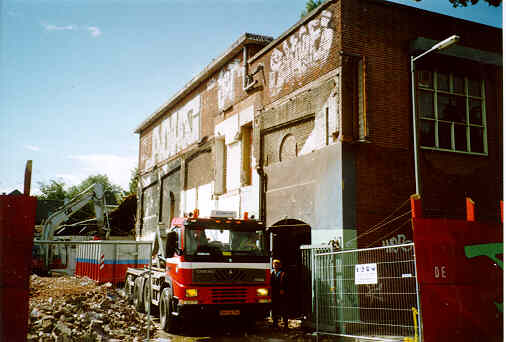
The Deli brewery, on Weesperzijde, was founded in 1886 and closed in 1939. It wasn't the most successful of the new generation of modern breweries founded at the end of the 19th century, never really challenging the likes of Amstel and Heineken. Surprisingly, parts of the brewery survived until 2003, buried in a later industrial building. I spotted parts of them as they were being demolished. The wall with the circular windows was part of the Ijskelder.

I think you know who Bass were.

Tuesday, 25 May 2010

Price fixing 1943

An illegal cartel. That's what they'd call it now.

These are the prices per hectolitre of draught beer:


Translation:

"2nd: Article 1.A of Chapter VII is replaced by:

Beer prices per barrel
----------------------
1.A The binding prices for member breweries for the beers mentioned in Chapter VI for draught beer are as follows:

Lager 24.80 guilders per hl
Pilsener or Münchener 34.65 guilders
Stout 51.30 guilders

with the understanding that the prices of the other types of beer mentioned in Article 1 of Chapter VI will be agreed on later, when it is necessary.

3rd: Article 3 of Chapter VII is read as follows:

Agent discount.
---------------
3.A this is:
per hl Lager a maximum of 4.15 guilders
per hl Pilsener or Münchener a maximum of 4.15 guilders
per hl Stout a maximum of 4.15 guilders

with the understanding that the discounts of the other types of beer mentioned in Article 1 of Chapter VI will be agreed on later, when it is necessary."


These are the breweries that agreed to it:


They'd never dare pull such a trick nowadays, would they?

Almost forgot the beer types featured. Beer styles, sorry. Must get my terminology right. Lager, Pilsener, Münchener, Stout. Interesting mix.

I must share the same brewers' proposals for introducing Märzen as a spring seasonal beer. Fascinating stuff. But I can't be arsed tot translate it at the moment. I'll do it later. Remind me if I forget. It's great stuff.

Tuesday, 7 April 2009

Matt, Lucas

Matt was over to stay at the weekend. It's always great to see him. For many reasons. Not only smugness. There's a bit of genuine affection. I've only known my brother and Henry longer.

Matt stayed with us twice on this trip. Once on his way to Vollenhove and again on the way back. (I'd have given him the Stout to try, but there's been none around for ages.) Old friends have a tendency to dwell on the past. Not me and Matt. We didn't go further back than the shed night*. That was only three and a bit years ago. The same day as my first archive visit.

He mostly spoke about the philosophy of history. I think that's what it was. It wasn't the history of philosophy, I'm sure about that. Very abstract stuff. In return, I expounded my theory of beer style evolution. We know each other well enough that he didn't bother feigning much interest.

Saturday, I had a party to take him to. Lucas's birthday. (I bought him stainless steel saucepans as a present.) Thankfully, it didn't end too late. Getting home with both ankles intact is always a relief.

Lucas calling on Sunday morning was a surprise. "Can I bring around an Al Murray video for Mike to borrow?" "Sure. What about a pub visit?" Matt had requested one pub visit during his time in Mokum. Unwaged, as often, too many Amsterdam nights out would soon, as so many rats, eat away his small pile of euros.

"Let's go to the pub by the bridge." I suggested. "Do you mean Ter Brugge, or the small one?" Lucas replied. "The posh one." "OK". Matt, as so often, said nothing. Couldn't have any objections, then.

"Can I come, dad?" "Only if you don't whinge, Lexie."

The yuppie pub by the bridge isn't a long walk. I'd name it, except that I won't. Another one of my things. It's a beery-ish pub. Maybe forty in total, across bottled and draught. Filliers jenever is on the menu, too.

"I'll have a witbier" Lucas said. "Whatever you're having." was Matt's tradition-true response. "Can I have cake?" You can probably guess who said that. His name starts in an a and ends in a lexie.

Over the years, I've learned a few things about luring the kids into pubs. Laying a trail of sweets is number 1. Much less trouble than number 2: giving them my full attention. I bought five Belgian bonbons. (I told you it was posh.) Five euros is a small price to pay for fifteen minutes peace.

We didn't drink quickly enough. I was barely three sips into La Chouffe number two when Lexie said "Can we go home now?" "You wanted to come." "Dad, finish your beer." Lexie tried to forcefeed me Chouffe. One bonbon more bought me enough time to finish my beer in relative peace.

Lucas cycled off to happy hour at the Hell's Angels bar. We strolled back home. "Tell me more about Slovenian philosphers." I said to Matt, as I drifted into my Sunday afternoon doze. I awoke in time to catch the last 25 minutes of Polizeiruf.


*When, at the 50th birthday party of other university friends, Matt and I had to sleep in the shed. That's telling you your place.