Showing posts with label Bass. Show all posts

Tuesday, 9 June 2026

Whitbread's bottled beers in 1934

Time to look at the bottled beers in Whitbread’s 1934 price list. Which includes, in addition to the four beers brewed in their Chiswell Street brewery, several produced elsewhere. Which is handy, as it gives a better idea of the beers actually available in a London pub.

A Whibread bottled beer price list from 1934.

The four Chiswell Street beers are the first in list. There appear to be four beers: London Stout, Oatmeal Stout, India Pale Ale and Double Brown. Though the two Stouts were, in reality, identical.

The two Forest beers came from the Forest Gate Hill brewery, which Whitbread bought in 1924. One of their main reasons for purchasing the brewery was to get hold of modern, sediment-free bottling technology. Whitbread having stuck with bottle-conditioning until after WW I.

Based on the price, I’m guessing that the two Forest beers were around 1040º. Hang on. I have an analysis from 1934. It gives the OG as 1039º. So, my guess was pretty close.

Pioneer Ale and Stout were brands of the Lovibond brewery. Not sure why Whitbread were selling them, as I can’t find any connection between the two breweries. I know from analyses in the Whitbread Gravity Book that both beers were around 1030º. 

As already mentioned, Mackeson Milk Stout was being sold at a premium. Based on its gravity in the mid-1050ºs , it falls in the 9d per pint class. But it was sold for 10d per pint.

Something similar is happening with Guinness Extra Stout and Bass Pale Ale. Both of those also had gravities in the mid-1050ºs, but also retailed at 10d per pint. Which was a 1d per pint premium over the expected price. 

Both Bass and Guinness were widely available in other brewers’ tied houses. Usually being bottled by the other brewery, too. The premium charged reflects the renown of the two beers.

In addition to the above prices, a deposit was charged on the bottles of 1d per half pint, 2d per pint and 3d per flagon.  Which, especially in the case of cheaper beers, was a considerable percentage of the total price paid. 

Whitbread's bottled beers in 1934
  Per doz. Botts Per doz. Half-botts crates of four flagons
  Wholesale Retail Wholesale Wholesale Retail
London Stout 6/1d 8/- 3/10d 5/-
do. ("Special Whitbread") 3/6d
Oatmeal Stout 6/1d 8/- 3/10d 5/-
India Pale Ale 5/4d 7/- 3/4d 4/4d
do. ("Small Whitbread") 3/1d
Double Brown 7/- 9/- 4/- 4/5d 5/8d
(A fine strong ale)          
FOREST ALE AND STOUT
Oatmeal Stout 5/4d 7/- 3/1d 3/4d 4/4d
Brown Ale 5/4d 7/- 3/1d 3/4d 4/4d
PIONEER ALE AND STOUT
Family Stout 4/6d 6/- 2/10d 3/8d
Family Ale 4/6d 6/- 2/10d 3/8d
MACKESON'S MILK STOUT
Milk Stout 7/8d 10/- 4/2d 4/10d 6/-
Bass 8/8d 10/- 5/-    
Guinness 8/8d 10/- 5/-    
Bass Barley Wine in nips          
Source:
A 1934 Whitbread price list.


Sunday, 30 November 2025

J.C Jacobsen discusses IPA

A Ny Carlsberg Lagerol label with the swastikas remnoved.
A special treat today. With a discussion with the Burton method of brewing IPA.

Starting with something about the weird way IPA was aged.

Monday Evening 22 March 1869
Dear Carl!
I still cannot get over my astonishment at your strange statement in your previous letter about the way in which the ale is stored in small casks in the open air, exposed to all changes of temperature. I had seen from your previous letters that Younger had no deep storage cellars, but I assumed that this was due to the fact that they were not equipped to brew ale of any importance for export. But that the world-famous and excellent Pale Ale and India Ale from Bass in Burton are treated so nonchalantly - I had no idea of ​​that, and that such a thing can be done is beyond my understanding, for it contradicts everything I have experienced and read about the tendency of wine-like drinks to spoil. There must necessarily be something special that protects this miraculous ale; but what is it?

I'm with Jacobsen senior on this one. Bass Pale Ale was racked into hogsheads, which were then stcked in the brewery yard, open to the elements. I was reluctant to believe this at first, Thinking someone had just misinterpreted empty casks being store in the yard. It's only after I found multiple reputable sources that I believed it.

What was protecting IPA? I think it was Brettanomyces. Which was slowly eating up any remaining sugars. This is also what protected IPA during its long voyage to India. During the year spent in the brewery yard Brettanomyces would have consumed pretty much all remaining sugars. Leaving nothing for anything nasty to eat.

Jacobsen senior then asks some very relevant questions.

Has ale for export to the Indians always been treated in this way? And wasn't Export Ale formerly much stronger than now and, like the strong wines, Port and Madeira, somewhat protected? - Don't you think that at some stage sulphuric acid is added in a very different form? -I have recently read somewhere a note on the use of sulphuric lime as a preservative for beer and wine, but I have never had any confidence in the innumerable recipes for preservatives, etc. and therefore have hitherto neglected this last one.- But now I can't help but think about it and I have let Kogsbølle - who is just as astonished as I am - order a portion of sulphuric lime, with which we would make a few small experiments this spring and test its effect in the following months until next year.- - But all foreign additions are strictly prohibited in England and where beer production is so enormous, the smallest dose of additive would have to amount to a quantum, the acquisition and use of which could not possibly be concealed from the workers and therefore not be kept secret. Be careful, though! - Especially after the main fermentation is over; in the clarification tanks and by the bottling from there into the storage barrels, and by the addition of "dry hops" to these. How are the storage barrels treated to extract the taste of the oak? and how is the bottling of export ale into bottles and kegs? - Are you sure that it is all kinds of ale - also export ale - that in Burton is lying in the open air. By the way, I also do not understand why the ale is allowed to be stored in such small barrels; it is, however, extremely inconvenient and increases the influence of heat. How can carbon dioxide be kept in the beer? - Is not sugar added when bottling for sale to make the beer sparkling? etc, etc, etc.

I wish I knew the answers. When and why did they start ageing IPA in the brewery yard? It seems such a counterintuitive process. And did any other brewers in Burton do the same? It sounds as if it was a general process rather than something limited to just Bass.

I'm pretty well 100% sure than Bass wasn't adding any type of preservative. Heavy hopping and Brettanomyces were enough to protect the beer from infection.

Of course, the storage casks didn't need to be treated as they were made of Memel oak, which wouldn't have imparted any oak flavour.

Why was the beer aged in Hogsheads? Because that was what it was going to be shipped in. Either to UK bottlers or onto ships for export. CO2 wasn't kept in the beer. It was even deliberately flattened before being loaded onto ships. It was given conditioning by a secondary conditioning after bottling. For which, as Jacobsen guesses, sugar was added at bottling time. It would have to be as there was nothing feermentable left in the beer when it arrived in India.

And, yes, both domestic and export IPA was stored out in the yard. 

Friday, 28 November 2025

J.C. Jocobsen writes again

A Ny Carlsberg Lagerol label with the swastikas removed.
More correspondence from Jacobsen. Because you lot seem to like this stuff. This time two short letters.

The first shows how keen Jacobsen senior was on finding out more details about brewing in Burton.

1869-03-02
Dear Carl!
Since I conclude from your letter to your mother, which came yesterday, that you choose the "Boring" of returning to Younger; perhaps in the very next days, I would not have written until I knew where you were, but since your loving mother cannot rest until she has sent a letter, which she wrote to you today, and has on her own responsibility decided to send it to Burton, I must also add a few lines in case they meet you in Burton. I would simply remind you that by making the acquaintance of the young brewers' sons in Strasbourg, you got into the Erhards'. Don't you think something similar was possible in Burton, if you stayed there for some time? Even if you could not become a formal apprentice in one of the larger breweries, there could be a lot of information to be gained by constantly living with young people who are employed in the breweries and if you could visit them once in a while you could also see a thing or two. But this can also happen in the autumn, if you only get there then. But dear Carl, you must overcome your indifference to the English language, it is high time!

So, if Jacobsen junior couldn't get an apprenticeship in Burton, he could just hang around the town and get to know brewers' sons. Not sure how successful that was likely to be. It seems like a plan mostly based on hope. And he should get on with improving his English.

The second doesn't have an exact date, just the year. It discusses the difference between fermentation at Younger and at Burton.

1869
Among the points I would like you to note, I remember at the moment: To note the difference in the degree of fermentation in the Fermenting Vessels at Edinburgh and Burton.- You will remember that at Burton no yeast is separated in the fermenting vessels, but first in the Union casks, whereas at the Abbey the yeast is obtained from the Fermenting Tubs and only a little from the Cleansing Squares. In Edinburgh the fermentation is thus interrupted during the development of the yeast. Why? Were the method of knocking the foam and yeast down into the fermenting vessels used elsewhere than at Younger? Were the ale fermenting vessels at Younger provided with high walls with a door with shutters to retain the foam, as in the Porter Breweries, or are they entirely open, as in Burton? Have you any records of the City Brewery at Edinburgh and of the City of London Brewery? - I have none. 

Could you not dry a portion of Younger's and send me so that I could make a comparative analysis with my malt?. How concentrated is the solution of double sulphuric lime, with which yeast at Abbey is rinsed? - If it is sold, then take down the address and send me a can or small cask of it. 

Is "Finings" - isinglas - used at Younger's or is it the landlord's business? Do you know the procedure with that? For export beer it is used is it not? Do they use the yeast for the addition as fresh and foamy at Younger's as we saw it at Bass's?

Obviously, they would harvest the yeast from the union sets in Burton. Propagating healthy yeast was one of the main reasons for using unions. Younger, on the other hand, where they were clearly using a dropping system, yeast was harvested earlier, before the beer was dropped to the settling square. Though this didn't apply to most of Younger's Pale Ales, which were brewed in their Holyrood brewery. That was fitted out with union sets.

Interesting question about the finings. I happen to know that in the 1970s, Scottish & Newcastle, i.e. Younger, sent out their cask beer unfined. The dad of one of my brother's school friends ran a pub that sold Younger's IPA. Once it was clearing well and he rang up the brewery. They suggested that he try adding finings.

Quite often in the 19th century fining was left to the publican. Gradually, brewers starting fining at racking time. For the simple reason that they didn't trust landlords to do it properly.
 

Thursday, 27 November 2025

More Carlsberg correspondence

A Ny Carlsberg Pilsner Beer label with the swastikas blanked out.
Or, more accurately, Jacobsen correspondence. This time, from Jacobsen Senior to Jacobsen junior. Dated 22nd March 1869.

After some time at William Younger, Carl Jacobsen went to Burton to try to get an apprenticeship at one of the large Burton breweries. Without any luck. And then returned to Edinburgh.

I see from the lines you sent me from Burton that you have now returned to Edinburgh, which I also assume is most correct, as it appears from your letters that, after leaving Younger, you have felt that you were not quite finished learning what you could learn there, whereby I assume that you are thinking more of the overview that is required to be able to run a manufacturing plant and this you can certainly best acquire in the establishment where you now know all the details and are also so well known to all the functionaries that you can get all the information you want. It is hardly wrong that you also, by looking back on what you have learned, have discovered that there were various little things that you could wish to know better about - and it is on these little things that ultimately it depends whether an undertaking will succeed immediately; for otherwise much time and much money will be lost before one, by "fumbling" (ed.), has found the complete articulation of the system, whereby this first becomes an organic whole that has true vitality. 

This sounds to me like at attempt to justify a possible retrograde step of returning to Younger, where  he had already spent quite some time.

Jacobsen senior was very keen on learning about how Burton Pale Ale was produced. There's a considerable amount of talk about this in the correspondence.

I now look forward to gradually receiving a continuation of your interesting report on the procedure in the Younger brewery and on the brewery's equipment, etc. I also assume that you have learned something in Burton about the fermentation and storage of their export ale, which I am very eager to learn. You may also be able to learn something through your friend through correspondence, which will give you a preliminary idea of ​​how to make the most of your stay in Burton when you return. Tell me if you spoke to Westenholz about whether he had any connection with any of the breweries in Burton. Tell me also whether you spoke to the hotelier, the former brewmaster, whose address Haagensen had given you. I cannot entirely give up hope that you may later get into one of the better breweries.

Jacobsen junior had managed to get to know one Burton brewer - Mr. Evershed. Of the brewery Evershed, one of the smaller operations in Burton. And where Jacobsen junior eventually served an apprenticeship. Clearly nit first choice. But the big boys - Bass, Allsopp and Salt - weren't interested.

In any case, it is good that you have become acquainted with Mr Evershed and, moreover, with his family, but it alarmed me, by the way, to hear that you still speak English as badly as the lady's statements suggest. I cannot urge you enough to now pursue the study of the English language, especially spoken language, journal reading, etc. systematically, that is, to set this as one of your tasks, which must be neglected just as the brewery. Now you must certainly be able to get the necessary time for it, even to take lessons from a teacher, if necessary, but you will get the best practice by constantly seeking association with English people and in this regard I would like you to live in a house where there was no Dane. Your mother and I wrote you some lines on March 2, which your mother would finally send the same day and the letter was then addressed franked to your hotel in Burton, from where I assume it was sent for you. 

For some reason, Jacobsen junior wasn't that keen on English and doesn't seem to have picked up much during his stay. Which didn't please his dad.

A Carlsberg Baiersk Lagerol label.

Here's one of the more personal bits of the letter.

Tuesday afternoon
At this moment I received your letter from Edinburgh, which pleased us a lot, not least your mother, who is extremely happy about the "happiness" you are having and about your cheerful mood.- I am also pleased about the benefit that your spiritual development will have from a fuller, social life in educated circles and I believe that this, far from harming your activity as a technician, will on the contrary increase your spiritual energy and make you better suited to work among people.

Jacobsen junior's good use of the money he was given seems to have pleased his father.

When I get to town tomorrow, I will order a bill of exchange for £100 and send it to you. It pleases me to see that you understand how to use your money with good economy without petty stinginess. When you are going to show yourself as a gentleman, you can only get out of what you are doing with a sensible and moderate use of your means. That's clear.

Finally, we get to the most interesting part of the letter.

With the next steamer to Leith, I will, according to your request, send you a half-bottle of Carlsberg beer, which I also believe is healthier for you than Ale and Porter. We drank your cup on the evening of March 2nd in all kinds of Ale and Porter that you had sent, among which we (especially Vogelius and I) preferred Bass & Co's Ale, as the noblest drink. (Do you know the % strength of Bass's pale Ale?) I had another rarity to offer my guests, namely a bottle of London Porter that was over 20 years old. I have received a couple of bottles of it from Grocer Clausen at Christianshavn, who has had a small supply lying uncorked for 20 25 years. It has no carbonation of course, but is wine-like, somewhat sour, like all Porter, but is finer and more pleasant than both the Younger and London Porter you sent me. I am keeping the other bottle of the old Porter until you get home so that you can also convince yourself with your own tongue of the possibility of keeping Porter that long. As for the two last-mentioned types of Porter, we liked the Younger best; the other tasted somewhat raw. It was perhaps too cold, however.

Descriptions of beer flavour from the 19th century are frustratingly rare. Making it dead interesting to find one. And especially of such a special, extremely old Porter. What particularly struck me was this "somewhat sour, like all Porter". I assume that he means Keeping Porter. As Running Porter wouldn't have had time to sour. 

Thursday, 25 April 2024

Bass Charrington

The company was formed in 1967 by the merger of Charrington United Breweries and Bass Mitchells & Butlers.  Creating the largest brewing group in the UK. A position it would retain until it eventually sold up.

They started the decade with a bewildering array of breweries, some quite small and many in close proximity to each other. For example, in the West Midlands and Northwest England. Heavy pruning ensued.

Who knows what Bass Charrington could have achieved, if they hadn’t been led by H Alan Walker, a domineering lunatic with no knowledge of the brewing industry? Despite his best efforts, the company became the biggest brewer in the UK and one of the largest in the world. In the hands of someone more competent, they could only have been more successful.

The chairman’s insane plan was to have just two breweries, Cape Hill in Birmingham and the new brewery in Runcorn serving the whole of the UK.  Which led them to closing most of their breweries. Though, when they discovered Runcorn couldn’t brew acceptable versions of some of their Northern brands, breweries such as Stones in Sheffield and the Tower Brewery in Tadcaster were reprieved.

They were one of the worst in terms of pub vandalism. When there was a pub swap in the 1980s, they took over the Little Park from Tetley. It was a lovely little pub, with two distinct rooms. Bass almost immediately fucked it up, knocking it through into a single room. Totally ruining the atmosphere.


Bass
The renowned Burton Pale Ale brewery of the 19th century, the glory days of Bass were well over after WW II. Once the largest brewery in England, its beers remained nationally available, making it a tempting target for the ambitious M&B. Even though their tied house estate was quite small.

Despite coming first in the company name, Bass had never been one of the driving forces of the conglomerate. Having lost their independence before the formation of Bass Charrington. Their name remained prominent on account of its historic resonance. Though the company could have promoted the brand better


Charrington

A classic London Ale brewery, Charrington’s directors seem to have been naïve about what joining the Bass Charrington collective entailed. Hoping for a shiny new plant just outside London, they were greatly disappointed when the replacement for their East End brewery was Cape Hill in Birmingham.

Cape Hill
The original Mitchell & Butler brewery in Birmingham. And, for a while, the largest cask brewery in the world. I can’t say I was that keen on their cask beer. Brew XI was a crap, sweet excuse of a Bitter. The Mild was OK. But no better than that. When in Birmingham, I much preferred Ansells Mild.

Springfield
One of the group’s three breweries in the West Midlands. They brewed Dunkirk Pale Ale and Springfield Bitter. Both lovely, delicate Bitters. Way better than Brew XI. So, obviously, it was closed and the beers discontinued, though Springfield Bitter was brewed at Cape Hill for a while.

Highgate
Bass Charrington had a weird variation in the size of their breweries. Highgate in Walsall being very much at the small end. And even weirder, as their only product was a Mild Ale.

It had been scheduled for closure around the start of WW II, but was kept open as each brewery was allocated a certain quantity of materials based on their pre-war usage. Had the brewery closed, M & B would have missed out on the ingredients. In the end, it outlasted all the other former M & B breweries, including Cape Hill.

Tadcaster
It’s really odd how all three Tadcaster breweries have managed to survive. There were three substantial breweries in the town in the 1970s. And there are still three now. Back then, they were Sam Smiths, John Smiths and what was the former Tower Brewery, owned by Bass.

I can’t say that I cared for its beers. What was the Bitter? Brew X? Yes, that was it. Can’t ever remember trying it. I usually stuck to Mild, which came in the form of XXXX. A bit thin and insipid. Not a patch on Tetley Mild.


Stones

William Stones was a successful Sheffield Brewery, but owing to the large spread in ownership of their shares, they feared a hostile takeover. For a while they managed to play their two potential suitors – Charrington United and Bass M & B – off against each other. Until the two merged in 1967 to form Bass Charrington. And gobbled up Stones.

Their Bitter, which was very pale, along the lines of Boddington, had a strong local following and was a pretty decent pint. At least in the early years. It caused the company lots of problems. They wanted to close it, but attempts to replicate it at Runcorn were a dismal failure and the Sheffield brewery had to stay open.

Hope & Anchor

Another Sheffield brewery, but one which played a weird role in the formation of Bass Charrington.

In the 1950s, they were trying to market their Jubilee Stout to Canada. They came to an agreement with Canadian brewery owner Eddie Taylor. He would brew Jubilee Stout and in return Hope & Anchor would brew Black Label in the UK.   It was a deal which, eventually, gifted one of the UK’s most popular Lagers to Bass Charrington.

This transaction prompted Taylor to take a closer look at the UK brewing industry. And soon he was in the UK trying to put together a national brewery group. Just as he had done in Canada. And eventually led to the creation of the UK’s largest brewing company, Bass Charrington.

In 1960, it merged with Hammonds United Breweries and had started on one of the paths which would lead to Bass Charrington. Surprisingly, given the company’s rigorous pruning of its breweries, it didn’t close until 1994.

Tennent
Home of Glasgow’s – and Scotland’s – favourite Lager. Tennent got into the Lager game very early, in 1885, importing Germans to build them a suitable brew house, which opened in 1889. Unlike most who got into the Lager game in the 19th century, they were able to make a fist of it.

The brewery was lucky that Lager took off much earlier in Scotland than in England. Despite only being available in Scotland and Northern Ireland, by 1970 Tennents was one of the best-selling Lagers in the UK. Only Harp, a cooperative beer of several large brewers, outsold it.

Welsh Brewers

Formerly Hancock, which was a major player in South Wales before falling into Bass Charrington’s hands.

Monday, 25 March 2024

The home of beer

I’ve arranged to meet Mike at 9:00 for breakfast. Which is a buffet.

What do I get? What do you think? Bacon, scrambled egg and mushrooms. Quite a lot of bacon. Why? Because it’s there. And you can’t go wrong with bacon.

There’s quite a good view from the breakfast room, as it’s on the top floor. To one side is the bus station, the other the city centre shops.

After breakfast I nip around the corner to the bus station where there’s a shop. In which I pick up some water for the hotel. And a little hotel whisky. I’ll be needing that later.

We meet Shane, who’s staying in a different hotel, at the station. And James, another AB Inbev person. Our train is at 11:10. And in ten minutes were pulling into Burton. Past what I recognise is the former Allsopps brewery.

As we’ve quite a while until our 13:00 appointment at Marstons, we wander into town, hoping to find a pub that’s open.

No luck. Even after noon. This is another worrying trend. No pubs seem to open before 14:00. Some not until 16:00. The lunchtime session seems moribund. Really annoying for me, as I love a lunch session. When it’s nice and quiet and you can sit in a corner reading a newspaper. While slowly slurping down a few pints. Now Wetherspoons is often the only option for midday  pints.

We get to Marstons a little early for our appointment. As there’s nothing else for us to do.

We’re greeted by Callum Turner, the surprisingly youthful head brewer. Who gets us kitted out in full protective gear: high-vis jacket, protective shoes, glasses and hat. All very proper.

Our tour starts in the brew house. An attractive (and listed) brick building, originally built for London brewer Mann, Crossman and Paulin.

First, we visit the room housing the old mash tuns. Massive, wooden-clad affairs with lids. They were still in use until surprisingly recently. In an adjoining room are their replacements. Two enclosed vessels built from shiny stainless steel.

Opposite are three similarly shiny coppers. Looking very similar to the mash tuns, save for the absence of grist cases.

I ask Callum: “Do you parti-gyle at all?”

“No, not since we stopped brewing Owd Roger. We used to parti-gyle that with Pedigree.”

“Owd Roger has been dropped?”

“Yes, a few years ago.”

That’s a shame. Owd Roger was a proper strong Old Ale, weighing in at around 8% ABV.

We walk the short distance to the fermentation room. Or hall of sadness, as it should be called. Where they’re currently dismantling the world’s last working union sets.

It’s a depressing sight. Especially as I never saw them in action. Which Mike did, the jammy bastard. I try to stifle my sobs as we survey the remnants of the sets. Will we ever see their like again?

According to Callum, one of the main reasons for using the union sets was yeast propagation. The yeast harvested from the sets being particularly healthy and active. They aren’t quite sure how they will replicate that.

The squares are up against the walls. Of a design I’ve never seen before. Totally enclosed and with a manhole. Though I don’t think it’s airtight and under pressure.

One square is being filled with Pedigree and they’re making sure to blend the right quantities of first and second wort to hit the target gravity.

We get ear plugs for the packaging department. Which is pretty noisy with all the bottles rattling around.

There is something hypnotic about cans or bottles shuffling around a filling line. But, other than that, there isn’t a great deal to see. Especially as they aren’t racking into casks at the moment.

Our final stop is the sampling room. The proper sampling room, with rows of casks along the floor. All firkins.

“What’s the largest cask size you use?” I ask Callum.

“Firkins. Other than Bass. That’s in 10-gallon casks.”

What? That’s a weird size.

We start with some Bass that’s been open for a few days. It’s dry and finishes satisfyingly bitter. And no trace of sulphur. Quite like the pint in the Smithfield. Moving on to a freshly-tapped Bass, the contrast is striking. It’s full of sulphur on the nose, not as dry and with less perceived bitterness.

I try a couple of the Marstons beers. Pedigree, which being quite fresh, is also quite sulphurous. But quite different from the Bass. I really like the Old Empire. A beer I’ve never encountered in cask form before.

Derek’s question is answered by the presence of Youngs Ordinary and Special. They’re brewed here in Burton.

As are Courage Best and Directors. A whole load of legacy brands has ended up here. My attention is drawn to the shelves of bottled beer.

“Do you brew Manns here?”

“Yes.”

I explain to the others that Manns was the original modern Brown Ale. And how the Brewers Association guidelines for English Brown Ale are way off the mark. Even on a basic characteristic as ABV. The guidelines say 4.2% to 6% ABV. While Manns, the classic example, is 2.8% ABV.

They ask Callum if they can try it. He goes to fetch a bottle. Which the others share. Its wateriness is quite a shock.

I give the Hobgoblin a try, not expecting much. And I’m not disappointed. I just don’t care for it. Never have. I’m not sure exactly why.

We spend quite some time in the cellar. Which has been very instructive. It’s time to go and drink some beer. In town.

We start at the Roebuck, a curved corner pub close to the station. Which we walked past earlier, when, frustratingly, it was closed.

The landlady is dead impressed by Mike’s Bass jacket. It is rather loverly. With an embroidered red triangle and the word “Bass”. Guess what we’re drinking? You’ll never get it. Bass!

It’s very good. The sulphur is almost all gone and there’s the dry bitterness that I liked in the older sample at the brewery. I can see why Bass still has a following. It’s excellent when looked after properly.

There are a fair few customers for 4 PM. But the customer profile is rather worrying, again. Most are 50 plus. This doesn’t bode well for the future of pubs. Maybe it’s just the time of day. And the young people all turn up later. That’s my hope.

We need to be moving on. Not far. To another pub that was closed at lunchtime: the Devonshire Arms. A former Ind Coope pub. That just happens to be selling Bass. Well, we are in Burton. Why not have a Bass?

The polished copper table tops reflect and enhance the deep amber colour of the Bass. It looks lovely, with its creamy collar and proud red triangle. It’s still a thing of wonder, a well-kept and pulled pint of Bass.

After a couple of pints, hunger, which has been lagging behind us all day, finally catches up with us. What about a curry?

There’s a curry house nearby and we decant there. For various starters and main courses. Not spicy enough for my taste. Do I like really spicy stuff now? I don’t think so.

The final Burton stop is the legendary Cooper’s Tavern. We have trouble getting in as a folk band is blocking the door. Not sure why they don’t just move a little further into the room.

The Bass is served by gravity here. Unfortunately, the cask is almost empty and the beer is pretty flat. Had we arrived a little later, we’d have had lovely, fresh Bass. What a shame.

We only stay for a couple. Before heading back to Derby.

“Fancy a pint in the White Horse?” Mike asks. It’s the pub opposite our hotel.

“Why not?”

It’s fairly full. Many middle-aged (or older) men, watching Derby playing. Though there are some younger drinkers as well Oh, look. They’ve got Bass.

The Bass is pretty good. Mike and I discuss football as we watch the game and sip our Bass. I mention Jim Baxter, who was sent off in the first football match I went to.

“You had to thump someone to get sent off back then. Which is what Jim Baxter did.”

We don’t make it too late. More travelling tomorrow.

On our way out, one of the old chavs comes up and says:

“I heard you talking about Jim Baxter. Great player.”

A tot of hotel whisky has me tooting away to sleep.


The Roebuck Inn
101 Station St,
Burton-on-Trent.
DE14 1BT.
https://www.roe-buck-inn.co.uk/


Devonshire Arms
86 Station St,
Burton-on-Trent,
DE14 1BT.


The Coopers Tavern
43 Cross St,
Burton-on-Trent,
DE14 1EG.


The White Horse

25 Morledge,
Derby,
DE1 2AW.


Disclosure: my travel and all expenses were paid by Goose Island.

Friday, 15 March 2024

Running Bass Charrington (part two)

More in the inimitable management style of H Alan Walker (HAW). When Bass M & B merged with Charrington United Breweries in 1967, Walker became its managing director and chairman, roles he had held at Bass M & B. The two halves of the new company had very different management approaches.

It led to a clash of cultures, in which authoritarianism easily triumphed under the leadership of HAW; all at M&B, and later BM&B [Bass M & B], including his fellow directors, had become used to his absolute authority and commanding style and offered no opposition. HAW once said "The smaller the brewery, the bigger the prima donna", in reference to the human problems arising when taking over companies. It was a comment too upon himself, as to his perception of those problems; his strength was also his weakness.
"The Brewing Industry 1950 - 1990", by Anthony Avis, 1997, page 103.

Walker sounds like a crazed narcissist in this next section.

Those present at the meeting were familiar with his views on the qualities of leadership, the principles of organisation, the ability to make and take the right decisions, and so on, as from time to time HAW put his thoughts into print and circulated them to senior employees as advised reading, and to others as recommended study; not bound up in little red covers, of course, but handed out on single sheets (see Appendix C). He referred to these and then began in earnest.

He outlined the essentials of his master plan - only two breweries, a London depot, overnight shuttle trains, the new brewery itself. He spoke of the benefits to be derived from his plan, in the manner of one conferring a privilege. He dismissed the fears of those about to lose their own regional beers, as having the petty-mindedness of provincials, men of limited faith and small vision.
"The Brewing Industry 1950 - 1990", by Anthony Avis, 1997, pages 107 - 108.


All sounds pretty reasonable, doesn't it?

The Runcorn project was already becoming a graven image. He went on about the advantages of huge production in new breweries, the advance of technology, the necessity for all present to get out into the market place and sell the beers. He announced the formation of a committee, made up of the company enthusiasts for his ideas, to be called the 1984 Committee, which would attempt to predict the manufacturing position of BC at that date, and in the meantime would organise to attain the decided goals. He wound up by saying there had been enough discussion within BC on the plan and the bellyaching had got to stop, as it would go ahead. He took a dim view of any more objection. He then asked if anybody had anything to say. They had not; the front row of his fellow directors was as silent as the grave whilst the rest of us were trying to memorise and digest what had been said. No note-taking had been allowed. Discretion kept us quiet; burgeoning anxieties were making us thoughtful.
"The Brewing Industry 1950 - 1990", by Anthony Avis, 1997, page 108.

"1984 Committee"? How creepy can you get? Was that deliberate or just ignorant? I suspect the latter. I mean, he doesn't sound like the sort of man you'd point out an error to. An error of his own, I mean.

Thursday, 14 March 2024

Running Bass Charrington

Today I'm going to publish some excerpts from Anthony Avis's wonderful memoir: "The Brewing Industry 1950 - 1990"

They all concern H Alan Walker (HAW), the first chairman of Bass Charrington. And someone with a rather creepily dictatorial management style. The scheme in question here is the new brewery in Runcorn.

In the run up to the introduction of this scheme. HAW had called a three line whip type of meeting at his London headquarters for all senior executives, to give his explanation of the grand scheme, and to reiterate his threat to sack personally anyone who queried it. The MD of BCN, Vernon Parker, could not attend, as he was ill, so I went in his place. I am not certain to this day if he was really ill or chose not to go, as he was in disfavour, quite unfairly, for raising profits but not volume barrelage, just when the flavour of the month with HAW was barrelage. Those who had been called assembled on the first floor of the Grosvenor Gardens house, sitting in rows, awaiting the arrival of the Great Man, like nervous schoolchildren. His habit was to make dramatic, stage effect, entries to this sort of meeting. His headquarters staff of young men having suitably corralled those attending, and warmed them up, television audience style, then stood around the edges of the room like ushers or warders. Those of the main board working directors involved in the brewery operations were also there, in the front seats, waiting - no question of them entering with the Great Man in a show of unity. Silence having descended on the meeting, there was a signal from the personal assistant by the staircase, and HAW descended from his second floor rooms, preceded by his butler who saw him seated, and then left. We all waited expectantly and nervously; if the intention had been to create such an atmosphere it had succeeded.
"The Brewing Industry 1950 - 1990", by Anthony Avis, 1997, page 107.

He sounds like a right twat. Who gets seated by their butler at a business meeting? It's clear that Mr. Walker was showing, through the whole forma=t of the meeting, that no dissent was going to be allowed.

This is really the way to get people to open up and give you their honest opinion.

He began by strictly warning all present that nothing was to be spoken outside as to what was said inside the meeting, and with that he glared round the room. This gesture could be unnerving, as he had an aggressive manner, his rubicund face topped with scanty white hair, projecting itself like a dart at the listener; to meet his gaze was to be reminded of the fate of those who looked into the eyes of Medusa. He had protruding eyes. He rarely laughed, but occasionally smiled thinly; his voice had a guttural quality. Conviviality was not what he set out to achieve when dealing with management, staff and employees.
"The Brewing Industry 1950 - 1990", by Anthony Avis, 1997, page 107.

Sounds like a terrible boss to work for. Unless you were a total sycophant. In which case, it would have been great.

Thursday, 7 March 2024

Carlsberg vs the Big Six

It may be hard to believe now, but the Big Six, in their prime during the 1970s, were some of the largest brewing groups in the world. But, while large breweries on the continent, such as Carlsberg and Heineken have continued to grow, the UK's biggest breweries all fell by the wayside.

When Watney Mann were making deals with Carlsberg in the early 1970s, they were by far the larger brewery of the two. At least in terms of the quantity of beer produced.

The figures are from slightly different dates, Carlsberg being for 1969 and Watney and Bass Charrington from 1976. Even Watney, one of the smallest of the Big Six, produced more than double as much as Carlsberg. Which must have had an impact on the relations between the two. I've included Bass Charrington, the largest of the Big Six, for comparison.

So where did it go wrong for the big UK brewers? They didn't expand internationally. Or at least not as much and not as successfully. Obviously, there wasn't quite the incentive for this as there was for brewers like Carlsberg and Heineken, whose home markets were much smaller. 

Carlsberg vs the Big Six
  hl barrels
Denmark consumption 4,830,000 2,951,256
Total Carlsberg 3,571,000 2,181,974
Carlsberg exports 825,000 504,096
Carlsberg domestic 2,746,000 1,677,877
% Carlsberg domestic 56.85%  
Bass 12,831,060 7,840,111
Watney 7,698,636 4,704,067
Source:    
Brewers' Guardian, Volume 99, April 1970, page 75.
“The Brewing Industry, a Guide to Historical Records” by Lesley Hammons & Alison Turton.


Friday, 23 February 2024

Bass Charrington's £20m. brewery project

More about the wonderful Runcorn brewery. This time it's a puff piece in the Brewers' Guardian.

It's rather typical of the technocrat tone of the publication at the time. As sort of Hooray for Everything approach

"Bass Charrington's £20m. brewery project
As can be seen from the above scale model, a feature of Bass Charrington's proposed £20m. brewery on a 100-acre site at Runcorn New Town, Cheshire, is that much of the production plant will be in the open air. At this stage, the company are not disclosing any technical details of the project, but it is thought likely that there will be a system of batch wort production and a degree continuous fermentation.

The practice of placing some of the plant outside the brewery walls follows similar recent moves at the Beamish & Crawford brewery in Cork and the Cornbrook Brewery, Manchester, where they have outside fermenters. Last year a completely exposed brewhouse at the Tennent Caledonian Brewery in Glasgow also went into production.

Bass Charrington's announcement follows the completion of a survey into the, brewing, packaging and distribution requirements the company are likely to be facing in the l970's and 1980’s."
Brewers' Guardian, Volume 99, May 1970, page 33.

This open-air shit seems to have been an obsession of Bass Charrington.I can understand why you'd put conical fermenters outside, especially the huge ones. But why the hell would you put the brewhouse outside? This is the UK. Where rain isn't totally unknown. Wouldn't it just be a right pain in the arse for the brewing staff?

"The new brewery, along with packaging and kegging facilities should come into production in 1972-73. It will have an annual capacity of 2.5 million barrels and will employ approximately 1,250 people. When completed it will be Europe’s largest single unit and it will be capable of expansion if this should prove necessary at some later date.

Stone & Webster in London are producing the engineering design, carrying out the purchasing and supervising construction of the development which will use processes specified bv Bass Charrington. Stone & Webster have been working as consultants with Bass Charrington during the planning stages and engineering design work has already been started by them."
Brewers' Guardian, Volume 99, May 1970, page 33. 


It actually opened in 1974. And initially employed 500. Which turned out to be far too many. Eventually it was staffed by just 150.

This next bit is rather disingenuous. Because the medium-term plan was to close all their breweries in England and Wales, other than Runcorn and Cape Hill. It looks like bottling and canning was already being concentrated at Runcorn in anticipation of this.

"Once the new brewery comes into operation a number of existing plants in the Group will be closed during 1972-73. The breweries affected are Barrow, Blackpool, Burnley, Liverpool, Manchester, Aberbeeg, Fernvale and Mile End. The Cannon brewery at Sheffield may also be closed.

Bottling will cease at Tadcaster and Wolverhampton; bottling and canning will cease at Cape Hill: and bottling and kegging will cease at Cardiff, but all these units will continue to brew. The bottling, kegging and canning plant at Tottenham will also close as will the bottling plant at Yeovil.

As a result of this reorganisation Bass Charrington breweries in England and Wales will, after the new brewers has come into production, be sited at: Runcorn; Tadcaster; Sheffield; Burton; Birmingham; Cardiff; Wolverhampton. The reorganisation will not affect Bass Charrington's operations in Scotland, Northern Ireland and the Irish Republic."
Brewers' Guardian, Volume 99, May 1970, page 33.

They seem to have forgotten about one English brewery: Highgate in Walsall. Or was it jsut too small to be worth mentioning? Never heard of Fernvale? Neither had I. It was in South Wales, apparently. Aberbeeg was the home of Webbs, another brewery from South Wales that I've never come across before. Probably because it was so small.


Thursday, 22 February 2024

When branding fails

Marketing releases are often hilarous when looked at with hindsight. Like Bass's new regional Bitter for Yorkshire. Which tried to build a nrew brand from a previous success.

"Bass launch new “regional” bitter
Despite the continuing disappearance of many local brews, one of the country’s largest brewing groups, Bass Charrington Ltd., is showing its awareness of regional palate preferences by the introduction of beers suited to a particular area.

Latest beer in this context is Brew Ten, which has been launched in the North-East and is advertised as being “specially brewed for the men of the North by Bass".

Described as a medium-priced draught bitter — it has a recommended public bar price of 2s. 2d. per pint — Brew Ten follows on from the success Bass Charrington have had in the Midlands with their Brew XI.

A major programme of television, Press and poster advertising starting this month has been planned by Bass Charrington to support the launch of Brew Ten."
Brewers' Guardian, Volume 99, May 1970, page 49.

Spoiler here: Brew XI was shit. A sweetish beer sometimes likened more to a Pale Mild than a Bitter. And Brew Ten? That was even worse. The success of Brew XI might not have totally been on its own merits.

"Brew XI draught beer took the Midlands by storm and was a genuine success; of course, that success was helped along by strenuous statements that it was successful - like a government minister justifying his policies - and the fact that it was replacing the existing M&B brands which had a ready-made market."
"The Brewing Industry 1950 - 1990", by Anthony Avis, 1997, page 104.

Picking a lower number for the new beer possibly wasn't the brightest idea.

"As part of the same thought process the Tadcaster Brewery had been allocated X, by which to call its main draught beer; and that too was a failure in marketing terms - the Yorkshire drinking public were convinced they were being sold weaker beer than the Midlands, since X was less than XI; so it was dropped as a brand name."
"The Brewing Industry 1950 - 1990", by Anthony Avis, 1997, page 107.

A top-down approach always works so well.

Tuesday, 20 February 2024

More Mablethorpe memories

There were two Bass Charrington pubs in town. The Eagle, a substantial detached Victorian building a bit outside the centre. I went in there at least once with my brother. Pretty sure they had no cask. As it’s the one and only time I drank Bass No. 1.

Just down the road, towards the seafront, was a rather good chippy. With an attached fish restaurant. A place where they served the chippy food, but on china with proper cutlery, accompanied by white sliced bread spread thinly with margarine and mugs of tea. It’s the only type of restaurant I’d eaten in before going to university.

The other Bass house was on the High Street. The Book in Hand. A pub whose narrow frontage shouted: fuck off, you’re not welcome. Just looking at it, you knew the atmosphere was shit, the beer was shit, the people were shit. They’d think you were a little shit and quite possibly kick the shit out of you.

I never visited it, oddly.

My memories are of walking past and being met by a waft of warm air. Caressing on the cheek but a frontal assault on the nose. A mixture of stale beer, fag smoke and other assorted odours I don’t care to think about too much. OK, it was much like any pub smelt at the time. Just in a more concentrated form. Perhaps on account of the narrow frontage not offering the foul air many routes of escape.

Just over the road was the was the far more salubrious Louth Hotel, a large and airy Home Ales house. In their plain, no-nonsense house style. But with cask Mild and Bitter served, as almost always in Home pubs, by electric pumps. The pubs could open crazily early – 10:00. And the Louth always seemed to do a surprisingly good trade in the two hours before midday. The democratically-priced beer might have been the key.

Much to my regret, unlike Skegness, Mablethorpe had no Shipstones pub.

Monday, 19 February 2024

Runcorn mega-keggery

The classic idiotically-conceived mega-brewery. Thought up by a chairman without brewing experience (who believed any beer could be brewed anywhere) and constructed by chemical engineers. How could it possibly have gone wrong?

The idea was that the whole of England and Wales would be served by just two breweries: Cape Hill and Runcorn. Beer brewed in Runcorn would be shipped by train to a depot in Stratford, East London. The train would later return to Runcorn with empties.

It was a personal project of H Alan Walker, chairman and chief executive of Bass Charrington. A man with, to put it mildly, a rather autocratic management style. Despite many in the company having misgivings about the plans, no dissent was allowed. The chairman made it very clear than anyone raising objections would be sacked.

After some delays, the brewery opened in 1974. With all the company’s breweries in Lancashire closing as well as the Charrington brewery in Mile End to make way for it. For some reason, the packaging plant was built far away from the brew house meaning beer had to be moved between the two through a very long pipe. Not exactly an efficient way of operating.

At the time, Bass Charrington was weirdly keen on having most of the brewing kit outdoors. Not just conical fermenters, but even the brewhouse itself. Something they had already done at Tennent’s Wellpark Brewery in Glasgow.

As soon as the brewery opened, it ran into problems. On the one hand, it struggled to replicate the beers from the existing breweries. And on the other, it had terrible industrial relations, leading to repeated strikes.

CAMRA weren’t great fans, as the brewery produced no cask beer. And had entailed the closure of a string of regional breweries: Barrow, Blackpool, Burnley, Liverpool, Manchester, Aberbeeg, Fernvale and Mile End. It left the group with no brewery further south than Birmingham.  

Eventually, they did manage to sort out the problems at the brewery, albeit too late:

"The beer was improved by rebuilding the brewery along orthodox lines, and the beer became acceptable for what it was, and not a pretence of being something else. Just as everything was going quite well the depression in the brewery trade descended, and there was too much brewing and canning capacity."
"The Brewing Industry 1950 - 1990", by Anthony Avis, 1997, page 109.

The brewery closed in 1993. Fewer than 20 years after first coming onstream. 

Sunday, 11 February 2024

Cask tank beer

Bass Charrington, rather oddly, given that they closed the brewery a couple of years later, put a lot of effort into developing a type of tank beer at Joules, at Stone in Staffordshire. The idea being to replicate cask beer in a more economical way.

"Over the past few years many traditional, locally-brewed beers have fallen by the wayside because of the economies offered by nationally distributed brands. But one smaller brewing concern, John Joule & Sons Ltd., a Bass Charrington subsidiary, are managing to retain their traditional beers by cashing in on the savings afforded by bulk tank distribution to pub cellars.

To cater for the increased demand for this tank beer they have recently opened a new £25,000 department at the Stone brewery. Beer which is used in the tanks is naturally conditioned but, instead of being racked into casks, it is racked into Porter Lancastrian tanks, conditioned for 48 hours and then chilled to about 52-54° F before being sent out to trade."
Brewers' Guardian, Volume 99, April 1970, page 60.

Instead of being racked into casks, the beer was transferred to tanks where it was conditioned for 48 hours at 58° F while being roused. The beer was centrifuged on the way into the tank, but not all the yeast was removed, as its presence helped extend the shelf-life to three to four weeks. Before transfer to delivery tankers by compressed air, the beer was chilled to 52-54° F.  

Pubs were fitted with five-barrel tanks, either Fairey and Grundy. Before each delivery a team from the brewery cleaned and sterilised the tanks. After filling, the beer was fined for clarity, left for 48 hours and presumably served by electric pump.  

It sounds basically like cask beer, just in a larger container. I wonder what it tasted like? Could drinkers tell it apart from true cask?

Monday, 5 February 2024

Bass Charrington dominate Lager

More Lager stuff from the Brewers' Guardian. Including a fascinating glimpse into early markey share.

Despite many smaller brewers plunging into the Lager pool, large and international concerns dominated the market. In 1970, 92% of sales were in the hands of five companies.

With 34%, Bass Charrington were very much in the driving seat. They were the largest brewery, but held nowhere near as much as a third of the total beer market. Both of their Lagers were also brands which they owned 100%. Of the Big Six, only Allied, with Skol, was in a similar situation.

It’s indicative of the scale of Lager sales in Scotland that Tennents, a regional brand not available in most of the country, was the second biggest seller.

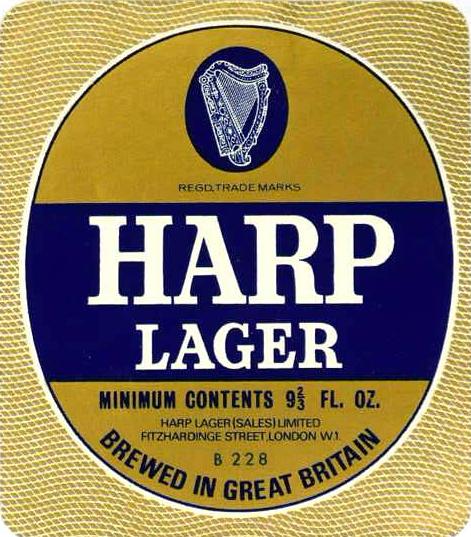
The Harp Lager consortium was originally owned 50% by Guinness, 22.5% by Courage, 22.5% by Scottish & Newcastle and 5% by Bass Charrington. Given the success of their own Lager brands, it's no surprise that Bass Charrington sold off their share in Harp early in 1970. As a result, the percentage owned by Courage and Scottish & Newcastle rose to 25% each.

Outside of the big boys, everyone else had to be happy with just 8% between them. Demonstrating that the growth of Lager was disproportionately exploited by the larger brewers, giving them yet another advantage. 

Lager market shares in 1970
Harp 26%
Bass-Charrington  
   Tennents 21%
   Carling 13%
Allied Breweries  
   Skol 16%
Carlsberg 12%
Heineken 4%
Remainder 8%
Source:
Brewers' Guardian, Volume 99, March 1970, page 39.