Showing posts with label Scottish beer. Show all posts

Saturday, 1 February 2025

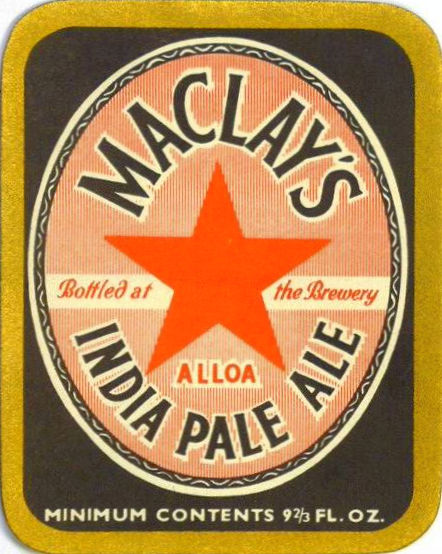
Let's Brew - 1966 Maclay PA 6d

To get you in the mood for the 1970s, here's a beer from the mid-1960s. A 60/-. Is it a Mild, is it a dark Pale Ale? Who gives a fuck? I don't any more. SO what if I thought it was a Dark Mild when I drank it?

There’s not a great deal to the recipe, which is also typically Scottish. Mostly pale malt with a bit of sugar and, some flaked maize. There’s also a proprietary sugar called DCS. No idea what that is, so I’ve just increased the quantity of No. 1 invert. And a touch of malt extract. But it’s really just a variation on a theme. Styrian Golding and English hops.

As for colour, the one in the recipe is as brewed. The versions I drank were around 20-25 SRM. Feel free to colour it with caramel to any shade you fancy.

1966 Maclay PA 6d
pale malt 5.00 lb 75.28%
flaked maize 0.75 lb 11.29%
malt extract 0.125 lb 1.88%
No. 1 invert sugar 0.75 lb 11.29%
caramel 5000 SRM 0.02 lb 0.26%
Styrian Goldings 90 mins 0.50 oz
Fuggles 60 mins 0.50 oz
Goldings 30 mins 0.50 oz
Goldings dry hops 0.50 oz
OG 1030
FG 1012
ABV 2.38
Apparent attenuation 60.00%
IBU 23
SRM 11
Mash at 148º F
Sparge at 165º F
Boil time 90 minutes
pitching temp 61º F
Yeast WLP028 Edinburgh Ale


Saturday, 1 May 2021

Let's Brew - 1945 William Younger No 3

It's a time for celebration. I've finished the last of the 531 recipes in my upcoming book "Blitzkrieg!"

I'm so glad it's all over. I've spent a big chunk of the last two years researching and writing these fuckers. How do I feel now? Relieved.

A very late war beer here. War in Europe, at least. This No.3 was brewed exactly a month before Hitler topped himself. Meaning lucky drinkers could have toasted that happy event with this very beer.

Had the plotters blown Adolf to bits a year earlier, drinkers could have toasted the evil dictator’s demise with exactly the same beer. Just about. The balance of base malt to flaked barley had tipped slightly in the favour of the latter. So slightly, that even the best taster would have been unlikely to notice the change.

Not much excitement with the hopping, where there was a single type of Kent hops from the 1943 harvest. 

1945 William Younger No. 3
pale malt 7.75 lb 72.94%
flaked barley 2.75 lb 25.88%
caramel 2000 SRM 0.125 lb 1.18%
Fuggles 75 min 0.75 oz
Fuggles 30 min 0.50 oz
Goldings dry hops 0.25 oz
OG 1044
FG 1013
ABV 4.10
Apparent attenuation 70.45%
IBU 15
SRM 19
Mash at 153º F
Sparge at 160º F
Boil time 75 minutes
pitching temp 60º F
Yeast WLP028 Edinburgh Ale


Saturday, 7 March 2020

Let's Brew - 1894 Thomas Usher 60/-

60/- is such a fascinating beer. Because there have been so many different types of beer called 60/- in Scotland. Most with absolutely no connection with the modern beer.

This is a beer of the most old-fashioned type of 60/-. That is, a Scottish Ale of what I call a Shilling Ale. Basically the Scottish equivalent of Mild Ale, but often sold bottled rather than on draught. Though I’ve never seen a 19th-century English Mild as weak as this beer. Down in London, they didn’t brew anything much under 1050º.

As usual, the hop varieties are a guess. The brewing record just lists them as Kent and Sussex. Feel free to change them around, as long as you stick with English ones.

I’m not going to bore you with too much chatter. It’s a simple beer, containing just pale malt and sugar. Which makes it typical of Scottish beer of this period. As does the crappy degree of attenuation.


1894 Thomas Usher 60/-
pale malt 5.75 lb 74.19%
No. 2 invert sugar 2.00 lb 25.81%
Fuggles 90 min 0.50 oz
Fuggles 60 min 0.50 oz
Goldings 30 min 0.50 oz
OG 1040
FG 1018
ABV 2.91
Apparent attenuation 55.00%
IBU 20
SRM 8
Mash at 146º F
Sparge at 170º F
Boil time 120 minutes
pitching temp 60º F
Yeast WLP028 Edinburgh Ale

The above is an excerpt from my excellent book on Scottish brewing:


Which is also available in Kindle form:

https://www.amazon.com/dp/B07Q8XHBL2

Friday, 5 July 2019

Scotch Ale in the late 19th century

A recent commentator was pleased to have post that tied in whith my talk on Scottish beerts at the NHC last week in Providence.

So here's some more.

Strong/Scotch Ale
Scotland – and Edinburgh in particular – was well known for its Strong Ales, or Scotch Ales as they were called in England. These formed a large part of Scottish exports, particularly to the West Indies.

Earlier in the century Strong Ales had been the upper echelons of Shilling Ales. Beers like 100/-, 120/- 140/- and even 160/-. These were higher-gravity versions of the weaker Shilling Ales, which generally filled the slot occupied by X Ale and XX Ale in England. Though these stronger versions were much more heavily hopped, sometimes containing over five pounds per 36-gallon barrel.

Around 1860 William Younger had introduced another range of Strong Ales, referred to by a number rather than shillings. The strongest being No. 1 and the weakest No. 4. The naming convention was possibly adopted in imitation of Burton practice. Brewers there such as Bass and Evershed used the system. The latter is particularly significant as at least one member of the Younger family had an apprenticeship there.

No. 1 and No.3 were longer-lived than the strong Shilling Ales that preceded them. No. 1 survived until well after WW II and No. 3 is still around today, albeit with a couple of interrupts in production.

You can see in the table that gravities began to be eroded after 1900, especially for No. 2 and No. 3. This process continued – and was even more dramatic – later in the 20th century.


William Younger numbered Strong Ales 1885 - 1914
Year Beer OG FG ABV App. Atten-uation lbs hops/ qtr hops lb/brl
1885 1 1103 1035 9.00 66.02% 12.44 6.26
1885 2 1091 1024 8.86 73.63% 9.76 4.80
1885 3 pale 1076 1025 6.75 67.11% 10.33 3.56
1898 1 1104 1030 9.79 71.15% 16.90 8.35
1898 3 1074 1019 7.28 74.32% 8.81 2.97
1913 1 1097 1037 7.94 61.86% 10.28 7.40
1914 2 Sc 1076 1025 6.75 67.11% 9.35 2.86
1913 3 1065 1021.5 5.75 66.92% 4.55 1.15
1913 3a 1072 1025 6.22 65.28% 5.48 1.22
Source:
William Younger brewing records held at the Scottish Brewing Archive, document numbers WY/6/1/2/31, WY/6/1/2/45 and WY/6/1/2/58.


The above is an extract from my book on Scottish beer:


http://www.lulu.com/shop/ronald-pattinson/scotland-vol-2/paperback/product-23090497.html 

Wednesday, 5 June 2019

Let's Brew Wednesday - 1931 Thomas Usher Stout 80/-

In the 1930’s, genuine Scottish Stouts began to fade away as breweries concentrated almost exclusively on brewing Pale Ales.

This had some odd results. With some pretty strange Stouts gracing the brewing logs. This is an example of one.

It’s mostly to do with the grist. You may imagine that at least one type of roasted malt was essential to the flavour profile of a Stout. Not so in Scotland. They made do with pale malt and a load of sugar, sometimes, as in this case, with a little crystal malt included.

I’ve done some interpretation in terms of the sugars. These were the ones used in the original: 6 cwt. cane, 2 cwt. Penang, 2cwt. CDW, 1 cwt. Caramax, 1 cwt. DF. The first two sound like simple sugars. The next two are types of dark proprietary sugars, the last, I’ve no idea. A combination of No. 3 and No. 4 invert should come somewhere close.

As always with Thomas Usher 20th-century recipes, the hops are a total guess as there are no details in the brewing record. Substituting something like Cluster for the 120 minute addition wouldn’t be out of place.


1931 Thomas Usher Stout 80/-
pale malt 6.00 lb 61.54%
crystal malt 60 L 0.75 lb 7.69%
No. 3 invert sugar 1.75 lb 17.95%
No. 4 invert sugar 1.25 lb 12.82%
Fuggles 120 min 0.50 oz
Fuggles 60 min 0.50 oz
Fuggles 30 min 0.50 oz
OG 1052
FG 1023
ABV 3.84
Apparent attenuation 55.77%
IBU 18
SRM 30
Mash at 148º F
Sparge at 170º F
Boil time 120 minutes
pitching temp 60º F
Yeast WLP028 Edinburgh Ale

This, and many other, excellent recipes appear in my definitive book on Scottish beer:


Saturday, 17 March 2018

My latest books

Just a reminder of my two most recent, wonderful books.

First, Let's Brew, which is packed with all sorts of exciting historic recipes, including Lagers and North American beers. The majority have never appeared in this blog. Every homebrewer whould own a copy.


http://www.lulu.com/shop/ronald-pattinson/lets-brew/paperback/product-23289812.html

Second is the definitive history of Scottish beer over the last 150 years or so. Other than a few recipes, of which there are almost 400, all the material is new.


http://www.lulu.com/shop/ronald-pattinson/scotland-vol-2/paperback/product-23090497.html 

Just think of poor Alexei. His bottle of gin is almost empty. Please help him buy a new one.

Tuesday, 16 January 2018

Scotland's Brewing Industry in 1938

Another copout post as I can't be arsed to write anything properly. Damn being ill.

This is a nice little overview of Scottish brewing on the eve of WW II. Its not a bad article.

"SCOTLAND'S BREWING INDUSTRY
High Reputation for "Quality"
[BY ROBERT BRUCE , C. A., J. P.]

POPULAR conception of Scotland and its products is very apt to identify the country with distilling of whisky, ignoring what, after all, is a very stable and important industry — the brewing of beer — which has contributed to Scotland's social and industrial life since the time of the great abbeys and monasteries of years ago.

A specialised industry such as this does not, as rule, establish itself without special reasons and advantages, and brewing centres in Scotland (Edinburgh, Alloa, &c.) are particularly favoured by the type of water which is available from their special wells, which provide naturally perfect water for the production of the first quality of beers. In addition, the broad acres of farm land in the Lowlands of Scotland provide barleys of the high grade essential for the production of malt liquors.

As the centuries rolled on breweries were enlarged and modernised. The somewhat slipshod methods of old were replaced by highly specialised technical methods assisted by the most meticulous scientific control, with the object, of not only maintaining quality but also of improving the stability, flavour and character of the product. This, combined with modern transport, has enabled Scotland to send its ales broadcast throughout the world and the reputation once purely local is now not only national but world-wide. As an example of the progress made in this industry, it is estimated that between £5,000,000 and £6,000,000 is paid annually in duty to the Exchequer.

The Local Trade
Trade in Scotland may be termed "local trade" inasmuch as it is trade competed for by Scottish brewers only for all practical purposes. The main sale here is for beer sold to the public on draught, and naturally the largest output is in the industrial areas such as the coalfields of the Lothians, Fife, and West of Scotland, and the engineering and shipbuilding districts of the Clyde. This trade is dependent on volume of wages very largely and, therefore, fluctuates considerably with the trade barometer, and as this barometer has been rising of late so sales have been recovering from the low levels of recent years in these districts . During the last few years there has been a very important development in the practice of brewers bottling their own article and this has, to a certain extent, displaced the sale of beer bottled by independent bottlers. This has only been to a certain degree, however, as there is no doubt that the sale of bottled beer has increased very materially of recent years. This is especially true of the present time as, with increased spending power, the sale of bottled beer has shown a marked rise, which seems to point to the fact that this class of trade will tend to show extreme fluctuations, depending upon the relative prosperity. There is, of course, a very important trade still done in beers bottled by outside bottlers, especially in districts at a distance from the source of supply.

In England
The trade here consists almost entirely of bulk beer — either to be consumed as draught beer or to be  bottled by outside bottlers, the exception to this being lager beer. While beer is sent to every district, even to the extreme South, the great volume is despatched to the North of England with its vast population employed in the heavy and other industries, and this district may be termed a veritable "cockpit", for brewers as it is open to intensive competition by Scottish, Burton, and local brewers.

While a certain number of licensed premises are owned by brewers, as is allowed by the Licensing Laws of England, there is nevertheless a large volume of trade which is at most competitive prices, and the rapidly rising costs may have a very important bearing on the financial results of this trading. So far as output is concerned, however, the prosperous conditions in heavy industries have played their part and, with the large share they hold of this trade, proportionate benefit has accrued to Scotland.

Export Trade
This is of special concern to Scotland as over 50 per cent of Great Britain's beer exports, and practically the whole of the bulk beer consumed by our troops abroad, is exported from Scotland.

Conditions have changed materially during recent years, local breweries have been established in many countries, and this, combined with adverse tariffs, has curtailed opportunities of profitable trade, Australia and South Africa — at one time our largest customers — have practically ceased to import, and local breweries in the Straits Settlements, Egypt, India, &c. are all combining to diminish the trade done in the various markets. In addition, there is a very intensive competition from other countries, especially in the case of lager beer. Notwithstanding this, the improvement in world conditions and spending power have their effect on the consumption of bottled beer and, with plentiful money, the extra cost of imported beer is overlooked, and what may be in the nature of a luxury is indulged in more freely.

The Outlook
The future is more difficult to forecast; the conditions referred to will continue to exist and, in the case of export, competition will increase rather than decrease. One serious problem is the increase of costs, which have risen consistently of late, and even now the full effect of this has not yet been felt and unfortunately there is no sign of any decreasebut on the contrary, every likelihood of further continued increases. As outstanding examples peculiar to brewing, the cost of barley has risen 80 per cent and of casks 60 per cent; these, combined with rising freights, carriage, coal, &c, all mean the profitable margin being reduced, and, in certain cases where heavy carriage is involved, may even mean the impossibility of doing business on a profitable basis. In view of this it is the more essential that output should be kept up and, given favourable conditions, it is hoped that this will be achieved, though probably at a sacrifice of profit for out-turn. Certainly no effort will be spared to ensure that the high reputation of the product will be maintained and that "quality" will be the watchword."
The Scotsman - Friday 29 April 1938, page 60.
It's weird how often the availability of good Scottish barley is mentioned as a reason for there to be ea big brewing industry in Scotland. Yet I don't see a great amount of it in brewing records. Edinburgh brewers got a lot of theirs from East Anglia. It's not uncommon to find beers in the breweing records where the only Scottish ingredients are the yeast and water.

Bottled beer certainly boomed in popularity between the wars. Not always for positive reasons. After the WW I gravity drop, publicans often struggled to keep the new, weaker beers in good condition. In response, drinkers became wary of draught beer and drank either bottled beer or draught and bottled mixed.

The Northeast of England was a hugely important market for Scottish brewers, whi tended to look more aggressively for export markets than their Englsih counterparts. It made sense. Brewers in London, for example, had an emormous market on their doorstep.

Scottish brewers had sold enormous a,ounts of beer to Australia. Around 1900 almost all the beer being imported into Australia came from Scotland. The only exexceptions being the odd London Stout an Burton Pale Ale. Heavy important duties introduced after confederation to protect Australian brewers totally destroyed this trade.

It's true that 50% - or even more - of British exports came from Scotland between the wars. Considering Scotland only accounts for about 10% of the UK population, that was enormously out of proportion.

The future was certainly difficult to forecast. Another World War and the loss of Empire would have a hige impact on the Scottish brewing industry. No-one could really see them coming in 1938.

Monday, 20 November 2017

A great christmas present for any beer lover

(and anyone Scottish) is my award-winning book of Scottish beer. It's available on Lulu at a very reasonable price.

http://www.lulu.com/shop/ronald-pattinson/scotland-vol-2/paperback/product-23090497.html

It's packed with all sorts of handy information about Scottish. Real facts backed up by documents from the Scottish Brewing Archive.

In addition to details of Scottish brewing methods and the ingredients used, it also has more than 370 historic recipes. More than one for every day of the year.


Friday, 18 August 2017

Yet another book

Crazy, I know. Yet another one. Another bloody book.

Me, swanning around, drinking beer, trying to flog my other Scottish book. Think it's all getting too recursive? Well so do I.


Lovely cover image from Alexei again.

Friday, 14 April 2017

Macbeth comes to Macclesfield (part three)

At 12:45 we head over to Five Clouds, the beer shop where I’ll be speaking. There are a few people milling around inside, which is a good sign. If half a dozen can be said to be milling.


I make myself known and am immediately offered a beer. Which is a very good sign. The event itself is taking place downstairs in the cellar. It’s, er, cosy. I can understand why attendance has been limited to just over a dozen.

On one table stand all the beers we’ll be trying. I’m dead impressed with the effort they’ve gone to. Some lovely adaptations of genuine William Younger labels. Appropriate as many of the beers were originally brewed by William Younger.

Rather than send out random recipes, I’ve sent the people taking part in the Macbeth project sets of themed recipes. For Macclesfield, that was Shilling Ales. The recipes are a mix of 1847 and 1868 William Younger and 1894 Thomas Usher. They’ve brewed the 1847 Younger beers, plus 80/- and 100/- from both breweries.

There’s no projector, which means everyone will have to look at the slides on my laptop screen. Not ideal but, as I said, it is quite cosy down here.


While we’re waiting for a few latecomers to toodle up, I chat with the club members. At 13:15 we decide to kick off, despite not everyone being there. It’s actually not that clear a break between the chat and the talk. Not that that bothers me.

This is my first go with this particular talk. It’s got rather more slides – 60 - than my usual 45-minute jobs. I wonder how long it will take. I’m aiming for around an hour. Which turns out to be hopelessly optimistic.

At several points we break to try the beers. Gives my voice a rest and slakes my thirst. And doubtless relieves the boredom of hearing me drone on and on.

The beers are pretty good, though a couple are a bit on the fizzy side. All are dangerously drinkable, despite their strength. Even Dolores likes them and she’s quite choosy. And not usually that keen on the strong stuff.


After just three hours, I’m done. I’ve noticed Dolores fidgeting and tapping her watch for about the last two hours. Do you think she’s been trying to tell me something.

Once we’re all packed up, Mike Gaskell, who organised everything, and a couple of club members take me and Dolores for a few beers and a bite to eat in the town. Go on. If you twist my arm I’ll drink some beer.

Rather than trad pubs, we head for a couple of newer-style drinking establishments. First, it’s the Treacle Tap, a narrow long bar that has a bit of the look of a café. But obviously a much better beer selection. It’s got handpulls, which pleases Dolores. She has her usual pint of Bitter.

We both eat pies, which are really dead good. Best pie I’ve had in a while. The kids would love that. Though somehow I doubt they will ever be in Macclesfield. But you never know.

Next stop is RedWillow, which also has its own brewery. It’s a much roomier place than Treacle Tap. Evidently it used to be a furniture shop. They’ve quite an array of their own beer, which is nice. Especially as they have handpulls as well as keg taps. Dolores would strangle me if I took her somewhere with only evil keg.

We’re at the bottom of the hill, thankfully. It’s a leisurely and flat walk back to the station.

Everyone else on the train seems to be going for a night out in Manchester. Two young lads are necking some spirit and cola combination from a pop bottle. While a group of young lasses in sparkly miniskirts pass around a bottle of wine. I wonder what state they’ll be in on the way home?

As a special treat, here’s one of the beers that was brewed for the event:


1868 William Younger 100/-
pale malt 17.75 lb 100.00%
Cluster 90 min 2.00 oz
Saaz 60 min 2.00 oz
Saaz 20 min 2.00 oz
OG 1076
FG 1034
ABV 5.56
Apparent attenuation 55.26%
IBU 69
SRM 6
Mash at 154º F
Sparge at 185º F
Boil time 105 minutes
pitching temp 57º F
Yeast WLP028 Edinburgh Ale


Five Clouds
8 Market Pl,
Macclesfield SK10 1EX.
http://www.fivecloudbrew.co/


The Treacle Tap
43 Sunderland Street
Macclesfield
SK11 6JL
01625 615938
http://www.thetreacletap.co.uk/

Opening Hours:
Mon-Thurs : 16:00 - 23:00
Fri - Sat : 12:00 - 00:00
Sun: 12:00 - 23:00


RedWillow Bar
32a Park Green,
Macclesfield,
Cheshire, SK11 7NA
http://www.redwillowbar.com/

Opening Hours:
Monday Closed
Tue - Thur 16:00 - 23:00
Fri - Sat 12:00 - 24:00
Sun 12:00 - 22:30


Buy my new Scottish book.


Wednesday, 29 March 2017

Let's Brew Wednesday - 1879 William Younger 80/-

Now here’s a special treat. No, not because it’s a Scottish recipe. Nor because it’s in my new book. Much better than that.

It’s a beer you’ll be able to taste this weekend. If you’re in Manchester, that is. Because it’s one of the beers that’s been brewed up for my talk at Beer Nouveau in Manchester this Sunday. I’m certainly anticipating drinking it keenly. That is, after all, the main reason I do all of this. To get to drink old recipes.

For those of you not paying attention at the back, this type of 80/- has absolutely nothing at all to do with post-WW II 80/-. This version is a Scotch Ale, in this particular case, a type of Mild Ale. While modern 80/- is a sort of Pale Ale. I hope that’s clear.

It’s a simple beer. But they all were before 1880. This is right at the end of the period when only malt, hops and sugar were allowed. Hence the lack of any adjuncts in the grist. There are, however, two sorts of pale malt. About a third is described as “Chev.”, which I’m pretty sure stands for “Cheviot”, i.e. Scottish barley. The other is “CM oder”. No idea what that means but, given the date, it’s probably some sort of foreign barley.

The hops are listed as Californian, American, Kent and Spalt. I’ve left the latter out of the recipe because the quantity is so small, just 20 of the 220 lbs. Feel free to throw in half an ounce of them if you want to be really authentic.


1879 William Younger 80/-
pale malt 13.75 lb 100.00%
Cluster 90 min 2.50 oz
Goldings 30 min 2.50 oz
Goldings dry hops 0.125 oz
OG 1059
FG 1020
ABV 5.16
Apparent attenuation 66.10%
IBU 75
SRM 5
Mash at 150º F
Sparge at 170º F
Boil time 90 minutes
pitching temp 61º F
Yeast WLP028 Edinburgh Ale

Saturday, 18 March 2017

Let's Brew - 1984 Maclay SPA

I may as well give you the full set of shillings, now we’ve had 60 and 80 Bob.

SPA, or 70/- or Heavy, wasn’t that old a beer. It only seems to date from after WW II. The first spotting I have of it is 1951. In the later war years, Maclay brewed just two Pale Ales, PA 6d and Export. PA5d, their weakest Pale Ale, was dropped, presumably because the strength of PA 6d had dropped to its level.

There was some rearrangement after the war and SPA was introduced as a new mid-strength Pale Ale.  It had about the same OG as PA 6d had had before the war. The stronger Export was emerged from WW II surprisingly unscathed, with an OG just a couple of points lower than in 1939.

Once they’d moved to this new three Pale Ale set up, Maclay brewed it relentlessly for the next forty years, with only small changes to the recipes and gravities. Incredibly boring, really. Which isn’t to say that the beers were bad, they weren’t. Just that for the historian there’s not a huge amount of material.

And there you have it: the full set of Maclay’s beers from 1984.


1984 Maclay SPA
pale malt 6.75 lb 89.82%
malt extract 0.14 lb 1.86%
No. 1 invert 0.50 lb 6.65%
No. 3 invert 0.13 lb 1.66%
Cluster 90 min 0.50 oz
Fuggles 60 min 0.50 oz
Goldings 30 min 0.25 oz
Goldings dry hops 0.25 oz
OG 1034
FG 1009
ABV 3.31
Apparent attenuation 73.53%
IBU 21
SRM 5
Mash at 148/157º F
Sparge at 165º F
Boil time 90 minutes
pitching temp 61º F
Yeast WLP028 Edinburgh Ale

Friday, 17 March 2017

It all Grew from 'Kitchen' Brewery

Companies – not just breweries – love celebrating anniversaries. Especially attention-grabbing ones like centenaries and bicentenaries.

So it’s no surprise that William Younger would want to make a big fuss in its 200th year of existence. Except, it’s not quite as simple as that.

According to Martyn Cornell, and he’s someone I tend to believe, William Younger almost certainly never brewed. And the business bearing his name wasn’t started in 1749.

Evidence points to it being his widow Grizel who first got into brewing, through her second husband, Alexander Anderson. Anderson was a brewer in Leith and Grizel ran the brewery after his death in 1781. Archibald Campbell Younger, William Younger’s eldest son, started a brewery close to Holyrood House in 1778. This was the real start of the firm later known as William Younger & Co.

When you start looking closely at foundation dates is striking how often the one claimed is wrong. And it isn’t always too early, as in this case. The date claimed by Shepherd Neame, 1698, is much more recent than the real start of brewing on the site, which was probably a century or more earlier. At least that’s what they told me when I dropped by the brewery last year.

It all Grew from 'Kitchen' Brewery
A NOTABLE event in the brewing industry in Scotland next month will the bi-centenary celebrations of the Edinburgh firm of Messrs William Younger and Co., Ltd.

In 1749, William Younger — then only a lad in his teens — founded the firm whose ales and stout have become famous all over the world.

What was once a small "kitchen" brewery in Leith now covers many acres of land. Branches in London, Glasgow, Leeds, Middlesbrough, Manchester, Belfast and elsewhere, coupled with Edinburgh, employ a staff of more than 1600. Last year's turnover was well in excess of £7,000.000.

Overseas Markets By the time of Waterloo there was scarcely a tavern in Scotland that did not sell Younger's Scotch Ale. A notable example was Johnnie Dowie's Tavern, regular haunt of Robert Burns, Adam Smith and Henry Raeburn.

In 1820, on the death of the oldest of the founder's three sons, the Younger brewing interests were consolidated under the trade name of William Younger and Co. Within a few years many overseas markets were opened in India, Australia. South America, the United States, and other countries.

A treasured relic of the Company is the last-known bottle of beer from a consignment specially brewed for the troops in the Crimea.

The present chairman, Mr Harry Younger, joined the board, at the age of twenty-one, in 1887 — the year in which Younger's was formed into a limited liability company.”
Aberdeen Press and Journal - Wednesday 30 March 1949, page 3.

I’m sure the numbers for 1948 are correct. 1,600 is quite a large workforce for a brewery. I wonder what that number included?

William Younger wasn’t the only brewery to produce beer especially for British troops in the Crimea. Truman in London produced a Crimea Porter. What type of beer did Younger brew? Their main export lines were IPA and Strong Ale but they might have made a Porter for the Crimea. That’s the type of beer ordinary soldiers drank. IPA would have been to classy and Strong Ale too expensive.

Younger was so proud of its 200 years that it released a beer in celebration, Double Century Ale. I guess you’d like to know more about this beer. Here you go:

William Younger Double Century Ale in 1949
OG FG ABV App. Atten-uation lbs hops/ qtr hops lb/brl boil time (hours) boil time (hours) Pitch temp
1057 1017 5.29 70.18% 4.64 0.98 1.5 2 60º
Source:
William Younger brewing record held at the Scottish Brewing Archive, document number WY/6/1/2/88.

If you need any more information, buy my new Scottish book. It has a detailed recipe of 1949 Double Century Ale.

Wednesday, 15 March 2017

1984 Maclay Export

Seeing as we’ve had Maclay’s 60/- from the 1980’s, we may as well have the 80/-, as well.

The recipe is exactly the same, obviously. Maclay only had one recipe at this point. So exactly the same percentages of pale malt, malt extract, No. 1 Invert sugar and DCS. For the latter I’ve substituted No. 3 Invert. It seems a reasonable enough guess. Too match the colour of the original you’ll need to add some caramel. I’d guess it was around 8-10 SRM.

It’s a beer that I know I drank occasionally. Though, if it was available, my preference was the 60/-. A perfectly decent drinking beer. Which is exactly how it looks on paper. Not really sure what else I can tell you. Er, buy my new book. That’s a good one. This recipe isn’t in the books by the way.


1984 Maclay SPA
pale malt 7.75 lb 90.70%
malt extract 0.17 lb 1.99%
No. 1 invert 0.50 lb 5.85%
No. 3 invert 0.13 lb 1.46%
Cluster 90 min 0.50 oz
Fuggles 60 min 0.50 oz
Goldings 30 min 0.50 oz
Goldings dry hops 0.25 oz
OG 1039
FG 1011
ABV 3.70
Apparent attenuation 71.79%
IBU 24
SRM 5
Mash at 148/157º F
Sparge at 165º F
Boil time 90 minutes
pitching temp 60.5º F
Yeast WLP028 Edinburgh Ale