Showing posts with label Charlie Papazian. Show all posts

Tuesday, 5 March 2013

Grätzer - it's official

Grätzer is now officially a style. At least according to the Brewers' Association.

Unfortunately, they seem to have let Charlie Papazian write the specs:

Grätzer
Grätzer is a Polish-Germanic pre-Reinheitsgebot style of golden to copper colored ale. The distinctive character comes from at least 50% oak wood smoked wheat malt with a percentage of barley malt optional. The overall balance is a balanced and sessionably low to medium assertively oak-smoky malt emphasized beer. It has a low to medium low hop bitterness; none or very low European noble hop flavor and aroma. A Kölsch-like ale fermentation and aging process lends a low degree of crisp and ester fruitiness Low to medium low body. Neither diacetyl nor sweet corn-like DMS (dimethylsulfide) should be perceived.
Original Gravity (ºPlato) 1.048-1.056 (12-14 ºPlato)
Apparent Extract/Final Gravity (ºPlato) 1.008-1.016 (2-4 ºPlato)
Alcohol by Weight (Volume) 3.2-4.3% (4 -5.4%)
Bitterness (IBU) 15-25
Color SRM (EBC) 6-12 (12-24 EBC)

Let's go through what they've got wrong. Or maybe I should do it the other way around and say what they've got right. Unfortunately that's impossible, because none of it is correct.

So here's what's wrong:

Gravity. The classic Grätzer gravity is 7.8º Plato. Not 12º to fucking 14º. Who researched that? Oh, silly me. I assumed they'd have done some research.

Ingredients. It should be 100% smoked wheat malt.

Flavour. Low to medium hop bitterness? Every old description mention the hop character of Grätzer. It was nmoted for being a hoppy beer. "low to medium assertively oak-smoky malt emphasized beer". What the fuck does that even mean?

Fermentation. "A Kölsch-like ale fermentation and aging process"? They've just made that up. Absolutely no evidence that's how Grätzer was brewed. And what about the specific Grätzer yeast strain? No mention of that anywhere in these guidelines.

What does "pre-Reinheitsgebot" mean? The Reinheitsgebot only very briefly applied to the region where Grätzer was brewed: 1906 to about 1916 and maybe a few years during WW II. The style doesn't date from before the Reinheitsgebot of 1516. So what on earth does "pre-Reinheitsgebot" mean?

It would have been nice if they'd bothered to mention the Polish name for the style.

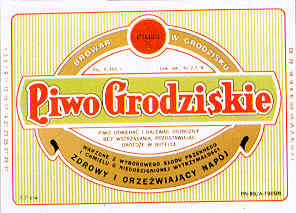
Based on this, the Grätzer/Grodziskie I helped brew at Jopen, which we went to great trouble to get as authentic as possible, isn't true to style.

Why do I get so annoyed? Because plenty of people will take this as the "official" definition of Grätzer. I'll waste days of my time arguing about what Grätzer is really like with those who take the excrement of the Brewers' Association as the gospel on beer styles.

I wish they's just carried on ignoring the style. It would have made my life much easier.

Saturday, 23 February 2013

Gobsmacked

Thanks to Aaron Bennett for the Charlie Papazian text I'd requested.

I've seen some bollocks written about beer history, but this take the whole McVitie's warehouse:

"Most barley wines are golden or copper colored. One style that is a deep rich copper brown is represenetd by Russian Imperial Stout brewed by the Courage Brewery in England. It is a style unto itself, not really a stout in the traditional sense , but historically named for its strength."
"The Complete Joy of Homebrewing" by Charlie Papazian, page 135.

Even the worst writers realise Russian Stout is, er, a Stout. They might name the wrong Russian monarch as its recipient, or talk twaddle about its strength being to avoid freezing in transit. But they do get its basic Stoutiness right.

He can't have ever tried the beer. It's pitch black and the flavour is, well, Stouty.

I'm gobsmacked.

Back from Boston

I'm just back from a week in cold and snowy Boston. Lots of fun, but the weather was a bit limiting. Very busy, too.


I drank a random selection of Pretty Things stuff, Stouts, a few IPAs, beers people gave me and whatever looked decent in whichever pub I was in. Met old friends, made new ones and generally had a good time. I even spent a few hours with the family.

But I'm not here to talk about my time in Boston. Well, not directly.

We'd been advised that the Coop on Harvard Square was the cheapest place to buy Harvard stuff. But mostly it sells books.  I couldn't resist taking a look at the beer section.

And there was really a section. Even though it was labelled "Wines and Spirits", there were a decent number of books. About 30 times as many as you'll find in a large German bookshop. Mostly American stuff, but some by British authors.

It gave me a chance to take a look at some books I'd heard about, but not seen. You can probably guess what's coming next. I had a simple way of checking their accuracy: look at what they said about the history of IPA, Porter, Stout and Mild.

I'm not sure what's more depressing: the errors or the fact that they all repeated the same ones. I don't think anyone had researched any further than the BJCP guidelines.

There was one unique to a single book. Something about Russian Stout, saying that it was really a type of Barley Wine and not a Stout in the modern sense at all. Quite an impressive garbling of history. Mixing up the stories of Burton Ale and Russian Stout.

I'm pretty sure it was in "The Complete Joy of Homebrewing" by Charlie Papazian. But I'm not sure, because I looked at 8 or 10 books. Does anyone own a copy? If you do, could you send me the passage in question? It's not that long.

Tuesday, 22 December 2009

Competition!

Two boxes arrived yesterday. Two boxes of beautiful books. If you've been attentive reader of this blog, you'll remember this is usually a cue for a competition.

My style has been described as stream of unconsciousness. I'll be honest with you. I started this post with no idea of what the competition question would be. The idea count now stands at almost one.


I hadn't meant to post this yet. Slipped through by mistake. But, usefully, one of you has come up with an idea for me. No need to waste my own brain power.

Thank you Rod:

"I think you should organise a competition, just for a bit of Xmas fun, to see who can get the most mistakes into one short sentence....."

You could call it the Papazian Cup (but let's not get him to judge it, eh? He just might not spot all the mistakes....)

Papazian Cup it is then. There will be more than one prize. Extra marks will be awarded for particularly outrageous or amusing mistakes.


(Added some hours later)
Right. I've misunderstood my own competition. That's a new one. My apologies to the entrants who understood the rules correctly.

But do try and keep it to one sentence. Though, should the muse possess you, feel free to write more. And you can submit quotes from bona fide experts if you want.

Is that clearer?

Monday, 30 November 2009

Traditional watch

Look, I know my work is littered with examples. Pot, black, kettle, etc. I'm a reformed man. But I haven't had chance to correct my past writings yet.

Traditional. A word as vague as it is handy. It covers any period more than 20 years in the past. Or earlier than you can remember. About as precise as that. Don't know any exact dates? Just use "traditional" instead.

Now I've realised that, every time I see the word it jumps off the page (or the screen). That gives me an idea, why don't I post the most flagrant and gratuitous uses of the word "traditional"? I could make it a regular feature of the blog.

Before you ask, this isn't an innovation. Private Eye have been doing something similar for years.

For no particular reason other than I just stumbled across them, here's a couple of outstanding examples of how to obscure history by the use of "traditionally" from Charlie Papazian:

"Contrary to popular belief the original Guinness draft stout is not strong ale; it’s no more than about 3.8% alcohol, even today. The bottled stout labeled “foreign export” traditionally reaches up to about 6% alcohol."
http://www.examiner.com/examiner/x-241-Beer-Examiner~y2008m9d21-Irishstyle-dry-stout--a-world-classic

"Stout’s deep brown/black color suggests strength, yet traditionally this beer was brewed to lower strengths. Even today, draft stouts in Ireland are at about 3% alcohol."
http://www.examiner.com/x-241-Beer-Examiner~y2009m11d23-Beer-Styles-Sociopolitical-stout-and-pilsener-part-22?

Random. Totally random.