Showing posts with label X Ales. Show all posts

Thursday, 5 October 2017

Let’s Brew Thursday - 1945 Barclay Perkins XX

I’m almost done with watery Barclay Perkins Milds. But not quite. Just two to go.

This beer was originally brewed in July 1945, after the war in Europe had ended, but while fighting was still going on in the Pacific. Which must have seemed pretty weird. In London the blackout was finally lifted and the lights had come back on, but British servicemen were still dying in the Far East.

How does this differ from their 1944 Mild? Not very much, is the short answer. It still contains the same malt: SA malt, crystal malt and amber malt. The only difference there is that mild malt makes up most of the base. The non-malt sources of fermentables are much the same: No. 3 invert sugar and flaked barley.

The one radical departure is the inclusion of malt extract. I’m guessing the reason behind that was the enzymes, but I could be wrong. It’s such a small amount that I struggle to find another reason for its inclusion.

Other than that, the proportion of sugar has increased, from just over 9% to almost 15%. Not sure why that should be. It was too soon after the German surrender for the sugar supply to have improved. And sugar and sweets remained rationed for several more years.

Quite a lot of the hops – more than half – were from the 1942 and less than a quarter from 1944. To account for that, I’ve reduced the total hops from 1.50 ozs. to 1 oz.

This was another heavily primed beer, with the primings raising the effective OG a full four gravity points to 1035.4º. Given that there would have been a secondary fermentation in the case, the eventual strength would have been over 3% ABV.

One last note. As brewed, this beer will come out about 14 SRM. You’ll need to add more caramel to get the colour of the beer as served in the pub.


1945 Barclay Perkins XX
mild malt 3.75 lb 55.35%
amber malt 0.67 lb 9.89%
crystal malt 60 L 0.50 lb 7.38%
flaked barley 0.67 lb 9.89%
malt extract 0.125 lb 1.85%
No. 3 invert sugar 1.00 lb 14.76%
caramel 1000 SRM 0.06 lb 0.89%
Fuggles 90 mins 0.50 oz
Fuggles 60 mins 0.50 oz
Fuggles 30 mins 0.25 oz
OG 1031.5
FG 1010
ABV 2.84
Apparent attenuation 68.25%
IBU 14
SRM 20
Mash at 150º F
Sparge at 165º F
Boil time 90 minutes
pitching temp 60.5º F
Yeast Wyeast 1099 Whitbread Ale

Thursday, 3 August 2017

Reid Ales 1852 - 1853

Did I mention my new book? It's just about done. Just the last few recipes to polish off and I can send it off to the printers. So to speak.

Let's Brew! it's called. Containing a couple of hundred recipes, of which almost half are brand new. You could see it as an add-on pack for The Home Brewer's Guide to Vintage Beer.

Why am I mentioning this? because one of things I was prompted to do while writing it was to take a closer look at some of the brewing records I had inexplicably neglected. Which included those of Reid.

Reid was one of the big Porter brewers in the 19th cntury and remained one of the largest breweries in London, and hence the UK, in the early part of the 19th. After which it began to fall behind the likes of Whitbread, Barclay Perkins and Truman.

In the frist half of the 19th century they brewed Ales as well as Porter and Stout, though inexplicably dropped the Ales in the 1860's or 1870's. As at other London breweries, their Ales fell into two groups, Mild Ales indicated by a number of X's and Stock Ales indicated by a number of K's.

Even the weakest, X Ale, their lowest gravity Mild was quite a strong beer. Mild Ales of 3% ABV or so are a relatively recent development, only really becoming the norm in the 1930's. Their XXX Ale, at 9.5% ABV, looks nothing like a modern Mild. Waich it isn't, as it was also pale in colour and pretty bitter.

All of these beers, with the exception of X Ale, which contained a tiny amount of black malt, were 100% pale malt. The main difference between the X's and the K's was the level of hopping, which was higher in the latter. Which makes total sense as they were meant to be aged for six months or more.

Reid Ales 1852 - 1853
Year Beer Style OG FG ABV App. Atten-uation lbs hops/ qtr hops lb/brl boil time (hours) boil time (hours) Pitch temp
1852 X Mild 1069.3 1024.9 5.86 64.00% 12.26 3.63 1.5 3 57º
1852 XXX Mild 1097.0 1025.8 9.42 73.43% 10.72 4.90 1.5 3 57º
1853 KK Stock Ale 1083.1 1018.3 8.57 78.00% 13.42 4.81 1.5 3 56º
1853 KKK Stock Ale 1095.6 1023.5 9.53 75.36% 13.10 5.71 2 4 57º
1853 KKKK Stock Ale 1116.3 1031.6 11.21 72.86% 13.56 7.23 2 4 56.25º
Source:
Reid brewing record held at Westminster City Archives, document number 789/273.

Despite closing in 1898 on their merger with Watney and Combe, the Reid name lived on as a brand for Watney Stout well past WW II.

Wednesday, 21 October 2015

Let’s Brew Wednesday – 1909 Barclay Perkins KK

A little relief from the 1950’s, with a classic Edwardian Burton Ale, KK. And a recipe from Kristen.

This beer would have been sold as Burton and would have been one of the standard draught beers in their London pubs. Burton Ales were pretty common in London until the 1960’s, though in their latter days as a winter seasonal. Youngs Winter Warmer is the only survivor of this tradition.

K Ales, the keeping versions of X Ales, evolved during the 19th century, especially towards the end. Initially K and X Ales were identical, save for the hopping, with K Ales having approximately 50% more hops. The grists were achingly simple: pale malt. At Barclay Perkins, that changed in the 1880’s, when crystal malt was added to their X Ale grist but not to the K Ales. Instead, they contained No. 2 invert sugar.

Around 1900 there was another change to the K Ales grists, with SA malt (I think it stands for Strong Ale) being used as part of the base malt. After WW I the grists diverged  even more at Barclay Perkins, leaving their Burton and Mild Ales as quite different beers.

At Fullers, it was different story. They were still part-gyling X Ale with their Burton or Strong Ales after WW II. Meaning their Burton was really just a stronger version of their Mild.

I’m pretty sure this would have been my drink of choice, had I been living in London a little over a century ago.


On that happy thought, it’s over to Kristen . . . . . .


Kristen’s Version:
Notes: Another week, another KK. This is the style of K-ales I really like. Absolutely loads of hops, lots of tasty dark sugar with a little higher finishing gravity to round everything out nicely. If you are in need of more K-ale’s in your life, this is for you. If not, this is for you. Seriously.

Malt: A few pale malts…English and American 6-row. Also, we have again here our ever sexy, never duplicated SA malt. Finishes pretty fat and sweet and tasty but we don’t have that. We’ve spoken of this before… so what I’ve done here is sub-out the English ale malt and SA malt with some nice English Mild malt. It won’t get you all the way there but it will definitely get you closer than just using pale malt. If you can’t find mild, they go ahead and go with something like Optic, that’s pretty nice and rich. The US 6-row I think is quite mandatory to these K-ales. Really lends some huskiness to bright up the rich malt character. I have crystal 120L on here but really you can use anything from 50 to 150ish. Pick your favorite English type because we aren’t talking ‘cara’ here…proper English caramel is all you need. Invert No2 is required; if you don’t have it, make it. If not, make something else.

Hops: Loads and loads of Goldings chucked into this baby here along with, surprisingly, a good amount of Hallertauer! We’re talking like +3#/bbl and that’s before all the dry hopping! The first addition should be first wort hopped, then follow along. Dry hops aren’t huge but a nice boost for the aroma at 0.5#/bbl or so. As always, they use different Goldings from different places but if you want to get this beer similar in character, you’ll keep your AA% low as you need that greenery to get the correct mouth feel and such. 

Yeast: Same problem as always with these types of beers is trying to keep the gravity higher and not finishing too dry. As long as you are north of 1.015 or so I think it will be close enough. Any drier than that and it will get oppressive.

Cask: Standard procedure:
1) let the beer ferment until finished and then give it another day or so. For me right around 5-7 days.
2) Rack the beer to your vessel of choice (firkin, polypin, cornie, whatever).
3) Add primings at ~3.5g/L
4) Add prepared isinglass at 1ml/L
5) ONLY add dry hops at 0.25g/l – 1g/L.
6) Bung it up and roll it around to mix. Condition at 55F or so for 4-5 days and its ready to go. Spile/vent. Tap. Settle. Serve at 55F.

Monday, 23 December 2013

Mr. Heppenstall takes a partner

Heppenstall was a name long-associated with brewing in Newark. According to a newspaper, at the end of the 19th-century Heppenstall's was the oldest name in brewing in the town:

"Heppenstall's Brewery, Newark. - We understand that the old-established brewery firm of Heppenstalls — the oldest in name we believe in Newark — have for family reasons formed themselves into a Limited Liability Company, under the style of Heppenstalls Limited. The new Company will acquire the business, with its freehold brewery, land, maltkilns, tied houses, etc., as from the 1st of October, instant."
Nottingham Evening Post - Saturday 11 October 1890, page 2.
In 1863, he took in a Mr. Holland as partner. Not sure how long it lasted, as I haven't found any other reference to Heppenstall and Holland.

Stamford Mercury - Friday 09 October 1863, page 1.

"ALBION BREWERY, NEWARK.
C HEPPENSTALL begs to thank his friends and patrons for the support so kindly afforded him for the last 14 years, and also Inform those friends and the public generally that he has taken into Partnership Mr. E. Wm. Holland, that henceforth the business will be carried on upon the same premises under the firm of Heppenstall and Holland. See following advertisement

HEPPENSTALL and HOLLAND beg to call the attention of the nobility, clergy, and gentry of Newark and its Environs to their first-class Fine ALES, brewed from this year's new Malt and Hops, which will be ready in few days for private and home consumption. For purity and excellence character, at the price, these Ales cannot be surpassed.

H. and H. Invite especial attention to their Pale Bitter Ale, at 1s per gallon, a fine tonic and agreeable beverage for private families.

Supplied by their respective Agents, or direct from the Brewery, in casks of 6, 9, 12, 18, 26, and 36 Gallons.
Carriage paid to any part

XX Ale. 1s. 0d. per Gallon.
XXX 1s. 3d. „
XXXX 1s. 4d. „ .

BITTER ALES.
XX Family Pale Ale 1s. 0d. „
East India 1s. 4d. „
Porter 1s. 0d. "
Stout 1s. 3d. „

Wholesale Wine and Spirit Merchants.
Agents for Burton Pale Ale.

For the convenience of their friends H. and H. have taken out a licence to enable them to supply Wines and Spirits from One Gallon down to a Bottle.
Albion Brewery, Newark."
Stamford Mercury - Friday 09 October 1863, page 1.
There are a few odd things about those beers. Why is there no X Ale?  Why aren't there even price differentials between the three Mild Ales? You'd expect them to be 1s, 1s 2d and 1s 4d per gallon. I'm starting to see a pattern in Newark beers. Everyone seemed to brew a light Pale Ale at 1s or 1s 2d per gallon. As well as a more expensive Pale Ale called IPA (or something similar). Though usually they were 1s 6d a gallon rather than the 1a 4d Heppenstall charged.

Interesting how Porter and Stout are included under the heading "Bitter Ales". It looks like they're using that term in the way "Beer" was used in the 18th century. Porter and Stout were, of course, types of Brown Beer.

The C stands for Christopher.  How do I know? Because of this death announcement:

"DEATHS
HEPPENSTALL - the 16th inst at Southwell, Christopher Heppenstall, Esq., proprietor of the Albion Brewery, Newark, aged 61 years."
Grantham Journal - Saturday 23 March 1872, page 4.

But hang on, has he come back from the dead a few years later?

"FARNSFIELD, Notts. To be LET, old-licenced PUBLIC-HOUSE. Rent £19. Inventory about £80. — Apply to Mr. C. Heppenstall, Albion Brewery, Newark.'
Stamford Mercury - Friday 13 December 1878, page 1.
No, it seems he had a son who was also called Christopher. Who can't have been all that old, seeing as his father had died aged 61 14 years earlier. He couldn't have been older than in his fifties.

"Newark Town Council.—A vacancy has been caused in the representation of the East Ward in the Town Council by the death of Mr. Christopher Heppenstall, which took place the other day at Finsbury Park, London. Mr. Heppenstall was a brewer, and well known for his benevolence to the poor in the town. He had been in failing health for some time past, so that the telegram announcing his demise, though it occasioned regret, cannot be said to have caused surprise. The funeral took place on Tuesday, the deceased gentleman being interred alongside the remains of his first wife at East Bridgeford. In polities Mr. Heppenstall was a Conservative. On Monday, a deputation waited upon Mr. J. F. Warwick, of (a member of the firm R. Warwick and Sons, brewers), and invited him to offer himself as a candidate. We understand Mr. Warwick has decided to accept the invitation, and there can be no doubt his candidature will be very popular."
Grantham Journal - Saturday 28 August 1886, page 2.

Now isn't that interesting? One Tory brewer replacing another on Newark council. The brewers were heavily involved in Newark politics as councillors, mayor and even MP.

Richard Warwick and Sons was one of the firms that merged to become Warwicks and Richardsons.

Saturday, 21 December 2013

Whitbread K Ales in the 1870's

It seems like several years ago I started this series on Whitbread's K Ales. At this rate, I may just finish before I expire.

It's a momentous, er, moment in the history of Whitbread's Ales. Why? We'll be getting to that in a minute. After I've run through a few other things in excruciating detail.

First let's look at the changes in K Ales since the last decade. The table shows a continued decline in gravity of both KK and KKK - 3%-odd. Not huge, but over the whole century such small changes add up. As you can see by comparing the figures from the 1840's and the 1870's. OG is down almost 16% for KK and 13% for KKK. There's been a similar fall in ABV and, for KKK, even a fall in the degree of apparent attenuation.

The hopping rates are more complicated. They're slightly down on the 1860's, but more than 50% higher than in the 1840's. Such a big change must have altered the character of the finished beers. Why did they up the hop rate so much? No idea. If you have an explanation, feel free to chip in.

period beer OG FG ABV App. Atten-uation lbs hops/ qtr hops lb/brl
1840's KXX 1089.0 1031.3 7.63 64.87% 10.10 3.96
1860's KK 1078.1 1027.4 6.70 64.76% 15.98 6.4
1870's KK 1075.1 1024.9 6.63 66.86% 15.34 5.22
difference 1860's - 1870's -3.83% -9.09% -0.98% 3.25% -4.04% -18.33%
difference 1840's - 1870's -15.64% -20.35% -13.09% 3.07% 51.92% 31.83%
1840's KXXX 1097.7 1030.8 8.85 68.42% 8.99 3.92
1860's KKK 1087.5 1028.9 7.30 67.01% 15.91 6.79
1870's KKK 1084.8 1032.2 6.98 62.12% 15.21 6.19
difference 1860's - 1870's -3.08% 11.57% -4.34% -7.30% -4.42% -8.92%
difference 1840's - 1870's -13.26% 4.47% -21.14% -9.20% 69.14% 57.86%
Sources:
Whitbread brewing records held at the London Metropolitan Archives.

The level of attenuation of the K Ales still looks pretty low at well under 70%. But remember that these were Stock Ales which would have been stored for perhaps a year or more before sale. During which time Brettanomyces would have been nibbling away slowly at the remaining sugars. The true final gravity was doubtless a good bit lower. How can I say for sure there would have been a secondary Brettanomyces fermentation? Because the customers would have complained if there hadn't been. If you were buying Stock Ale, you'd expect the "aged" flavour imparted by Brettanomyces.

Before we go any further, I have to point out something I noticed when looking at the X Ales. For this decade I've examples from both the winter and summer months. And there's a clear difference in the hopping. I've seen brewing manuals advise a higher hopping rate for the warmer months and here it's plain to see. 10%-15% per quarter, 14%-30% per barrel.

period beer OG FG ABV App. Atten-uation lbs hops/ qtr hops lb/brl
1870's summer X 1062.2 1019.0 5.72 69.49% 8.33 2.32
1870's winter X 1061.4 1018.0 5.75 70.71% 6.03 1.63
difference summer - winter -1.29% -5.19% 0.49% 1.75% -27.56% -29.79%
1870's summer XL 1069.7 1022.2 6.28 68.17% 8.74 2.83
1870's winter XL 1069.0 1023.0 6.08 66.69% 7.47 2.36
difference summer - winter -1.02% 3.61% -3.18% -2.17% -14.51% -16.54%
1870's summer XX 1079.0 1031.1 6.34 60.62% 9.10 3.41
1870's winter XX 1077.6 1023.6 6.28 61.27% 8.14 2.93
difference summer - winter -1.87% -24.07% -0.87% 1.08% -10.58% -14.14%

(The figures are derived from the other and previous tables.)

A continued reduction in Whitbread's range of X Ales - this time XXX has disappeared, has left only one meaningful comparison. The only two beers to still share a strength band, XX and KK. This whittling down of the strong Milds is probably connected with the most fascinating insight these figures have given me: the weakening of the connection between K and X Ales. The hopping rate of XX is 44% lower per quarter and 39% lower per barrel. About what I'd expect.

period beer OG FG ABV App. Atten-uation lbs hops/ qtr hops lb/brl
1870's KK 1075.1 1024.9 6.63 66.86% 15.34 5.22
1870's XX 1078.4 1030.7 6.30 60.8% 8.64 3.20
difference: 4.43% 23.33% -4.97% -9.09% -43.64% -38.76%

Now here's the best bit. Looking at the recipes, for the first time there are significant differences between the K and X Ales. No longer is the K Ale just a more heavily hopped version of the X Ale. The grists aren't the same. This is the start of the process which, by the 1930's, would leave Mild and Burton with significantly different recipes.

Looking at the K Ales first, they have grists of around 85% pale malt and 15% sugar. Given all that sugar, it's surprising how poor the attenuation is. What type of sugar is it? Probably No. 1 or No. 2 invert. Looking at the recipes, those K Ales  are starting to look quite like Pale Ales, just higher gravity and not quite as heavily hopped.

Now look at the X Ales. Only one contains sugar and about a quarter contain a small quantity of brown malt. Which is why, unlike in some of the earlier decades, K and X Ales were never parti-gyled together in the 1870's.

There's also a notable difference in the type of hops used. More than half the K Ales contain only English hops. Almost every X Ale does. Poperinghe and Belgian hops both only occur in X Ales. My conclusion: they used better quality hops in the K Ales. Which, of course, makes sense.

Nothing remains but to show you the final tables.

Whitbread K Ales in the 1870's
Date Year Beer OG FG ABV App. Atten-uation lbs hops/ qtr hops lb/brl boil time (hours) boil time (hours) Pitch temp max. fermen-tation temp length of fermen-tation (days)
6th Dec 1871 KK 1078.7 1029.9 6.45 61.97% 15.36 6.31 58º º
17th Oct 1872 KK 1075.1 1017.5 7.62 76.75% 14.10 4.98 58º º
25th Sep 1873 KK 1078.4 1028.3 6.63 63.96% 14.20 5.50 58º 72º 3 + 3
11th Dec 1874 KK 1075.9 1030.5 6.01 59.85% 13.64 5.14 57º 73º 4 + 3
15th Nov 1875 KK 1073.4 1022.2 6.78 69.81% 14.85 5.23 1.75 3.17 56º 72º 4 + 5
24th Nov 1876 KK 1073.1 1023.3 6.60 68.18% 13.08 4.39 1.75 2.83 58º 73º 4 + 4
17th Apr 1877 KK 1073.4 1021.6 6.85 70.57% 15.88 5.44 1.75 2.58 58º 71.5º 4 + 5
25th Jan 1878 KK 1069.3 1023.5 6.05 66.00% 15.08 4.87 1.75 3 58º 75.5º 5 + 6
4th Dec 1879 KK 1078.4 1027.7 6.71 64.66% 21.84 5.10 2 3 58º º 9
9th Feb 1870 KKK 1084.8 1029.1 7.37 65.69% 14.38 6.21 1.5 2 58º º 6
27th Mar 1871 KKK 1085.0 1035.5 6.56 58.31% 13.51 5.97 2.5 58º º 5
27th Nov 1872 KKK 1085.0 1034.1 6.74 59.93% 14.36 6.85 58º º
23rd Sep 1873 KKK 1084.5 1033.2 6.78 60.66% 14.53 6.90 58º 72º 3 + 3
6th Oct 1874 KKK 1084.8 1036.0 6.45 57.52% 11.54 4.92 58º 73º 4 + 3
6th Jan 1875 KKK 1083.4 1028.0 7.33 66.45% 14.53 6.35 57º 72.75º 4 + 4
20th Nov 1876 KKK 1085.3 1028.5 7.51 66.56% 14.17 6.24 1.75 2.5 57º 72.25º 4 + 5
19th Jan 1877 KKK 1086.4 1034.1 6.93 60.58% 14.99 5.94 2 2.75 57º 71.5º 5 + 3
28th Jan 1878 KKK 1085.6 1031.3 7.18 63.43% 15.04 6.11 2.75 57º º 9
8th Dec 1879 KKK 1083.1 25.03 6.37 2 3.08 58º º 8
Source:
Whitbread brewing records held at the London Metropolitan Archives, document numbers LMA/4453/D/01/035, LMA/4453/D/01/036, LMA/4453/D/01/037, LMA/4453/D/01/038, LMA/4453/D/01/039, LMA/4453/D/01/040, LMA/4453/D/01/041, LMA/4453/D/01/042, LMA/4453/D/01/043, LMA/4453/D/01/045 and LMA/4453/D/02/024.


Whitbread K Ale grists in the 1870's
Date Year Beer OG FG ABV App. Atten-uation pale malt sugar hops
6th Dec 1871 KK 1078.7 1029.9 6.45 61.97% 85.32% 14.68% English hops.
17th Oct 1872 KK 1075.1 1017.5 7.62 76.75% 84.68% 15.32% English hops.
25th Sep 1873 KK 1078.4 1028.3 6.63 63.96% 85.16% 14.84% English hops.
11th Dec 1874 KK 1075.9 1030.5 6.01 59.85% 86.76% 13.24% English hops.
15th Nov 1875 KK 1073.4 1022.2 6.78 69.81% 88.57% 11.43% American and Altmark hops
24th Nov 1876 KK 1073.1 1023.3 6.60 68.18% 86.82% 13.18% American and English hops.
17th Apr 1877 KK 1073.4 1021.6 6.85 70.57% 87.36% 12.64% American and English hops.
25th Jan 1878 KK 1069.3 1023.5 6.05 66.00% 86.85% 13.15% American and English hops.
4th Dec 1879 KK 1078.4 1027.7 6.71 64.66% 73.73% 26.27% American and English hops.
9th Feb 1870 KKK 1084.8 1029.1 7.37 65.69% 85.62% 14.38% American, Bavarian and English hops.
27th Mar 1871 KKK 1085.0 1035.5 6.56 58.31% 84.46% 15.54% English hops.
27th Nov 1872 KKK 1085.0 1034.1 6.74 59.93% 86.14% 13.86% English hops.
23rd Sep 1873 KKK 1084.5 1033.2 6.78 60.66% 86.37% 13.63% English hops.
6th Oct 1874 KKK 1084.8 1036.0 6.45 57.52% 87.10% 12.90% English hops.
6th Jan 1875 KKK 1083.4 1028.0 7.33 66.45% 84.82% 15.18% English hops.
20th Nov 1876 KKK 1085.3 1028.5 7.51 66.56% 86.87% 13.13% American and English hops.
19th Jan 1877 KKK 1086.4 1034.1 6.93 60.58% 88.02% 11.98% English hops.
28th Jan 1878 KKK 1085.6 1031.3 7.18 63.43% 86.50% 13.50% English hops.
8th Dec 1879 KKK 1083.1 76.28% 23.72% American, Californian and English hops.
Source:
Whitbread brewing records held at the London Metropolitan Archives, document numbers LMA/4453/D/01/035, LMA/4453/D/01/036, LMA/4453/D/01/037, LMA/4453/D/01/038, LMA/4453/D/01/039, LMA/4453/D/01/040, LMA/4453/D/01/041, LMA/4453/D/01/042, LMA/4453/D/01/043, LMA/4453/D/01/045 and LMA/4453/D/02/024.


Whitbread X Ales in the 1870's
Date Year Beer OG FG ABV App. Atten-uation lbs hops/ qtr hops lb/brl boil time (hours) boil time (hours) Pitch temp max. fermen-tation temp length of fermen-tation (days)
17th Mar 1870 X 1061.2 6.06 1.71 1.5 2 64º º
19th Jul 1871 X 1061.8 1022.2 5.24 64.13% 8.99 2.61 64º º 5
18th Oct 1872 X 1059.8 1018.3 5.50 69.44% 6.94 1.88 64º º
23rd Aug 1872 X 1065.9 1021.6 5.86 67.23% 8.66 2.54 64º º
29th Jul 1873 X 1062.0 1023.0 5.17 62.95% 8.03 2.41 64º º 5
16th Jan 1873 X 1062.3 1022.7 5.24 63.56% 5.77 1.63 64º º
18th Jul 1874 X 1060.4 1019.7 5.39 67.43% 8.40 2.33 64º 74.5º 2 + 3
19th Oct 1874 X 1061.5 1016.3 5.97 73.42% 6.43 1.63 62º 73º 2 + 3
23rd Sep 1875 X 1062.3 1019.9 5.61 68.00% 7.73 2.17 2.17 60º 71º 3 + 3
1st Nov 1875 X 1062.3 1017.5 5.94 72.00% 6.54 1.73 1.33 2 60º 72º 3 + 3
19th Oct 1876 X 1061.8 1016.1 6.05 73.99% 6.13 1.66 60º 72.5º 3 + 4
17th Jul 1876 X 1064.8 1015.8 6.49 75.64% 8.04 2.14 1.5 2 61º 73º 3 + 4
19th Jul 1877 X 1060.4 1015.8 5.90 73.85% 8.52 2.27 1.5 2.58 61º 72º 3 + 4
19th Oct 1877 X 1060.9 1019.1 5.53 68.64% 5.06 1.35 1.5 2.33 61º 72º 8
5th Feb 1878 X 1060.7 1016.6 5.83 72.60% 5.29 1.41 61º 72º 7
16th Jul 1878 X 1060.7 1015.8 5.94 73.97% 8.53 2.29 2.5 2 61º º 7
26th Jul 1879 X 1061.8 1017.2 5.90 72.20% 8.03 2.13 2 2 62º º 6
6th Jan 1879 X 1062.3 1017.5 5.94 72.00% 6.08 1.69 1.5 1.75 61º 75º 3 + 3
29th Mar 1871 XL 1067.6 1021.3 6.12 68.44% 8.14 2.67 1.5 2 60º º 6
26th Sep 1871 XL 1068.1 1024.7 5.75 63.82% 10.18 3.35 60º º
15th Jul 1872 XL 1069.3 1026.3 5.68 62.00% 9.06 2.79 60º º
10th Feb 1872 XL 1070.1 1024.9 5.97 64.43% 7.00 2.05 60º º
18th Oct 1873 XL 1070.1 1024.7 6.01 64.82% 9.11 2.99 60º 75º 3 + 3
2nd Aug 1873 XL 1071.2 1027.1 5.83 61.87% 9.09 3.08 60º 75º 5
28th Jul 1874 XL 1071.7 1023.8 6.34 66.80% 9.41 3.14 60º 75º 3 + 2
17th Feb 1875 XL 1068.4 1022.4 6.08 67.21% 8.06 2.58 59º 72.5º 3 + 3
22nd Sep 1875 XL 1069.3 1022.2 6.23 68.00% 7.79 2.49 1.5 60º 71º 3 + 3
11th Jul 1876 XL 1070.4 1019.9 6.67 71.65% 8.11 2.87 2.5 2.75 60º 72.5º 3 + 3
19th Oct 1877 XL 1068.7 1021.6 6.23 68.55% 5.06 1.52 1.5 2.33 61º 72º 8
17th Jul 1877 XL 1069.0 1016.6 6.93 75.90% 8.49 2.62 3.5 60º 72º 3 + 5
16th Jul 1878 XL 1069.3 1018.3 6.74 73.60% 8.53 2.62 2.5 2 61º º 7
29th Jul 1879 XL 1069.0 1020.8 6.38 69.88% 8.02 2.52 1.5 61º 72.5º 8
18th Mar 1879 XL 1070.4 1015.8 7.22 77.56% 6.00 1.80 1.75 2.25 61º 73º 7
26th Sep 1871 XX 1080.1 1030.2 6.60 62.28% 10.18 3.93 60º º
3rd Apr 1871 XX 1080.3 1032.7 6.30 59.31% 8.53 3.33 1.5 2 64º º 5
23rd Aug 1872 XX 1079.5 1031.9 6.30 59.93% 8.66 3.06 60º º
8th Aug 1873 XX 1077.6 1031.3 6.12 59.64% 8.47 3.23 60º 75º 3 + 2
16th Apr 1874 XX 1077.0 1029.1 6.34 62.23% 7.98 2.76 60º 75º 3 + 2
17th Feb 1875 XX 1075.9 1029.4 6.16 61.31% 8.06 2.86 59º 73.75º 3 + 3
Source:
Whitbread brewing records held at the London Metropolitan Archives, document numbers LMA/4453/D/01/035, LMA/4453/D/01/036, LMA/4453/D/01/037, LMA/4453/D/01/038, LMA/4453/D/01/039, LMA/4453/D/01/040, LMA/4453/D/01/041, LMA/4453/D/01/042, LMA/4453/D/01/043, LMA/4453/D/01/044, LMA/4453/D/01/045 and LMA/4453/D/02/024.

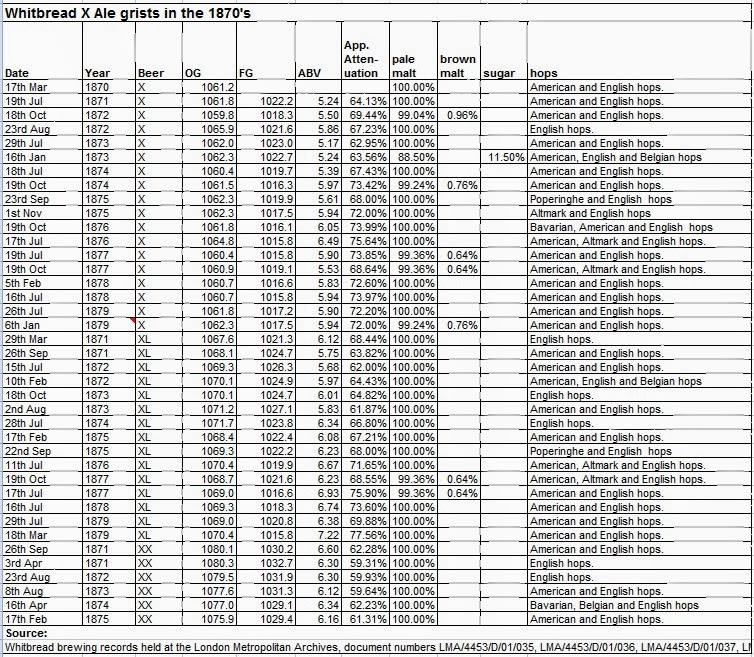
Whitbread X Ale grists in the 1870's
Date Year Beer OG FG ABV App. Atten-uation pale malt brown malt sugar hops
17th Mar 1870 X 1061.2 100.00% American and English hops.
19th Jul 1871 X 1061.8 1022.2 5.24 64.13% 100.00% American and English hops.
18th Oct 1872 X 1059.8 1018.3 5.50 69.44% 99.04% 0.96% American and English hops.
23rd Aug 1872 X 1065.9 1021.6 5.86 67.23% 100.00% English hops.
29th Jul 1873 X 1062.0 1023.0 5.17 62.95% 100.00% American and English hops.
16th Jan 1873 X 1062.3 1022.7 5.24 63.56% 88.50% 11.50% American, English and Belgian hops
18th Jul 1874 X 1060.4 1019.7 5.39 67.43% 100.00% American and English hops.
19th Oct 1874 X 1061.5 1016.3 5.97 73.42% 99.24% 0.76% American and English hops.
23rd Sep 1875 X 1062.3 1019.9 5.61 68.00% 100.00% Poperinghe and English  hops
1st Nov 1875 X 1062.3 1017.5 5.94 72.00% 100.00% Altmark and English hops
19th Oct 1876 X 1061.8 1016.1 6.05 73.99% 100.00% Bavarian, American and English  hops
17th Jul 1876 X 1064.8 1015.8 6.49 75.64% 100.00% American, Altmark and English hops.
19th Jul 1877 X 1060.4 1015.8 5.90 73.85% 99.36% 0.64% American and English hops.
19th Oct 1877 X 1060.9 1019.1 5.53 68.64% 99.36% 0.64% American, Altmark and English hops.
5th Feb 1878 X 1060.7 1016.6 5.83 72.60% 100.00% American and English hops.
16th Jul 1878 X 1060.7 1015.8 5.94 73.97% 100.00% American and English hops.
26th Jul 1879 X 1061.8 1017.2 5.90 72.20% 100.00% American and English hops.
6th Jan 1879 X 1062.3 1017.5 5.94 72.00% 99.24% 0.76% American and English hops.
29th Mar 1871 XL 1067.6 1021.3 6.12 68.44% 100.00% English hops.
26th Sep 1871 XL 1068.1 1024.7 5.75 63.82% 100.00% American and English hops.
15th Jul 1872 XL 1069.3 1026.3 5.68 62.00% 100.00% American and English hops.
10th Feb 1872 XL 1070.1 1024.9 5.97 64.43% 100.00% American, English and Belgian hops
18th Oct 1873 XL 1070.1 1024.7 6.01 64.82% 100.00% English hops.
2nd Aug 1873 XL 1071.2 1027.1 5.83 61.87% 100.00% American and English hops.
28th Jul 1874 XL 1071.7 1023.8 6.34 66.80% 100.00% English hops.
17th Feb 1875 XL 1068.4 1022.4 6.08 67.21% 100.00% American and English hops.
22nd Sep 1875 XL 1069.3 1022.2 6.23 68.00% 100.00% Poperinghe and English  hops
11th Jul 1876 XL 1070.4 1019.9 6.67 71.65% 100.00% American, Altmark and English hops.
19th Oct 1877 XL 1068.7 1021.6 6.23 68.55% 99.36% 0.64% American, Altmark and English hops.
17th Jul 1877 XL 1069.0 1016.6 6.93 75.90% 99.36% 0.64% American and English hops.
16th Jul 1878 XL 1069.3 1018.3 6.74 73.60% 100.00% American and English hops.
29th Jul 1879 XL 1069.0 1020.8 6.38 69.88% 100.00% American and English hops.
18th Mar 1879 XL 1070.4 1015.8 7.22 77.56% 100.00% American and English hops.
26th Sep 1871 XX 1080.1 1030.2 6.60 62.28% 100.00% American and English hops.
3rd Apr 1871 XX 1080.3 1032.7 6.30 59.31% 100.00% English hops.
23rd Aug 1872 XX 1079.5 1031.9 6.30 59.93% 100.00% English hops.
8th Aug 1873 XX 1077.6 1031.3 6.12 59.64% 100.00% American and English hops.
16th Apr 1874 XX 1077.0 1029.1 6.34 62.23% 100.00% Bavarian, Belgian and English hops
17th Feb 1875 XX 1075.9 1029.4 6.16 61.31% 100.00% American and English hops.
Source:
Whitbread brewing records held at the London Metropolitan Archives, document numbers LMA/4453/D/01/035, LMA/4453/D/01/036, LMA/4453/D/01/037, LMA/4453/D/01/038, LMA/4453/D/01/039, LMA/4453/D/01/040, LMA/4453/D/01/041, LMA/4453/D/01/042, LMA/4453/D/01/043, LMA/4453/D/01/044, LMA/4453/D/01/045 and LMA/4453/D/02/024.