Wednesday, 15 June 2022

Let's Brew Wednesday - 1902 Boddington TA

This one almost slipped through the cracks. A low-gravity Table Ale. A weaker Mild Ale, really.

I wonder what form Table Ale was sold in? It could have been an exclusively bottled beer. Unfortunately, it doesn’t appear in the only Boddington price list I have. It does seem odd calling this a watery Mild, when it’s stronger than most post-WW II versions. But, at a time, when average OG was over 1050º, 1038º was watery. Outside London, there were Mild Ales of a similar strength, especially out in the sticks.

The malt was 10 quarters of English and 2.5 quarters of Californian. A pretty typical mix for the period. By this time, 100% English malt was unusual.

No. 3 invert is just a guess. Pretty sure it’s some sort of invert as it was manufactured by Garton. And No. 3 because it only turns up in Boddington Mild Ales. The Pale Ales have a different type.

A whole of different harvests of hops were used. English from 1898, 1899, 1900 and 1901, Californian from 1900.

1902 Boddington TA
pale malt 7.50 lb 90.91%
No. 3 invert sugar 0.75 lb 9.09%
Cluster 120 mins 0.25 oz
Fuggles 60 mins 0.75 oz
Fuggles 30 mins 0.75 oz
Fuggles dry hops 0.25 oz
OG 1038
FG 1006
ABV 4.23
Apparent attenuation 84.21%
IBU 24
SRM 8
Mash at 155º F
Sparge at 165º F
Boil time 110 minutes
pitching temp 60º F
Yeast Wyeast 1318 London ale III (Boddingtons)


Tuesday, 14 June 2022

Breakfast today

Brunch, really, as I ate it well after noon. 

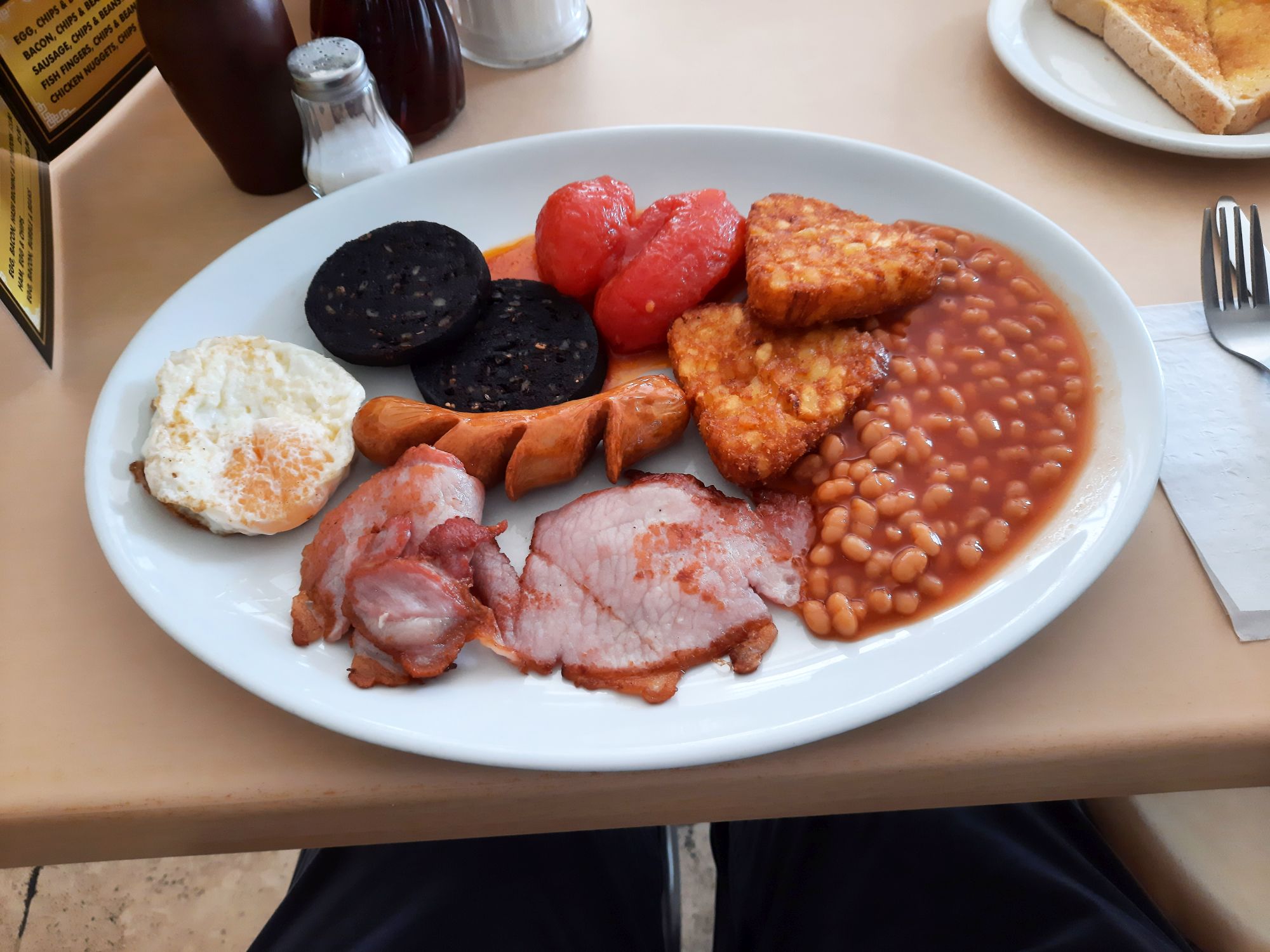
This is what it looked like, just after I started tucking in.


Before anyone starts slagging my breakfast off, the potatoes are a leftover from yesterday's tea. No toast, as our toaster died a couple of days ago. You can see how Dutch I've become: I'm drinking milk with it. Can't get more Dutch than that.

I don't make a habit of eating meals like this. Just once every few weeks. Except when I'm on holiday.

That's all for today. Nothing about beer. OK, then. I'll probably drink a St. Bernardus Abt later. Not had one in a while. It's been mostly Black Eagle No. 1 Barley Wine this week.

Monday, 13 June 2022

Pies

It wasn’t all beer and breakfasts in Folkestone. There were pies, too.

I so like a good pie. Minced beef and onion, or meat and potato, if they have it, are my preferences. Steak and kidney is OK. As is chicken and mushroom. And cheese and onion. Come to think of it, I like all pies.

Folkestone is lucky enough to have a pretty good chippie in the town centre. Pausing only for a quick drink in my room after checking into our hotel, we set off on the not very long walk to Papa's Fish Restaurant. A proper chippie. Not a kebab shop pretending to be one.

Mikey, being a tight git, doesn’t want to pay the extra to eat in the restaurant at the back.

“I can’t eat a pie standing up. I’m old.”

“They’ve a couple of tables at the front. We can eat there. They give you plastic cutlery.”


 What a classy experience it was. We both went for pies. Mince beef and onion, obviously, for me. With mushy peas. Not sure what sort of pie Mikey chose. I think the same as me. Dead good chips, chunky and brown. Yummy soaked in vinegar. And I mean soaked. The pie was on the dry side. A dousing in mushy peas sorted that out.

You can’t really linger at a tiny table in the shop. Nosh noshed down, it was pub time.

“East Kent Arms?”

“Can do, Mikey. But what about one in Chambers? It is on the way.”

“OK.”

Chambers is a cask beer sort of place. I usually manage to strongarm Mikey into a couple of visits per trip.

We were sitting in Spoons the next day, wondering what we wanted for our tea. I didn’t really fancy anything on the menu.

“What about the chippie?”

“That could work, Ron.”

And so we walked back up the hill to Papa’s. I persuaded Mikey to splash out and have a proper sit down. In the restaurant. He’d only stump up for a pie, though.

“It’s too much for the fish, man.”

Fair enough. Pie was my intention, anyway. Though it’s licensed, we forego drinks. “Too expensive” Mikey reckons. Nothing I particularly want to drink. I’m happy to give it a miss.


 The chips were a tad paler than the day before. Still with a decent enough colour. The pie exactly like yesterday: in need of mushy peas or gravy. Despite Mikey insisting that the pies weren’t microwaved, as they had been the day before.

Where did we go after that? Harveys, I think. I was too full of pie and peas to care by then.


Papa's Fish Restaurant and Takeaway
110 Sandgate Rd,
Folkestone
CT20 2BW.
https://www.papasfolkestone.co.uk/

Sunday, 12 June 2022

More bacon

Sunday, our planned breakfast location was Dawn’s Delight. We duly drove up outside, only to find it very closed. They only open six days a week.

Where were we going to have breakfast?

“What about that place we just drove past?” I asked.

“The Beano? It wasn’t very good last time I was there. Or it was expensive? There was some reason I wasn’t impressed.”

“Let’s at least have a look.”

There were quite a few diners. A good sign. We decided to give it a whirl.

None of the set options worked for me. But extras were just a quid. I went for a pretty basic option – bacon, egg and mushrooms – and added on black pudding, tomatoes and a second egg (I took the photo before the extra egg arrived). Pretty much exactly what I wanted. And under a tenner.


The eggs were slightly odd-looking again. But the yolks were nice and runny. Bit stingy with the tomato, but otherwise pretty good. Where did Mikey get his negative opinion from? OK, not quite as good as the Black Bull. Still, more than decent. Mikey was equally pleased with his choice. Weird as it was. No black pudding, for fuck’s sake.

There’s a slight Beano (the comic) theme going on. Not sure where that comes from, as the owners are Turkish. (As they are at the Black Bull, too.) They probably just inherited the name from the previous owners.

My last breakfast didn’t last long. I was quite hungry. A night on the lash leads to an aching need for a fried breakfast the nest morning. At least with me.

That hole filled, it was time to drop the car back at the hotel and walk to Spoons. It was already 10:30, after all. A raging thirst. That’s another result of a night on the lash. With me.

Heading for a train around 9 PM, we didn’t have a huge amount of time for breakfast on the last day. I’d ordered, well Mikey had ordered for me, a bacon baguette. I didn’t eat it immediately, as we had to head to the tunnel.

Where we hung around for ages, first getting our passports controlled, then waiting for a train. Eurotunnel must have been having some problems: we were loaded onto a carriage intended for lorries.

Lukewarm, at best. But still delicious. You can’t beat a bacon buttie.


Dawn's Delight
22 Cheriton High St,
Cheriton,
Folkestone,
CT19 4ET.


The Beano Cafe
Cheriton Rd,
Cheriton,
Folkestone,
CT19 4DX.


Saturday, 11 June 2022

Let's Brew - 1901 Boddington BB

Some brew house names I’ve never managed to work out. BB is a fairly common designation. It usually stands for Bitter Beer. Which, obviously, it doesn’t in this case, this being a Strong Ale. Your guess is as good as mine. I’m equally clueless about its replacement, the equally enigmatic CC.

At least its properly strong, weighing in at a similar gravity to a London KKK. It would be great to know if it was aged. My guess would be yes. Probably a few months in trade casks.

BB isn’t a complicated beer. Its grist is mostly pale malt. In the mash tun, 100% pale malt, as the black malt was added to the copper along with the sugar. There’s really nothing more to say. There’s not enough black malt to make the finished beer properly dark. Leaving it in the no man’s land between pale and dark.

Only four types of hops this time, three English and one Californian. None with a harvest date.

1901 Boddington BB
pale malt 17.25 lb 91.80%
black malt 0.04 lb 0.21%
No. 2 invert sugar 1.50 lb 7.98%
Cluster 165 mins 1.00 oz
Fuggles 60 mins 2.00 oz
Fuggles 30 mins 2.00 oz
Fuggles dry hops 0.50 oz
OG 1086
FG 1030
ABV 7.41
Apparent attenuation 65.12%
IBU 50
SRM 11
Mash at 154º F
Sparge at 165º F
Boil time 165 minutes
pitching temp 60º F
Yeast Wyeast 1318 London ale III (Boddingtons)


Friday, 10 June 2022

The triumph of Lager

I came across some dead handy information about the spread of Lager to North Germany. I had thought that it only really kicked off in the second half of the 19th century. It seems I was out by several decades.

By 1845, Lager (in the quotes called "Bavarian beer") was already popular in Berlin and breweries had been set up to produce it in the Prussian capital.

"It is absolutely and undeniably certain that the brewing of beer is a chemical process of such robustness that one can always produce the same product with the same material. This truth and the importance of the established scientific rules are well known in England and Bavaria, and all breweries of some importance are subject to them. On the other hand, in Prussia, where distilling has risen so completely on the basis of chemistry, brewing has still been carried on in a sorry and careless manner. This alone is the reason why we have not, so far, despite all the attempts made, been able to produce Bavarian beer - which is so universally valued for its advantages - which is the equal, either in terms of taste and quality, or in terms of durability, strength and price, of that from Bavaria. Many Bavarian breweries were established in Berlin and elsewhere; but they are far from doing the right thing. Every admirer knows how to distinguish genuine Bavarian beer from Berlin, so that the latter begins to fall more and more into discredit and many an entrepreneur is threatened with his downfall if he does not decide to accept those basic kegs. So it is with imitation English beers. Instead of sticking to the point, people think they can produce the same product by using all sorts of additives, to which they never resort in England, but results shows how badly they were mistaken."
"Handbuch der praktischen Bierbrauerei" by Dr. Julius Ludwig Gumbinner, 1845, pages 128 - 129.


I wonder why they couldn't get Lager right in Berlin? Was it the brewing process? The ingredients? Lagering? It's impossible to say without more details.

What were the additives used to mimic English beers? Obviously, English brewers couldn't use the. Not unless they fancied a spell in jail. I'm guessing that English beers had arrived in Berlin before those from Bavaria.

The new-fangled beer from Bavaria was, like any invasive species, already driving natives to extinction:

"It will therefore do you good to look around for the means that can help the art of brewing, which has fallen so much in northern Germany. Foreign beverages have supplanted older domestic products because they taste better and in some cases are healthier, when the price has not been taken into account. Many types have disappeared completely, others are only in very insignificant demand, and if you want to exclude Berliner Weissbier, for example, its conspicuous peculiarity assigns it an independent position, Bavarian beer has triumphed over all others. From this it is clear that one must focus on its production and in such a way that one produces a cheap domestic product for the masses of the people who, because of the high price, have until now only had to rely on imitations. Some of the material used for these imitations is just as good as in Bavaria; and it can only be due to the company and the lagering if an equally good product does not come to light."
"Handbuch der praktischen Bierbrauerei" by Dr. Julius Ludwig Gumbinner, 1845, page 132. 

Ironic that Berliner Weisse is mentioned as an exception to the slumping popularity of older styles. Given its now very tenuous existence.


Thursday, 9 June 2022

Bacon

Three full cooked breakfasts and one bacon baguette. There was a good reason for the last one. We'll get to that later.

"Breakfast smells good." I remarked to Mikey in our hotel reception the first morning.

"They want 16 quid for it. I'm not paying that."

"The thieving bastards."

We already had plans that day, anyway. A morning ride up to London and breakfast in a Toby Carvery.

Mikey convinced me with: "They have bacon Yorkshire pudding."

After driving around some random bits of South London, we rolled up at the carvery.

It's a buffet breakfast. So I loaded up on the bacon. The rashers of which, as often in buffets, were often half crispy, half barely cooked. I picked carefully. The fried eggs had hardened under the lights. Another problem with buffets. You need to pounce just after a fresh lot has been put out and the yolks are still vaguely liquid. It brought back the horror of Columbian hard fried eggs.

I finished cramming my plate with mushrooms, tinned tomatoes and some potato stuff. With bacon in it. Yum. Almost forgot: I had a sausage.


I've learnt to be wary of breakfast sausages. Unless I'm in a nice hotel, I usually steer clear of them. Horrible offal and sawdust tubes of terror. Mikey said they were OK. I took a punt on one. Perfectly edible.

The bacon Yorkshire pudding was a slight disappointment. Just a standard pudding with a bit of bacon in the bottom.

We had a pint in a random pub on the way back. Some place on Shooter's Hill. I see we had a pint. I did. Mikey was driving. To make up for him not having a pint, I had a double whisky as well. That balanced things up.

Mikey had a whole breakfast schedule worked out. On Saturday, it was the turn of the Black Bull.

We've dined there many times before. Pretty reliable. I get one of their specials. Not exactly what I would have ordered, given the choice. Two slices of bacon, a sausage, a fried egg, black pudding, hash browns, baked beans and tinned tomatoes. I could have done without the beans. And have another egg.


The egg was a bit strange. But the yolk was liquid, which was the most important. The suasage was even weirder, looking like the victim of a slasher attack. It doesn't taste too bad. Obviously, the bacon is good. And evenly cooked.

The owner is a friendly chap and chats away with us.


Toby Carvery Bexley Heath
Crook Log,
Bexleyheath
DA6 8EQ.
https://www.tobycarvery.co.uk


Black Bull Cafe
49 Black Bull Rd,
Folkestone
CT19 5QT.


Wednesday, 8 June 2022

Let's Brew Wednesday - 1901 Boddington Double Stout

You can’t fault Boddington for consistency. Just like their Stout was the strength of a London Porter, their Double Stout had a similar gravity to a London Single Stout.

You might have expected the Double Stout recipe to simply be a beefed-up version of their Stout, but it isn’t quite. There’s a smaller proportion of black malt. Overall, the percentage of sugar is about the same, but is distributed differently over the two types. I’ve made the same guesses for the sugars, that is, that they were No. 3 and No. 4 invert.

As with the Stout, the black malt was added to the copper rather than the mash tun. Would that extract more colour? I suspect it might. As, even assuming the one sugar was the very dark No. 4 invert, this still comes out looking a little pale.

The hops used were, once again, four types of English hops plus a few Californian. As with the Stout, there’s no indication of year they were harvested.
 

1901 Boddington Double Stout
pale malt 12.00 lb 84.21%
black malt 0.25 lb 1.75%
No. 3 invert sugar 1.50 lb 10.53%
No. 4 invert sugar 0.50 lb 3.51%
Cluster 135 mins 0.50 oz
Fuggles 60 mins 1.25 oz
Fuggles 30 mins 1.25 oz
Fuggles dry hops 0.50 oz
OG 1068
FG 1023
ABV 5.95
Apparent attenuation 66.18%
IBU 34
SRM 25
Mash at 156º F
Sparge at 165º F
Boil time 135 minutes
pitching temp 60º F
Yeast Wyeast 1318 London ale III (Boddingtons)


Tuesday, 7 June 2022

Brewing Berliner Weisse in the 1840s

The proportions of wheat and barley malt varied through time. At this point, the quantity of wheat malt was higher than usual.

There’s a fairly brief description of how Berliner Weisse was brewed in a book published in 1842.

Berliner Weisse was brewed from 5 parts wheat malt to one part barley malt. 

The malt was mashed in with water at 35º C, 35.35 litres per 55 kg of malt. Another 80 litres of boiling water were added to the mash and mixed in. 

Some of the thin mash was transferred to the kettle and brought to a boil with 0.234 kg of Altmark hops per 55 kg of malt. The hops had been soaked in water or very thin mash for 30 minutes beforehand. 

The boiled mash was returned to the mash tun, raising the temperature to 72.5º C. The mash was left to stand for 30 minutes, then pumped to the cooler.

45.8 to 57.25 litres per 66 kg of malt of boiling water were poured over the goods in the mash tun to form the second wort. This was mixed with the first wort and when, the temperature had fallen to 18.75º C, yeast was pitched. The next day the beer was already delivered to pubs. 

The author makes this interesting comment about wheat beers in general:

"all wheat beers, especially in the summer, easily turn sour and sometimes even sour during the brewing process." 

And, finally, there’s a mention of smoke. Zimmermann recommends that those still using an old-fashioned smoke kiln should use dry oak, beech or coke as fuel, as these gave off relatively little smoke. 

Monday, 6 June 2022

I drank a bottle of Newcastle Brown - and I liked it

Well, a bit. I didn't hate it, let's put it that way. Drinking it was a mildly pleasurable experience.

I'd not had it for years. Since then it's been through a few breweries. Pretty sure it was still brewed in Newcastle the last time I drank it. I didn't know what to expect at all. Malty, a bit caramelly, not too sweet. 

Why was I drinking Newcastle Brown. Because the pub we were drinking in, Harveys, had one cask option: Doom Bar. I really didn't fancy that. They used to sell Courage Best. That was OK.  But I really didn't want to waste my liver on Doom Bar. Mikey ordered a Newcastle Brown and I just followed suit.

The circumstances of its consumption probably boosted my enjoyment. It was a beautiful sunny afternoon. And the Brown Ale, with the sun shining through it looked a treat. Let's just not think about all the skunking going on.


Sunday, 5 June 2022

Class divide

Last weekend I was in Folkestone with Mikey. It was at least three years since I'd last been. The longest gap, probably, ever. Well, since we started going there.

Mikey went twice every year. I'd accompany him on at least one of those trips. I became weirdly fond of the place. Perhaps because of its ordinariness. And the really good chippy.

Andrew asked on my return: "What did you do other than hang around in pubs and cafes?"

"Nothing, really. Other than a little light shopping."

It genuinely was all breakfasts and beer. And the odd whisky.

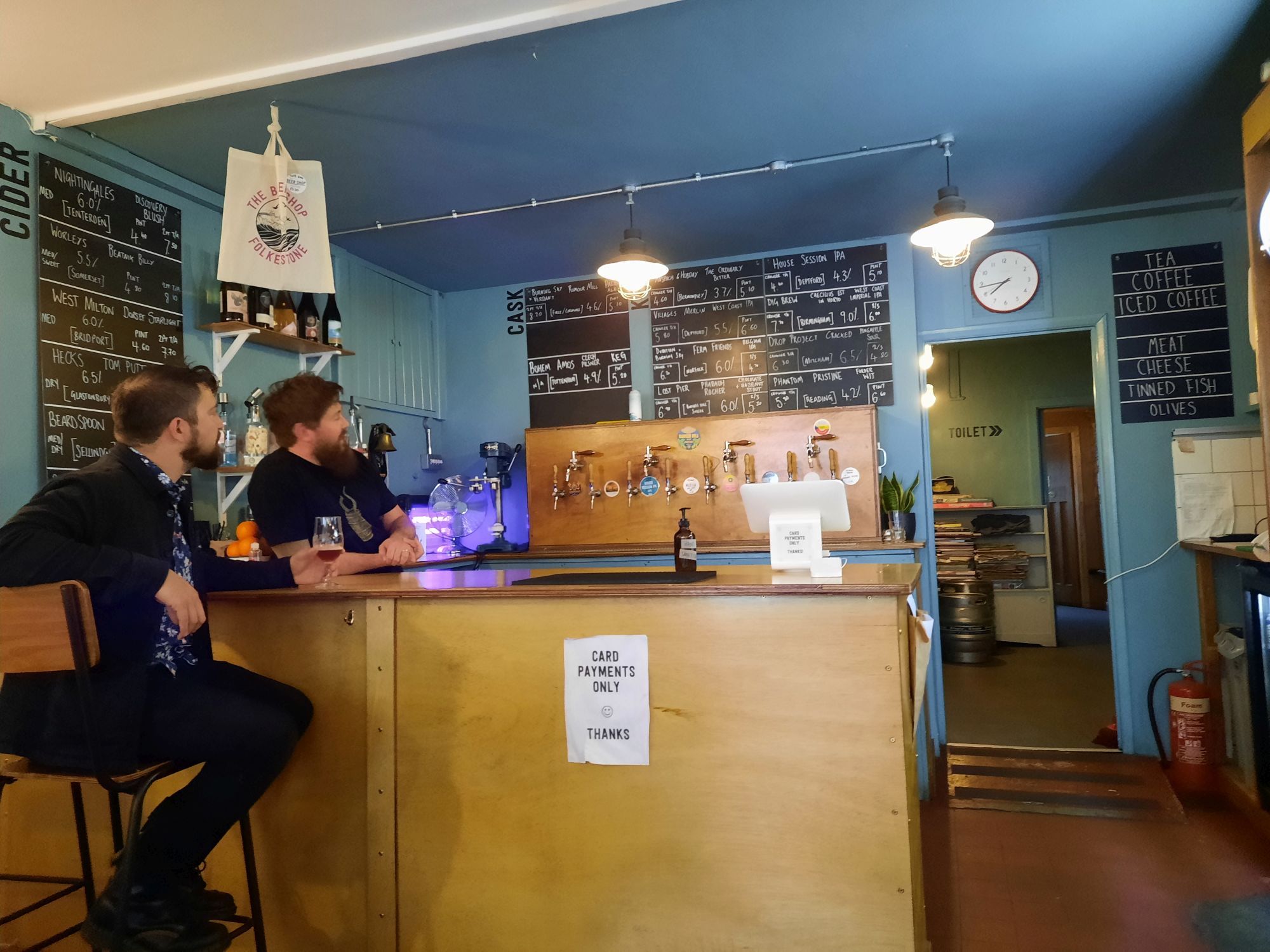
Folkestone was reassuringly unchanged. Mostly. On the way to Wetherspoons I spotted a new place opposite. In a single shop unit, it had all the signs of a micro pub. And called The Beer Shop.

"Can we have one in here first?"

"I don't mind, Ron. It's your round."

Inside it was fairly Spartan and modern. But nice enough. Glancing at the bar, it looked like all evil keg. Luckily the blackboard listed one cask beer: Burning Sky/Verdant Rumour Mill. Mikey went for a Lost Pier chocolate and hazelnut Stout, the trendy bastard.


There were plenty of beards and tattoos. And a youngish middle-class clientele. Other than me and Mikey. As so often now, I was the oldest by a few decades. Not surprising our fellow drinkers were mostly middle class, given the prices. My - very good beer, refreshing but with plenty of hop flavour - was 5.10 a pint. Mikey's was north of 6 quid.


We only had the one. Then trudged over to Spoons. Where there was a very different vibe. A generally older crowd. Or better said: a greater variation in ages. Still plenty of tattoos. But a lot more baldy heads. And rather different types of beards. Cask beer at 2.10 a pint. Less than half the price over the road.

Basically a class divide. Middle class one side of the road, working class the other. Separated by price. Where were me and Mikey? Plumb in the middle of the road.


I originally ended the post here. Well, the paragraph before here, to be precise. Then I realised, while wandering the streets just now, that I hadn't written anything about how I felt about the two pubs. Here goes.

I felt comfortable in both. It was soon obvious in the Beer Shop that I was the oldest person by several decades. They were friendly enough and didn't seem to mind my oldie presence too much.

Though The Beer Shop only had one cask beer (why would I drink keg when I'm back in the UK?), it was really excellent. An absolute pleasure. The Broadside in Spoons was OK. Perfectly drinkable, but nowt special. 

I'd have wrapped my face around several pints of Rumour Mill, but for one thing: the price. At £5.10 a pop, four or five pints could work out pricey. Especially with Mikey on something even more expensive. Sure, the Broadside over the road wasn't as nice. But not three quid less nice.And good enough.

When it comes to decor, the Spoons wins hands down. A really good conversion of a Methodist chapel which manages to be pub-like, while still obviously a former place of worship. Booths along either side break up the space and stop it seeming too cavernous.


 What chance does The Beer Shop have in competing with that? I mean, it's a shop unit. And is still a shop, too. Fair enough that it looks like a shop. Not somewhere you could imagine spending a long afternoon watching racing on the telly and working your way steadily through a gallon of Bitter, accompanied by several double whiskies.


Which do I prefer? I can't really pick one. It all depends on what I want. If I was after a good session, it would be Spoons all the way. While if I wanted a really good beer, it would be The Beer Shop.

Diversity is a features of pubs I've always loved. You don't have to like every one of them. I'm sure there are plenty who despise some of the boozers I adore the most. Each pub has its own audience. (However much you might think that they are all-welcoming.) And you can be in multiple audiences.


The Beer Shop Folkestone

32 Rendezvous St,
Folkestone CT20 1EZ.
http://www.thebeershopfolkestone.co.uk/


The Samuel Peto - JD Wetherspoons
23 Rendezvous St,
Folkestone CT20 1EY.

Saturday, 4 June 2022

Let's Brew - 1901 Boddington Stout

Porter may have died out in most of provincial England in the latter part of the 19th century, but some Stouts look rather Porter-like.

Boddington’s being a good example. 1051º being way too weak for a London Stout. For example, in the same year at Whitbread, Porter was 1055.1º and Single Stout 1072.5º.

As was usual outside London, the grist is just pale and black malt. Though there is a twist: the black malt was added to the copper, not the mash tun. I’ve come across brewers who added some to the copper – Barclay Perkins is an example – but not the full charge. Not sure exactly why Boddington did this. Possibly to keep the black malt out of the spent grains, as their presence reduced the price farmer would pay.

The sugars are simply described as “Garton” and “Clarke”. The former was a big producer of invert sugar, especially No. 3, so that’s what I’ve guessed. I’ve gone for No. 4 for the latter, as otherwise the colour comes out too pale.

As was usual at Boddington there are loads of different hops. In this case, four English and one Californian. All, sadly, without mention of a harvest date. 

1901 Boddington Stout
pale malt 9.25 lb 85.33%
black malt 0.25 lb 2.31%
No. 3 invert sugar 0.67 lb 6.18%
No. 4 invert sugar 0.67 lb 6.18%
Cluster 135 mins 0.50 oz
Fuggles 60 mins 0.75 oz
Fuggles 30 mins 0.75 oz
Fuggles dry hops 0.25 oz
OG 1051
FG 1015
ABV 4.76
Apparent attenuation 70.59%
IBU 27
SRM 25
Mash at 154º F
Sparge at 165º F
Boil time 135 minutes
pitching temp 60º F
Yeast Wyeast 1318 London ale III (Boddingtons)

Friday, 3 June 2022

Racking and Dry hopping 1880 - 1914

Time for another preview from my major book after next. Or something like that. I've a very good reason for posting this now. I've got a cold and can't be arsed to write anything new. Well, apart from this paragraph. But that doesn't really count, does it?

Racking
After fermentation had finished, the beer was left to settle for 24 hours either in the fermenting vessel or a settling back.

When the beer was bright, it was racked into trade casks. A rubber pipe, fitted with a metal nozzle was used to fill the casks. The nozzle's function was to ensure that the tube reached almost to the bottom of the cask so the beer didn't get too agitated and begin to froth over.  

Dry hopping
Before being filled with beer, a quantity of whole hops was added to the trade casks. Standard-strength beers received between 1 and 1.5 pounds per barrel, stronger beers more. The best quality hops were used, usually Goldings or Worcesters. Only whole flowers, free from disease of fungus, were suitable.  

Dry hopping was about a lot more than just adding flavour to beer. It also benefitted the secondary fermentation in the cask.

The volatile oils present in the hops added flavour and aroma to the beer. The hops also helped conditioning, as they contained a diastatic enzymes that broke down lower malto-dextrins into more fermentable sugars, which would be consumed by the yeast during secondary fermentation. By attracting suspended particles, the hops aided clarification, too.  

Thursday, 2 June 2022

Mashing 1880 - 1914

By this period the very complicated mashing schemes employed for Porter earlier in the century – when there might be four or five mashes all at different temperatures – were a thing of the past. But this didn’t mean that everyone was performing a single infusion mash followed by a sparge or two.

In Scotland, that was mostly the case, but in England underlet mashing was the norm. This was effectively a type of step mash. It was a very widespread and long-lasting process, which was still common after WW II.

Single Infusion
The method of a single infusion mash, followed by sparging first appeared in Scotland. By simplifying the process, Scottish brewers had managed to greatly reduce the time it required compared to their London colleagues, who were still performing three or four mashes. By the 1860s, while Barclay Perkins might have adopted sparging, they still performed multiple mashes. The scheme of an X Ale of theirs brewed in 1862 had three mashes, an underlet, and three sparges.

While around the same time, in 1869, William Younger had a far simpler scheme of a single mash and two sparges.

In well-equipped breweries, water for mashing was heated in the hot-liquor back, where any treatment chemicals were also added. Usual practice was to boil the water the evening before brewing for 15 minutes. After cooled overnight and needed to be reheated to get to the correct mashing temperature. Boiling ensured that the water was sterile. Most water contained chalk, which precipitated out when boiled, taking with it any organic matter in the water to the bottom of the back. To stop this getting into the mash, the opening through which the water was drawn off was always a few inches above the bottom.

Here are some examples of Scottish mashing schemes from Thomas Usher, a prominent Edinburgh brewer. They had two methods, one for their Pale Ales:

Thomas Usher IP and PA mashing scheme 1894
  Strike heat mash tun underback
mash 156º F 151º F 150º F
sparge 1 180º F 156º F 155º F
sparge 2 165º F 159º F 155º F
sparge 3 155º F 153º F 152º F
Source:
Thomas Usher brewing record held at the Scottish Brewing Archive, document number TU/6/1/2.


And another for their Scotch Ales, which were mashed cooler: 

Thomas Usher 80/- and 100/- mashing scheme 1894
  Strike heat mash tun underback
mash 154º F 144º F 144º F
sparge 1 170º F 154º F 153º F
sparge 2 160º F 160º F 159º F
sparge 3 155º F 156º F 155º F
Source:
Thomas Usher brewing record held at the Scottish Brewing Archive, document number TU/6/1/2.

Wednesday, 1 June 2022

Let's Brew Wednesday - 1914 Hancock XXX

Mild month is over, so back to Hancock recipes. Though maybe this was a Mild. Or maybe not. 

I’m becoming more convinced that XXX was marketed as a Strong Ale. Mostly because of its gravity compared to X.

Though, ironically, this version was parti-gyled with X. In the earlier years, everything was brewed single-gyle. Which remained the case with their other beers. Though there had been a reduction in the number of different beers brewed.

The gravity is 10º lower than in 1897. Which isn’t a huge surprise. A tax increase to help pay for the Boer had seen many brewers reduce the strength of their beers.

There have also been changes to the recipe, which was all malt in 1897. For more details about the recipe, see the X I posted earlier.

1914 Hancock XXX
pale malt 10.50 lb 83.67%
glucose 1.75 lb 13.94%
malt extract 0.25 lb 1.99%
caramel 1000 SRM 0.05 lb 0.40%
Cluster 90 mins 1.00 oz
Strisselspalt 60 mins 0.75 oz
Fuggles 30 mins 0.75 oz
OG 1061
FG 1015
ABV 6.09
Apparent attenuation 75.41%
IBU 33
SRM 8.5
Mash at 152º F
Sparge at 170º F
Boil time 90 minutes
pitching temp 60º F
Yeast White Labs WLP099 Super High Gravity

Tuesday, 31 May 2022

Secondary fermentation 1880 - 1914

Another preview from the book I'm working on. This time with some handy confirmation of Bass's tough love.

When in trade or storage casks, beer began a slow secondary fermentation. Maltodextrins were gradually broken down and consumed through the hydrolic action of the yeast, helped by the diastatic enzymes in the dry hops. The fermentable material created in this way was enough to keep the beer saturated with CO2, which helped protect it from bacterial attack. Some of the CO2 combined with water to form carbonic acid. During long storage, esters were formed, which contributed to the character of aged beers.  

Standard pitching yeast, a type of Saccharomyces cervesiae, was not capable of performing this type of secondary fermentation. Brettanomyces was the yeast responsible. This gave beers that were matured for long periods the typical "aged taste". Until 1903, when N. H. Clausen isolated Brettanomyces at the Carlsberg laboratory in Copenhagen, the process had been a mystery.  Brettanomyces was either a component in a multi-strain yeast, which only really became active during secondary fermentation, or was picked up from wooden equipment. Its discovery explained why single-strain pitching yeasts often struggled to successfully carry out secondary fermentation.

Aged beers were going out of fashion and beers were rarely stored more than a few weeks before shipping.  The age of tun rooms, filled with Porter maturing for 12 months or more, had passed. The London breweries had dismantled their massive vats and converted their tun rooms to other uses.

Many beers were not left to mature in the brewery at all, but shipped immediately after racking. In this case any secondary fermentation took place in the pub cellar. Today most cask-conditioned beer is handled this way.  Sykes & Ling did not think this a true secondary fermentation, but an extension of primary fermentation, as only the easily-fermentable sugars were being consumed. They only considered the slow fermentation of maltodextrins over a period of many months as a true secondary fermentation.

Different breweries might have very different methods of storing casks for ageing.

"The methods of storing beer in different parts of the United Kingdom vary considerably. In Burton the beer is run into the trade casks, and these are often stacked in the open during the winter months, and only placed under cover as the season advances. In other localities the trade casks full of stock beer are stored in underground cellars, where a very uniform temperature is maintained. Of these two plans, the former answers well if the beer is sound and good enough to stand it, but if there is any doubt on this point the latter plan must of course be adopted. Then again, black beers and old ales are frequently stored in vats, and vatting greatly improves the quality of these varieties of malt liquor." 

The rough treatment given to some beers actually seemed to make them more robust:

"The fact is, that by coddling beers, while you certainly preserve them from disease, you are sure at the same time to render them tender, and susceptible to every change of temperature. Burton beers, in former days, were exposed by day to the heat, and by night to the frost, and, by this treatment, they became so hardy that they retained their condition and brilliancy under the most adverse circumstances."  


Monday, 30 May 2022

Adjuncts 1880 - 1914

The popularity of adjuncts increased quickly when they were allowed after 1880. By 1914, most breweries used an adjunct of one type or another. The most popular being maize, mostly in flaked form, but occasionally as grits.

There was a very simple reason adjuncts became very popular: price. It was far more economical. Per pound of extract, raw grains could cost less than 50% compared to malt.

Rice provided the most extract per quarter, which I find quite surprising. Though as it cost more than maize, it was less economical.

Here are analyses of maize and rice. If you’re wondering why the extract per quarter is higher in the table below, it’s because these are laboratory extracts, not what could be achieved in a brew house. 

Cost of 1 lb of extract from different grains
grain extract per quarter price per quarter (d) price (d)
malt 88 480 5.45
barley 78 288 3.69
maize 86 218 2.53
rice 96 360 3.75
Source:
"The Manual of Brewing" by Egbert Grant Hooper, 1891, page 165.


Analysis of raw grain
  Granulated Flaked
  Maize Rice Maize Rice
Oil 0.98 0.76 0.97 0.29
Extract per quarter (336 lbs.) 98.44 102.48 98.78 103.15
 ,, per cent. 75.9 79.01 76.16 79.53
Total proteids or albuminoids 9.2 8.74 9.5 8.53
Soluble  "  " 0.62 0.41 0.34 0 28
Insoluble  "   " 8.58 7.33 9.2 8.25
Mineral matter or ash 0.3 0.26 0.44 0.32
Moisture 10.72 7.83 6.3 7.43
Source:
The Brewers Analyst, by R. Douglas Bailey, 1907, page 232

Sunday, 29 May 2022

Last bit on malt 1880 - 1914

A final post on malt. Increasingly dark types. I hope you enjoy it. Full of fun facts as it is. Well, fact-filled. Not so sure about the fun part.

Imperial malt
This was manufactured in a similar way to amber malt, but at the very end of the process oak or beech wood was added to the furnace to raise the temperature from 240 to 270º F.

Crystal malt
This was another malt finished in roasting drums rather than a standard kiln. The difference being that after germination the grains were soaked in a sugar solution or water and then roasted.

Unlike today, maltsters didn’t make multiple different shades of crystal malt. I’m sure that it did some in various colours, but this would between one maltsters product and another’s.

Its use was principally in Mild Ales and Stout. In the former, around 5% helped fill out the body. While between 5% and 25% was recommended in the latter.

Brown malt

Not left on the withering floor as long as other malt and spread in the drying kiln no more than 1.5 inches (37.5 mm) thick. Initially the heat was moderate, but when all the moisture in the malt was gone, the heat was suddenly increased by adding oak or beech wood to the fire. The sudden heat caused the grains to swell by 25%. The smoke from the wood gave the finished malt a smoky flavour.  

The deliberate addition of wood to create smoke and allowing it to come into contact with the malt is very different from 18th century practice, where every attempt was made to prevent this happening. Though with the much-reduced proportion of brown malt being used in Porter and Stout - a maximum of 20% - the smoky effect would have been much less than in a beer made from 100% brown malt.

The method of making brown malt was changing, for a variety of reasons, one of which was the high risk of a fire.

"it was formerly the custom to dry brown malt also on ordinary kilns, with wire floors, but the labour on these was of a most disagreeable and exhausting character, and brown malt is now generally dried in wire cylinders." 

The presence of diastase in older forms of brown malt is explained by the way it was produced. Diastase is much more sensitive to heat when moist. By first removing all the moisture from the malt at a low temperature, the diastase was not damaged as much by the finishing high heat.   

Other coloured malts were produced in a very different way. To get the desired aroma in the malt, it needed to be heated to 160º F while it still had a moisture content of between 12 and 15%. If the moisture content was below 7 or 8%, the aromas would not be formed and all.

Though London brewers remained loyal to the malt behind the 19th-century Porter revolution, it was rarely present in Stouts brewed outside the capital. I have seen examples of its use in other styles, such as Mild Ale and Burton Ale, but these are relatively rare.

Black malt
Roasted like coffee and often made from inferior quality malt, though use of a better-quality malt produced a better end result. The final colour was not black, but a chocolate brown. Because it was readily absorbed water, it didn't store well.

Most breweries had adopted black malt to colour and flavour their Stouts in the second half of the 19th century. It was invented in 1817 specifically for the purpose of colouring Porter when burnt sugar was made illegal the previous year.

Some brewers mashed their black malt separately from the bulk of the mash in a small tun. The reason was simple: spent grains contained black malt fetched a much lower price than those with just pale malt.  I know from Derek Prentice that this was still the case at Truman’s London brewery in the late 1960s and early 1970s.

While its use wasn’t totally restricted to Stout, black malt wasn’t very common in other styles. It does turn up in beers such as Mild or Burton Ale. Though usually both of those styles usually used a combination of crystal malt, invert sugar and caramel for colouring purposes.

Black malt gave between 60 and 70 lbs per quarter – significantly less than other malts.