Thursday, 21 October 2021

Delivering beer to the Wehrmacht (part two)

The CBK (Dutch brewers' organisation) was in a very tricky position. Not only did it have to serve the interests of its members, but it also had two differrent authorities making demands on it. In addition to the Dutch government there were also the German authroities and the Wehrmacht.

When in spring 1941 the CBK realised that further gravity cuts were required to maintain the supply of beer, it wasn't possible to do so without the approval of the Wehrmacht.

"It was agreed that a gravity reduction should be introduced in the short term, with effect from 8 April next with a tenth part, with which, according to Mr. Biel, the German Wehrmacht agrees, while further gravity reduction will be discussed with the N.A.C. in the intended meeting on April 4th. The discussion with the gentlemen, who were present on March 27th, will be continued on April 9th. In this last meeting, the following topics will be discussed:

a. with what turnover is it considered possible to meet the demand and what gravity is necessary for this;
b. an arrangement for a proportional distribution for the customers if the entire demand cannot be met and all measures (including sales arrangement and Kundenschutz) that would result from this.

With regard to the beer supply to the German canteens, etc., it was decided that the N.M.C. will consult with Mr Engelhard about the distribution via a central point; this distribution will then take place in collaboration with the C.B.K. through the eligible breweries.

Mr. Zylker emphasizes the importance that any complaints about German beer imports are reported to the secretariat so that they can possibly be taken up with Mr. Louwes."
Minutes of the management of the CBK on 3rd April 1941, held at the Amsterdam City Archives, document number 31121-1, page 189.

Though they were still fretting about German beer imports. I'm not really sure why, given that Dutch breweries were unable to meet demand, at least with beer close to pre-war strength. You'd have thought they would have been pleased to have some of the pressure taken off them.

The CBK was hoping to get approval for "heavy" beer to bee 9º Balling and Lagerbier 7% Balling. Which would have left Pilsner at around 3.6% ABV and Lagerbier 2.8% ABV.

"Mr. Stikker says that Mr. Gentzsch will probably agree with a reduction in gravity to +- 7 and 9%, but the Chief Intendent of the Wehrmacht also has yet to comment on this. The German authorities now wish for a new discussion, in which on the part of the C.B.K. the plans in terms of gravity, output level and regulation of the sales restriction must be submitted. These plans will be discussed in advance with the N.A.C. April 4."
Minutes of the management of the CBK on 3rd April 1941, held at the Amsterdam City Archives, document number 31121-1, page 190.

This last comment makes clear who was really in charge: the Wehrmacht.

"Mr. Stikker puts forward that the ultimate decision regarding the reduction of the gravity does not lie with Mr. Louwes, but with the German authorities. It is uncertain whether the German armed forces will accept a low gravity."
Minutes of the management of the CBK on 3rd April 1941, held at the Amsterdam City Archives, document number 31121-1, page 197. 

Interested in which breweries were supplying the German army? We'll get to that soon. Let's just say this: some brewers were doing way more than a fair share.

Wednesday, 20 October 2021

Let's Brew Wednesday - 1878 Adnams IA

This is the real oddity of Adnams beer range. Why an oddity? Because it was never brewed single-gyle, unlike most of their beers. But it wasn’t always with the same beer. It was produced in combination with XXXK, XXXX and Tally Ho.

What does IA stand for? My guess is “Intermediate Ale”. Not that it really tells us that much. Then again, what does X really stand for? At just 1044º, it’s considerably weaker than any London-brewed Mild.

The grist is much the same as all their other beers: base malt and sugar. You can’t get much simpler than that.

As IA was always parti-gyled with strong beers, the hopping rate per quarter was higher than for XX Ale. 12 lbs per quarter (336 lbs) of malt, opposed to 8.5 lbs. Which is reflected in a slightly higher bitterness level, despite being quite a bit weaker.

1878 Adnams IA
mild malt 5.50 lb 66.67%
No. 2 invert sugar 2.75 lb 33.33%
Goldings 105 mins 2.50 oz
Goldings 30 mins 2.50 oz
OG 1044
FG 1012
ABV 4.23
Apparent attenuation 72.73%
IBU 66
SRM 10
Mash at 154º F
Sparge at 172º F
Boil time 105 minutes
pitching temp 64º F
Yeast WLP025 Southwold


Tuesday, 19 October 2021

Light Lager ban (part two)

It seems that not every brewery had agreed to stop selling Licht Lagerbier (Light Lager) in Rotterdam. A couple of quite significant breweries were continuing to supply this type of beer to Rotterdam.

"Mr. Zylker notes that two important suppliers in Rotterdam, namely the Z.H.B. and Hengelosche, would not be among them. The speaker said that currently in Rotterdam Amstel H.B.M., van Vollenhoven and Oranjeboom are selling Dark Lager, the Drie Hoefijzers Semi-dark Lager, the Z.H.B. and some other breweries, Light Lager. The Z.H.B. has recently stopped complying with the Light Lager ban.

Mr Smits van Waesberghe says that the Drie Hoefijers can colour its Lager Beer darker when this arrangement is introduced.

Mr. Six says that the C.B.K. has always scrupulously refrained from intervening in existing interests, but the Speaker considers it justified with regard to Rotterdam to perpetuate a situation that has existed for 75 years and now threatens to go wrong.

Mr. Swinkels says that he will try to adhere to the Light Lager arrangement if the Kundenschutz discussed in this regard continues."
Minutes of the management of the CBK on 26th March 1941, held at the Amsterdam City Archives, document number 31121-1, page 212.

Neither ZHB nor Hengeloosche attended the meeting. Looking back, I see that it was always the same breweries who were represented on the committee:

Amstel
Bavaria
Brand
Drie Hoefijzers
H.B.M. (Heineken)
Klok (Grolsch)
De Leeuw
Oranjeboom
Vollenhoven
v. Waes-Boodts

Though I'm sure that both Z.H.B. and Hengelosche were members of the CBK (the Dutch brewers' organisation). I'm surprised that the ZHB, which was a substantial brewery located in The Hague, wasn't represented on the committee.

The obvious solution - shipping Pilsner instead of Ligh Lager - wasn't possible because of government restrictions on the percentage of a brewery's output which could be "heavy" beer. That is beer of the highest gravity that was allowed.

"Mr. van Waes suddenly hears about the Light Lager ban in Rotterdam. Speaker does not understand the difficulties. If Speaker's brewery were to supply Pilsener instead of Light Lager in Rotterdam, its heavy beer percentage would have to be increased.

Mr. Honig says that this is not possible, as the heavy beer percentage is set by the government.

After some further discussions, the board decides in principle: 

a. the decision of the pub owners in Rotterdam to only deliver dark beer on some days, will be supported by the breweries with sanctions against violation;
b. the sale of Light Lager Beer in Rotterdam will be banned from 1 April;
c. Pilsener beer will not be supplied by other breweries to customers who no longer receive Light Lager Beer from the brewery supplying them;
d. an exception to the Light Lager ban will be: deliveries to the German armed forces in bottles bottled in the brewery itself;
e. points a to d will be communicated to the breweries as soon as possible in a circular, on the understanding that the provisions under c will only apply to the breweries that are part of the board, while before sending these circulars the ZHB and the Hengeloosche will be requested to join in the agreement."

Minutes of the management of the CBK on 26th March 1941, held at the Amsterdam City Archives, document number 31121-1, pages 212 - 213. 

Note that German forces in Rotterdam would still be able to get light Lager. I guess German soldiers weren't that keen on Dark Lager.

Monday, 18 October 2021

Light Lager ban

The second infliction on Rotterdam was the banishment of Light Lager (Licht Lagerbier) from the city. OK, by this point such a type of beer was piss-weak, around 2.4% ABV. No great loss, then. As there was a limited amount of "heavy" beer, the other pale alternative, Pilsner, might not be available.

There does seem to be a reason behind this: preventing fraud:

"Mr. Six considers it in the interest of the breweries that publicans no longer sell Light Lager for Pilsener beer, since drinkers in some areas, such as the South, cannot tell the difference.

Messrs. Honig, Zylker and Smits van Waesberghe agree in principle.

De Heer Swinkels says that he only has Light Lager customers in Rotterdam. It will be very difficult for Spreker's brewery in connection with the heavy beer percentage to supply Pilsener beer to these clients, while Speaker wonders whether he will be able to get enough colouring for Dark Lager. The speaker is afraid of losing customers in Rotterdam.

Mr. van Waes agrees.

Mr. Smits van Waesberghe understands the objections of Heeren Swinkels and van Waes. The speaker wondered whether it is not possible to introduce the Kundenschutz already now with regard to the Light Lager issue among the breweries present here.
Minutes of the management of the CBK on 26th March 1941, held at the Amsterdam City Archives, document number 31121-1, page 211.

Of course. Publicans were passing off the cheaper beer as Pilsner. Now there's a surprise.

Why were Southerners singled out as having no discernment?

Can't sell Light Lager any more? Simple. Add caramel to it and hey presto: Dark Lager.

Sounds like all the brewers had agreed not sell Light Lager in Rotterdam. But they hadn't. Find out who the renegades were next time. 


Sunday, 17 October 2021

Dark Lager Day

No, not a new celebratory day for one of my favourite types of beer. Rather, a requirement imposed on publicans in wartime Holland. Yes, I'm back with that again. Using, as ever, the CBK minutes as my source.

I do love a good Dark Lager. As a Mild drinker, I sought out the darker-hued beers in my first forays into Bavaria. There's a very specific flavour in a good Bavarian Dunkles for which I've never come up with a good description. It's sort of nutty, but not quite. I've always assumed it came from a specific type of dark malt, but I could be wrong. I haven't the palate of a professional brewer.

I wish Augustiner would serve their Dunkles the "Bayerischer Anstich" way (straight from the cask). Don't get me wrong, I like the keg version. Knowing how much the old-fashioned dispense improves their Helles, cask Dunkles would be a knockout.

The robustly simple Dunkles brewed by Frau Hofmann out in the Franconian sticks.  What a great afternoon that was with Andy and Jeff Bell in - wow was it that long ago? - 2007.

Apologies for the digression. Just some great memories came back I when started thinking about Dark Lager.

Back to the imposition of Dark Lager Day in Rotterdam. Its March 1941. Nazi forces have occupied the country for almost a year. Time to make Rotterdam suffer some more. I don't mean that. Just wondering why specifically Rotterdam was singled out. Why not Amsterdam and The Hague as well?

Let's see what the CBK (Dutch brewers' organisation) planned:

"VI. SALE OF LIGHT AND DARK BEER IN ROTTERDAM.
Mr Zylker says that at a meeting of cafe owners in Rotterdam, at the suggestion of the H.B.M. it was decided to sell only Dark Lager beer one day a week. The H.B.M. would then consult with the other breweries to support such an arrangement through sanctions.

In the Speaker's opinion, this proposal from the H.B.M. is only enforceable, if the C.B.K, supports it, possibly by laying down this matter in regulations. The sanction should then consist of the exclusion of violating café owners from beer supply.

De Heer Six thinks that in the summer in the Netherlands there will be one or more beer-free days in the cafes. A Dark Lager day then takes on the meaning of a transitional measure towards a beerless day. Speaker is for a Dark Lager day.

The speaker went on to say that even rural innkeepers already ask for a Dark Lager day, while the concept of a beerless day is already alive with them.

Mr. Zylker says he has no objections to a Dark Lager day. However, in addition, a regulation will have to be made in Rotterdam with regard to Light Lager, since in the current circumstances it is impossible to maintain the Light Lager ban any longer.
Minutes of the management of the CBK on 26th March 1941, held at the Amsterdam City Archives, document number 31121-1, page 211.

H.B.M. is Heineken, in case you were wondering. Which, as I'm sure you remember, had a big brewery in Rotterdam.

I suppose I should explain what Dark Lager (Donker Lagerbier) and Light Lager (Licht Lagerbier) were. Relatively low-gravity by continental standards, at just 3.5% ABV when the panzers rolled over the eastern border. At this point, March 1941, it was a feeble 2.4% ABV.

Brewers and pub owners agreed: one day a week, nothing but Dark Lager. That didn't mean any old old dark beer. They specifically mean Donker Lagerbier. Which meant that not only were drinkers being limited in their choice of colour, but also strength. As the option of Pilsner was denied.

Then another problem pops up: the ban on Light Lager. What the hell was that about? A ban on Licht Lagerbier? What did they have against Rotterdam? Find out next time.

Saturday, 16 October 2021

Let's Brew - 1879 Adnams PA

In addition to their rather watery AK, Adnams also produced a full-strength Pale Ale. Called, simply, Pale Ale. Not that they brewed a huge amount of either. The bulk of their output was either Mild Ale or Stout.

I’m going to struggle to come up with too much to say about this beer. The brewing records are extremely sketchy. About all it includes are the ingredients and the gravity. Everything else is just an educated guess.

The grist is simply base malt and sugar. As this is a high-class Pale Ale, I’ve chosen No. 1 invert as the sugar.  It could also have been No. 2, but at this point they mostly strove to keep Pale Ales of this type as light in colour as possible.

That probably explains the high percentage of sugar, which makes up a third of the total grist. A higher proportion even than in XX Ale.

As for the hops, I know nothing other than the quantity. Which was an awful lot. Even after me reducing the quantity (the actual amount would have come to two 8.5 oz. additions) to allow for some age, the calculated bitterness still comes to stupid number of IBUs. As PA was most likely aged for 12 months, the bitterness would have mellowed out before it was sold.

1879 Adnams PA
mild malt 7.27 lb 65.97%
No. 1 invert sugar 3.75 lb 34.03%
Goldings 105 mins 7.00 oz
Goldings 30 mins 7.00 oz
Goldings dry hops 1.00 oz
OG 1061
FG 1016
ABV 5.95
Apparent attenuation 73.77%
IBU 165
SRM 9
Mash at 152º F
Sparge at 172º F
Boil time 105 minutes
pitching temp 65º F
Yeast WLP025 Southwold


Friday, 15 October 2021

Franconian goodness

It's been far too long since I've been to Franconia. Happily, Franconia came to me.

In the form of the Franconian Anstich Fest at Butcher's Tears last weekend. Lots of lovely Franconian beers, served the way god intended: straight from the cask. And they had Monchsambacher. Such wonderful stuff.

The older I've got, the less I've enjoyed most beer festivals. Too may people, too many beers, too few seats. Thankfully, none of those failings apply to the festivals held at Butcher's tears. And there's no travelling involved, other than a 15-minute walk. 

I love Lager. I've said it many times, but it bears repeating. Good Lagers, I mean. Brewed the old-fashioned way and served up without too much fizz.

I almost forgot one of my other pet hates at beer festivals: tiny glasses. You can fuck off serving me 10 cl or even 15 cl. That's why I used to take my own pint glass to the Borefts festival. I don't want 20 mouthfuls of beer I'll never remember. I want to give each beer the respect it deserves. Which, unless it's super-strong, is at least a half litre. Then again, I've be known to drink Imperial Stout by the pint.

A great festival, just hope they do another.


Thursday, 14 October 2021

Delivering beer to the Wehrmacht

Germans like their beer. Especially young men. No surprise then that German cantines in occupied Holland needed to supplied with beer. And quite a lot of it.

They weren't very happy when Dutch brewers proposed weakening their beer:

"Gravity reduction.
The second unpleasant point, that the German authorities objected to a further reduction in the gravity of the Dutch beer, partly in connection with the claims of the German armed forces."
Minutes of the management of the CBK on 26th March 1941, held at the Amsterdam City Archives, document number 31121-1, page 228.

The Wehrmacht, quite predictably, wanted full-strength beer for its troops. Though they wouldn't be able to demand that forever as the food supply situation worsened in occupied Europe.

The plan was to distribute beer to German cantines centrally, through the Meelcentrale (an organisation dedicated to  distributing grain) and the CBK (the brewers' organisation:

"6. Deliveries to the German Wehrmacht, Survey regional beer turnover.
With regard to the deliveries to the German armed forces, it was promised that these would be made on the basis of a distribution by the Meelcentrale via the C.B.K. The same system is applied in Germany in the distribution of beer requirements for the German armed forces in Poland, which are distributed among the German breweries by the Ersatz Verpflegungs Magazin (E.V.M.), without taking into account preferences for certain beer brands.

The N.M.C. already provided a similar distribution for several other articles in the Netherlands. With regard to the practical application of this, it is still necessary to speak with Dr. Engelhard. Meanwhile, the C.B.K. a survey will be set up to find out approximately how large the beer consumption of the German soldiers is. In connection with this, a survey is held at 16 breweries, together representing + 85% of the total Dutch turnover, to get an impression of the regional sales of the beer. The speaker is convinced that this survey will provide a great deal of work for the breweries concerned. The Meelcentrale originally wanted a survey into the turnover of the +- 30,000 pubs in the Netherlands, in which case the amount of beer consumed by the German military would also have to be stated. The speaker replied that such a survey was practically impossible to carry out, if only because many pubs do not keep accounts at all. The speaker continued that the idea occurred to the chairman and secretary to link the problem of supplying the German armed forces with redistribution. There is still the difference of opinion between export breweries which have large stocks and breweries with relatively little stock. A leveling of supplies can be achieved if the breweries with the largest stocks deliver the beer to the canteens; for this they receive extra brewing rights, but no extra raw materials. This point will require further discussion."
Minutes of the management of the CBK on 26th March 1941, held at the Amsterdam City Archives, document number 31121-1, page 230. 

One of the problems in working out how much German troops consumed, was that they didn't limit their drinking to military canteens, but also drank in normal pubs. Pretty complicated, as you'd need information from every one of the 30,000 pubs in the country. It would also depend on publicans keeping track of what was drunk by soldiers and what by civilians.

Central distribution of beer for German canteens had one huge potential danger. It meant that the CBK would know exactly where each German canteen was and how much beer they required per month. Which meant they'd know the size and disposition of all the German military in the country. Very handy information for the Allies. 

As I've already posted, someone at the CBK did, indeed, pass the data on to Allied spies.

Wednesday, 13 October 2021

Let's Brew Wednesday - 1878 Adnams XXXX

Here’s a Mild Ale which challenges modern concepts of the style. Strong and heavily hopped, no-one would describe such a beer Mild today.

That said, it wasn’t as strong as the Milds brewed in London. In the 18760s, Whitbread X Ale had an OG of 1062º and XX Ale 1076º. In general, breweries out in the sticks, like Adnams, tended to brew weaker beers, especially when it came to Mild.

Though it wasn’t parti-gyled with XX, the grist is essentially the same. With just a single type of malt and another of sugar, there’s not a great deal to it.

The brewing record says nothing about the hops, other than the quantity. I’ve just guessed that they were Goldings.


1878 Adnams XXXX
mild malt 9.00 lb 72.00%
No. 2 invert sugar 3.50 lb 28.00%
Goldings 105 mins 4.00 oz
Goldings 30 mins 4.00 oz
OG 1067
FG 1018
ABV 6.48
Apparent attenuation 73.13%
IBU 91
SRM 13
Mash at 154º F
Sparge at 172º F
Boil time 105 minutes
pitching temp 63º F
Yeast WLP025 Southwold


Tuesday, 12 October 2021

Beer in Belgium in WW II (part three)

The situation was continuing to deteriorate rapidly. Seing what happened even in the early war years, I'm surprised the brewing industry survived at all

Beer strengths were being cut far more than in Holland. Where Lagerbier gravity was reduced in January 1941 to 7.8º Balling and Pils to 10.3º Balling. Compare that to the pitiful gravities below.

"VI. SITUATION IN BELGIUM.
Mr Stikker points out that the raw material position of the Belgian breweries is very bad. With effect from 1 January this year the gravity has been reduced again; only 6 days were given for its preparation. There are currently 3 beer types:

inn beer 1st category of 2° or +-5% Blg
" 2nd " “ 1.4° ” +-3.5% Blg
table beer " 0.8° " " +-2% "

It is to be expected that the Belgian breweries will be completely dry by April next.

Beer is only available for bread coupons in Belgium.

The free association of all Belgian breweries has been abolished and its place has been replaced by an official corporation within the framework of the Reichsnahrstand with compulsory membership and regulatory authority. At the head of this is Mr. Breedam. This body has recently introduced the above-mentioned gravity reduction. In addition, no more beer may be brewed of a higher quality than has been determined for sale."
Minutes of the management of the CBK on 21st January 1941, held at the Amsterdam City Archives, document number 31121-1, page 264. 

The first gravity figures - 2º, 1.4º and 0.8º are Belgian degrees. The strengths would have been approximately 2% ABV, 1.4$ ABV and 0.8% ABV, Basically, not worth drinking. Even worse, some beer could only be obtained with bread coupons which the public was reluctant to use in this way. 

"In Belgium, the system of dispensing beer on bread coupons would have been abolished, but this only applies to beer with a 2% original wort content. The breweries have large stocks of beer, but cannot sell it, as the public will not give up bread coupons."
Minutes of the management of the CBK on 5th March 1941, held at the Amsterdam City Archives, document number 31121-1, page 243.


The combination of higher taxes, bread coupons and low gravities was starting to seriosly damage the whole industry.

"The speaker pointed out that here in the Netherlands one should not be faced with the situation as in Belgium; there the breweries had little stock, while the coupon system makes it impossible to sell beer, so that the breweries are unable to afford the large reclaim due to the sharp increase in beer excise duty. The consequence of this is that the brewing industry has been damaged in a very serious way in Belgium, while the gravity there is particularly low. Some things resonated with Mr. Biel."
Minutes of the management of the CBK on 26th March 1941, held at the Amsterdam City Archives, document number 31121-1, page 229.

Six months later and gravities were cut again with the elimination of the strongest category of beer.

"B. Belgium.
The maximum gravity is currently still there, but the levels will be reduced to 3.5% and 2% as of July 15th. Despite the presence of the occupying troops, turnover amounts to only 60% of that in 1940. In. Some Belgian circles are of the opinion that the reduction in turnover is a result of the series of reductions in gravity which have taken place which render the beer undrinkable and turn the public away from the beer."
Minutes of the management of the CBK on 4th July 1941, held at the Amsterdam City Archives, document number 31121-1, page 110.

Consumption of beer had collapsed and was continuing to fall. In contrast to Holland, where production had increased, albeit at lower gravities than before the war.

One of the committee disagreed that the low gravities were responsible for the marked decline in beer consumption.

"Mr. van Marwijk Kooy believes; that the reduced beer consumption in Belgium is not the result of the poorer beer quality, but of a lack of money on the part of the Belgian population, which has to spend much more money on food due to its very poor food position. A reduction in volume would be at the expense of the public, as the armed forces will continue to claim their normal quantum. For this reason, the Speaker considers a reduction in gravity, which is technically possible, to be preferable to a reduction in volume. In these times the public does not attach so much importance to quality; The main thing is that a product is still available."
Minutes of the management of the CBK on 4th July 1941, held at the Amsterdam City Archives, document number 31121-1, page 111. 

My guess is that it was a combination of ridiculously weak beer and lack of money. Why waste cash on beer that was hardly worth drinking?

Monday, 11 October 2021

Beer in Belgium in WW II (part two)

Back with the disaster that was Belgian brewing during WW II.

Over the two world wars, the Belgian brewing industry was probably more damaged them any other in the world. Including Germany. In WW I, most breweries were either blown to pieces by artillery or looted of their copper by the Germans. In WW II, they just ran out of war materials. It's a wonder that brewing survived at all.

Just as in the UK, bottles and casks were in short supply. Brewers couldn't afford to lose packages. With losses concentrated in the south of Holland, a finger was pointed at their closest neighbour.

"XII. LOSS OF CASKS AND BOTTLES
Mr. van Reede points out that the loss of bottles is great in the south of the country, while it is practically non-existent in the north.

Mr Stikker does not consider it impossible that bottles will disappear to Belgium.

Mr. Chambille says that it is not only a question of losing bottles, but also of barrels. It is therefore advisable to instruct the representatives of the breweries not to deliver casks that can be transported to Belgium and France."
Minutes of the management of the CBK on 14th November 1940, held at the Amsterdam City Archives, document number 31121-1, page 300.

Meanwhile, a lack of raw materials was really hitting home in Belgium:

"Mr Stikker agrees. In Belgium, too, beer gravity has been further reduced, with effect from 1 January to 7.5 and 2.5%. Nevertheless, Belgian breweries will probably run dry in about May. The result of this will probably be a redistribution of raw materials, at the instigation of Mr. Breedam, leader of the breweries on the agricultural front, who seems to feel more in favour of redistribution of raw materials than beer. At the moment a lot of German beer is sold in Belgium. With regard to possible further measures in the Netherlands, Speaker considers that an attempt should first be made to induce the authorities in Berlin to import malt into the Netherlands, for which purpose Speaker may possibly go to Berlin."
Minutes of the management of the CBK on 10th December 1940, held at the Amsterdam City Archives, document number 31121-1, page 281. 

That's a reduction from around 3% ABV - just about intoxicating for the determined drinker - to 1% ABV. A beer you could safely give to a toddler.

In comparison, Holland was doing fairly well. Pilsner had fallen in strength, but was still 3.5% ABV. A decent session strength.

Sunday, 10 October 2021

Beer in Belgium in WW II

The minutes of the CBK (Dutch brewers' organisation) aren't just packed with useful stuff aboput Holland. There's plenty about their southern neighbour, Belgium.

It's fascinating to see how different the situation was in the two countries. Unlike Holland, Belgium didn't seem to grow much malting barley. Even in early 1940, before Belgium was officially participating in the war, the country's brewers were trying to import barley. Itt looks like their supplies were drying up. Where had they imported their barley from previously? It it was anything like the UK, the USA, Chile and the Middle East would have been the biggest suppliers.

"III. MALTING FOR EXPORT.
Mr Stikker announces that at the N.A.C. has been urged to have any malting barley to be exported be malted in the Netherlands.

De Heer Swinkels believes that the N.A.C. has already exported 6,000 tons of malting barley to Belgium.Minutes of the management of the CBK on 16th January 1940, held at the Amsterdam City Archives, document number 31121-1, page 379.

Rather than just buy it outright, the Belgians were offering to exchange feed barley for malting barley:

"The N.A.C. announced that it has to export 7,000 tons of Zeeland malting barley to Belgium in exchange for feed barley in the ratio of 100 : 155. In Belgium, the Assbra (Association of large Belgian breweries) offers this barley at frs.185- (± f.11 .50) to breweries or malthouses. In addition, Belgium is also considering importing Moroccan barley at frs. 150.- "
Minutes of the management of the CBK on 13th February 1940, held at the Amsterdamse Stadsarchief, document number 31121-1, page 367.

We're now into the summer of 1940, after the Germans had occupied both Belgium and Holland.

"V. BEER GRAVITY AND BREWING INDUSTRY IN BELGIUM.
Mr Stikker announces that the beer gravity in Belgium since 20th July may not exceed 10%; the use of rice is prohibited, only malt and sugar are allowed; Furthermore, it is forbidden to malt barley. Belgian breweries would receive 55,000 tons of barley for the next season, which is very little in relation to their needs.

The two brewery associations existing in Belgium, namely the Assbra and the Federation, have united to form an association which has regulatory authority for the brewing company.
Minutes of the management of the CBK on 30th July 1940, held at the Amsterdam City Archives, document number 31121-1, pages 339 - 340.

Immediately beer gravity was cut and restrictions imposed on the use of certain materials. Unlike in Holland, there was immediately a shortfall in barley supplies. In Holland not much changed in the first six months of the occupation as malt and barley stocks were sufficient.

Things only got worse.

"IV. SITUATION IN BELGIUM.
Mr Stikker says that it has recently been forbidden in Belgium to give a Belgian beer names that indicate a foreign origin, such as "Pilsen", "Baviere", "Munich", "Dortmund".

Regulations have also been given with regard to gravities. Three qualities of beer are allowed with a gravity of +- 10%, +- 6.25% and +- 5.75%.

The recently issued ban on processing the raw material stocks of the breweries has now been lifted again.

Beer consumption has recently fallen by about 30 to 40%."
Minutes of the management of the CBK on 14th November 1940, held at the Amsterdam City Archives, document number 31121-1, page 297. 

The Belgians weren't even allowed to keep their beer names. And the strengths of some types of beer were already getting frighteningly weak. Those gravities equate to about 4%, 2.5% and 2.3% ABV. What a contrast to Holland, where beer production increased in the first couple of years of the war.

All this was just a taste of the bad times to come.

Saturday, 9 October 2021

Let's Brew - 1878 Adnams SS

Like every brewery in the UK at the time, Adnams brewed a Stout. Though they didn’t produce a Porter. That style was starting to fade away outside of London.

In terms of strength, it looks very much like a standard London Stout. Something line Barclay Perkins Brown Stout.

While London brewers remained faithful to brown malt until the bitter end, by the middle of the 19th century most provincial brewers had adopted far simpler grists, usually consisting of just base malt and black malt. I’ve gone for mild malt as base, as that’s probably closest to the pale malts used in black beers. Why bother with a high-class pale malt when it was going to be covered up with lots of roast?

As was common in the 19th century, the brewing record is very vague about the type of sugar. I’ve opted for No. 3 invert, mostly because this is a dark beer.

I’ve no real idea what the hops were. One is illegible and the other looks like “Kt”, i.e., Kent. I’ve guessed at Fuggles.

1878 Adnams SS
mild malt 8.00 lb 168.42%
black malt 3.75 lb 78.95%
No. 3 invert sugar 1.00 lb 21.05%
Fuggles 105 mins 5.00 oz
Fuggles 30 mins 1.75 oz
Goldings dry hops 1.00 oz
OG 1068
FG 1020
ABV 6.35
Apparent attenuation 70.59%
IBU 65
SRM 38
Mash at 154º F
Sparge at 172º F
Boil time 105 minutes
pitching temp 63º F
Yeast WLP025 Southwold


Friday, 8 October 2021

European Brown Stout

Now here's a new one. Not Export Stout, Tropical Stout or Foreign Extra Stout but European Brown Stout. I've no idea why it was called "European" as from the advert below it's quite clear that this was a beer for the domestic UK market.

The advert is quite wordy, which is good for me, as it includes a few nuggets.

"Bass & Co.’s European Brown Stout,
BREWED ESPECIALLY AND SOLELY FOR BOTTLING.

The Water of Burton-on-Trent is celebrated for the peculiar excellence of its brewing properties, and the Stout now manufactured there by Messrs. BASS & CO., from the very choicest qualities of English Hops and Malt, bids fair to rival in worldwide popularity their East India Pale Ale.

The supposition that Burton Water will not, or that Burton Water cannot make good Stout, is gratuitous and erroneous, and founded only on the fact that the demand for Burton Ale has hitherto been beyond the possibility of supply, causing the brewing of Stout for the time to be a matter of secondary consideration.

Messrs. BASS & CO.’S Stout is not introduced as a cheap Stout, but one which, being brewed especially for bottling and family use, has a distinct character of its own, is absolutely free from any trace of acidity, and is as pure, grateful, and nourishing, as the best materials and skill in the science of brewing can produce.

It is bottled with the most scrupulous care in Imperial Pint Bottles, which are all labelled with Messrs. BASS & CO 's Brown Diamond Trade Mark, and secured by Patent Metallic Capsules, bearing the COOPER CO.’S ”CASTLE” trade mark, so as to guarantee its being genuine.

It can be obtained at 4s. dd. per dozen Imperial Pints, from all Wine Merchants and Grocers, and at Clubs and Hotels;
and Wholesale from

THE COOPER COMPANY,
HOP EXCHANGE VAULTS, SOUTHWARK-STREET, BOROUGH, LONDON, S.E ,
AGENTS FOR MESSRS. BASS AND CO.,
Who will also deliver it in quantities of not less than four dozens to private customers in any part of Town, or at any Railway Station in London, if a difficulty arises in obtaining it in any particular locality.

PRICE. Imperial Pints.
Bass’s European Extra Brown Stout 4s. 6d. per dozen. 
Bottles (if not exchanged) 2s.         " 
Bin Cases (if sent by rail)  4s. 6d. per 2-doz. Case.

Islington Gazette - Friday 31 December 1875, page 1.


I'm not sure that Burton water is particularly suited to brewing Stout. An opinion shared by some brewing scientists.

"To begin with, then, it is not customary to employ saline waters, or, in other words, if such water be employed the black beer produced is deficient in that roundness and fulness of palate taste that is considered so necessary a feature, while I can example this by referring to the black beer produced at Burton, which has been universally described as a mere black pale ale — i.e., though black in colour, its palate taste reminds one very strongly of the pale beers produced by Burton firms. It will be quite understood that I am not decrying this article; it may and does suit many palate tastes, and is thought a great deal of on the Continent, but at the same time it differs very widely from the accepted standard quality of a black beer as specified."
"The theory and practice of modern brewing" by Frank Faulkner, 1888, pages 259-260.

And there people were thinking that Black IPA was recent invention. Maybe its popularity on the Continent is why Bass called it European Brown Stout.

That's a good excuse - the demand for Burtion Ale was so high that Bass had no time to brew Stout.

Bottled beer wasn't really a big thing in 1876 - it only really started to catch on a decade or two later when new bottling techniques were adopted. Which makes it interesting that this was a bottled only product. Being totally free of acidity implies that there was no Brettanomyces secondary fermentation. That is, it was bottled without any ageing. Which would have been very unusual for a Stout.

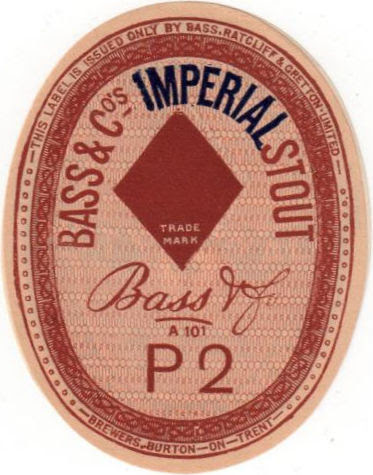
After digging around in old price lists, I'm pretty sure that I know which Bass beer they're talking about: P2 or Extra Stout. Which would give it an OG of around 1075º. That was their second strongest Stout after P2 Imperial Stout. It definitely wasn't a cheap beer. 4s 6d for a dozen imperial pints is the same price as Bass Pale Ale, which was an expensive beer. Though it had a lower OG of 1065º.

Thursday, 7 October 2021

Heineken's 1935 Lagers

I recently recorded as joint talk with Peter Symons about beers from Heineken's pilot brewery in 1935. It goes into excruciating detail about what they were brewed from and how they were brewed. One for the real obsessives.


Too detailed? Possibly. Rather that than too sketchy.


Chasing down Burton

When was Burton first used to refer to a London-brewed Stock Ale? I had no real idea.

My first reaction was to take the easy way out and ask Martyn Cornell. Unfortunately, he didn't know either. There was nothing for it but to start looking myself. The obvious place being the British Newspaper Archives.

Just searching for "Burton Ale" wasn't going to be very productive. I'd just find hundreds of adverts for Bass and Allsopp. Reckoning brewery price lists were my best bet, I went for a dual search: "Burton Ale" and "Mild Ale". As I was only looking for London brewery price lists, I also limited the search to just London publications.

I kicked off in the 1860s. Plenty of references to Burton Ale, but none of them brewed in London. I'd just about given up on the 1870s, when I came across this:

Tottenham and Edmonton Weekly Herald - Saturday 24 May 1879, page 8.

This is what will appear in "Free!", my book after next, on the topic:

Stock Ales Had been brewed in London for a considerable length of time. Even the big Porter breweries had been bashing them out since the 1830s. Initially called XXK, XXXK and XXXXK, by the latter part of the century they were mostly known as KK, KKK and KKKK withing the brewery.

There was also a change in what they were sold as down the pub. With the name Burton gradually coming into common usage. By the time WW II rolled around Burton was the term universally used in London for strong, dark beers.

Why the term was used is a bit of a mystery. Most likely it was on account of strong Stock Ales for which Burton-on-Trent was famous. And had been long before IPA was ever brewed in the town

The when I can do a bit better on. Trawling through the British Newspaper Archives, the first mention of the name in connection with a London-brewed Strong Ale I could find was from 1879. In an advertisement from the Collier Brothers brewery of Walthamstow, which lists a “Fine Strong Burton Ale” for 60 shillings a barrel.  That price indicates a very powerful beer, probably 1080º, at least.

A pair of price lists from the same brewery give a clue to when the adoption of the term Burton began. In 1876 Santer and Collingwood, of the Albion Brewery on the Caledonian Road in London advertised a “Strong Ale” for 4 shillings and 3 pence a dozen imperial pint  bottles. Four years later, the same beer was advertised as “Strong Burton Ale”.  Which places the term’s origin at the end of the 1870s.


Wednesday, 6 October 2021

Let's Brew Wednesday - 1887 Fullers XXK

The set of Fullers beers is completed by XXK, described in an 1893 price list as Strong Old Ale. I see no reason to disagree with the name.

Unsurprisingly, being the strongest beer in the range, it was also the most expensive, at 70 shillings per 36-gallon barrel.  A good 10 shillings more than IPA, the second most expensive.

I’m not sure if the term Burton was already in use for Strong Ale in London. But that’s certainly what it would have been called a decade or two later. By which time it was firmly established of one of the standard draught beers in a London pub.

It’s fascinating to see crystal malt making an appearance. It wasn’t commonly used by London brewers. Whitbread only adopted it in the 1930s. Barclay Perkins sometimes threw in a small amount, mostly in Milds. Truman added it to its X Ale just before WW I.

Other than the crystal, it’s just pale malt and our old friend “Sacc.”. Giving it a fairly dark colour. Earlier in the century Stock Ales – KK, KKK and KKKK – had been made from 100% pale malt and fairly pale. Though the strongest ones would have had a little colour, purely due to the massive amount of malt.

There were no fewer than five types of hops, some of which I can’t read. Others where I’ve no idea what they mean. This is how I have them noted down. HB (1886), EK (1986), W of K (1886),?? (1886), Poperinge (1886). The last two were in pretty small quantities, 80 lbs and 94 lbs, respectively, out of a total of 1,100 lbs. About a third were EK, so something Goldings-like. Whatever they were, all the hops were fresh, as this brew was in April 1887.

I know for certain it was aged. There’s a note in the brewing record:

“Pumped over into settling back Tuesday Morning 26th April and run into No. 13 vat, next day very bright”

If they’re taking the trouble to put it into a vat, they’d be ageing at least 6 months. More likely, 12 months. Which would have considerably increased the attenuation and ABV. The latter possibly as high as 9% or more due to a Brettanomyces secondary fermentation..


1887 Fullers XXK
pale malt 12.75 lb 75.00%
crystal malt 60 L 0.50 lb 2.94%
No. 2 invert sugar 3.75 lb 22.06%
Fuggles 90 mins 3.00 oz
Fuggles 60 mins 3.00 oz
Goldings 30 mins 3.00 oz
Fuggles dry hops 1.00 oz
OG 1079
FG 1021
ABV 7.67
Apparent attenuation 73.42%
IBU 87
SRM 26
Mash at 150º F
Sparge at 170º F
Boil time 90 minutes
pitching temp 57º F
Yeast WLP002 English Ale


Tuesday, 5 October 2021

When did Burton Ale originate?

I don't mean when did the beer first called Burton Ale appear. Rather, when were London-brewed Stock Ales first called Burton Ale? But that was a bit too long for a title.

I started wondering about this when writing a post about a Fullers Stock Ale recipe from 1887. I know that later it would have been called a Burton. But was it back in 1887?

My gut instinct said late 19th century. I know from a London publicans' price fixing agreement from around the start of WW I that Burton Ale was part of the standard draught range of a London pub. Logically, the term must have pre-dated WW I by at least a decade. But how to nail down a more precise date?

Being a very lazy person, the first thing I did was to ask Martyn Cornell. Him being a fount of knowledge on everything connected with brewing in London. Unfortunately, he didn't know any better than me., coming up with around 1900.

Getting off my lazy arse a little, I remembered my spreadsheet derived from brewery price lists. Bound to be something in there. Sure enough, there was. This from 1893:

Kelly's Directory for Ealing, Acton, 1893-94

It ticks all the boxes. A London-brewed Strong Ale clearly named Burton. I've knocked the date back to the early 1890s. Surely it must be older than that. I'm guessing at least the 1880s.

Why don't I just check all the London brewing records I have? Because brewers called beers differently in the brewhouse. What a drinker called Burton, was KK or KKK internally. At least at the big breweries. 

The same was true at smaller Fullers. Where in the 1880s and 1890s, their Burton was called XXK inside the brewery. Though sometime between 1898 and 1902 the name was changed to BO - Burton Old.

My curiosity now roused, I've started trawling the newspaper archives. Beginning with the 1860s, where I came up with zilch. I'm now on the 1870s. I'll let you know how I get on.

Monday, 4 October 2021

German beer (part four)

Yet more about German beer imports into Holland during WW II.

The following question - which must have been posed by the German authorities - was in German, as was the Dutch brewers' reply.

"1. Import of German beer.
What are the wishes regarding the import and export of beer on the Dutch side?

The following was answered in writing: 

A. The beer imported into the Netherlands will be:

1. in a calendar year be not more than 25,000 H.L.,
2. have an original wort gravity which is not higher than the maximum percentage that is permitted for Dutch beer,
3. be subject to the same sales regulations as the local beer (possible rationing, customer protection)."
Minutes of the management of the CBK on 8th May 1941, held at the Amsterdamse Stadsarchief, document number 31121-1, page 158.

It's very much a summation of the CBK (the Dutch brewers' association) attitude to German imports. Basically, they didn't want German beer to have any advantage over Dutch beer. And only be imported in limited quantities. Relations still seem to have been quite cordial between the German authorities and the Dutch brewers. A couple of years later there would have been more demanding than asking questions.

I'd wondered why Heineken analysed Patzenhofer. Here's the answer:

"C. Import of German beer.
The speaker put forward that the C.B.K has the impression that considerably more beer is being imported than corresponds to the agreed quantity of 25,000 hl. The Speaker mentioned the Patzenhofer Brauerei as an example, which had never before imported into the Netherlands, but now suddenly appears here on the market.

Mr. Abraham made some announcements from which it could be calculated that the import amounted to an annual quantity of more than 50,000 hl. The German side then informed them that the Ausfuhrgemeinschaft in Germany only allows exports to certain breweries for which a limited quantity of raw materials is made available, which amounts to 140,000 - 150,000 hl. per year, which must be used for export to various countries. It was suspected, however, that some breweries are now exporting at the expense of their domestic turnover, which matter will be discussed in Berlin. Mr. Abraham suggested that the Ausfuhrgemeinschaft specify how much beer each of the recognized export breweries is allowed to import into the Netherlands each month to facilitate control by the Meelcentrale. The German authorities did not consider such a check on imports appropriate. The only solution was seen in the introduction of a Kundenschutz, which would then apply to both Dutch and imported bier.

The speaker replied that he was generally an opponent of Kundenschutz, but that he had no objection to this under the present circumstances, even if this would entail very great difficulties. The speaker added that there are breweries that cannot agree with Kundenschutz.

Finally, it was agreed that Co Haupt-vereinigung (Ausfuhrgemeinschaft) will be proposed by the German gentlemen to limit beer imports to the Netherlands in the months May to December 1941 at 37,500 hl. (this quantity was increased in proportion to the increase in domestic turnover in the Netherlands) in connection with the supply of raw materials to German breweries. This will be further announced. The Meelcentrale will check the imports."
Minutes of the management of the CBK on 5th June 1941, held at the Amsterdamse Stadsarchief, document number 31121-1, pages 125 - 126.

How crazy was it to be shipping beer from Patzenhofer - based in Berlin - all the way to Holland? Didn't the Germans have more pressing need of transport than shipping beer around the place?

I'm amazed that German beer was being exported to multiple countries. Again, what a waste of limited transport. And of raw materials, with regard to domestic production. No wonder they lost the war.

 In the UK zoning was introduced to limit unnecessary movement of beer internally in the UK

Sunday, 3 October 2021

German beer (part three)

Yes, yet more weirdness relating to German beer imports into Holland during the war. I hope you're enjoying all this as mush as I am. Which is a stack.

This discussion reveals why German brewers might have been so keen to sell their beer in Holland: it made them more money.

"IX. IMPORT OF GERMAN BEER.
Mr Stikker says that the price of the German imported beer has also been discussed with Mr Schokker.

As is known, Löwenbrau now offers beer for f 49.50 per H.L.

With regard to this price in the Netherlands, the following global comparison can be made with the price of this beer in Germany:

  in Germany  in the Netherlands
  R.M. f R.M. f
price 56 42 66 49.5
levies 25 18.75 14 10.5
net 31 23.25 52 39

According to this calculation, the German breweries in the Netherlands would make much higher profits than in Germany, which may give rise to renting or buying Dutch cafes. This subject greatly interested Mr. Schokker; he asked for further details."
Minutes of the management of the CBK on 26th March 1941, held at the Amsterdam City Archives, document number 31121-1, pages 236 - 237.

That's 68% more markup that Löwenbräu was getting in Holland compared to Germany. No wonder German brewers were keen on getting into the Dutch market.

German brewers were approaching Dutch brewers and pub owners directly, offering to sell them beer.

"Mr. Chambille announces that a quantity of 25,000 H.L. has been offered to de Leeuw by a German brewery along with the representation for some Dutch provinces. Speaker asks if he can accept this offer.

The meeting is of the opinion that De Leeuw should not accept this.

Mr Zylker says that German breweries are offering beer to customers of Oranjeboom on the condition that the customer undertakes to purchase only the beer from the German brewery.

Mr Stikker says that in The Hague several customers already carry German beer in addition to Dutch beer.

Mr. Zylker says that, as far as Speaker is known, none of the Oranjeboom customers have accepted the offer to buy exclusively German beer."
Minutes of the management of the CBK on 26th March 1941, held at the Amsterdam City Archives, document number 31121-1, page 237. 

De Leeuw was located in Limburg, very close to the German border. So they would have been an obvious company for a German brewer to approach. Unsurprisingly, the CBK didn't want them to accept the offer.

In the case of Oranjeboom, the Germans were even bolder, going behind the Dutch brewer's back and offering beer directly to their pubs. I can understand why they would be worried by such a development. That the German beer would force out Dutch. With hindsight, it's easy to say that this was obviously never going to happen. Pretty soon they wouldn't be able to supply beer to the German domestic market. But in early 1941 no-one in Holland knew that.

Dutch customers would have been tempted by the offer of German beer, as local breweries struggled to brew enough to match demand. A simple solution to that problem was suggested:

"Mr Stikker proposes that in the forthcoming discussion with the authorities about the arrangements to be made, the Netherlands breweries can only cooperate if a definitive arrangement with regard to German beer imports has been reached. The speaker said that he was of the opinion that, if German imports continue to increase, to the extent that people are currently experiencing, it was better to do everything they can and for instance to reduce the gravity, than to limit their turnover themselves. If the government then deems measures necessary, it must prescribe them immediately.

The meeting unanimously declares that it agrees with Mr Stikker's proposal.

Mr Stikker asks the breweries present to make analyzes of German imported beer. At the laboratory of the H.B.M. some investigations have already been carried out, which showed that the gravity of the beer was approximately at the agreed level."
Minutes of the management of the CBK on 26th March 1941, held at the Amsterdam City Archives, document number 31121-1, page 237. 

I happen to have the analyses HBM (Heineken) carried out in early 1941:

German beer in WW II
Date Year Brewer Town Beer OG Plato FG Plato ABV App. Atten-uation Colour
6th Mar 1941 Dortmunder Union Dortmund Dortmunder 11.54 3.18 4.35 73.35% 0.52
6th Mar 1941 Dortmunder Union Dortmund Pilsener 10.03 2.83 3.73 72.59% 0.48
Source:
Rapporten van laboratoriumonderzoeken naar producten van Heinekenbrouwerijen in binnen- en buitenland en naar producten van andere brouwerijen held at the Amsterdamse Stadsarchief, document number 834 - 1794.

It seems that few publicans were tempted to buy German beer, despite everything:

"Mr Zylker remarks that in general the buyers do not buy German beer, despite the fact that Dutch breweries are often unable to serve them as required. If the breweries ensure by lowering the gravity that they can supply their customers with the largest possible quantity of beer, in the first place the buyers are given a weapon to oppose German beer, while on the other hand, the door which Mr. Louwes has opened has opened, is kept open."
Minutes of the management of the CBK on 3rd April 1941, held at the Amsterdamse Stadsarchief, document number 31121-1, page 197.

Still quite a bit more of this to come. Dutch brewers spent a lot of time fretting over the topic.