Monday, 19 September 2016
More low-key travel
I've a whole array of unfinished posts. It's quite scary, really. Now I need some quick posts to cover a week of travelling, it's time to dust off one and sort of finish it.
It's about a trip to Nijmegen me and Dolores made last winter. Yes, it's taken me the best part of a year to get around to finishing it off. What a lazy bastard I am.
Dolores had never been to Nijmegen before. "Let's go there, then." I said. We had to go somewhere. Our cheap day tickets expired in a few days. It was a case of use them or lose them.
We'd bought the tickets to travel to the Kerstbierfestival in Essen. Then discovered it was all ticket and sold out on the day we planned attending. Bum. Time to find another destination. Quickly. Harlingen - which looks lovely - was too complcated a journey. I couldn't persuade Dolores to visit Zwolle. And Arnhem was out because "the station is too far from the centre". Options running short, we finally settled on Nijmegen.
I must be mellowing. Because I didn't buy any cans for the train in the station. Just a newspaper. The journey was magical. A low, grey sky barely illuminating the washed out verdure of the fields. Not that I was paying the scenery much attention. Too busy reading Private Eye. I've managed to get two issues behind and I needed to catch up. At least that was my excuse. I let Dolores devour the paper.
Considering it's vomitting distance from the German border, the trip to Nijmegen is short, just under 90 minutes. And then just a few minutes' walk into the centre. Dolores was keen on dropping by Primark to get some clothes, so we headed there first. It was mobbed. But Dolores managed to pick up somedead cheap clothes for her and the kids.
Shopping out of the way, it as time for refreshment. Nijmegen is a slightly odd town, mostly as a result of heavy wartime damage. The Americans accidentally bombed it, believing it was in Germany. It means that a lot of the city centre is compased of fairly bland postwar buildings. Though some of the older fabric of the city has survived.
One of those bits is now a brewery, Stadsbrouwerij De Hemel. Though it is sort of hidden around the back of the city centre, the sole older building is a sea of modern flats. It's all a bit odd.
They've been around for a fair while and have built up a reasonable reputation. For a long time it was the only brewery in town, though now it has several companions. Brewing is booming in the city. As it is in many parts of Holland.
Inside there are two rather grand rooms, with high ceilings and at atmosphere of the past. One houses the brewing kit, the other the bar. We settled in the one containing the bar and set about resolving our refreshment issues. Beer and food - what more could you need? A happy hour or two was spent gnawing away at out hunger and thirst.
On our way into town I'd noticed a beer shop, De Bierhoeder. Seemed a shame to just walk past it again, so in we popped. They had a very decent array of locally-brewed beers, of which I pliucked a dozen or so from the shelves. I hadn't been looking at the prices and had quite a shock when I came to pay. Many were over 3 euros a pop.
Still, at least I had something to pop on the journey back. And much classier than a can of Heineken.
Stadsbrouwerij De Hemel
Franseplaats 1,
6511 VS NIJMEGEN
024-360 61 67
info@brouwerijdehemel.nl
http://www.brouwerijdehemel.nl
De Bierhoeder
Bloemerstraat 86
6511 EM Nijmegen
Tel: +31 24 3601620
http://www.debierhoeder.nl
It's about a trip to Nijmegen me and Dolores made last winter. Yes, it's taken me the best part of a year to get around to finishing it off. What a lazy bastard I am.
Dolores had never been to Nijmegen before. "Let's go there, then." I said. We had to go somewhere. Our cheap day tickets expired in a few days. It was a case of use them or lose them.
We'd bought the tickets to travel to the Kerstbierfestival in Essen. Then discovered it was all ticket and sold out on the day we planned attending. Bum. Time to find another destination. Quickly. Harlingen - which looks lovely - was too complcated a journey. I couldn't persuade Dolores to visit Zwolle. And Arnhem was out because "the station is too far from the centre". Options running short, we finally settled on Nijmegen.
I must be mellowing. Because I didn't buy any cans for the train in the station. Just a newspaper. The journey was magical. A low, grey sky barely illuminating the washed out verdure of the fields. Not that I was paying the scenery much attention. Too busy reading Private Eye. I've managed to get two issues behind and I needed to catch up. At least that was my excuse. I let Dolores devour the paper.
Considering it's vomitting distance from the German border, the trip to Nijmegen is short, just under 90 minutes. And then just a few minutes' walk into the centre. Dolores was keen on dropping by Primark to get some clothes, so we headed there first. It was mobbed. But Dolores managed to pick up somedead cheap clothes for her and the kids.
Shopping out of the way, it as time for refreshment. Nijmegen is a slightly odd town, mostly as a result of heavy wartime damage. The Americans accidentally bombed it, believing it was in Germany. It means that a lot of the city centre is compased of fairly bland postwar buildings. Though some of the older fabric of the city has survived.
One of those bits is now a brewery, Stadsbrouwerij De Hemel. Though it is sort of hidden around the back of the city centre, the sole older building is a sea of modern flats. It's all a bit odd.
They've been around for a fair while and have built up a reasonable reputation. For a long time it was the only brewery in town, though now it has several companions. Brewing is booming in the city. As it is in many parts of Holland.
Inside there are two rather grand rooms, with high ceilings and at atmosphere of the past. One houses the brewing kit, the other the bar. We settled in the one containing the bar and set about resolving our refreshment issues. Beer and food - what more could you need? A happy hour or two was spent gnawing away at out hunger and thirst.
On our way into town I'd noticed a beer shop, De Bierhoeder. Seemed a shame to just walk past it again, so in we popped. They had a very decent array of locally-brewed beers, of which I pliucked a dozen or so from the shelves. I hadn't been looking at the prices and had quite a shock when I came to pay. Many were over 3 euros a pop.
Still, at least I had something to pop on the journey back. And much classier than a can of Heineken.
Stadsbrouwerij De Hemel
Franseplaats 1,
6511 VS NIJMEGEN
024-360 61 67
info@brouwerijdehemel.nl
http://www.brouwerijdehemel.nl
De Bierhoeder
Bloemerstraat 86
6511 EM Nijmegen
Tel: +31 24 3601620
http://www.debierhoeder.nl
Sunday, 18 September 2016
Tetley’s acquisitions
Not all breweries took the same route to greatness. That’s one of the things I’m starting to realise. Tetley and Allied Breweries came into existence in quite a different way to Whitbread or Bass Charrington.
In the case of the latter two, they were the result of a large number of acquisitions and mergers. Bass Charrington started with Hammonds taking over multiple Northern breweries, then merging with Charrington which had also bought serval breweries and finally hooking up with Bass M & B. The story was similar at Whitbread, which made multiple purchases of brewers that were often the result of mergers themselves.
As you can see from the table, Tetley made a small number of large purchases. Before merging with first Walker Cain then with Ansells and Ind Coope to form Allied breweries. Because Allied was the result of the merger of a relatively small number of large breweries, they operated far fewer plants initially than other Big Six brewers: Leeds, Warrington, Birmingham, Burton-on-Trent, Alloa and Romford. That was it.
While Bass and Whitbread spent the 1960’s and 1970’s trying to rationalise their brewing operations, Allied didn’t need to close many breweries. And when they did close one, Ansells, it because of poor labour relations, not rationalisation.
When Tetley merged with Walker Cain, it owned 2,771 pubs.*
* “The Brewing Industry: a Guide to Historical Records" edited by Leslie Richmond and Alison Turton, 1990, page 326
In the case of the latter two, they were the result of a large number of acquisitions and mergers. Bass Charrington started with Hammonds taking over multiple Northern breweries, then merging with Charrington which had also bought serval breweries and finally hooking up with Bass M & B. The story was similar at Whitbread, which made multiple purchases of brewers that were often the result of mergers themselves.
As you can see from the table, Tetley made a small number of large purchases. Before merging with first Walker Cain then with Ansells and Ind Coope to form Allied breweries. Because Allied was the result of the merger of a relatively small number of large breweries, they operated far fewer plants initially than other Big Six brewers: Leeds, Warrington, Birmingham, Burton-on-Trent, Alloa and Romford. That was it.
While Bass and Whitbread spent the 1960’s and 1970’s trying to rationalise their brewing operations, Allied didn’t need to close many breweries. And when they did close one, Ansells, it because of poor labour relations, not rationalisation.
| Tetley acquisitions | |||
| Year | Company | Town | tied houses |
| 1897 | Joshua Tetley | Leeds | 102 |
| 1954 | Duncan Gilmour | Sheffield | 500 |
| 1959 | William Whitaker | Bradford | |
| 1960 | Melbourne | Leeds | 345 |
| 1960 | Walker Cain | Warrington | |
| Source: | |||
| The Brewing Industry: a Guide to Historical Records" edited by Leslie Richmond and Alison Turton, 1990, pages 231 and 326 | |||
When Tetley merged with Walker Cain, it owned 2,771 pubs.*
* “The Brewing Industry: a Guide to Historical Records" edited by Leslie Richmond and Alison Turton, 1990, page 326
Saturday, 17 September 2016
Let's Brew - 1949 William Younger Pale XXPS
Another exciting beer from the colourful late 1940’s. Only joking. I realise the period was as grey as its beers were watery.
This is so exciting. Because this is a beer I drank quite often, it being one of Younger’s main cask beers. Though it was sold under different names: 70/- in Scotland, Scotch in England. It seems to have been introduced just after WW I, possibly as a reaction to the drop in gravity of their former flagship Pale Ale, XXP. Post-war, XXP became 60/-. So a beer which had originally been an IPA, ended up as Dark Mild. Now there’s a weird transformation. But I digress.
On paper, this looks very similar to the beer I drank in the 1970’s and 1980’s. The gravity, 1037º, is identical. Though I suspect the recipe was rather different by then. I can’t imagine that they continued to use flaked barley. I wonder if they went back to grits when maize became available again?
I know from a 1960 document that XXPS came in three different colours: 5, 6 and 9 SRM. The first was the as-brewed number, which is pretty close to the figure BeerSmith spat out.
Not much else to say, other than that this looks like an archetypal post-war Ordinary Bitter. Maybe the bitterness is a little below average.
This is so exciting. Because this is a beer I drank quite often, it being one of Younger’s main cask beers. Though it was sold under different names: 70/- in Scotland, Scotch in England. It seems to have been introduced just after WW I, possibly as a reaction to the drop in gravity of their former flagship Pale Ale, XXP. Post-war, XXP became 60/-. So a beer which had originally been an IPA, ended up as Dark Mild. Now there’s a weird transformation. But I digress.
On paper, this looks very similar to the beer I drank in the 1970’s and 1980’s. The gravity, 1037º, is identical. Though I suspect the recipe was rather different by then. I can’t imagine that they continued to use flaked barley. I wonder if they went back to grits when maize became available again?
I know from a 1960 document that XXPS came in three different colours: 5, 6 and 9 SRM. The first was the as-brewed number, which is pretty close to the figure BeerSmith spat out.
Not much else to say, other than that this looks like an archetypal post-war Ordinary Bitter. Maybe the bitterness is a little below average.
| 1949 William Younger Pale XXPS | ||
| pale malt | 7.25 lb | 85.29% |
| flaked barley | 1.25 lb | 14.71% |
| Fuggles 90 min | 0.50 oz | |
| Fuggles 60 min | 0.50 oz | |
| Fuggles 30 min | 0.50 oz | |
| Goldings dry hops | 0.25 oz | |
| OG | 1037 | |
| FG | 1011 | |
| ABV | 3.44 | |
| Apparent attenuation | 70.27% | |
| IBU | 21 | |
| SRM | 4 | |
| Mash at | 153º F | |
| Sparge at | 160º F | |
| Boil time | 75 minutes | |
| pitching temp | 62º F | |
| Yeast | WLP028 Edinburgh Ale | |
Labels:
1940's,
beer recipes,
Edinburgh,
India Pale Ale,
IPA,
Let's Brew,
pale ale,
Scotland,
Scottish Ale,
Younger
Friday, 16 September 2016
Business good for Tetley (part three)
A final look at Tetley in the 1950’s.
Tetley had an impressive tied house estate, at least in Leeds. Lots of high-quality late Victorian and Edwardian pubs. The Garden Gate, The Adelphi, The Cardigan Arms and the Rising Sun. the latter being one of the top-notch houses they acquired when the bought rival Leeds brewery Melbourne. They were noted for having spectacular pubs.
Trading in licences – usually more than one – to be able to build a new pub was common practice. Small, old-fashioned pubs in districts where a brewery owned many were usually the ones sacrificed. Pubs on new housing estates were an attractive proposition because there was usually limited competition.
While a fall in the barley – and hence malt – price would have been welcome, it wouldn’t really have had much of an impact on Tetley’s costs, as the price of raw materials were only a small part of their overall costs, which were dominated by the beer tax.
I’ll end with analyses of a few of Tetley’s beers:
It’s a bit dull, as there are only really two beers in the table. Family Ale was the name for the bottled version of their Dark Mild. Which, as you can see, wasn’t very dark. The specs look very similar to the Tetley’s Mild and Bitter I drank in the 1970’s.
“Policy of improvements
Our licensed properties have been maintained in good repair during the year and we are always endeavouring to improve as far as we can both the service offered to the public and also the comforts and accommodation provided for the tenants who manage them so well for us. During the past year we opened two new public houses, one in Leeds and one near Barnsley, giving up licences in the case of one them taken from other houses which have been closed. In the coming year we hope to start building one or two more houses on new housing estates.
I do not wish to prophesy as to the future, but I can tell you that since September 30 sales have been well maintained and it is to say that owing to the fall in the price of barley there will be some reduction in the cost of malt. At the same time I must confess that I was too sanguine last year when I forecast that our new drum maltings should be fully employed in the spring of 1955. They will be in partial production during next year but probably not in full operation until October, 1955.
In conclusion I should like to pay tribute to the work done by all the men and women employed by the group The results achieved are due to a large extent the devoted services rendered by them. I am sure that all stockholders will wish to Join me in saying "thank you.”
I now beg to move that the statement of accounts for the year ended September 30. 1954, as audited, together with the directors’ report, be and are hereby approved and adopted and I will ask Mr M. H. Tetley to second this motion. The Report and Accounts were then unanimously adopted, the dividend approved as proposed by the directors and the formal business duly transacted, the proceedings ending with a vote of thanks to the chairman for presiding.”
Yorkshire Post and Leeds Intelligencer - Monday 03 January 1955, page 3.
Tetley had an impressive tied house estate, at least in Leeds. Lots of high-quality late Victorian and Edwardian pubs. The Garden Gate, The Adelphi, The Cardigan Arms and the Rising Sun. the latter being one of the top-notch houses they acquired when the bought rival Leeds brewery Melbourne. They were noted for having spectacular pubs.
Trading in licences – usually more than one – to be able to build a new pub was common practice. Small, old-fashioned pubs in districts where a brewery owned many were usually the ones sacrificed. Pubs on new housing estates were an attractive proposition because there was usually limited competition.
While a fall in the barley – and hence malt – price would have been welcome, it wouldn’t really have had much of an impact on Tetley’s costs, as the price of raw materials were only a small part of their overall costs, which were dominated by the beer tax.
I’ll end with analyses of a few of Tetley’s beers:
| Tetley beers 1949 - 1960 | |||||||||
| Year | Beer | Style | Price per pint d | package | OG | FG | ABV | App. Atten-uation | colour |
| 1949 | Dark Ale | Brown Ale | 13 | bottled | 1029.8 | 1003.4 | 3.44 | 88.59% | 48 |
| 1950 | Family Ale | Brown Ale | 15.5 | bottled | 1030.1 | 1003.4 | 3.48 | 88.70% | 52 |
| 1952 | Family Ale | Brown Ale | 15 | bottled | 1035.5 | 1009 | 3.44 | 74.65% | 54 |
| 1952 | X | Mild | 13 | draught | 1031.3 | 58 | |||
| 1952 | Pale Ale | Pale Ale | 16 | draught | 1036.3 | 20 | |||
| 1953 | X | Mild | 13 | draught | 1031.4 | 58 | |||
| 1953 | Pale Ale | Pale Ale | 16 | draught | 1037.3 | 20 | |||
| 1954 | Family Ale | Brown Ale | 24 | bottled | 1035.1 | 1007.2 | 3.62 | 79.49% | 57 |
| 1955 | Bitter | Pale Ale | 25 | bottled | 1037.1 | 1004 | 4.32 | 89.22% | 23 |
| 1959 | Bitter Ale | Pale Ale | 21 | bottled | 1039 | 1006.1 | 4.11 | 84.36% | 23 |
| 1960 | Mild Ale | Mild | 12 | draught | 1031.9 | 1003.6 | 3.54 | 88.71% | 60 |
| 1960 | Bitter | Pale Ale | 16 | draught | 1037.9 | 1003.7 | 4.28 | 90.24% | 20 |
| Sources: | |||||||||
| Truman Gravity Book held at the London Metropolitan Archives, document number B/THB/C/252 | |||||||||
| Whitbread Gravity book held at the London Metropolitan Archives, document number LMA/4453/D/02/002 | |||||||||
It’s a bit dull, as there are only really two beers in the table. Family Ale was the name for the bottled version of their Dark Mild. Which, as you can see, wasn’t very dark. The specs look very similar to the Tetley’s Mild and Bitter I drank in the 1970’s.
Thursday, 15 September 2016
Wet hops at Goose Island
I spent Monday at Goose Island helping, well, watching , really, a wet hop beer brewed.
It was lots of fun. Then again, hanging around in a brewery is always fun. But they're a good bunch the brewers at Goose Island. Making it even more fun. The beer was brewed in their 2-barrel pilot plant. And the 50 pounds of wet Chinooks pretty much filled the pot.
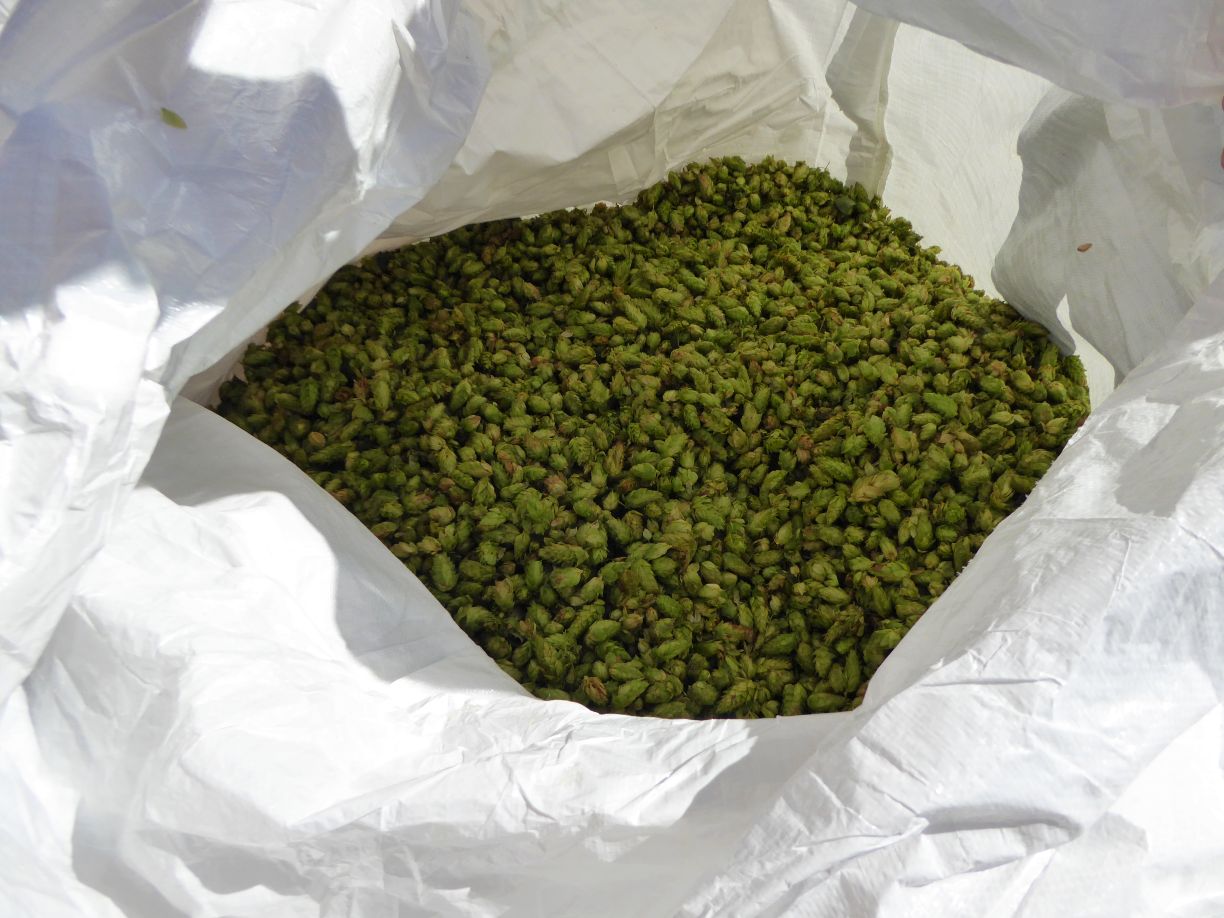
The smell of the hops was just amazing. And they were so sticky when you rubbed them between your hands. Interestingly, they looked really similar to the wild Amsterdam hops Dolores picked last week.
Not many words this time. Just some lovely pictures.
Disclaimer.
My trip to Chicago was paid for by Goose Island as part of their contractual obligations for our Brewery Yard collaboration beer.
It was lots of fun. Then again, hanging around in a brewery is always fun. But they're a good bunch the brewers at Goose Island. Making it even more fun. The beer was brewed in their 2-barrel pilot plant. And the 50 pounds of wet Chinooks pretty much filled the pot.
The smell of the hops was just amazing. And they were so sticky when you rubbed them between your hands. Interestingly, they looked really similar to the wild Amsterdam hops Dolores picked last week.
Not many words this time. Just some lovely pictures.
Disclaimer.
My trip to Chicago was paid for by Goose Island as part of their contractual obligations for our Brewery Yard collaboration beer.
Wednesday, 14 September 2016
Let's Brew Wednesday - 1949 William Younger No. 3 Btlg
No. 3 is a personal favourite of mine. Having drunk when it was still brewed by William Younger has left me with a lingering affection for the beer.
Which explains why I keep bothering you with recipes for it. I’m hoping eventually I’ll get some in my glass. Though this is quite a tame looking version, what with its low level of hopping and modest OG.
As I’ve been explaining, foreign hops disappeared for the most part from British beer after WW II. For the simple reason that they weren’t required any more. The UK was capable of growing all the hops it needed. Which certainly hadn’t been true for the second half of the 19th century and some of the early 20th. You occasionally see classy continental hops like Saaz or Hallertau, but US hops had disappeared entirely from British beer.
It’s strange that Younger’s grists actually appear to have improved in quality due to government restrictions. The 1933 version of No. 3 contained 41% grits. I wonder if drinkers noticed? If they did, they’d probably have complained that the beer didn’t taste like it used to. During the whole interwar period Younger’s beers had crazy levels of grits in them. People must have got used to it.
I wouldn’t pay too much attention to the colour listed. Third-party analyses I have of the beer put the colour somewhere in the 20’s on the SRM scale.
Which explains why I keep bothering you with recipes for it. I’m hoping eventually I’ll get some in my glass. Though this is quite a tame looking version, what with its low level of hopping and modest OG.
As I’ve been explaining, foreign hops disappeared for the most part from British beer after WW II. For the simple reason that they weren’t required any more. The UK was capable of growing all the hops it needed. Which certainly hadn’t been true for the second half of the 19th century and some of the early 20th. You occasionally see classy continental hops like Saaz or Hallertau, but US hops had disappeared entirely from British beer.
It’s strange that Younger’s grists actually appear to have improved in quality due to government restrictions. The 1933 version of No. 3 contained 41% grits. I wonder if drinkers noticed? If they did, they’d probably have complained that the beer didn’t taste like it used to. During the whole interwar period Younger’s beers had crazy levels of grits in them. People must have got used to it.
I wouldn’t pay too much attention to the colour listed. Third-party analyses I have of the beer put the colour somewhere in the 20’s on the SRM scale.
| 1949 William Younger No. 3 Btlg | ||
| pale malt | 9.75 lb | 88.64% |
| flaked barley | 1.25 lb | 11.36% |
| Fuggles 90 min | 0.75 oz | |
| Fuggles 60 min | 0.50 oz | |
| Fuggles 30 min | 0.50 oz | |
| Goldings dry hops | 0.25 oz | |
| OG | 1047 | |
| FG | 1012 | |
| ABV | 4.63 | |
| Apparent attenuation | 74.47% | |
| IBU | 22 | |
| SRM | 4 | |
| Mash at | 153º F | |
| Sparge at | 160º F | |
| Boil time | 75 minutes | |
| pitching temp | 61º F | |
| Yeast | WLP028 Edinburgh Ale | |
Labels:
1940's,
beer recipes,
Edinburgh,
Let's Brew,
Scotch Ale,
Scotland,
Scottish Ale,
Strong Ale,
Younger
Tuesday, 13 September 2016
Business good for Tetley (part two)
We’re back in mid-1950’s Leeds looking at Tetley’s annual report.
It looks as if they were making healthy profits and paying a reasonable dividend. Though as we saw last time, a large proportion of the money they earned was paid in beer duty.
Improving their tied estate was a priority for all forward-looking breweries. Better pubs meant more beer was sold. It was an investment in the future growth of the business. In the period 1940 to 1950 restrictions on building work and a shortage of materials meant very little work could be carried. Leaving breweries with a backlog of maintenance on their pubs.
I didn’t know much about Duncan Gilmour, so I looked them up. This is what I found.
Duncan Gilmour and Co. started as a wine merchant in Sheffield in 1831. In 1892 the company diversified into brewing when it bought two breweries on Merseyside: United Breweries (Liverpool) and the Windsor Brewery. In the early 20th century it purchased several breweries in and around Sheffield: W.H. Birks & Co. (1900), H.W. Dearden (1901), Whitmarsh, Watson & Co. Ltd. (1906) and Wm. Greaves & Co. Ltd. (1920). In the process the company built up a considerable tied estate. When it was taken over by Tetley in 1954 Duncan Gilmour had 148 pubs in Sheffield and a further 350 pubs in Merseyside supplied by the Windsor Brewery. It stopped brewing sometime in the early 1960's.*
With 500 pubs it was a considerable addition to Tetley’s estate, especially west of the Pennines. Naturally Tetley would seek to serve them from the brewery in Leeds. Presumably the bottling store in Sheffield was built on land owned by Duncan Gilmour.
I leave you with the only Duncan Gilmour analyses I have:
* A synopsis of information in "The Brewing Industry: a Guide to Historical Records" edited by Leslie Richmond and Alison Turton, 1990, page 154.
It looks as if they were making healthy profits and paying a reasonable dividend. Though as we saw last time, a large proportion of the money they earned was paid in beer duty.
“Group profit and dividend
Trading results of the group show a net profit before taxation £719,682 but the deduction of taxation at the rate of 11s. 11d. in the pound as against 11s. 8d last year reduces the group net profit to £291,527 as against £259,465 a year ago.
We have recommended the payment of a final dividend of 7% on the increased capital which, with the interim dividend already paid, makes a fractional percentage increase on last year’s dividend on a smaller capital. We also suggest that the sum of £50,000 should be transferred general reserve and £50,000 to property improvements reserve and that £216,771 should be carried forward. As mentioned in the chairman’s statement published with the accounts, our board has been engaged since last March in co-ordinating the working of Duncan Gilmour & Co and its subsidiaries with the activities of the parent company. We have taken over already the production of beer to be sold by certain of Duncan Gilmour’s subsidiaries and over a period of years we hope gradually to supply the demands of the whole Duncan Gilmour group from our Leeds brewery. We are also contemplating the eventual building of new bottling store in the Sheffield area which should greatly increase our capacity for producing bottled beer. Various companies in the group have substantial interests in the wine and spirit trade both in this country and abroad. These interests are also in process of co-ordination so as to obtain the maximum results therefrom. We are also engaged in the survey of the transport and carriage facilities of the group with a view to effecting economies in this most expensive charge our trading.”
Yorkshire Post and Leeds Intelligencer - Monday 03 January 1955, page 3.
Improving their tied estate was a priority for all forward-looking breweries. Better pubs meant more beer was sold. It was an investment in the future growth of the business. In the period 1940 to 1950 restrictions on building work and a shortage of materials meant very little work could be carried. Leaving breweries with a backlog of maintenance on their pubs.
I didn’t know much about Duncan Gilmour, so I looked them up. This is what I found.
Duncan Gilmour and Co. started as a wine merchant in Sheffield in 1831. In 1892 the company diversified into brewing when it bought two breweries on Merseyside: United Breweries (Liverpool) and the Windsor Brewery. In the early 20th century it purchased several breweries in and around Sheffield: W.H. Birks & Co. (1900), H.W. Dearden (1901), Whitmarsh, Watson & Co. Ltd. (1906) and Wm. Greaves & Co. Ltd. (1920). In the process the company built up a considerable tied estate. When it was taken over by Tetley in 1954 Duncan Gilmour had 148 pubs in Sheffield and a further 350 pubs in Merseyside supplied by the Windsor Brewery. It stopped brewing sometime in the early 1960's.*
With 500 pubs it was a considerable addition to Tetley’s estate, especially west of the Pennines. Naturally Tetley would seek to serve them from the brewery in Leeds. Presumably the bottling store in Sheffield was built on land owned by Duncan Gilmour.
I leave you with the only Duncan Gilmour analyses I have:
| Duncan Gilmour beers 1948 - 1952 | |||||||||
| Year | Beer | Style | Price per pint d | package | OG | FG | colour | ABV | App. Atten-uation |
| 1952 | Milk Round Stout | Stout | 22 | bottled | 1038.1 | 1012.4 | 11B + 1R | 3.32 | 67.45% |
| 1948 | Export Quality Golden PA | Pale Ale | bottled | 1053.1 | 1011.8 | 21 | 5.38 | 77.78% | |
| Source: | |||||||||
| Whitbread Gravity book held at the London Metropolitan Archives, document number LMA/4453/D/02/002 | |||||||||
* A synopsis of information in "The Brewing Industry: a Guide to Historical Records" edited by Leslie Richmond and Alison Turton, 1990, page 154.
Monday, 12 September 2016
Random Dutch beers (part forty-one)
You'll live to regret encouraging to write more of this drivel. The three or four of you who said they liked these sketches, that is.
It's Sunday again. It's been another busy weekend. Yesrerday I scanned my magazine entries for the British Guild of Beer Writers awards. This morning I packaged them into pdf files and sent then off. I'll probably end up empty handed again, but I don't enter there's no way I'll win.
I checked out a new pub, Tap Zuid, yesterday with Mikey. It started slightly chaotically with Mikey waiting for me in the wrong pub. All turned out well in the end.
Time for a beer. I really need to drink some beer. No, I really do. Dolores is getting pissed off with the area of living room floor.
"Don't buy any more beer, Ronald." she said when I went to take the empties back to Ton Overmars yesterday. I only got one bag of Abt rather than two. That's none as far as I'm concerned.
First beer of the day is from Kompaan, a highly-respected outfit from Den Haag.
Kompaan India Pale Lager 5.7% ABV
I didn't expct that. It's a deep copper colour. I'd expect a Pale Lager to be, er, paler. Bready aroma, with no trace of hops. Bloody hell that's bitter. Wasn't expecting that from the nose. Not particularly aromatic, more straight-on bitterness. Nothing very Lagery about it that I can tell. Pleasant enough, but a bit too bitter to drink a gallon of. Pretty sure Dolored won't like it.
"Dolores, do you want to try my beer?"
"No."
Not much wiggle room there.
It's now Friday. Been a busy week, as ever. Off to Chicago tomorrow. Luckily no work today. Just written a post about Tetley. Time for a beer.
It's one from highly-respected Emelisse.
Emelisse TIPA, 10% ABV
Nice copper colour and a soapy head. Pleasantly malty aroma, not the dominated as I'd expected. So good so far. Quite bitter, not not aromatically hoppy. And with plenty of malty goodness backing it up. Rather nice really. And full of alcoholy goodness. It's a non-lose, non-lose.
"Dolores, do you want to try my beer?"
I remember. She's still at work.
"Andrew, do you want to try my beer?"
I remember. He's just left to see his mate. You'll just have to make do with my bollocks.
It's Sunday again. It's been another busy weekend. Yesrerday I scanned my magazine entries for the British Guild of Beer Writers awards. This morning I packaged them into pdf files and sent then off. I'll probably end up empty handed again, but I don't enter there's no way I'll win.
I checked out a new pub, Tap Zuid, yesterday with Mikey. It started slightly chaotically with Mikey waiting for me in the wrong pub. All turned out well in the end.
Time for a beer. I really need to drink some beer. No, I really do. Dolores is getting pissed off with the area of living room floor.
"Don't buy any more beer, Ronald." she said when I went to take the empties back to Ton Overmars yesterday. I only got one bag of Abt rather than two. That's none as far as I'm concerned.
First beer of the day is from Kompaan, a highly-respected outfit from Den Haag.
Kompaan India Pale Lager 5.7% ABV
I didn't expct that. It's a deep copper colour. I'd expect a Pale Lager to be, er, paler. Bready aroma, with no trace of hops. Bloody hell that's bitter. Wasn't expecting that from the nose. Not particularly aromatic, more straight-on bitterness. Nothing very Lagery about it that I can tell. Pleasant enough, but a bit too bitter to drink a gallon of. Pretty sure Dolored won't like it.
"Dolores, do you want to try my beer?"
"No."
Not much wiggle room there.
It's now Friday. Been a busy week, as ever. Off to Chicago tomorrow. Luckily no work today. Just written a post about Tetley. Time for a beer.
It's one from highly-respected Emelisse.
Emelisse TIPA, 10% ABV
Nice copper colour and a soapy head. Pleasantly malty aroma, not the dominated as I'd expected. So good so far. Quite bitter, not not aromatically hoppy. And with plenty of malty goodness backing it up. Rather nice really. And full of alcoholy goodness. It's a non-lose, non-lose.
"Dolores, do you want to try my beer?"
I remember. She's still at work.
"Andrew, do you want to try my beer?"
I remember. He's just left to see his mate. You'll just have to make do with my bollocks.
Sunday, 11 September 2016
What I drank in Berlin (part three)
More filler stuff while I'm away. I should be doing a radio interview as you read this. Always a good laugh doing radio stuff.
I was particularly pleased to find the Weissenoher, having been to the brewery a couple of times. Quite odd to find beer from such a small Franconian brewery in Berlin.
And before you ask, Dolores drank the pre-mixed Berliner Weisse.
I was particularly pleased to find the Weissenoher, having been to the brewery a couple of times. Quite odd to find beer from such a small Franconian brewery in Berlin.
And before you ask, Dolores drank the pre-mixed Berliner Weisse.
Saturday, 10 September 2016
Let's Brew - 1949 William Younger LAE
Here’s a post-war version of William Younger’s LAE, allowing us to compare and contrast with the 1939 version. I always get a kick out of that. Now I think of it, there’s also that 1913 version to look at, too.
I’m surprised to see how little the gravity changed over the years. 1045º in 1913, 1046º in 1939 and 1041º in 1949. That’s quite unusual. I’d have expected the OG to be under 1040º. And because the degree of attenuation increased, the ABV of the 1949 version is barely lower than the other two.
There were some big changes to the beer over time. Most of them involuntary. Younger didn’t drop the grits and start using flaked barley from choice. Maize, which was imported mostly from the USA, became unavailable during WW II. And the government forced brewers to use flaked barley. Barley production increased enormously during the war, meaning there were reasonable supplies for brewers. The idea behind using flakes was to save the fuel expended in the malting process.
The war is also the reason for the change in hops. During both wars supplies of US hops dried up. But, due to the fall in gravity, the UK became self-sufficient in hops. This continued after WW II meaning there was no need to import hops.
If you look at the chart below you’ll see one truly massive change: the level of bitterness. Which fell dramatically between 1898 and 1913 and again between 1913 and 1939. Though remember these are just calculated IBU numbers. Even so, the quantity of hops used was hugely reduced which must have had a big impact on the bitterness of the beer.
I’m surprised to see how little the gravity changed over the years. 1045º in 1913, 1046º in 1939 and 1041º in 1949. That’s quite unusual. I’d have expected the OG to be under 1040º. And because the degree of attenuation increased, the ABV of the 1949 version is barely lower than the other two.
There were some big changes to the beer over time. Most of them involuntary. Younger didn’t drop the grits and start using flaked barley from choice. Maize, which was imported mostly from the USA, became unavailable during WW II. And the government forced brewers to use flaked barley. Barley production increased enormously during the war, meaning there were reasonable supplies for brewers. The idea behind using flakes was to save the fuel expended in the malting process.
The war is also the reason for the change in hops. During both wars supplies of US hops dried up. But, due to the fall in gravity, the UK became self-sufficient in hops. This continued after WW II meaning there was no need to import hops.
If you look at the chart below you’ll see one truly massive change: the level of bitterness. Which fell dramatically between 1898 and 1913 and again between 1913 and 1939. Though remember these are just calculated IBU numbers. Even so, the quantity of hops used was hugely reduced which must have had a big impact on the bitterness of the beer.
| Younger LAE 1898 - 1949 | |||||||
| Year | grist | hops | OG | FG | ABV | Apparent attenuation | IBU |
| 1898 | 85% pale malt, 15% grits | Cluster and Fuggles | 1051 | 1014 | 4.89% | 72.55% | 160 |
| 1913 | 56% pale malt, 44% grits | Cluster and Fuggles | 1045 | 1013 | 4.23% | 71.11% | 78 |
| 1921 | 58% pale malt, 42% grits | Cluster, Saaz and Fuggles | 1047 | 1013 | 4.50% | 72.34% | 68 |
| 1933 | 57% pale malt, 43% grits | Cluster and Fuggles | 1046 | 1013 | 4.37% | 71.74% | 51 |
| 1939 | 74% pale malt, 26% grits | Fuggles | 1046 | 1013 | 4.37% | 71.74% | 26 |
| 1949 | 91% pale malt, 9% flaked barley | Fuggles | 1041 | 1010 | 4.10% | 75.61% | 24 |
| 1949 William Younger LAE | ||
| pale malt | 7.75 lb | 91.18% |
| flaked barley | 0.75 lb | 8.82% |
| Fuggles 90 min | 0.75 oz | |
| Fuggles 60 min | 0.50 oz | |
| Fuggles 30 min | 0.50 oz | |
| Goldings dry hops | 0.50 oz | |
| OG | 1041 | |
| FG | 1010 | |
| ABV | 4.10 | |
| Apparent attenuation | 75.61% | |
| IBU | 24 | |
| SRM | 4 | |
| Mash at | 155.5º F | |
| Sparge at | 160º F | |
| Boil time | 75 minutes | |
| pitching temp | 60.5º F | |
| Yeast | WLP028 Edinburgh Ale | |
Labels:
1940's,
beer recipes,
Edinburgh,
Let's Brew,
pale ale,
Scotland,
Scottish Ale,
Younger
Friday, 9 September 2016
Business good for Tetley
The seven years I lived in Leeds as a young man left me with a lasting love of Tetleys. They were one of the few Big Six breweries that could inspire such affection.
Why was that? For one thing, their beers were good. And they didn’t mess around with them. In all the years I drank it, Tetley’s Mild didn’t change one iota. Always exactly the same and always reliable. They didn’t mess up their pubs, either. Something highlighted when they swapped a few Leeds pubs with Bass Charrington. Who promptly “improved” them.
It always gave me the impression of a very well run business. Which it appears that it was:
I’m getting old. I moved to Leeds in 1975 – just 20 years after this annual report was published. That’s more than 40 years ago. I like making these calculations to put things into perspective.
You can see that members of the Tetley family were still firmly in control at this time. Tetley had been one of the first Yorkshire breweries to grow to become quite large. In the 19th and early 20th century pub breweries still accounted for a fair amount of the beer brewed in Yorkshire. The last homebrew pub, the Lord Nelson in Armley, only stopped brewing about the time the report was published.
The family rule wasn’t to last much longer. In 1961 Tetley merged with Ansells and Ind Coope to form Allied Breweries. After such corporate mergers, control inevitably slipped away from family members, though they didn’t anticipate it at the time. Exactly the same occurred to the Charringtons.
I find the table showing where the money they earned went very revealing. To the government in the form of tax, most of it. When you consider that part of the wages would also have gone to the government in the form of income tax and some of the operating expenses would have included other taxes, such as on fuel, probably around two-thirds of their earnings went on some form of tax. I’m sure that if you looked at a German brewery at the same time things would have looked very different.
It meant that the price of raw materials and the level of wages had little impact on the price of beer. The rate of tax was the greatest influence on how much beer cost. Which could also be a factor in many smaller breweries having survived until this point. It levelled the playing field. The advantages of scale – lower wage bills and cheaper materials - weren’t going to lower your production costs by that much.
But there was area where larger breweries had an advantage: less beer was lost during the production process in a bigger plant. Tax was paid according to the volume and gravity of wort in the fermenter. Brewers were allowed wastage of 6% on this to allow for losses during the process from that point. In a large brewery the actual wastage was usually less, meaning they got some beer tax free.
That was a bit more than I intended. Best stop now. Next time we’ll look in more detail at their latest acquisition, Duncan Gilmour.
Why was that? For one thing, their beers were good. And they didn’t mess around with them. In all the years I drank it, Tetley’s Mild didn’t change one iota. Always exactly the same and always reliable. They didn’t mess up their pubs, either. Something highlighted when they swapped a few Leeds pubs with Bass Charrington. Who promptly “improved” them.
It always gave me the impression of a very well run business. Which it appears that it was:
“JOSHUA TETLEY & SON, LTD.
Co-ordination of subsidiaries
CURRENT SALES WELL MAINTAINED
Col. F. Eric Tetley’s speech The 58th Annual General Meeting of Joshua Tetley & Son. Ltd., was held at 12 noon on December 31, 1954, at the Registered Office of the company. The Brewery, Leeds, 10, Col. F Eric Tetley. Chairman of the company, presiding.
The secretary of the company Mr Robert F. Tetley, read the notice convening the meeting and Mr. W. N. Herald of Messrs. Peat, Marwick, Mitchell & Co., read the report of the auditors.
The chairman then suggested that as the directors’ report and statement of accounts had been the hands of the stockholders for the required period of time they should be taken as read (This was agreed.)
Trading results
The chairman then went on to say I have much pleasure in submitting for your approval and adoption the accounts and directors’ report for the year ended September 30. 1954 The company itself, apart from its subsidiaries, showed an increase of some £15,000 in sales of beer and total income of £6,737,524 shows an increase of £12,901 over the figure for last year. The income for 1954 has been absorbed in the following manner:
Beer duty 61.10% Taxation Materials and production costs, (excluding wages) 10.30% Wages, salaries and pension schemes 6.10% General trade expenses 8.90% Depreciation and reserves 3.00% Interest 1.20% Dividends (net) 2.70%
As regards our subsidiaries. Reaney & Greaves Ltd. shows a slight profit of £1,616, while Duncan Gilmour & Co. Ltd and its subsidiaries have yielded a trading profit of £96,621 for the seven months from March 1, the date on which we took over.
The trading expenses of the company have risen by some £38.000 while the charge for interest on loan capital shows an increase £30,000.”
Yorkshire Post and Leeds Intelligencer - Monday 03 January 1955, page 3.
I’m getting old. I moved to Leeds in 1975 – just 20 years after this annual report was published. That’s more than 40 years ago. I like making these calculations to put things into perspective.
You can see that members of the Tetley family were still firmly in control at this time. Tetley had been one of the first Yorkshire breweries to grow to become quite large. In the 19th and early 20th century pub breweries still accounted for a fair amount of the beer brewed in Yorkshire. The last homebrew pub, the Lord Nelson in Armley, only stopped brewing about the time the report was published.
The family rule wasn’t to last much longer. In 1961 Tetley merged with Ansells and Ind Coope to form Allied Breweries. After such corporate mergers, control inevitably slipped away from family members, though they didn’t anticipate it at the time. Exactly the same occurred to the Charringtons.
I find the table showing where the money they earned went very revealing. To the government in the form of tax, most of it. When you consider that part of the wages would also have gone to the government in the form of income tax and some of the operating expenses would have included other taxes, such as on fuel, probably around two-thirds of their earnings went on some form of tax. I’m sure that if you looked at a German brewery at the same time things would have looked very different.
It meant that the price of raw materials and the level of wages had little impact on the price of beer. The rate of tax was the greatest influence on how much beer cost. Which could also be a factor in many smaller breweries having survived until this point. It levelled the playing field. The advantages of scale – lower wage bills and cheaper materials - weren’t going to lower your production costs by that much.
But there was area where larger breweries had an advantage: less beer was lost during the production process in a bigger plant. Tax was paid according to the volume and gravity of wort in the fermenter. Brewers were allowed wastage of 6% on this to allow for losses during the process from that point. In a large brewery the actual wastage was usually less, meaning they got some beer tax free.
That was a bit more than I intended. Best stop now. Next time we’ll look in more detail at their latest acquisition, Duncan Gilmour.
Thursday, 8 September 2016
What I drank in Berlin (part two)
I realise now just how many different beers I got through in my hotel room. No idea, really, what beers I drank at the festival itslef. Too busy having fun to waste time doing any of that note-taking crap.
These pretty wll all came from one Getränkemarkt just around the corner from the hotel. Dead impressive selection. Lots of stuff from the former DDR and Bavaria. As you'll see.
Right. That's your word ration for today.
These pretty wll all came from one Getränkemarkt just around the corner from the hotel. Dead impressive selection. Lots of stuff from the former DDR and Bavaria. As you'll see.
Right. That's your word ration for today.
Wednesday, 7 September 2016
Let's Brew Wednesday - 1885 Thomas Usher 100/-
Yet more Scottish brewing fun. It’s almost as if I’m writing a book on Scottish brewing.
Shilling Ales, which formed the backbone of Scottish brewing in the first half of the 19th century, were gradually eclipsed in the second half by styles more similar to those from south of the border. In particular Pale Ales. Shilling Ales soldiered on until WW I, which put them out of their misery. Post war, most Scottish breweries produced a range of Pale Ales, a Stout, a Strong Ale and perhaps a Mild Ale.
It was a huge transformation, the war having an even greater impact on the styles brewed than in England. But it did help brewers rationalise their brewing. By parti-gyling they could cut back to just two recipes, one for the Stout and the other for everything else. Some even managed to parti-gyle their Stout with their Pale Ales and so needed only once recipe.
The Scots weren’t ones for overcomplicated recipes. 100% pale malt up until 1880 Free Mash Tun Act, pale malt and some sort of adjunct after it. In the case of Usher, than meant sugar. With 12% sugar in this recipe, I’m amazed at how high the FG is. Though if you’ve been reading carefully you’ll realise low levels of attenuation were pretty standard for Shilling Ales.
A word on the hopping. In the brewing record the hops are listed as California and Alsace, which I’ve interpreted as Cluster and Strisselspalt. Though I’m not sure if Strisselspalt was already around in the 1880’s. If it wasn’t, I’ve no idea what variety they might be.
Shilling Ales, which formed the backbone of Scottish brewing in the first half of the 19th century, were gradually eclipsed in the second half by styles more similar to those from south of the border. In particular Pale Ales. Shilling Ales soldiered on until WW I, which put them out of their misery. Post war, most Scottish breweries produced a range of Pale Ales, a Stout, a Strong Ale and perhaps a Mild Ale.
It was a huge transformation, the war having an even greater impact on the styles brewed than in England. But it did help brewers rationalise their brewing. By parti-gyling they could cut back to just two recipes, one for the Stout and the other for everything else. Some even managed to parti-gyle their Stout with their Pale Ales and so needed only once recipe.
The Scots weren’t ones for overcomplicated recipes. 100% pale malt up until 1880 Free Mash Tun Act, pale malt and some sort of adjunct after it. In the case of Usher, than meant sugar. With 12% sugar in this recipe, I’m amazed at how high the FG is. Though if you’ve been reading carefully you’ll realise low levels of attenuation were pretty standard for Shilling Ales.
A word on the hopping. In the brewing record the hops are listed as California and Alsace, which I’ve interpreted as Cluster and Strisselspalt. Though I’m not sure if Strisselspalt was already around in the 1880’s. If it wasn’t, I’ve no idea what variety they might be.
| 1885 Thomas Usher 100/- | ||
| pale malt | 14.75 lb | 88.06% |
| cane sugar | 2.00 lb | 11.94% |
| Cluster 90 min | 1.50 oz | |
| Cluster 60 min | 1.50 oz | |
| Strisselspalt 30 min | 0.75 oz | |
| OG | 1078 | |
| FG | 1033 | |
| ABV | 5.95 | |
| Apparent attenuation | 57.69% | |
| IBU | 59 | |
| SRM | 5 | |
| Mash at | 155º F | |
| Sparge at | 175º F | |
| Boil time | 120 minutes | |
| pitching temp | 57º F | |
| Yeast | WLP028 Edinburgh Ale | |
Tuesday, 6 September 2016
Chicago city centre pubs
East Ontario Street. Any recommendations for beery places nearby? Reckon I'm going to have a bit of a thirst after an 8.5 hour flight.
More bollocks about Scottish brewing
In response to my post about Scottish fermentation temperatures, someone pointed me in the direction of an article in All About Beer by K. Florian Kemp. You can find it here:
http://allaboutbeer.com/article/scottish-ales/
It's shockingly poor. Then again, pretty well everything written about Scottish brewing is. Here's a few of my corrections:
Scotland is one of the most urbanised countries on the planet.
Total bollocks. Largely indigenous ingredients? I've plenty of recipes wher ethe only Scottish ingredients are the yeast and water. Scottish beers have nothing in common with those of Bavaria. They weren't fermented slowly and they weren't cold conditioned. They'd have needed ice to keep the cellars just above freezing, as they did in Bavaria. But there isn't enough natural ice for that in Scotland.
The Scottish climate isn't like the Bavarian one. They aren't even the same climate type.
Scottish brewers used bugger all dark malts. Other than in Porter and Stout, it was rare to see anything other than pale malt used. Do you know how many Scottish recipes I've found in brewing records that contain roast barley? Three from Maclay in the 1990's (all Oat Malt Stout) and one from William Younger (1949 DBS). That's from hundreds of recipes from 6 different breweries over a period spanning the 1840's to the 1990's. They coloured their beer with caramel after 1880.
Brewers who tried roasting their own barley would have ended up in court. Using unmalted grains was highly illegal before 1880. The only unmalted grains a brewer could have in his brewery were oats to feed the horses. Even roasting malt wasn't allowed in a brewery. Only certain maltsters were allowed to make it because the excise didn't trust people to use unmalted grain.
I've seen no evidence of higher mashing temperatures. The author is clearly clueless about parti-gyling. It's not only possible to parti-gyle with a mash then followed by a sparge, most Scottish breweries were enthusisatic users of the technique. Why would the kettle fill more slowly with a mash and a sparge? You run off the initial mash and boil that while you're sparging. A long boil? No total crap. In some periods Scottish boil times were shockingly short - a hour or even less.
Edinburgh isn't really much cooler than much of England. And wort warms up when you start fermenting it anyway. As is demonstrated by the fact that Scottish brewers needed attemperators to keep the fermentation temperature down. Scottish fermentations were no cooler and no slower than those in England. They didn't have fucking lagering cellars. That's complete fantasy. They stored beer in a normal, uncooled cellars, just as in England.
Not done that for a while I'd forgotten how much fun it could be.
http://allaboutbeer.com/article/scottish-ales/
It's shockingly poor. Then again, pretty well everything written about Scottish brewing is. Here's a few of my corrections:
"Largely rural and natural, the ales of Scotland symbolize both the people and landscape, which can be at once rugged and pastoral."
Scotland is one of the most urbanised countries on the planet.
"Scottish ales are a hybrid of sorts, with largely indigenous ingredients lending finesse to brews that otherwise owe their profile to the disparate brewing cultures of England and Germany. They are top-fermented (albeit patiently), and truly ales in that respect, but are cold-conditioned in the manner of lager brewers of Bavaria and Bohemia."
Total bollocks. Largely indigenous ingredients? I've plenty of recipes wher ethe only Scottish ingredients are the yeast and water. Scottish beers have nothing in common with those of Bavaria. They weren't fermented slowly and they weren't cold conditioned. They'd have needed ice to keep the cellars just above freezing, as they did in Bavaria. But there isn't enough natural ice for that in Scotland.
"What then, makes Scottish ales different from their counterparts to the south? The answer lies in the irony that they employ many of the same ingredients, but have craftily waged a symbiotic relationship with their distinctive climate, which approximates the distant environs of Bavaria."
The Scottish climate isn't like the Bavarian one. They aren't even the same climate type.
"The color in a Scottish ale comes from judicious use of dark malt. Today, caramel malt is more common in the grist, but traditionally a small amount of roasted, unmalted barley is used for color and a hint of smokiness. Thrifty brewers of yore roasted the unsprouted, or slack, barley and used it in the mash, usually amounting to one to two percent on average."
Scottish brewers used bugger all dark malts. Other than in Porter and Stout, it was rare to see anything other than pale malt used. Do you know how many Scottish recipes I've found in brewing records that contain roast barley? Three from Maclay in the 1990's (all Oat Malt Stout) and one from William Younger (1949 DBS). That's from hundreds of recipes from 6 different breweries over a period spanning the 1840's to the 1990's. They coloured their beer with caramel after 1880.
"There is historical evidence that Scottish beers were mashed at a slightly higher temperature than British beers. This would also add a fuller, more dextrinous wort, a characteristic that is evident in modern Scottish ales. Unlike the English, Scots were employing the practice of sparging, rinsing the grain while running off the wort, instead of the repeated drain and mash “parti-gyle” method to produce multiple brews from a single mash. As the sparge method filled the kettle slower, and resulted in prolonged contact with the fire, the wort acquired a more caramelized character. Again, this is yet another contemporary characteristic of the Scots ware, as it is achieved through a prolonged boil."
I've seen no evidence of higher mashing temperatures. The author is clearly clueless about parti-gyling. It's not only possible to parti-gyle with a mash then followed by a sparge, most Scottish breweries were enthusisatic users of the technique. Why would the kettle fill more slowly with a mash and a sparge? You run off the initial mash and boil that while you're sparging. A long boil? No total crap. In some periods Scottish boil times were shockingly short - a hour or even less.
"The cool climate of Scotland necessitated the selection of a yeast that could ferment at temperatures more like that of a lager beer. Still an ale yeast, it worked leisurely and left the beers somewhat under-fermented. Storage in cellars that approximate the lagering caves in Bavaria imparted a distinct lager-like character: smooth, full, and malty, with a dryish finish."
Edinburgh isn't really much cooler than much of England. And wort warms up when you start fermenting it anyway. As is demonstrated by the fact that Scottish brewers needed attemperators to keep the fermentation temperature down. Scottish fermentations were no cooler and no slower than those in England. They didn't have fucking lagering cellars. That's complete fantasy. They stored beer in a normal, uncooled cellars, just as in England.
Not done that for a while I'd forgotten how much fun it could be.
Subscribe to:
Posts (Atom)