Wednesday, 16 September 2009

Truman's Burton-brewed beers in WW I

I love WW I. It's such a pivotal event in the development of modern British beer. So excuse me if I go into it in ridiculous detail once again. Focus of my attention this time around is Truman's brewery in Burton.

Truman bought a brewery in Burton in 1873 for the express purpose of brewing Pale Ales, which were very much in fashion. The brewery made a wide range of Burton Ales, not just Pale Ale. There was no overlap in products with the original Truman brewery in Brick Lane, which concentrated on Porter and London Ales.

1917 was a cataclysmic year. The German U-boat campaign was at its peak and Britain was down to just a few week's supply of grain. Knowing the background makes the draconian restrictions on brewing imposed in April of that year more understandable. Output was limited to 10 million standard barrels per annum. That was about a third of the pre-war level.

The effect was dramatic. Breweries slashed both their product range and the gravity or their remaining beers. The table below demonstrates this perfectly.


Truman's Burton brewery discontinued all of its beers. The three Pale Ales (P1, P2 and P3) and its number Burton Ales (1 to 9). Hardly any ever returned. P1 was the first to be revived, in early 1919. P2 came back a little later. Most numbered Ales disappeared forever. For two years (march 1917 to March 1919) Truman's Pale Ale brewery produced no Pale Ale whatsoever.

In their place, five new Ales were brewed, though two, S1 and XM, only very occasionally.


XX and XXX continued to be brewed, at 1033.8 and 1047.4 respectively, throughout the 1920's.

Truman’s strongest Pale Ale, P1, suffered a relatively minor drop in gravity across the war. 14% as opposed to an average for all beer of about 25%. It fell from 1064º in 1914 to 1055º in 1921, which is where it remained for the rest of the 1920’s.

mid-18th century malting

Following on from the discussion of brown malt, here is a description of drying malt written in the 1750's.

Just like every other 18th-century source I've seen on malting, the author wasn't very keen on wood as a fuel. In particular because of the horrible smoky tang it gave to the finished beer.


CHAP. II.
Of the drying of malt.

THERE are various degrees of drying malt, according to its intended use ; and different contrivances for the doing of it. The paler the malt is to be, the more gentle must be the drying : but in this there is a great deal of variation. The palest malt will require ten hours or twelve in drying, whereas the brownest will be very well dried in four, and a middling kind in fix or seven hours.

There is a dispute among malsters, about the thickness the malt should lie upon the hair cloth for drying. Our ancestors spread it very thin, they rarely let it lie at more than three inches deep : our late improvers, as they call themselves, lay it fix inches or more; but this is a great error. About four inches is a proper thickness: in this manner a space of fifteen foot square will dry two quarters of malt. It is not to lie all the time quiet. It must be turned upon the hair cloth as upon the floor, more or less, according to the nature of the fire, and the time intended to be allowed. If the fire be gentle, and 'tis a pale malt, that is to have ten or twelve hours on the hair cloth, once in four hours is very well for the turning: if it be a kind that must dry quicker, once in two hours will be a proper method : observing to keep a clean bottom. When the malt is sufficiently dried, it must be thrown off from the kiln to the floor, and spread thin and wide. in an airy place, that it may cool. Then it is finished and fit for use.
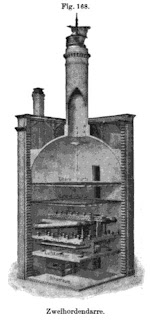
There is not, in all the common arts of life, any that requires so nice a caution as the making of malt. The time mull be considered : three weeks is a moderate allowance, often it will take much longer. As different lengths of time are required for drying malt, there have been invented various ways of doing it. The iron-plate frame, and the tile frame, both full of small holes, are esteemed by many; others prefer the brass-wire and others the iron-wire frame ; and others the hair cloth: the husbandman is not to give his voice in favour of any one of these in general terms ; but to consider the use it is intended to answer : the nature of the malt to be dried is a material consideration, for that kind will do for one that will not for another; and when the most expeditious can be used, without hurt, there is something in the saving of fewel. Those which do with the least fewel are the iron-plate frame and the tile frame : they were invented for this purpose, and are a ready and cheap method. They dry the brown malts very well, but they will not answer for the pale.

None of the methods heat the malt so violently as these, the corns often jump like parched pease, and crack: but they get -a fine brown. It is a cheap way ; but let the farmer fee he is not deceived in it, especially if he buy malt of this brown fort. The nature of it is to look dry, and it is not the worse for that; but those who fell it, frequently sprinkle water over it, and this makes it swell up vastly. 'Tis fairer to the eye, but this takes away a great deal of its sweetness.

People find the Brown malt dried this way apt to spoil in keeping : but they accuse the machine, when the malsters are in fault: all the damage is owing to the sprinkling water over it; this subjects it to decay in keeping. Brown malt, dried on one of these frames, will keep as well as any, if it be spread to cool as soon as made, and no tricks be played with it. All the damage it is subject to is, contracting something of a bitterness by burning ; but this is owing to the carelessness of the maker, more than the fault of the frame.

The carelessness of some, and the tricks of others, have turned these methods of the plate and tile frame out of fashion, but without any real cause. They are fit only for brown malts, but in a fair and proper management they dry these as well as any other of the methods, and much cheaper.

The wire frame comes next after the plate and tile ones, and now is generally used in their (lead. This dries the malt more gently and leisurely; but there is some difficulty in the turning it, and cleaning the bottom.

Of all the methods the plain and simple hair cloth is the best for the finest malts. A flow fire under this dries it very gradually and equally, it is easily turned as is required, and when it is done there is no difficulty in getting it out, for 'tis only turning it at once and all is clean.


CHAP. III.
Of the fuel to be used in drying malt.

THERE is a great variety in the article of fewel for malt, some kinds being cheaper, some dearer ; and some better, Others worse. However this is not so absolute, but that some of those which are bad for the drying certain forts, may be proper for others.
The principal kinds of fuel are five: 1. Coak; 2. Welch- coal ; 3. Straw ; 4. Wood ; and 5. Dry fern or brakes. What is to be done by this fuel is to dry the malt, and nothing more : no flavour is required from it, and therefore the purer the fire is, and the cleaner the malt is dried by it the better. All smoak is wrong; and therefore all those fuels that yield a great deal of smoak, are to be rejected in the drying the nice malts.

Fern is a very bad fuel for this use : and at first fight a person might join wood and straw under the fame denomination, because of the quantity of smoak, but there is in this a difference. All smoak is an enemy to malt; but there are varieties in the taste and flavour of the smoak of different materials. The smoak of fern is not only plentiful, but of a very ill hogoe, which it will communicate to the malt. And the smoak of straw, though almost as plentiful as that of fern, is so sweet, that it scarce does any damage. The smoak of wood is of a middle nature.

Dividing our fuel into two general kinds ; the coak and welch coal being the best, and the straw, wood, and fern the inferior : the straw is the best of these, the wood the second, and the fern worst.

There never can be a necessity of using fern, therefore it ought wholly to be excluded : wood may always be had, and must be better than fern ; and for some of the ordinary malts it is a cheap fuel, and answers well. Straw, with good management, may he made to do for any but the very best and nicest kinds. With respect to the other two coak is the best; but the other is very good.

We advise the husbandman to use coak, if it is to be had ; but let him fee that it be good and well made: for otherwise the the inferior fuels may do better. Fine coak is made of large pit coal charr'd, or burnt to a cinder. It is to be burnt till all the ill smell is consumed, and no smoak rises; and in this condition it makes the steadiest and the sweetest fire of any fuel whatever. It is a common negligence to char this coal imperfectly, but the husbandman who dries his own malt should examine strictly into it; for one smoaky piece will do vast damage. He may fee this by the eye, for there is a particular dry aspect which coak has when well burnt, that is wanting in such as has any of its gross parts remaining.

The next to pure coak is welch coal: this is called by many culm. It is a fine sweet coal dug naturally out of the grounds It comes in thin fleaky pieces, and burns to white ashes with a little flame, and no smoak. This brings it nearer to the nature of coak, but it is not altogether so pure : however, it is cheaper in many places, and for all but the fine malts will very well answer.

Let the farmer, if he have convenience, dry his own malt, for out of this variety of materials it is possible the malster may chuse the worst: in some places it will not be worth while, because every thing must be built for it, and that the farmer may not think this proper, when he has a small family: but in other places most of the conveniences will be ready. In the hop countries the fame kiln that dries hops will dry malt ; and so on many other occasions; and wherever it can be done 'tis much best at home. As to a little expence, let him consider 'tis a thing for which there is a constant demand. I shall offend the malsters; but I must add, that if he knew their practices as well as I do, he would fee more reasons than are here set down for doing his business himself.
Source: "A Compleat Body Of Husbandry" by Thomas Hale, 1758, pages 316 - 319


If you're good I'll post the section on brewing from the book tomorrow.

Tuesday, 15 September 2009

London Ale Brewing 22 Quarters

Another recipe from the handwritten notebook. Which is starting to confuse me more and more. London Ale, this time.

Why is it confusing me? Mostly because of the illegal practices. Today's recipe is full of illegal ingredients. Hartshorn shavings, salt, liquorice root. So very dodgy practices are proposed, if the book dates from post-1816 (the year a ban on ingredients other than malt, hops, yeast and water was introduced). Especially as the quantities are far too large to be for a private brewer. Private brewers' didn't usually mash more than a single quarter of malt.

Then there's the note, obviously added later, that says "no black" above the malt entry. Remember, black malt was invented in 1817. When was this book written?


London Ale Brewing 22 Quarters

Malts

22 quarters of Pale Ware [in a different hand "no Black" written above]


Hops

176 pounds of new pale Kent


Turn over four liquors devide into two worts.

First wort boil half an hour.
Second wort boil four hours.

Use in the first wort in the copper 6 pounds of hartshorne shavings and one pound salt.

First liquor over @ 187 degrees with 32 barrels of liquor over.

Second liquor over @ 190 degrees with 22 barrels of liquor over.

Third liquor over @ 150 degrees with 22 barrels of liquor over.

Lett the worts down into the square at 60 degrees with 4 scoopes of yeast well rousd.

Scim the head clean of and cleanse at 76 degrees. Use in the square well mixed up
1 pound salt 4 pound flour
1 pound of ground ginger &
1 pound of ground liquorice root.

Truman's Burton-brewed beers in 1914

Sometimes brewing logs are simple. Clear and in neat handwriting. Then there are Truman's. It's taken me a while to get the hang of them.

I blame those who catalogued them. Let me explain. I'd already looked at Truman's logs from the 19th century. Both Ale and Porter. Which is why the WW I logs were such a shock. I couldn't find any beer names I recognised. P2, P3. 4, 5, 7, 8. What the hell was all this stuff. Where were the Porters, Stouts and X Ales? I got all confused.

The answer was simple. They were logs from a different brewery. Not their original Brick Lane premises, but their Burton brewery. Despite what it says in the archive's catalogue. That's why I couldn't find the beers I expected. Because they didn't brew any of them there. Like at other Burton breweries, many beers had names that were just numbers. With 1 the strongest and 9 the weakest.

Once I'd got that sorted out and looked at them a little more closely, pretty much everything fell into place. Though the scrawly handwriting is still a pain. Here's what they were brewing in Burton in 1914:


Unfortunately, I missed a couple. Most notably No. 1. It's easily done. There were only a couple of brews each year.

You'll notice that the attenuation is greater than in some others we've looked at recently. There's a simple explanation. I'm pretty sure it really is the racking gravity that's given in the logs.

That's about all I have to say at the moment. When I've worked my way through the rest of WW I, there'll be more to discuss. Just wait until you see what happened in 1917.

Monday, 14 September 2009

Berliner Weisse and Brettanomyces.

Friday night I was a happy, lucky man. I got to taste some 25+ years old Berliner Weisse. (Courtesy of Barak. Thanks Barak.)

After what I'd learned recently about the role of brettanomyces in the secondary conditioning of Berliner Weisse, there was just one thought on my mind. How much horse blanket would there be?

The two Weisses were Landré and Groterjan. Both, very honestly stated on the label, brewed by Schultheiss. The western one, for you Cold War conspirators. I'd tell you more about the history of those breweries and names. I would. But "Die Berliner Weisse", which I still had on my pile (I can no longer call it a desk), hasn't supplied any quick answers. Except that Groterjan had a rather racy 1920's brewery and started brewing Berliner Weisse in 1932.

Can someone else do the research? Just this once. It's getting in the way of me telling my tale. Feeling obliged to look this stuff up. No later than 1975, would be my guess. The age of the beers, going by the style of the labels.

"What did they taste like?" That was the point of all this. Telling you that. Sort of. I didn't take notes. I never do in Wildeman. These are just my impressions, recorded a day or two later. Ohne Gewähr, as they say on German TV.

The Landré was nicely, but not crazily, sour. Pretty clean tasting. A touch of rotting hay. Bone dry. In incredibly good nick for its age.

Groterjan had a whole barnyard in its aroma. A touch less sour, and with a a spike of infection. Think bière de garde. About double the mouldy wood accent that has. Drinkable despite that. Despite that. What am I saying, despite that. Beers several decades its junior I've spat into the canal. I'm being picky.

This was all about brettanomyces. For me. I'm not the best taster in the world. But some tastes are sledgehammers. Even I notice when they strike. All that rotty, shitty farm stuff. I'd put money on brettanomyces. My own money.

Landré? Possibly. Could have been some brett in there. But if Joris said no, I wouldn't argue with him. Well, yes, I would argue with him. With little real conviction.

I've changed my tune on Berliner Weisse. From "No, no, no brettanomyces" to "Yes, yes, yes brettanomyce" in, what? Three weeks. Fresh.

I'm a jammy git

Beer Nut said "Amsterdam is the best city I've been to for beer." After contemplating his possible lack of travel experience, I did me some thinking. About life, beer, the present and the future.

Dangerous, I know. Thinking. It's been a while since I jerked the cogs of my mind into motion. Rust trickled from my ears. But there was the odd funny flicker in the cinema of my consciousness.

Despite having my head firmly jammed between the buttocks of the past, I do pay attention to the present. With half an eye. Like how I "watch" television and fiddle on my PC simultaneously. Much as I would love an Edwardian pub in town (Mild, Bitter, Porter, Stout, Burton on draught. Bass Pale Ale, Guinness, Barclay's Russian Stout and Bass No. 1 in bottle), I can't complain. I really can't complain.

When I first lived in Amsterdam, back when mastodons still roamed the earth, there were already a couple of beer bars. Beiaard, Wildeman, Belgique, Gollem. When beer - good beer - meant Belgian beer. A thrill for me, who'd had little contact with the stuff. The world moves on. Hairy elephants disappear. Other countries start brewing good stuff.

Good German beer is as hard to find in most of the world as it is to miss in its Franconian homeland. Not in Wildeman. Schlenkerla Fastenbier By gravity. The Bock, too. You can't get much better than that.

Arend's Nest. Finally somewhere that showcases Dutch beer.

No, we can't complain about lack of choice. Then this week. Peter van der Arend's new pub opened. Beer Temple.

It's billed as an American beer pub. But it's more than that. Thankfully. There's stuff from the likes of Mikkeller and Ellezelloise. I'd give you more details, but it was a bit crowded.

Another place tot tempt me to town. Like I said, I'm a jammy git.


Beer Temple
Nieuwezijds Voorburgwal 250,
1012 RR Amsterdam.
http://beertemple.nl/

Sunday, 13 September 2009

I love Courage

When I go to the archives, I try to use my time well. I've a wodge of blank document request forms at home. Don't have to waste time filling them in at the archive. That would eat into my pub time.

Those bloody Scots. Trying to cram thirty beers onto on page. Whitbread with their faded, hand-written exercise books. In the 1860's - when they were in the top five breweries in the world - they were recording their brews in something that could have contained my Latin homework. Maybe that should be my next contest. Making sense of the mashing details. Remind me to post images.

Fuller's, theirs are pretty informative. Brewing records, in case you've forgotten the theme. Barclay Perkins aren't bad. On Saturday, I explained them a little to a bloke who had photos eerily similar to my own. Thinking about it later, I couldn't remember exactly how I'd worked out the various bits.

Truman. I hate their Burton records. The League of Illegible Brewers had their headquarters there. But I think I've cracked them. After months of trying to ignore them. Because they made no sense. Bloody Burton brewers and their numbers instead of names.

Courage. Good old Courage. Their Horsleydown brewery made nothing but dark beers. Even into the late 1930's. And when it came to recording their activities. Well, they were dead good. Their Porter. Now there's a story.

I got them sort of by chance. I'm usually over-optimistic about how many documents I can get through. Monday, I took 780 photos in about two and a half hours. I'm not always that quick. I had a pile of forms left over from previous visits. I couldn't remember exactly which documents they were for.

Turned out to be notebooks, partly. The notes of employees. Very personal. Gives me a weird feeling. Respecting their personal nature, I'll be posting them in full.

Lots. Stuff of. (I'm sure you can rearrange those words yourselves.) I'll post about it. All. Harp Lager. You must want to know about 1960's Harp Lager. Courage Light Ale. All the class stuff.

Brown Stout Brewing 20 Quarters

Time for ercipe number two from the handwritten notebook in the Courage archive. Today it's Brown Stout.

One thing is slightly odd about the recipe. It includes Spanish juice. Liquorice it's usually called today. But, in the period I think the book dates from, that would have been illegal. Certainly if it's after 1816. But the amount being brewed - 60 or 70 barrels - is way too much for a private brewer.


Brown Stout Brewing 20 Quarters

Malts

10 quarters of Pale
10 quarters of Brown


Hops

160 pounds of old Brown

Turn over three liquors devide into 2 worts

First wort to boil for 3 quarters a hour
Second wort to boil for 3 hours and a half

Use in the first wort in the copper 5 Spanish juice

First liquor turn over at 160 degrees 40 barrels of liquor over.

Second liquor turn over at 170 degrees 25 barrels of liquor over.

Third liquor turn over at 150 degrees 40 barrels of liquor over.

Lett the worts down into the square @ 66 degrees 4 scoopes yeast.

Rouse the head well in and cleanse at 78 degrees.

Start from the barrells into butts or puncheons 14 hours after cleansing.

Saturday, 12 September 2009

Porter Brewing for 40 Quarters

Here's something you might enjoy. It's a Porter recipe taken from a handwritten notebook in the Courage archive. Judging by the recipe, handwriting style and mashing scheme, I would guess that it dates from between 1800 and 1830.

There are four mashes of decreasing length. The last sentence where it talks of "starting into butts" refers to vatting the beer for maturation.


Porter Brewing for 40 Quarters

Malts

14 quarters of Brown }
14 quarters of Pale } Ware
12 quarters of Amber }


Hops

160 pounds of New }
160 pounds of Old } Kent

Turn over four liquors devide into 3 worts

First wort boil 3 quarters
Second wort boil 1.5 hours
Third wort boil 1.5 hours

First liquor turn over at 160 degrees with 60 barrels of liquor turned over. Mash for one hour and stand on the goods for one hour and a quarter.

Second liquor turn over at 166 degrees with 60 barrels of liquor turned over. Mash for three quarters and stand on the goods for one hour.

Third liquor turn over at 170 degrees with 40 barrels of liquor turned over. Mash for half an hour and stand on the goods for three quarters an hour.

Fourth liquor turn over at 150 degrees with 40 barrels of liquor turned over. Mash 20 minutes and stand on the goods for half an hour. Afterwards sett tap.

Lett the worts down into the square at 67 degrees and in the Summer at 66 degrees with six scoopes of yeast well rousd together to mix them.

Rouse the head well in and cleanse at 78 degrees. Cleanse in full vigour.

Start from the barrels into butts or puncheons 14 hours after cleansing.


If you're interested, it contains several other recipes. Brown Stout. London Ale. Windsor Ale. Amber. Table Beer. Common Small Beer. No doubt I'll post them. It'll save me having to think. Or translate that description of Broyhan printed in a virtually illegible Gothic typeface.

Friday, 11 September 2009

Upcoming highlights

Here's advance warning of the delights I'm preparing for you over the coming days and weeks.

I photographed a load more Truman logs in the archives on Tuesday. As I suspected, many are incorrectly catalogued and are from the Burton brewery. While I was snapping, they started making a lot more sense. I can work out what most the entries mean. I even know for sure what a couple of the beers are. 1 is their Barley Wine, 6 and 7 are Milds. It looks like they added caramel at racking time to create the dark versions of Mild. So expect lots and lots of lovely tables.

I looked at Truman's logs that covered quite a long period, but they all had one thing in common. Terrible handwriting. The one above is pretty typical. Can you read the names of the three beers being party-gyled?

I also went through a variety of Courage records. Brewing logs from the 1920's and 1930's, which are wonderful. Very clear, and include everything you could possibly wish to know. But a couple of notebooks I found were fascinating. One has instructions on how to brew each of the beers in their range. Judging by the handwriting and the beers described it seems to date from the early 19th century. I'll probably publish images of it all, as it's not that many pages. And the writer had lovely handwriting.

Another thing about the Courage logs. Like Whitbread, there's a summary of all the beer brewed in a year inside the front cover. I was immediately struck by how much Porter they brewed in the late 1930's. Way more than Whitbread. And they were still brewing it after WW II. 1950 was the last year I spotted it. When it had become a bottled beer.

One other odd thing about Courage. In the 1930's they still weren't brewing a Pale Ale. They'd bought the Alton brewery in 1903 specifically to supply them with Pale Ales. But it's odd that they only produced dark beers in their main brewery.

And I looked at their lager records. I found their very first brew of Harp Lager. That might be a fun thing to include in Let's Brew Wednesday.

God knows how long it's going to take me to get through all of this. I still haven't processed everything from my last visit to the Metropolitan Archives.

Thursday, 10 September 2009

Barnard on Younger

This is a discussion of a tavern kept by John Dowie in Edinburgh:

"It was chiefly celebrated for ale - Wm. Younger & Co.'s Edinburgh Ale - a potent fluid which almost glued the lips of the drinker together, and of which few therefore could dispatch more than a bottle. John, the proprietor, was a sleek quiet looking man, who always brought in the ale himself, drank a glass to the healths of his company, and then retired. He was most careful in the management of the bottle, and held the opinion of William Coke, who rebuked an inexperienced waiter with the remark 'Sirrah, you ought to handle a bottle of ale as you would do a new born babe!'

When the reckoning came John's duty consisted simply in counting the empty bottles, which he had placed on the shelf above the heads of his customers, and multiplying by three pence, the price of the liquor. John did such a flourishing business, chiefly in Wm. Younger & Co.'s Ale, that he eventually retired with a fortune, said to have amounted to six thousand pounds, a large sum in those days. Messrs. Wm. Younger & Co. still brew the celebrated Edinburgh ale, of a less potent quality, but their principal manufacture, India Pale Ale, is well known and appreciated in all parts of Great Britain as well as in foreign countries."
"Noted Breweries of Great Britain and Ireland, Vol II" by Alfred Barnard, 1889, pages 7-8.

Wednesday, 9 September 2009

London visit

I'm just back from a couple of days in London. And feeling totally knackered. "What did you do in London?" This and that. Oh alright then. Here are (some of) the details.

The main reason for the visit was to be one of the judges at the International Beer Challenge. (Before you say anything, I do realise the irony in me being a beer judge. Especially as I haven't been certified.) It took all day. Surprising what a chore it can be drinking from morning until early evening. Especially when you kick off with nine alcohol-free beers.

Having a good group at the table made it less of an ordeal. People with far more discerning palates than mine. Jo Copestick, De de Moor, the bloke who runs Beer Essentials (whose name escapes me) and Kelly, brewer at Thornbridge. It made me realise how many subtleties I nornally miss.

What else did I do? Ate a Cornish nasty, had two full English breakfasts, drank a few pints of Old Puke at the Gunmakers, met Boak and Bailey for some beers, visited the archives and bought pork pies and mini Scotch eggs for the kids. Not too bad in just 30 hours. Now I'm in need of rest. Dire need. My eyelids are dropping even as I type this.

But I won't be getting any rest. Not tonight, anyway. I've got to go to the opening of Beer Temple, Amsterdam's new American beer bar. It's a hard life, being an international pisshead. Sorry, international beer blogger. You really wouldn't want to do it.

German top-fermenting styles in 1915 (part four)

Today it's the turn of two styles beginning with the letter "B". Broyhan and Bitterbier. Hope you enjoy them.

"Broyhan is a dark, lightly hopped, poorly attenuated top-fermenting beer brewed mostly in the province Hannover. It is made from barley malt with the addition of up to 20% wheat malt. In some parts of North Germany, particarly the port cities, a dark, sweet beer of 9 to 11º Balling is brewed. After primary fermentation it's lagered in medium-sized lagering barrels, usually with wood chips, at 7 to 10º for 8 to 14 days and after being drawn off it usually has some Krausen added. Harvest beers often have a higher gravity (11 to 13º Balling), are fermented at 8 to 13º, lagered for a few months in large barrels, bunged and filled into transport barrels. "
"Encyklopädisches Handbuch der technischen Chemie, Volume 4, Part 1", 1915, page 30. My translation.

Mm. I'd love to have detailed enough instructions in order to recreate Broyhan. Still not there yet. Lots of, often contradictory, snippets are all I have.

Not quite the same problem with Bitterbier. See if you can guess what it probably evolved into from the description:

"Bitterbier is mainly brewed in the Rhein province and in Westphalia. The heavily hopped, about 9º Balling wort is pitched with yeast at about 10º; after 6 or 7 days there is a break and the beer is transferred into lagering barrels. The lagering takes place at around 6º, clarification is helped through the use of wood chips, is is bunged and drawn off through a filter clear and gold-coloured. These beers acquire their extremely bitter taste not only through the large amounts of hops added in the kettle, but also through the addition of boiled hops, with the water they were boiled in, to the lagering barrels."
"Encyklopädisches Handbuch der technischen Chemie, Volume 4, Part 1", 1915, page 30. My translation.

Any guesses? Sounds an awful lot like Kölsch to me. Though probably more bitter. Love the hop addition to the lagering vat. As they've been boiled, you can't really call it dry-hopping. Wet-hopping, perhaps?

I'm still nothing like finished. I've been saving the sour and smoky ones. And Porter. There's some revealing stuff about German Porter. to come, too.

Tuesday, 8 September 2009

German top-fermenting styles in 1915 (part three)

Fun. That's that funny feeling of happiness we all experience now and again. Though probably not it in the next few minutes. Yes, I'm still banging on about German top-fermenting beer styles. In 1915.

As you'll be able to see from the label I've so thoughtfully provided as an illustration, it wasn't just sugar that was used to sweeten these beers. They used artificial sweeteners, too. For some reason that was allowed, even in the Reinheitsgebot days. It's amazing how many ingredients - other than the malt, hops, water, yeast - were allowed under the RHG.

"Süßbier and Malzbier, also Doppelbier and Kraftbier, are without exception dark in colour and have a sweet taste. The latter rests partly on the malt used in their manufacture; the minimum quantity of malt is, for such beers as Malzbier or those beers which have "Malz" in their name and are made with sugar, in the North German Brausteuergebiet legally set at a minimum of 15 kg per hectolitre. The sweet taste in these beers is also partly derived from sugar, which however is not used in all such products. The original gravity of these beers derived from malt differs greatly, however names such as "Doppel-", "Kraft-" and suchlike imply an especially concentrated wort, in whose manufacture at least the amount of malt normally used for bottom-fermenting Lager is employed. The malt is usually high-dried, and contains an addition of up to 10% Karamlemalz. It is coloured with Farbmalz, Farbebier or Biercouleur. Mashing schemes vary greatly and hopping is very light. For fermentation only lightly-attenuating yeast is used; lagering is performed in several ways according to one of the methods described. The addition of sugar, often in the form of a concentrated water solution, which these beers undergo, amounts to between 2 and 5 kg per hectolitre of beer and usually occurs during filling."
"Encyklopädisches Handbuch der technischen Chemie, Volume 4, Part 1", 1915, page 304. My translation.

Broyhan is next. That's the beer I'd most like to see revived. If only I could work out how the hell it was brewed. Maybe we'll find out tomorrow.

Monday, 7 September 2009

German top-fermenting styles in 1915 (part two)

Hey there. Time for part two of my new series on German top-fermenting styles in 1915. Should have thought of a snappier title, I know.

First up is Weißbier. The Bavarian type. Do you want to hear something weird? I have next to no material on what is the commonest type of German top-fermenting beer. Weizen. Not quite sure why that is. Could be that my attention is always draw to the bizarre extinct styles.

I was surprised by the assertion that it was brewed from 100% wheat. And that isinglass was added to the bottles. The second type, brewed from mostly barley, sounds rather like Dampfbier. Or a cross between Dampofbier and Kristall Weizen.

"For Weißbier (not to be confused with Berliner Weißbier), as it is brewed for example in Bavaria, only wheat malt is used; after primary fermentation about 10% sterile Vorderwürze and isinglass are added. This helps both the production of CO2 during bottle conditioning and the settling of the yeast. Another Weißbier is brewed from barley malt with at most a small amount of wheat malt, it is lagered at 5º to 7º with wood chips then filtered and bottled with little Krausen. From this beer a clear appearance and plenty of foam in the glass are demanded.
"Encyklopädisches Handbuch der technischen Chemie, Volume 4, Part 1", 1915, page 303. My translation.

Einfachbier. Now there's a good one. Beers with minimal quantities of alcohol and lots of sweetness. It's not quite extinct. Not that could tell you where to find one. I believe they are still top-fermented sometimes. That's probably so they can be loaded with sugar, which would be illegal in a bottom-fermenter. By current German law, Einfachbier must be below 7º Plato.

"The top-fermenting beers known as Einfachbier are usually dark in colour, their orginal gravity is mostly between 5º and 7º Balling. Sometimes they are made from malt with or without the addition of sugar, other times from the last runnings with sugar and Couleur or Farbmalz added. After primary fermentation in a tun or a barrel, these beers are either put into transport barrels, briefly bunged and then served or they are left undergo a secondary fermentation often lasting two or three weeks and after the addition of Krausen sent to be served, either from the barrel or bottle. Jung- or Frischbier are the lightly-fermented worts of Eifachbier which are mostly sold directly from the brewery by the liter, their small amount of yeast is usally added immediately before sale."
"Encyklopädisches Handbuch der technischen Chemie, Volume 4, Part 1", 1915, pages 303-304. My translation.

Süßbier tomorrow. Or the day after. Something like that. It all depends on how I quickly I get through Thomas Usher's WW I brewing records.

Sunday, 6 September 2009

Usher's beers in WW I

Time for a table. Or two. How about some stuff from the Scottish Brewing Archive? Yes, go on then.

I've just finished ploughing through the WW I brewing records of Thomas Usher. The Edinburgh brewer. Fascinating. For me. Unsurprisingly, the logs told a similar tale to those of the London brewers I've already looked at. Falling gravities after 1916 and a savage reduction in types of beer brewed during 1918.

Take a look:


I haven't included all their pre-war products. There were a couple of other Milds (44/- and 50/-), a few low-gravity Pale Ales and two more Stouts. After the war their product range was very different. Susprisingly, it was almost all Pale Ale. They brewed four: PA, PA 60/-, PA 70/- and PA 80/-. X disappeared without trace. The Milds were trimmed down from 5 to 1 and the Stouts from 3 to 1. And the Mild and Stout were party-gyled. Something I've never seen before. And there werre the odd few barrels of Strong Ale brewed, party-gyled with PA.

For comparison purposes, here are Barclay Perkins AlesI:


And Whitbread's:


Not sure what all that tells us. Maybe you can tell me.

Younger's Abbey Brewery in the 1870's (part two)

As promised, part two of the description of William Younger's Abbey Brewery in the 1870's.

The wort having after several days' fermentation become beer, it is run off from the vats to the 'brightening squares' on the ground floor. These are huge square wooden vessels, where the beer 'flattens' and brightens up to the extent desired—an operation which occupies generally two or three days. At length the beer is conveyed by elastic tubes from the squares to the ' stock-room vats,' w, as is usually the case, put with some dry hops into barrels and sent to the export stores for bottling, to meet demands in the British and other markets. On the stone-floored cellars we now pass hundreds and hundreds of barrels piled tier above tier, filled with

'The nut-brown beer that will drive away care,
And welcome the harvest home,'

while returned empties are constantly arriving for fresh supplies.

Emerging from the cellars we enter another enormous apartment, in which we find a dozen round vats of gigantic proportions towering up to the height of three stories. Four of these, they will tell you, contain each three hundred and twelve of the thirty-six imperial-gallon barrels; and of the remainder, each contains one hundred and eighty barrels of the same size that we have seen upstairs.

Enormous as will appear from this description the capabilities of the Abbey Brewery, it only indicates about one-half the producing power of these gigantic ale brewers. For, only separated by a short distance, stands the Holyrood Brewery, of equal, and in some few particulars of larger proportions than the old Abbey Brewery. For instance, there are here twenty-six fermenting tuns, each capable of containing seventy-five barrels of beer; the engines are of twenty-five and eight horse-power; the copper boilers above described are here capable of holding one hundred and nineteen, and boiling eighty-five, barrels of liquor. The hot-water boiler contains three hundred and twenty barrels. In other respects this brewery is constructed on the same principles as that of the Abbey.

Adjacent to the breweries are the malt and barley stores, maltings and drying kilns. These buildings are five stories high. On these floors hundreds of quarters of malt were in process of preparation, and in the fourth and fifth flats were thousands of quarters of barley and malt, stored to answer the large and constant demands of the breweries. By means of a spout the prepared malt is conveyed by steam-driven elevators to the grinding mills, where, passing between heavy rollers and being bruised to the extent desired, the malt is conveyed to the hopper in the brewhouses. The great mailings and storehouses in which the bulk of the malt is prepared for the Abbey and Holyrood Breweries are situate at Canonmills, the northern district of the city, occupying an area of about three acres.

The export stores, occupying two acres on the site of what was the famous orchard of Holyrood, form an interesting and imposing feature in the surroundings of Holyrood Palace, Messrs. Wm. Younger and Co. having had most commendable regard to the architectural construction of their buildings, so as to preserve a harmony of character with the surrounding buildings of historic interest. Viewed from the heights of Arthur's Seat, the castellated elevation and ornamental towers in the baronial style, appear as appendages of the ancient palace. But we are on the ground, and the huge piles of beer-casks, the heaps of timber ready to be converted into casks, the loading and unloading of wagons, and the scores of busy workmen, bring us back from the land of dreams, and tell us that we are in one of the busiest workshops of the world.

Facing us, as we enter the extensive court-yard, is the main building or export store; on the west side is the cooperage, at which fifty men and boys are always in full employment. Another extensive cooperage is at Canonmills, its steam saws, planes, &c. being driven by a twenty-five-horse-power engine, the oak used being chiefly Dantzic. The firm do not, however, make more than a comparatively small quantity of barrels for their use, as the condition of the cooperage trade is such that Messrs. Younger can more economically obtain the casks for their purposes, than manufacture for themselves. The extent, however, of this department may be estimated somewhat by the fact that the casks alone represent a capital of from £50,000 to £60,000.

But what we are now looking at is the unloading of bottles— mostly of glass, but some few of stone—manufactured for the firm in Glasgow, Portobello, and other parts of the kingdom. The bottles, which have been packed with straw, are removed to a water-tank, and having been cleaned outwardly, are placed neck downwards on a series of tubular spikes, on a circular frame, and constantly revolving. Through an aperture in the tube a strong jet of water is ejected upwards into the neck of the bottle, so that it is thoroughly cleansed- from dust, straw, or other impurities. The ale or beer now arrives from the bulk store, flowing through flexible tubes to the bottling machines, which perform their work with extraordinary rapidity. One lad, during his ten hours' work per diem, can fill 120 dozens of bottles, and from 50,000 to 60,000 a week can be accomplished. The corking of the bottles is an interesting and expeditious operation : one boy places the bottle in the socket of the machine, another inserts a cork, which has been previously heated and moistened by a steam-kettle, in the neck of the bottle, when the lever-working handle of the machine comes down and forces the cork home. A bottle breaks occasionally, but accidents are very rare. The bottles thus filled and corked are next handed over to more boys, whose business is to secure the corks with copper wire. The capsules- bearing the name and trade-mark of the firm are next fastened over the cork and bottle-neck by a machine patented by the manufacturers of the capsules, Messrs. Betts and Co. of London. More boys now take possession of the bottles, and attach to them the distinctive labels ; after which the bottles have twenty-four hours' rest for the labels to dry, and for the discovery of any leakage from faulty bottles.

And now we have arrived at the package department, where the ale is packed in casks of four dozen quarts or eight dozen pints. The casks, which are numbered and bear the initials of the merchants to whom they are to be consigned, are then closed, secured at each end by cross lengths of red tape, over which is impressed in wax the seal and trade-mark of the firm, and the beer is then ready for exportation to any part of the world.

Well, compagnons de voyage, have you found out the secret of the superiority of these ales? We believe that the technical secret is a secret still, and will ever so remain. But a foundation secret we feel we have both discovered—the purity and fitness of the water, and the almost fastidious cleanliness of everything connected with the plant.

Visitors to the Crystal Palace at Sydenham can there enjoy the luxury of an honest 'drop of good beer;' for all the ale consumed in that most popular place of public resort is exclusively supplied to Mr. Sawyer, the refreshment contractor, by Messrs. Wm. Younger and Co., to whom is fairly due the credit of having brought the brewing of ale to the acme of perfection.

The present families came into possession of the Abbey Brewery about the time of the Rebellion in '45, since which the business has steadily progressed, until the breweries extend over ten acres of ground, and are capable of brewing more than 60,000 quarters annually. The great impetus to the trade was afforded by the railways ; but the great success of the firm may be attributed to the uniform and intelligent supervision of its members. The present partners are Henry Johnston Younger, David Younger, and Alexander Smith. The first named has resided for several years in the Colonies, and has brought with him a knowledge of the requirements of those parts. Mr. Cuthbert takes the commercial management of the Edinburgh establishment. The breweries were for many years managed by Mr. Thomson, who earned the title of 'Father of the Brewers of Scotland,' and who has sent forth many a pupil to improve the breweries in other places.

There is one peculiarity of this firm, that it has no public-houses under its control, but is wholly free; and its ales ought to reach the consumer as pure and unadulterated as they leave the brewery. If our Home Secretary had devoted his legislative powers to a bill which would have secured the public against adulteration of their beer, and that it should have been obtainable by the people at a public-house, as pure as it was when brewed, he would have conferred a blessing upon the minds and bodies of the community. The purity of ale should be no less the care of our legislators than it was in the days of our forefathers. It has been regarded now as a ' power in the State'—it pays a large amount to the exchequer; the malt duty for last year being between £6,000,000 and £7,000,000 It is drank by at least two-thirds of the population of Europe ; under the tropical sun of the Indies it is ever in demand; blockades were broken to furnish it to the Confederate army; and throughout America it holds its own amidst the charms of 'brandy-smashes,' 'cock-tails,' and 'eye-openers;' ahout eight hundred and fifty million gallons are brewed annually; wherever there is a thirsty soul, there is a market for it; its kingdom is co-extensive with civilisation, and it numbers as its subjects 'men of every tongue and colour under the sun.'
"Belgravia, Volume 19", 1873, pages 68 - 71.

I think that's enough Younger's for now. For a day or two, anyway.

Saturday, 5 September 2009

German top-fermenting styles in 1915 (part one)

I told you I'd translate the section on top-fermenting beers in "Encyklopädisches Handbuch der technischen Chemie". Not all at once though. It's too long and I'm a deeply lazy person.

A little general stuff to start off:

"German top-fermenting beers can be divided into four large goups (according to Schönfeld): Süß- or Einfachbier, smoky bitter beers (Grätzer), Bitterbier similar to Lagerbier and sour beers (Berliner Weißbier).

Most German top-fermenting beers are in the group Süß- or Einfachbier. They are as varied in name as they are in colour, brewing methods and flavour. The majority of these beers (Weißbier, Weizenbier, Malzbier, Doppelbier, Kraftbier, Broyhan, Werdersches Bier, Hamburger „Beer" etc.) are, through the use of Farbmalz or Couleur, coloured dark and are to a greater of lesser degree sweet in flavour, which derives partlt from the addition of sugar. The orignal gravity of varies between 5º and 7º Balling for many Einfachbier to 20º Balling for some Doppel- and Kraftbieren. The worts are prepared from barley malt, wheat malt or a mixture of the two. In many, up to 20% of the grist is made up of sugar. Fermentation takes place in tuns or barrels of widely varying sizes and lasts for two or three days at a temperature of 18º-20º C; for secondary fermentation some beer is filled into transport casks from the tun and sold after being briefly bueged up, other beer is put unbunged (ungespundet) into small casks in which it will be later transported and left to condition. A strong, foamy head is demanded of all these beers, the degree of attenuation is usually low. Sugar is added to many of these beers just before bottling and their shelf-life is increased by pasteurisation at 55 to 60º C."
"Encyklopädisches Handbuch der technischen Chemie, Volume 4, Part 1", 1915, page 303. My translation.

More tomorrow. I think. Unless anything particularly fascinating pops out of my Scottish material.

Again, in case you don't believe my translation, here's the original German:

Die deutschen obergärigen Biere lassen sich in vier große Gruppen einteilen (Schönfeld): Süß oder Einfachbiere, rauchig-bittere Biere (Grätzer), dem untergärigen Lagerbier ähnliche Bitterbiere und säuerliche Biere (Berliner Weißbier).

Die große Gruppe der Süß- oder Einfach- biere bilden die Hauptmenge der in Deutschland hergestellten obergärigen Biere. Sie sind ebenso verschieden dem Namen, als der Farbe, der Herstellungsart und dem Geschmack nach. Die meisten dieser Biere (Weißbier, Weizenbier, Malzbier, Doppelbier, Kraftbier, Broyhan, Werdersches Bier, Hamburger „Beer" u. a.) sind indessen durch Zusatz von Farbmalz oder Couleur dunkel gefärbt und besitzen einen mehr oder weniger süßen Geschmack, der seinen Ursprung zum Teil in dem den Bieren zugesetzten Zucker hat. Die Konzentration der Stammwürzen dieser Biere schwankt von 5 bis 7 Proz. Bllg bei vielen Einfachbieren, bis zu über 20 Proz. bei einigen Doppel- und Kraftbieren. Die Würzen werden teils aus Gersten-, teils aus Weizenmalz, oft auch aus Gemischen beider Malze hergestellt. Manche Malze erhalten einen Zuckerzusatz, der bis zu 20 Proz. der Schüttung beträgt . Die Gärung in Bottichen oder Fässern verschiedenster Größe dauert bei einer Temperatur von meist 15 bis 18° etwa zwei bis drei Tage; zur Nachgärung werden die Biere teils vom Bottich auf Transportgebinde gefüllt und nach kurzer Spundung ausgeschenkt, teils zunächst ungespundet in kleinen Fässern, in denen sie dann später zum Versand gelangen, der Nachgärung überlassen. Von allen diesen Bieren wird ein starkes Moussieren verlangt, der Vergärungsgrad ist meist niedrig. Viele dieser Biere erhalten den Zuckerzusatz erst kurz vor dem Abfüllen auf Flaschen, man erhöht ihre Haltbarkeit durch Pasteurisation bei 55 bis 60°.

Friday, 4 September 2009

Old and Mild

Could be a description of me. Old and Mild. Could be. But, after the crazy interweb arguments I've got myself into, perhaps only the first adjective applies.

I'll tell you what got me thinking about Old and Mild. It's a short, but dull, story. Skip to the next paragraph if you can't be arsed with it. I prompted Jeff to tell me which beers he'd have on next Tuesday, when, after another archive excavation, I'd be nipping into his boozer for a pint or seven. There. I told the tale in just one sentence. Except the beer bit. Shit. Landlord, Harvey's, Moorhouses Black Cat, Old Peculier. That doesn't count. Not a sentence. No verb.

Takeaway draught beer. You don't get it many places. Not any more. In the 19th century everyone drank draught at home. The better off bought in barrels of it. Those of lesser means fetched it in jugs. Either from an off-licence or a pub. Victorians being what they were, it wasn't mum or dad who went. A servant. Or one of the kids.

They got into a bit of a tizzy in the last couple of decades of the 19th century. About impressionable infants and serving girls having to mix with the hoi poloi in the public bar while fetching supper beer. The solution? Not to make the man of the house do the job. They were far more practical than that. Pubs acquired a separate off-sales entrance, where the innocent were shielded from the inebriate masses.

Sipping. That was another problem. Kids having a taste of dad's beer on the way home. It still didn't persuade the authorities to make it illegal for minors to buy beer. They had a solution for that, too. The publican put a seal over the top of the bottle or jug. In theory, the thirsty teen or tiny couldn't take a tope unnoticed.

My mum was born in 1916. As a girl, she was sent by her mother to fetch beer. So late 1920's, early 1930's. From the local pub. I'm pretty sure it was an Ansells house. In Handsworth*, where they lived. A whole tribe of Candelents. She had 11 brothers and sisters, my mum. Most lived on or around Newcombe Road. You can see it in the photo.

I never met my maternal grandmother. She died around the start of WW II. But we have more in common than just a few random genes. Our taste in beer. Old and Mild. My mum fetched her a pint of that every evening. Old and Mild. Just what I like to drink. Though not usually mixed.

Black Cat Mild. Old Peculier. Have to give it a try. In the genes.


Couldn't help thinking. Granny, born around 1880. Started drinking pre-WW I. Was mixing Old and Mild an attempt to re-create the Mild of her youth?

*Part of Birmingham.

Thursday, 3 September 2009

Younger's Abbey Brewery in the 1870's (part one)

Thanks to Gary Gillman for pointing me in the direction of this. A description of Wm. Younger's Abbey Brewery in the 1870's. A nice companion to all the rather dry numbers I've been axcavating from their brewing records.

"Whether it is from the peculiar quality of the water, or some secret in their method of brewing, or from both combined, it is certain that the purity, body, flavour, and tonic power of the ales of Messrs. Younger and Co. of Edinburgh stand unrivalled. Many readers will remember the fine Edinburgh ale which, long before this firm had any idea of establishing their stores in London, was looked upon by ale- drinkers as an exceptional indulgence. At that time, doubtless, the Edinburgh ale was brewed to suit the palate of the sturdy Scot, whose misty climate required a firmer tonic and a greater heat-giver than our own. But experiments on southern palates, and the wants of India, have taught this enterprising firm to produce a series of ales exactly fulfilling the requirements we have indicated.

In the Belvidere-road, reached in five minutes from the Strand over Hungerford-bridge, are the London stores situate, where we became acquainted with a totally new sensation in the matter of ale. We had often drank the pale ale, so admirably adapted for ' a big drink,' and the India ale, the praises of which had been chanted loudly by our Indian friends; and we found them both in perfection here. We tasted ale which was clear and bright, though little more than a week old, and with the delicious aroma of the hop pervading it; we tasted ale which had been long in bottle, straw-coloured and clear as the driest sherry, and yet sparkling and lively as the finest champagne; and we tasted what it is impossible to forget—the finest and strongest ale brewed by the firm, one of the greatest luxuries of the Russian nobility to this day, and sold in St. Petersburg and Moscow at from four to five shillings a bottle. This latter ale is extraordinary, and in perfection it would be difficult to distinguish it from a glass of fine brown sherry, while it is vastly more invigorating.

Our anxiety, however, was to penetrate into the secret of this perfection, and if our readers will now go with us to Edinburgh, they will know at any rate as much about it as we do ourselves.

Close to the royal palace of Holyrood, at the entrance of the Queen's park, and on the borders of its plantations, stand the Abbey and Holyrood Breweries of this famous firm. Every inch of the ground is historical, and redolent of the memories of the past. As Sir Walter Scott remarks, ' the Court end of the city excels all the rest in interest, for here lies the dust of the mouarchs of Scotland.' The monks of old were no mean judges of localities and their advantages, and doubtless the founders of the house of Wm. Yonnger and Co. were guided in the establishment of their breweries by the same motives which actuated the monks in the reign of David I. to fix upon this spot for their abbey, namely, the excellence of the wells. The first thing which occurred to us was to inquire about the water, and we found that constant analysis is conducted by experienced chemists, whose testimony has long been that the water produced from the wells of Messrs. Younger ' possesses all the peculiar properties essential to the brewer without any of the drawbacks.' The wells, five in number, are 180 feet deep, connected with each other by 400 feet of mines, while the bores through the solid rock are 150 to 850 feet below the surface.

The Abbey Brewery, in which more than half the ale is produced, is the one over which we will proceed; and the first thing which must occur to any visitor is the admirable character of all the arrangements. The varieties of plant necessary for the various operations are so carefully adapted, that all hurry, confusion, and loss of time are avoided, and everything, though complicated to the eye at first, is soou seen to be conducted with smoothness and regularity, while the whole building and every vessel used in brewing is the perfection of brightness and cleanliness.

And now we see a number of workmen emptying from carts several loads of malt into a large wooden receptacle attached to the- outside wall in the court-yard. As the malt reaches the narrow neck at the bottom of this receiver, the malt is carried away by a hoist, which, working by steam-power, empties it into a large holder on one of the upper floors. Through this the malt descends in a regulated flow on to a screen, the object of which is to cleanse it from the ' growth,' dust, and other impurities, and thence it is conducted by spouts to a chamber on the ground floor. Passing between a couple of heavy revolving iron rollers, it undergoes the process of grinding, the motive-power being a twelve-horse horizontal engine. The malt then again ascends by closed elevators to the ' hopper,' 011 the third floor of the building. From this ' hopper' it progresses down through an aperture into a conduit leading to the steam-working mashing-machine, having spikes at the back on a screw, by which, in the process of mashing, the malt is propelled until it is discharged into either of two large copper mash-tuns on the second floor. These tuns are capable of working about 150 quarters per diem. The requisite quantity of mashed malt having been deposited in each tun, a stream of boiling water from a huge close boiler overhead mixes in a certain proportion with the malt. Here is one of the secrets, for the utmost care is required to regulate the temperature; and a certain degree of heat having been attained, the tuns are closed at the top, and for about two hours the ' mash' undergoes the process of 'washing.' This completed, the liquid, or wort, passes through the bottom of the mash-tuns to the ' under-back tank' on the ground floor, whence it is again elevated by steam-worked pumps, through the copper and iron pipes to the copper boilers on the top story, to be boiled with a certain proportion of hops. An ingenious contrivance secures equality of temperature in this process. At intervals along the pipes which convey the wort to the upper story,. 'steam jackets' are placed, through which jets of steam are introduced at the will of the person in charge between the outer or wooden partition of the tank and the inner or copper lining within which the liquid is conveyed; the effect being to preserve an equality of temperature which conduces greatly to the subsequent clearness and purity of the beer, and prevents it assuming a bluish or muddy colour that would detract from its quality, as it frequently does in other breweries.

The wort has now reached the third floor, where we follow it, and find two large boilers or 'copper-heads,' in which the liquid,, now mixed with hops, is boiled for a time varying with the quality of the beer to be produced. These two boilers are capable of working at a given time nearly 140 barrels of beer. By the side of this is another boiler of huge dimensions, and containing 230 barrels of hot water for the general purposes of the establishment. From the windows of this floor we perceive four large iron cisterns, the capabilities of which are estimated at ahont 1000 harrels, independent altogether of the plentiful supply of the wells to which we have already referred. But even this immense supply is carefully husbanded, for after the water in one of these cisterns has heen drawn upon for the purpose of cooling the ales, it is repnmped to the upper part of the brewery, and again used for general purposes of cleaning.

Descending a few steps to the left we reach the hop - store, a spacious chamber, well aired, well lighted, scrupulously clean, and the walls lined with wood. This store contains a large stock of hops, principally from the gardens of Kent and Surrey.

Passing again through the copper-heads room, we arrive at the 'hop-drainer.' By an opening made in the bottom of the boilers: bore, the wort and hops, now well boiled together, flow into the ' drainer,' so that the liquor may be separated from the refuse of the hops that have been engaged in the manufacture of the beer. The drainer, which is some thirty feet in length, will contain about eighty barrels, and is fitted with a bottom of sectional perforated plates, through which the liquor gradually percolates, leaving the hop refuse behind. A series of copper pipes carry the liquor from under the bottom of the drainer to the coolers. In these the wort runs slowly along the surface of one half the floor, four large fans, driven by steam-power, and rotating with extreme velocity, imparting their cooling influence to the liquor as it courses to the end and returns along the other side of this long chamber, finding its way into the refrigerators. This delicate operation of cooling is carried out with a plentiful supply of cold water from the cisterns above the refrigerators, being the newest improvements introduced and patented by Mr. Morton of Stockton-on-Tees.

After ten minutes, most agreeably employed in refreshment, we proceed to the works devoted to the important process of fermentation. In a spacious chamber, in which are fifty-six tuns capable of containing thirty-six imperial-gallon barrels of beer, the work of fermentation goes on. There is a fall of only two or three feet from the refrigerating to the fermenting department. As the wort enters it receives the necessary portion of barm, and is allowed there to remain in fermentation for four, five, or six days, according to the description of beer under treatment."
"Belgravia, Volume 19", 1873, pages 64 - 68.
That's all for today. Part two tomorrow.


