Saturday, 21 June 2014

Chicago day one (part one)

Time for the next journey. An international one, too. That's always extra special fun. Especially when travelling to the US.

I don't bother with breakfast in the hotel. My flight is at 10 am. I want to be there in plenty of time and I'm pretty wary of Toronto traffic, having seen the congestion at the weekend. Today is Monday. I decide to get a taxi at 7 am. I get an orange juice and a coffee while I'm waiting for the cab to trundle up. Breakfast proper can wait until the airport.


The traffic isn't as dreadful as I'd feared. I've still more than two hours until my flight leaves. But I immediately check in and go airside. Or at least start going airside.

It's all a bit strange. After I check my bag, it isn't whisked off on a conveyor belt but handed back to me. I'm told to take it off that way, so that's where I go. And find a long queue waiting for the security check. My favourite part of flying. There's a flight soon to Beijing, which explains the number of Chinese in the queue. After a while we're told to walk a couple of hundred metres to another security queue. Now isn't this fun. We're on a queue crawl.

We were told it was shorter. The queue, I mean. Doesn't seem appreciably so to me. There are several returns on the taped-off snake. I'm glad I showed up early. Why do I still have my checked in bag with me? One of the reasons for checking it in is so I don't have to lug it around the airport.

I picked up one of the US customs forms on the way to the initial queue. I thought I could fill it in before I got on the plane. So much easier when you're not crammed in an economy seat with the Samoan sumo-wrestling team either side of you. I realise why those forms were lying around and why I still have all my luggage when I emerge from security, my belt in hand and my shoelaces untied, to another queue. One for US immigration.

I'm actually pleased. For two reasons. The queue isn't that long. And it means I won't be pissing around after landing in Chicago.


The US immigration officials are always polite and often quite friendly. Quite a contrast with the bastards at Schiphol who keep picking me out for special attention. Ha ha, they couldn't get me this time - my initial destination was Canada, not the USA.

Right, all the official crap is out of the way. Time for some scran. There's bound to be somewhere selling a Full American. Always is, places like this. I decide to get as close to my gate as possible before my bacon and egg-based feast. There's a bar/restaurant on the right pier that's just the job.

Soon I'm staring wistfully over a plate of fried things at the planes outside. My mind is a wonderfully empty space, doing little but regulate chewing and breathing. Sometimes you just have to switch off. Especially when you schedule is as busy as mine.

I refuse a coffee refill. Time to get to the gate. It's surprisingly quiet, given the flight is due to leave in 40 minutes. I find a seat and start reading. After a while I get concerned about the lack of activity. Checking the screen, I see that the gate has changed . . . . as has the flight status. It's now "delayed awaiting aircraft" and the departure time has been pushed back an hour. I move to the new gate and continue reading.

The news doesn't get any better. It's the old trick of only slowly revealing how bad the delay will be. It starts as an hour and gradually edges up to two.

I wander back to the restaurant and sit at the bar.

"Double whisky, please."

"We can't serve alcohol before 11 am."

What? Never come across an airport, even in Britain, with that sort of restriction.

"I'll have a coffee, then."

The waitress remembers me from before and lets me have it for free. Guess my right to a refill didn't lapse first time I walked out the door.

There isn't even a gate assigned to the flight now. Where to sit? The bar is prickling with iPads, I guess. You're allowed to use them even if you don't buy anything. That's what a sign says. So that's what I do. Start fiddling with an iPad. I can check my mail. And write a blog post.

Other delayed travellers around me are doing the same, fiddling with iPads. After a while they start ordering drinks. First coffees. Then a bottle of wine. Which gets me thinking. Ordering is so easy. Just a few taps on the ipad and a Wellington Imperial Russian Stout and a double Maker's Mark are on their way.

Finally the delay stops increasing and the time to departure begins to tick down. The incoming aircraft appears to great rejoicing. At least in my heart. I may be only an hour late for my 2 pm appointment, if I'm lucky. Thankfully I've had a chance to warn Mike that my flight is delayed.

It's after 2 pm when we take to the air. I'm just glad to be on my way. And that I'll make that meeting. It's special because . . . . well, we'll discover that next time.


The main reason for my trip to Canada and the USA was to gently encourage sales of my fantastic new book:

The Home Brewer's Guide to Vintage Beer.


Friday, 20 June 2014

Toronto day two

Ah, the days are just rattling by. In a crawly sort of way. I'll have to see if I can get through this one in a single post.

It's Sunday 8th June, date of the first event on this leg of my tour. A homebrewers' event held, appropriately enough, at a homebrew shop.

Last night was a pretty late one. Midnight was really 6 am for my body. I'm impressed that I lasted that long. But when beer is involved my stamina is remarkable. I'm that dedicated a pisshead.

You can tell this hotel is an old building. I can feel the uneven floorboards through the carpet and there's plenty of creaking going on when someone walks along the corridor. Yesterday Jordan told me it was built as a home for the Gooderham family, owners of Gooderham & Worts, at the time one of the largest distilleries in North America.

The event isn't until noon, but is out in the boondocks, in Toronto's northern sprawl. It'll take a while to get there. Now 9 am. My mind is telling me to get up and go down for breakfast. My body disagrees: stay in bed, it's saying. A tricky one. Eventually my mind wins and I descend in the rickety lift.


I've noticed a trend in North American hotels. First time was in March in Brooklyn. You used to have to pay for breakfast, but did at least get a fry-up option. Always handy for calming the stomach and evening the shakes out of the hands after a heavy night. Now some hotels offer a free continental breakfast. Yippee, you might say. Except the food choice is extremely limited and . . . the plates, cups and cutlery are all disposable. Not exactly classy.

At a couple of these breakfast travesties I've found zero to eat, it being all jam and cake and flavoured yoghurt. Finding something I can theoretically eat often leaves me no happier: like the processed cheese less appetising than its plastic wrapper I encountered in Brooklyn.

They've got boiled eggs here, which is something. But the roll I lay it on is so dry I feel it sucking the last moisture from my already parched mouth. I abandon it and get more orange juice.

The Chinese girl on the next table is watching a film on her laptop as she breakfasts. Good idea. Distract yourself from the food.


I've still 90 minutes or so before I plan leaving. I use them wisely lying on the bed staring at the ceiling. Not really sleeping, more a stupor. I can't even be arsed to switch on the TV.

When I tell the taxi driver the address, he asks "Is that in Toronto?" "Pretty sure it is." He looks it up on a map. For quite a long time. He's struggling his way through the street index. I resist the urge to tell him that it's in alphabetic order. Eventually he finds it and off we head.

"How long will it take to get there?"

"About forty minutes." Plenty of time to stare aimlessly out of the window, I think.

The suburbs to Toronto's north are no less sprawly than their sprawly neighbours by the airport. And no prettier. The roads are surprisingly crowded for a Sunday morning. I'll remember to avoid travelling around the city during the week. If this is anything to go by, it must be like Bangalore on a bad day.


Toronto Brewing at 3701 Chesswood Drive is where I'm headed. It isn't a single address so much as a small complex. Finding the right bit takes a while. We do some driving around until I spot a sign. It's hidden around the back. The driver forgets my box of books in the boot and was about to driven off with them until I reminded him. Sort of need those. That's the whole point to being here: selling books. Well, that and making friends and talking beer with people who genuinely want to talk about it. Unlike my miserable family.

I'm doing one of my standard homebrewer events: I supply recipes and local home brewers brew thyem. The format works really well, especially for me as I get to taste the beers. Me getting beer is a pretty big thing. For me. I talk bollocks for a while, sorry, explain the historical context of the beer, the brewer says something about brewing it, then we all knock some back. Practical history in, er, practice.

They've brewed a decent variety: strong Mild, XXXXK, Grodziskie/Grätzer, Brown Ale, AK, No. 3 and IPA. There's even one in a cute little pin. It's a bit odd when customers pop in as we're doing our talking and drinking thing. I'm doing most of both, loquacious boozer that I am. The beers are pretty good, even the ones that really needed longer to mature. I'm happy to drink all of them.


Zack, whose shop it is, has arranged a table and chair for me to do my selling and signing thing. Which I do for a while.

I'd not expected food. The chicken barbecued on bourbon barrel chips is a welcome plus. Tasty stuff. I have two chunks, which is a lot for the new diet-conscious me. Not for the old gutsy bastard me, but I'm trying to keep him chained up in the cellar with Tarquin.

Peter Friesen offers to drive me back into town for a few beers. It takes a while. The traffic on the return is even worse than on the way. There seem to be a few design flaws in the road system.


It's started raining by the time we park up. I've no coat with me so we enter Bar Volo pretty sharpish.

"This is where craft beer in Toronto started." Peter tells me. It's been around for nigh on 30 years, having been founded in 1985. Back in the dark days.

Another tiny brewery is somehow squeezed in behind the bar. Breweries seem as common as Bet Lynch around these parts.


I'm pleased to see not just a single beer engine, but a set. They've six cask beers in total, plus 26 kegs. Unfortunately, yesterday they held a cider festival and many of the taps are still pouring apple-based drinks. Never one to change hobbits, I order a cask beer, Punters Gold. English Golden Ale, it's described as. Can't fault that as a colour guide. Maybe a bit heavy on the citrus hops to be truly English, tasty though.

Peter has gone for a dry-hopped cider. His face tells me he won't be ordering another. Pretty weird, I think when he gives me a taste. Yeah, not sure I could drink a whole one . . . but I do. When I order the next round I inadvertently get one for myself. My own fault for paying more attention to the ABV than the description.

I hate wasting drinks. Even weird ones. It's not that bad. Just . . . odd, in a not totally good way. I finish it anyway.


We don't stay very late. Peter has a long ride home and I'm flying to Chicago tomorrow.

I walk back to my hotel. Oh look, what's that? Somewhere called Spirits. I quite fancy a whisky. The power of suggestion, eh?

"A Lug Tread and a double whisky, please."

"What type of whisky? We've a special on Jameson, $4 a shot."

"That'll do nicely. Straight up, no ice."

At the other end of the bar, two off-duty barmaids discuss men, music, waitressing embarrassments, random concert violence, and how effing cold it was last winter. "That's why I left Manitoba, weather like that."

Their chatter distracts me through a few whiskies then it's home and bed.

I'm so excited. Tomorrow I'll see Chicago for the first time*.


*Other than O'Hare. Airports don't count.


Time for the obligatory book plug on the feeble grounds I was in Canada and the USA to promote it:

The Home Brewer's Guide to Vintage Beer.


The Clarion Hotel & Suites Selby
592 Sherbourne Street,
Toronto, Ontario M4X 1L4
Tel: 416-921-3142
http://www.clarionhotelselby.com


Toronto Brewing Co.
3701 Chesswood Drive,
Unit 115, Toronto,
Ontario M3J2P6
http://www.torontobrewing.ca/


Bar Volo
587 Yonge St.,
Toronto, ON.
Tel: 416-928-0008
http://blog.barvolo.com/


Spirits Bar and Grill
642 Church Street
Toronto, Ontario
M4Y 2G3
Tel: 416.967.0001
Email: goodtimes@spiritsbarandgrill.com
http://www.spiritsbarandgrill.com

Thursday, 19 June 2014

Hear me talk


I sometimes wish I had fewer ideas. It would make my life far simpler. But concepts for new projects keep popping into my head. Especially ones that don't cost me money, like my research does. Which is why I'm trying to easse my way into the public speaking market place.

I'm starting to build a nice little portfolio of talks. As I've already invested the work needed to write them, it makes sense to present them more than once. Especially as I have a couple of crackers. This is what I have so far

  • Brettanomyces in British Brewing (45 minutes)
  • The Home Brewer’s Guide to Vintage Beer (45 minutes)
  • The History of British Lager (60 minutes)
  • Dutch Lager Styles (45 minutes)
  • German Sour Styles (45 minutes)
  • 18th Century English brewing (75 minutes)


E-mail me if you're interested in hearing me bullshit about any of these topics. My rates are very reasonable.

20% off my Lulu books


It's confusing how many special offers Lulu has. I'm struggling to keep pace with them.

Until the 23rd June there's a 20% discount on all my Lulu print books if you enter this code:

JFS20

My books are Pokemon - gotta catch 'em all.

Barclay Perkins Bookstore

Toronto day one (part two)

Alan Mcleod originally said he wouldn't make it to Toronto until around 17:00. Then an email arrived saying he'd be able to escape earlier than anticipated and should be hitting town in the rearly afternoon.

And sure enough there he is, as chatty and jolly as ever. He joins me and Jordan at our table, but doesn't join us for a drink. He still has his car with him. Being a lawyer, he wisely stays off the booze when any driving is involved. One slight problem. He needs to drop off the car at his hotel before he can start enjoying himself properly. And his hotel is out by the airport. Which is miles away.

Alan is gracious enough to watch me and Jordan continue to get our mouths wrapped around more beer while sipping an iced water. If only I possessed such self-restraint. I wouldn't be such a fat bastard, for one thing. We finally relent to Alan's sad puppy eyes and are preparing to leave when Peter Friesen arrives. Damn good timing, that.

I'm not quite sure why, but our plan involves Alan driving us all out to his airport hotel for car ditching tyhen us all coming back into town in a taxi. On reflection it seems crazy, but I was a few pints into the session when I agreed. Beers has a way of making the oddest ideas appear totally logical.

The hotel is in a weird 1970's wasteland. A concrete colony of chain hotels stretched out along the airport's approach roads. Neither atmospheric nor particularly convenient unless you're flying. But it had one very important thing going for it: price. Alan couldn't find a reasonably priced room in the centre.


After bailing out of our return taxi we rush inside Indie Ale House. I really do rush, having been beerless for more minutes than I care to remember. It's bright, modern and full of young people. I count anyone under forty as young, old fart that I am. I could be the father of every other customer other than Alan. Another odd feeling to stack up with the ones from earlier in the day.


Not that I've anything against this sort of thing. Youth hanging around in pubs, I mean. It's what I did when I was their age. Though I avoided places like this like Watneys*. I stuck to pints of Mild and the company of old men. But I've changed as I've aged. Mostly because that type of drinking experience isn't really possible any more. Also because I realise any culture without a constant influx of the young is doomed to wither and die as its devotees dodder.

There's a fair percentage of women, too. (Something else my youthful haunts lacked. Unless you counted barmaids.) Not that I find it odd. It's much like the trendier places in Amsterdam in that respect.


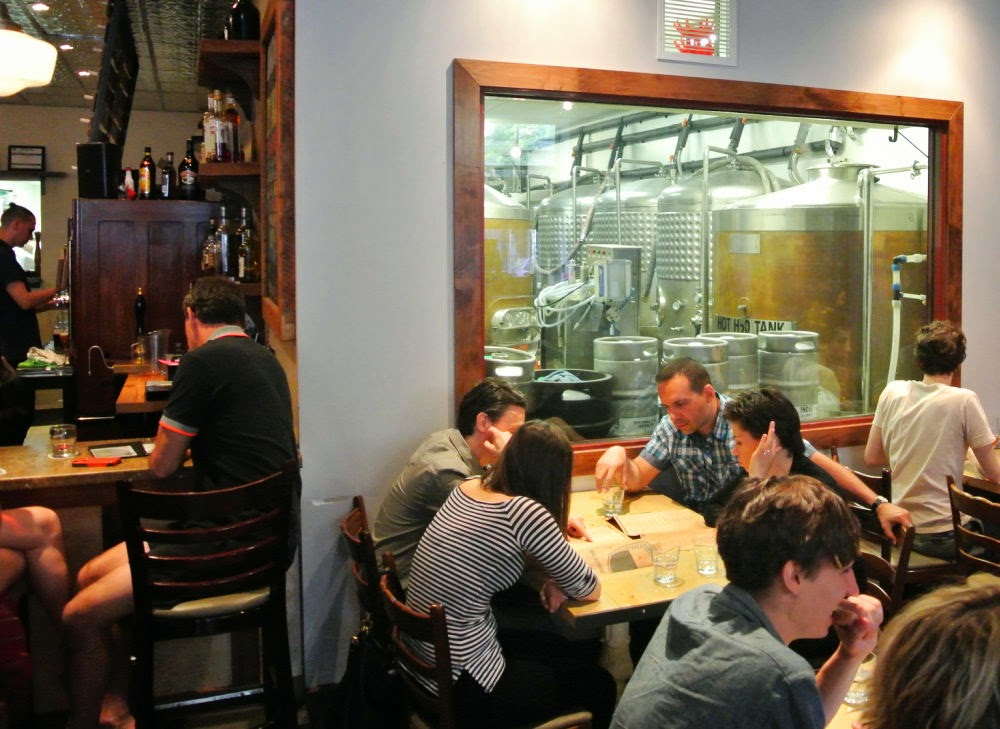
Tucked behind the bar there's a brewery. One of the shiny modern type I saw so many of in San Diego. Crammed into a space that seems just slightly too small. They must employ slim brewers.

I'm in pleasure mode and having fun, not scribbling frantic notes. What was that beer I just had? What's the one in my glass now, for that matter? It doesn't matter. As it tastes good and the chatter is flowing as freely as the beer, who cares? I certainly don't. Not as if the vast majority of you will ever get to try it, anyway.


It's still light when we emerge bleary-eyed and stagger off to the next destination, 3030. Look to the bottom of the page and you'll see why it's called that. Neither that imaginative nor memorable. It's a barn of a place, divided into two bars by a curtain. We head to the rear one, which ends in a stage, as it's the emptier. Bit of a mistake that as a band turns up and makes conversation if not impossible, more effort and less fun than I like. We decamp to the front room as conversation is the main reason we've assembled. Alongside drinking beer, obviously. But I don't need to mention that, do I?


We end at another brewery, Bellwoods. It's popular. A bit too popular. We have to queue to get. I consider saying "Don't you know who I am?" to the nice young lady on the door, but think the better of it, anticipating a "No - now fuck off, you sad old git" reply. We eventually squeeze our way in and sit at a rustically rough table with a view of the shiny things. How much of the world's stainless steel is now tied up in brewing kit? A fair percentage, based on my recent North American experiences.

I get that paternal feeling again looking around the room. Do they have old men's bars this side of the Atlantic? Maybe hidden away out of sight somewhere.


We eat some meat thingies and bread, served on a plank of wood. That wouldn't impress my son Andrew. He hates all the trendy modern food serving methods. "Can't they afford proper plates, dad?" is a typical comment. I'm more relaxed about this sort of thing. What's on it tastes pretty good.

Not sure what time I get back to my hotel. Midnighty-ish I think it is. I can afford to be fairly late. I haven't that early a start. My first event is all that's planned and that doesn't begin until the afternoon.

We'll be hearing all about that next time.


* Early CAMRA reference there.


I was in Canada and the USA to try to convince a few more suckers to buy my new book:

The Home Brewer's Guide to Vintage Beer.


Indie Ale House
2876 Dundas St West
Toronto.
Tel: 416-760-9691
info@indiealehouse.com
http://indiealehouse.com


3030
3030 Dundas Street West,
Toronto.
Tel: 416-769-5736
3030DundasWest.Reservations@gmail.com
http://www.3030dundaswest.com/


Bellwoods
124 Ossington Ave.
Toronto, ON M6J 2Z5
Tel: 416-535-4586
info@bellwoodsbrewery.com
http://bellwoodsbrewery.com/

Wednesday, 18 June 2014

Toronto day one

Another tour, another set of travel reports to write. It feels like being back at school.

The little time I spend at home is now consumed by writing about my travels. Life could be worse. Every day could be much like the last. I should enjoy the excitement while it lasts.

My schedule is as punishing as ever, kicking off with two nights in Toronto. It's a city I've not visited before. Only my second time in Canada, too. My only previous experience of the country was a few nights in rural northeastern Ontario. Where I brewed a beer at Beau's and hung out at their festival back in September 2012. I had a great time and unexpectedly got a chance to practice my French. But I'd not seen big-city life, other than rushing through the Montreal suburbs going to and from the airport.

I divvied up some extra dosh for more legroom on the flight out. Well worth it. I've no twat in front of my reclining his seat down into my lap. Plus there's just one seat next to me. There's so much legroom that the burly Russian sitting by the window can go for a leak without me needing to stand up.

I've brought Boak and Bailey's "Brew Brittania" with me. Travelling is about the only time I get chance to read anything long for pleasure. Though I do catch myself looking at the footnotes, curious to see their sources. That's not really what you'd do on a 100% pleasure read. Old habits are like Bruce Willis.

Once they get to the 1970's, they're retelling events I lived through. It's both slightly unnerving and highly illuminating to see them narrated in a coherent way. I thought I knew the story of the CAMRA's birth, but it turned out to be both more complex and character-driven than I had realised. I'd noticed the tensions around the formation of CAMRA Investments without realising how deeply in had split the movement.

The stuff about the SPBW was mostly news to me. I'd been aware of them, but, other than seeing their stand at beer festivals, they'd had little direct impact on me. Having learned more about them, I'm tempted to join.

Some of what was recounted form the 1970's really resonated with me. Like The first big national CAMRA festival at Covent Garden. It was in the summer I left school. Me and Martin Young, one of my classmates, made the trek down from Newark. It really did look as if the market had been moved out the previous day. We had to queue a while, but were lucky enough to get in. I recall drinking a pint of Yorkshire Clubs Dark Mild. The brewery was taken over and closed not much later.

It was another moment of bizarre recognition when a couple of places in Leeds were mentioned: CAMRA pub the White Horse and the Brahms & Liszt. I was once refused a drink in the latter for looking too much like a hippy. Sort of put me off it. I never had any trouble in the more down-to-earth pubs. Bloody yuppies.

The description of the machinations around the Beer Orders was informative, too. I'd only seen the affair through CAMRA eyes at the time. And though "Government Intervention in the Brewing Industry" has since informed me of the big brewers' side and in particular Guinness's perfidious role, I'd heard little of the publicans' view.

The personal connection weakens after the 1990's, if only because, living abroad, my personal links with the British beer scene have loosened.

Hang on. This is supposed to be a travel report and I've ended up writing a book review. May as well throw a conclusion out. Well written - but I'd expect no less from them - and with loads of good stories about the individuals who drove the quest for better beer. It kept me entertained even while my arse was aching from hours of sitting.

I got a free copy, obviously. I'd have been pissed off if I hadn't, seeing as I had my publisher send them a copy of mine. Though I would have bought one as it's a pretty damn useful book for anyone interested in recent British beer history. And you know me. History is my thing. I've also met the authors once, exchanged multiple emails with them and my name appears in the acknowledgements.

Where was I before I wandered off? Sitting on a plane enjoying extra legroom. Let's continue.

I arrive in Toronto on time and start hunting for Peter Friesen. He's organised my Toronto event and offered to pick me up. Somehow we don't manage to connect. Me forgetting to charge my US phone before leaving didn't help matters. After a while of trudging around outside I get a taxi.

Despite being Saturday, it takes forever. Partly because Toronto sprawls so much - the airport is miles out, despite not being at the city's edge - and partly due to road works. Nearly an hour later, I roll up at my hotel.

The cab ride has left me with the impression of a schizophrenic city. On the one hand, there's the low suburban sprawl of houses and light industrial units. On the other, clumps of residential tower blocks, slowly forming into a forest around the lakefront and downtown. Like a combination of Hong Kong and Melbourne. Don't think I've ever been to a city quite like it.

The hotel is in a rather grand 19th-century mansion. I arrive with not long to spare before an appointment with beer writer Jordan St. John. He's taking me for a tour of the city's cultural highlights. Only kidding. It's a pub crawl. At least I hope so. I've just about got my head sorted from the travel and time jump when he trawls up in the hotel lobby.

He suggests kicking off at Stout. Who am I to argue with a local? It's about a ten-minute walk away. On the way I get a chance to see a bit more of the city. Its schizophrenia is confirmed, with towering  new flats alternating with remarkably English-looking Victorian terraces. Stout is a on a street of the latter, with tram tracks running down its centre. I think: "The kids would love this." Though maybe the kids aren't quite as into PCC cars as they were age nine. I keep forgetting that they're nearly adults.


Stout's billing as an Irish pub might have put me off, had Jordan not assured me of its good beer selection. It's pretty hot and we sit on the patio at the rear. They have a cask beer. Churlish to to start there. Great Lakes Canucklehead. A golden Paley Aley sort of thing topped by a deep collar of creamy foam. Pretty effing brillarific. Especially as it's my first beer in a while.

Jordan shares my love of history, beer and beer history. We've plenty to chat about. He tells me about the book he wrote with Alan Mcleod on the history of brewing in Ontario and the new one he's writing by himself about the brewing in Toronto.

The Canucklehead slips down so sweetly that I order another. Food is ordered, chewed and digested while we wait for Alan (Mcleod) to show up. More beer is consumed, too. An Imperial Stout because, well, I'm on holiday and I can do what I want.

I'm easing into the day, Canada and the tour. Relaxation, like the beer, flows through my body like a low voltage electric shock. Only more pleasant. Just a few hours in and the fun is already palpable.

Next time Alan arrives and I finally meet up with Peter Friesen.


You may have forgotten, but I haven't. The main point of my trip was to tart this:

The Home Brewer's Guide to Vintage Beer.


Brew Britannia: the strange rebirth of British beer
Jessica Boak and Ray Bailey
http://boakandbailey.com/book-brew-britannia/


Stout Irish Pub
221 Carlton Street East,
Toronto, Ont. M5A 2L2.
Tel: 647-344-7676
email: info@stoutirishpub.ca
http://www.stoutirishpub.ca


Ontario Beer
A Heady History of Brewing from the Great Lakes to the Hudson Bay
Alan McLeod and Jordan St. John
http://www.dundurn.com/books/ontario_beer


Great Lakes Brewery
30 Queen Elizabeth Boulevard (Map)
Etobicoke, Ontario
M8Z 1L8
Tel: 416-255-4510
http://www.greatlakesbeer.com

Tuesday, 17 June 2014

Amsterdam Vintage Beer Festival


Yet another event where I'll try and foist my new book on anyone with enough dosh in their sky rocket. A bit closer to home, this time. In my own back yard, in fact. A challenging 30-minute tram ride from my house.

Which pleases Dolores, who worries about the amount of travelling I've been doing. She has a point.

Some of the hottest local breweries - Butcher's Tears, Brouwerij de Molen, Jopen, Oedipus en Oersoep - have made recipes from my latest book. For one day only they'll be available at a mini-festival in Arendsnest.

I'm really looking forward to it. Not just because it's a chance to shift some books. It fulfills the ultimate purpose of  me publishing the thing in the first place (the real reason for any of my research): I get to taste the beers I see in brewing records.

I'll be doing some talking, too. That'll certainly encourage you to rty the beers on offer, if only to distract you from my droney voice. Having given a couple of talks at the AHA Conference last week, I'm growing to like the sound of my own voice. Not sure everyone shares my enthusiasm.

Vintage Beer Festival
28th June, 13:00–16:00
Proeflokaal Arendsnest
Herengracht 90,
1015 BS Amsterdam.
https://www.facebook.com/events/814039351939635/

This is my new book, in case you're a goldfish:
The Home Brewer's Guide to Vintage Beer.

London vs provincial beer in the 1930's: Strong Beers and Old Ales

We're just about at the end of this table-heavy series. That's just how I like my posts: without too many words in them.

Based on the hugely diverging strengths is the samples - from 4.76% to 11.91% ABV - it's clear that they encompass several different types of beer. I'm not sure how meaningful any comparisons are going to be. But why let a little detail like that stop me? Especially now I've come so far.

I'm not just scratching my head, but turning my scalp into a bloodied mess, trying to work out which London beers these could be. Let's start off by saying what they aren't: Burton. At least not draught Burton. All are way too strong (draught Burton was 5% to 5.5% ABV). Even Fuller's Old Burton Extra is well short, strength-wise. Even Barclay Perkins KKKK was much weaker, 7 and a bit % ABV, 1080 OG.

No. 25 must have had a massive OG. It's 11% ABV and still has lots of unfermented stuff in it. Probably about as high as you reasonably go with gravity, 1140 or so. I'm sure I've never seen any 20th-century London beer anywhere near that level, other than Russian Stout.

As usual, we begin with London beers:

Composition of London Beers
Calories per pint.
Total Solids per cent. Absolute Alcohol (by weight) per cent. Ratio of Total Solids to Alcohol (T.S.=1). ABV Solid Matter. Alcohol. Total.
Strong Beers and Old Ales
No. 23 4.65 7.00 1:1.50 8.89 108 278 386
No. 24 6.11 8.62 1:1.41 10.95 142 343 485
No. 25 9.55 8.72 1:0.91 11.07 222 347 569
No. 26 5.16 9.38 1:1.82 11.91 120 374 494
Average 6.36 8.43 1:1.32 10.71 148 335 483
Source:
Journal of the Institute of Brewing, Volume 38, Issue 1, January-February 1932, pages 84 - 88.


The country beers are a real hotch-potch:

Composition of Country Beers
Calories per pint.
Total Solids per cent. Absolute Alcohol (by weight) per cent. Ratio of Total Solids to Alcohol (T.S.=1). ABV Solid Matter. Alcohol. Total.


Strong Beers and Old Ales
No. 79 7.97 7.14 1:0.89 9.07 185 284 469
No. 80 6.04 5.27 1:0.87 6.69 141 209 350
No. 81 6.72 4.72 1:0.70 5.99 156 187 343
No. 82 10.42 5.28 1:0.50 6.71 243 210 453
No. 83 5.47 8.53 1:1.55 10.83 127 339 466
No. 84 6.12 4.28 1:0.69 5.44 142 170 312
No. 85 6.57 5.86 1:0.89 7.44 153 233 386
No. 80 3.89 3.75 1:0.96 4.76 91 149 240
No. 87 4.44 4.33 1:0.97 5.50 103 172 275
No. 88 5.13 4.52 1:0.88 5.74 119 180 299
Average 6.27 5.36 1:0.85 6.81 146 213 359
Source:
Journal of the Institute of Brewing, Volume 38, Issue 1, January-February 1932, pages 84 - 88.

Some of the weaker ones look like the equivalent of a London Burton, while a couple look like Barley Wine. The lower ration of solids to alcohol in the country beers means that they must have been drier.

Finally the comparison of averages:

Strong Beers and Old Ales Calories per pint.
Total Solids per cent. Absolute Alcohol (by weight) per cent. Ratio of Total Solids to Alcohol (T.S.=1). ABV Solid Matter. Alcohol. Total.
London 6.36 8.43 1:1.32 10.71 148 335 483
Country 6.27 5.36 1:0.85 6.81 146 213 359
% difference -1.44% -57.28% -0.77% -57.28% -1.37% -57.28% -34.54%

I can see a pattern emerging now: more of everything in the London beers.

Monday, 16 June 2014

10% off my Lulu books


Until the end of the month (30th June) there's 10% off all my Lulu books if you enter this discount code:

JUNE10

You know you want to collect the full set of my books - well now's your chance.

Barclay Perkins Bookstore

Heineken and pure yeast cultures (part two)

Here's more about the forgotten contribution of Heineken to pure yeast cultures. This time in the form of a book review.

"THE INDUSTRIAL PRODUCTION OF
PURE YEAST.

Attention is drawn in an interesting article by E. Elion (Ann. Brass. Dist., 1932, 30, 275-8 and 291-4) to a recently published monograph on the history of pure yeast culture by H. Lüers and F. Weinfurtner. The monograph is considered to be incomplete and in some respects inaccurate. It is contended that the production of pure yeast had its inception at the beginning of 1886 in the installation of the Hansen-Kuhle apparatus in Copenhagen, since Hansen's earlier method of working with small open vessels could not be considered to give a pure product. The new process met with much opposition in brewing circles, but had strong supporters in Aubry, of the brewing research station in Munich, where the open-vessel process was in use, and H. Elion, of the Heineken Brewery in Rotterdam. Elion designed and had made an apparatus of his own based on that of Hansen and Kiihle, and it was a facsimile of this apparatus which, in 1887, was the first to be introduced into Germany. Records show that the amount of yeast distributed from Rotterdam during the next few years was greatly in excess of that sent out from Munich, many breweries in Germany and other parts of the Continent being supplied from the Heineken Brewery. This information goes to prove that the process of pure yeast production, conceived in Denmark, owed its rapid development to Holland and not to Germany, and that the work of Elion at Rotterdam did not, as has often been stated, follow along paths already prepared by the station at Munich. Hansen himself, in 1888, subscribed to the erroneous belief that the introduction of the pure yeast system into Germany was due to Aubry, and Lüers and Weinfurtner have omitted almost all reference to the work of Elion in their mono graph. Michel, director of the school of brewing in Munich, in 1897, acknowledged the Heineken brewery to have been foremost in the industrial development of pure yeast culture."
Journal of the Institute of Brewing, Volume 39, Issue 1, January-February 1933, page 2.
Elion, the chemist at Heineken Rotterdam had only died a couple of years before this article was published. I know that because an obituary appeared in the Journal. They hadn't forgotten about his achievements. Then again, he was an honorary member if the Institute.

"OBITUARY.
H. ELION.
Dr. H. Elion, from 1894 honorary corresponding member of the Institute of Brewing, died at the Hague, Holland, on April 13, 1930, at the age of 77 years.

Dr. Elion, who was born in Rotterdam in. 1853, obtained the degree of chemical engineer at Delft Technical University and continued his studies at Leiden University, from which he received the degree of D.Sc, in 1884.

From 1886 to 1921 he was the technical adviser of Heineken's Brewery, Rotterdam. In this sphere of action, he exerted a great influence on the development of the brewing industry both in Holland and abroad, especially by his successful industrial application of pure culture methods. The pure culture yeast and the apparatus, introduced by Dr. Elion in Heineken's Brewery, found their way in to many of the greatest breweries in Austria, France, Switzerland, Belgium and above all in Germany, and contributed mainly to the rapid development of this new process of manufacturing. In 1906, at the 6th International Congress of Applied Chemistry in Rome, Dr. Elion reported that the yeast, which he introduced in 1886, was still cultivated in Heineken's brewery in pure state, without any alteration of its properties. He then stated that it would be possible to maintain its good condition as long as desired, and when he retired 15 years later, this prediction proved to be confirmed. Even at that time the Rotterdam yeast was still used in several foreign breweries.

Although much of Dr. Elion's research work could not be published, he wrote a number of interesting chemical and biological subjects. Mention may be made of an extensive study on the estimation of the dry substance in maltwort and beer by the aid of dry air under diminished pressure at a temperature of 97° C, which method has proved useful in many directions. He constructed a table on reference to which the dry material can be derived from the specific gravity. He published work on the determination of salicylic acid in beer, the gravimetric estimation of sugar, the partial decomposition of beer, maltwort and hop by boiling, the detection of preservatives in beer, and a biochemical method for the determination of maltose, dextrose and dextrin in maltwort and beer, based on a fermentation of the sugar by a pure culture of Saccharomyccs cerevisiae.

Dr. Elion's knowledge of yeast fermentation and yeast culture not only advanced the development of the brewing industry, but also the manufacture of bakers' yeast. Indeed, more than 35 years ago, he succeeded in devising a process for producing a yeast of high quality for baking purposes from a new raw material, namely molasses. At that time a good pressed yeast could be made only from cereal products, and the new mode of procedure was an advance from a technical as well as from an economical standpoint. The process is employed industrially on a large scale and was of especial use during the War. At present, bakers' yeast is manufactured principally from molasses and in some countries the use of cereals in the fermentation industry is not allowed.

Dr. Elion was one of the oldest honorary corresponding members of the Institute of Brewing, a compliment which he acknowledged by sending a paper to this Journal. By his decease the brewing industry loses one of its most distinguished representatives."
Journal of the Institute of Brewing, Volume 36, Issue 4, July-August 1930, page 334.

I think that's me done with pure yeast for now.

Sunday, 15 June 2014

Mum again

There are some odd features of British legislation. Especially the way some items are specifically mentioned by name long after they had disappeared from the real world. Did nothing except confuse the hell out of everyone. Mum is a good example.

"MUM.
Many of our readers must have wondered when reading Customs and Excise Regulations, what was the meaning of the word "Mum" in the sentence "Mum, spruce or black beer, Berlin White Beer," etc. In May last, when the House was debating the Finance Bill (Committee stage), Captain Waterhouse, in order to obtain information on this point, moved to delete the word "Mum," not, as he explained, because he objected to it, but because he wanted an explanation of the entire phrase in which  it occurred. Mr. Pethick-Lawrence replied, "At the present time there is no beer being imported under the description 'Mum,' but there has been, in the past, a special kind of German beer called 'Mum,' which came into this country, and was of the same category as the black beer manufactured in this country. The form of beer which is covered by this description is not a beverage in the ordinary sense, but is of the same character as beer, and is used partly as a medicine. It has been for many years included under the Beer Duty, and it is not the intention of the Government to change the practice adopted all this time. The reason why the word 'Mum' is continued is because, though actually at the present time no 'Mum' is being imported, we have to be prepared in case it should be imported, in which case, if the amendment were carried, it would be very unfair to British producers, and would be the exact reverse of a protective duty." Further information as to "Mum" was supplied by Mr. Leif Jones, the well-known temperance advocate, who stated that the word was at least as old as the 14th century, and that it appears in some Statutes as far back as 1594. It was, he said, an old-fashioned remedy of the 17th and 18th centuries, and was imported from Brunswick. The concise Oxford dictionary describes it as a kind of beer originally brewed in Brunswick, its name being derived from the German "mumme," while Thorpe's dictionary of Applied Chemistry describes it as a kind of fat ale (sic) brewed from wheat and bitter herbs. Chamber's Encyclopaedia, on the other hand, says it is a kind of beer made from wheat malt, to which some brewers add oat and bean meal. Those who would like to pursue the matter further will find information on this question in " Notes and Queries" for November, 1881, page 376."
Journal of the Institute of Brewing, Volume 36, Issue 4, July-August 1930, page 325.
It's quite weird that parliament continued to pass legislation with words no-one understood the meaning of.

I wonder when Mum was last imported into Britain? Must have been sometime in the 19th century. I'm not sure they were really making Mum in Germany any more by then.

Even weirder that they should be getting information about Mum from a temperance campaigner.

This is the relevant section from the 1930 Finance Act:

2.-(1) In lieu of the duties of customs payable on beer of the descriptions called or similar to mum, spruce or black beer, or Berlin white beer, or other preparations, whether fermented or not fermented, of a similar character imported into the United Kingdom, there shall, as from the fifteenth day of April, nineteen hundred and thirty, be charged, levied, and paid the following duties, that is to say :-


For every thirty-six gallons of beer where the worts thereof are, or were before fermentation, of a specific gravity: £ s. d.
Not exceeding one thousand two hundred and fifteen degrees 20 14 0
Exceeding one thousand two hundred and fifteen degrees  24 5 0


(2) In lieu of the duty of customs payable on every description of beer other than those specified in the preceding subsection imported into the United Kingdom there shall, as from the fifteenth day of April, nineteen hundred and thirty, be charged, levied, and paid the A.D. 1930 following duty, that is to say:-  £ s. d.
For every thirty-six gallons where the worts thereof were before fermentation of a specific gravity of one thousand and fifty-five degrees  5 3 6

That's a very high rate of duty - a British-brewed beer with a gravity of 1215º would have paid £15 12s duty per 36-gallon barrel.

I'm puzzled as to what possible connection Berlin White Beer (assuming it means Berliner Weisse) could have with Mum. A beer with a gravity of, at most, 1030º. Let me know your thoughts.

Saturday, 14 June 2014

London vs provincial beer in the 1930's: Stout and Porter

I bet you just love all these interminable series. Though I'm fairly rattling through this one. we're already on Porter and Stout.

These are the beers on which London had built its brewing reputation and they were still a big part of their business. At Truman, 23% of the output of their Brick Lane brewery was Porter or Stout in 1930*. For Whitbread, they were even more important: 28% of production**.

I can tell you one thing for certain: there's not a single Porter in the London table. All of the beers are too strong. Well, maybe No. 17 could just about be a Porter. But it would be right at the very, very top end.

Don't believe me? OK, here is a selection of London Porters from the period:

London Porter in 1930
Brewer Beer Price per pint Acidity OG FG ABV App. Atten-uation
Courage Porter 5d 0.07 1038 1012.8 3.26 66.32%
Courage Porter 5d 0.10 1036 1008.4 3.58 76.67%
Hoare Porter 5d 1035 1010.8 3.13 69.14%
Hoare Porter 5d 1037 1009 3.63 75.68%
Hoare Porter 5d 0.07 1034 1006.6 3.56 80.59%
Hoare Porter 5d 1037 1010.2 3.47 72.43%
Wenlock Porter 5d 0.08 1038 1014.2 3.07 62.63%
Wenlock Porter 5d 1037 1009.8 3.53 73.51%
Source:
Whitbread Gravity book held at the London Metropolitan Archives, document number LMA/4453/D/02/001.

Convinced now?

The London Stouts show the greatest concentration of residual sugars we've seen so far, both in absolute terms and in relation to the amount of alcohol. The ones over 4.5% ABV look like typical draught London Stouts, with gravities in the 1050-1055 range. The modest ABV is explained by apparent attenuation of less than 70%, which was common.

Composition of London Beers
Calories per pint.
Total Solids per cent. Absolute Alcohol (by weight) per cent. Ratio of Total Solids to Alcohol (T.S.=1). ABV Solid Matter. Alcohol. Total.
Stouts and Porters.
No. 15 7.04 3.82 1:0.04 4.85 164 152 316
No. 16 5.77 3.53 1:0.61 4.48 134 140 274
No. 17 4.75 3.10 1:0.05 3.94 110 123 233
No. 18 6.11 4.23 1:0.69 5.37 142 168 310
No. 19 5.69 3.40 1:0.59 4.32 133 135 268
No. 20 5.40 3.42 1:0.63 4.34 126 136 262
No. 21 6.08 4.20 1:0.69 5.33 142 167 309
No. 22 5.42 4.30 1:0.79 5.46 126 171 297
Average 5.78 3.75 1:0.64 4.76 134 149 283
Source:
Journal of the Institute of Brewing, Volume 38, Issue 1, January-February 1932, pages 84 - 88.

Relatively high levels of alcohol and lots if unfermented stuff give London Stout the highest value rating so far, reaching almost 300 calories.

Now for the country beers:

Composition of Country Beers
Calories per pint.
Total Solids per cent. Absolute Alcohol (by weight) per cent. Ratio of Total Solids to Alcohol (T.S.=1). ABV Solid Matter. Alcohol. Total.
Stouts and Porters.
No. 71 5.02 3.65 1:0.72 4.64 117 145 262
No. 72 5.78 4.55 1:0.78 5.78 135 181 316
No. 73 4.57 3.16 1:0.69 4.01 100 125 231
No. 74 5.29 3.14 I:0.59 3.99 123 125 248
No. 75 3.86 2.58 1:0.66 3.28 90 102 192
No. 76 4.12 3.08 1:0.74 3.91 96 122 218
No. 77 5.12 3.50 1:0.68 4.45 119 139 258
No. 78 6.19 3.98 1:0.64 5.05 144 158 302
Average 4.09 3.45 1:0.69 4.38 116 137 253
Source:
Journal of the Institute of Brewing, Volume 38, Issue 1, January-February 1932, pages 84 - 88.

We see the pattern of lower alcohol levels in the country beers continue. This time the residual sugars are much lower in the country beers.

And finally my comparison of the averages.

Porter and Stout Calories per pint.
Total Solids per cent. Absolute Alcohol (by weight) per cent. Ratio of Total Solids to Alcohol (T.S.=1). ABV Solid Matter. Alcohol. Total.
London 5.78 3.75 1:0.64 4.76 134 149 283
Country 4.09 3.45 1:0.69 4.38 116 137 253
% difference -41.32% -8.70% 0.08% -8.70% -15.52% -8.76% -11.86%


Once again, more of just about everything in the London beers. If the London and country beers sold for the same price, it's clear which were better value.


* Document B/THB/C/256c held at the London Metropolitan Archives.
** Whitbread brewing records held at the London Metropolitan Archives, document numbers LMA/4453/D/01/096, LMA/4453/D/01/097 and LMA/4453/D/01/098.