Tuesday, 17 November 2020

Maize adjuncts in WW II

Flaked maize
The brewer’s favourite adjunct soon had to be dropped, I assume for pure supply reasons. Maize not being grown in the UK at the time, it had to be imported. Which was always going to be problematic, when there were other priorities for scarce transatlantic transport.

Almost immediately following the outbreak of war, there were restrictions on the raw materials available to brewers.

"At the outbreak of war every brewer realised that he would be forced to make drastic alterations in the composition of his grist, for he was forbidden to use flaked maize, future supplies of barley from Central Europe was cut off, while available supplies of Californian malt were materially reduced and in some cases ceased entirely while there was a possibility that sugar would be rationed.

It is probable that flaked maize has been used more from the view of economy than anything else, and its effect on the composition of the wort is hardly of sufficient importance to present any difficulty in replacing it. Flaked rice in limited amount is still available, however, and can easily replace flaked maize although it is quite possible that it may be restricted in the future."
Journal of the Institute of Brewing Volume 46, Issue 4, August 1940, page 274.

Flaked maize disappeared in 1940, initially replaced by flaked rice and later by flaked barley. It only made a reappearance in the early 1950s, when it quickly regained its pre-war position as brewers’ favourite adjunct.

Grits
A few brewers preferred grist over flaked maize, though this this was definitely the exception. Presumably because an extra piece of equipment – a cereal cooker – was required.

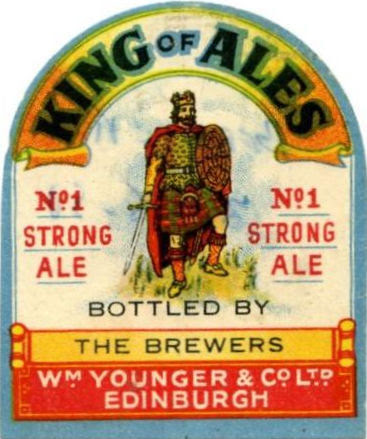
William Younger of Edinburgh was an enthusiastic user of grits. It often made up over 40% of their grists. Barclay Perkins also used grits, but only in some of their Lagers. Never in their other beers.

Unlike flaked maize, grits didn’t disappear from brewing records in 1940. They hung around until early 1942 in William Younger’s brewing records.  Though they were then definitively dropped by the brewer. Once the most enthusiastic user of grits, William Younger never returned to them. Preferring, when maize became available again in 1949, to use them in flaked form, like everyone else.

Monday, 16 November 2020

More pub crime

In my series on WW II pub crimes, here's one where it definitely was the landlord who was up to no good.

Why have I started this series? Because I'm in a lazy mood and can't be arsed to write something technical.

You quite often to have to do some reading between the lines in these sparse reports about what was really going on.

"GOVERNMENT STORES IN LICENSED HOUSE
Portsea Manager Fined

UNLAWFUL possession of public stores by the manager of a Portsmouth public-house alleged at the Portsmouth Magistrates' Court on Wednesday.

Defendant was James Oatley, of the Ship Anson public house, The Hard, Portsea, and he was summoned for having in his possession a table cloth, two hand towels, two bath towels, a linen mattress case, three "C " gas masks, a 2 lb. tin of marmalade, a 2 lb. ton of blackcurrant jam, two 2 lb. tins of suet, and 24 lbs. of tea, valued together at £15 7s. 5d., contrary to the Public Stores Act, and also having in his possession a sailor's blue serge suit and a sailor's duck suit, valued together at £2 0s. 5d., contrary to Seaman's Clothing Act. Detective Inspector Bray said on March 7 he went to the Ship Anson public house where, after a conversation, Oatley handed him 24 lbs. of tea. Within an hour or two witness obtained a search warrant and searched Oatley's premises. Detective Constable Kendal said when asked where he got the marmalade, jam and suet Ostley replied, "Mum bought those." 

BEEN HERE A LONG TIME
Sergeant Heale said Oatley told him the linen articles had "been here a number of years," and he told Detective Hall the gas masks "have been here a long time." Oatley, in evidence, said he had never been in trouble before. His public-house was just opposite the Dockyard and he had a lot of service men as customers. They sometimes left things which they claimed afterwards. Regarding the parcels, on March 7, he did not hand them back immediately as Det. Insp. Bray asked for white parcels and the parcels in question were grey. The gas masks were left with him during the period of blitzes. 

Iris Oatley daughter of defendant, said the sailor's clothing were left with her by a Fighting French sailor who  was courting her. 

The magistrates dismissed the summonses relating to the possession of sailor's clothing and gas masks, but on the other summonses Oatley was lined £5."
Hampshire Telegraph - Friday 24 March 1944, page 14. 


The gist is Oatley had large packages of rationed food which I assumed were identifiable as government property. Presumably for use in canteens. And also rationed textiles.

What about the parcels? Reference is made to them but there's no explanation as to what they were and why Det. Insp. Bray wanted them.

It sounds like they had got wind of Oatley selling items on the black market and had sent Bray there to trap Oatley.

The stuff with the sailor's uniforms is just weird. Why would the French sailor leave them with Oatley's daughter, even if they were courting. And why would he want spare gas masks?

Presumably worker in the dockyard had pinched the items and swapped them for alcohol with Oatley.

Oatley was running a great risk. Any sort of criminal activity was used by magistrates as a reason for refusing a licence.

Sunday, 15 November 2020

Sunday afternoon scene in a public house

You bump onto some odd stuff idf you search for "public house" in the newspaper archives. Mostly involcing a crime of some sort.

19th century reports are the most gruesome. Regularly starting off with a few jars in the vaults with a couple of strangers and ending with several dismembered bodies.

This one features a little violence, but nothing too horrible. It's just a weird story, where I can't really make out what was going on. See wht you think.

"Colne Licensee Assaulted
TROUBLE OVER DROPPED TREASURY NOTES
SUNDAY AFTERNOON SCENE IN PUBLIC HOUSE

Summoned at Colne Magistrates' Court Monday for assaulting Joseph Albert Swift, landlord of the Hargreaves Arms, and his wife, Catherine Swift, William Whalley (52}, Naze Edge Farm, Colne, was fined £3 and costs in the first ease, thr second being dismissed. 

Mr. Ogden appeared for the complainants and defendant was represented Mr. Waddington. Mr. Ogden said that on Sunday, November 19th. the defendant, with two other men, was having‘drinks at the bar and whilst in conversation Mr. Swift noticed some Treasury notes lying the floor. He picked them up and asked the three men if they had lost any money. Two of the men, Mr. Metcalfe and Mr. Gill, both said the money did not belong to them, and it was alleged that Whalley remarked: “Put it in your pocket; if find any money it mine." Mr. Swift told him not be stupid and to feel if had lost any, but he did not go anything. 

Some time later, continued Mr. Ogden, the defendant retired to the rear of the premises and in the meantime Mr. Swift again noticed some Treasury notes lying the floor. He questioned the other two and said the joke was being carried too far. When Whalley returned, Mr. Swift asked him to feel his pockets as he had found some more money. Whalley is alleged have replied. "Shove them in your pocket and don't be a --- fool.” Swift said he was not trying be funny, but wanted the defendant to have the money if it belonged to him. The men, however, drank up and went out and as they did so Mr. Swift said: ” Don't forget; I have some money belonging to one of you.” 

About twenty minutes later there was knock at the door. Mr. Gill was the door and he said that Whalley was at the rear of the premises. Mr. Swift went out and Whalley said : I have come for money.'’ Asked how much had lost, he replied "£l5 or more.” Mr. Swift said there was only £ll, whereupon Whatley called him a liar and said wanted £l5 or hr would fetch the police. Mr. Swift said himself would hand the money over to the police and told Whalley to leave the premises. When they got to the door it was alleged that Whalley turned round and hit Mr. Swift a severe blow in the face, knocking out tooth, and when Mrs. Swift tried to get between them it was alleged that Whalley struck her a blow in the face and kicked her. 

POLICE CALLED
Mr. Swift telephoned to the police, proceeded Mr. Ogden, and in due course Sergeant Wignall and P.C. Atherton arrived. Mr. Swift was trying to carry out his licensee and, realising their might some difficulty, he did all he could to trace the ownership of the money. He had been the licensee for 14 years without complaint and he brought the proceedings at the instigation of the police, added Mr. Ogden. 

The licensee gave evidence bearing out Mr. Ogden's statement. He said that when he found the first notes he mentioned it to the three men. Metcalfe said he had only 10s. when he came into the house, it did not belong to him, and Mr. Gill looked in his wallet and said it was not his. Defendant made use of obscene expression, saying findings were keepings, and told witness to put the money in his pocket. He told defendant put his hand in his pocket to see if had lost anything. Whalley had gone to the rear when the second lot of notes were picked up and when Whalley returned witness said : "What about this money; I have found some more." Whalley replied : "I have told you what to do with it; shove it in your pocket.” Witness said : “It is obviously yours,” but Whalley told the others to drink up, saying they were going, which thei shortly did. 


WHEN DEFENDANT RETURNED

Describing what happened when Whalley returned to the hotel, Mr. Swift said defendant, when asked how much money there was, said it was £l5 or more. Witness told him there was only £ll and that he would hand the money over to the police for them to establish ownership. They went together to the front door and defendant turned round and struck him violent blow in the mouth, knocking out a tooth. Mrs. Swift interfered and Whalley struck her a blow on the jaw and kicked her on the right leg. The police were sent for and it was on their advice that he took out a summons.

Cross-examined Mr. Waddington, the landlord said he did not know that as result of an injury in the last war Whalley had only one ear drum. 

Mr. Waddinpton: I suggest he did not say anything when you first saw some notes: —Yes he did; he told to shove them in my pocket. 

In answer to further questions, witness denied that he called Whalley a liar and that he did not think he was worth €l5. He also denied saying "Get out of that ---- door." 

Mr. Waddington: Did you twist his arm up his back and did Mrs. Swift hit him in the left eye? —Not at all. 

Have you bragged about your proficiency in chucking people out of your house? — No, on the contrary, there has never been any trouble before. 

Witness agreed that when the police came the defendant told the Sergeant he had approximately €l6 and that the Sergeant counted £ll. 

A LOT OF PAIN
Evidence was given by Mrs. Swift in corroboration of her husband’s statement. She said that she had had two operations on her right leg and since defendant’s assault on her she had had lot of pain and could not I sleep at night.

Questioned by Mr. Waddington, she denied that it was she and her husband who attached Mr. Whalley first.

Sedgwick Metcalfe spoke of the landlord finding the notes, but said he did not remember whether Whalley asked answered or not when Mr. Swift asked if he had lost any money.

Answering Mr. Waddington, he said he did not think Whalley realised he had lost any money when he left.

Sergeat Wignall spoke to being sent to  the Hargreaves Arms in company with P.C. Atherton in response to a telephone call from the landlord. He gave evidence to what Mr. Swift had told him regarding the alleged assault on the landlord and his wife. Defendant was present, and when witness counted the money handed to him by Mr. Swift he found there was £ll, which he prevailed upon defendant to take. Whalley said he was sorry about havng struck Mrs. Swift, and as the assault on the landlord he remarked: " We all lose our tempers now and again."

PC. Atherton corrobornted Sergeant Wignall’s evidence.

For the defendant. Mr. Waddington asked the magiatrates whether they could believe the complainants’ story. Could they believe that a man who lst a considerable amount money and who had really been told about it would go out of a house without having looked in his pocket and then return in a quarter of an hour? Defendant alleged that the complainants were trying to “chuck” him out of the house without his money. 

DEFENDANT’S EVIDENCE
Giving evidence on his own behalf, defendant said Mr. Gill, licensee of the Commercial Hotel, Gisburn. called at his house and, having regard to the business they wanted to transact, they went to see the witness Metcalfe. 

Defendant said he had £l6 when he left his house and he carried it in front pocket of his trousers. During the visit to the Hargreaves Arms he paid for round of drinks and pulled the money out of this pocket. While he was there nothing was said as far he knew about money being found on the floor. Mr. Swift did pick up a cigarette packet and said. "Have you lost something?” and witness replied, "If that is all I have lost you cap keep it.” He left the house in Gill's car. and when he got little distance he had occasion to put his hand in his pocket and missed the money. He asked Gill to take him back. When saw the landlord, continued defendant, and he told him what had come for. Mr. Swift said: "Get out of that door.” He seized witness by the right arm and screwed it up his hack, and alleged that Mrs. Swift tried to gouge his left eye out with her finger nails. I broke loose and struck twice.” he added, "and must have hit them both.” 

"CONCOCTED STORY”
Answering Mr. Ogden, defendant said he had £l6 in his pocket the Saturday afternoon quarter to five and did not out again until he went to this public house. He alleged that the landlord and his wife were telling pack lies and had concocted their story. 

Defendant’s wife and daughter gave evidence to the state he was in when he returned home this Sunday afternoon. His right ear was full of blood, his left eye was blood-shot and his face was scratched, the daughter remarking that he looked if a cat had been scratching him. 

At the request the Chairman (Mr. J. N. Hey), Sergeant Wignall was recalled and said that, according to the statement made to him by the landlord, the alleged assault on Mrs. Swift was made after she had intervened and scratched defendant. 

In announcing the decision the magistrates, after they had consulted in their room, the Chairman said the evidence in the second case they regarded as unsatisfactory and that was why they were dismissing it."
Barnoldswick & Earby Times - Friday 08 December 1944. 

Was Whalley trying to extort money from the landlord? Or was the landlord trying to cheat Whalley? It does sound as if Whalley was up to no good, but what exactly. Ut's all a bit strange.

Let me know what you think.


Saturday, 14 November 2020

Let's Brew - 1941 William Younger Export

Stronger beers didn’t fare well in the war. And Younger’s Export was no exception. This example, brewed on 19th March, is the last sighting I have of it until after the end of the war. At least it did return after the war, unlike most English strong Pale Ales.

Somewhat surprisingly, the OG is only 3º lower than pre-war. Leaving it an impressive 5% ABV. Probably more than that by the time it was consumed, as 1013º is the cleansing gravity, not the racking gravity

It was brewed in somewhat of a transition period, when Younger replaced some of the grits with rice. I’m surprised that they still had any grits available. They must have built up a large stock before the war made them unobtainable.

Most of the hops were Kent from the 1939 harvest. But 26 lbs of the 130 lbs are described simply as “samples” from the 1940 harvest.

1941 William Younger Export
pale malt 8.00 lb 66.67%
flaked rice 2.00 lb 16.67%
grits 2.00 lb 16.67%
Fuggles 145 min 1.00 oz
Fuggles 30 min 1.00 oz
Goldings dry hops 0.25 oz
OG 1051
FG 1013
ABV 5.03
Apparent attenuation 74.51%
IBU 23
SRM 4
Mash at 153º F
Sparge at 160º F
Boil time 145 minutes
pitching temp 60º F
Yeast WLP028 Edinburgh Ale

Friday, 13 November 2020

The price of malt

I've written quite a bit of my next book this week. About 5,000 words. And pruned out a lot of stuff which I never intended to be in the final book. But just as reference material while I'm writing it.

Not sire how many of you give a fuck about my writing process. On with the real topic of this post.

Some brewing records, Barclay Perkins, for example. are very detailed.So detailed, that I can't easily record all the information in my spreadsheet.Things like the prices which they handily supply for all the ingredients.

Having decided to look at the costs of the different malts for the new book, a renewed trawl through the Barclay Perkins brewing records was in order. Not too much work, really. Just as well given how lazy a sod I am. 

Not that I have much else to do, other than watch Homes Under the Hammer and Come Dine With Me, now that I'm unemployed.

After a few hours of not particularly taxing work, I'd assembled some fun tables. One of which I'm about to share with you. How much Barclay Perkins paid for their malts during the war.

In general terms. the movement of the prices isn't what you'd expect. That is, rising steadily throughout the war. But that's not what happened. After peaking in 1942, prices fell and remained fairly constant through the end of hostilities and beyond. 

There's a very simple explanation for why that occurred: the government stepped it and imposed a maximum price for malting barley. Even so, the cost was about treble the prewar value.

Barclay Perkins malt prices shillings per quarter (336 lbs) 1939 - 1945
date pale mild SA PA crystal amber brown lager
Jun. 1939 47 50 49 55 46.5 51.5   53
Jun. 1940 61 89 52 93.5 79 90 84 80
Apr. 1941 56 116   124 83 91 84 118
May 1942   185   195 230 280 185 125
Jan. 1943   155 195 190 158 180   153
Nov./Dec. 1944     150 164 146 146   154.5
Apr. 1945   142 142 157 146 161 152  
Aug. 1946   142 142 153 131 147.167 136  
1947   147 142 157 131 147.167 136  
Source:
Barclay Perkins brewing record held at the London Metropolitan Archives, document number ACC/2305/01/623, ACC/2305/01/624, ACC/2305/01/625 and ACC/2305/01/627.


Thursday, 12 November 2020

Water in WW II

Rousing my naturally extremely lazy arse, I've been getting stuck into the sections of my next book I've been avoiding working on. For, oh, just about a year or so.

I'm clearing out the marker source material and replacing it with something resembling coherent text. Something I should really have hot on with  a very long time ago. And now I've started, It's much less daunting than idle me feared.

The section on ingredients is coming along nicely. And includes this little section on water which I've just written.

One ingredient of which there was an abundant local supply was water. Just as well, as importing would have been enormously impractical.

Once the importance of water chemistry had been twigged in the middle of the 19th century, brewers stated to fiddle with their water if it didn’t fit the profile for the type of beer they wanted to brew.

Initially, treatment was all about mimicking Burton water. There was huge incentive to recreate Burton water. The alternative being to build, or buy, a brewery where that water profile was naturally available.

With the essential elements of what made Burton water so suited for Pale Ales identified, brewers began to “Burtonise”. Which, essentially, entailed dumping a load of gypsum into it.

It didn’t stop there. The more sophisticated breweries began treating the water for all their beers, leaving some with no beer brewed from liquor which hadn’t been tweaked.

A good example is Barclay Perkins. Who treated the brewing water for all of their beers, whatever, the style, except for Lager.

You’ll note that each class of beer had its own, distinctive, treatment. Not all breweries were quite as pernickety, but pretty well everyone, outside Burton, treated the water for their Pale Ales.

Barclay Perkins water treatment in 1941
Mild Ale Company's liquor, treated cold. 2/3 oz. salt and 7/12 oz gypsum per barrel in hot liquor back. Heated to 170º F, allow to drop to mashing heat. Half hour before mashing add 1/8 pint per barrel bi-sulphate of lime. Salt in copper: 3 ozs per barrel.
Burton Ales Company's liquor, treated cold. 3 ozs. salt and 3 ozs. gypsum per barrel in hot liquor back. Boil overnight. Half hour before mashing add 1/8 pint per barrel bi-sulphate of lime. Salt in copper: 1 oz per barrel.
Bitters and DB Company's liquor, treated cold. 1.5 oz3. salt and 4 ozs gypsum per barrel in hot liquor back. Heated to 170º F, allow to drop to mashing heat. Salt in copper: 2 ozs per barrel. DB nil
Porter and Stout Company's liquor boiled for 30 minutes, allow to drop to mashing heat. 2 ozs. Salt and 1 oz gypsum per barrel of liquor used over the goods added to grist. Salt in copper: 3 ozs per barrel.
PA Ex Company's liquor, treated cold. Boiled 5 minutes, allow to drop to mashing heat. 5 ozs CaS04 and 1 oz MgS04 per barrel in liquor backs.
Source:
Barclay Perkins brewing record held at the London Metropolitan Archives, document number ACC/2305/01/624.


Wednesday, 11 November 2020

Let's Brew Wednesday - 1858 William Younger XS

William Younger produced a crazily large range of very strong beers. And these weren’t limited to their Shilling Ales. They also brewed a set of Stock Ales.

They’re as insanely strong as the Shilling Ales, but more heavily hopped as they were intended to be aged. I’m not sure why Younger switched to using the English system of X’s for these beers. Though they weren’t used in quite the same way. XS is way stronger than an English X Ale.

Base malt remains the only element in the grist. The hops are different. All English: Kent., East Kent and Farnham. Mostly Farnham. As they were some of the most expensive hops, it’s a sign that this was aa high-class beer.

I forgot to mention the yeast. Younger at this point seemed to rarely use their own yeast. All of the beers so far were fermented using the yeast of Drybrough, another Edinburgh brewery. Swapping yeast seems to have been common in Edinburgh. It was simplified by the fact that so many breweries were located close to one another in the Old Town.


1858 William Younger XS
mild malt 23.00 lb 100.00%
Goldings 90 min 3.75 oz
Goldings 60 min 3.75 oz
Goldings 30 min 3.75 oz
Goldings dry hops 0.50 oz
OG 1102
FG 1032
ABV 9.26
Apparent attenuation 68.63%
IBU 101
SRM 9
Mash at 152º F
Sparge at 190º F
Boil time 90 minutes
pitching temp 55º F
Yeast WLP028 Edinburgh Ale


This recipe is in my two new books, Strong! vols. 1 & 2 and Strong! vol.2.


Tuesday, 10 November 2020

Brewing ingredients in WW II

When the dust had settled at the end of WW I, things didn’t totally revert to the way they had been pre-war. UK brewing still wasn’t self-sufficient in raw materials, though it was less dependent than it had been. Not because UK production of materials had expanded, but because less beer was being brewed and it was of the lower gravity and hence required fewer ingredients.

Considerable quantities of barley continued to be imported, and all of the maize employed came from overseas. As well as considerable quantities of cane sugar. Between 1930 and 1938, on average, about 15% of the hops used in UK brewing were imported.

Difficulties in sea transport greatly limited – or entirely suppressed – the importation of most brewing materials. This wasn’t as big a problem as in WW I, as percentage of foreign ingredients in 1939 than it had been in 1914. But it still required brewers to adapt their grists.

The war made people do many things that they wouldn’t usually do. Brewing was no exception. Brewers being forced to use ingredients they wouldn’t usually have considered.

Flaked maize, for which there was no domestic source, was the first for the chop. Though, as it was only really used as a cheap substitute for malt, rather than for any inherent characteristics which had little impact on the character of the beer, replacing it wasn’t such a problem.   Several alternatives were employed at various points of the war: rice, oats and flaked barley.


Brewing materials 1938 - 1950 (%age)
year malt Un-malted corn rice, maize, etc sugar hops per bulk barrel (lbs) hops per standard barrel (lbs) Hops per quarter (lbs)
1938 78.31% 0.12% 5.75% 15.82% 1.28 1.71 7.8
1939 78.35% 0.08% 5.82% 15.75% 1.25 1.67 7.61
1940 83.81% 0.07% 3.09% 13.03% 1.19 1.62 7.58
1941 86.90% 0.09% 1.95% 11.05% 1 1.43 6.68
1942 85.54% 0.41% 2.99% 11.06% 0.84 1.31 5.87
1943 79.34% 0.31% 9.55% 10.80% 0.87 1.39 6
1944 78.88% 1.06% 9.22% 10.83% 0.87 1.38 6.09
1945 75.63% 1.78% 9.65% 12.93% 0.86 1.36 5.96
1946 76.53% 1.06% 8.69% 13.73% 0.82 1.29 5.83
1947 80.37% 0.79% 5.22% 13.61% 0.81 1.37 6.22
1948 81.75% 0.60% 5.22% 12.42% 0.9 1.52 6.69
1949 82.94% 0.55% 4.61% 11.89% 0.98 1.61 7.15
1950 83.50% 0.52% 4.17% 11.81% 1.03 1.67 7.19
Source:
my calculation from figures in 1955 Brewers' Almanack, page 62
Notes:
assumes a quarter = 336 lbs


Monday, 9 November 2020

The Outlook for Hops

Throughout the war brewers worried where their hops would be coming from. Emergency stocks which many brewers sensibly had, helper ease the situation in the first year or two. But when these had been used up, UK brewers were 100% dependent on the local hop harvest.

Unfortunately, the UK crop fell short of brewers' needs.

"The Outlook for Hops
With the picking of the 1943 crop nearing its conclusion, there seems to be a general feeling that the quantity available will not be less than last year, and may show a slight increase. However this may be, the fact remains that last year’s crop fell far short of a full year’s requirements of the brewing industry, and it is quite certain that this year it will also fall substantially short of that desirable target. Consequently brewers cannot expect to receive the full quantity of their contracts, which again will have to be scaled down by a percentage which cannot be determined until the total number of pockets available has been ascertained. It is clear, therefore, that the average brewery, which to-day has enough hops to last until about the end of the present year, will receive only enough of the 1943 crop to carry on until perhaps early November next year. There is no reason to hope that the supply will improve next season, and by the autumn of 1945 the position will, indeed, become serious. There may be cases where a greater reduction than the present 20% as compared with pre-war hop rates is practicable, and indeed some few breweries have been able to show a greater reduction, but breweries by and large are finding that a reduction in the neighbourhood of 20% is about the limit to which they can go without danger to the stability of their beers."
The Brewing Trade Review, October 1943, page 306.

A 20% reduction in hopping rate already had some brewers struggling. If you remember, there was a minimum hopping level of 1 lb per standard barrel, under which they were not compelled to fall. Though some did voluntarily. Some brewers, such as William Younger, had been under that minimum rate before war erupted.


Even if shipping were available for the importation of hops, where would you find them? Pre-war, Germany, Bohemia or the USA would have been the obvious choices. But the first two were in enemy hands and the last was experiencing a shortage of its own.

"There is the prospect in view, therefore, that before the end of next year shortage of hops will bring about an enforced curtailment in the quantity of beer brewed unless some means can be found of easing the position. That means can only consist in bringing in from overseas additional supplies of hops in some form. There has continued to be some quantity of hop oil imported, but it is quite infinitesimal, and although useful in maintaining flavour it is doubtful whether it is of much assistance from the point of view of preservative value, and it is from the point of view of preservative value that the brewer is most anxiously watching the hop position. There is a world shortage of hops. For five seasons the supply from the Continent has been cut off, and America, which normally exports a large quantity annually, is now herself short of hops. Other countries, such as South Africa and New Zealand and Canada, which grow hops do not do so on a scale which would admit of any exportable surplus, in fact in at least two of the three they are not self-supporting. Nevertheless, America is the only possible source from which it may be hoped to obtain some relief of the position. Hops as such are bulky and occupy too much shipping space to leave any likelihood that this space can be spared at the present time, but there is some, hope that it may prove possible to bring over a quantity in concentrated form. Brewers have been given an opportunity of bespeaking a share in this supply if it can be obtained, and if the necessary permission is accorded to import it."
The Brewing Trade Review, October 1943, page 306.

 That's the first I've heard of a shortage of hops in the USA during WW II. I wonder what caused it? With exports impossible, I would have rather expected a glut.

The collapse of brewing in Nazi territory at the end of the war meant that there were plenty of Bohemian hops available for export as soon as the war ended. And they turm up it lost of UK brewing records in the late 1940s

Sunday, 8 November 2020

Beer for the Forces

Churchill was very insistent that the armed forces be adequately supplied with beer. He was no idiot. A reliable supply of beer was obviously good for morale. But, at a time where the demand for beer was higher than the supply, finding enough to satisfy both the military and civil population wasn't easy.

"The Society was doing its best to see that the supply of beer to canteens, and particularly to the Forces through NAAFI and otherwise, was at a satisfactory level. In many cases breweries asked to supply canteens and messes had replied that they had no surplus beer available, with the result not only that beer had to be brought from considerable distances but also that the distant brewers supplying were only able to do so by reducing the supplies to their own customers. It had to be realised that the supply of canteens with reasonable quantities of beer was most desirable and the Committee recommended that brewers should be urged to consider carefully applications made to them for such supplies and to see whether a limited quantity could not be made available even if it involved some reduction in the supply of beer available for their own houses."
The Brewing Trade Review, October 1943, page 301.

Most brewers were struggling to supply their own tied houses.  It wasn't surprising that there was an increased demand for beer. Large numbers of young men from all over the world had been brought into the UK. Many for the planned invasion of France the following year.

Recognising this, the government had allocated extra raw materials specifically to brew beer for the forces.

"Beer for the Forces
There is an aspect of the activities of the Brewers’ Society which is seldom referred to in these columns, but it is one which engages the Society’s constant attention and is a material contribution to the war effort. This is the arrangement of supplies of beer for the large number of canteens and messes established throughout the country for our own troops and those from overseas. Last year the Society set up a special Committee to deal with this matter, and among other things it was necessary for the Society to depart from its usual course so far as to act as a merchant for the distribution of materials specially made available for this purpose. The Committee has been gratified at the ready response met with from brewers, large and small, the majority of those approached having been ready to cooperate wholeheartedly in seeing that the soldiers, sailors and airmen quartered in this country and proceeding overseas do not go short of a reasonable supply of beer. Nevertheless, there has been difficulty in many districts in finding sufficient supplies. The exigencies of war put down large numbers of men in areas where in normal times there is not a very large demand for beer and which are therefore not sufficiently equipped with breweries close at hand. In such cases it becomes necessary to send beer into the district from breweries further afield.

It should be said that this provision of beer for canteens and so forth is not done without a good deal of sacrifice on the part of breweries of the reasonable demands of their regular customers and of the calls upon them by their own licensees. It is a sacrifice which we believe most brewers are ready to make in the National interest, but it is one which cannot in the nature of things be evenly spread because the demand for beer for this purpose is subject to a good deal of variation as between district and district. But the Society endeavours to be as fair as possible in calling upon the various breweries to assist the forces as occasion arise, and it is hoped that it may continue to rely upon receiving the willing help of every brewery concerned."
The Brewing Trade Review, October 1943, page 307.

The forces gathering in the UK weren't spread evenly across the country. There were proportinally far more in the South of England, were D-Day forces were being assembled and in the East of England, where most of bomber command was based.

Saturday, 7 November 2020

Let's Brew - 1941 William Younger No. 1

The most surprising thing about No. 1 is just how little it has changed after a few years of war. And the fact that they were still churning it out in quite large quantities.

I’d love to know where No. 1 was consumed during the war. As there were few beers this strong. Was it sipped as a nightcap in their pubs? Or was most distributed as off sales?

You’ll notice grist have reappeared in this recipe. Alongside some rice. I’m still not 100% certain about my current interpretation. But, as there’s a column clearly marked “grits”, it’s reasonable to assume that there are some in there. It’s all pretty confusing, to be honest.

The presence of two adjuncts has knocked down the malt percentage, but it’s still higher than in the mid-1930s, when Younger’s beers were typically 45% grits and 55% malt. One other change is a reduction in the amount of lactose.

Just a single type of hops this time, Kent from the 1939 harvest.

1941 William Younger No. 1
pale malt 11.25 lb 59.21%
crystal malt 120L 1.50 lb 7.89%
grits 2.00 lb 10.53%
flaked rice 3.75 lb 19.74%
lactose 0.50 lb 2.63%
Fuggles 150 min 1.00 oz
Fuggles 60 min 1.00 oz
Fuggles 30 min 1.00 oz
Goldings dry hops 0.25 oz
OG 1081
FG 1027
ABV 7.14
Apparent attenuation 66.67%
IBU 30
SRM 16
Mash at 156º F
Sparge at 160º F
Boil time 150 minutes
pitching temp 59º F
Yeast WLP028 Edinburgh Ale

Friday, 6 November 2020

Sugar in WW II

Sugar had been a standard ingredient in British beer for almost 100 years when WW II erupted. Ever since it was first allowed in 1847, sugar has been used as a source of fermentable material, to colour, to prime and to flavour beer. It was an essential ingredient in some styles, such as Dark Mild, whose typical character couldn’t be achieved with malts alone.

 Unfortunately, unlike some other beer ingredients, such as hops, sugar was also useful as a human food. Which meant supplies to brewers were limited. A bad harvest in the West Indies in 1940 didn't help.   This prompted a cut in both the domestic sugar ration and the quantities allocated for industrial use. 

In 1940, the UK had 1.25 million tons of sugar of imported sugar to play with. It came from all over the British Empire. Wonder how much of that was used in brewing? Of course, you do. And what better way to convey the information than a nice table. 

Brewing sugar (tons)
year sugar
1938 94,739
1939 99,324
1940 76,639
1941 69,882
1942 70,571
1943 70,029
1944 72,932
1945 89,203
1946 89,501
Source:
1955 Brewers'Almanack, page 62

Around 70,000 tons of sugar were used in brewing in 1940 and 1941. That was about 25% less than in 1939. And about 5 or 6% of all that sugar coming in from the West Indies, South Africa and the Pacific. Not that big a proportion, really. Then again, there were all those cakes, biscuits and cups of tea that needed sugar.

It’s worth noting that the 1.25 million tons wasn’t the total sugar supply. That’s just cane sugar. There was also UK-produced sugar from sugar beet.

The average amount of sugar used in beer fell during the war. From around 15% in the late 1930s to 10 or 11% after 1940. What the hell. Here's another table showing that:

Proportion of sugar in grists 1938 - 1946
year sugar
1938 15.82%
1939 15.75%
1940 13.03%
1941 11.05%
1942 11.06%
1943 10.80%
1944 10.83%
1945 12.93%
1946 13.73%
Source:
my calculation from figures in 1955 Brewers' Almanack, page 62