Thursday, 23 January 2014

Camden Brewery raises capital

I've managed to track down details of the Camden Brewery's transformation into a public company. The exact when and how much. It turns out 1889 was the correct date.

"Parr's Banking Company and the Alliance Bank, Bartholomew-lane, and its London branches, are authorised to receive applications for 1st Mortgage Debenture Stock and Preference Shares in the Camden Brewery Company, the former to the amount of £150,000, bearing 4.25 per cent. interest, and the latter to the extent of £100,000, carrying a dividend of 5 per cent. The Debenture Stock will become payable on the 1st day of March, 1940, but is redeemable, at the Company's option, on or after the 1st day of March, 1920, at £110 for each £100 Stock. The interest on the Debenture Stock is payable half yearly, on the 1st of March and the 1st of September in each year, and the dividends on the Preference Shares are also payable on the same dates for the periods ending respectively the 30th of June and the 31st of December. The first payment of interest and dividends, calculated from the due dates of the instalments, will be made on the 1st of September, 1895. The dividends on the Preference Shares are cumulative, and the memorandum and articles of association of the Company provide that the Preference Shares shall have priority over all other shares of the Company, both as regards dividend and capital. The Company was formed in the year 1889, and acquired the brewery business established in 1889 by the late firm of Garrett, Whitaker, Grimwood, and Co., with the premises situate in Camden-town, where the Company have since carried on the business. Particulars as to the profits and properties are given in the prospectus. The share capital of the Company is 15,000 5 per Cent. Cumulative Preference Shares of £10 each, £150,000, 10,000 only of which it is proposed to issue at the present time, the remaining 5,000 being reserved for future issue, and ranking pari passu with the present one ; and 12,000 Ordinary Shares of £10 each, £120,000 (all of which were issued as fully paid up on the incorporation of the Company)."
Morning Post - Tuesday 19 March 1895, page 6.

The company was established with a capital of £120,000. Though, based on other brewery flotations, the 12,000 ordinary shares were probably divided up amongst the partners and wouldn't actually have brought in any cash. Raising another £250,000 just six years later implies that the business was doing well. Investors certainly did, as this issue was massively over-subscribed:

"Letters of allotment and regret in the Camden Brewery Company (Limited) have been posted. The total amount applied for was, it is stated, upwards of £1,750,000."
Pall Mall Gazette - Tuesday 26 March 1895, page 5.

It seems those 5,000 Preference Shares which were held back were issued, because in 1899 the capital was already £420,000 when they attempted to raise a further £200,000:

"The Camden Brewery Company, with a share capital of £270,000 and £150,000 4.25 per Cent. 1st Mortgage Debenture Stock, announces an issue of £200,000 4.25 per Cent. B Debenture Stock, at £103 per £100 Stock, which will become payable at par on the 1st day of March, 1940, but is redeemable at the Company's option and on six months' notice, on or after the 1st day of March, 1920, at £110 for each £100 Stock, and the like premium will be given in case of payment off for any other reason before the 1st day of March, 1940. The prospectus states: "The Company was incorporated in the year 1889 for the purpose of acquiring and carrying on the well-known brewery business established by the late firm of Garrett, Whitaker, Grimwood, and Co., at Hawley-crescent, Camden-town. Since the Company's incorporation the business has largely increased, and additional capital is now sought for the repayment of temporary loans on premises recently acquired, and for the purchase of other licensed properties and the further extension of the business.""
Morning Post - Saturday 10 December 1898, page 7.

That they wanted the money to invest in tied houses as no surprise. Most brewers were frantically buying pubs in the 1890's, especially in London. Eventually almost all London pubs were tied to a brewery.

£620,000 is a lot of capital compared to most of the Scottish breweries I've looked at. But a brewery based in London would need more dosh because pubs in the capital cost more money.

The Camden Brewery made healthy profits in the 1890's, as we'll be seeing soon.

Wednesday, 22 January 2014

Tied House Concerts

Here's another weird libel case, this time featuring one of Camden Brewery's tenants as plaintiff.

A local resident wasn'tkeen on the noise from a beerhouse and wrote to the Camden Brewery to complain. He should perhaps have been more careful in his choice of language.

"TIED HOUSE CONCERTS.
In the Queen's Bench Division on Tuesday, before Mr. Justice Lawrance and a jury, Alfred Bellinger, a licensed victualler, sought to recover damages for an alleged libel contained in a letter written by the defendant, David Smith, to his landlords, a firm of brewers.

Counsel, in opening the case for the plaintiff, said it was one quite out of the ordinary class of libel actions. The plaintiff was the occupier of a tied beerhouse, known as the Elephant's Head, situated in the Lower Clapton-road, under a lease granted to him by the Camden Brewery Company. The plaintiff was a member of one or two athletic clubs. He soon got several clubs to make his house their rendezvous, and they met in the club-room and occasionally held social evenings there. At some of these concerts were given, and it was in respect of these musical evenings that the defendant, who lived in a semi-detached house immediately opposite the Elephant's Head, had thought proper to write to the Brewery Company and complain. The letter which contained the alleged libel was dated July 18, 1895, and was as follows:-

I must draw your attention to the disgraceful concerts or "sing-alongs" which take place at the Elephant's Head several times a week, and which are a curse to the neighbourhood as well as to the house. It is quite bad enough to have our garden made into a public urinal to accommodate your disgusting beerhouse - a rendezvous for drunken boys and girls - without having our brains split from nine p.m. until 12.30 a.m., and frequently two a.m., with a lot of drunken yelling brutes. Unless this nuisance is stopped, and that at once I must advise my neighbours to take drastic measures to put down this annoyance and disgrace.

The brewery company at once communicated the contents of this letter to the plaintiff, which was the first intimation he received from the defendant that he disapproved of the way in which he carried on his business. In further correspondence the defendant refused to retract his statements, and complained that he was also disturbed by the noise of the beer-engine in the bar, and desired that the windows should be kept closed.

Alfred Bellinger, the plaintiff, then gave evidence in support of his counsel's opening statement.

Cross-examined: Witness said there were generally from sixty to seventy young fellows, all members of their respective clubs, at these social gatherings, which were always orderly.

Re-examined: Very few women were served in the bar at any time. It was quite untrue to say that factory girls or women crowded into the bar on the nights that concerts were given.

Dr. Bremner, who lived at 12, Lower Clapton-road, stated that the concerts were of constant occurrence, and that the noise was often kept up until half past twelve. He had seen on concert nights men, but never women, after going in the defendant's garden, return to the public-house. He had never heard "shouting and yelling," but the acclamations and applause were of a very hearty description.

Mr. David Smith, the defendant, who described himself as a brewers' agent, gave evidence to the effect that the persons who attended these concerts were a very rowdy lot, and that there was a great deal of yelling and shouting. They could hear the concerts distinctly in the house, even with the windows closed. So many persons used the garden that it was in a filthy state the morning after a concert, and servants left rather than keep the place clean.

Cross-examined: Witness said that his statement in the letter that the noise was frequently continued until two a.m. was incorrect. On one occasion that was so. With this one correction he declined to withdraw any statement contained in the letter, and added, "the letter is the plain and unvarnished truth, and I glory in having written it."

The jury found that the letter had been written with the view of injuring the plaintiff, and assessed the damages at £150. Judgment for the plaintiff accordingly.
Reynolds's Newspaper - Sunday 17 May 1896, page 2.
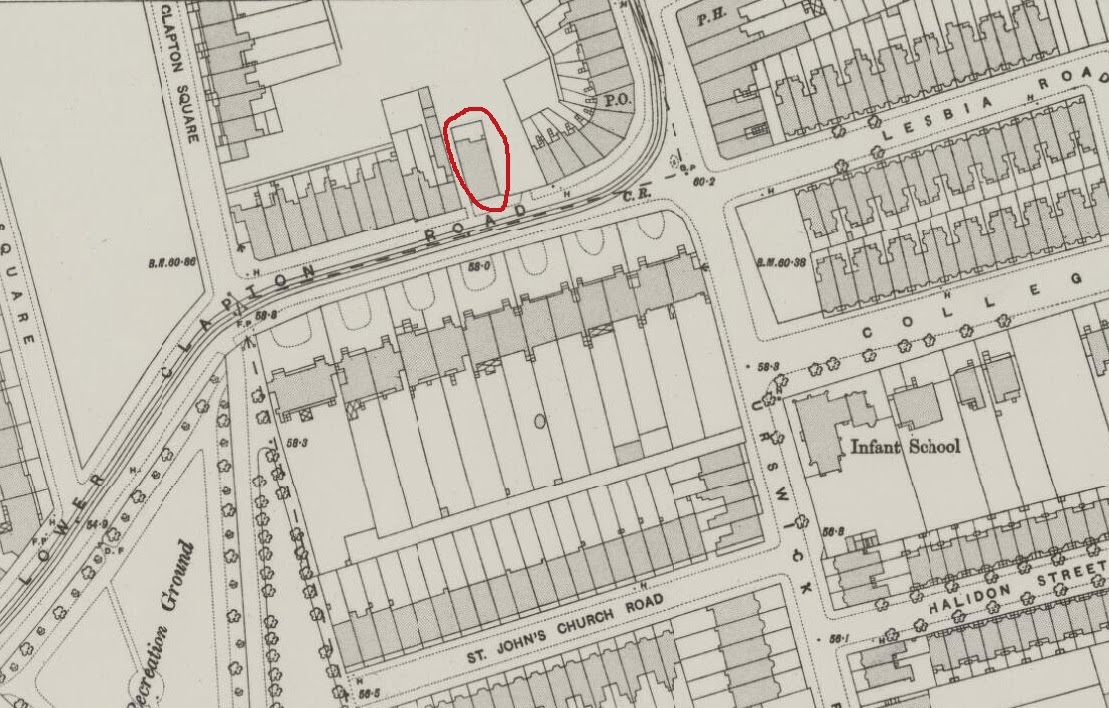
I'm pretty sure that I've identified where all this happened. The doctor's address was a big help. Plus there are/were few semi-detached housed on Lower Clapton Road. I've circled in red what I think was the beerhouse:


I think I can understand some of the cause of the argument. This part of was an odd mix in the 1890's. There were some grand older semis which were being surrounded by much smaller new terraced houses. The inhabitants of the different types of houses must have been from very different social classes. The doctor Mr. Smith lived in the posh houses on the south side of the street.

Here's what the pub looked like in the 1970's (I think, could be early 1980's). As you would expect, it was a Courage pub.


And here it is today - renamed Fitzgerald's and closed:


And this is what the posh side of the street opposite looks like:


There are several weird things about this case. That someone who described himself as a brewer's agent should complain about the noise of a beer engine. How he could hear across a road with a tram running down it I can't understand.

I'm surprised that Dr. Bremner was so unsupportive. He lived on the posh side, too, and must have been subjected to a similar level of nuisance. I suspect that it was his testimony that swayed the jury.

In the late 19th century, the middle classes made a big deal of women going to pubs and drinking. They were a bit obsessed by it, much the way the tabloid press is today. How often do stories about binge drinking show a woman sprawled drunkenly on the pavement?

I had to smile when Smith said that the mess in his garden was so bad that he couldn't hang on to servants. He didn't have to clear it up himself. I can sympathise with him on having his garden used as a urinal. Didn't the pub have a toilet? And why didn't he just lock the gates?

£150 is a huge amount to have to pay. The equivalent of several years' wages for most people.

Sadly, Lesbia Road no longer exists.

Tuesday, 21 January 2014

The distribution of James Hole tied houses

Having the addresses of all the Holes tied houses in 1968 means I can do all sorts of exciting things. Like see where they clustered geographically.


For those of you not conversant with English geography, Newark is in Nottinghamshire. But it's very close to the border with Lincolnshire. Go a few miles South or East and you're in a different county. It did have its advantages in the dark days of fixed closing times. Because pubs in Lincolnshire closed half an hour later at the weekend than those in Nottinghamshire. So many made a quick dash into Lincolnshire at 22:30 that they decided it was safer to have Newark adopt Lincolnshire's opening times.

James Hole tied houses per county
County No. of tied houses % of total
Derbyshire 7 3.38%
Leicestershire 26 12.56%
Lincolnshire 94 45.41%
Northamptonshire 10 4.83%
Nottinghamshire 59 28.50%
Rutland 7 3.38%
Warwickshire 1 0.48%
Yorkshire 3 1.45%
Total 207
Source:
Document ACC/2305/41/1 held at the London Metropolitan Archives

Which explains why Holes had more tied houses in Lincolnshire than Nottinghamshire: getting on for half the total. Nottinghamshire is quite a way behind with just over a quarter, followed by Leicestershire. Those three counties contained around 85% of Holes tied houses. In all, they had pubs in eight counties.

James Hole tied houses per town
Town No. of tied houses % of total
Boston 5 2.42%
Chesterfield 3 1.45%
Grantham (town) 3 1.45%
Grantham and surrounding villages 13 6.28%
Leicester 8 3.86%
Lincoln (town) 14 6.76%
Lincoln and surrounding villages 24 11.59%
Loughborough 5 2.42%
Mansfield 4 1.93%
Market Rasen 6 2.90%
Melton Mowbray 4 1.93%
Newark (town) 16 7.73%
Newark and surrounding villages 32 15.46%
Nottingham 5 2.42%
Oakham 5 2.42%
Peterborough 6 2.90%
Spalding 12 5.80%
Stamford 3 1.45%
Sutton-in-Ashfield 3 1.45%
Worksop 4 1.93%
Source:
Document ACC/2305/41/1 held at the London Metropolitan Archives

In terms of towns, Newark and Lincoln had the most Holes pubs, but there was a surprisingly large concentration around Spalding. Also quite a few pubs around Oakham in Rutland. Most surprising is how few there were in Nottingham itself, just 5. The only explanation I can think of for that is that the three Nottingham breweries (Home Ales, Shipstone and Hardy & Hansons) had the town sewn up between them.

The majority of pubs were in a radius of about 25 miles around the brewery. The most distant was in Rugby, about 60 miles away. It's a nice compact estate. However, it includes a lot of village pubs. Many in pretty small Lincolnshire villages. There are relatively few in large cities. There are no pubs on the coast at all, the closest being in Wainfleet.

Monday, 20 January 2014

London 4d and 5d Mild Ales in the 1920's

As promised, here are the two weaker classes of Mild Ales, 4d and 5d.

The 4d and 5d refer to the price, though as you see, there are some Milds that cost 6d a pint in the 5d table. I've really grouped them by gravity, as there are also quite a few I don't have a price for.

Some strange things happened to Mild in the first decades of the 20th century. Especially in London. Some of it seems to be the result of the price controls introduced in WW I. The usual trend is that when a style becomes popular, it begets multiple sub-styles. Pale Ale is a good example. First there was IPA, out of which PA and AK developed. But with Mild, the opposite happened. As Mild increased in popularity in the second half of the 19th century, the stronger varieties (XX, XXX and XXXX) gradually withered away. By 1914 the London brewers I have brewing records from were all down to just one Mild, X Ale.

Don't ask me why that happened. Possibly because, as the favourite of the  working classes, Mild Ale was expected to be cheap. Which, at 2d a pint, it certainly was. As its popularity rose, so its gravity fell. Eventually Mild and Porter ended up with the same gravity, unsurprising since they cost the same price.

Here's an illustration of that in table form:


Whitbread Mild and Porter gravities
Year Porter X Ale
1837 1060 1074
1840 1062 1076
1850 1061 1070
1860 1054 1067
1870 1050 1061
1880 1056 1061
1890 1057 1060
1900 1056 1056
1914 1053 1053
Source:
Whitbread brewing records held at the London Metropolitan Archives


In the latter years of WW I and the immediate post-war years, there was strict government control of brewing. Beers had controlled prices, based on their OG. Brewers, presumably trying to appeal to as broad a public as possible, started brewing Milds in several different price categories. It was simple enough, they just needed to parti-gyle beers of different gravities from the same worts.

When controls were lifted in 1921, brewers continued to make two or three Milds. Whitbread kept two, LA and X Ale. Though the sales of LA were much smaller than of X Ale and declined every year. It was the next war that killed off the weakest class of Mild. Restrictions on brewing materials and government controls forced down gravities so much, that there was barely a difference between Ale (the name usually given top the weakest type of Mild) and X Ale.

You can see that there were considerable differences in value for money amongst the 5d Ales. A few are only about 1030, while others are as high as 1037. Note that the 5d Ales mostly have a higher degree of attenuation than the 4d Ales. You might expect that brewers would have done the opposite, to try to get the highest possible ABV for the gravity. But I think they kept the FG relatively high to stop the beer tasting too thin. The FG's of the 4d Ales are very similar to those of the 5d Ales. And you have to remember that no-one knew the ABV of the beer they were drinking back then because brewers kept it secret.

None of the beers in the tables are particularly dark, but the darker ones (40 + something) are all 4d Ales. Camden XX is very pale. Mid-20's is a typical Bitter colour.

That's me done. Nothing left but the tables.

London 4d Mild Ales
Year Brewer Beer Price per pint (pence) FG OG colour ABV App. Atten-uation
1922 Camden XX 1030.2 25
1923 Camden XX 1029.9 25
1924 Camden XX 1006.1 1029.9 27 3.15 79.63%
1925 Whitbread LA 1004.0 1027.3 40 + 2 3.08 85.32%
1926 Buddon Bigg Ale 4 1030
1926 Isherwood Ale 4 1026.7
1926 Meux Ale 4 1032.1
1926 Whitbread LA 1005.5 1027.2 40 + 3 2.87 79.80%
1927 Buddon Bigg Ale 4 1028.8
1927 Fuller Ale 4 1036.5
1927 Isleworth Ale 4 1033.1
1927 Meux Ale 4 1028.7
1927 Truman Ale 4 1029.7
1927 Whitbread LA 1005.5 1027.2 40 + 4.5 2.87 79.76%
1927 Young & Co Ale 4 1029.6
1928 Barclay Perkins Ale 4d 4 1006.5 1028.8 34 2.95 77.43%
1929 Barclay Perkins A 1007.5 1028.7 38 2.80 73.83%
1929 Whitbread LA 1007.5 1027.1 40 + 1.5 2.59 72.29%
Sources:
Barclay Perkins brewing records
Camden Brewery brewing records document number ACC/2305/9/5 held at the London Metropolitan Archives.
Truman Gravity Book held at the London Metropolitan Archives, document number B/THB/C/252
Whitbread Gravity book held at the London Metropolitan Archives, document number LMA/4453/D/02/001
Whitbread brewing records document numbers LMA/4453/D/01/090, LMA/4453/D/01/091, LMA/4453/D/01/092 and LMA/4453/D/01/095 held at the London Metropolitan Archives.

London 5d Mild Ales
Year Brewer Beer Price per pint (pence) FG OG colour ABV App. Atten-uation
1922 Barclay Perkins 5d 5 1006 1030 3.12 80.00%
1922 Beasley MA 5 1010.4 1034 3.05 69.41%
1922 Camden XXX 1008.9 1036.8 32 3.70 75.94%
1922 Cannon Brewery X 6 1007.4 1036.4 3.77 79.67%
1922 City of London X 6 1005.2 1034.2 3.77 84.80%
1922 Courage 6d 6 1007 1034 38 3.51 79.41%
1922 Hoare X 6 1008.8 1034.3 3.31 74.34%
1922 Huggins X 6 1006.5 1038 4.10 82.89%
1922 Truman MA 5 1007.6 1029.6 2.85 74.32%
1922 Wenlock X 6 1005.8 1037.2 4.09 84.41%
1922 Whitbread MA 5 1004 1030.7 3.47 86.97%
1923 Camden XXX 1036.6 32
1923 Cannon Brewery X 6 1007.4 1034.9 3.57 78.80%
1923 City of London X 5 1007.3 1033.3 3.37 78.08%
1923 City of London X 6 1006.6 1035.6 3.77 81.46%
1923 Courage X 5 1007.5 1034.5 3.51 78.26%
1923 Forest Hill Brewery XX 1008.6 1037.1 3.70 76.82%
1923 Hoare X 6 1011.8 1034.3 2.91 65.60%
1923 Huggins X 6 1007.6 1037.6 3.90 79.79%
1923 Meux MA 5 1006.4 1028.9 2.92 77.85%
1923 Truman MA 5 1007.8 1030.8 2.98 74.68%
1923 Wenlock X 5 1007.6 1034.1 3.44 77.71%
1923 Wenlock X 6 1006.8 1037.3 3.97 81.77%
1924 Camden XXX 1008.9 1036.6 33 3.66 75.76%
1924 Cannon Brewery X 5 1031.7
1924 Courage X 5 1007.9 1036.9 3.77 78.59%
1925 Courage X 5 1007 1035.6 3.72 80.34%
1926 Cannon Ale 5 1031.6
1926 Commercial Brewery M.A. 1036.2
1926 Courage Ale 5 1037
1926 Wenlock Ale 5 1027.7
1928 Courage X 5 1006.5 1035 3.70 81.43%
1929 Courage X 5 1006.4 1037 3.98 82.70%
1929 Friary Ale 1010.6 1039 3.68 72.82%
1929 Hoare LA 5 1007.5 1034.1 3.45 78.01%
1929 Wenlock Ale 5 1037.2
Sources:
Camden Brewery brewing records document number ACC/2305/9/5 held at the London Metropolitan Archives.
Truman Gravity Book held at the London Metropolitan Archives, document number B/THB/C/252
Whitbread Gravity book held at the London Metropolitan Archives, document number LMA/4453/D/02/001
Whitbread brewing records document numbers LMA/4453/D/01/090, LMA/4453/D/01/091, LMA/4453/D/01/092 and LMA/4453/D/01/095 held at the London Metropolitan Archives.


xxxx

Sunday, 19 January 2014

Camden Brewery and world history

Weird things you find in the newspaper archive.  I netted this on one of my regular trawls.

I don't generally adhere to the idea of individuals determining history. But there are exceptions.

After reading this, I couldn't help thinking; "How would the world be now, had the crash been a little more serious?".


"MR CHURCHILL IN MOTOR SMASH.
Car Collides With Brewer's Dray.
Windows Smashed; Wheel Broken.

Mr Winston Churchill had a narrow escape this morning in a motor accident. His car had just left the War Office, and was proceeding down Whitehall towards Trafalgar Square, when a brewer's dray belonging to the Camden Brewery Company collided with it.

The wheel of the car was broken off, and the window nearest to where Mr Churchill was sitting was smashed.

Mr Churchill, although considerably shaken, was able to continue his journey in another car."
Evening Telegraph - Wednesday 25 February 1920, page 1.

Churchill would have been remembered as a failure. And there'd have been no Special Brew.

"What happened to the driver?" Andrew just asked me. He could have been killed. They wouldn't have thought his fate worth reporting.

Saturday, 18 January 2014

Watney's Mild Ale 1870 - 1929

Watney's and Mild Ale. A combination that's bound to pull the readers in. This will prove to Andrew that he's wrong. Everyone loves Mild. Especially Dark Mild.

Look, if I do a poll of those legally able to drink in this family, 100% like Dark Mild. Love it even. There - statistical proof, Andrew, that everyone loves Dark Mild. Not the beers we'll be looking at today were necessarily that dark. Many London Milds between the wars were half dark, about midway between true Dark Mild and Bitter. Though there were breweries, Barclay Perkins, for example, who produced differently coloured versions of the same beer by adding caramel at racking time.

I've so many examples of Watney's Mild, I'm spreading them across several instalments. And ridiculous numbers from other London breweries. Unsurprisingly, as Mild was an extremely popular style and an important product for most breweries. It's obvious that Whitbread and Truman would be very interested in what their competitors were up to with their Milds.

Just checked on Whitbread's Mild output in the 1920's and it's rather less than I would have expected - a little over 20% of the total. Here are all the numbers in nice table form.

Whitbread Mild output in the 1920's
LA X MA All Milds All beers
Year barrels brewed %age of total barrels brewed %age of total barrels brewed %age of total barrels brewed %age of total barrels brewed
1921 127,944 18.94% 53,930 7.98% 181,874 27% 675,647
1922 99,485 17.27% 35,893 6.23% 135,378 23% 576,118
1923 89,145 17.65% 22,939 4.54% 112,084 22% 505,097
1924 21,844 3.96% 101,221 18.35% 123,065 22% 551,616
1925 18,260 3.46% 103,961 19.69% 122,221 23% 527,977
1926 14,861 2.90% 104,632 20.41% 119,493 23% 512,528
1927 10,660 2.31% 93,752 20.28% 104,412 23% 462,250
1928 9,317 6.55% 113,934 23.33% 123,251 25% 488,357
1929 7,972 9.29% 130,609 29.42% 138,581 31% 443,888
Sources:
Whitbread Ale brewing records document numbers LMA/4453/D/01/086, LMA/4453/D/01/087, LMA/4453/D/01/088, LMA/4453/D/01/089, LMA/4453/D/01/090, LMA/4453/D/01/091, LMA/4453/D/01/093, LMA/4453/D/01/094, LMA/4453/D/01/095 and LMA/4453/D/01/096 held at the London Metropolitan Archives.
Whitbread Porter brewing records document numbers LMA/4453/D/09/113, LMA/4453/D/09/114, LMA/4453/D/09/115, LMA/4453/D/09/116, LMA/4453/D/09/117, LMA/4453/D/09/118, LMA/4453/D/09/119, LMA/4453/D/09/120, LMA/4453/D/09/121 and LMA/4453/D/09/122  held at the London Metropolitan Archives.


Before we go any further, I should emphasise that the beers were looking at here are the full-strength Milds. Beers usually called X Ale by the brewery. There were two other weaker classes which we'll examine in a later post. Whitbread LA and MA in the table above belonged to the weakest class of Mild.

Watney's Mild Ale 1870 - 1929
Date Beer Price per pint (pence) Acidity FG OG ABV App. Atten-uation
1870 Mild 2 0.19 1018.7 1063.76 5.85 70.67%
1922 X 7 1008.6 1042.1 4.36 79.57%
1922 X 7 1009 1042.5 4.36 78.82%
1922 X 7 1008.8 1042.8 4.42 79.44%
1922 X 7 1042.9
1922 X 7 1009 1044 4.55 79.55%
1922 X 7 1009.3 1046.3 4.82 79.91%
1923 X 7 1008.6 1038.6 3.90 77.72%
1923 X 6 1007.6 1041.1 4.36 81.51%
1923 X 6 1009 1041.5 4.22 78.31%
1923 X 7 1008.6 1042.6 4.42 79.81%
1923 X 7 1008.8 1043.8 4.55 79.91%
1923 X 7 1009 1044 4.55 79.55%
1923 X 7 1009 1045 4.68 80.00%
1923 X 7 1008.4 1045.4 4.82 81.50%
1924 X 6 1008.5 1044.9 4.74 81.07%
1924 X 6 1045.9
1924 X 6 1009.4 1046 4.76 79.57%
1925 X 6 1009.8 1044.9 4.56 78.17%
1926 X 6 1039.6
1926 X 6 1041.3
1926 X 6 1043
1926 X 6 1043.3
1926 X 6 1043.5
1926 X 6 1043.5
1928 X 6 0.06 1010.3 1041.3 4.02 75.06%
1928 X 6 0.07 1012.3 1043.3 4.02 71.59%
1928 X 6 1009.8 1044.8 4.55 78.13%
1929 X 6 0.08 1011.2 1043 4.13 73.95%
1929 X 6 0.07 1013 1043.1 3.90 69.84%
Sources:
British Medical Journal 1870, vol. 1, 1870, page 68.
Truman Gravity Book document B/THB/C/252 held at the London Metropolitan Archives.
Whitbread Gravity book held at the London Metropolitan Archives, document number LMA/4453/D/02/001.

You'll notice that I've thrown in a Watney's Mild from the 1870's. That gravity in the 1060's is pretty typical of X Ales of the period.

But how typical was Watney's Mild of London X Ales? Let's take a look shall we:

London Mild Ales in the 1920's
Year Brewer Beer Price per pint (pence) FG OG colour ABV App. Atten-uation
1922 Barclay Perkins 7d 7 1010 1042 4.16 76.19%
1922 Camden M 1010.5 1043.8 40 4.40 75.95%
1922 Charrington 7d 7 1010 1042 39 4.16 76.19%
1922 Lion Brewery X 7 1006.3 1041.2 4.55 84.71%
1922 Mann 7d 7 1010 1046.5 50 4.75 78.49%
1922 Meux X 7 1006.8 1041.3 4.49 83.54%
1922 Truman X 7 1011.1 1042.1 4.02 73.63%
1922 Whitbread X 7 1009.3 1043.3 4.42 78.52%
1923 Barclay Perkins X 7 1013.2 1044.7 4.08 70.47%
1923 Camden M 1009.4 1043.8 40 4.54 78.48%
1923 Charrington X 7 1009.6 1042.6 4.29 77.46%
1923 Lion Brewery X 7 1007.6 1042.1 4.49 81.95%
1923 Mann X 7 1010 1042.5 4.22 76.47%
1923 Meux X 6 1009.6 1042.2 4.24 77.25%
1923 Truman X 7 1010.2 1041.7 4.09 75.54%
1923 Whitbread X 1008 1042.1 40B + 1.5R 4.44 81.00%
1924 Barclay Perkins X 6 1011.7 1044.6 4.27 73.77%
1924 Camden M 1011.1 1043.5 45 4.29 74.52%
1924 Cannon Brewery X 6 1010.5 1039 3.69 73.08%
1924 Mann X 6 1007.3 1043.7 4.74 83.30%
1924 Smith Garrett X 6 1045.1
1924 Truman X 6 1014.1 1043 3.74 67.21%
1924 Whitbread X 1012.0 1042.7 40 + 5 4.06 71.87%
1925 Barclay Perkins X 6 1011.4 1044 4.23 74.09%
1925 Cannon Brewery X 6 1010.4 1039.8 3.81 73.87%
1925 Meux X 6 1004 1041.2 4.86 90.29%
1925 Truman X 6 1010.8 1041 3.92 73.66%
1925 Whitbread X 1010.0 1042.2 40 + 7 4.26 76.30%
1926 Barclay Perkins X 1010.8 1043.2 4.21 75.00%
1926 Charrington X 6 1043.4
1926 City of London X 6 1045.4
1926 Lion Brewery X 6 1042.6
1926 Mann X 6 1043.8
1926 Meux X 6 1043.8
1926 Smith Garrett X 6 1041.9
1926 Taylor Walker X 6 1045.7
1926 Truman X 6 1045
1926 Wenlock X 6 1042.8
1926 Whitbread X 1012.5 1042.6 40 + 13 3.99 70.68%
1927 Whitbread X 1014.0 1042.8 40 +13 3.81 67.27%
1928 Barclay Perkins X 1011.0 1042.9 42 4.22 74.35%
1928 Courage X 6 1010 1042.7 4.25 76.58%
1928 Hoare X 6 1012.2 1043.3 4.03 71.82%
1928 Mann X 6 1010.7 1045.6 4.53 76.54%
1928 Taylor Walker X 6 1013 1044.5 4.08 70.79%
1928 Truman X 6 1011.7 1042.7 4.02 72.60%
1928 Whitbread X 1012.5 1042.1 40 + 13 3.92 70.31%
1929 Barclay Perkins X 1012.5 1042.6 40 3.98 70.65%
1929 Hoare X 6 1011 1044.7 4.38 75.39%
1929 Mann X 6 1009 1044 4.55 79.55%
1929 Taylor Walker X 6 1014.7 1044 3.79 66.59%
1929 Truman X 6 1010 1042 4.16 76.19%
1929 Whitbread X 1012.0 1042.2 40 + 14 4.00 71.57%
Average 6.3 1010.5 1043.0 4.21 75.43%
Sources:
Barclay Perkins brewing records
Camden Brewery brewing records document number ACC/2305/9/5 held at the London Metropolitan Archives.
Truman Gravity Book held at the London Metropolitan Archives, document number B/THB/C/252
Whitbread Gravity book held at the London Metropolitan Archives, document number LMA/4453/D/02/001
Whitbread brewing records document numbers LMA/4453/D/01/089, LMA/4453/D/01/090, LMA/4453/D/01/091, LMA/4453/D/01/093, LMA/4453/D/01/094 and LMA/4453/D/01/095 held at the London Metropolitan Archives.

The answer is: pretty typical. The gravity was usually a point or two either side of the average of 1043. The attenuation was a tad higher than the average of 75%, but there were examples from other breweries with values over 80%. Looking at both tables, it does appear that the rate of attenuation was higher in the first half of the decade than the second.

A note on the colour values. 40 is the half dark colour, 40 + 13 is dark brown.

Next time we'll have a quick run through the other classes of London Mild in the 1920's.