Tuesday, 24 January 2012

Yet another new cover

Support independent publishing: buy this book on Lulu.

You can tell how desperate for dosh Lexie currently is. He's created a whole bunch of new covers (front and back). Lust for an iphone is the cause.

Buy "Decoction!" now!. remembering, of course, to enter this code that will knock 25% off the price until the end of January:


LULUBOOKUK305

Brothers - you know how competitive they are. Andrew and Lexie have been trying to get me to start a poll as to your favourite cover. I'm reluctant to give it a go. Too much like argument fodder.

William Younger adverts from the 1920's (part three)

More ads, you spoilt children. And here something vaguely intriguing happens. Probably not for everyone. But if you're still here after months and months of Scotland, it may tickle your curiosity.

The two previous sets of ads were from January to March 1923.  If you can think back that far, you'll recall Scotch Ale was being pushed as a warming winter bevvy. See how the ads had changed after the summer break:


"Good luck- Professor Coné, every day I get 'YOUNGER' and younger."

TO warm your blood and fortify your system on raw cold days, drink Wm. YOUNGER'S SCOTCH ALE. It produces a cheerful glow and a healthy stimulation which no other Malt Liquor surpasses. That is why it has so quickly become the favourite with all who enjoy a glass of GOOD Ale.

William Younger's
Scotch Ale
Brewed in Edinburgh
The beer with a bite in it.
Nottingham Evening Post - Thursday 13 December 1923

See the transformation? Gone are those smiling landlords in tights and foaming tankards. And there's Father William, rather natty in his tartan kecks and waistcoat. They're still making dubious claims about its stimulating and warming properties, but now it's in a modern setting.

Anyone know who the hell Professor Coné was? For once, Google was no help.


"Youth will be served you know. Father William"
"Yes. and if youth's wise It insists on being served with 'YOUNGER'S'"

There's a grand satisfaction in a glass of Wm. YOUNGER'S SCOTCH ALE.  It appeals to the palate as no other malt liquor does. Sparkling, sound and stimulating, it upholds the reputation of centuries enjoyed by Edinburgh Ales.

William Younger's
Scotch Ale
Brewed in Edinburgh
The beer with a bite in it.
Nottingham Evening Post - Thursday 27 December 1923
In addition to suspect health claims, they're now also encouraging the young to drink. That's another no-no according those stuffy modern rules. As jokes go, the opening conversation is even worse than my efforts. They don't get any better. A series of obvious puns on the name Younger, mostly.

I can't say that the bloke with the fag in his gob strikes me as looking particularly youthful. Then again, footballers of the day all looked about 50.


"You are old, father William." the youth did say—
"All nonsense, my lad I get 'YOUNGER' each day!"

For hundreds of years - since the monks of Holyrood first brewed - Edinburgh has been famous for her Ales and THE Edinburgh Ale of  to-day is that wonderful Malt Liquor Wm. YOUNGER'S SCOTCH ALE. Pure Hops and Malt - brewed with the famous Edinburgh Water.

William Younger's
Scotch Ale
Brewed in Edinburgh
The beer with a bite in it.
Nottingham Evening Post - Thursday 24 January 1924

This and the previous advert emphasise the good reputation that Edinburgh had long had for the quality of its Ales. Though I suppose the "brewed in Edinburgh" tagline had already been doing that. And where is Younger's brewed now? Bedford. I doubt they'd give that much prominence in an advert.

There's that pure malt and hops claim again. Lies. Worse, damn lies. How could they get away with that? 40% maize grits, that's what Younger's beers were really brewed from in the 1920's.

The bloke in the weird clothes with the pitchfork has me puzzled. Who the hell is he supposed to represent? He reminds me of Jack from a panto of Jack and the Beanstalk.Either that or an armed morris dancer.

There's quite a bit more of this. Younger's advertised regularly and rarely repeated ads. Enough to keep me going for weeks yet.

Monday, 23 January 2012

Another new cover

Lexie has been busy over the weekend. Not totally voluntarily. But once he'd finished, I did untie him. That's the sort of caring father I am.

Despite the duress, his work was top-notch. As you can see from the image to your right. I'm very happy with it. Only half a dozen more and Lexie will be able to roam free whenever he likes.

Buy "Brown Beer!" now. And let Lexie have a childhood.

And don't forget, until the end of January you can get 25% off with this discount code:

LULUBOOKUK305
 

England vs Scotland, part 2e: the 1840's

It's finally bye bye to Mild in this interminable series. Something completely different thistime: Pale Ale.

I'll start with a caveat. There are only seven beers from just two breweries. A rubbish sample size. I would be very reluctant to draw too much in the way of conclusions from this handful of Pale Ales.

That fact in itself tells us something. Of the three large London breweries for which I have long sets of brewing records (Whitbread, Truman and Barclay Perkins) only Truman brewed a Pale in the 1840's. As I've mentioned several times before, the Scots were ahead of the game when it came to Pale Ale. That was a big factor in the success of Edinburgh and Alloa brewers: anticipating the demand for Pale Ale.


Date Year Brewer Beer Style OG FG ABV App. Atten-uation lbs hops/ qtr hops lb/brl boil time (hours) boil time (hours) boil time (hours) Pitch temp max. fer-ment-ation temp length of fer-ment-ation (days)
23rd Oct 1845 Truman Pale Ale Pale Ale 1066.2 1017.5 6.45 73.64% 20.0 5.92 61 76.5 10
16th Mar 1846 Truman Pale Ale Pale Ale 1066.8 1019.1 6.30 71.37% 25.0 7.44 60 77 12
Average 1066.5 1018.3 6.38 72.50% 22.50 6.68 60.5 76.8 11.0
10th Jan 1849 Younger, Wm. Export Pale Ale 1061 1018 5.69 70.49% 20.00 5.41 1 2 56 65 6
24th Jan 1849 Younger, Wm. Export Pale Ale 1062 1015 6.22 75.81% 20.00 5.83 1.33 1.33 56 66 7
3rd Apr 1849 Younger, Wm. Export Pale Ale 1062 1014 6.35 77.42% 20.00 5.68 1.17 1.17 56 67 8
14th Nov 1849 Younger, Wm. Export Pale Ale 1063 1012 6.75 80.95% 20.00 5.95 1 1 56 67 9
7th Jun 1849 Younger, Wm. Export Pale Ale 1071 1017 7.14 76.06% 20.00 6.32 1 55 66 8
Average 1063.8 1015.2 6.43 76.15% 20.00 5.84 1.10 1.38 55.8 66.2 7.6
difference -2.7 -3.1 0.05 3.64% -2.50 -0.84 1.10 1.38 0.00 -4.7 -10.6 -3.4
Sources:
Truman brewing record document number B/THB/C/127 held at the London Metropolitan Archives
William Younger brewing record document number WY/6/1/2/3 held at the Scottish Brewing Archive

Rather than go through point by point as usual, I'll restrict myself to more general comments. The beers are generally pretty similar. Truman's has a slightly higher OG, but Younger's is a bit more attenuated, leaving the ABV almost identical. That's a bit of a turnaround. So far in my comparisons the London beers have always been the most attenuated. I can't see any huge difference in the hopping. All the beers in the table contain a shitload. Considering how similar the beers are in other respects, the difference in fermentation temperatures is striking. The maximum temperature of Truman's beers averaged over 10º F more. Yet weirdly, the Younger's beers fermented for more than three days less on average.

Whatever the differences with Truman's, Younger's Pale Ale looks the part for the mid-19th century: moderate gravity, quite high attenuation, loads of hops. And nothing at all like the cliché of Scottish beer.

Sunday, 22 January 2012

An Irish tied house

What a real treat - a post that isn't about Scotland. True, I did find it when looking for stuff on Scotland, but it's most definitely about Ireland.

Court cases and tied houses. Two topics dear to my heart.

"EIRE HIGH COURT.

Cork Brewery Appeal.—Trading Agreement in Question. In the High Court of Eire last month an important case was heard before the Chief Justice, Mr. Justice Fitzgibbon, and Mr. Justice Murnaghan. An appeal was made on behalf of Andrew O'Donovan, publican. 22 George's Quay, Cork, from a judgment of the High Court, dismissing his appeal from a decision of Circuit Judge O'Donnell at Cork, granting an injunction in favour of James J. Murphy and Co., Ltd., brewers, Cork, restraining Mr. O'Donovan from selling on his licensed premises stout or porter other than the products of Messrs. Murphy and Co., Ltd.

The case for Messrs. Murphy and Co., Ltd., was based on a trading agreement of May 23rd, 1935, in respect of the licensed premises, of which originally they were lessors by a lease of December, 1893, which provided that Mr. O'Donovan should deal exclusively with them for porter and stout. The parties to the agreement were Messrs. Murphy and Co., Ltd., Mr. O'Donovan, and a former licensee who had transferred his interest in the premises to Mr. O'Donovan.

It was submitted on behalf of the appellant that the agreement was illegal and void, as being in unreasonable restraint of trade ; and that it was void in so far as it provided that the licence should be in the custody of Messrs. Murphy and Co., Ltd., and sought to create in them an interest in the licence.

The Court, without calling on counsel for the respondents (Messrs. James J. Murphy and Co., Ltd.), unanimously dismissed, with costs, the appeal.
"The Brewers' Journal 1938", June 15th 1938, page 303.
Unreasonable restraint of trade? Sounds like a perfect description of the tied house system. That's the whole point of it, keeping your competitors' beer out of pubs. I'm not surprised that the court ruled in favour of Murphy.

It's a peculiarity of Irish brewing that only in Cork did breweries - Murphy and Beamish & Crawford - build up estates of tied houses. I've seen it argued that the Cork brewers owed their survival to this. Elsewhere Guinness bought or bullied their way into pubs driving out competitors. Not sure if it's true, but it is striking that the only decent-sized Porter breweries to survive (other than Guinness, obviously) were in Cork.

Note that the tie agreement is only for Porter and Stout. There's a reason for that. It's all Murphy brewed. Though by the time of this dispute their Porter was all but dead.

Saturday, 21 January 2012

New cover for Porter!


Support independent publishing: buy this book on Lulu.
Sometimes, just very occasionally, I pay attention to readers' comments. It was mentioned a while ago that the cover of "Porter!" wasn't quite up to the standard of my other books. Then Lexie asked me yesterday if I had any jobs for him to do . . . . .

I'm proud to announce the new Lexie cover to "Porter!". Sort of like the old one, but different. And remember, until the end of the January you can buy "Porter!" at a discount of 25%! All you need to do is enter this discount code:

LULUBOOKUK305

Thank you Lexie.

Proprietary yeast

Yeast. A vital element in producing beer. Larger brewers carefully nurture their strain, coddling it like a small child. Small brewers carefully choose the yeast most suited to each of their beers. In the past they were much less precious about yeast.

In London brewers' logs I occasionally come across references to other brewers yeast. Reid using Meux yeast. Or Truman using Whitbread's. The occasional reference is all it is. London brewers did borrow yeast from others, but not that often.

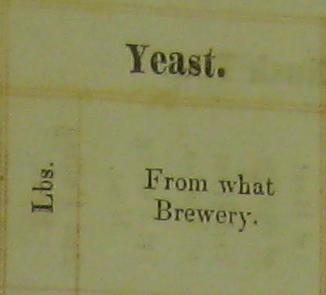
Go North to Edinburgh and the situation is very different. Just looking at a blank sheet in William Younger's brewing records tells you they brought in yeast more often: there's a special column to specify from which brewery:


Here's part of a Younger's log from December 1851. It covers a period of 9 days, in which you can see that they used 4 different breweries' yeast:


Haldane, Ritchie, Drybrough, and Jeffrey were the yeast suppliers. On other pages there are several others: Blair, Campbell, Bernard. I can't find any beer that was brewed with their own yeast. The Usher's logs I have show use of other brewers' yeast, though not as promiscuously as at Younger.

This page is typical. Yeast from several different breweries used apparently randomly. You'll find the same beer brewed on consecutive days but with a different yeast. Sometimes yeast from two different breweries is used for one batch. There's no rhyme or reason to it.

What does this tell us? That Scottish brewers didn't worry about having their own yeast strain. They seem happy to use any healthy yeast that happened to be to hand. Why was that? Did the yeast have so little impact on the flavour profile of the finished beer? Were all the strains of Edinburgh brewers broadly similar? Or were punters used to a bit of variation in flavour?

Or do modern brewers that make too big a deal of the strain of yeast they use? I'll have to try asking one.

Friday, 20 January 2012

William Younger adverts from the 1920's (part two)

Back with the Younger's ads. I thought you'd enjoy them. If only for the pictures. And the bullshit copy.

There's something interesting that happened during 1923. But I'll tell you about that in the next instalment of this fascinating series.

Here's the first:

 Nottingham Evening Post Friday 19th January 1923.

"Since Beer was Brewed
in this island of ours none better has ever been brewed than Wm. Younger's Scotch Ale. This honest product of good malt and hops is today in greater favour than at any period in it long history because its soundness, its flavour, and its quality are those in which our forefathers delighted. Cheering, stimulating, warming - it is just the right winter drink for Britons.

William Younger's
Scotch Ale
Brewed in Edinburgh

The beer with a bite in it. "

That's definitely No. 3 on the barrel again. I'm certain now that's the beer being advertised. Here they go with the dodgy claims again - cheering, stimulating, warming. Maybe they'd get cheering past the Advertising Standards people. Maybe. Absolutely no way they could say stimulating.

And there's that claim about pure malt and hops again. I happen to have Younger's brewing records from 1922 and 1923. Let's see, there's a No. 3 that was brewed 6th October 1922. Was it pure malt and hops? Like buggery. Of the 28 quarters used in brewing 11.5 were maize grits. That's a long, long way short of pure. Admittedly, it didn't contain any sugar.

Nottingham Evening Post Friday 16th March 1923.

"To the Last Drop
You will thoroughly relish that wonderfully fine ale - Wm. Younger's Scotch Ale. As a winter drink it is ideal: stimulating, warming and nourishing. Its fragrance and flavour tell the tale of pure malt and hops and ideal brewing. The proof is that the demand is steadily increasing everywhere. You'll be right if you order

William Younger's
Scotch Ale
Brewed in Edinburgh

The beer with a bite in it."
I'm convinced these are both Elizabethan dress. Bizarre. I suppose they were just trying to conjure up pictures of merry old England.

Pushing Scotch Ale as a winter drink is very much a theme. And sure enough, all the adverts appeared in the colder months of the year. In London, Younger's No.3 occupied the same slot on the bar as Burton, which was also more of a winter than a summer drink.

One thing has been puzzling me. Where was this No. 3 sold in Nottingham? The lack of bottles in the adverts suggests that it was a draught beer (though I could be wrong about that). Whose pubs was it sold in? Or was it just in the free trade? My recollections of Nottingham are of wall to wall tied houses. So many questions.

Thursday, 19 January 2012

England vs Scotland, part 2d: the 1840's

The end of the Milds is in sight. Or rather, here already. I'm already dreading trawling through the next set of William Younger logs. It's about 20 hours of work. Just as well I don't have a family.

This set is in the range 1100 to 1120º. Imperial Mild, you could call it. Really there just be a fourth group, 1120 and above. Except there are no London beers of that strength. To be honest, I wasn't totally sure how to classify the stronger shilling Ales from Younger. The weaker ones are definitely Milds. But what about 140/- and 160/-? In later years there's a clear pattern. Shilling Ales are the versions for bottling. The draught versions of the same beers were either X, XX, XXX Mild Ales and the stronger ones Stock Ales: XS, XXS, etc. We'll have to see. I may throw in some of the 140/- and 160/- Ales into the Stock Ale comparison, too.

Let's begin with the numbers:

Date Year Brewer Beer Style OG FG ABV App. Attenuation lbs hops/ qtr hops lb/brl boil time (hours) boil time (hours) boil time (hours) Pitch temp max. fermentation temp length of fermentation (days)
20th Apr 1841 Whitbread XXX Mild 1101.4 1030.7 9.34 69.67% 7.45 3.11 1.5 2 3 60 78 3
25th Aug 1840 Truman XXX Ale Mild 1104.7 1029.9 9.89 71.43% 7 4.07 60.5 75.5
14th Jul 1845 Truman XXX Ale Mild 1105.5 1031.0 9.86 70.60% 10.0 5.94 58.5 80 9
11th Jul 1840 Truman XXX Ale Mild 1106.1 1031.9 9.82 69.97% 9 4.97 59 75 11
12th Jan 1846 Truman XXX Ale Mild 1106.6 1031.9 9.89 70.13% 7.0 3.38 58 80.5 11
3rd Sep 1845 Truman XXX Ale Mild 1107.2 1034.3 9.64 67.96% 11.0 5.34 58.5 82 9
17th Sep 1840 Truman XXX Ale Mild 1110.5 1035.2 9.97 68.17% 9 5.63 58.5 77 8
8th Sep 1840 Truman XXX Ale Mild 1112.2 1037.9 9.82 66.17% 10 6.41 59 72 9
Average


1106.8 1032.9 9.78 69.26% 8.81 4.86 1.50 2.00 3.00 59.0 77.5 8.6
17th Feb 1848 Younger, Wm. 100/- Ale 1100 1039 8.07 61.00% 3.87 2.00 1.08 1 55 67 8
6th Jul 1848 Younger, Wm. 100/- Ale 1100 1034 8.73 66.00% 7.00 3.42 0.92 58 72 10
12th Sep 1849 Younger, Wm. 100/- Ale 1100 1041 7.81 59.00% 7.00 3.33 1 0.92 55 70 9
5th Oct 1848 Younger, Wm. 100/- Ale 1101 1039 8.20 61.39% 4.52 2.16 1 59 70 9
6th Oct 1848 Younger, Wm. 100/- Ale 1101 1039 8.20 61.39% 4.65 2.25 1 1 57 69 9
29th Mar 1849 Younger, Wm. 100/- Ale 1101 1030 9.39 70.30% 10.00 5.14 1.25 1.25 54 68 11
20th Sep 1849 Younger, Wm. 100/- Ale 1101 1039 8.20 61.39% 8.00 4.00 1.08 1.08 56 71 11
11th Oct 1848 Younger, Wm. 100/- Ale 1102 1036 8.73 64.71% 4.52 2.22 1 1 55 69 8
6th Sep 1849 Younger, Wm. 100/- Ale 1102 1035 8.86 65.69% 8.00 3.87 1 1 55 69.5 9
10th Sep 1849 Younger, Wm. 100/- Ale 1102 1039 8.33 61.76% 7.00 3.39 1 0.92 56 70 10
25th Sep 1849 Younger, Wm. 100/- Ale 1102 1039 8.33 61.76% 6.00 3.00 1.08 1.08 55 71 10
13th Nov 1849 Younger, Wm. 100/- Ale 1102 1038 8.47 62.75% 5.00 2.63 1.08 1.17 55 69 10
23rd Mar 1847 Younger, Wm. 120/- Ale 1103 1040 8.33 61.17% 5.00 2.59 1 1.17 54 70 10
6th Jan 1849 Younger, Wm. 100/- Ale 1103 1039 8.47 62.14% 4.69 2.27 1 1 54 68 10
17th Jan 1849 Younger, Wm. 100/- Ale 1104 1039 8.60 62.50% 4.19 2.13 1 1 57 68 9
25th Jan 1849 Younger, Wm. 100/- Ale 1104 1040 8.47 61.54% 4.10 2.00 1.08 54 68 10
28th Mar 1849 Younger, Wm. 100/- Ale 1104 1041 8.33 60.58% 5.00 2.50 1 1 54 68 10
5th Jun 1849 Younger, Wm. 100/- Ale 1105 1037 9.00 64.76% 8.00 4.07 1.08 1.08 55 69 10
6th Apr 1849 Younger, Wm. 100/- Ale 1106 1040 8.73 62.26% 5.00 2.54 1 54 68 10
21st Apr 1848 Younger, Wm. 120/- Ale 1111 1040 9.39 63.96% 9.02 5.09 1.17 1 54 71 9
19th Mar 1847 Younger, Wm. 140/- Ale 1112 1046 8.73 58.93% 10.00 6.49 0.83 54 72 10
12th Mar 1847 Younger, Wm. 140/- Ale 1112 1046 8.73 58.93% 11.88 6.49 1 54 71 10
18th Feb 1848 Younger, Wm. 120/- Ale 1112 1045 8.86 59.82% 4.17 2.70 1 58 61 10
16th Mar 1848 Younger, Wm. 120/- Ale 1112 1044 9.00 60.71% 5.00 3.43 1 54 70 9
10th Oct 1848 Younger, Wm. 120/- Ale 1112 1046 8.73 58.93% 5.00 3.28 1.17 1.66 56 71 10
1st Jun 1849 Younger, Wm. 120/- Ale 1113 1038 9.92 66.37% 11.00 6.60 1.17 54 69 10
19th Mar 1847 Younger, Wm. 140/- Ale 1114 1046 9.00 59.65% 10.00 6.15 0.83 56 72 10
30th Mar 1849 Younger, Wm. 120/- Ale 1114 1041 9.66 64.04% 10.00 5.75 1.17 1.17 53 71 10
19th Jan 1849 Younger, Wm. 120/- Ale 1115 1047 9.00 59.13% 5.50 3.38 1 54 72 10
5th Apr 1849 Younger, Wm. 120/- Ale 1115 1040 9.92 65.22% 13.58 6.36 1.08 55 69 10
30th May 1849 Younger, Wm. 120/- Ale 1115 1045 9.26 60.87% 11.00 6.77 1.08 54 69 10
21st Sep 1849 Younger, Wm. 120/- Ale 1115 1047 9.00 59.13% 7.92 5.00 1 56 72 9
8th Jan 1849 Younger, Wm. 120/- Ale 1116 1043 9.66 62.93% 5.50 3.38 1 55 71 11
26th Sep 1849 Younger, Wm. 120/- Ale 1116 1048 9.00 58.62% 6.00 3.66 1 56 72 9
26th Jan 1849 Younger, Wm. 120/- Ale 1117 1045 9.53 61.54% 6.00 3.69 1.08 53 72 11
Average


1107.5 1040.9 8.82 62.02% 6.95 3.82 1.04 1.08 0.00 55.1 69.7 9.7
difference


0.8 8.0 -0.96 3.10% -1.86 -1.04 -0.46 -0.92 -3.00 -3.9 -7.8 1.2
Sources:
Truman brewing record document numbers B/THB/C/122 and B/THB/C/127 held at the London Metropolitan Archives
William Younger brewing record document number WY/6/1/2/3 held at the Scottish Brewing Archive
Whitbread brewing record document number LMA/4453/D/01/004 held at the London Metropolitan Archives
Hopping rates continue to confuse. At first glance it looks clear: Younger's beers have on average 1 lb less per barrel. But it's not that simple. The four most heavily hopped beers are all from Younger. As are the 12 least heavily hopped. There's a great deal of variation. The differences between even one specific type are large. One 100/- has over 5 lbs per barrel, another just 2 lbs. Part of it appears seasonal - i.e. the hopping is heavier in the summer - but that doesn't explain all the variation. You're going to want some sort of conclusion, aren't you? Bit tricky. How about this: in the 1840's Younger's Imperial Milds were sometimes more heavily hopped and sometimes less heavily hopped than equivalent London beers.

With only one London beer to compare to, there's not much I can say about boil times. Except that the Scottish ones are extremely short, with none longer than an hour and a quarter and many under an hour. No comparison, but a conclusion of sorts: in the 1840's Younger's Imperial Milds had very short boils.

Fermentation temperatures have shown one of the clearest patterns so far. It's repeated here. The pitching temperature of Younger's beers was on average 4º F cooler. The maximum fermentation temperature was almost 8º F cooler. Excuse me if you've heard this before:  in the 1840's Younger's Imperial Milds were fermented cooler than equivalent London beers, on average around 7 - 8º F.

There's no surprise with the length of fermentation, either. Just over a day longer on average for Younger's beers. Though, if you remove the Whitbread beer which had a much shorter fermentation time than any other beers in the class, the difference is only 0.2 days. Or bugger all in layman's language. So: in the 1840's Younger's Imperial Milds took marginallly longer to ferment than equivalent London beers.

I was surprised by the average attenuation of Younger's beers in this class. It's the highest of any of the groups of Younger's Milds. I'd have expected it to be the other way around. The result is that the gap with London Milds is much smaller, just under 5% or about half what it was for the other groups. With lower attenuation, it's no shock than the ABV of the Younger's beers is lower. About 1% ABV, on average. Which is why I'm slightly confused by the difference in FG - a full 8 points. Or nearly 25%. It's a fair comparison, too, as the average OG is very similar for both groups. I'm starting to sound like a broken record: in the 1840's Younger's Imperial Milds were slightly less attenuated and lower in alcohol than London Milds of a similar gravity.

Mild finally done, where to go now? As I'm working alphabetically through the styles, it'll be Pale Ale.