Thursday, 15 November 2007

Things I like about the BJCP style guidelines

I've gone for another easy one today.

There's so much good about the BJCP style guidlines, that it's difficult to know where to start. Here's a try.


  1. They start at number 1.
  2. They are innovative and forward-facing. (I got that one from "Management bullshit for idiots".)
  3. They cement the beer world in the mid-1970's - just when I started drinking.
  4. They inspire insights like "this beer is too roasty for a Porter".
  5. They don't mis-define Czech lager styles. They don't realise they exist. I promise not to tell them about them if you don't.
  6. When I'm bored at work, browsing them provides endless amusement.
  7. They are imaginative. They've invented whole families of beer styles. Think Scottish Ales.
  8. No-one in Belgium pays the slightest attention to them.
  9. They combine Belgium and France (styles 16 A to E) - something the Congress of Vienna was determined to prevent.
  10. They finish at number 28, having used all the integers from 1 upwards.


Tears of laughter prevent me listing any more. Tears, at least. Just the boring sort: tears of despair.

Wednesday, 14 November 2007

Going to America

It was 22 years ago today. (Or thereabouts. My visa is dated October 23rd 1985.)

The papers for my visa application arrived while I was in Brno. (The most important four weeks of my life were spent on a summer school learning Czech in Brno. I improved my Czech enough to be able to read Kundera, had more money than I could spend, met lifelong friends and found my wife.) J1 visa, I think. Some fiddle it was, thought up by the dodgy agency I worked through. A work experience visa it was supposed to be. We were just plain old ordinary wage slaves. I hope they don't decide to come after me. The agents, I mean. The mafia are pussycats compared to contract agencies.

October 28th 1985. I've just inspected my old passport more closely. That was the exact date I arrived in America for the first time. In Newark. How aposite.

My first beer in America - I can remember it crap - was an Amstel Light, in some soulless midtown bar. A beer that was totally immemorable yet I still recall what it was.

In the 1980's, the British were the IT job tourists. BONY bought in a gaggle of us.

I lived on Staten. In a neighbourhood as dull as dull can be. Where the buses do run, but the streets have no pavements. The looks I got, walking home with my shopping. The Recovery Room was one of my local bars. We played darts there. Me and some of my British workmates. The beer was crap. I drank bottled Heineken.

Darts. British blokes. Beer. Manhattan. In the mid-1980's this spelled "Manhattan Brewery" . Not literally. Obviously.

Our office was downtown. If I hadn't spent the last 30 years boozing every day, I could tell you the exact address. Washington Street, possibly. We could walk to the Manhattan Brewery. Which is exactly what we did. At least once a week. Playing darts was the general excuse. I was glad to have the chance to drink something handpulled.

One night, after the darts, I got to talk to the brewer. I was impressed. He was knowledgeable and enthusiastic. I wonder what happened to him?

This was my first going to America. More happened.

Sunday, 11 November 2007

Parenting a beer obsessive

I never got to share a beer with my dad down the pub. He died when I was 14. It's one of my greatest regrets. Maybe that's why I'm so keen on taking my own kids to the pub.

Mum and I shared plenty of pub time. From Montego Bay to Sydney. But I only ever saw her tipsy once - after drinking rum punch in Kingston. Tea was her drink of choice. Rum and black, on a special occasion.

Being the mother of a beer obsessive isn't easy. I should know. I dragged my poor mother around so many smoky pubs. She rarely grumbled, even though her asthma left her gasping for breath. "Ronald, don't you think you've had enough?" That was her catchphrase. "Just one more, mum, then we can go." That's what I want to say to her now: "Just one more, mum, before you go."

I didn't get that last beer with her. But I'll drink every beer now as if it were that one lost last beer with mum. This sip's for you, mum. I'll be thinking of you every time I lift a glass. And when my feet become unsteady, I'll hear your gently chiding voice: "Ronald, don't you think it's time to go?" And you'll be right, as you always were.

I don't believe in god. Or heaven. But if there's one person whe deserves heaven, it's my mum. I hope I'm wrong and she's sitting there now, smiling down at me. And saying "Ronald, ............"

Friday, 9 November 2007

Parenting tips for beer obsessives

Today is a momentous day. It's the day I start working through my list.

I'm glad I came up with the idea. It means I don't have to worry about thinking up themes or titles for a few weeks. After five months and 177 posts, all the inspirational fluid has been drained from my brain. Of course, the problem has just been displaced. I still have to think up the words to fit the title.

Let's start with an easy one: parenting tips for beer obsessives. I like to think that I have a gtreat deal of useful personal experience in this area.


  1. Catch them young. I started taking my kids to the pub before they could walk. That wasn't too bad. The trouble started when they could walk. Andrew had a habit of running off down Gravenstraat when I took him to Cafe Belgique. At first, it freaked me out. Would he disappear into the crowds? I used to chase after him down the street, until I realised that was what he wanted. Then I just used to let him run. He always came back eventually. As he became older and lazier, gave it up.

    At 9 and 11 my kids are completely used to pubs. And beer festivals. I don't have to drag them along any more - they come willingly. Sometimes they are even keener than me. "Can we go to the pub please, dad?" What more beautiful sentence is there in the English language? It makes all the initial effort seem so worthwhile.

  2. Buy them food. Food is a great way of bribing kids. It's even more effective than money. Something that takes a while to eat is best. They longer they're chomping away, the more time you get to drink undisturbed. Germany is good. The Brauhauser of Cologne and Dusseldorf always have chips and sausages. Amsterdam pubs don't offer much in the way of food, but there's always a bakery close by stuffed with doughnuts and eclairs. As are the kids after an hour or two.

  3. Talk to them. Not paying attention to your kids in the pub is just asking for trouble. That's why I usually don't meet with anyone else while they're along. When they realise that the pub is a good place to get quality dad time without him being distracted by his computer, they get much enthusiastic about pub visits.

  4. Go to the toyshop first. It gives them something to fiddle with while you sneakily order a jenever to complement your beer. Though lego is unsuitable. I know. I've been down on my hands and knees searching for an errant piece amongst the fag ends.

  5. Let them try your beer. Kids don't like the taste of beer, so they'll soon give up asking. Well, all kids except Alexei. He got a real taste for Tripel Karmeliet when he was a toddler. Though I never let him drink more than half a glass. I have a 50 euro bet with Andrew that he'll drink a whole glass of beer before his 18th birthday. We both think that we're onto a sure thing.

  6. Teach them how to play spoof. It's a great way of keeping them entertained that costs nothing and needs no special equipment. It doesn't interfere with your drinking much, either.

  7. Drink strong beer. Then you don't have to spend as long getting to the point where you don't care what they do. Or go in for two fisted drinking - strong beer plus jenever. That gets you to the don't care zone quicker than you can say "kidnapped toddler".

  8. Don't live in Britain. Trying to work out which pubs in Britain allow kids is a nightmare. The majority don't. Thankfully, I live on the Continent and can take my kids along to any pub.


As you can see, I've managed to seamlessly combine beer drinking and responsible parenting. "I'd rather drink a beer than be father of the year." That's my motto.

Thursday, 8 November 2007

More Guinness

Why two posts today? Because I forgot to publish yesterday's ("How can I be sure?"). And you can never learn too much about 19th century Guinness. At least that's what I reckon.

These are the gravities of the main Guinness products in the 1800's. The weakest - Porter - is considerably stronger than today's Extra Stout. FES, on the other hand, is pretty much unchanged since 1860.


You may have heard me dream of Guinness producing a bottle-conditioned version of Special Export, the 8% version that's sold in the Benelux. I was pained to discover that this was the first type of Guinness to be pasteurised, way back in 1930. Guinness paid for a pasteuriser to be installed in John Martin's bottling hall. Given that strong beers are still usually bottle-conditioned in Belgium, this seems slightly odd.

I would start a campaign for Guinness to make a naturally-conditioned version of FES or Special Export. Either would be wonderful in this form, I'm sure. But I doubt Diageo would be interested. They're too busy launching slightly tweaked versions of draught Guinness. It's a lack of imagination and daring typical of large brewers.

Wednesday, 7 November 2007

How can I be sure?

How can I? Be sure of what? A fair way to eliminate the surplus titles for my list. Alphabetically? By word count? By character count? Randomly?

It's going well today. I nearly have my quota of question marks. A few crap jokes and Stalin references and this will be a regulation post. (I do have my rules, you know. I've determined the exact number of characters in each post for the next three years. It's based on a complex mathematical formula. I won't bore you with the details, but it involves my shoe size, the phase of the moon and the public bar price of Tetley's Mild on the same date 25 years previously. The punctuation (number and type of) is calculated from the day number in the Babylonian calendar and the distance between earth and Io on that day. That's why my sentences are so short. The algorithm generates far too many full stops.)

All the packages from Britain I'd been waiting for arrived yesterday. The 2005 Statistical Handbook of the British Beer and Pub Association (one of my favourite books), the issues of Private Eye I reordered because someone here couldn't be arsed to deliver them the first time, "The Tetley Brewery, Leeds" and a July issue of Private Eye. The post here is very post-modernist. The last four issues of Private Eye have been dated (in order of delivery) October, July, September, July. I wonder what happened to those from August? (That's all the questions marks for today. I now either have to be assertive or to do some re-editing.)

Tomorrow. I'll start using titles from the list tomorrow. If I can think of a way of weeding out nine. Pin. That's it. I'll get the kids to stick a pin into a printed list of the titles. The ones they hit, follow William Patrick Hitler into obscurity.


. . . . .

. . . . .

. . . . .

. . . . .

Right. Andrew's pin has decided. The lucky titles are:

Brettanomyces: The Musical
Backpedalling
Floaters (The Good Kind)
Floaters (The Bad Kind)
A Day Without Details
Going to America
Alternative grains
Oettinger
out of the can
warm piss
Base malts now and then
Things I like about the BJCP style guidelines
Parenting tips for beer obsessives
Fruit and vegs that should not be used in beer
Bubbles in my Beer
Dutch Bar Snacks (the "bitterballs" question)
Dutch v. Belgian Oud Brun
How To Shop For Beer In Holland
Archeological Evidence of Long Term Beer Aging Pre-1850


These are the unhappy losers:

It Was Like That When I Found It
Debbie Does Den Haag
Average Maltsack Corn Counts, 1857-1913
Double IPA: say it one last time
Why Grimbergen blonde is a good beer
The Reinheitsgebot is a joke
Belgian Brewing Logs, pre & post WWI
Beer ads 1910-1920
Ron's Favorite Crap Jokes (continuing series)


A shame. Some of my favourites have missed out.

Just like Earl, I'll work through the list in no particular order. I wonder where I'll start. (Bum, I have to leave this incorrectly punctuated, because I'm not allowed any more question marks today.)

Tuesday, 6 November 2007

Polls

The votes are now in for the most thrilling polls since the referendum on American independence. Wait a second, they didn't actually vote on that one, did they? . . . Since Lady Di was elected princess. That's wrong, too. (My son Alexie asked me last week how he could be elected king of Europe. I told him becoming a Stalin was the best a pleb like him could hope for.) Since Hollyoaks was voted Best Chester-based Soap Opera. Dead exciting.

First down, the what you like reading in my blog. I expected "nothing" to feature more prominently. Remember, this poll was for entertainment only. These are the full results:

What do you enjoy reading in my blog?
statistics 9 (27%)
numbers 4 (12%)
beers from the logs 13 (39%)
crap jokes 6 (18%)
clumsy attacks on the bjcp 15 (45%)
reports of me pub-crawling with my kids 17 (51%)
nothing 1 (3%)
about yourself 2 (6%)

I'm disappointed so few of you like my jokes. To win you over, I'll be posting lots more. You'll grow to love them.

Mike will be delighted with the winner. He loves me taking the kids along. "If you have to." "Not again!" Don't worry Mike, the boys will be on every future trip.

I need no encouragement (and little excuse) to attack the bjcp. Mandate accepted.


How many entries should my list have? (explanation of the question)
3 3 (14%)
17 3 (14%)
19 7 (33%)
37 2 (9%)
53 6 (28%)

A late run for 19 robbed longtime leader 53 of victory just minutes before the poll closed. What a shame. I only have to use 19 of your suggestions.

These were submitted:

Brettanomyces: The Musical
It Was Like That When I Found It
Backpedalling
Floaters (The Good Kind)
Floaters (The Bad Kind)
Debbie Does Den Haag

A Day Without Details.
Average Maltsack Corn Counts, 1857-1913.
Going to America.
Double IPA: say it one last time.

Alternative grains
Why Grimbergen blonde is a good beer
Oettinger
out of the can
warm piss

Base malts now and then
The Reinheitsgebot is a joke
Things I like about the BJCP style guidelines
Parenting tips for beer obsessives
Belgian Brewing Logs, pre & post WWI

Fruit and vegs that should not be used in beer
Beer ads 1910-1920
Bubbles in my Beer

Ron's Favorite Crap Jokes (continuing series)
Dutch Bar Snacks (the "bitterballs" question)
Dutch v. Belgian Oud Brun
How To Shop For Beer In Holland
Archeological Evidence of Long Term Beer Aging Pre-1850

That's 28 in total. Nine too many. Any ideas for elimination criteria?

Monday, 5 November 2007

Denmark

The latest issue of Olentusiasten (the magazine of the Danish beer consumers' organisation Danske Olentusiasten) arrived last week. Ninety two pages of full colour. It makes most other EBCU members' organs look like Sniffin' Glue (apologies for the punk reference that only people born between 1955 and 1962 will understand). It's a sign of how quickly the beer scene has developed in Denmark.

In the late 1990´s, there was very little decent beer, with the exception of a few locally-brewed porters. Mostly your choice was limited to Carlsberg or Tuborg pils.

The turning point came in 1998 with the foundation of Danske Ølentusiaster , Denmark´s beer consumers´organisation. Their success in attracting members and educating the public is an example to campaigners everywhere. Specialist beer bars began to appear: Charlie´s, Gulliver´s, Tatoverede Enke. At first they concentrated on imported British, Belgian or German beer. Not surprising, as there was very little Danish beer worth bothering with. But with consumer demand and retail outlets established, microbreweries followed. A trickle of good beer turned into a flood.

In 2000, there were a mere 18 breweries, of which around half were controlled by Carlsberg or Royal Unibrew. In the last 7 years these have been joined by 80 new micronbreweries and brewpubs, leaving Denmark with an impressive 92 breweries (if you're wondering about my arithmetic, some breweries have closed in the intervening years) for its 5 million people. That's the equivalent of 5,500 breweries in the USA. Another 50 breweries are in the planning stage and there are 11 "breweries" who get their beer brewed elsewhere.

Here in Amsterdam, de Bierkoning has finally started stocking Scandinavian beers. I filled my bags (did I ever tell you about my special beer-carrying bags? No? Don't worry, one day when I'm desperate for material I'll tell you all about them) with Stout and Porter on Saturday. I'm drinking a Nils Oscar Imperial Stout right now. Very nice. I know, it's Swedish, not Danish. I'm saving the Olfabrikken for tomorrow.

Saturday, 3 November 2007

Guinness and roast barley

A couple of comments about yesterday's post have prompted me to investigate roast barley, patent (black) malt and roast malt.

In "Guinness's Brewery and the Irish Economy 1759-1876" by Lynch and Vaizey and it says this (talking about the early 19th century) on page 158:

"For example, roasted barley was a good substitute for roasted malt, but its use would have evaded the excise on malt."

This is from "Guinness 1886-1939" by S.R. Dennison and Oliver MacDonagh page 11 (again talking about the first half of the 19th century):

"The brewing processes changed little over the century. It is necessary to go back to 1819 to find a mildly revolutionary change in the introduction of 'Patent Brown Malt'."

"it shall not be lawful for any Brewer to have in his or her Brewery, or in any Part of the Premises connected with his or her Brewery, any raw or unmalted Corn or Grain" -- Duty on Malt (Ireland) Act, 1813 (section 10). (Thanks for this quote, beer nut)

It seems to me that:

1. Irish brewers weren't allowed to use unmalted barley in the early 1800's
2. Guinness used roast or patent malt
3. Guinness was an early adopter of patent malt - Whitbread didn't use it until several decades later

This has left me wondering exactly when Guinness started using roast barley.

Going back to "A Bottle of Guinness Please" by David Hughes I think I've found the answer. On page 74 it says that in 1972 the Guinness Park Royal brewery in London brewed extra Stout from a grist to 70-71% malted barley (I uppose it means pale malt) 9-10% roast malt and 20% flaked barley. On page 75 it gives the 1983 Park Royal grist - 60% pale malt, 30% flaked barley, 10% roast barley.

The bjcp say this of "dry" Stout: "The dryness comes from the use of roasted unmalted barley in addition to pale malt, moderate to high hop bitterness, and good attenuation." So I suppose pre-1980's Guinness wasn't true to style. I wish I'd known that at the time. Then I could have marked bottle-conditioned Guinness down.

Until yesterday I had assumed that Guinness had been using roasted barley for centuries. Once again, how wrong I was.

Zythophile has dug up even more interesting information about early Guinness grists in Bristol-fashion Guinness and the roast barley question.

Thursday, 1 November 2007

Irish Porter, London Porter

I was gutted when the Guinness archive told me that they don't let anyone look at their brewing records. How was I ever going to get evidence about Irish Porter and Stout. How did they differ from their London cousins? Was there a difference, other than mere strength, between Irish Porter and Stout?

I was beginning to accept that I might never get answers to these questions. The archivist had suggested I try looking in the two histories of the brewery ("Guinness 1886-1939" by Dennison & MacDonagh and "Guiness's Brewery in the Irish Economy 1799-1876" by Lynch and Vaizey). As it happens, I own both. And neither has details of the compostion of their beers.

Along with a no smoking section, it was the bookstall at last weekend's Bokbier Festival that interested me most. I've told you my weakness for beer books. When we buy a new bookcase there won't be piles of them on the living room floor any more. At least for a while. The stall had a couple of Dutch brewery histories that I didn't own and a big glossy volume called "A Bottle of Guinness Please" by David Hughes. It looked like a compilation of old Guinness advertising from the cover. But you never know, so I flipped through its pages. I found a few of the thing I most love - tables of numbers - so reckoned it was worth 40 euros of my money.

It was only when I had chance to peruse it more dilligently at home that I noticed what was on pazge 71. The malt bills and hoping rates for all Guinness's beers in 1883. Words cannot convey my joy. Obviously someone had looked at the brewing records.

I'm a generous type. I don't keep this sort of stuff to myself.

It was sort of what I expected. Mostly pale malt with 5% roast malt for colour. Though I hadn't foreseen the 10% amber malt. Sure enough, no brown malt at all was used. The similarity of the grists for Porter, Stout and Export Stout didn't surprise me either. Breweries liked to keep things simple in the 19th century.

Some claim that the difference between Irish Porter and London Porter was the use of roast malt. As you'll see from the tables below, this doesn't appear to be the case. Some London brewers used black malt for colouring, others also called roast malt. But they They all used brown malt. Whitbread were still using it in the 1950's.

To answer another of my questions, there's no significant difference between Guinness Porter and Stout, except that the latter was more heavily-hopped.


I want to commission beers to be professionally brewed

Don't be obvious. Approach subjects obliquely. That's what my creative writing tutor would have told me, if I hadn't left school at 13 to be become a merchant seaman.

Being semi-literate hasn't stopped me fantasising about creative writing classes. Amongst other things. (No. Not that, you dirty-minded bastard. Go wash your brain out with soap or I'll tell your mum. A 1942 Newark pub-crawl was my dream.)

More likely, perhaps, than my oversophistication, is the lack of professional brewers amongst you, my loyal readers. I like to think of us as a family - jealous, resentful, bitchy. And incapable of understanding each other.

I want to get a couple of old Whitbread beers professionally brewed. It sounds quite fun to me. And I'll be paying. So is anyone interested?

Wednesday, 31 October 2007

Bokbier Festival

Did I tell you that I got a new camera for my birthday? I needed a better one for photographing brewing logs. Until now, I've been borrowing Mikey's.

My new camera takes reasonable videos. On Saturday I let my son Andrew video the Bokbier Festival. He seems to enjoy his role as my cameraman.

I missed the Bokbier Festival last year. We were on holiday in Tunisia. (Where there was a suprisingly good German-style brewpub - Golfbräu just a couple of hundred metres from our hotel. Me and their Dunkles became well-acquainted during the course of the week.) When I'm not off on holiday, I feel obliged to go to the festival. Even though it's often been a disappointment.

What didn't I like about it:

  • loud music
  • clouds of fag smoke
  • lack of seating
  • infected beer
  • beer in just one style

Apart from that, it was perfect.

So my expectations weren't all that high last Saturday. I got there at opening time - noon. Crowds are another thing I don't like. And queueing for my beer. That's why I turn up early. First pleasant surprise: there was a no smoking room! Finally. That's one crossed off the list.

Inside the main hall it was too early for the aural assault of amplified music. But to make up for the lack of a live band, they were pumping out the sort of horrible Dutch pub music you hear on the Rembrandtsplein. Luckily it wasn't audible where we were sitting. There were still far too few chairs, but I didn't care because me and the kids had one each. That's another one sort-of crossed off.

It wasn't just me and the kids. I'd arranged to meet John Clarke (a schoolfriend of my brother, sorry, the schoolfriend of my brother) and John Hein (kind providor of photos for my pub guides). It's always handy to have a few extra pairs of eyes to watch Alexei. I don't want him chewing his glass again.

I like nothing better than reading about what someone else has been drinking. So here's what I tried at the festival:

Jopen Bock: liquorice, dates, raisins. Nice and fruity. Quite tasty. 7/10

De Molen Borefts Bok: very nice. A little roasty and a bit hoppy. 8/10

Phoenix Bok: a bit too fizzy, malty in a nutty Münchner sort of way. I thought it tasted bottom-fermented and it is. Like a traditional Dutch Bok before they were sweetened.

Mahr's Heller Bock: nice change of pace, fiercely hoppy with a biscuity malt base. Drinktastic. 9/10

Polderbok: bit bland and yeasty. It's homebrewed and it tastes like it. Not off, but not very interesting either. 3/10

Schlenkerla Urbock: heaven in a glass. 9.9999999/10

SNAB Ijsbok: like madeira cake without the flour. 8/10

SNAB Ezelenbok: a top-fermented try at a classic Dutch Bok. Tasty but unspectacular.

Molen Winterbok: rich and sweet but complex. Like sweet sherry with added sugar. 8/10

Pelgrim Bok: tastes a bit on the turn. Too cold and too fizzy. 4/10

Beck Bock: amber Bock with fruit and hops. 7/10

Not one infected beer. Most were even pretty good. I suppose that's anther crossed off. Oh yes, and the German beers were quite different in style - pale, amber, schwarz and smoked. Maybe I can even cross off one more item on my hate list.

I've saved the best until last. There was an excellent bookstall at the festival. I didn't realise quite how good until I got home and had chance to look at "A Bottle of Guinness Please" properly. Page 71. Something I've been searching for, but feared I would never find: the Guinness grists from 1883. More about that tomorrow.

Tuesday, 30 October 2007

Brew

The best ideas come after the fact. One. Word. Titles. I should have insisted on that. At least I forbade oranges.

(Small aside here. There's a prize for explaining the connection between "orange", "Marlon" and "something".)

Brew for me.

That's my dream. And drinking Warwick's Best Mild. Theoretically both are possible. But let's be realistic. Time-travel would be way too expensive.

I have a couple of Whitbread recipes I would love to taste. Do you want to brew them for me? 1,000 litres of each is what I'm after.

List

My son Andrew is a big fan of "My name is Earl". We watch it together. Father son bonding stuff. It's funny and it has a list.

By accident, we once paused on Earl's list. (Those who haven't seen the programme will just have to bear with me. The important thing is the list. Not Earl.) Two hundred and sixty three entries his list has. Or something like that. I would ask Andrew, but he's upstairs. He would remember the exact number. He has a fresh young brain. He's observant, too. He can recognise the individual wood pigeons in our garden. It's something to do with the colouring of the neck.

Back to Earl's list. Each episode is based around one entry on the list. Whilst paused, you could read what was on the list. Sure enough, each has been the basis of an episode.

I know how American series work. A network show will air (notice how au fait I am with American telly terminology) twenty-something episodes a year. The makers of "My name is Earl" must be hoping for at least a ten-year run. Andrew would be happy. Though, being eleven, his tastes are likely to change alarmingly in two years' time. I may have to watch series 6 alone.

When I saw the freeze-framed list I thought "What a great idea it would be if the makers showed all 200-odd entries now". Why? Because it would be great fun (I try to avoid the word "challenge", excepting job interviews and chats with my boss) to set writers the challenge of thinking up a story around a pre-defined title.

It got me thinking. There's no reason why I couldn't set myself a fun. I could pick some random number - three, say - of titles to put on a list of my own. And then concoct a post around them. Or do you think three is too big a number for me to commit to? What about 19 then? or 53?

You can decide. Unless you come up with something stupid, then I'll revert to Stalin mode. You pick how long my list is and come up with the titles.

In a perfect world, I wouldn't bother limiting your imagination. In our world, AB Budweiser is the biggest-selling beer. (At least I think that's true. Or is it Bud Light? You know what I was getting at, something uninspiring.) Until the Bud keg runs dry, I'll insist on rules:

- nothing obscene
- nothing libelous
- no more than ten words long (unless I think it's funny)
- the words "orange", "Marlon" and "something" are not allowed

I always worry if I'm making myself understood. Send me titles for my blog posts. We'll know how many lucky winners there will be after the close of the poll. Which, for no good reason except confusion, I'll open before I post this explanation.

Monday, 29 October 2007

Exhaustion

I don't know about you, but my mind dosn't work properly when I'm tired. The thingies just won't whatsit properly anymore. Well that's my excuse for this filler of a post.

I was planning a post about the Bokbier Festival today. But I'm cream crackered. Donald Ducked, even. The perfect time for another poll.

I want to know what you think about my blog so I can try to improve it. Well, not really. The whole fun of having a blog is that you don't have to answer to anyone. Unlike in the rest of life. Chances are, whatever the outcome, I'll stick with what I'm doing. It's me.

Isn't that point of a blog? Communicating something personal. Or have I got everything all wrong again? Tell me if I have. Not that I'll pay any attention. I just like getting reactions.

Sunday, 28 October 2007

You are forgiven

It's been a weekend. Interesting, challenging, hellish, October - you pick the adjective.

Bokbier Festival. The books I bought prove I was there. I may tell you more about it tomorrow. But I'm not very reliable.

All the feretting around I like to do comes at a price. That price is work. In a perfect world, each of you would post me a tenner every day. But we live in another, less charitable place.

(Just in case anyone does fancy bunging a few used notes in an envelope, my address is available on request.)

If you don't like what I write, what I do what I think - the title applies to you.

"If I had a hammer . . . "

I did start telling the kids what I would do with a hammer. Then I realised it might prompt inappropriate behaviour. Would you like you know the words to the song? It's very like the dull old folk song, but with a Quentin Tarrantino twist. Again, it's available on application. Remember to stuff your request with used fivers.

Kids . . . no don't go and fetch a real hammer ... no . . no... NOOOOO ,,, NOOOOOOO ,,, ARRRRGGGHHH ...

Friday, 26 October 2007

Austrian Lager in the 1870's

The reponse to yesterday's post about British lager was so overwhelming I've decided to stick with the theme. The lager bit, that is. If you've bothered to read the title you'll have realised that I've moved the location to the east.

Austria. That's where I'm looking at today. Austria (which at the time included Bohemia and Moravia) played an important role in the development of bottom-fermenting beers. The samples were taken in Vienna in the 1870's. I don't think the locals could have complained about lack of variety. There are beers from all over Austria-Hungary and from Bavaria.

What interests me most about these analyses are the inclusion of a number for the beer's colour. I'll be honest with you. I haven't the foggiest idea what scale they are using. But fortunately there are a couple of points of reference. Salvator and Porter both have a colour of around 40. We can assume that's pretty dark brown. The palest beer is Pilsner Urquell with 3.5. I can't imagine that Pilsner Urquell has got darker over the years, so I'll take 3.5 as being a golden colour. An English is 10 and Munich Bocks around 15. I'll interpret those as dark amber and pale brown.

Now we've got some idea of what the colour scale is, we can look more closely at the individual beers. Most are in the range 4 to 7. I reckon that makes them between golden and pale amber. Most modern pilsners would be, I reckon, between 2 and 3 on this scale.

But I'm most interested in the Viennese beers. This is the supposed heyday of "Vienna Lager". Now what colour would you expect them to be?

I've just had a look at the bjcp pages. I know, I shouldn't do it. It isn't good for my blood pressure. What I noticed is that the scale used in these analyses bears a remarkable similarity to SRM. That's very convenient. It saves me a lot of messing around.

Now my mates at the bjcp reckon that the colour of a Vienna lager should be in the range 10 - 16 SRM and a Pilsner 2 - 5. That's very intersting. Pretty well all the beers in the table fall in the range 4 - 7. The Bohemian beers (Jaroschau, Napagedl, Leitmeritz, Pardubitz, Medleschitz) are mostly the palest, but are at the upper end of the Pilsner colour range (3.5 to 4.8). The Viennese beers - Schwechater and Dreher, for example - are 6 to 7. Right at the pale end of amber.

I haven't explained myself very well, have I? These are my conclusions: the Vienna beers are paler than I would have expected, the Bohemian beers a bit darker. Rather than there being a strict division between amber and pale, there's a continuum from gold to pale amber. Put simply, Vienna lagers don't seem to have been as dark as we've been told.

(I'll try to improve the quality of my writing tomoroow. This post's been a bit clumsy and incoherent. My apolgies.)


The figures come from the book "Theory and Practice of the Preparation of Malt and the Fabrication of Beer" by Julius E. Thausing, Anton Schwartz and A.H. Bauer, Philadelphia 1882, pages 748-751.

Thursday, 25 October 2007

The birth of pissy British lager

A change of pace today as I return to the Whitbread gravity book. Brillarific, I hear you say. (All except Matt, of course.)

One thing struck me about the British-brewed lagers I found: they don't have fake Germanic names. They are called things like Graham's Golden Lager (later relaunched as Skol), Red Tower Lager, Wrexham. Perhaps in the immediate postwar years teutonic branding wouldn't have gone down too well.

In the 1930's, British lagers like Barclay Perkins London Lager had very respectable gravities - in the high 1040's or even low 1050's (in the case of their dark lager). Postwar the decline to Mild-like gravities was soon underway. Imported lagers followed suit. Carlsberg bought in Singapore had an OG of 1049.9, in the UK just 1031.8. There's also a lower gravity version of Pilsner Urquell, at 1038.9. Belgian-bought Stella was 1052.4, the one sold in Britain just 1043.7. The Zuid Hollands Brouwerij (ZHB) lager was, at 1032-1034, also obviously made specially for the British market.

In effect, what you can see is the start of a distinct British lager culture, with strengths far lower than on the continent.


Wednesday, 24 October 2007

Eisenach


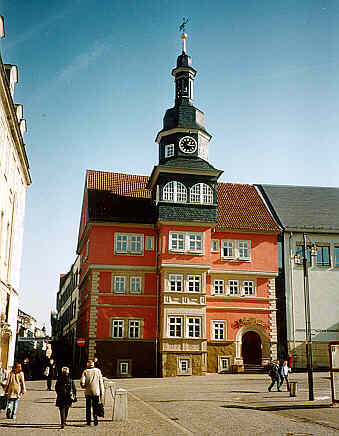
Eisenach is a town which will always have a special place in my heart, for a multiplicity of reasons. For one, it's where I was married (and the authorities thoughtfully sent along someone to photograph the proceedings, without us even having to ask). It's also a rather charming old place, which despite its many important historical associations, is oddly unknown in the English-speaking world.

Here's a quick crash course in the town's significance:

  • Bach was born here
  • it has one of Germany's most impressive medieval castles, Wartburg
  • it's here (in Wartburg castle) that Martin Luther first translated the bible
    into German
  • it was home to the world-renowned Wartburg car factory (it wasn't exactly
    well-known for the right reasons)
The old town is a significant size and mostly quite well preserved. A few bits on the edge were left to rot then replaced by Plattenbau, but the rest hasn't been fiddled with too much in the last century. Sadly, some of the villas on the Wartburg side of town have been standing empty for years as arguments rage as to who exactly the legal owner is. It has, ironically, caused many similar problems to the ones arising from lack of investment from the DDR authorities - fine buildings crumbling slowly to rubble.

On the west east side of town there's a chunk of the old city wall slicing across Georgenstrasse. But it's nothing that would keep out an agile 5-year old, let alone rampaging Austian/Bavarian/Prussian armies. The only even vaguely convincing section is Karlstor (Karl's Tower), gateway to the town's first significant square, Karlsplatz (formerly Platz der Deutsch-Sowjetischen Freundschaft). The square is one of many spots in Eisenach of which I have eternal recollections. Not many wedding parties leave the reception by bus, but it was a pleasure accorded us. Our own very special wedding bendy-bus left from Platz DSF.

You can criticise the DDR regime for many things, but their stance on drink-driving couldn't be faulted. The legal limit for alcohol in the blood was effectively nil and the penalties (jail sentences in many cases) certainly acted as a deterrent to irresponsible behaviour. No drunken guest stupid enough to drive us home, no taxi to be found (check out the difference now - whole caravans at every taxi stand); what else can you do but take the bus? It looks very romantic in "The Graduate", bride in wedding dress (to be perfectly accurate, jilting bride in the film). Standing amongst the shoppers in our ill-fitting suits (in my wife's case, beautiful white dress) was a far more prosaic experience. Well, it would have been, if Dave hadn't spotted the kiosk just by the busstop.

You can criticise the DDR regime for many things, but the general availability of alcoholic drinks, of all strengths, under their governent couldn't be faulted. Quicker than you could say "we're a bunch of alcoholics" we were all supplied with miniatures, proper Nordhäuser, I think. The journey was an event for my British guests, not only because of the novelty of riding in an articulated bus.


Lindenhof

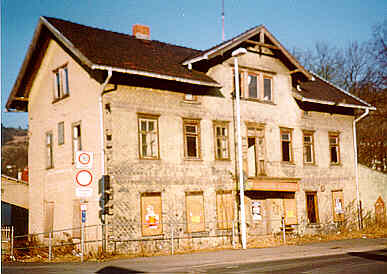
To the left you can see the Lindenhof, which is currently on the market and I am sure will be attracting the attention of astute investors everywhere. Here is one of the many locations in Eisenach that conjure up very personal memories.

It may look a wreck now, but in 1988 it was totally different - all the windows had glass and there was draught beer. Inspirational design and sophistication weren't words that cropped up the HO's mission statement. Lindenhof took this corporate philosophy to the absolute limit. Today it's possible to peep at the bar inside through some of the smashed boards and, despite the vandalism, it's not looking that much worse than when I last had a beer there in 1988. The outside hasn't deteriorated considerably, either. It looks as if someone might have even tidied up the garden since the old days.

If you're thinking that's the grip this pub has on my throat and mind, then you're very wrong. The memory that will never fade is from my wedding feast. Over the road at my in-laws house, we were having an after-reception party. A half dozen of my friends and family were staying there for a few days around the wedding. My father-in-law had bought in a barrel of Wartburg Pils, but was worried that we would never get through it. Early in the evening of the wedding day, we had just finished off the second barrel of Wartburg (an emergency order when the first ran out after two days).

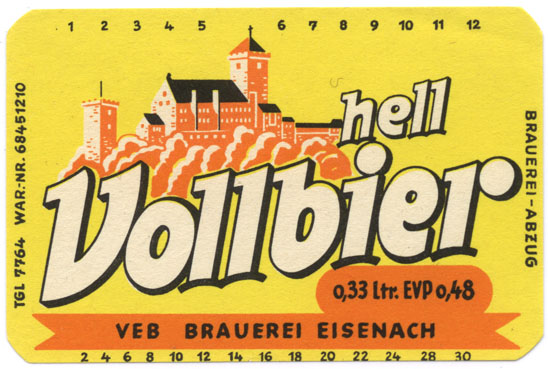
(I've drunk beer from the Eisenacher Brauerei since 1987. In the early days, it was OK. The Helles was a bit thin. Wartburg Pils was drinkable, but very unstable. If properly (and quickly) tapped, it was quite a reasonable beer. Bottled, you needed to buy it and drink it straight away. If you walked slowly, it could go sour before you got home. Perhaps hygiene wasn't all it could have been inside the brewery. )

Lindenhof was just over the road and the only pub in the district open at that time of day. Great idea - we nip over there and buy a couple of crates of beer. After all, this is the DDR and the price of a crate in a pub is the same as in a supermarket. Even in a country where I had learnt to love the charming drabness of of the surroundings, Lindenhof was drably charmless. The landlord - a scruffy, miserable git in the best tradition of publicans totally unsuited for their profession - soon disappointed us: they had no bottled beer. About the only drinks available were draught pils and doppelkorn (and I suppose tap water, though I wouldn't have bet my left shoe on them having running water that was drinkable). What a dilemna: beer a mere 50 metres away from a happy group of revellers, but nothing to transport it in. Suddenly someone - I can't remember who, but he was a man of genius - suggested we fetch a bucket and put 10 litres of draught beer in it.

Now, bar staff could be a fickle bunch in the DDR. Moving a chair from one table to another could be considered as a capital offence. I was once scolded by a waitress for reading a book at the table. Yet being asked to pull 20 beers and tip them into a bucket was seen as a perfectly reasonable request. If you want to appreciate what I mean by this, try doing the same in your local pub. Go in with a bucket and ask them to fill it with beer. I bet you that they won't act as nonchalantly as this bloke did.

Tuesday, 23 October 2007

Matt


My mate Matt rang last night. He said he'd been reading my blog. "A good insomnia cure" was his verdict. Thanks Matt. It's good to get an honest opinion every now and again.

In October 1975, I drank my very first pint of Tetley's Mild with Matt in the Pack Horse in Leeds. It was the a beginning of a beautiful and lasting friendship. Matt and I have kept in touch, too.

My first taste of Belgian beer was in Matt's company. A bottle of Gouden Carolus that we'd bought in Prisunic on Cour Alsace-Lorraine in Bordeaux. We were living hand to mouth, relying the odd English conversation class to buy the bread, onions and wine we subsisted on. When my tax refund arrived, we splashed out on a sausage and a bottle of Belgian beer. Happy days. Being half-starved and penniless is such fun. Afterwards, that is. When it's become a good story to tell the grandkids.

Of the three breweries whose archives I pore over, Truman's is the only one whose beer I ever tried. Me, Matt, Simon and Tym were living in a squat in Swaton Road in the East End. Just around the corner on Devons Road was a Truman's pub, the Tenterden Arms. It was a well-preserved old boozer that even sold cask beer. Truman's something or other. I can't remember exactly what it was called. Their first cask beer for many years, when they were still a bit tentative about moving away from keg. It wasn't great. I used to mix it with bottled Guinness to get something half decent. I've always been a fussy drinker. Matt wasn't so bothered. He drank the Truman's straight.

About this time, I drank my first Courage Russian Stout (hah! I finally worked in a Barclay Perkins connection). It was in a grotty Courage tied house on the Roman Road. They didn't sell cask beer, but they did have Russian Stout. I can't remember if Matt was with me. He could have been. He was usually hanging around somewhere in the background during the important events in my life.

We last met almost a year ago, at the Argyll Arms, just around the back of Oxford Circus. It's a smashing pub, with all the partitioning intact. The Victorians certainly liked drinking in intimate surroundings. Most of the rooms won't seat more than half a dozen people. I was fresh from an archive visit. My tales from the crypt entranced him almost as much as my blog. I stopped when I saw his eyelids starting to drop. I didn't want him spilling his pint and getting us thrown out.

Later that evening, we were at a surprise birthday party for another university friend. In an odd reversal of custom, the party wasn't a surprise for the birthday boy, but for me and Matt. It turned out to be a memorable night. Though not for the usual reasons. I'm not going to bore you with the full story (I have my numbers to do that job). Matt and I ended up sharing a shed for the night. I've slept in some funny places before, but never in a shed. Now I think about it, it's no surprise that Matt was along for this first, too.