Monday, 25 December 2023

Drinkalongathon 2023 - tawny port and James Martin


14:30

Relaxing a little from the cooking. By watching someone else cook. With the raisiny sweetness of the port combining well with fancy cooking on the TV.

The port is a Christmas present. From Alexei. Very thoughtful of him. And noted for future reference. Especially as I had nothing from Andrew.

Just gearing up the reactionary views so we can have a traditional Christmas "discussion". I've a kitchen knife ready in case things turn nasty.

Drinkalongathon 2023 - Glenfiddich 12 year and stuffing

 13:42

Just to make things clear, I'm making the stuffing not eating it. I wouldn't want to eat it raw, as there's chicken in it.

Most of the things you see are going into the stuffing. Plus some others. I'd say they were secret, but, in reality, I just can't be arsed to go through the whole list. I need to get me some more whisky down. Now the duck is happily roasting.

Two more hours until D-hour.

Drinkalongathon 2023 - Glenfiddich 12 year and Shakey


12:10

Time for a quick relax before all the cooking. And what better combination to soothe away the aches and pains than a single malt Scotch? Especially when paired with a crappy - and rather creepy - Shakin' Stevens Christmas song.

The dry alcohiliness of the whisky contrasts sharply with the sickly sweetness of the music video.

Drinkalongathon 2023 - bacon sandwich and fino sherry


11:34 

As is traditional, the day starts with a bacon sandwich and fino sherry. 

I usually come up with some bollocks about the saltiness of the bacon complementing nicely the dryness of the sherry. But I can't be arsed this year. You'll have to make do with the photo,

The sherry, incidentally, is the very best Lidl stock. It's a sads reflection on tyhe malaise in the sherry world that one of our local supermarkets, Dirk van den Broek, no longer stocks it at all.

Sunday, 24 December 2023

Most popular posts of the year

This is an idea I nicked from the Beervana blog. And why not? The internet is a plagiarism paradise.

It turns out the two most popular posts by a very long way are both from 2018. In fact, only four of the posts are from this year.

What does this list tell us? Not very much. Other than that people are very interested in the price of beer. I suppose that's not such a shock. More surprising is that the first recipe is at number nine. And there was me thinking recipes were the most popular of my posts.

Average UK draught beer prices 1973 - 2017
https://barclayperkins.blogspot.com/2018/01/average-uk-draught-beer-prices-1973-2017.html


Draught beer prices 1939 - 1948
https://barclayperkins.blogspot.com/2018/12/draught-beer-prices-1939-1948.html


The Dinosaur in the room
https://barclayperkins.blogspot.com/2023/11/the-dinosaur-in-room.html


Why dry hop? (part three)
https://barclayperkins.blogspot.com/2018/04/why-dry-hop-part-three.html


Coming along nicely
https://barclayperkins.blogspot.com/2023/01/coming-along-nicely.html


Prices and wages 1914 - 1919
https://barclayperkins.blogspot.com/2008/11/prices-and-wages-1914-1919.html


Illegal liquor sales in the House of Commons
https://barclayperkins.blogspot.com/2012/06/illegal-liquor-sales-in-house-of.html


Trends
https://barclayperkins.blogspot.com/2023/02/trends.html


Let's Brew Wednesday - 1956 Tennant's Glucose Stout
https://barclayperkins.blogspot.com/2018/04/lets-brew-wednesday-1956-tennants.html


Why did you start drinking Lager?
https://barclayperkins.blogspot.com/2023/04/why-did-you-start-drinking-lager.html


Saturday, 23 December 2023

Christmas saved

Yesterday, at Ton Overmars, they swore they had another crate of Abt at the back. But they were too busy to look for it. "Come back tomorrow."

He wasn't lying. It was mobbed. With annoying Christmas drinkers. Spending 20 minutes staring at the hundreds of whiskies. Get out of my way you fuckers. I need to find the cheapest Islay. I can only dream of buying Lagavullin.

I went back today. Far less crowded. No Abt on the shelves.

"Sorry, I was wrong. I think I forgot to order."

Well, there's Christmas fucked. I didn't say. I sadly surveyed the depleted shelves and settled on Guinness Special Export. And one bottle of Westvleteren 12. A good substitute for Abt. And not too crazily-priced at 4.95 euros. But I can't afford Drinkalongathon quantities.

Christmas wouldn't be Christmas without Abt.

After sobbing a while at home, I remembered the Gall & Gall on Amsteveenseweg. They usually stock it. But how many bottles would they have? Enough for Drinkalongathon?

I braved the long trek there, over the river and beyond. Five bottles on the shelf. Could I stretch that little out over the whole of Christmas?

"Do you have any more bottles of Abt?"

"In the fridge."

Christmas saved.

Let's Brew - 1914 Crowley BBB

Strongest among Crowley’s Pale Ales was BBB, though it still wasn’t at the level of a Burton-brewed example.

Like all their beers, there’s nothing at all complicated about the grist, which is just pale malt and sugar. There’s not even any hidden complexity as there’s just one pale malt. And English one. It really is a dead simple recipe.

The hopping isn’t exactly complicated, either, just 1913 English and Oregon. The additions, as usual, are pure guesswork. Feel free to fiddle with them.

Having seen a price list, I would have guessed that B, BB and BBB were all parti-gyled together. But they weren’t. BB and BBB were always brewed single-gyle. This allowed them to have a different level of hopping for each. B had 7 lbs per quarter, BB 10 lbs and BBB 11 lbs. This is reflected in the much higher IBU rating of BBB. 

1914 Crowley BBB
pale malt 11.50 lb 93.88%
No. 2 invert sugar 0.75 lb 6.12%
Cluster 120 mins 1.25 oz
Fuggles 90 mins 1.25 oz
Fuggles 60 mins 1.00 oz
Fuggles 30 mins 1.00 oz
Goldings dry hops 0.50 oz
OG 1054
FG 1012
ABV 5.56
Apparent attenuation 77.78%
IBU 63
SRM 7
Mash at 153º F
Sparge at 160º F
Boil time 120 minutes
pitching temp 59º F
Yeast Wyeast 1275 Thames Valley ale

The above is one of almost 300 recipes in this wonderful book.


There's also a Kindle version.


Friday, 22 December 2023

Bum

Just been gardening the "Keg!" manuscript. Going through random sections, pruning words and replanting sentences. All good fun, and part of the iterative process of writing a book.

I laid the keel of the book quickly. As I always do. Plonking down the chapters and subsections like a world-creating god. Racing through the easy-to-write already-in-my-head bits in a few days. Yeah! Dead productive.

Reading back through, it's good stuff. And I'm sure most of it is true. But where are the references? So many assertions without sources. Which is what I'd say if someone else had written it.

It's like seeing a sink hole appear a foot in front of your feet. Fuck. I've become my own worst enemy.

Referencing is going to take way more time than the writing. And be so much fun. Has to be done, though. Hello rod, hello my back.

I'll see you in March.

Courage in the 1970s

I have very mixed feelings about Courage. Having ended up owning both of my hometown of Newark’s brewers, they owned almost all the pubs. All but one of which sold no cask beer. On the other hand, they brewed Russian Stout.

On the other hand, my first job after school was working in their Newark plant, the former Holes brewery. Filling kegs. It was so much fun. Not really. It was very heavy work. Which my 18-year-old body could cope with. Then there was all that free beer.

In the North and Midlands, Courage produced no cask beer at either their Tadcaster or Newark breweries. Drinkers in the South were luckier, with the London and Bristol plants producing some cask. Though Worton Grange, the replacement for the former Simmonds brewery in Reading, produced only keg beer.


London
Horselydown, the original Courage brewery on the South bank of the Thames opposite the Tower of London, was open all through the 1970s, not closing until 1982.

It produced at least some cask right up until its closure. Though it wasn’t always easy to tell which of their breweries the beer had been brewed in.

Reading
The former Simonds brewery in Reading was one of the constituent parts of the original group, Courage Barclay Simonds.

Having a good reputation for their beer, there was quite a bit of consumer resistance to its closure, orchestrated by CAMRA. Of course, this had no effect on the decision to close it.

Worton Grange
The replacement for Reading was a massive brewery, with a capacity of six million barrels. Designed as a keg beer plant, it never brewed any cask beer. It was never greatly loved and closed in 2010.

It was one of the megakeggeries built in the 1970s when brewers assumed that beer consumption would continue to rise and that extra capacity would be needed. When consumption started to fall in the 1980s, the industry was left with considerable overcapacity.

Bristol
The former George’s plant in Bristol had a long history and a good reputation. After the closure of Reading, it became home of Courage Bitter and Directors.

It was founded in 1781 and had grown to a decent size. When Courage bought it in 1961 it had almost 1,000 tied houses, which would have made it one of the largest independent brewers. It finally closed in 1999.

I’m pretty sure that I drank both Courage Bitter and Directors which had been brewed in Bristol. Perfectly serviceable beers, if not particularly exciting by that date.


Newark

The former Holes plant has a special place in my memories, being the only brewery I’ve ever been employed in.

Bought by Courage in 1967, it continued in much the same way as before. Except that, as the other Newark brewery (Warwick & Richardson) had also ended up in the hands of Courage and been closed, they went from serving half the pubs in Newark to virtually all of them.

It continued to brew the former Holes beers such as AK and Mild. But also brewed one Warwick & Richardson beer, IPA. One thing had changed, however: none of the beer was cask. It was all bright beer, filled into 50 and 100 litre kegs and served by electric diaphragm pump.

The beers weren’t terrible, not being heavily pasteurised. Definitely better than keg beer. But not a patch on decently-kept cask.

Fellow Newark exile John Clarke recalls of Holes AK:

After Holes had been closed I went on a CAMRA trip to Simpkiss whose head brewer at the time was the former head brewer at Holes up to closure. He told us that AK was only very rough filtered, so rough in fact that it was sometimes sold under its own pressure. How true that is, I don't know, but I definitely recall him telling me that.


Tadcaster
The former John Smiths brewery is the only Courage plant still in operation. In the early 1970s they phased out cask beer. And didn’t brew any again until the early 1980s. Which was frustrating, because, in cask form, their beer was pretty decent.

The Bitter was quite dark, dry and reasonably Bitter. Magnet was similar, but stronger. For a while, quite a few Courage pubs in Newark had cask again. And fairly good cask. Then John Smiths Smooth came along and fucked everything up again.


Barnsley

A much-beloved brewery, famous for its Bitter. Which was the first good beer I ever tasted. Having taken over Warwick & Richardson before being gobbled up themselves by John Smith.

A few pubs in Newark still served Barnsley Bitter when I started drinking in the early 1970s. But, as the Barnsley brewery was scheduled for closure, most had swapped over to beer from Newark.

When the brewery closed in 1976, only one pub in Newark, the Wing Tavern, was still selling Barnsley Bitter.

Plymouth
This was one of Courage’s latest acquisitions, happening in December 1970. The brewery soldiered on for a reasonable length of time, not closing until 1983.

I remember coming across their beer at the Great British Beer Festival. They were unusual in using cast iron casks which weighed an absolute ton. Heavy, their Mild, was top class.

Thursday, 21 December 2023

Beer writing as a job

I was slightly surprised, but not shocked, by Boak & Bailey's announcement that they have reverted to amateur status. As far as beer writing is concerned.

Though I totally understand why they took the decision. The simple truth is: there's bugger all money in writing about beer. Even if you're lucky enough to get commissioned to write articles and books. They pay crap. And the opportunities are few.

Boak & Bailey's two books are quality works. Not stuff you knock out in a week-long speed binge. Something requiring serious research. And that what takes time. Banging out a couple of thousand words a day is a doddle. If you already have all the source material assembled.

Who can afford to take a couple of months off work for a project that might pay the equivalent of a few weeks pay? I never could have. Which is why I did a lot of my writing at work. Mostly when I didn't have any "real" work to do. (But not always. I'm such a bad person.) Few have such luxury.

Which lead onto the question, why do I self publish? Partly for the control. I can write exactly the books I want to write. No matter how unfashionable or commercially unviable. Then there's the calm of working without external deadlines. But there's also a financial aspect.

"Let's Brew!" is basically an expansion pack of recipes for my "proper" book, "The Home Brewer's Guide to Vintage Beer". It's earnt me almost as much money as I was paid for Vintage Beer. And will continue to earn me money in the future. Unlike the other book. For which I'm never likely to garner any royalties.

That's why I don't bother pitching book ideas to publishers. I'm unlikely to make much money, and someone else will have control of my words. What's the point in that?

Now I'm retired, my time is my own. And I can continue to churn out my commercially suicidal books. But I'm just lucky.

It's the beer world's loss that Boak & Bailey made a very financially sensible decision. However sad it might be.

Light Ale hops 1968 - 1984

We’ll end with the hops, of which there are also loads. Every beer contains at least two different types. While most have three or more.

There was a reason for this: so that when the supply of one hop ran out, it’s replacement wouldn’t alter the flavour of the beer too much. The Watney Mann Quality manual insists that at least three different growths be used in all beers.

The vast majority of the hops were English. Which is what you would expect in this period, when the UK was pretty much self-sufficient in hops. The only foreign hops are two lots of Styrian and one of British Columbian.

Where specified, the English hops are all from Kent or Worcester. Which makes sense as these were the largest hop-producing regions.

As for the varieties, most would likely have been Fuggles or Goldings, simply because they were the most produced types. At least at the start of the period.

Later, Northern Brewer, Bramling Cross, Bullion, Wye Northdown and Wye Challenger became more prominent. The Watney Mann Quality Manual states that no more than a third of the hops should be of these new varieties. The remainder being Fuggles or Goldings.     

Light Ale hops 1968 - 1984
Year Brewer Beer hop 1 hop 2 hop 3 hop 4 hop 5
1977 Adnams LBA English English English    
1971 Boddington Bod English English      
1984 Eldridge Pope BAK English English English English Styrian
1968 Fullers LA Worcester 1967 EK 1966 Styrian 1967    
1972 Shepherd Neame LA Kent 1970 Kent 1971 Kent 1972    
1969 Truman LK English 1967 English 1967 English 1968 British Colombia 1967  
Sources:
Adnams brewing record held at the brewery.
Boddington brewing record held at Manchester Central Library, document number M693/405/134.
Eldridge Pope brewing record.
Fullers brewing record held at the brewery.
Shepherd Neame brewing book held at the brewery, document number 1971 H-5O5.
Truman brewing record held by Derek Prentice.


Wednesday, 20 December 2023

Next year

I'm starting to think seriously about my travel in 2024. I've a couple of things pencilled in. But the same was true last year and pretty much everything fell through.

One US trip does look fairly firm: North Carolina, Tennessee and Georgia in late May or early June. I've events set up with a couple of breweries, but others are welcome to get in touch. I'm always up for giving talks on a wide variety of beery topics. Especially if it will help sell some of my books.

I'm open to offers to talk anywhere in the world, pretty much. In particular, countries I haven't yet visited.

In the summer, I plan to go to South America with the kids. Brazil, Uruguay and Chile are probable destinations.

Other than a couple of things I can't talk about, that's it for next year. And how many days holiday do I have? 366. Plenty of time for more travelling.

Let's Brew Wednesday - 1964 Eldridge Pope Dorset Brown Ale

You should let me know if there's any particular period of recipes you'd like. Especially if you want me to stop posting watery post-WW II recipes.

Essentially identical of the Mild was Eldridge pope’s Brown Ale. It was often parti-gyled with it, though this particular example also had XXXX in the mix, too.

This is another beer that was darker than the recipe implies. I’ve added enough caramel to get the colour right.

The hopping is very similar in all Eldridge Pope’s beers. In this case, it’s Kent (1961), Worcester (1962) and Sussex (1962). Some of the others also contain a small amount of Styrian Goldings. 

1964 Eldridge Pope Dorset Brown Ale
pale malt 4.00 lb 66.67%
crystal malt 60 L 0.75 lb 12.50%
wheat flour 0.25 lb 4.17%
malt extract 0.25 lb 4.17%
brown sugar 0.25 lb 4.17%
white sugar 0.25 lb 4.17%
caramel 1000 SRM 0.25 lb 4.17%
Fuggles 90 min 0.50 oz
Goldings 30 min 0.50 oz
OG 1025.5
FG 1006.5
ABV 2.51
Apparent attenuation 74.51%
IBU 14
SRM 20
Mash at 148º F
Sparge at 160º F
Boil time 90 minutes
pitching temp 61.5º F
Yeast WLP099 Super High Gravity Thomas Hardy

The above is an excerpt from my overly detailed look at post-war UK brewing, Austerity!

https://www.lulu.com/shop/ronald-pattinson/austerity/paperback/product-1mkrq4zg.html


There's also a Kindle edition.

Tuesday, 19 December 2023

It's that time of year again

What I like to call Drinkalongathon season. So it's time to get your eggs and string at the ready for the big day next week.

Am I going to do this for yet another year? Sure as hell I am. As long as there's string to be cut and eggs to be boiled.

Here's what you'll need to participate in Drinkalongathon 2023:

1 bottle Islay whisky (as expensive as you can afford)
7 pieces of string
4 hard-boiled eggs
3 soft-boiled egos
1 rubber egg (realistic)
2 bottles fino sherry
1 bottle scummo sherry
2 more pieces of string
4 slices of bacon
3 vegan sausage rolls
2 chains
0.5 back
3 quarters (wings)
100 weights
500 feet (a whole sheet)
3 yards (or gardens)
7 lengths of string
1 apple
2 bottles of port (one street, one dinner table)
3 bottles of fairly decent wine* (one white, one red, one red and white mixed (or rosé if you're being a  posh git))
24 cans of Whitbread Gold Label** (for the lucky bastards who can buy it still)
4 cans of baked beans (2 Imperial pints), own brand only
2 Imperial pint glasses (preferably nonic or tulip, oversized)
1 crate St. Bernardus Abt (the Christmas version is an acceptable substitute, for jammy twats lucky enough to find it)
17 shorts of string
1 duck
2 dives
1 comically large pencil, not necessarily sharp
1 rubber duck (yes, the last one was a real fucking duck)
Stuffing of your own choice*** (For the real duck, obviously, not the rubber one. Unless you really are dead thick and were confused by the order of the items.)
1 bottle of rum (with at least 3 years of ageing in wood.) (Or cachaca.)
7 bottles of beer from the Lidl Oktoberfest package****
1 coffee, surreptitiously laced with an octuple measure of cheap whisky/any other spirit hanging around unattended
2 mince pies (for decorative purposes only)
2 limes
6 lines (of chalk)
3 times
4 pines (cones)
13 (at least) of my books
2 rolls (soft)
3 rocks (hard)
1 satsuma (or other easily-peeled orange citrus fruit)

That's all I can think of for the moment. I may recall other essential items later. As a pensioner, I'm just glad I can remember both of my names when I get up in the morning: Reginald Peterson.


* Costing less than 3 euros a pop. Preferably less than 2. And litre size.

** I'll happily trade the recipe for a case or two of 1950s Tennant's Gold Label.

*** I'm no stuffing Nazi.

**** Coincidentally, exactly how many bottles I have left.

Light Ale sugars 1968 - 1984

Loads and loads of sugars. Two full tables worth. Starting with the ones I understand.

Malt extract was a surprisingly popular ingredient. Unlike other sugars, it was added in the mash tun, not the copper. For the simple reason that it was there for extra enzymes. Something many UK brewers worried about after WW II. Note that the quantities in the Fullers and Shepherd Neame examples are tiny.

Next, it’s the invert sugars: No. 1 and No. 3. Now, the former, being very pale, is exactly what you would expect in a Style like Light Ale. But No. 3? That’s just odd. Especially in the quantity found in the Shepherd Neame beer, 11%. Which explains why it’s by far the darkest in colour of the set.

It’s interesting that glucose and fructose, the component parts of invert sugar, appear in beers which also include a numbered invert. Not sure what the point of that would be. Possibly because it was paler in colour than the numbered sugars, even No. 1.

Finally, cane sugar. Which I assume means raw cane sugar. Making it the simplest of all the sugars used.

Now for the difficult bit: all the weird proprietary sugars.

I’ve little idea what any of them are. Wortex seems to be a wort extender, which would be a combination of invert sugar and maltose.

Caramel. I know what that is. Though not something you’d expect to see much of it in a style like Light Ale.  And, it this case, that’s all there is. A tiny amount, presumably for colour correction. 

Light Ale sugars 1968 - 1984
Year Brewer Beer malt extract no. 1 sugar no. 3 sugar glucose fructose cane
1977 Adnams LBA   15.03%     11.28%  
1971 Boddington Bod 5.36%          
1984 Eldridge Pope BAK            
1968 Fullers LA 0.65%   1.94% 1.29%    
1972 Shepherd Neame LA 0.55%   10.93%      
1969 Truman LK           7.85%
Sources:
Adnams brewing record held at the brewery.
Boddington brewing record held at Manchester Central Library, document number M693/405/134.
Eldridge Pope brewing record.
Fullers brewing record held at the brewery.
Shepherd Neame brewing book held at the brewery, document number 1971 H-5O5.
Truman brewing record held by Derek Prentice.


Light Ale proprietary sugars 1968 - 1984
Year Brewer Beer Fla Br Flowsweet PEX Wortex caramel
1977 Adnams LBA           0.40%
1971 Boddington Bod 4.29% 4.29%        
1984 Eldridge Pope BAK     8.96%      
1968 Fullers LA       1.29%    
1972 Shepherd Neame LA         6.56%  
1969 Truman LK            
Sources:
Adnams brewing record held at the brewery.
Boddington brewing record held at Manchester Central Library, document number M693/405/134.
Eldridge Pope brewing record.
Fullers brewing record held at the brewery.
Shepherd Neame brewing book held at the brewery, document number 1971 H-5O5.
Truman brewing record held by Derek Prentice.

Monday, 18 December 2023

Time train

Checkout is now 11:00. Not leaving a huge amount of time between breakfast and fucking off.

What’s the plan today? A walk down to the British Museum for a quick look around. That’s first on the agenda.

We get down for breakfast a little earlier, to give us a bit more time. It’s pretty empty. Probably because it’s a Monday and the hotel isn’t as full.

K. has found a large teapot. Enough for three big cups. Just what I need to kickstart my day. My breakfast is frugal. Not got a great deal of appetite. But I’m never going to pass on bacon. That would be a sin.

Bags packed and dumped, we head to the British Museum. We spend an hour or two there each trip. Concentrating on one section. We’ve still lots left to see. This time, it’s Dark Ages and medieval Europe.

There’s quite a queue for the security checks. A jangle of Chinese girlies in front of us are taking selfies. Lots of selfies.

“I wonder what they do with them all?” I ask K..

“The same as you do with all your boring pub photos. Nothing.”

“They’re for my blog.”

“Right. Nothing to do with your weird building obsession.”

“That’s not true.”

“Then why do your photos never have people in them?”

“They do sometimes.”

“Only by accident.”

I can’t argue with K. there. I hate it when people get in the way of the buildings.

It’s pretty crowded. As always. Lots of parties of schoolkids with high-vis jackets over their uniforms. Stressed teachers like sheepdogs doing best to keep the flock together.

When my legs can’t take any more, we decamp over the road to the Museum Tavern.

Before we left, Alexei asked: “Will you be drinking in the Museum Tavern like Karl Marx?”

Alexei has a weird thing about Marx. Not sure why. Probably something to do with the beard. “Yes, we always go there. Though the bastards don’t sell Old Puke anymore.”

That’s why I get both me and K. pints of Landlord. Not that it’s such a sacrifice. I just used to look forward to a well-kept pint or five of Old Peculier. One of the highlights of my London trips.

Around us are mostly tourists eating lunch. Only a few are drinking beer. We’re the only ones on cask. Someone must drink it, as they have five on. I don’t know about the others, but the Landlord is in good nick.

K. sends Alexei a photo of us in the pub.

“That should impress him, K..”

“I doubt it.”

K. is right. He’s past the age of being impressed by his parents. In any possible way.

On the way back, we troll down the supermarket. To buy all our contraband: joints of meat, crisps, crumpets, mince pies, train whisky.

On the way to the St, Pancras, we rest our legs awhile in the Euston Flyer. No Porter today. So, I get a London Pride for both of us. Only, after ordering, noticing that there was also ESB.

Even at 16:00 on a Monday, there’s a Christmas party over in the corner. Paper hats and tinsel. I remember the fun.

“How’s your beer?”

“Very good, as always.”

She’s not wrong. It is pretty nice.

Just the one pint, then over the road to St. Pancras and the international station. Which, unlike last time, isn’t mobbed. We even manage to find seats. After doing the mandatory security and passport shit.

The good news is that our seats have a window. But, as it’s already dark, it’s not of much use.

I’m better prepared this time. K. has made sandwiches for both of us. From the really nice baguette we were given yesterday, And I’ve got some train whisky. I’ve everything I need for the journey. Now it’s time to relax.

When the train empties out in Brussels, I move to another row to give us each more room. A little bit cramped, I find the seats.

We arrive in Amsterdam on time. Thankfully. As it’s already pretty late: 23:15. A short tram ride, and we’re home before midnight.

The kids haven’t wrecked the flat. That’s good.


The Museum Tavern
49 Great Russell St,
London WC1B 3BA.
https://www.greeneking.co.uk/pubs/greater-london/museum-tavern


The Euston Flyer
83-87 Euston Rd.,
London NW1 2RA,
ttps://www.eustonflyer.co.uk/

Sunday, 17 December 2023

Bermondsey

South London today. Just for a change. You may be able to guess where we’re heading.

First, it’s time for breakfast. A pot of tea, obviously. Just the one egg, a couple of slices of bacon.

“Do you want some fruit?”

“Good idea. I always have some fruit for breakfast in South Ame-  … ‘”

“Yes. I know. You’ve told me a million times.”

K. is trying all the different types of coffee. She isn’t too keen on the mocca. “Too sweet.”

First destination today is Borough. Which entails a shortish hop on the Northern Line. Our first time on the tube this visit. We’ve done well to dodge it for two days. It also means another delightful walk down Euston Road.

K. has never been keen on the Underground. I’ve only come gradually to despise it as I’ve got older. On account of all the fucking walking and stairs. (I’ve turned into a dalek when it comes to stairs.)

The tube is packed. We just about manage to squeeze on. Now I recall how much I enjoyed riding the tube when I lived in London. Fucking not at all. It’s just after noon on Sunday and it’s teeming with people. Where the hell are they all going?

It’s raining quite heavily when we emerge from the tube. I think I can remember the way to the Royal Oak. The junction is quite complicated, though. Past the church and right a bit, isn’t it?

As we walk down Tabard Street, either I’m having aural hallucinations, or I can hear singing. Against the odds, it turns out to be the latter. There’s carol singing going on. It’s packed and all the windows are steamed up.

That’s a bummer. No way we can drink in here. We can barely squeeze through the door, never mind get a seat.

“Is there somewhere else we can go?”

“I just noticed that the pub next to the tube station is a Fullers house.”

“There’s a pub next to the tube station?”

Odd the different things that you notice.

Yes, there’s a pub next to the tube station. I spotted in the first time I came this way. And filed it away for future reference in case of the need for an emergency pint. Or emergency piss, which is more likely now.

I don’t say any of that out loud, obviously. At least I think not. K. hasn’t given me a look so I can’t have.

The Trinity isn’t too full. But most of the tables are booked. For more Christmas parties. Must be the time of year or something. Once again, we manage to find somewhere to sit.

I order two pints of London Pride without even asking K.. Just a waste of time. Not that there was any choice as they’ve only the one cask beer. And K. isn’t going to drink keg.

Roast dinners float past. Very nice they look. Then two are placed in front of us.

“I wondered why they put cutlery on our table.” I remark.

The dinners are for two pensioners sitting just behind us.

“See, they’re paying with cash.”

I’d just been telling K. how everyone only paid by card in Britain. Almost everyone, I should have said.

A large group of depressingly healthy-looking young people dribbles in. Based on the glittery dresses, I’m guessing it’s another Christmas party. Looking more relaxed, as it’s friends rather than work colleagues.

We do have an appointment this afternoon. Or, at least, I do. At the Kernel. It’s not that far away. Just a bit further than I want to walk. It’s two stops on the tube. With a change at London Bridge.

Changing on the tube is always such a pleasant experience. All that endless walking through tunnels and up and down stairs.

When we emerge blinking into the light from Bermondsey tube station, we’re not really sure of the way. K. is the one with mobile data and hence a map.

“We need to go this way.” She says confidently. I’ve no grounds to argue.

We wander through an estate of various period council houses. This is interesting.  After a bit of ambling around, we get to the railway line. And start walking along the railway arches.

“Is this the right way?”

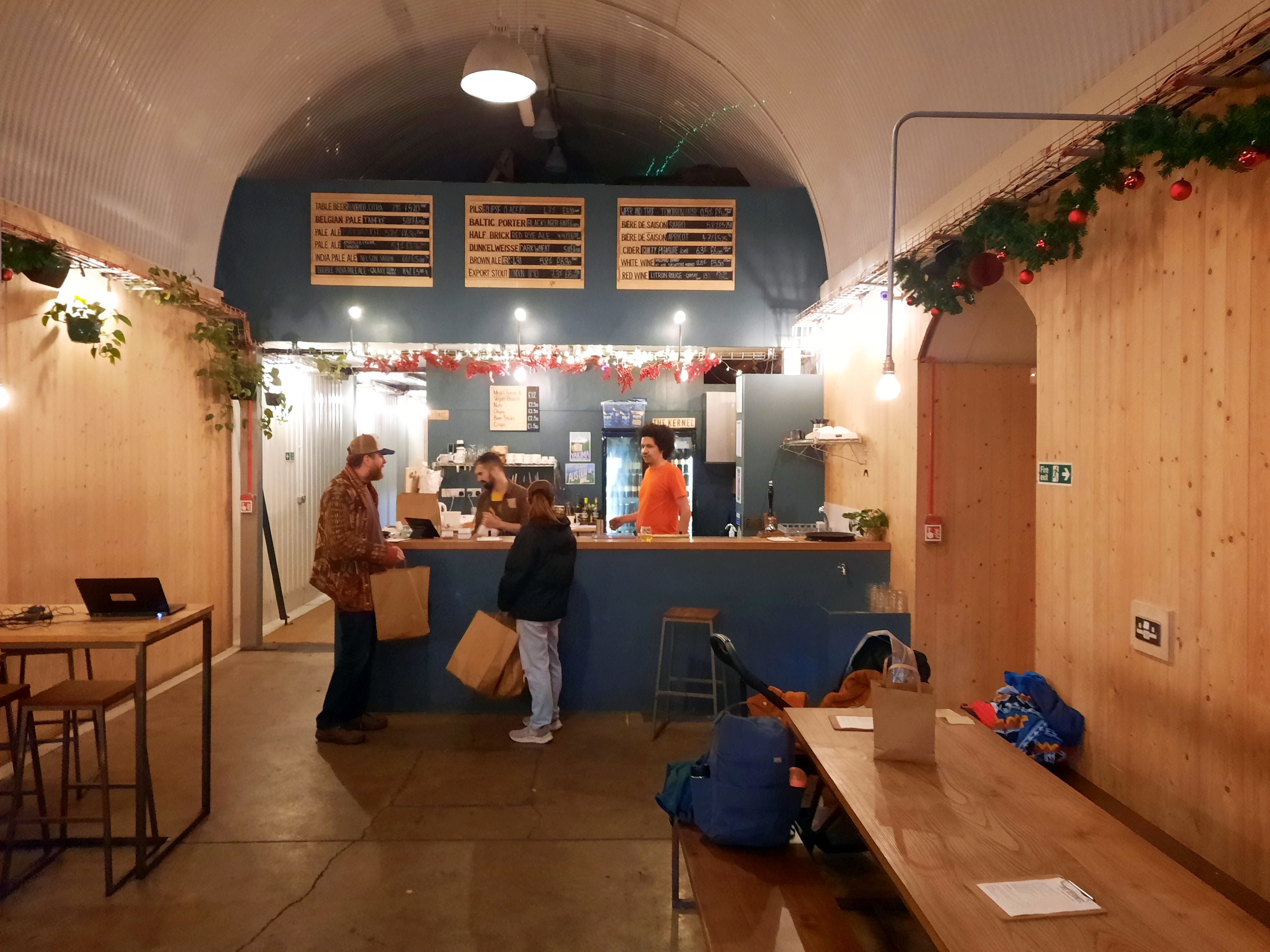
“It’s just a bit further down here. Look.” K. says, showing me the map on her phone. She’s right.

There are only a couple of other customers. Leaving us a free choice of seats. 

“What would you like, K.?”

“What would you suggest?”

There’s no Mild. And the Pale Ales all have evil modern hops in them.

“What about Brown Ale? That shouldn’t be too weird.”

I get myself a London Export Stout.

I’m here to see Evin, the brewer/owner. But he’s not here yet. We are, surprisingly, a bit early. I’m usually late for appointments in London, always underestimating how long it takes to get around. Despite having lived here.

Evin soon arrives. And we can get down to business. Discussing a project for next year. One it’s a bit early to make public yet. It should be fun, though.

I have a good chat with Evin about all things beer. Especially blending. Which has become a bit of an obsession of mine. Joining many others on the shelves in my obsession shed.

“Would you like some bread?” we’re asked by a couple of people with bags of bakery items they’re giving away. I assume they’re from a nearby artisan bakery.

“It’s for free?” K. makes sure.

It looks very nice. A proper sourdough French bread.

“We can use it for sandwiches tomorrow.” K. is always thinking ahead.

We don’t stay too late as there’s a carol singing event. What is it – carol day?

We change tube at London Bridge. I struggle up the many stairs.

Channelling my new pensioner persona, I ask: “Why didn’t they install escalators? This part is all new, built for the Jubilee line.”

“Don’t ask me.”

“Fucking cheapskates. The old Northern line bits have escalators.”

I’m really getting into the grumpy old git thing. Think I’ll run with it. Or perhaps walk as swiftly as I can is mor erealistic.

The Northern Line train is packed. Again. We get on the last carriage where there’s a little space.

Euston station is mobbed, too. Where do all these fucking people come from? Euston Road is still wet, filthy and crowded. I remember now why I moved away from London as soon as I got the chance.

I’m too knacked to do much this evening. Other than chill in our room. With my cheapo whisky.


Royal Oak
44 Tabard St,
London SE1 4JU.
https://www.royaloaklondon.co.uk/


The Trinity
202-206 Borough High St,
London SE1 1JX.
https://www.thetrinity.co.uk


The Kernel
Arch 11,
Dockley Road Industrial Estate,
Dockley Rd,
London SE16 3SF.
https://www.thekernelbrewery.com/

Saturday, 16 December 2023

Let's Brew - 1941 Barclay Perkins IPA (bottling)

With their bottled Pale Ales concertinaing due to gravity cuts, Barclay Perkins seem to have dropped the bottled version of XLK, either in late 1940 or early 1941. Those reductions in OG left IPA at about the same strength as pre-war bottled XLK.

It doesn’t look much like a modern IPA. But what the hell. It didn’t seem to confuse beer drinkers in the 1940s. They had much less fixed ideas about beer styles.

This being from the strange period towards the start of the war when Barclay Perkins used no adjuncts, the recipe is very simple. Though it was a bit more complicated in practice, there being four different pale malts. One from California and a couple described as PA malt. And one described as Gilstrap, meaning it was made in my hometown of Newark.

I love that Barclay Perkins could be arsed to note both the hop varieties and where they were grown. In this case, Mid-Kent Fuggles (1940 crop), Worcester Fuggles (1939, cold stored), Kent Goldings Varieties (1939) and East Kent Goldings (1939) as dry hops. 

1941 Barclay Perkins IPA (bottling)
pale malt 7.25 lb 85.29%
crystal malt 60L 0.75 lb 8.82%
No. 1 invert sugar 0.50 lb 5.88%
Fuggles 105 mins 0.75 oz
Fuggles 60 mins 0.50 oz
Goldings Varieties 30 mins 0.50 oz
Goldings dry hops 0.25 oz
OG 1037
FG 1007.5
ABV 3.90
Apparent attenuation 79.73%
IBU 26
SRM 7.5
Mash at 147º F
After underlet 151º F
Sparge at 165º F
Boil time 105 minutes
pitching temp 61º F
Yeast Wyeast 1099 Whitbread ale


This recipe is from my recently-released Blitzkrieg!, the definitive book on brewing during WW II.

Get your copy now!

The second volume contains the recipes. But not just that. There are also overviews of some of the breweries covered, showing their beers at the start and the end of the conflict.

Buy one now and be the envy of your friends!

Both volumes are also available on Kindle:

Volume I

Volume 2