Showing posts with label German beer. Show all posts

Monday, 10 November 2025

German beers in Holland during WW II

A Kronen Export Dunkel label featuring a drawing of a crown and the text "Kronen-Brauerei Bruno Ermisch Leipzig - Connewitz".
There's loads of dead handy Heineken material in the Amsterdam archives. Not just their brewing records. They also had their own version of a gravity book, containing analyses of all sorts of Dutch and foreign beers.

What makes it particularly interesting is that it covers WW II. A period where various unpleasantness made both brewing and moving beer about rather problematic. Plus the fact that the authorities weren't always keen on drinkers finding out what was happening to their beer.

For example, at one point in WW II the Dutch brewers organisation reduced the strength of beer without informing the public. No doubt fearing what their reaction would be.

Holland was quite fortunate is being just about self-sufficient in malting barley. Which allowed beer of a reasonable strength to be brewed much longer than in other places under Nazi control. In 1942, you could still get a Pils over 3% ABV.

It seems as if German beer was imported into Holland up until 1942. When I presume there was no longer enough beer to let it leave the country.

The beers in the table, though lower in gravity than pre-war, are at least still intoxicating, with only a couple below 3% ABV. And are stronger than the beers the general public were getting back home in Germany. As beers like these, intended for German servicemen, were stronger.

Unsurprisingly, most come from North Germany: Dortmund, Bremen and Hamburg. No surprise with the first of those, Dortmund producing the most beer of any German city and being relatively close to Holland. 

German beers in Holland during WW II
Year Brewer town Beer Style package OG FG ABV App. Atten-uation colour
1941 Dortmunder Kronen Dortmund Dortmunder Dortmunder bottled 1039.3 1009.5 3.79 75.78% 0.52
1941 Dortmunder Union Dortmund Dortmunder Dortmunder draught 1046.3 1012.3 4.35 73.35% 0.52
1941 Dortmunder Union Dortmund Dortmunder Dortmunder bottled 1040.2 1008.5 4.06 78.78% 0.48
1942 Bavaria Brauerei Altona Export Bier Export bottled 1031.6 1006.9 3.18 78.18% 0.35
1942 Bavaria Brauerei Altona Export Bier Export bottled 1031.8 1006.4 3.25 79.73% 0.45
1942 Beck Bremen Export Bier Export bottled 1034.2 1008.7 3.26 74.67% 0.30
1942 DAB Dortmund Export Bier Export bottled 1028.8 1008.0 2.70 72.41% 0.58
1942 Dressla Bremen Export Export draught 1033.1 1007.1 3.35 78.65% 0.28
1942 Dünckler & Rüppert   Export Bier Export bottled 1028.7 1007.1 2.75 75.10% 0.38
1942 Holsten Bremen Export Bier Export bottled 1040.0 1008.8 4.03 77.99% 0.30
1942 Janssen Hamburg Export Tafelbier Export draught 1045.3 1012.1 4.24 73.30% 0.40
1942 Schloss-Cabinet Berlin Export Bier Export bottled 1032.3 1008.6 3.04 73.44% 0.30
1942 Tijger?   Export Export draught 1037.2 1010.4 3.44 71.99% 0.40
1941 Paulaner Munich Helles Helles bottled 1039.3 1009.5 3.83 75.78% 0.52
1942 Schultheiss Berlin Helles Helles draught 1032.6 1009.9 2.90 69.63% 0.40
1942 Bavaria Brauerei Altona Pils Pils draught 1039.9 1007.8 4.11 80.46% 0.40
1941 Dortmunder Union Dortmund Pilsener Pilsener draught 1040.0 1011.0 3.73 72.59% 0.48
1941 Schultheiss-Patzenhofer Berlin Patz Pilsener draught 1042.6 1009.2 3.76 78.31% 0.50
Source:
Rapporten van laboratoriumonderzoeken naar producten van Heinekenbrouwerijen in binnen- en buitenland en naar producten van andere brouwerijen held at the Amsterdamse Stadsarchief, document number 834 - 1794.


Tuesday, 7 June 2022

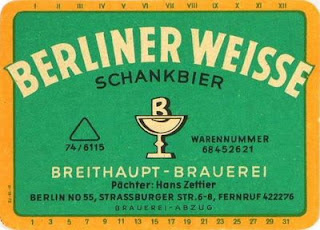
Brewing Berliner Weisse in the 1840s

The proportions of wheat and barley malt varied through time. At this point, the quantity of wheat malt was higher than usual.

There’s a fairly brief description of how Berliner Weisse was brewed in a book published in 1842.

Berliner Weisse was brewed from 5 parts wheat malt to one part barley malt. 

The malt was mashed in with water at 35º C, 35.35 litres per 55 kg of malt. Another 80 litres of boiling water were added to the mash and mixed in. 

Some of the thin mash was transferred to the kettle and brought to a boil with 0.234 kg of Altmark hops per 55 kg of malt. The hops had been soaked in water or very thin mash for 30 minutes beforehand. 

The boiled mash was returned to the mash tun, raising the temperature to 72.5º C. The mash was left to stand for 30 minutes, then pumped to the cooler.

45.8 to 57.25 litres per 66 kg of malt of boiling water were poured over the goods in the mash tun to form the second wort. This was mixed with the first wort and when, the temperature had fallen to 18.75º C, yeast was pitched. The next day the beer was already delivered to pubs. 

The author makes this interesting comment about wheat beers in general:

"all wheat beers, especially in the summer, easily turn sour and sometimes even sour during the brewing process." 

And, finally, there’s a mention of smoke. Zimmermann recommends that those still using an old-fashioned smoke kiln should use dry oak, beech or coke as fuel, as these gave off relatively little smoke. 

Sunday, 20 February 2022

Berliner Weisse (part seven)

Now it's time to look at the Francke method of souring. It's a radically different way of brewing Berliner Weisse.

Wort was run off the mash tun and cooled to just 45-47º C when it was pitched with a pure culture of lactobacillus delbruckii. Due to the warm temperature this quickly soured the wort. After five to seven hours the wort had reached a lactic acid content of 0.16-0.20%. This level of sourness was enough for the flavour, but not enough to interfere with the yeast fermentation, which could happen at higher concentrations. The wort was then boiled, cooled and pitched with yeast.  

After primary fermentation the beer was handled in the usual way. It was bottled and stored in cool cellars to allow bottle conditioning.

"Important Question for Breweries which produce Acid Beers of the Type of Berlin " Weiss" Beer. 0. Francke (Wochensch. Brau., 1907, 24, 621—624).—"Weiss" beer is prepared by fermenting wort with yeast and lactic acid bacteria. It is a very difficult matter, however, to acclimatise a mixture of lactic acid bacteria and pure yeast in constant proportions. The author recommends a process (which has been employed for two years with very satisfactory results) in which the lactic acid and yeast fermentations are carried out separately. The wort, as it runs off from the spent grains, is subjected to the action of pure culture lactic acid bacteria until the required degree of acidity is attained. The wort is then boiled, cooled, and fermented with pure culture yeast. The beer thus prepared has a pleasant acid taste, and does not require the aid of certain non-slime forming pediococci (see this Journal, 1907, 13, 626—630) to impart a pleasant flavour to it. If a mature, vinous " Weiss " beer is required, it is only necessary to treat the lactic acid-containing wort with ordinary bacteria-containing " Weiss " beer yeast. The presence of the lactic acid protects the fermenting wort against the attack of dangerous pediococci, and the beer acquires a sound, vinous taste. The beer prepared by the first method (i.e., that in which the lactic acid fermentation is followed by a pure yeast fermentation) only requires a short period of storage before it is ready for consumption. For the lactic acidification, the author employs distillery culture lactic acid bacillus Delbrucki, and for the alcoholic fermentation, top-fermentation pure yeast, Race B (high attenuating)."
"Journal of the Institute of Brewing, Volume 14", 1908, pages 196 - 197.

So, rather than going to the trouble of keeping the mixed yeast/lactic acid bacteria culture in balance, you ferment first with the bacteria, then with the yeast.

The method was abandoned after 2 years because beer brewed this way didn’t acquire the typical Berliner Weisse flavour. The explanation was simple: no Brettanomyces was involved. At the time no-one was aware of its crucial role in the flavour development of the style.
 

Monday, 14 February 2022

Berliner Weisse (part six)

Only a small quantity of hops were used: 375 to 500 g of hops per 100 kg of malt. These weren’t boiled in the copper in the usual way. They were boiled in the water than was used for mashing and were present through the whole mashing process. The hops helped filter the mash, important with a grist containing so much wheat.

There were two reasons for not boiling. The first was to preserve the lactobacillus on the malt, though Schönfeld’s own investigation found none in the spent grains. He concluded that the mash temperature was enough to kill it and the souring organism must come from another source. The second was flavour. A wort that had been boiled for a long time tasted differently from an unboiled one and Berliners were used to the latter.

The cooled wort was pitched with a symbiotic yeast and lactobacillus mixed culture. The proportion of yeast to lactobacillus was 4:1, 5:1 or 6:1. Acidity developed during primary fermentation through the action of the lactobacillus. A high degree of attenuation for the time -  66% to 75% - was achieved during primary  fermentation. Attenuation was helped by diastase remaining in the wort which, in conjunction with CO2 and lactic acid, broke down the maltodextrins into more easily fermentable sugars.

When primary fermentation was complete, the beer was kräusened with young beer in a proportion 2:1, 3:1 or 4:1. It was then either delivered to pubs in barrels for later bottling by the publican or bottled at the brewery. The gravity was higher than today, 9-12º Plato, but 10-35% water was often added at bottling time.

Adding a Schuss – a flavoured syrup – to Berliner Weisse was already an established practice:

“A great favourite with the ladies is the frothy Berlin white beer, drunk out of large bowl-shaped glass, and with a liqueur-glass of raspberry syrup added to it.“
Dundee Evening Telegraph - Wednesday 01 November 1905, page 6.

Sunday, 13 February 2022

Berliner Weisse (part five)

Berliner Weisse entered the century in robust health. New-fangled Lager beers had dented its popularity a little, but it remained one of the city’s favourite styles. That was to change as the century progressed, as its popularity slowly declined.

Situation around 1900:

•    Weissbier had been brewed in Berlin for centuries.
•    Between 1892 and 1897 the number of top-fermenting breweries in Berlin increased from 47 to 71. In the same period, production of top-fermenting beer increased from 1,000,000 hl to 1,300,000 hl.
•    In Berlin, 33% of beer brewed was top-fermenting.
•    The two largest top-fermenting breweries each produced about 150,000 hl a year.
•    In the early decades of the 19th century Berlin Weissbier brewers regularly refreshed their yeast with fresh Bitterbier yeast brought in from Cottbus. If they kept repitching harvested yeast, their beer was too sour.
•    Many of the breweries were very small – if we take out the two largest, they averaged only around 15,000 hl a year.

Schönfeld, who worked at the VLB (Berlin’s brewing school), specialised in top-fermenting beers and described the method of brewing Berliner Weisse around 1900 in great detail. He had first-hand experience, having visited many of the Weisse breweries.

The proportion of wheat had risen. The grist now consisted of three or four parts wheat malt to one part barley malt. In some breweries an infusion mash was employed, in others a decoction. 

Thursday, 10 February 2022

Berliner Weisse (part four)

We're now up to the late 19th century.

Berliner Weisse retained its popularity in, managing to keep the new-fangled Bavarian beer - Lager as we would call it - at bay, at least for a while. It was consumed in specialist pubs, called "Weissbier Ausschank". These were mostly hidden away on quiet side streets and frequented almost exclusively by regulars.

Here’s a description of such an Ausschanke by a British journalist:

“Before every one stood a gigantic tumbler, containing a liquid, pale and clear as Rhine wine, and surmounted by a huge crown of froth. This was the famous "weiss". The liquor being ordered and duly brought, we observed that the quart bottle filled not more than one-third of the large glass, the voluminous bead of froth not only occupying the remaining space but foaming over the sides. Hence the necessity for such capacious tumblers, which a novice is only able to raise to his lips by the aid of both hands. Not so however, the experienced weissbier-drinker, who by long practice has acquired the knack of balancing, as it were, the bottom of the glass on his outstretched little finger, while he grasps the side with the remaining fingers and thumb of the same hand. A preliminary nip of kummel (aniseed) is considered de rigueur, and, this disposed of, the Berliner will drink his four quarts of "kuhle blonde" as weissbier is poetically termed by its admirers - as readily as his native sand sucks in a summer shower;”
Aberdeen Journal - Wednesday 26 February 1879, page 8.

The glasses in which Weissbier was served were indeed enormous, looking more like a small fish tank than a drinking vessel.

Unlike today, Berliner Weisse came in a variety of strengths. In addition to the usual Schankbier – 8-10º Plato, 3-3.5% - there were also ones at Vollbier (12º Plato, 5% ABV), Märzen (14º Plato, 5.5% ABV) or Starkbier strength (16º Plato, 6.5% ABV).

One last surprise, according to Schönfeld, a brewing scientist based in Berlin and who spent his career studying the style in great detail, until 1860 Berliner Weisse was brewed with smoked malt.

You can see from this table that there was a considerable variation in strength in the second half of the 19th century:

Berliner Weisse 1850 - 1908
Year Brewer country Acidity OG FG ABV App. Attenua-tion
1850 Unknown, Berlin Germany 0.85 1032.5 1015.9 2.13 50.12%
1850 Unknown, Berlin Germany   1037.8 1022.3 1.98 40.00%
1887 Berliner Actien Brauerei Germany 0.363 1022.6 1019.3 1.18 14.21%
1890 Berliner Germany   1051.05 1013 4.89 73.95%
1895 Berliner Export Brauerei Germany   1043.5 1009.8 4.40 76.65%
1895 Berliner G Germany   1039.9 1011.4 3.64 70.60%
1895 Unknown, Berlin Germany   1040.9 1007.1 4.41 81.97%
1898 Unknown, Berlin Germany   1038.2 1011 3.52 71.20%
1908 Herman F. Wilms USA       1.56 0.00%
Sources:
“Archive der Pharmacie”, 1855, pages 216-217
Wahl & Henius, pages 823-830
Handwörterbuch der reinen und angewandten Chemie by Justus Liebig, Johann Christian Poggendorff, Friedrich Wöhler, 1858, page 1038
"Handbuch der chemischen technologie" by Otto Dammer, Rudolf Kaiser, 1896, pages 696-697
Brockhaus' konversations-lexikon, Band 2 by F.A. Brockhaus, 1898 http://books.google.de/books?id=oZ5PAAAAMAAJ&pg=PA999&dq=bierdruckapparat+konversationslexikon#PPA1000,M1
"Pure products" published by The Scientific Station for Pure Products, 1909, page 212 


There have been some pretty wild assertions about hundreds of Weissbier breweries in Berlin in the early 19th century. I won’t name names, but the source of this story is a writer not renowned for historical accuracy. The reality was somewhat different, as this table shows: 

Number of Weissbier breweries in Berlin (in brackets limited companies)
1844 12 1872 17 1895 34 (4) 1916 23 (2)
1849 13 1875 17 (3) 1899 49 (4) 1918 11 (2)
1855 12 1877 19 (3) 1905 51 (4) 1920 9 (2)
1860 13 1880 25 (3) 1909 39 (5) 1924 12 (3)
1865 13 1885 35 (4) 1912 38 (4) 1928 14 (2)
1870 16 1890 40 (4) 1914 25 (2) 1933 14 (2)
            1940 10 (1)
Source:
"Die Berliner Weisse", by Gerolf Annemüller, Hans-J. Manger and Peter Lietz, 2008, page 319.

Sunday, 6 February 2022

Berliner Weisse (part three)

Jumping forward several decades to 1834, Johann Heinrich Moritz Poppe ‘s "Die Bierbrauerei auf der höchsten Stufe der jetzigen Vervollkommnung" has another detailed description of how to brew Berliner Weisse . By this time the style was hugely popular in Berlin.

The grist was still two parts wheat malt to one part barley malt. During a decoction, the hops were boiled for 15 minutes with part of the mash. Though some brewers had developed an alternative method, where part of the mash was boiled for 45 to 60 minutes. The longer boil had the advantage of requiring fewer hops, as more was extracted from them.

The wort was now fermented in trade casks, rather than in the mash tun,. The fermentation was quite lively, spurting yeast and beer from the bung hole. The expelled beer was collected in bowls and returned to the barrel. This is very similar to a process in British breweries called “cleansing”, in which most of the yeast is removed from the wort.  The most sophisticated form of this process was performed in Burton unions. At the end of fermentation, the beer was bottled.

Based on the quantities of malt used, the beer probably had an OG of around 1045º, quite a bit higher than today.

Some points from the chapter on Berliner Weisse in "Die Herstellung Obergähriger Biere" by Dr. Franz Schönfeld, 1902:

•    In the early decades of the 19th century Berlin Weissbier brewers regularly refreshed their yeast with fresh Bitterbier yeast brought in from Cottbus. If they kept repitching harvested yeast, their beer was too sour.
•    Only in the 1830's or 1840's did the mixed yeast/lactobacillus strain develop which could be safely repitched without needing to be periodically refreshed.
•    Before 1850 most Berliner Weisse was sold young, just a day or two after being brewed. The beer was finished by publicans, who also bottled it.
•    In the 19th century, Weisse was often watered down a bottling time, but not as universally as in 1900. It used to only happen in working-class pubs, while posher establishments sold it uncut.
•    Until the 1860's smoked wheat malt was used to brew Berliner Weisse. Then one brewer experimented with an unsmoked version that was so well received by drinkers that all the other brewers quickly followed suit.
•    Two things remained constant between 1800 and 1900: the use of wheat malt and barley malt; not boiling the wort. 


Friday, 4 February 2022

Berliner Weisse (part two)

We're now looking at Berliner Weisse in the 18th century.

The first detailed description of brewing Berliner Weisse I’ve found is in the Oekonomische Encyklopädie of J. G. Krünitz, published in 1773. It’s fascinating because of how some of the distinctive features of the style’s brewing methods had already appeared.

He describes the grist as being two-thirds wheat malt and one-third barley malt, mashed by a decoction method. This was an important technique, as Berlin brewers didn’t want to boil the whole wort. Instead they added hops to the decoction.

Lactic acid bacteria is very sensitive to hops and could easily be killed by over-hopping. Not a problem – in fact a blessing – when brewing most styles. But Berliner Weisse relies on lactobacillus to acquire its trademark sour note. Over the years brewers have used several techniques to get around this problem. We’ll learn about some others later.

Some of the wort was drawn off before cooling and pitched with yeast. By the time the rest of the wort had cooled, this would already be fermenting and could be pitched into the main body of wort. What’s slightly bizarre is that the wort was pumped back into the mash tun to ferment. The yeast was only repitched once then replaced by fresh yeast from Kottwitzerbier, brewed in Kottbus in Silesia.

Berliner Weisse wasn’t usually sold on draught. Barrels were dispatched to publicans, who then bottled it.

The grist sometimes contained oats.

Tuesday, 1 February 2022

Berliner Weisse (part one)

The deeper I dig into beer history, the more I realise that much received wisdom is bollocks. Or that reality is much more complicated. Berliner Weisse is a great example of this.

Like all styles that have been around for more than five minutes, Berliner Weisse has undergone several transformations, adapting to technological, political and social change. Though it’s currently in a very sad state, hanging on by a thread. With only one version made in any quantity, Kindl, and that barely authentic.

Some new breweries in Berlin are playing around with the style, again with various levels of authenticity..

Origins
Let’s go back to the beginning and the origins of the style. There are two theories about the origins of Berliner Weisse.

One says brewing of wheat beer was brought to Berlin by French Huguenot refugees in the 17th century. Not sure I believe that. I’ve seen no hard evidence. And the brewing of Weissbier in North Germany predates the 1600s.

Though the Landré family, who were prominent Weissbier brewers, were Huguenots. But they only opened their brewery in 1741 . Which seems rather late.

I’m more inclined to go with the other theory. That Berliner Weisse is a development of Broyhan, a Weissbier that first appeared in the 16th century and was incredibly popular across northern Germany for several centuries. In the late 1700’s, Berliner Weisse seems to have emerged as a distinct style of its own.

I should explain something about the term Weissbier. It’s usually translated into English as Wheat Beer, which includes a very dangerous assumption. Because Weissbier has nothing to do with wheat, although many types did contain it. The term really refers to beer brewed from air-dried rather than kiln-dried malt. The latter, logically enough, was called Braunbier.

Sunday, 31 October 2021

Bye, bye Reinheitsgebot

War makes people do strange things. Fore the Germans it meant, temporarily at least, ditching the Reinheitsgebot.

The supply of raw materials was getting so tight that, in early 1942, the weaker sort of beer was allowed to be 80% malt and 20% sugar. Gravities were also cut again. Even the stronger category was down to just 3% ABV. 

 To put this into context, UK average OG in 1942 was 1035.53. Which would have left average ABV around 3.5%. But, most importantly, it would remain at that level until 1946. While in Germany gravities would continue to fall until they reached ridiculously low levels.

"The breweries are then taken care of until 1945 without carryover and will then only have the regular beer stock. The German side was informed that decisions have now been made in Germany about the beer gravity and the beer production in 1942. Production will be reduced by 1/4 part from 1941, while 55,000,000 tons of barley will be made available. As of February 1, 1942, the beer sold will have a lower gravity, namely:

a. 25% of the production (14,000,000 hl.) 7.7%
b. 75% of the production (30,000,000 hl.) +-4.0%.

This second type of beer will be produced from malt, insofar as a content of 3.3 to 3.5% can be obtained therefrom, while sugar can be used in the manufacture of this beer in a ratio of 20 kg. sugar at 80 kg. malt to increase the gravity. According to the German side, the average gravity would be 5 to 5.1%. According to calculations by the C.B.K. however, this comes to 5.3 to 5.5%. The German authorities considered that, in view of the measures taken in Germany, an average level of 6.5% in the Netherlands would probably be unsustainable. It was pointed out from the Dutch official side that the raw material supply of the Dutch breweries in relation to the German tonnage amounts to a lower calorific value in beer per Dutch person. On this occasion the Speaker warned of the dangers to the company associated with such a sharp reduction in the gravity, as has been shown in Belgium, for example. Moreover, if one were to get a situation like that in Belgium in the Netherlands, this would have social consequences.

Finally, it was agreed to wait for the experience to be gained in Germany with the gravity reduction and to end this subject. March to be discussed again, so that any preparation can start on April 1 and a change can take effect on May 1."
Minutes of the management of the CBK on 22nd December 1941, held at the Amsterdam City Archives, document number 31121-1, page 70.  

Note that only 25% of a brewer's output could be in the stronger category. Even with the addition of sugar, the weaker category was only a little over 2% ABV. So a bit of a waste of ti,e. Though I should point out that there were many very low ABV German top-fermenting beers. Things even weaker than Berliner Weisse. Some German drinkers were already accustomed to piss-weak beer.


Friday, 15 October 2021

Franconian goodness

It's been far too long since I've been to Franconia. Happily, Franconia came to me.

In the form of the Franconian Anstich Fest at Butcher's Tears last weekend. Lots of lovely Franconian beers, served the way god intended: straight from the cask. And they had Monchsambacher. Such wonderful stuff.

The older I've got, the less I've enjoyed most beer festivals. Too may people, too many beers, too few seats. Thankfully, none of those failings apply to the festivals held at Butcher's tears. And there's no travelling involved, other than a 15-minute walk. 

I love Lager. I've said it many times, but it bears repeating. Good Lagers, I mean. Brewed the old-fashioned way and served up without too much fizz.

I almost forgot one of my other pet hates at beer festivals: tiny glasses. You can fuck off serving me 10 cl or even 15 cl. That's why I used to take my own pint glass to the Borefts festival. I don't want 20 mouthfuls of beer I'll never remember. I want to give each beer the respect it deserves. Which, unless it's super-strong, is at least a half litre. Then again, I've be known to drink Imperial Stout by the pint.

A great festival, just hope they do another.


Monday, 4 October 2021

German beer (part four)

Yet more about German beer imports into Holland during WW II.

The following question - which must have been posed by the German authorities - was in German, as was the Dutch brewers' reply.

"1. Import of German beer.
What are the wishes regarding the import and export of beer on the Dutch side?

The following was answered in writing: 

A. The beer imported into the Netherlands will be:

1. in a calendar year be not more than 25,000 H.L.,
2. have an original wort gravity which is not higher than the maximum percentage that is permitted for Dutch beer,
3. be subject to the same sales regulations as the local beer (possible rationing, customer protection)."
Minutes of the management of the CBK on 8th May 1941, held at the Amsterdamse Stadsarchief, document number 31121-1, page 158.

It's very much a summation of the CBK (the Dutch brewers' association) attitude to German imports. Basically, they didn't want German beer to have any advantage over Dutch beer. And only be imported in limited quantities. Relations still seem to have been quite cordial between the German authorities and the Dutch brewers. A couple of years later there would have been more demanding than asking questions.

I'd wondered why Heineken analysed Patzenhofer. Here's the answer:

"C. Import of German beer.
The speaker put forward that the C.B.K has the impression that considerably more beer is being imported than corresponds to the agreed quantity of 25,000 hl. The Speaker mentioned the Patzenhofer Brauerei as an example, which had never before imported into the Netherlands, but now suddenly appears here on the market.

Mr. Abraham made some announcements from which it could be calculated that the import amounted to an annual quantity of more than 50,000 hl. The German side then informed them that the Ausfuhrgemeinschaft in Germany only allows exports to certain breweries for which a limited quantity of raw materials is made available, which amounts to 140,000 - 150,000 hl. per year, which must be used for export to various countries. It was suspected, however, that some breweries are now exporting at the expense of their domestic turnover, which matter will be discussed in Berlin. Mr. Abraham suggested that the Ausfuhrgemeinschaft specify how much beer each of the recognized export breweries is allowed to import into the Netherlands each month to facilitate control by the Meelcentrale. The German authorities did not consider such a check on imports appropriate. The only solution was seen in the introduction of a Kundenschutz, which would then apply to both Dutch and imported bier.

The speaker replied that he was generally an opponent of Kundenschutz, but that he had no objection to this under the present circumstances, even if this would entail very great difficulties. The speaker added that there are breweries that cannot agree with Kundenschutz.

Finally, it was agreed that Co Haupt-vereinigung (Ausfuhrgemeinschaft) will be proposed by the German gentlemen to limit beer imports to the Netherlands in the months May to December 1941 at 37,500 hl. (this quantity was increased in proportion to the increase in domestic turnover in the Netherlands) in connection with the supply of raw materials to German breweries. This will be further announced. The Meelcentrale will check the imports."
Minutes of the management of the CBK on 5th June 1941, held at the Amsterdamse Stadsarchief, document number 31121-1, pages 125 - 126.

How crazy was it to be shipping beer from Patzenhofer - based in Berlin - all the way to Holland? Didn't the Germans have more pressing need of transport than shipping beer around the place?

I'm amazed that German beer was being exported to multiple countries. Again, what a waste of limited transport. And of raw materials, with regard to domestic production. No wonder they lost the war.

 In the UK zoning was introduced to limit unnecessary movement of beer internally in the UK

Sunday, 3 October 2021

German beer (part three)

Yes, yet more weirdness relating to German beer imports into Holland during the war. I hope you're enjoying all this as mush as I am. Which is a stack.

This discussion reveals why German brewers might have been so keen to sell their beer in Holland: it made them more money.

"IX. IMPORT OF GERMAN BEER.
Mr Stikker says that the price of the German imported beer has also been discussed with Mr Schokker.

As is known, Löwenbrau now offers beer for f 49.50 per H.L.

With regard to this price in the Netherlands, the following global comparison can be made with the price of this beer in Germany:

  in Germany  in the Netherlands
  R.M. f R.M. f
price 56 42 66 49.5
levies 25 18.75 14 10.5
net 31 23.25 52 39

According to this calculation, the German breweries in the Netherlands would make much higher profits than in Germany, which may give rise to renting or buying Dutch cafes. This subject greatly interested Mr. Schokker; he asked for further details."
Minutes of the management of the CBK on 26th March 1941, held at the Amsterdam City Archives, document number 31121-1, pages 236 - 237.

That's 68% more markup that Löwenbräu was getting in Holland compared to Germany. No wonder German brewers were keen on getting into the Dutch market.

German brewers were approaching Dutch brewers and pub owners directly, offering to sell them beer.

"Mr. Chambille announces that a quantity of 25,000 H.L. has been offered to de Leeuw by a German brewery along with the representation for some Dutch provinces. Speaker asks if he can accept this offer.

The meeting is of the opinion that De Leeuw should not accept this.

Mr Zylker says that German breweries are offering beer to customers of Oranjeboom on the condition that the customer undertakes to purchase only the beer from the German brewery.

Mr Stikker says that in The Hague several customers already carry German beer in addition to Dutch beer.

Mr. Zylker says that, as far as Speaker is known, none of the Oranjeboom customers have accepted the offer to buy exclusively German beer."
Minutes of the management of the CBK on 26th March 1941, held at the Amsterdam City Archives, document number 31121-1, page 237. 

De Leeuw was located in Limburg, very close to the German border. So they would have been an obvious company for a German brewer to approach. Unsurprisingly, the CBK didn't want them to accept the offer.

In the case of Oranjeboom, the Germans were even bolder, going behind the Dutch brewer's back and offering beer directly to their pubs. I can understand why they would be worried by such a development. That the German beer would force out Dutch. With hindsight, it's easy to say that this was obviously never going to happen. Pretty soon they wouldn't be able to supply beer to the German domestic market. But in early 1941 no-one in Holland knew that.

Dutch customers would have been tempted by the offer of German beer, as local breweries struggled to brew enough to match demand. A simple solution to that problem was suggested:

"Mr Stikker proposes that in the forthcoming discussion with the authorities about the arrangements to be made, the Netherlands breweries can only cooperate if a definitive arrangement with regard to German beer imports has been reached. The speaker said that he was of the opinion that, if German imports continue to increase, to the extent that people are currently experiencing, it was better to do everything they can and for instance to reduce the gravity, than to limit their turnover themselves. If the government then deems measures necessary, it must prescribe them immediately.

The meeting unanimously declares that it agrees with Mr Stikker's proposal.

Mr Stikker asks the breweries present to make analyzes of German imported beer. At the laboratory of the H.B.M. some investigations have already been carried out, which showed that the gravity of the beer was approximately at the agreed level."
Minutes of the management of the CBK on 26th March 1941, held at the Amsterdam City Archives, document number 31121-1, page 237. 

I happen to have the analyses HBM (Heineken) carried out in early 1941:

German beer in WW II
Date Year Brewer Town Beer OG Plato FG Plato ABV App. Atten-uation Colour
6th Mar 1941 Dortmunder Union Dortmund Dortmunder 11.54 3.18 4.35 73.35% 0.52
6th Mar 1941 Dortmunder Union Dortmund Pilsener 10.03 2.83 3.73 72.59% 0.48
Source:
Rapporten van laboratoriumonderzoeken naar producten van Heinekenbrouwerijen in binnen- en buitenland en naar producten van andere brouwerijen held at the Amsterdamse Stadsarchief, document number 834 - 1794.

It seems that few publicans were tempted to buy German beer, despite everything:

"Mr Zylker remarks that in general the buyers do not buy German beer, despite the fact that Dutch breweries are often unable to serve them as required. If the breweries ensure by lowering the gravity that they can supply their customers with the largest possible quantity of beer, in the first place the buyers are given a weapon to oppose German beer, while on the other hand, the door which Mr. Louwes has opened has opened, is kept open."
Minutes of the management of the CBK on 3rd April 1941, held at the Amsterdamse Stadsarchief, document number 31121-1, page 197.

Still quite a bit more of this to come. Dutch brewers spent a lot of time fretting over the topic.
 

Friday, 1 October 2021

German beer (part two)

It's odd how much time the CBK (the Dutch brewers' organisation) dedicated to discussing German beer imports. Especially when they could easily sell any beer they managed to produce. Their mindset was still in pre-war mode.

They were very keen that the import duty on German beer be raised so that it was taxed at the same level as Dutch beer.  It's a bit strange that goods being moved around areas under German control were being charged duty when they crossed the former borders. It doesn't seem very efficient. Then again, the Nazis were a bit of a disaster when it came to organisation.

 "8. Increase in excise duty and import duty.
A reduction in gravity for heavy beer to 9% and for lager to 7% means a reduction of about 10% compared to the current gravities, which will have to be offset by an increase in excise duty of about 11%. The excise duty is currently f 2.20 per H.L.º, so that it will have to be approximately f 2.45, which means per H.L. beer of 9.34% Balling. It may also be urged that the specific import duty on German beer be raised from f. 9.- to f. 9.40 per H.L., in order not to give imported beer an advantage over Dutch beer with regard to the excise duty. "
Minutes of the management of the CBK on 5th March 1941, held at the Amsterdamse Stadsarchief, document number 31121-1, page 248.

They were also getting their knickers in a twist about the quantity of German beer being imported. Far more than the agreed 25,000 hl. At least that's what they thought. Weird when in Germany rivers of beer weren't exactly flowing.

"A fundamental decision must be made in a meeting with the authorities on March 27. The speaker will first state that the very large increase in the import of German beer, contrary to all agreements made for this purpose, must stop. If this does not happen, the Speaker is of the opinion that it is pointless to take measures regarding sales restrictions and the like. This point of principle will be discussed later, as well as the question of whether to keep the distribution to customers in one's own hands or whether it is preferable to have an official voucher system. However, decisions about this will have to be taken by the board."
Minutes of the management of the CBK on 26th March 1941, held at the Amsterdamse Stadsarchief, document number 31121-1, page 222.

It sounds like they were threatening the German authorities. Which, given their attitude to dissent, doesn't seem either very clever or safe. 

I'm still struggling with the idea of German brewers flooding the Dutch market.

"10. Importation of German beer.
With regard to the question of the import of German beer, the undertaking was repeated from both the German and the Dutch sides that it would not exceed 25,000 H.L. per calendar year. In this connection, the Speaker remarks that in recent weeks there has been a strong impression that these imports are increasing strongly. The speaker will therefore discuss this point in principle later in the meeting (see minutes of the 18th meeting, p.l, sub II.1.)

The speaker considers that there is no point in making further arrangements by the breweries if this matter is not adequately settled beforehand. You should be as strong as possible on this point. Furthermore, with regard to the sale of the German beer in the Netherlands, it has been promised that the same provisions will apply as for the Dutch beer, i.e. a proportional distribution with due observance of existing provisions, possibly also of Kundenschutz. Beer will be declared an import monopoly article for this purpose; on the basis of this, regulations can then be established for the imported beer."
Minutes of the management of the CBK on 26th March 1941, held at the Amsterdamse Stadsarchief, document number 31121-1, page 231.

No idea what "Kundenschutz" means in this context. Only that the CBK was dead against it. It literally means "customer protection".