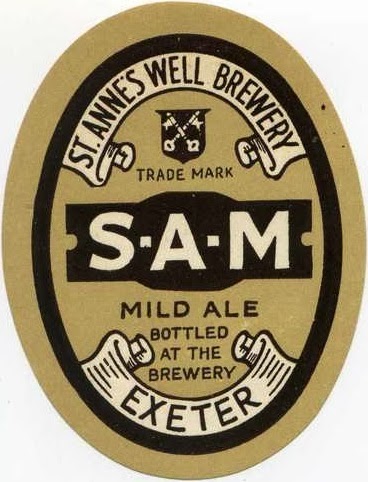
Showing posts with label St. Anne's Well Brewery. Show all posts

Wednesday, 26 February 2014

St. Anne's Well Brewery again

Pure randomness today. Partly due to pressure, partly because I spotted it on a page I'd copied for another reason.

I'm currently hard at work getting a couple of weeks ahead in my posts. When I go to the US next month, I'll have enough posts lined up that I won't need to write while I'm away. The way the schedule is packed, I'll have no time. I've just seen another of my rest days disappear

I'm developing an unhealthy interest in the St. Anne's Well Brewery. All because they dabbled in Lager in the 19th century.

I'm starting to see a pattern in chairmen's speeches at annual meetings. They often took the opportunity to make what are more political than commercial points. This was especially true of the years immediately after WW I, when it wasn't clear at what level taxation and opening hours would be fixed.

At the time, it was by no means certain that the type of retricted opening times enforced during the war would become permanent. On the other hand temperance twats were pushing for the "local option" - having local polls on whether or not to go dry. It was a difficult time for brewers and decisions which had a huge impact on there finances were completely out of their hands.

"St. Anne's Well Brewery Co., Ltd.
The annual meeting was held at Exeter, Mr. W. C. Richards presiding.

The directors recommended payment of a dividend of 10 per cent. on the ordinary shares. The trading profit for the year was £11,540, making, with £6,715, the balance from last year's account, £18,255.

The chairman, in moving the adoption of the report, said the year had been quite satisfactory. Times pressed rather hardly on the Trade, but, as he had intimated, the company had not done at all badly during the year. The shortening of licensed hours, particularly in country districts, had been a great blow to licensed victuallers, who were the principal customers of the company, he hoped that in the future, no matter what Government was in power, the hardships to the Trade would be considered. In the country districts people got up quite early, and, although people in towns did not require a drink until certain times. there were people who desired to have refreshment much earlier in the country by reason of their commencing work the first thing in the morning. And, that being so, he failed to see why they should not have it. He hoped those responsible would not listen entirely to the voices of the enemies of the Trade, but show them consideration, which would be much appreciated.

Mr. L. D. Thomas seconded the motion, which was carried."
"The Brewers' journal, 1923", page 18.

I'm sure lots of agricultural workers did get up at daylight. But the same was true of many workers in towns, too. I don't see that as a totally rural problem. Whilesale markets, for example, often had pubs with exemptions from the normal hours and would open early in the morning.

Sadly, I've no details of any St. Anne's Well beers. But I do have some from one of there Exeter rivals, Norman & Pring of the City Brewery.

Norman & Pring beers 1928 - 1961
Date Beer Style Price size package Acidity FG OG colour ABV App. Atten-uation
1928 City Special Pale Ale 6d pint bottled 0.05 1008.7 1036.1 3.55 75.90%
1949 Mild Ale Mild 1/1d pint draught 0.06 1006.8 1032.6 21 brown 3.35 79.14%
1953 Imperial Strong Ale Strong Ale 1/6d nip bottled 0.05 1051.8 1081.2 16 + 40 3.74 36.21%
1953 Light Ale Light Ale 6d nip bottled 0.05 1011 1031 17 2.58 64.52%
1955 Nap Ale Strong Ale 1/- half bottled 0.05 1011.8 1037.7 33 3.35 68.70%
1955 Pale Ale Pale Ale 11d half bottled 0.05 1009 1031.1 20 2.86 71.06%
1960 Pale Ale Pale Ale 10d half bottled 0.02 1003.8 1031 15 3.40 87.74%
1961 Tan Bitter Pale Ale 24d pint draught 0.04 1005.2 1038.4 18 4.15 86.46%
Sources:
Whitbread Gravity book held at the London Metropolitan Archives, document number LMA/4453/D/02/001
Whitbread Gravity book held at the London Metropolitan Archives, document number LMA/4453/D/02/002

I just checked the FG of that Imperial Strong Ale. I assumed that it was a typing fault. It wasn't. It really says that in the Gravity Book, though I'm inclined to doubt that it's true.

Monday, 24 February 2014

St. Anne's Well Brewery in the 1920's

Funny the stuff you comae across when you're not looking for it. In this case, it's random stuff about the St. AAnne's Well brewery in Exeter.

You may remember that this brewery has come up before. Principally because, bizarrely, it was one of the earliest breweries to make Lager in Britain. Still not sure why a small westcountry brewery should have been so quick to get into Lager.

This account of a rate assessment appeal tells us something about the changes in the brewing industry brought about by WW I.

"ASSESSMENT OF BREWERY.
EXETER APPEAL SUCCEEDS.
RECORDER AND COSTS QUESTION.

The appeal of the St. Anne's Well Brewery Co., Limited, against the assessment of their premises in Lower North-street, Exeter, was allowed at the Exeter City Quarter Sessions yesterday, before the Recorder, Mr. Percival Clarke.

Yesterday was the second day of the hearing, and the Recorder decided that the amount offered, £850, should have been accepted, and must be the figure to be placed the rate-book. But he pointed out that, although the Assessment Committee, representing the ratepayers, were technically the losers, they in fact had won, and he would only allow appellants' costs up to June 3 (the date of the offer of £850), the respondents to be allowed the costs after that date.

Mr. E. W. Wingate Saul. K.C., Mr. G. Dodson, and Mr. H. Lhind Pratt (instructed Messrs. Sparkes, Pope, and Thomas) were for appellants, and Mr. J. A. Hawke K.C., and Mr. G. D. Roberts (instructed Mr. F. Thomas) for the Exeter Assessment Committee, the respondents.

Continuing the case for the respondents, Mr. C. G. Eve, valuer, of London, said in valuing the site he consulted with Mr. Body (whom respondents called the previous day) and arrived the conclusion as he did — 2s. per foot. Apart from the site, his valuation was quite independent, his basis being the structural efficiency value. He reckoned the prewar values, and added a percentage for the present-day increase. The pre-war figure came to £13,000 for the whole of the buildings, including £300 for the well. Then he added one-fifth for the increase since the war, as rents had gone up about 20 per cent., and arrived at a total figure of £16,333 capital efficiency value, of the buildings.

AN OBSOLETE CUSTOM.
He had jettisoned part of the buildings, as the old custom of storing beer was obsolete and the storing places had no rateable value. The present efficiency capital value of the plant and machinery placed at £7,439. He took off £128 for the site.

Cross-examined Mr. Saul, witness said the St. Anne's Well Brewery could turn out a little more than the Heavitree Brewery because it had more hot liquor capacity.

Do you know the number of men employed at Heavitree Brewery compared with the men at St. Anne's Well Brewery? —No.

Would not the number of hands had to employ be material factor in the minds of the hypothetical tenant?— Witness replied that it would be difficult to make a comparison between the number of employes at various breweries, because there were many different departments.

I suggest to you that if you thought it material it would be quite easy to obtain information solely in regard to the brewery and the bottling stores?— The task would be greater or less according to the three breweries in Exeter. Some breweries employ too many hands. They have employes who have worked for them for 50 yeans, and they don't like to get rid of them. Thty would keep an old man of 70 when young matn had nothing to do. I place the rateable value of the brewery at £1,160.

This concluded the case for the Assessment Committee.

HEAVY GRAVITY BEER.
Ivanhoe Alan Peiser, London, who had had extensive experience in the valuation of breweries for rating purposes, called by appellants, said in 1901 special buildings were erected at St. Anne's Well Brewery in order to deal with the heavy gravity beer trade. In 1902 the brewery, including these new buildings, was assessed at £650, but after 1902 the heavy gravity trade fell off completely, and the development of the new buildings never came about. Therefore the valuation of £650 was on the high side, they had property which they cou'd not use beneficially. Last year the output of the Heavitree Brewery was larger than that of St. Anne's Well by nearly 3,000 barrels.

The Recorder: Is that because it is capable of gieater output, or because they got more orders?

Witness: More orders would account for it, but Heavitree Brewery is capable of a larger output.

Witness continued that, Heavitree Brewery employed 13 men in the brewing of beer and placing in the carts. St. Anne's Well employed 16 men on the same work.

Mr. Dodson remarked that it was suggested that St. Anne's could run more cheaply than Heavitree because of its greater facilities. But those were the facts. St. Anne's also used more city water than Heavitree.

Witness further rated that the output required to satisfy the trade in the various breweries, and what, in fact, they were actually producing, was: —St. Anne's Well, 20,000 barrels per annum; Heavitree, 22,500; and City, 27,750. The rateable value per barrel on these bases was:- St. Anne's Well, 1s.; Heavitree, 7.5d.; and City, 6d. He valued the site at the same figure which Mr. Body placed upon the Heavitree site — 1s per foot. Hos estimate of the rateable value was £651.

"UNFAIR BURDEN."
Mr. Saul said his clients were not seeking in any way to avoid the fair their share of the poor rate of the city. But they did feel, as did the City and Heavitree Breweries, that the figures that had been imposed upon them Mr. Body when he made the 1923 valuation, was not a fair burden. In the two cases of the City and Heavitree Brewery, Mr. Body's valuation was proved to be far in excess of what was a right and proper figure at which to value the premises.

In 1902 the City Brewery was rated £329. Mr. Body thought it right increase that in 1923 to £1,070. On threat of an appeal to the Sessions, the Assessment Committee reduced that amount to £650. In the same way Mr. Body raised the Heavitree valuation from £400 to £780, ans eventually the Court decided that the figure to be inserted in the rate-book was £595. That was, therefore, the correct valuation of the Heavitree Brewery, and £650 was the correct valuation of the City Brewery.

The Assessment Committee were compelled bu law to see that people were rated fairly and equitably, and it was a ground of appeal by any ratepayer to show that somebody else was not rated fairly and equitably. It did not lie the mouth of Mr. Body to come there and say that in those cases the Assessment Committee lacked courage, and that they should disregard the settlements made by the body of which he was the principal representative because he found a difficulty in his way when it was pointed out to that his enormous figures had been substantially reduced by the Assessment Committee.

NO COMPARISON.
They could not decide the case comparison. They could not do what the Assessment Committee had done in that case, and say that there was a certain percentage increase in the City and Heavitree Breweries, and therefore they must have the same percentage of increase in the St. Anne's Well Brewery. The City assessment, it now stood, was practically double what it was in 1902. But they could not take the 1902 assessment and say that bceause the Heavitree and City Breweries had a substantial increase on their assessments since then they must also make a substantial increase in the St. Anne's Well, because they were not comparing like with like, in view of the additional buildings put up in 1901 and rendered practically useless after 1902.

It did not help the Court to talk about the dividends of the brewery companies being doubled or trebled. The dividends did not represent the profits made from the brewery, but from the sale of the beer after it had been sold in the tied houses. Furthermore, in the St. Anne's Well Brewery there was a wine and spirit business, which also affected the dividends.

Mr. Hawke said Mr. Peiser had omitted in his valuation buildings which, according to Mr. Body's valuation, had a total value of £1,427. This meant addition £71 on Mr. Peiser's estimated rateable value £651. He had also omitted machinery to the value £1,079.

RECORDERS JUDGMENT.
Delivering judgment, the Recorder said that after going over the brewery it seemed to him to be as nearly a model brewery as it was possible to get. He could not draw real comparison between the opposing valuations put forward, because Mr. Peiser's was incomplete. It was within his power to find an assessment which was higher than £850 (the amount finaliy offered appellants by the Assessment Committee), but he was very reluctant to do it. He could not help feeling that the £850 offered should have been accepted, and he decided that that must be the figure to placed in the rate-book.

QUESTION OF COSTS.
The question of which party had won the case arose on the question of costs, for when Mr. Hawke claimed the costs, Mr. Saul submitted that appellants, and not respondents, had won the case. The appeal had been launched because the most the Assessment Committee would reduce the rating to was £1,000. The case had not been fought on the fact that £850 was the proper amount. The figure they had fought about was £1,300 or a little under the valuations of Mr. Body and Mr. Eve. He had never heard of the successful appellant having to pay the costs of his opponents.

The Recorder said thai the Assessment Committee was representing the ratepayers, and the ratepayers should not be saddled with the costs, even their own costs, on a serious issue like that. Although technically they were losers, in fact they had won and he would allow appellants' costs to June (the date the offer of £850), and the respondents would allowed the costs after that date. The costs of the 11 cases withdrawn would be the respondents."
Western Morning News - Saturday 04 October 1924, page 3.
See - the buildings for ageing beer were obsolete because beer was no longer aged. The same was true of the parts of the premises dedicated to making high-gravity beers. Aged and higher-gravity beers had been losing popularity for decades before WW I, but the war was the final nil in their coffin.

Heavitree and the City Brewery were also in Exeter. Interesting that there were three breweries of such a similar size in the city. That must have led to intense competition. In the 1970's Nottingham, where most of the trade was in the hands of the three local breweries, had some of the lowest beer prices in the country.