Friday, 31 December 2021

Beer is Bust beers

To go with yesterday's post of an advert listing various beers on sale here are analyses of most of them.

The ones described as "all" beers selling for 3 shillings or so a quart are those with gravities in the low 1030ºs. They're things like Brown ale, Light Ale and low-gravity Stouts. A beer selling for 3 shillings a quart would be around 10d or 11d when packaged as a half pint.

1/4 (16d) seems like pretty good value for a beer as strong as Bass or Worthington. I'm sure the advert got it wrong when it spoke of red and green labelled Bass. Their Pale Ale came with either a red label (bottle conditioned) or a blue label (brewery conditioned). It was Worthington which had Green Shield, the brewery-conditioned version of White Shield.

In the strong Pale Ale segment, Double Diamond, Tavern and Ben Truman were less value for money, being only 0.5d per half pint cheaper, despite being considerably weaker than Bass or Worthington.

Beer is Bust beers
Year Brewer Beer Style Price size OG FG ABV App. Atten-uation colour
1955 Bass Pale Ale (Blue Triangle) Pale Ale     1063.5 1003.1 7.96 95.12% 19
1955 Bass Pale Ale (Red Triangle) Pale Ale     1063.2 1009.6 7.02 84.81% 19
1953 Bass Barley Wine Barley Wine 20d nip 1104.6 1036.3 8.90 65.30% 80
1956 Ind Coope Double Diamond Pale Ale 17d half pint 1048.3 1012.7 4.62 73.71% 20
1956 Simonds Bitter Ale Pale Ale 12d half pint 1030.1 1010 2.60 66.78% 25
1956 Simonds Berry Brown Ale Brown Ale 16d half pint 1031.9 1011.9 2.58 62.70% 85
1957 Simonds Luncheon Stout Stout 11d half pint 1033.6 1014.9 2.41 55.65% 275
1959 Simonds Tavern Export Ale Pale Ale 17d half pint 1045.8 1013 4.25 71.62% 18
1959 Simonds SB Light Ale Pale Ale 10d half pint 1034.2 1010.3 3.09 69.88% 19
1956 Truman Trubrown Brown Ale 10.5d half pint 1034.9 1016.5 2.37 52.72% 95
1956 Truman Light Ale Pale Ale 10d half pint 1031.7 1011.4 2.62 64.04% 19
1956 Truman Eagle Stout Stout 11d half pint 1034.8 1016.1 2.41 53.74% 225
1959 Truman Ben Truman Pale Ale Pale Ale 16d half pint 1049.9 1010 5.20 79.96% 17
1953 Watney Yorkshire Stingo Barley Wine 17d nip 1089.6 1031.7 7.52 64.62% 110
1956 Watney Brown Ale Brown Ale 10d half pint 1032.2 1011.1 2.73 65.53% 120
1957 Watney Special Stout Stout 13d half pint 1042.3 1009.4 4.28 77.78% 200
1959 Watney Pale Ale Pale Ale 10d half pint 1033.2 1010.1 2.99 69.58% 23
1955 Worthington India Pale Ale (Green Shield) IPA     1063.3 1009.4 7.06 85.15% 18
1955 Worthington India Pale Ale (White Shield) IPA     1063.7 1002.9 8.02 95.45% 18
Source:
Whitbread Gravity book held at the London Metropolitan Archives, document number LMA/4453/D/02/002.


Dutch Pils 1945 - 1950

Yes, time for another fun table of Dutch beer analyses. For that most iconic of Lager styles, Pils.

Most Dutch beers bounced back to just about pre-war strength pretty quickly. The first couple of years after the war gravities were lower, but by 1947 were back to where they had been in 1939.

Take Pils, for example. In 1939 eight examples averaged 11.84º Plato, 4.72% ABV and 76.48% apparent attenuation. In analyses taken between 1947 and 1950, the gravity averages out a little lower. However, an increased degree of attenuation left the ABV almost the same.

Those lucky Dutch drinkers. Beer back to its proper strength after just two years of peace.

Dutch Pils 1945 - 1950
Year Brewer Beer OG Plato FG Plato ABV App. Atten-uation Colour
1945 Heineken Pils 8.21 1.78 3.26 78.87% 0.55
1946 Oranjeboom Pils 7.87 1.95 3.03 75.81% 0.65
  Average   8.04 1.87 3.14 77.34% 0.60
1947 Amstel Pils 11.13 2.45 4.56 78.74% 1.30
1947 Heineken Pils 11.64 2.84 4.60 76.44% 0.62
1947 Oranjeboom Pils 10.96 2.11 4.60 81.42% 0.75
1947 Van Vollenhoven Pils 11.41 2.48 4.70 79.03% 0.68
1947 ZHB Pils 10.92 2.78 4.27 75.36% 0.58
1949 Amstel Pils 11.17 2.49 4.53 78.47% 0.70
1949 Bavaria Pils 11.87 1.86 5.21 84.94% 0.52
1949 Brand Edel Pilsener 11.34 2.32 4.72 80.27% 0.52
1949 Dommelsch Pils 11.47 1.51 5.20 87.35% 0.58
1949 Drie Hoefijzers Pilsener 11.00 3.13 4.07 72.43% 0.38
1949 Grolsch Pils 11.87 2.10 5.15 82.98% 0.52
1949 Heineken Pils 12.06 3.64 4.40 70.81% 0.48
1949 Oranjeboom Pils 11.03 1.97 4.76 82.78% 0.52
1949 Phoenix Pils 10.77 1.92 4.61 82.79% 0.32
1949 Van Vollenhoven Pils 11.64 1.91 4.94 84.22% 0.58
1949 ZHB Pils 11.18 2.35 4.50 79.71% 0.48
1950 Brand Edel Pilsener 11.61 2.99 4.53 75.12% 0.42
1950 Phoenix Pils 11.26 2.36 4.65 79.77% 0.70
  Average   11.35 2.40 4.67 79.59% 0.59
Source:
Rapporten van laboratoriumonderzoeken naar producten van Heineken brouwerijen in binnen- en buitenland en naar producten van andere brouwerijen held at the Amsterdamse Stadsarchief, document number 834 - 1794.


Thursday, 30 December 2021

Beer is Bust

If you're wondering about that title, it comes from the advert below. And is obviously a joke on the campaign of the brewing industry at the time call Beer is Best.

This advert provides an interesting snapshot of what types of beer were on offer in the late 1950s.

BEER is BUST - wide open!
Maybe you KNOW us best as WINE MERCHANTS but we can also tell you ALL there is to know about BEER - if you're interested. What's mere, we STOCK far MORE different BEERS than MOST brewers — because we have NO "ties" at all. We are not bound to sell ONLY this beer or that: we stock ALL the good been you are likely to ask for -  BECAUSE hate to lose a sale.
Worthing Gazette - Wednesday 26 June 1957, page 9.

First, the standard beers. Where they don't even bother mentioning the individual types, just the brewery.

We stock all SIMONDS beers, 3/- qt; all TRUMANS beers, 3/1 qt. ; all WATNEYS, 3/1 qt; all WHITBREADS, 3/7; also Fremlins, Tolly, Mackesons, Friary, Younger's, Eldridge Popes, Benskins, Flowers, and Uncle TOM COBLEY's too if you even SUGGEST you might want it.
Worthing Gazette - Wednesday 26 June 1957, page 9.

Fascinating that Whitbread was sold at a premium price compared to the other breweries. Especially surprising as two of the other brewers - Truman and Watney - were Whitbread's direct rivals. 

Next a selection of Burton Pale Ales.

BASS, of course — both Red and Green labels - in pints 2/7, half-pints 1/4, and nips 1/-; WORTHINGTON, same prices; Double-Diamond 1/4 ; TAVERN Ale, 1/3.5; Ben TRUMAN 1/3.5; and all other best ales.
Worthing Gazette - Wednesday 26 June 1957, page 9.

As relatively strong beers for the period, this set is much more expensive: 1/4 for a half pint when the standard beers sold for 3/- per quart.

I love the way the strongest ones are described as "he-man" beers:

And the HE-man beers: Simonds 5-X at 1/4 per nip; Stingo 1/6 nips: Barley Wine 1/8 nips. Lay in some beer at HOME and get the GARDENING done this weekend.
Worthing Gazette - Wednesday 26 June 1957, page 9.

A bit unusually, they still sold beer in casks.

If YOU like it from the WOOD - for real BEERMANSHIP - we can cope with that too: try a "PIN" (4.5 gallons), it should last you ALL evening! SIMONDS 30/-; Whitbreads Bitter 57/-; Younger. Scotch Ale No. 3 57/-, Worthington 57/-. Or any OTHER brew you fancy, in ANY size you like from a PIN to a HOGSHEAD (72 gallons - lasts MANY people a whole WEEKEND).
Worthing Gazette - Wednesday 26 June 1957, page 9.


Though they got the size of a hogshead wrong: it's 54 gallons. I'm guessing that the Simonds beer must have been Mild Ale, given the price relative to the other ones mentioned.

They were very keen on cans. I doubt any advert today would mention the method of can disposal suggested.

Beer in CANS is excellent - tastes BETTER than beer in bottles - honestly, And SO handy! NO empties to return. Just chuck them over the hedge; easy to CARRY, to OPEN, to DRINK. Keeps perfectly for MONTHS - if nobody sees it - and we can even POST a dozen cans to you and you get them NEXT morning - NO charge for postage or packing. We STOCK 8 kinds of BEERS in CANS - biggest seller is TAVERN at 16/- dozen. For a BARBECUE up the CREEK take some CANS in your CANOE.
Worthing Gazette - Wednesday 26 June 1957, page 9.

Wow - 8 types of canned beer. The crazy bastards.

Of course, Lager was also on offer. Only a couple of types, mind.

It you like it LIGHT and mild, fresh and FROTHY, how about LAGER? We stock Barclays 1/3; TUBORG and Carlsberg 1/5; HEINEKEN'S 1/7. One LAST try to get YOUR order.
Worthing Gazette - Wednesday 26 June 1957, page 9.

Finally, a selection of Stouts. 20 different ones, no less.

About STOUT now, which we nearly forgot to mention. We stock GUINNESS of course, in 4 sizes: 4/3 qt., 2/2 pt., 1/1.5 half-pint, 11d nip. MACKESONS, in bottle or can. OATMEAL Stout, PLAIN stout and FANCY stout - perhaps a score of them. Very good for NURSING MOTHERS. Very good EXCUSE for nursing mothers. We deliver to you IMMEDIATELY if you say so throughout the TOWN area; and regularly EVERY WEEK in all COUNTRY districts. A postcard brings us RUSHING to your door.
DOMINIC
Peter Dominic Limited
Worthing Gazette - Wednesday 26 June 1957, page 9.

How quaint, ordering by postcard. 

Next time - some details of the beers mentioned.

Dutch Bokbier in 1948

While in the late 1940's beer in the UK was still getting weaker, things were picking up in Holland. In 1948 there was even some full-strength Bokbier. Those jammy continental bastards.

Though not every beer in the table was really Bok-strength. Currently the Dutch Boks sold in Autumn have to be at least 16º Plato. Only four of the examples meet that criterion. Pre-war analyses have gravities ranging from 15.14º to 17.63º Plato, averaging 16.8º Plato.

The ABV of every beer is certainly below what would be expected today, where 6.5% is the norm. This set only has one over 6% ABV and one at just 4.4% ABV. The pre-war set varied between 5.51% ABV and 6.85% ABV, averaging 6.03%.

Colours are quite varied. That's the Brand scale, by the way. If my little conversion table is correct, 14.5 to 32 Brand is approximately 20 to 40 SRM. Or dark brown to near black, in layman's terms.

Almost back to pre-war Bok, but not quite. Still, was better than the situation in the UK, where average gravity was about at its nadir..

Dutch Bokbier in 1948
Brewer Beer OG Plato FG Plato ABV App. Atten-uation Colour
Heineken (Ams) Bok 16.42 5.83 5.65 65.94% 22
Heineken (Rtm) Bok 16.15 5.46 5.69 67.58% 20
Oranjeboom Bok 16.08 5.28 5.82 68.53% 32
Drie Hoefijzers Bok 15.73 5.00 5.69 69.53% 14.5
Grolsch Bok 15.18 3.87 6.04 75.62% 22
Hengelo Bok 15.81 4.61 5.95 72.10% 22
Bavaria Bok 14.10 3.83 5.41 73.92% 19
Amstel Bok 15.65 7.27 4.42 55.05% 15.65
Phoenix Bok 15.23 5.04 5.39 68.21% 20
ZHB Bok 16.05 5.97 5.47 64.25% 22
Van Vollenhoven Bok 15.73 5.11 5.66 68.84% 19
Source:
Rapporten van laboratoriumonderzoeken naar producten van Heinekenbrouwerijen in binnen- en buitenland en naar producten van andere brouwerijen held at the Amsterdamse Stadsarchief, document number 834 - 1794.


Wednesday, 29 December 2021

Let's Brew Wednesday - 1881 Whitbread XPS

One step up in strength from Porter was XPS. The name presumably stands for Export Stout. It’s about the same as a Single Stout for the domestic market.

I’ve no real idea where it was exported to. It could have been pretty much anywhere in the world. Possibly even as far away as Australia, which at the time was importing large quantities of British beer.

The grist is mostly made up of the same elements as the Porter: pale, brown and black malt. In slightly different proportions, however. There double the percentage of brown malt and less pale malt. There’s also one extra element: sugar. I’ve guessed No. 3 invert, as there’s no indication of type in the brewing record.

Two types of English hops, from the 1880 and 1881 harvest, and one type of American hops, from 1881, graced the copper. I’ve guessed that there were also quite a lot of dry hops, this being a beer that would have to stay sound for a long time.

For that same reason I’ve reduced the FG from the 1021.9º listed in the brewing record.

1881 Whitbread XPS
pale malt 11.50 lb 71.88%
brown malt 2.25 lb 14.06%
black malt 0.75 lb 4.69%
No. 3 invert sugar 1.50 lb 9.38%
Cluster 120 mins 2.00 oz
Goldings 60 mins 4.00 oz
Goldings 30 mins 4.00 oz
Goldings dry hops 1.00 oz
OG 1073
FG 1016
ABV 7.54
Apparent attenuation 78.08%
IBU 122
SRM 34
Mash at 149º F
Sparge at 170º F
Boil time 120 minutes
pitching temp 57º F
Yeast Wyeast 1099 Whitbread Ale


Tuesday, 28 December 2021

Light Mild 1946 to 1964

A bit of a change of pace, today. Or perhaps a return to the past. To those heady days of the 2010s, when every day I'd post tables of beer analyses. Let's see if we can relive them.

This is some information on post-war Light Mild which I've assembled for another project. One which, doubtless, I'll bore the eyebrows off you with later.

Where does Light Mild become Dark Mild? I've plumped for 46 EBC (old scale). Totally arbitrary, and possibly a little too high.

Talking of high, the degree of attenuation is just that in most examples. With the odd exception like Whiitaker Best Mild. Some are crazily high at over 90%, resulting in some Milds over 4% ABV. Which is pretty damn strong for a post=war Mild, Light or Dark. On the other hand, a few can't even scrape up to 3% ABV.

Light Mild 1946 to 1964
Year Brewer Beer Price per pint OG FG ABV App. Atten-uation colour
1946 Barclay Perkins Ale 13.5 1031.1 1008.8 2.89 71.70% 19.5
1949 Brickwoods Mild Ale 13 1033.2 1004.8 3.7 85.54% 20.5
1949 City Brewery Mild Ale 13 1032.6 1006.8 3.35 79.14% 21
1949 Mitchell & Butler XX 18 1034.6 1003.9 4 88.73% 35
1949 Portsmouth United Mild Ale 13 1029.3 1003.1 3.41 89.42% 19
1949 St. Annes Brewery Mild Ale 13 1034.9 1003 4.16 91.40% 20
1951 Vaux Mild Ale 15 1035.6 1002.9 4.27 91.85% 24.5
1951 Fremlin XXL 12 1029.4       22
1951 Shepherd Neame X 12 1031.4       24
1952 Lees K   1031       34
1955 Thwaites Mild Ale 16 1032.2 1006.1 3.39 81.06% 40
1959 Ramsdens Best Mild 13 1035.5 1006.5 3.63 81.69% 35
1959 Websters Best Mild 13 1034.9 1004.4 3.81 87.39% 20
1959 Bentleys Mild 13 1032.9 1005.4 3.44 83.59% 30
1959 Ramsdens Mild 12 1029.2 1004.7 3.06 83.90% 45
1959 Whitaker Best Mild 13 1033.1 1010.2 2.86 69.18% 45
1961 Cornbrook Keg Mild 17 1035 1002.3 4.09 93.43% 20
1961 Ansell King Pin Mild 19 1037.6 1006.7 3.86 82.18% 45
1961 M & B Keg Mild 19 1038.5 1009.9 3.58 74.29% 45
1962 Ind Coope Mild Ale 14 1033.7 1009.5 3.13 71.81% 20
1962 McMullen Mild Ale 14 1034 1006.3 3.46 81.47% 20
1964 John Smith Mild Ale 15 1030.9 1008.5 2.8 72.49% 30
  Average   14.3 1033.2 1006.0 3.5 82.12% 28.8
Source:
Whitbread Gravity book held at the London Metropolitan Archives, document number LMA/4453/D/02/002.


Monday, 27 December 2021

Heineken, the war and the Republic of Ireland

I've just renewed my annual subscription to the British Newspaper Archives. Best start making sure that I get my moneys worth out of  it.

It's a slightly odd item about a patent on a type of crate.

"DUTCH FIRM'S APPLICATION GRANTED
Expressing the view that it was a reasonable application Mr. Justice Kingsmill Moore granted an application in the High Court on behalf of Messrs. Heinekens Bierbrouwerij Mattschappij. N.V. of Amsterdam, to extend the time for the filing of a petition for the extension of the period of a patent. He granted the extension to April 30. 

Mr. Kenny, S.C., who, with Mr. Y. Danaher (instructed by Messrs. Bennett and Walsh) appeared for the firm moved on the affidavit of Mr. Thomas E. P. Bennett. solicitor, in which it had been stated that Messrs. Heinekens were the registered proprietors of the patent which related to an invention of a type of wooden box, or packing case for holding bottles and a method of placing bottles in it. 

The patent, the affidavit stated, was first granted on June 19, 1935, to Mr. John Patrick Fitzgerald. No. 12A Mountpelier Hill, Dublin. The company were first registered as proprietors of it on October 16, 1935, under an assignment of September 2, 1935, from Mr Fitzgerald. It was due to expire on January 31. 

GERMAN OCCUPATION
As a result the occupation of the Netherlands by the German armed forces during the recent war and the consequent destruction of property and disruption of business and communications, the company's business had been seriously disorganised for a long time, most of their documents and records had been lost or destroyed, especially at their offices in Rotterdam, and communication with their agents and representatives in other countries, particularly in Ireland, was impossible. Their normal routine business relations with Ireland were only recently restored. 

It was not until last August that they had become aware that the patent would expire on January 31. That information had been conveyed to them by Messrs. Legg Brothers, Dublin, the who were the licensees of patent in the Republic of Ireland, it was stated in the affidavit."
Irish Independent - Tuesday 19 December 1950, page 7. 

Not so sure Heineken were being totally honest. There are plenty of pre-war and wartime documents from Heineken's Rotterdam brewery in the archives. I think they're playing on the bombing of Rotterdam. Which didn't affect Heineken's brewery there.


Sunday, 26 December 2021

Becoming a modern person


Yesterday's Drinkalongathon was a turning point. Where I threw away the shackles of the past and embraced the present. A really big moment for me. 

What was new? I used my phone to take the photos. Other than for the first post. Which was taken by my fairly crappy camera.

I even managed to accomplish this feat with no, well, only minimal help from family members. I feel so proud. My ambition for 2022 is to learn how to get onto the internet with my phone. I may even start taking my phone with me when I leave the house. Then I can walk around like a zombie just like everyone else. Can't wait.

Saturday, 25 December 2021

Drinkalongathon 2021 - St. Emilion and duck


17:03

Lots of work, this cooking Christmas dinner shit. Luckily, I've had the strings and eggs to help out.

Be ready for my next post. That's when everything will come together: string, eggs, light bulbs, heavy bulbs. Everything. Just wait a few minutes while I have a quick Bowmore and we can get started on the serious business.


Drinkalongathon 2021 - white wine from Alsace and cheese thingies


16:05

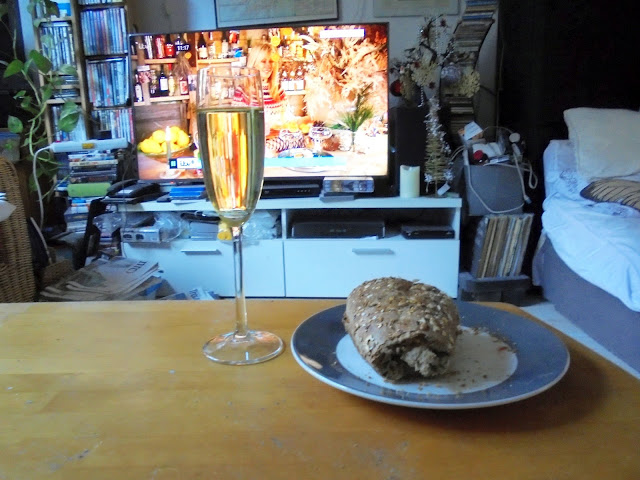
How posh are we? Not very, really. Goat's cheese and white wine. The cheesiness contrasting with the wineniness. Great thingy. Combination that's the word.

You'll be happy to hear that I rescues my string just in time from the oven Crispy golden black but not quite charcoal.Just how I like my bacon. I hope none of you over-baked your string. That would be a tragedy, given what;s coming up.

Drinkalongathon 2021 - quick whisky


15:30

While Dolores prepares the oranges, a quick whisky dash from the Islay pool. Its smokiness matching that coming from the oven. Best check nothing bad has happened to my string.

Drinkalongathon 2021 - St Bernardus Abt and a long phone call with my brother


13:30 

Christmas wouldn't be Christmas without some Abt. My brother is on his own this year. Wisely not risking travelling to London to see his family. Chatting with him right slowed my drinking down.

I need to pick up the pace. Another Bowmore next, I think. The stuffing needs to be made, too.

Best get those eggs boiling, too.

Drinkalongathon 2021 - the first whisky


13:07

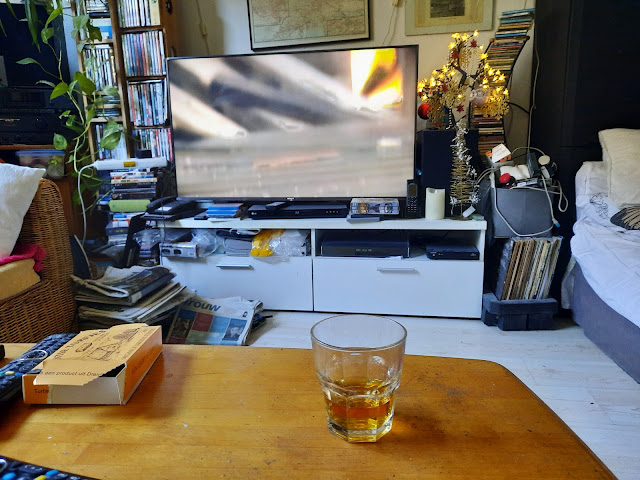
Time too pick up the pace. With a traditional Islay whisky - Bowmore Legend, the cheapest I could find -  and James Martin. The smoky depths combine perfectly with the salty shallowness of the TV programme.

Just as well I took time to check my string. One was over regulation length and needed to be trimmed. Now where are my eggs and light bulbs? I'll be needing them soon. I hope Alexei didn't use one in his full English.


Drinkalongathon 2021 - bacon sarnie and fino sherry


12:30

 It's a late start this year. I was too busy enjoying my kip. No point getting up early as we got our presents according to German tradition - yesterday evening.

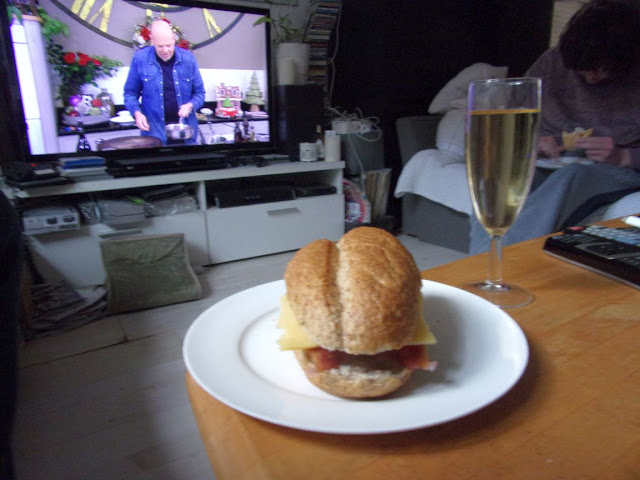
I still kick off with a traditional bacon sandwich and some sherry. A vert dry one, obviously. Sweet sherry just wouldn't go with bacon. The salty yumminess of the bacon combines brilliantly with the grapey dryness of the sherry. Always a good way to start the day.

Now is a good time to check that you have the correct number of pieces of string and that all are regulation length.

Friday, 24 December 2021

Get ready now for Drinkalongathon 2021

Sorry I'm a bit late with the list this year. I would come up with some lame excuse about being busy. But I haven't. 

Mostly doing stuff like discussing with Alexei how long it would take to walk to Gibraltar. And the best route to take. I'd go for one along the coast rather than the more direct route over the Pyrenees. Far too much climbing in the latter one. Up to 500 hours. That's how long it would take according to Google maps. The exact number depending on the route.

But I digress. Time for the list of items required for tomorrow's Drinkalongathon. You've still got a couple of hours to get them

1 bottle of Islay whisky
1 crate of St. Bernardus Abt
1 bottle Fino sherry
2 bottles of port
2 bottles of some sort of red wine
2 bottles of some sort of fizzy wine
6 hard boiled eggs
another crate of St. Bernardus Abt
3 soft boiled eggs
1 box of matches (extra long)
3 candles (not scented or coloured or any shit like that, just plain fucking white one.)
1 bottle of reserve Islay whisky (Lagavullin, if you can afford it. Bowmore is the only one I can afford. And not even a full litre, just a measly 70 cl.)
9 pieces of string
2 crates of alcohol-free beer*
1 bag of mixed nuts (with all the peanuts taken out and destroyed by fire.)
7 under-boiled runny eggs
1 protractor
2 light bulbs
4 raw eggs
3 heavy bulbs
1 bottle of gin.(I prefer the cheapo litre bottles Lidl in Germany sells for 8 euros a pop.)
1 crate alcoholic tonic water (If such a thing exists.)
1 final bottle of Islay whisky (just to be on the safe side)

A shirt list this year to reflect our plague-ridden times. I would have included 1 bottle of bourbon but Andrew polished off my value German Lidl bourbon. The twat.


* This is obviously a joke. Of course no drink substitutes are required,

Let's Brew - 1881 Whitbread Porter

Though in the wane elsewhere in the country, Porter was still a big deal in London. Though no longer Whitbread’s biggest seller – that honour had passed to X Ale – it was still number two. In 1881, they brewed 75,423 barrels of Porter.

Called simply “P” in the brewing records, it had originally been the Running Porter, i.e. the unaged version. By this time, “K”, the Keeping Porter, had been discontinued for around a decade and the giant vats used to mature it had been ripped out.

Ever since the invention of black malt in 1817, London Porter almost always had a grist of pale, brown and black malt. Though over time the proportion of the three varied. Most brewers outside the capital had switched to a simpler grist of just pale and black malt. Interestingly, Whitbread’s Porter was all malt, while their Stouts contained sugar.

Two types of hops were employed, both from the 1880 harvest. One was English and the other “Bavarian”, which probably means Hallertau.

1881 Whitbread Porter
pale malt 11.50 lb 86.79%
brown malt 1.00 lb 7.55%
black malt 0.75 lb 5.66%
Hallertau 90 mins 2.75 oz
Goldings 30 mins 3.00 oz
Goldings dry hops 0.50 oz
OG 1055
FG 1010
ABV 5.95
Apparent attenuation 81.82%
IBU 65
SRM 27
Mash at 149º F
Sparge at 160º F
Boil time 90 minutes
pitching temp 60º F
Yeast Wyeast 1099 Whitbread Ale