Sunday, 15 June 2008

Charrington's Mild and Bitter 1939 - 1969

It's time to take a closer look at one of the other great London breweries, Charrington's. A rather different beast to the Porter brewers I've concentrated on until now.

Established on the Mile End Road in the East End of London in the middle of the 18th century, Charrington's was principally an Ale brewer. They experienced a rapid growth in the second half of the 19th century when public taste shifted away from Porter. Theirs was reckoned to be the best Mild Ale brewed in London.

Charrington's merged with Bass in 1967 to form Bass Charrington. The brewery closed in 1975 and only the office (and the front right corner of the photo) and front enclosing wall are still standing. When I first lived in London, although the brewery had disappeared, Charrington's IPA (brewed elsewhere in the Bass empire) was still one of the commonest draught beers. I suppose revisionists wouldn't class it as a "real IPA" as it was in the London style. Consulting my 1983 Good Beer Guide, I see that at that time it was brewed at M & B Springfield in Wolverhampton and had an OG of 1039.

First is a graph showing the gravity of Charrington Mild, PA (Bitter) and Best PA (Best Bitter) from the outbreak of WW II until the 1960's. You'll notice that the curve for Mild is shallower than for the Bitter. Also that the two are slightly out of sync.


The second graph shows the price per pint in a public bar. During the course of WW II the cost of a pint of Mild more than doubled, rising from 5d in 1939 to 11d in 1945. Still, not as bad as WW I.

The source of this information is, as usual, the Whitbread Gravity Book.

Saturday, 14 June 2008

Austro-Hungarian beer production 1887-1893

Yesterday was very exciting. The postman delivered more books. You can never have enough books. I'm not sure Dolores agrees.

Three books came. One is a particular favourite of mine: "Zeitschrift für das gesammte Brauwesen". The 1889 edition. It never disappoints. Just quickly flicking through I found half a dozen tables of enthralling statistics. Stuff very relevant to one of my summer themes: Lager.

That's no coincidence, of course. I deliberately ordered the book because I knew it would be packed with bottom-fermenting delights. It's a wonderfully information-rich source for a period (the end of the 19th century) when central European brewing techniques were starting to conquer the world.

I've always had a fascination for the Austro-Hungarian Empire. Probably connected with the way in which one of the largest countries in Europe disappeared overnight at the end of WW I. Or how its legacy refuses to disappear.

Judging by the wonderfully detailed figures, the Austro-Hungarian beer taxation system must have been based on gravity. Lucky for me. And you. It means we can see exactly how much of each strength of beer was brewed. You think that's dull? Then I think you're reading the wrong blog. Try Stonch's. He has more populist stuff about strippers and Hollyoaks.

So just us serious saddoes left. I won't count how many of us there are. Let's just say we won't need to rent a bus.


The vast majority - 95% - of beer produced was in the range 10-13º Balling (1040 - 1052). Over 50% was 10º Balling. What does that tell us? That not much has changed in the strength of beer brewed in the Czech Republic over the last 120 years. The situation today is remarkably similar. It might surprise some that the classic gravity of 12º is so poorly represented.

Here are the raw numbers. This is for the hardcore only.


While this is typical for central Europe, a similar table for Britain would look very different. In the 19th century, little British-brewed beer had a gravity below 1052 (13º Balling). A Pale Ale of the period would have been 1060-1065 (16º Balling). In 1900, the average gravity of all beer brewed in Britain was almost 14º Balling, a hefty 3º Balling higher than in Austria-Hungary.

The original figures are broken down by province. Which is why I can now focus in on two specific parts of the Austro-hungarian Empire: Bohemia and Moravia (the Czech Lands or the modern Czech Republic) and modern Austria. The latter is only an approximation, as part of Tirol is now in Italy.


The preponderance of 10º is even greater in the Czech lands - 72%. The tiny amount of 12º brewed is a surprise. Remember Pilsen is in Bohemia and 12º is the classic Pilsener gravity. As you can see from the table below, the situation is still quite similar today.

Beer production by beer type
beer type 2004 2005
výcepní (10º)
61.3% 59.8%
ležák (11-12º)
34.4% 35.8%
specialní (13º +)
1.05%
non-alcoholic beer 1.1% 1.25%
Source:
Český svaz pivovarů a sladoven

The distribution by gravity is quite different for Austria:


Here almost as much 12º and 13º was brewed as 10º. There's also considerable variation between the different Austrian provinces. In Steiermark almost two thirds of production was 13º or higher. In Niederösterreich (which included Vienna) little other than 10º and 14º was brewed.

How does that compare to modern Austrian beer production. Well let's have a look:


There's been a dramatic shift towards the middle. Whereas in 1888 the most popular gravity was below 11º, today 85% of beer is between 11º or 12º.

Ten Amsterdam pubs to visit this summer

Here's a list of Amsterdam's essential pubs. According to me, at least. Places you shouldn't miss if you're in the city this summer.

Wildeman
One of the world's top beer pubs. And they have loads of quality German lagers, perfect for cooling you down on a hot day. There's a no-smoking room, too, but that won't matter after July 1st, when smoking will be banned in Dutch pubs. Will that affect my sitting habits?


Arendsnest
The world of Dutch beer at your fingertips. The canalside tables are very pleasant at this time of year. Perhaps an ice-cold jenever might go down nicely, too. When the smoking ban arrives, drinking inside may bceome a possibility, too.


Blijburg
Hang out with the hippies at Amsterdam's coolest beach. If the weather's good, you could almost be in Negril. Get there this year, because the kill-joy council plan closing it forever at the end of the summer. Just love that driftwood bar with the Buddha head. Shame about the dogs, though.


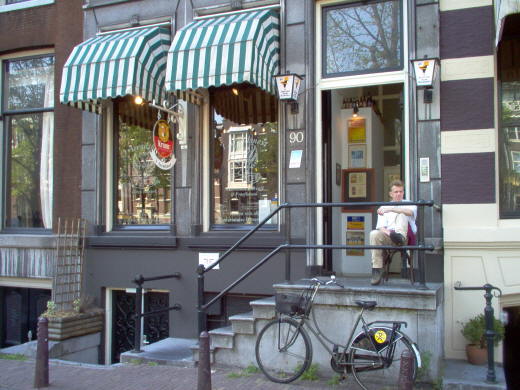
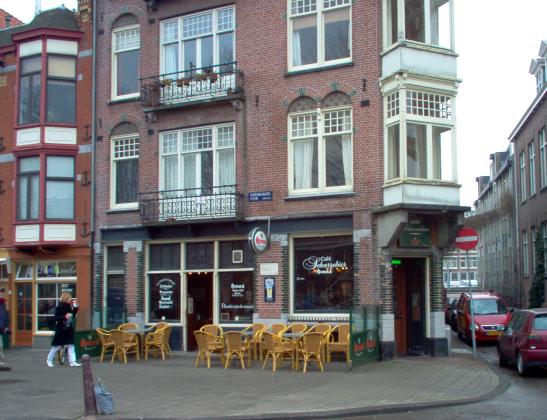
Scharrebier
Another pub with a relaxing canalside terrace. Handy for NeMo, too. I would have also included a mention of the Scheepvartsmuseum, but that's currently undergoing renovation (like many myuseums in the city). A recent cheerful correspondent told me my Amsterdam pub guide was a bunch of tourist hellholes, with the exception of Scharrebier and Druif. See if you agree.


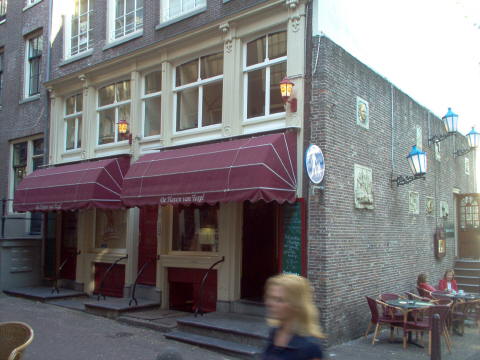
Haven van Texel
A full range of microbrewery Texelse beers and a terrace with some of the best views in town. When the sun goes down or it gets chilly, it's just a few steps to Olofspoort. Shit, that's eleven pubs now. Can't be arsed to change the title, mind.


Wijnand Fockink
The garden has reopened! This unique outdoor space is a real summer treat. Don't miss it. The perfect place for pickling yourself in jenever. Ever wonder what's around the back of the 17th century houses in the centre of Amsterdam? This is your chance to find out.


Wildschut
Located on Amsterdam's most beautiful square. Wonder at Boterenbrood's wilful asymmetricity. Wonder at the Rutger's curving brick balconies. The Van Gogh and Rijksmuseum are close by, too. There's plenty of space indoors and out in this substantial 1930's pub. The art deco interior matches the Amsterdamse School exterior perfectly.


Dopey's Elixir
Nothing particularly summery about Dopey's. I just thought it deserved a mention. And you wanted an excuse to visit De Pijp, didn't you? No? Well, you should do. It's full of all the ethnic and trendy stuff I imagine my readers going for. Don't know why. Imagine you like that sort of thing. You're probably a bunch of fat old blokes like me.


Brouwerj Het Ij
On a warm summer afternoon, nothing's more soothing than hiding inside Het Ij while everyone else mobs the beer garden. Dirt cheap, too. See if you can spot the join where the bar was recently extended.


Alverna
One of the few places in Amsterdam West where you can enjoy a beer outside and not be crammed on the pavement next to a main road. They have a few decent beers to make the experience extra special.


(This has been a post in the series "Get More Hits for my Website" and "Keep Mike Happy".)

Friday, 13 June 2008

Decoction mashing in the DDR

I own a few East German brewing manuals. They were some of the first technical books I obtained. My mother-in-law got them from some of her many contacts back in the days when the DDR was still a country. Until now, I'd not paid much attention to the sections on decoction mashing.

Wolfgang Kunze's "Technologie für Brauer und Mälzer" is a wonderful book. It describes in minute detail how to run a VEB brewery. He's pretty good on the technical stuff. Which explains why a later version of this book, produced after reunification, is still a standard text.

This information comes from pages 198 and 199 of the 1961 edition.

It's always the Dickmaische which is boiled. The Dunnmaische or Lautermaische is very enzyme rich as the enzymes are soluble.

The amount of the mash to be boiled (Kochmaische) is one third and two thirds of the total. [There then follows a series of formulae for calculating the exact amount]

hl Kochmaische = (desired rise in temperature * hl total mash)/(90 - Restmaische hl)

Restmaische = total mash - Kochmaische

Example: you've got 130 hl of mash at 50º C that needs to be heated to 64º C

hl Kochmaische = (14 * 130)/40 = 45.5 hl


The time the mash should be boiled varied, depending on the type of beer:

pale beer - 10-20 minutes
dark beer - 20-30 minutes
adjunct mashing - 30 - 40 minutes

The Kochmaische should be pumped into the Restmaische (and not the other way around) so that the temperature of the Restmaische rises slowly and the enzymes aren't destroyed.

Triple decoction
This is the oldest method of decoction.

einmaischen 35º C
1st Kochmaische 50º C
2nd Kochmaische 65º C
3rd Kochmaische 72-74º C

Triple decoction is very intensive, time-consuming and requires much more energy than double or single decoction. The gains are very small in comparison to the extra effort and consequently is no longer much practised.


Double decoction

einmaischen 50º C
1st Kochmaische 65º C
2nd Kochmaische 72-74º C

You may have noticed that the triple decoction is very similar to the Munich method I told you about earlier. Don't worry about all the entries for this series looking very similar. The Augsburg method is very different. That makes use of Saz. Never heard of Saz? Don't worry. Neither had I before yesterday.

Self-censorship

One of the most effective methods of censorship is to scare writers into avoiding topics you don't want discussed. Not just oppressive governments employ the tactic. It's a favourite of religions and large corporations, too.

This particular form of bullying stifles debate, which is, of course, the idea. There are plenty of organisations that don't want an open discussion of their beliefs, their finances, their actions or their secrets.

Why am I bringing this up in a beer blog? Something happened this week that made me realise I've been bullied into abandoning a full expression of my views. And it's rather disheartening.

I'd wondered why my post "Is Kölsch an Ale?" had suddenly received a couple more comments. They immediately struck me as a little strange, especially as it was apparent that at least one of those commenting hadn't read the related posts. He wouldn't have put in all that technical stuff if he had.

A link to "Is Kölsch an Ale?" had been placed in RBPMail. Someone had then copied my article and posted it as a new thread on BeerAdvocate. Slightly annoying, because there was no reference to me or this blog. (On my request, the inital post quoting the whole article has been replaced by a link to my blog post.)

I'll be honest with you. I haven't read through the whole thread. Depressingly - since my article tried to explain my rationale behind not referring to Kölsch as an Ale - the conversation followed very similar lines to the one on RateBeer. Basically that top-fermenting yeast = Ale yeast, ergo Kölsch is an Ale. Either that or abuse.

The discussion (if you can call it that) was disheartening enough first time around. I can live without a repeat. Head and brick wall situation. Last time it did feel really good when I stopped, but that isn't enough to get me banging again.

It's no wonder that conversations on beer forums are limited to "Watcha drinkin'?", "what's your favorite barrel-aged German Quadrupel?" or "Is XXXXX over-/underrated?". Anyone trying to make a serious point that doesn't agree with current homebrewing orthodoxy is likely to be greeted with a stream of hatred and abuse. At least, that's why I don't bother any more. You need either a very thick skin or to conform. A bit sad, really.

Am I the only one who's been driven away? Maybe I'm just a sensitive soul. Is it inevitable that a small clique of verbal bullies will come to dominate any forum?

In avoiding discussion I'm censoring myself. And, in doing so, helping to reinforce ideas which I beleive to be false by not challenging them. It's a sobering thought.

Thursday, 12 June 2008

Salvator

The Summer of Hate, sorry, Summer of Lager continues with a look at Salvator. One of the most famous beeers of the 19th century. Today, it's a trademark of Paulaner, but back then it was used as a generic term for all Doppelbocks.

Because of its fame, I've plenty of hard evidence about Salvator. I collect numbers. I can't help it. Occasionally, like now, it does come in handy. If I weren't such a saddo, I wouldn't all the fascinating figures with which I'm about to regale you. So don't mock me.


The first data I have comes from the 1850's. The beer was brewed by Zacherl, the forerunner of Paulaner, so it's the real deal. It has a massive OG of 23.5º Balling (approx. 1095), but a relatively puny alcohol content of just over 6% ABV. Let's be honest, the attenuation is crap. Less than 50% apparent. With an FG higher than the OG of most beers today, it must have been pretty thick and sweet. No wonder they used it as a meal substitute.

The 1858 version (not sure if it's from Paulaner or another Munich brewery) has a substantially lower gravity (19.8º Balling, or around 1080) , but almost as high an ABV (5.74%). As a consequence, the apparent attenuation has increased from a pathetic 46% to a still unimpressive 53%.

By 1870, the gravity has dropped further, to 18.5º Balling (approx 1074), but the ABV has remained about the same (5.64%). Apparent attenuation has again increased and is 56%.

Unfortunately for me, I have no idea which breweries the 1930's samples come from. However, the first in the list looks rather like a Doppelbock to me. Assuming that it is, we can see a further slight reduction in the OG (17.99º Balling, approx 1072), but a similar ABV (5.8%). Consequently, apparent attenuation is up to 60%.

Finally we see the present incarnation of Salvator. This has a much higher alcohol contente - 7.5% ABV - than any of the older versions. Which has a big impact on the apparent attenuation, which is now a respectable 75%.

So how does modern Salvator compare with the 19th century versions? It has a 22% lower OG, but a 25% higher ABV. The difference in body is enormous. The FG in the 1850's was more than double what it is now. To sum up, modern Salvator is less full-bodied, less sweet and sticky, but more alcoholic.

Another difference is the colour. Though I don't have enough numbers to do a precise analysis, I know from personal observation that Salvator has become paler over the last 15 years. And generally pretty crap, but that's a subjective opinion.

I suppose I should try and dig out an old description of Salvator brewing. My guess would be that the 19th-century method was a triple decoction Dickmeisch. If you've been paying attention you should know all about that. Don't tell me you've forgotten already? Really.


(Published as part of my one-interesting-to-one-boring_post initiative.)

Football beer

There seems to be a football tournament of some kind occurring in Europe. Not quite sure where, but there are always mountains in the background. I guess that rules out Holland.

Sometimes it's soothing to stick to sterotypical male behaviour. Like football and drinking beer. The two go together extremely well. Unless you're actually trying to play the game, in which case it's annoying to have to keep going to the dressing room for a wee.

As England managed to avoid qualification, watching the tournament is less stressful than in previous years. Consequently, I have less need of beer to get me through to the final whistle thrombie-free. The throbbling effect of constant tension gives me a hell of a thirst when England's best are cocking things up again on the pitch. So I usually plump for something fairly weak. My usual tipples - all strong Belgians - would have me lying in a pool of my own fluids before half time.

A tension-free tournament is something else. With England out of the picture, I'm not reflex slurping all through the games. I'm able to drink consciously and with pleasure. So which beers are best suited?


Early games (18:00)
I only get home shortly before these games kick off. In such pre-prandial circumstances, my beer of choice has to be St. Bernardus Abt. Served in a Chimay glass, of course. It just doesn't taste right any other way. It's the perfect way to unwind after a busy day. It works for my type of days, too.


Games of the Dutch team
I'll admit that not all games are tension-free for me. When Holland play, I do get the odd twitch of steel band across the chest. Alcohol is what you need to stop your pulse dancing to a drum 'n bass beat. The perfect delivery system is St. Bernardus Abt. Served in a Chimay glass.


Late games (21:00)
Just when I'm starting to wind down and prepare for bed. Too much fluid at this point, and I'll be in and out of the bathroom all night. So a beer without too much water. Just about perfect is St. Bernardus Abt. Served in a Chimay glass.


Quarter-finals
Things start to get interesting in this phase. But there's the possibility of extra time and penalties. A game could last as much as two and a half hours. This is when something less strong is needed. My recommendation is St. Bernardus Prior. Served in a Chimay glass.


Semi-finals
It's serious agogo time. No-one likes to fall at the final hurdle before the final. But there's a long build up to the games. You want to be able to focus for the second half, so easy does it before kickoff. My choice is St. Bernardus Pater. Served in a Chimay glass. Moving on to St. Bernardus Prior after half time. Served in a Chimay glass. Extra time or post-match analysis should be accompanied by St. Bernardus Abt. Served in a straight pint glass. Only joking. In a Chimay glass.


The final
This will be a long day. For the first 3 hours of the pre-match build up, St. Bernardus Pater is your man. Served in a Chimay glass. Pop a bottle of St. Bernardus Prior at kickoff. If the Dutch are playing, you'll also need a bottle of jenever. Korenwijn at least. Rutte 12 or Villiers 8 are best. Every time the Dutch have a shot on goal, drink a shot. If they score, pour yourself a double.

At half time, clean your Chimay glass thoroughly. Have a full (Chimay) glass of St. Bernardus Abt ready for the start of the second half. If the Dutch are in the lead, have a jenever to keep it company. Should the Dutch be winning at full time, at least you won't be able to see it. If it goes to penalties (and you're still conscious) knock back a jenever every time the Dutch score or their opponents miss.

What's your favourite football beer?


* 1914 SSS is a good substitute for Abt and Prior.
** 1914 Porter is a good substitute for Pater.

Wednesday, 11 June 2008

Aristocratic

In the course of a recent pointless argument on an internet forum, I was criticised for the "aristocratic tone" of my posts. Little did my taunter realise how close he was to the truth.

Blue blood does indeed flow through my veins. Very ancient blue blood. An ancestor of my mother's was one of William the Conqueror's gang and, as a reward for all that killing and oppressing, was given a title and a large estate in the Midlands.

The Earls de Chandelent were a force throughout the Middle Ages, but by the early 20th century only the rump of the estate - a few farms and a village - remained in the family's hands. Still, there was enough money left to provide me with a reasonable private education, albeit not at Eton, as was family tradition.

I don't usually like to talk about my background as it tends to evoke envy and hatred amongst the plebs. You lot won't turn nasty on me, will you, just because I'm a bit of a toff?

I'll see if I can dig out an image of the family coat of arms for you to admire.

What's this got to do with beer? Well, there's a disused brewery at the family seat. It looks just like a stable or storehouse, but I've been assured that they brewed there until sometime in the middle of the 1800's. See if you can spot which it is in "Country House Brewing in England 1500 - 1900" by Pamela Sambrook, 1996 (ISBN 1 85285 127 9).

Gravity Tables - Lager

I was surprised to discover at least one fan of my tables of beer gravities. I don't know why I was so shocked. I could stare at them for hours. Quite often, I do.

Just a small one this time. German Bocks from the early 1950's. These are probably some of the first strong beers brewed in Germany after WW II. What can I say. The attenuation is higher than in 19th century Doppelbocks.


Hang on. I said this was going to be the Summer of Lager, didn't I? You deserve more than one table. And it's a while since I did any. How about far more tables than you'll be able to absorb in one sitting? Sounds perfect.

Here's some German Pilsners.


1950's Lager

Let's take a look at Lager in various European countries in the 1950's. That should be fun, shouldn't it? At least until I swamp you with numbers.


Belgium
As I can't be bothered to think of a clever way of organiosing them, let's look at the different countries alphbatically. We start with Belgium.


They're all Pilsners, you may have noticed. Nothing particularly unusual about them, either. Except that the Stella Artois bought in Belgium is stronger than the others. The weaker ones may have been bought in Britian, which would explain them being weaker.


Czechoslovakia
Beer from just one Czech brewery, Pilsner Urquell. Only one of them appears to be the classic 12º Ležák. That looks the same as it always does in analyses, from the 19th century up until the present. Though it would be interesting to compare the colour with the modern version.


Denmark
Just beers from Denmark's Big Two, Carlsberg and Tuborg, when they were still separate companies (and still each had a brewery).


From the feeble gravities of just over 1030 of many of the examples, it's clear that both were already brewing versions especially for the UK.


Holland
Again beers from the countries largest brewers - Amstel, Heineken, Oranjeboom and ZHB.


All are under 1040 and presumably brewed for the UK market. In the 1950's Heineken brewed three versions of its Pils: one for the Dutch market, one for the USA and one for the UK. Only the UK Pils was piss-weak.


Norway and Sweden
I was shocked to see three Norwegian breweries represented. But only one Swedish. Can't have everything, I suppose.


Given their strengths, I doubt any of these were intended for the UK market. Note that the Swedish beer is just a shade under the 5.6% ABV maximum which was at that time in force in Sweden.

Munich method of decoction

I'm feeling revitalised. So much so that I've had the energy and drive to read brewing manuals rather than the football reports on the tram and bus today. Lucky you. It means I've already a second installment to my summer decoction series.

Today it's the turn of the Munich method. Again, taken from "Handbuch der Chemischen Technologie: Die Bierbrauerei" by Dr. Fr. Jul. Otto, published in 1865, pages 120 to 122.

For 100 pounds of malt, 800 pounds of water are used. [Not sure what sort of pounds. I would assume around 1 pound = 0.5 kg.]

Half to two-thirds of the water is cold and used to Einteigen. The rest is brought to the boil in the kettle. After Einteigen, the mash is left to rest for 3 or 4 hours. If warm water is used for Einteigen, the mash should not be left to rest.

When the water has boiled it is added to the mash. The temperature should rise to 30-37.5º C.

When this temperature has been reached, about a third of the thinner part of the mash is transferred to the kettle and boiled for 30 minutes. (Boiling the first Dickmeisch.)

The Dickmeisch is returned to the mash tun and mashed for 15 minutes, so that the thinner and thicker parts completely separate. The temperature should now be 45-50º C.

As soon as this is finished a third of the mash, again the thicker part, is transferred to the kettle and boiled for 30 minutes. (Second Dickmeisch.)

The second Dickmeisch is returned to the mash tun and mashed. The temperature should now be 60-62.5º C.

Now a portion of the thin mash is transferred to the kettle (enough to raise the temperature of the mash to 75º C when returned to the mash tun) and boiled for 15 minutes. (Lautermeisch.)

The Lautermeisch is returned to the mash tun and there's another round of mashing. The temperature should now be 75º C. The mash is left to rest for 90 minutes.

After the wort has been drawn off, more water is brought to the boil (30 - 60 pounds for 100 pounds of grain) and poured over the grains. The resulting wort is either added to the main wort or used to make Nachbier (Small Beer), which in Munich is called Scheps.


I think there's a mistake in the text I've quoted. For the first decoction it says "use the thin mash", but then for the second it says "use the thick mash again". For the last it says "this time use the thin mash". I suspect the first decoction should be of the thick mash.

Which method should I do next? Bamberg 1819 or Augsburg 1860's? Let's just see how the fancy takes me.

The Summer of Lager

Lager lovers lick your lips. 2008 is officially The Summer of Lager. In my head. And that's all that counts.

The first focus falls on decoction mashing. Who hasn't lain awake at night wondering what the temperature of the mash should be after the second Dickmaisch is returned to the tun? I know I have. I'm not that out of step with humanity that I'm the only one, am I?

Misunderstood lager styles. That'll be all of them, then. Märzen, Export, Kellerbier and Dunkles. There's plenty of scope for me to do some metaphorical shouting about those ones. Especially Märzen.

Lager evolution. How lagers have changed over the last 150 years. Salvator (Doppelbock) is a good one. Not even the name has remained the same.

My new Big Idea is to have more posts announcing posts than actual posts. It's going well so far this week. Watch out for my next announcement about more announcements.

Tuesday, 10 June 2008

Things I hate

I was going to write about Things I Love. But I need more than a single paragraph. A slight change of viewpoint and suddenly I have more material than I know what to do with.

I hate:

- calling German beers "Ales"
- writing Barley Wine as Barleywine
- Cascade hops
- mustard
- Porter or Stout drenched with citrus hops
- work
- mosquitoes
- nitro-served beer
- ice-cold beer
- sunshine
- the term "Dry Stout"
- double anything, apart from Bock
- Imperial anything, apart from Mild
- hot weather
- cars
- the Dutch football team
- books written without research
- beards
- homebrewers with beards
- Hollyoaks
- cats
- pigeons
- the rubbish Dutch postal service
- Arsenal
- all London football teams
- fake Irish pubs
- smoking
- queue jumpers
- dogma
- dogmatic twats
- certainty
- uncertainty
- pullovers
- T-shirts with jokey slogans
- designer clothes
- jeans
- trainers
- owners who don't control their dogs
- fizzy beer
- all politicians except Stalin and Trotsky
- slugs
- cats
- waking up having a coughing fit
- pubs that don't look like pubs
- Frankfurt
- formula 1
- tennis
- basketball
- sugar
- Gert Wilders
- Leo van den Berge
- closing time
- CO2
- the word "proactive"
- anyone who uses the word "proactive" seriously
- cats
- mission statements
- bullies
- Andrea Rijntjes
- Steve Vaswani
- German pubs that serve Klösse from a packet
- "innovative" beers
- gravity
- cross-channel ferries
- guns
- knives
- spoons
- motorways
- internet forums
- beer names of more than 3 words
- bearded wikipedia contributors
- chocolate
- pneumonia
- decimal currency
- pudding (except for steak and kidney)
- Golden Ales
- Blonde Abbey beers
- paprika-flavoured crisps
- frozen chips
- instant mash
- football teams based at the Emirates Stadium
- stadiums named after a sponsor
- the terms "inside right" and "outside half" falling into disuse
- pints that are half litres
- people who don't mind being served a half litre when they asked for a pint
- novelty underwear
- Amstelveen
- variegated foliage
- sandals
- alcohol-free beer
- personalised number plates
- cats
- ice cream
- Monday
- blaming everything on global warming
- global cooling
- Wednesday
- live test match coverage being only on Sky
- the All Blacks
- Thursday
- kitchens at the front of houses
- painting everything orange
- Tuesday
- August
- December
- mornings
- chips with mayonaisse
- tomato ketchup
- avocado
- not being rich enough to give up work
- the rich
- ivy
- plastic-framed windows
- Windows
- aluminium-framed windows
- plastic door handles
- drivers that won't stop at zebra crossings
- "classic" rock
- breaking my ankle
- breaking my other ankle
- losing an argument
- being wrong
- hamburgers
- treading in dogshit
- bauxite
- DIY
- TNT
- ABC
- TB
- anthropomorphism
- 24-hour days
- Robust Porter
- smug bastards
- the phrase "the golden age of beer"
- airport security
- winter sport
- extreme sport
- ironing
- thin chips
- buttermilk

There will be several more, rather longer installments in this Hate series.

Bayerisches Lagerbier

Time to begin my summer decoction series. Let's kick off with a recipe from the 1860's. This is a loose translation of pages 215 and 216 of "Handbuch der Chemischen Technologie: Die Bierbrauerei" by Dr. Fr. Jul. Otto, published in 1865.

In the 19th century, especially the earlier decades, bottom-fermenting beer was commonly called Bayerisches Bier (Bavarian Beer) or Bayerisches Lagerbier. Because, well, Bavaria is where it was originally developed.

To brew 76 Bayerische Eimer (52 hl), you'll need 12 Bavarian bushels (1478 kilos) and 30 kilos of hops.

In the mash tun, Einteigen (make into dough) the malt with 89.5 Eimer of cold water (61.25 hl). The volume of the mash after Einteigen is 108.3 Eimer (74.1 hl). Leave the mash for four hours. Put 82.5 Eimer (56.5 hl) of water in the kettle.

When the water in the kettle is boiling, it will have reduced to 78.5 Eimer (53.7 hl). Pour the hot water into the mash tun and mash for 15 minutes. The temperature of the mash should be 37.5º C. The volume of the mash is now 186.6 Eimer (127.7 hl)

Take 80 Eimer (54.7 hl) of the mash and put it in the kettle. Boil for half an hour. This is the first Dickmeisch (thick mash).

Add the boiled Dickmeisch back to to the mash tun so that the temperature is raised to 56.25º C. Immediately take another 78 Eimer (53.4 hl) of the mash and put it into the kettle. Boil for 20 minutes. This is the second Dickmeisch.

Put the second Dickmeisch back into the mash tun and mash for 15 minutes. Draw off 92 Eimer (63 hl) of Lautermeisch (clear wort) and boil for 20 minutes in the kettle.

Add the boiled Lautermeisch back into the mash tun. Mash for 30 minutes at 77.5-78.75º C. Rest for 1 hour, then draw off the clear wort.

You should have 118.7 Eimer (81.2 hl) wort at a gravity of 9.37º Balling. Boil for two hours with the hops, after which there should be 107 Eimer (73.2 hl) at 11º Balling.

Cool the wort. There should now be 81.5 Eimer (55.8 hl) of wort at a gravity of 12.1º Balling. Ferment in an open tun for approximately 10 days. Put 76 Eimer (52 hl) into barrels at a gravity of 6.5º Balling, 3.2% ABW.

I'll make a couple of observations. Firstly, the efficiency of the mash is rubbish compared to British breweries of the same period. They usually reckoned on around 80 brewer's pounds of extract per quarter of malt. In this example they only managed 56.5. That's about the same as an English brewer would get from 100% brown malt. Perhaps the recipe is for all dark Munich malt. Secondly, the attenuation, at only 46%, is also crap. Thirdly, it was a very time-consuming process - 14 hours and ten minutes from Einteigen until the end of the boil.

Monday, 9 June 2008

Summer specials

As if my Beer Gibbon drinking on the edge series wasn't enough, I've more special treats lined up for the summer.

Another edition (1889) of "Zeitschrift für das gesammte Brauwesen" should be splintering the floorboards beneath my letter box soon. Then we'll be returning to the wild and wacky world of 19th century German brewing statistics. Should be good for a few dozen posts.

Having told you what I'll be doing on my holidays, it seems only fair to tell what I actually did on my holidays, too. Belgium, Berlin and some others places beginning with the letter B. Betondorp, perhaps. Or Bangladesh.

It's about time I had a proper look at the Truman's brewing logs. Expect lots about Runners and Keepers. If I can read the handwriting. Here's a small aside. Modern Dutch handwriting is similar to old-fashioned English handwriting. When I can't decipher something in the logs, I often ask my son Andrew to take a look.

Warm weather isn't my favourite. It makes me irritable. So expect more rants. The hotter it gets, the more rants there'll be. Check the rantometer (commonly - if mistakenly - called a thermometer) to see the likelihood of a rant in the coming days.

Decoction mashing. I've neglected this topic shamefully. Quoting from old brewing manuals, I'll outline some of the different methods. Einteigen, Dickmeisch. All will be explained. Well, maybe not exactly explained. Described, at least. As traditionally bottom-fermenting beers weren't brewed in the summer, this seems the perfect time to discuss the process.

It's going to be a long, dull summer. Sorry. Long, hot summer.

Borrel met de buren

Here, as promised, is my first report from the edge. The edge of my garden, to be precise. Borrel met de buren. Drinks at our next-door neighbours'.

It was as tense and edgy as only middle-aged, middle-class gatherings can get. And, the guests being middle-aged and middle-class, the drink of choice was wine. My wine drinking is as eclectic as my writing. Basically, I grab anything that comes within my reach. Red, white, pink, green, black. Any colour will do.

This is a good technique to employ at a party where you don't know people that well. Grab a bottle of wine and take it around the room (garden in yesterday's case) and serve fellow guests. Everyone likes having their glass filled. It's a good excuse to approach people. And you keep your own glass full without looking like a raging alkie.

The beer was limited to Amstel Pils. Good enough reason to stick to wine. Though I did notice an empty bottle of Duivels Bier. Quite a good sign. It was Peter's birthday so I took along a bottle of my beer as a present. Another good icebreaker.

Next doors' flat was built as a mirror image of our own (architect Piet Kramer, king of Amsterdam bridges). Divergent refurbishments have left them quiet different in layout. And theirs isn't full of junk like ours is. Dolores won't have a party because of the mess. But what was most striking was how much bigger both their flat and garden appear. I'd swear that hey have 50% more space than us. Compare and contrast the sheds in the photo. Ours, with the emergency corrugated plastic roof, theirs with electricity.

The European Championship is a great boon for social inadequates like myself. It's a great topic of conversation. Football in general is. But a tournament brings it to the fore even more. Of course, when in the company of the Dutch, I'm careful not to express my real sentiments about their team. Because my overwhelming love of Dutch football might embarrass them. Or something like that.

My first venture into the world of extreme drinking was quite successful. We returned with the same number with which we set out: four. Everything else is just a matter of opinion.

Sunday, 8 June 2008

Beer Gibbon

Just to announce my new series of posts: Beer Gibbon. This will be beer drinking on the edge. I'll booze with those on the fringes of society and, if I get back, report my experiences. It'll be edgy, seat of the brown trousers stuff. Are you person enough to read it?

Here are just a few "places on the edge" I'll be venturing to:

- Het Probleem (The Problem). The name says it all. I'll be knocking baclk jonge jenever with the hard men of Andrew's chess club.

- Schoolplein: I take my life in my hands to share beers with the boys on incapacity benefit while waiting for Andrew to come out of school.

- Blijburg . As edgy as Amsterdam comes. Literally. It's on an edge they've just finished building. I take on the urban hippies and their dogs. Choice of drink is theirs - Rosé. Who will triumph?

- Borrel next door. Nothing's scarier than neighbours. What chaos will ensue when I bring along a bottle of Pattinson 1914 Porter? I'll be taking my camera to record every blow.

Loads more to follow. Really. Loads more.

Saturday, 7 June 2008

Exorcism

I used to work with a bloke called Bernie. Way back in the days when I still lived in London. He taught me many of my assembler programming skills.

We also used to go boozing a lot. At lunch time. After work. He liked his beer. So he should have. He grew up in Lewes. His mum still lived in town, not all that far from the brewery. I went down there for the weekend a couple of times. Once for November the 5th.

They make a big deal of Bonfire Night in Lewes. Something to do with some protestant martyrs. There's a big procession. When that's over, people dressed up as Roman Catholic cardinals are sat in thrones. And the crowd throw fireworks at them. It's dangerous, it's weird and quite disturbing. It shocked me. In Leeds they just used to set light to police cars. I'd honestly never realised there was an anti-catholic aspect to Bonfire Night. Maybe I'm just naive. Or perhaps, elsewhere in Britain, that side of it has been long forgotten.

Of course, while in town I tried to get around as many Harvey's pubs as possible. I can't remember and of the names. But I can clearly recall many excellent pints. And the pub on the same street as Bernie's mum's house having a very flexible interpretation of opening times.

I've had a few strange experiences in my life. But this was a particularly odd one. Once when I was staying there, Bernie's mum asked if we'd take part in an exorcism. The house was pretty old - 17th century, I think - and she thought it had a ghost. Or some strange spiritual presence. So she got in this sort of C of E monk to exorcise it.

It wasn't like in the movies. No green bile or any of that malarky. Just a few prayers and a bit of sprinkling holy water. But it was a fully fledged exorcism ceremony. And I did say a few words when required. I can truthfully say "I've taken part in an exorcism". Haven't you?

Cooking with beer

You may have seen my earlier post where I mentioned judging for the "Beers Of the World" competition. The tastings had a side-effect: quite a lot of beer I couldn't/didn't want to drink. Like a couple of the pale lagers. I'll be honest with you. The nice ones I drank every last drop of.

What to do with all the leftovers. I hate throwing anything away, but in particular beer. It seems like a sin. I fed some of it to Dolores. But there were a couple she wouldn't drink, either. I did contemplate slipping some into the kids' cornflakes. They'd probably have noticed and complained.

Eventually (I'm not very bright) I thought of a solution. Cook with it. So here, in a series that will probably only have a single installment, it's time for Cooking With Ron.

Pork stew with leftover beer
500 gm pork, cut into cubes
3 large carrots
2 large onions
3 cloves of garlic
3 half bottles (approx 600 ml) of leftover beer
5 bottles St. Bernardus Abt
1 tsp paprika
1 tsp ground coriander
0.5 tsp ground cumin

Brown the pork in oil in a frying pan. When done put into a large saucepan. Roughly chop the onions and garlic and brown in the frying pan. Add these to the saucepan, too. Open a St. Bernardus Abt and pour into a Chimay glass. Put the bottle, with the dregs, to one side. Take a big slurp of the Abt. Briefly fry the spices in the frying pan, making sure they don't start to burn, and add to the saucepan. Clean the frying pan because you don't want to be a filthy git, do you? Take another couple of mouthfuls of Abt.

Put the saucepan onto the heat and add the first bottle of leftover beer. Drink another mouthful of Abt, making sure to leave at least 2 cm in the bottom of the glass. Add the Abt to the saucepan and stir in well. Open another bottle of Abt and pour into a Chimay glass. Add the dregs to the saucepan and the dregs from the bottle you earlier put to one side. Add the rest of the leftover beer. When the mixture comes to the boil, give it a good stir, turn down the heat and cover. Drink all but the last 2 cm of the Abt and add the remainder to the saucepan. Leave to simmer for 30 - 45 minutes, while drinking Abt and occasionally stirring. Serve with bread or potatoes.

Friday, 6 June 2008

My manor

I rarely mention the pubs close to my home. It's mostly deliberate. A couple of the pubs on my "secret list" are local. Look, I don't want any of you degenerates dropping by pubs where people know who I am. And where I live. I have to maintain a little privacy.

Anyway, one of my local pubs, one I almost never enter, attracted my attention last week. The main reason I don't go there is the beer choice. Amstel Pils or Amstel Pils. I'm not keen on either. Then last week my attention was drawn to some new signs in the window. In particular the one listing their beer selection. Duvel. That's a definite improvement. And West Mahler. Now that really does sound interesting. I wonder if it's German?

All of this does have a point, Believe me. Yesterday I trolled by to take a photo of the West Mahler sign. Sadly, I was unable to acquire the image I wanted. Firstly, because an old couple were sitting exactly where I needed to be to take the photo. Secondly, and more crucially, the sign had been removed.

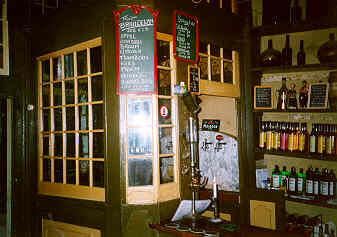
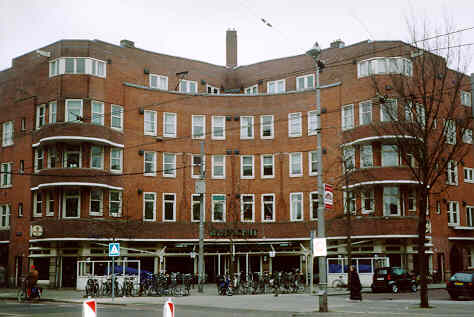
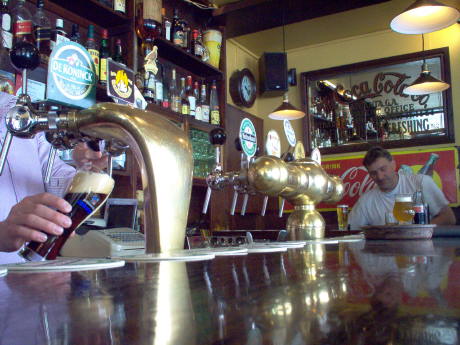
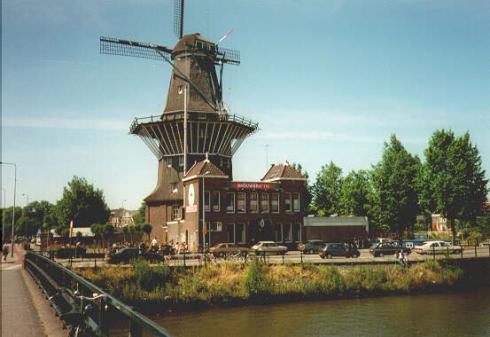
So instead I've taken a series of photos of my manor: Hoofddorpplein. Not particularly beer-related, but, hey, you can't have everything. Marvel at the Amsterdamse School architecture, drool over Ton Overmars's bottles.