Thursday, 17 January 2013

Let's Brew Wednesday - 1896 Eldridge Pope AK

Sorry about the long gap between recipes. You can blame Kristen and his kids. I won't go into it any deeper, but it was 100% not my fault.

Today's recipe is a departure in some ways. For one thing, it's not taken from a record I collected myself. I (and you, too) have Peter Symons to thank for this one. He sent me a collection of Eldridge Pope logs. This is one of the earliest ones.

I don't need to remind you of my AK obsession. I find this type of Light Bitter (it's not an effing Light Mild no matter Kristen says below) fascinating. So common in the last couple of decades of the 19th century but almost completely vanished by 1939. Except at McMullen and Holes. I still find it hard to accept McMullen's role in convincing many that AK was some sort of Light Mild. It wasn't. It was a Light Bitter. Or a Mild Bitter. But not a Light Mild. Is that clear?

I was about to say that this was a little on the strong side for an AK. Then I looked up Fuller's. That was 1050º in 1897, so about exactly the same as this one. This beer is a typical strength for an AK. It's a "light" Pale Ale, as a full-strength Pale Ale was a good bit stronger, with a gravity around 1060º.

It's also a "mild" or Running Pale Ale, which would have been consumed pretty much immediately after racking. At this time beers like Bass were still brewed as Stock Pale Ales which were aged for extended periods - up to a year or more - before sale.

Eldridge Pope brewed two versions: AK and BAK, the latter being the bottled version. BAK hung around for a long time. It was still being brewed in the 1980's, though it wasn't sold as AK. The trade name was, I believe, Crystal Ale.

Here's an advert from a few years earlier which includes Crystal Ale:

Taunton Courier and Western Advertiser, Wednesday 4th February 1891, page 4.

There will be more about Eldridge Pope's other beers from 1896 later this week. With nice, neat tables of data.

One point about the recipe. One ingredient is listed as "flake". Kristen has taken it to mean flaked barley. I think it's flaked maize. Mostly because I've never seen flaked barley in a 19th century recipe.

Oh, another point. About the sugar. This record doesn't specify the type, but some others do. Based on them, I'd say that it was No. 2 invert in this beer.


It's so long since I've written this . . . . . . time to pass you over to Kristen . . . . .


Kristen’s Version

Notes: Well well well…My apologies for the extended absence. With the brewery now fully operational, we are back in the swing of things! So, we start, with the first in a series of beers from Eldridge Pope given to us from my good buddy Peter! Thanks Peter even if I can’t understand what you say half the time! Can I get a Hill Yis!!!

To the recipe then…oh man, an AK. One of my very very very favoritist beer styles ever. I call it a Pale mild, as that seems most awesome. You can call it what you like…maybe even what would today be a Golden Bitter. Either way, its delicious.

Malt: The malt for this beer is pretty damn straight forward. English and Continental pale malt from a few various lots. A bit of some flaked barley and then a bunch of sugar...tasty tasty sugar. The idea is to choose what you really want to taste in this beer because it is very pale with nothing to hide behind. I really like Tipple if you can get it, or Optic, but this is a really good place for some Golden Promise (I like Simpsons) or some Maris…yeah, maybe a combination…50:50?

Hops: So lets rap about these hops. The most important thing for a beer this pale and simple, chose your very best ones. Its much better to have fresh over ‘perfect choice’. This beer is perfect from some Goldings of any variety. Maybe a combination of EKG or Styrian and Willamette. Now, you see we have a new technique down here. The very last entry for the Goldings. It says ‘Hop back’. Very few people actual have a hop back which basically is a container, holding hops, that you run your beer through post-boil, pre-chill. You can accomplish pretty much the same thing by using a whirlpool/steep. After knockout, add your hops at zero minutes stir…get a nice whirlpool going. If you have a pump, leave it on about 15-20min. If not, give it a good stir and leave it be for about for 25-30min. You’ll need less time for the pump because the agitation. You’ll have to experiment with your own system to get the most out of it. Its not exactly the same but its much closer doing it this way, than end of boil hops or dry hops.

Yeast: If you want to use the Eldridge Pope/Hardy’s yeast, use the WLP099 Super High Gravity. This yes is a pretty strong fermenter but you can limit it by reducing the amount you pitch and the oxygen you give by about 1/3rd. If you want another yeast, anything that gives a nice bright beer with a good note of lighter fruits. Nothing weird here.




Wednesday, 16 January 2013

Steamed pudding

How crazy is this? More than five year's after my mother's death, I'm still trying to please her.

If only I could have such influence.

I made my first steamed pudding on Sunday. This is it:


I think Mum would be pleased.

Five Gallons of Ale Sucked through a gas pipe

This is a novel way of stealing beer - by sucking it through a pipe. It's quite clever, in a way. Though getting caught isn't quite so smart.

"Five Gallons of Ale Sucked through a gas pipe.
—On Saturday forenoon a man named John McKenna appeared before Sheriff Arkley on a charge of stealing five gallons of ale from the brewery of Messrs. Drybrough and Company, Canongate. On the afternoon of Thursday last McKenna, along with three companions, was at the foot of Logan's Close, immediately adjoining the brewery, one of the windows of which was open, and a barrel of ale close beside it. The temptation proved too strong to be resisted ; and accordingly a piece of lead gas-pipe was introduced through the window and into the bung-hole of the barrel, the four vagabonds each in turn taking a pretty long suck. Some boys observed their movements, but the abstraction of the ale went on for some hours ere the boys thought of informing the police. They ultimately did so, however, but the thieves observed the police coming up the close, and three of them managed to make their escape, leaving McKenna, who was considerably more than half-seas-over, to the tender mercies of the law. The ale in the cask was afterwards measured, and it was found that the four had managed to extract five gallons. McKenna pleaded guilty to the charge, and was sentenced to thirty days' imprisonment. — Edinburgh Courant."
Hertford Mercury and Reformer - Saturday 02 May 1863, page 3.

Interesting approach to sentencing in the old days. A cooper who hit his foreman so hard that he blinded him in one eye only got 8 months. Which makes a month inside for stealing 5 gallons of beer - probably worth around 5 shillings worth - seem pretty harsh.

I'm not surprised McKenna was pissed. Five gallons amongst just people means they averaged more than a gallon each. At a time when even weak beer was 5 to 6% ABV.

Tuesday, 15 January 2013

Reputed Pint Bottles

This article highlights one of the nightmares of deciphering old price lists. The vagueness of the terms "pint" and "quart". Do they mean a reputed pint or an Imperial pint? Sometimes the distinction is made, but often not

I must say that I'm surprised by this case, pointed out to me by Korev in a recent comment. Even I know, almost 150 years later, that a reputed pint is way short of a proper pint. Why did the revenue inspector decide to prosecute this particular grocer? Especially when it was clear that everyone was aware that a reputed pint wasn't a full measure.

The other thing is, having lived myself in Melbourne, I know what measure they sell draught beer in there. One is something called a reputed pint. Or schooner. It's about two-thirds of a pint. Oh, the happy memories of nipping into the Canada for a quick schooner of Copper's Stout on the walk home from work. It was often 40º C. That's my excuse.


"REPUTED PINT BOTTLES.

The postponed cases in which Henry Black, grocer, at 175 Bourke-street west, and Alexander McIntosh, grocer, at 180 King-street, were summoned, under the Wines, Beer, and Spirits Sale Statute 1804, for selling bottles of liquor in bottles containing less than a pint, to wit, five-eighths of a pint, came on at the District Court yesterday, before Mr. Sturt, P.M., and Mr. Wilton, J. P. Black's case was taken first. Mr, F. Stephen prosecuting, and Mr. Gillott defending.

John Wilson deposed that he was a surveyor in the employ of the revenue inspector, Mr. Evans, and on the 10th inst., by the latter's direction, went to the defendant Black's shop, and purchased the bottle of "Guinness's stout, bottled by Burke," produced. Purchased it from the grocer's assistant.

Wm. McDonald gave evidence to the effect that he had measured the bottle produced when empty, and found it would contain barely five-eighths of a pint.

For the defence Mr. Gillott urged that there was no deceit proved, as the bottles were those universally known as pint bottles, though known by the trade and the public not to contain a pint. He also deprecated the style of doing business by the revenue inspector, who sent informers to buy these bottles, and pointed out that there was no proof of the reliability of such an informer. He called -

Hugh Miller Guthrie, customs officer, who deposed that he very frequently received through the custom-house bottles like that produced, reputed pint bottles, and sold in the trade as pints, though they did not contain a pint. Witness has been in Melbourne 23 years, and never saw a reputed pint bottle that contained-a-pint.

Cross-examined. - The duty on pints reckoned 12 to a gallon. The act said they should take them as reputed pints. About 20, or a good many, years ago they used to take them by usage as pints without any act, and afterwards they were required to measure them ; but that was put a stop to, and an act of Parliament was passed to take them as reputed pints, at 6d. per gallon. The bottle produced was a little smaller than usual. Five years ago pint bottles were not "much larger" than that produced. Quart bottles held more than a tablespoonful more than a pint. He should say they held six-eighths of a quart.

To Mr. Gillott.-Witness had measured thousands, and never found a reputed pint bottle that contained a pint. Six reputed quart bottles were reckoned to a gallon, but it would take about seven, or six and a quarter, or six and a half, to actually make up the gallon. Some brewers placed more than others did in a reputed quart bottle. There were no twelve bottles of brandy containing two gallons of brandy. The nearest was Hennessy's, and that was 2-32nds short. That mode had been in the trade ever pince Johnny Fawkner sold liquor.

To the Bench.-Witness never saw a full imperial pint or quart to come in full-sized bottles, and they used to measure every cargo that arrived. The nearest was Byass's porter.

Euler Smythers, wine and spirit merchant and grocer's licence holder, said he bad been 17 years in the trade. Burke's stout was sold as pints. The bottle produced was exactly the same as those sold as a pint in the trade. Quart bottles were about six to a gallon. Bottles like that produced had always been sold as pint bottles during the last 17 years. The public, of course, knew they were not getting a pint. It would not bo safe to import such large sizes as bottles holding a quart, on account of the loss which would result from breakage.

To Mr. STEPHEN.-Witness knew that by his grocer's licence he must not sell a less quantity than a pint. Had never measured the bottles to see what they contained. He believed that produced held about six-eighths of a pint.

- Smithson, grocer and wine and spirit merchant, in Queen-street, said he had been 18 years in the trade, and sold bottles like that produced as reputed pints. Had sold that class of ale and porter since the act came into force in 1865. Never came across a case of brandy containing two gallons.

Cross-examined. - Never compared other bottles with that produced. Did not think Guinness's pint bottle wad a whit smaller now than 10 years ago. Did not know that the importers at home had been reducing the size of the bottles in order to make a greater profit.

Isaac Sewell, of Elizabeth-street, 16 years in the trade, deposed that be had never had any complaints from the public, and he sold the bottles as reputed pints.

This was the case for the defence.

Mr. Sturt, P.M., said that the Bench considered that in complaints of this kind under a penal act, it must be a wilful evasion of the act to constitute an offence. Now in this case there was not wilful evasion of the act, and, moreover, it was selling by the pint bottle by repute, and custom, he thought, bore it out ; and the case was therefore dismissed. On the same plea, he might observe, persons might be actionable for selling a dozen quart bottles of wine, which would be for selling less than two gallons.

Mr. Stephen said ho would apply to have a case stated.

The case of McIntosh was the next, and the only difference being that the bottle in question was one of Tennent's reputed pints, Mr. Stephen said he would allow it to be dismissed with the other, and it was accordingly dismissed.

Two other cases, in which Henry Black was charged with permitting to be sold on two occasions liquor not in the quantity and manner which his grocer's licence authorised under the Act of 1804, were by consent postponed until Thursday.
The Argus (Melbourne, Vic.) Tuesday 28 March 1871, page 7.
http://trove.nla.gov.au/ndp/del/article/5845043

It all seems like a huge waste of time and money. Everyone except Mr. Evans, the revenue inspector, understood perfectly well that the bottels weren't an Imperial pint in size.

One thing that struck me was that the beer was being imported already bottled.I'd have expected mostt to be sent out in casks and to be bottled locally. Did they really avoid large bottles because of the risk of breakage? Sounds like a godd excuse for using under-sized bottels to me.

Monday, 14 January 2013

Why Drybrough moved to Duddingston

At one time many of Edinburgh's breweries were around Canongate, filling much of the space between Waverley Station and Holyrood Palace.

William Younger, with their Holyrood and Abbey breweries was the most famous, but there were many others. Including Drybrough and Bernard, who were closer to Waverley Station. Rather too close, as it turned out:

"THE RECONSTRUCTION OF THE WAVERLEY STATION.
Another important stage in the work of reconstructing and enlarging the Waverley Station, Edinburgh, and its approaches has been reached by the completion of the new double line of rails between Waverley and Abbeyhill, and of the new up main line platform. To-day these additions to the undertaking come into operation, and it is manifest from the size and situation of the new permanent works that the increased facilities they afford for the conduct of the traffic to and from the east and south will be of immense advantage and convenience, not only to the railway officials, but also to the travelling public. This new portion of the line lies to the north of the present railway. Its construction involved the removal of, among other buildings, a large grain store, and Drybrough & Bernard's breweries, and the setting back of the North Back of Canongate to the foot of the Calton rock. It also involved the cutting of a new tunnel through the Calton Hill, and the carrying of the double line of rails to Abbeyhill Junction. Extensive operations were thus necessitated over a large area, but the work has been pushed forward with great celerity by the North British Railway Company's engineers and contractors. Most passengers who travel to the south and east have experienced the discomfort of boarding a train in the narrow, draughty archway formed by the north abutment of the Old North Bridge. The abutment is now in course of demolition, and its removal will be followed by the widening of the "up" or north platform, in accordance with the plan of the new permanent works."
Evening Telegraph - Monday 26 April 1897, page 3.
Here's a map showing the area affected. The building in the centre of the picture marked "brewery" is Drybrough. It looks like the railway line passes right through it. The big building to its left is the grain store mentioned in the article. The building with the "H" of South Leith on it on the other side of the road is Bernard's original brewery.


It's clear that Drybrough's brewery was right in the way of the railway. Presumably the enforced demolition of their brewery was a good chance to escape to a less crowded part of the city with more room for expansion. Duddingston, with its water supply and railway connections, was the perfect choice.

What's surprising is that the largest of the Old town breweries, William Younger, was the last to disappear. Not moving, of course, but just closing.

Demolition couldn't have been too big a problem for Bernard. They'd already built a new brewery on the Slateford Road some years earlier.

Sunday, 13 January 2013

Beer Competitions

I keep saying that the minutely anally categorised type of beer competition so loved buy the BJCP and Brewers' Association is just one way of doing things.

No-one listens. "But how can you have competitions without rigid categories. It's not perfect, but it's the only way to have a fair competition." People keep saying that, Even though there are dozens of competitions that have been held that prove this to be bollocks.

There's one simple counter argument. Why bother having competitions in the first place? They prove fuck all. I know that from having judged a few myself. Ever wonder why breweries like Deschutes and Rogue win so many medals? Because they enter every contest they can. Does it mean their beers are better than everyone else's? Of course not. Only beers that enter can win. And there are loads of breweries who never bother.

I suppose medals are good for massaging brewers' egos. But, lets face, there are plenty whose egos have already spent the whole week in a Chinese massage parlour. They are in no need of further manipulation. Rock star brewers - the worst development of the last 20 years? I think so.

If you do insist on having a competition, there are plenty of ways you can define categories. Like the the way they did at the Brewers' Exhibition in 1888. See what you think. It'll  have craft enthusiasts choking on their Choccomocca Pickle-barrel Imperial Stout. You see the categories were all about rice.

"THE BREWERS' EXHIBITION.
The Brewers' Exhibition at the Agricultural Hall, Islington, was yesterday a busy scene of activity, and visitors came to it from many parts of the country. All the machinery intended to be worked at the show was seen in operation, and even experts found much to engage their attention in the large number of modern inventions which are on view. Some of the exhibitors had barely sufficient space wherein to display their contrivances, but this was a penalty which they readily pay to the great popularity the Exhibition has achieved. Much interest has been evinced in the special beer competition organised by Messrs. Gillman and Spencer Limited, of Southwark and Rotherhithe. The following is a complete list of the awards made by the judges, who were leading London and provincial brewers :—

Gold medal and diploma for the best beer brewed, of any class or age, with at least 15 per cent of patent gelatinized rice malt or torrefied barley malt: Messrs. Drybrough and Co., Edinburgh, whose beer contained no less than 20 per cent of rice malt.

For the best beer of an original gravity of under 20 lbs. brewed with at least 10 per cent of rice: 1, silver medal, Messrs. Drybrough; 2, silver medal, Messrs. Wrangham, of Malton; bronze medals. Messrs. Ash and Co. (Canterbury), Messrs. Matthews (Gillingham), Messrs. E. T. and C. Healey (Watford). Diplomas were also given to Messrs. Cartwright and Co. (Lincoln) and Messrs. Roberts and Wilson (Ivinghoe).

Beer of an original gravity of from 20 lb. to 24 lb. brewed with at least 10 per cent of rice : 1, gold medal, Messrs. Ash and Co., Canterbury; 2, silver medal, Messrs. Clissold and Sons. Nailsworth ; 3, bronze medal, Messrs. Miller and Co., Hereford. Beers in the same section made by Messrs. Wrangham, Messrs. Loades, of Morpeth, and Mrs. M. B. Silver, Binningham, were highly commended.

Beer of an original gravity of 24 lbs. and upwards, brewed with at least 10 per cent of rice: 1, silver medal, Messrs. : Drybrough and Co.; 2, silver medals, Messrs. Buchan (Rhymney), and Messrs. King and Sons (Horsham); 3, bronze medals, the Scarsdale Brewery Company (Chesterfield), and the Swansea Old Brewery Company. The beer of Messrs. Reiley and Sons, Waterford, was highly commended.

Pale ale of an original gravity of over 20 lbs. brewed with at least 10 per cent of rice: 1, silver medal, Mr. H.Payne, Braintree; 2, bronze medal, Mr. E. Edwards, Botley : 3, diploma, Messrs. Ash and Co. The beers of Messrs. Buchan and the Swansea Old Brewery Company were highly commended.

Black beer of an original gravity of under 24 1bs., brewed with at least 10 per cent of rice or torrefied barley : 1, silver medal, the Scarsdale Brewery Company; 2, bronze medal, Messrs. Buchan.

Black beer, of an original gravity of over Mbs.: 1, silver medal, Messrs. Morland and Co., Abingdon ; 2, bronze medal, Mr. R. C. Armstrong, Horncastle; 3, diploma, Messrs. Clissold and Sons, Stroud.

Any description of ale or beer brewed from torrefied barley: 1, silver medal, Messrs. Colclough and Palmer, Ongar; 2, bronze medal, Messrs. Howard, White, and Co., Malling.

A silver medal for beers containing the largest proportion of rice malt was awarded to Mr. A. M. Loaves, of Morpeth.

Prizes were also offered for ginger ale and nonexcisable herb or botanic beverages, the judges being Mr. T. Bond, London; Mr. W. Bratby, Ancoats, Manchester; Mr. F. Foster, London; and Mr. P. L. Simmonds, London. The competition was divided into two sections—one for ginger ale and the othor for non-excisable herb or botanic beverages, the total number of entries being about 100. After careful examination of the samples the judges gave the prizes as follows :—

Ginger ale: 1, Messrs. Talbot and Co., Ipswich; 2, Messrs & Shelvey and Co., Brighton; 3, Mr. B. Shaw, Huddersfield; 4, Mr. Stokes, Hull; 5, Messrs. Bellamy Bros., Grimsby.

Botanic beverages: 1, Mr. H. Firth, Manningham, Bradford; 2, Mr. Taylor, Attercliife, near Sheffield; 3, Mr. Lapworth, Acton; 4, Messrs. Dabell and Hicton, Nottingham: 5, Messrs. J. Lyon and Co., Liverpool.

During the afternoon in connection with the fourth annual brewers' congress, Mr. A. J. Mott read an interesting paper on "The Licensing Tribunals of the Future," Mr. C. J. Phillips, of London, presiding."
Manchester Courier and Lancashire General Advertiser - Wednesday 24 October 1888, page 3.

What's even weirder than having a competition for beer brewed using rice is that there are a couple of breweries who received awards whose beer I've drunk.

Why hold such a contest in 1888? I guess the sponsor must have been in the rice and torrefied barley business. This was just the time when adjunct-makers would be trying to attract the attention of brewers, what with the Free Mash Tun Act having been just a few years before.

From what I've seen in brewing records, there wasa bit of a lag before brewers really took adbvantage of the relaxation in the law. Even enthusiastic adjunct users like Barclay Perkins didn't take them up until 1886. A conservative lot, these brewers.

Saturday, 12 January 2013

Deplorable Fluid Sold as Beer

They aren't my words, but those of a wartime Labour MP. A bit unfair, in my opinion.

And a bit surprising, as he had presumably lived through WW I, when beer quality got much, much worse than it was in 1943. Average gravity was 1034.34º in 1943*. Not that much lower than the 1037º average of when I started drinking in the 1970's. Though admittedly they weren't making brewers use flaked oats and other crap. In the 1970's the brewers threw in all the nasty adjuncts voluntarily.


""DEPLORABLE FLUID SOLD AS BEER"
A Labour M.P. (Mr. Wilmot, Kennington) told the Commons to-day that he had heard many complaints about "deplorable fluid sold as beer" and said the heavy tax involved some obligation that the beer should be of reasonable quality.

His remark was made during a debate on the Budget, when the Finance Bill was considered in Committee.

Sir William Wayland (C., Canterbury) moved an amendment to omit Clause One, which dealt with the duty on beer. Since 1914, he said, the duty on a standard barrel had risen from 7s. 9d. to 28s.

The duty bore most hardly on old age pensioners, the poorer section of the middle classes, and agricultural workers.

He asked the Chancellor to arrange for beer and tobacco to be sold at reduced rates to old age pensioners in exchange for sweet points.

" TAX CIDER"
"I cannot understand why the Chancellor allows cider to go free. It often contains more alcohol than mild ale," he added.

Sir Ernest Shepperson (C., Leominster): "It is not the industrial workers who are poor. It is we who are poor, workers have money spend luxuries.

Sir Kingsley Wood, Chancellor of the Exchequer, said that he was not a temperance reformer or a killjoy.

"I desire to see as many people as possible, within reasonable limits, enjoying themselves in this way, as I do occasionally myself.

"This Budget might go  down as the pay if you like Budget because no one need pay any of these taxes."

He would call Sir William Wayland a "beer diehard." He was sure that between now next year a reasonable consumption could be provided.

Production of cider for 1940 was a rather small figure, some 12.5 million gallons, a considerable number of farmers made cider, and to see that they all made returns for the collection of the tax might cause difficulties. Sir William, Wayland withdrew his amendment."
Gloucestershire Echo - Wednesday 02 June 1943, page 1.

There's something reassuring about the continued political squabbling in parliament during WW II. Was it indicative of a desire to get on with life as normal or were they just incapable of behaving any other way?

Some of the debate is slightly odd. Like the way a Tory MP sticks up for pensioners and agricultural workers. And their right to drink beer. But hang on, he was MP for Canterbury. In Kent. Which gives him a vested interest in the brewing trade. I quite like his proposal, though, that pensioners should get cheap beer in return for their ration coupons for sweets. That would have been perfect for me, aging, non-sugar-eating pisshead.

That stuff about the beer tax having gone up from 7s 9d to 28s is also odd. Wrong, I should say. Wildly wrong. The tax hit 100s. per barrel in 1921. It was 80s at the outbreak of WW II and 240s 7.5d in 1943. So he was out by almost a factor of 10 in the current tax on beer. Weird. How could he be so poorly informed when they were discussing legislation on that very topic?

I like the reason for not taxing cider: too much trouble. It's difficult today to remember how little cider used to be produced in the days before it was industrially manufactured. 12.5 million gallons is a little under 350,000 barrels. To put that into context, 26 million barrels of beer were brewed in the UK in 1943*.


* Brewers' Almanack 1955, p. 50.

Friday, 11 January 2013

Blame Drybrough

If I've been a little light on Scottish tables of late, there's a good reason. Drybrough. And their  eccentric brewing records.

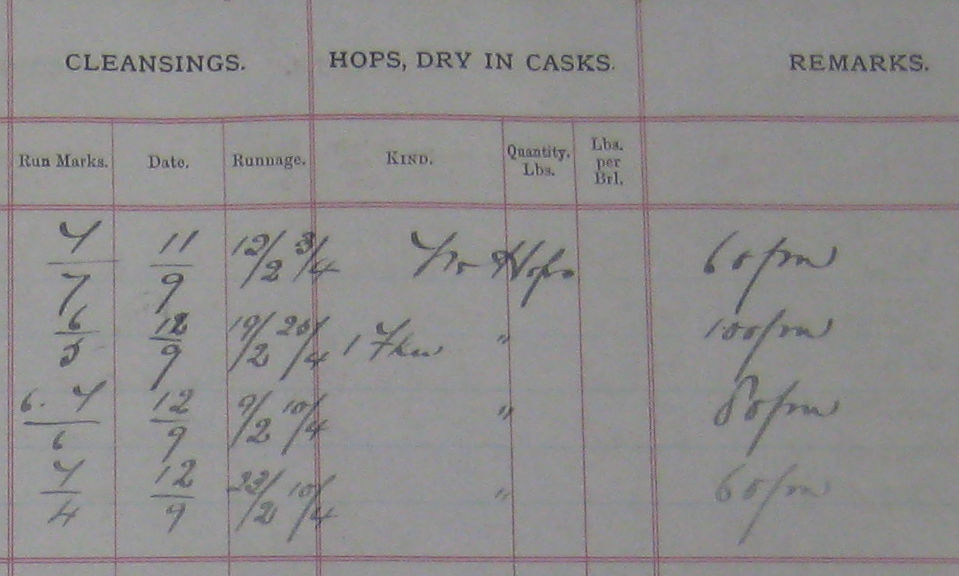
A snapped a whole load of during my last commado raid on the Scotttish Brewing Archive. I grabbed 700+ photos of their records, getting every year from 1906 to 1970. It's a great set. And I would have gone through them as soon as I got back. But . .

Very first record of the first year and I can't understand it. Some, but not this:


That column heading "Runnage" - what the hell is that?

It was enough to make me scratch my head, scratch a few less-mentionable bits, and then move on to something I could understand. Being intensely lazy, I naturally seek the line of least resistance. Robert Younger's and Maclay's records may have been as dull as December, but at least I could understand them.

Drybrough's records are frustrating in many ways.

There are three or four different formats. each of which omits some really handy piece of information. Between them, everything you need is there. Just never all on one record. In some the boil times are missing. Others the pitching temperature. Or even the FG.

Then there are the beers that appear from nowhere in the last columns, conjured from who know's where.

Over Christmas I forced myself to look at Drybrough again. Starting with the less weird later records and working backwards. It's not a great deal of fun. They belonged to the one recipe school of Scottish brewing.

I've done most of the 1950's. It was a bit like hammering a nail through your big toe, but without the thrill of an ambulance ride to casualty.

The 1930's were a weekend in Bamberg in comparison. Slight exaggeration. A year in Swindon. That's it. Like a year in Swindon.

I'm on WW I now. And I've tipped over my comprehension horizon. I'm recording stuff I don't understand. I really hate that.

I'll be busy for weeks, whatever my level of understanding. It'll be worth it in the end. For the 64-year arc of a Scottish 60/-.

The Price of Fourpenny

It seems pretty obvious how much Fourpenny should cost - fourpence. Things weren't quite that simple in WW I.

This highlights one of the basic flaws in naming beers by their price. What happens when that price changes?

You'll notice that the term "four ale" is thrown about in the article. That's the pre-war name for Ordinary Mild, deriving from the price per quart, which was fourpence. By the later war years fourpence had become the price per pint. For a weak Mild. If you were lucky enough to be able to find it.

"THE PRICE OF "FOURPENNY."
The Chelmsford Rural Food Committee met yesterday, Mr. E. A. Hunt, presiding.—A letter was read from the Divisional Food Commissioner stating that there was reason to believe that the Beer (Prices and Description) Order was being generally evaded, and asked the Committee bring the matter to the notice their inspectors.—A letter was read alleging that licensed victuallers in the writer's district refused serve him with "four ale." He alleged publicans evaded the Act by calling it "old and mild," and charging 6d., at the same time saying they had not got any mild ale The writer asked if the Committee stop publicans charging 6d. per pint for beer? A postscript to the letter asked if four-ale could be dealt with the ration-book? (Laughter).—Mr. Neill: Everything is the P.S. (Laughter;. —It was decided to ask for the names of the publicans."
Chelmsford Chronicle - Friday 19 July 1918, page 4.

In the summer of 1918, there were price control orders in place for some categories of beer.  Anything with a gravity of under 1030º retailed for 4d a pint. Beer of 1030-1034º was 5d a pint.

Passing off a weaker beer as a stronger one as in this case seems to have been rife during WW I. Like selling Porter as Stout. It's no wonder that publicans became the object of suspicion. Many thought that they were profiteering from the war by practices such as this.

The postscript about the ration book is referring to the fact that, unlike many foodstuffs, beer was never rationed. In neither WW I nor WW II. The amount that was brewed was limited by the government and there was often not enough to go around, but it was never officially rationed.

Which meant that beer supply was patchy. As pubs were mostly allocated an amount of beer based on their pre-war trade, those in areas where a growth in the munitions industry had dragged in workers were often under-supplied. While those in rural areas, where many men had left to join the armed forces, there was plenty.

Thursday, 10 January 2013

Robert Younger's grists in 1957

It's time for the second part of my enthralling look at the beers of Robert Younger in 1957. Don't worry. I'll stop being so general and get more specific soon.

Robert Younger's beers have been an education to me. And shown me how atypical William Younger was. All those different recipes. Other Scottish brewers kept it much simpler. Much, much simpler.

How simple the malt stores must have been in Scotland. On one corner a pile of Scottish malt, in another malt from foreign barley. And finally a carrier bag of black malt. The sugar stores, on the other hand, were piled high with different sweet wonders.

If you're wondering why the grists look so similar for all their beers there's a good reason: they were all brewed from the same basic recipe. That includes the Sweet Stout, which they cleverly managed to parti-gyle with 60/-. How? That's a good question. One I'll attempt to explain.

It's all to do with the coppers. For each brew they used a single mash tun but multiple coppers, usually three. As in English breweries, the sugars weren't divided evenly between the coppers, but tended to be concentrated in those of the later, weaker worts. When brewing Sweet Stout, they took it a bit further, dumping black malt and liquorice into one of the coppers.

Those of you who understand true parti-gyling, are probably thinking: "What happens when the worts all get blended together? Won't some of the wort from the black malt and liquorice copper end up in the 60/-?" The answer is simple: yes. Unless they were throwing away wort, which is extremely unlikely.

How do I know that for sure? By looking at the numbers. The Black malt copper yielded 52 barrels at 1041º. But there were 52.75 barrels at 1031º of Sweet Stout wort in the fermenter. I make that 500 missing gravity points. Where else could that wort have gone, other than in another beer in the parti-gyle?


Robert Younger's grists in 1957
Beer Style OG FG ABV App. Atten-uation pale malt black malt caramel liquorice invert sugar hydrol sugar flaked maize malt extract
54/- Pale Ale 1028 1008 2.65 71.43% 71.47% 0.06% 4.65% 4.65% 17.43% 1.74%
60/- Pale Ale 1030 1012 2.38 60.00% 75.34% 0.05% 4.02% 4.02% 15.07% 1.51%
70/- Pale Ale 1035 1011 3.18 68.57% 75.32% 0.05% 4.83% 3.86% 14.49% 1.45%
80/- Pale Ale 1043 1012 4.10 72.09% 75.32% 0.05% 4.83% 3.86% 14.49% 1.45%
Export Pale Ale 1045 1012 4.37 73.33% 76.67% 0.05% 4.56% 3.65% 13.69% 1.37%
Old Edinburgh Ale Old Ale 1044 1012 4.23 72.73% 77.06% 0.47% 0.06% 4.37% 3.28% 13.12% 1.64%
Sweet Stout Stout 1030 1015 2.05 51.67% 75.99% 0.68% 0.15% 0.11% 4.52% 3.62% 13.57% 1.36%
Strong Ale Strong Ale 1070 1024 6.09 65.71% 71.71% 0.05% 3.48% 5.21% 18.25% 1.30%
Source:
Robert Younger brewing record held at the Scottish Brewing Archive document number RY/6/1/2.

Wednesday, 9 January 2013

A vessel to carry beer

Remember me mentioning that I'd seen text similar to "Our casks are vessels to carry beer, not measures, but care is taken that they contain not less than their reputed quantities" on bottle labels? Here's proof that I wasn't just making it up.

The text is basically identical, save for the changes necessary to apply it to a different type of container:

"This bottle is a vessel to carry beer, not a measure, but care is taken that it contains not less than the reputed quantity."

That's it. I had a small point to make and I've made it.

Fremlin's Milk Stout

This is just weird. If anyone can help explain it I'd be mightily grateful.

Take a close look at the label to the right. "Brewed in Scotland" it says at the top of the label. Brewed in Scotland? The Fremlins brewery was in Maidstone, Kent. Which is quite a long way from Scotland.

Why were they getting their Milk Stout in Scotland? And who was brewing it? It just seems too bizarre for words, a brewery in the southeast of England getting their Milk Stout brewed in Scotland. Especially as Milk Stout originally came from Kent.

"Product of finest Scotch malt" made me smile. I've seen what Scottish beers were brewed from and quite often they contained not one grain of Scottish barley. I'd be very surprised if Fremlin's Milk Stout was brewed from all Scottish barley.

I may not know who brewed it, but I do have some idea of what Fremlin's Milk Stout was like,. Courtesy of the Whitbread Gravity Book. The entry for the 1935 version even says "Brewed in Scotland". Whitbread must have found it pretty weird, too.

Here are the analyses:


Fremlin's Milk Stout 1931 - 1935
Year Beer Price size package Acidity FG OG ABV App. Atten-uation
1931 Milk Stout pint bottled 0.05 1020.7 1047.4 3.44 56.33%
1931 Milk Stout 10d pint bottled 0.05 1019.9 1047.5 3.56 58.11%
1934 Milk Stout 8d pint bottled 0.05 1020.4 1048.7 3.65 58.11%
1935 Milk Stout 8d pint bottled 0.06 1020.2 1048.8 3.69 58.61%
Source:
Whitbread Gravity book held at the London Metropolitan Archives, document number LMA/4453/D/02/001

Note the quite respectable gravity in the high 1040's.

Tuesday, 8 January 2013

Competition result

Probably not the one you think. I'm still deliberating the Thrale Cup entries. No, this is the result of one of my throwaway end-of-year contest.

Remember me saying that whoever could guess the origin of Yule Logs' cover would win a free copy of the book? Well someone did and has. Step forward . . . BryanB who ciorrectly identified it as a Fuller's brewing book. Well done Bryan.

Especially as you'll be getting the last copy of the book ever to be printed. Unless I change my mind.

BryanB - get in touch and a copy of Jule Logs will be on its way.

The Size of Brewers' Casks

Here's a good one. A landlord taking a brewery to court for selling him a kilderkin of Mild with less than 18 gallons in it.

I'd always wondered how they made wooden barrels to a specific capacity. It seems that the simple answer is: they didn't.

"THE SIZE OF BREWERS CASKS.
IMPORTANT RAINTON APPEAL.

In the King's Bench Division yesterday, the case of the North-Eastern Breweries v. Gibson came before the Lord Chief Justice and Justices Wills and Kennedy, on appeal from a decision of the Justices of Durham, on a case stated by the Justices for the opinion of the High Court.

The facts of the case are that Robert Gibson is licensed victualler, and a tenant under the appellants of the Lord Seaham public-house, at West Rainton. In October last Gibson ordered one kilderkin mild ale. and received from the appellants cask of ale which held only gallons 1 quart and 1 pint, the respondent also proved that had in his possession eleven other casks, purporting to kilderkins of gallons each, and that seven of such casks were deficient in holding capacity; of the remainder one held exactly 18 gallons, and three slightly more than that quantity. On behalf the appellants it was proved that the process of coopering casks had the effect of diminishing their holding capacity, and that it was usual to send with casks an invoice, which was stamped with the words: "Our casks are vessels to carry beer, not measures, but care is taken that they contain not less than their reputed quantities." The invoice left with the respondent in this case did not bear the words referred to.

The Justices stated that after careful consideration of all the evidence, they found as facts (1) that a kilderkin a cask of sufficient capacity to hold 18 gallons. (2) that the cask only held 17 gallons 1 quart and 1 pint, (3) that the cask had been supplied to the respondent by the appellants in the usual course of business and with their knowledge, (4)that the appellants were aware that the process of coopering casks had the effect of diminishing the holding capacity of such casks. They therefore convicted the appellants of the offence charged, and inflicted a penalty of £5 and £2 0s 6d costs.

The Lord Chief Justice, giving the judgment the Court, held that the Justices were right in their findings, and dismissed the appeal with costs."
Sunderland Daily Echo and Shipping Gazette - Friday 06 May 1904, page 6.

The offending cask was 5 pints short of 18 gallons. That's 5 pints out of 144 in total. Or about 3.5% short. Not a huge shortfall, if you look at it in percentage terms. And not as much as the 5% short that landlords are allowed to pull your pint today.

I've seen a similar disclaimer on some old beer labels, saying that they are vessels for transporing beer, not measures. It always implied to me that the bastards were deliberately using under-sized bottles. But then again I'm a cynical bastard.

I remember my brother telling me about how Home Ales invoiced for beer. He knew it from being the accountant for some of their publicans. They's weigh the cask before and after filling so they could calculate exactly how much beer was inside it. They charged for the actual contents rather than the nominal capacity of the cask. It seems a very fair system to me.

Monday, 7 January 2013

Barely alcoholic Mild

This is so sad. It documents the fall of Mild from a very respectable 5% ABV in 1914 to what was little more than a soft drink.

Though I think they are overemphasising the low strength. I'll explain that later. Read the article first:

"THE BEER OUTPUT.
GOVERNMENT DECISION;
ANOTHER 33 PER CENT.

The "Times" says the Government have decided to allow an immediate increase in the output of beer. The barrelage already sanctioned for the summer term is to increased 33 per cent. Provision is also to made for brewing a light beer in place of much of the heavy beer now brewed, and this may raise the increased output to something like 50 per cent.

The aim of the Government will be to provide, with the co-operation of the brewers, an ample supply of light, wholesome beer which can be retailed at 4d a pint. The high price of beer has contributed quite as much as the scarcity of beer to the discontent now prevalent.

Much the home-brewed "harvest beer," which was forbidden under the Food Controller's order, and the lack of which is now so severely felt by the hay harvesters, contained little more than 2 per cent, proof spirit, and this has always been appreciated by agricultural labourers.

The public must not confuse light beer brewed in the same way stronger beers with decoctions (not brewed at all in the accepted sense) which are offered in bottles under fancy names of which "ale" or beer forms part. In some of these no barley whatever is used, and the flavour of beer is missing. Some prejudice against "light beer" has been created consequence, but the real "brew" is in great demand wherever it has been introduced. Some of the "mild ale" now sold in public-houses is of low gravity, and contains very little more than 2 per cent, proof spirit.

In the Birmingham area, where work is conducted under heated conditions, the light beer is preferred to the heavier graded. From Swansea, Bolton, Wednesbury, Dudley Port, West Bromwich, and Tipton most favourable reports have been received."
Liverpool Echo - Saturday 23 June 1917, page 3.
4d a pint beer in 1917 was Government Ale. It was weaker than pre-war stuff but "very little more than 2 per cent, proof spirit"? Proof spirit is ABV * 1.75. So that would mean Mild of 1.25% ABV or so.


I just happen to have details of Government Ale from July 1917. Whitbread's. It had an OG of 1033.5 and was 3.77% ABV. Quite a bit stronger than the article suggests. Barclay Perkins GA from the same month was fairly similar: 1036.4, 3.72% ABV. Stronger than most modern Milds.


Not that there weren't non-intoxicating Milds in WW I. Exactly a year later, in July 1918, one version of Whitbread's GA was just over 1% ABV. I wonder what it tasted like?

What has me wondering most, though, are those "decoctions" with "ale" in the name. What on earth were they? What were they made out of? Were there any government restrictions on making them?

This article repeats the same tale of Mild being non-alcoholic:

"MILD ALE.
The gravity of the beer now sold in most localities is so low as to make intoxication a matter of impossibility, state the directors of Home Counties Public-house Trust.
Western Daily Press - Thursday 26 July 1917, page 5."

Sunday, 6 January 2013

Tasty Meals at Short Notice


I've done with Mild Ale cocktails, but here's something else you can do with Mild: cook with it.

I'd like to to give this version of Welsh Rarbit a go. Just one small problem: I have no Mild Ale. Can  you believe that in this modern day an age there's nowhere in Amsterdam that sells Mild? It's a disgrace.

"TASTY MEALS AT SHORT NOTICE
Some Easily Prepared Recipes
In many households these days meals must be prepared and eaten at all sorts of odd times, and recipes for easily prepared—and easily digested—dishes are much in demand, writes Ellen Ainsworthy.

Here are three very useful dishes.

If the family is fond of cheese, make especially tasty Welsh Rarebit by melting in the frying pan a tablespoon of butter, and, when hot, add half-a-pound of stale, mild cheese cut up finely.

Stale Cheese for This

Then stir in half-a-tablespoon of paprika pepper, a large pinch of salt, and tablespoon of mild ale. Stir continually until the mixture becomes a thick cream, then stir in softly two more tablespoons of ale, and lastly a teaspoon of mads mustard. When the mixture begins bubble it is ready to pour on hot toast. This is a dish you must serve immediately.

Dish of Herrings

A meal of herrings is nourishing but not always attractive. Here's good recipe. Clean the fish, remove the scales and cut open from head to tail. Then take out the backbone. Now cover the herrings with oatmeal, and grill them for about eight minutes, turning carefully. When cooked, arrange on a hot dish, and sprinkle with lemon juice, or dash of vinegar, and garnish with chopped parsley. Brown bread goes well with this fish dish.

Potatoes With Ham

Potatoes and ham make tasty dish cooked in the casserole. You peel the potatoes and cut them in thick slices, then allow an onion to a pound of potatoes, cutting the onion into thin rings. Cut an ounce of ham into small pieces, fill the casserole almost to the top with alternate layers of potato, onion, ham. chopped parsley and seasorring. Pour over some milk, and sprinkle on top pieces of margarine. Cover, and cook this dish over gentle heat.

To get that rich brown look which tickles the appetite, you must uncover the casserole half-an-hour before taking it: from the oven.
Western Daily Press - Saturday 24 August 1940, page 3.

I'm a bit surprised by the inclusion of papika in the recipe. How could they have got hold of it during wartime? The Hungarians were on the side of the Axis.

Saturday, 5 January 2013

Attempted Till Robbery

It wasn't Mild that was being stolen this time. Buying Mild was part of a ploy to get alone with a till.

See what you think about the evidence and the sentence handed down:


"TAMWORTH BOROUGH POLICE.
FRIDAY, JANUARY 23.
Before the Mayor (Mr. H. C. Goostry) and Alderman T. W. Woodcock.
ATTEMPTED TILL ROBBERY.
Albert Stanton, labourer, of no fixed abode, was charged on remand with attempting to steal money from a till at the Carpenters' Arms inn, Upper Gungate, the property of Albert Edward Beaumont, on January 15. - William Jones, labourer, 4 Upper Gungate, stated that about 12-30 p.m. he went to the outdoor department of the inn. He looked through the window and saw that the till was open, and a man's hand was in it. There was no one else in the room but accused. He afterwards spoke to the landlady, and pointed to the till. The landlady accused Stanton of opening the till, and he denied it. - Hilda Beaumont (14), daughter of the landlord of the inn, stated that accused asked for a pint of mild ale, and she served him. Accused then asked her for a safety pin, and she left to go into the kitchen, leaving accused alone in the taproom. When she left the room the accused was standing against the fireplace, about four yards from the till, which was closed. Four or five minutes later she came back to the bar, and opened the till to get some change. Accused was still standing by the fireplace alone in the room. Having taken the change, she closed the till, and left the room. - Nellie Clara Beaumont, wife of the licensee, stated that when she asked accused what he was doing with his hand in the till, accused said Jones was a liar. He continued to deny tho charge. - P.s. Batkin said when charged, accused replied. "Let them prove it." - Accused pleaded not guilty, and said when Jones came in he was standing by the fire, and could not have reached the till if he had tried. He denied that he put his hand in the till.-Inspector Jeffery produced a long list of previous convictions against the accused, who, he said, was a cunning thief. - Accused was sentenced to three months' imprisonment with hard labour."
Tamworth Herald - Saturday 31 January 1925, page 2.

It sounds as if the main reason the poor bloke got sent downm was his past record. Which seems a bit unfair. As does the 3 months' hard labour, considering he didn't actually nick anything. Hard but unfair the courts were in the old days.

Friday, 4 January 2013

Robert Younger's beers in 1957

Another year, another set of details from a defunct Scottish brewery.

Sadly, the Scottish Brewing Archive only has three of Robert Younger's brewing books. They cover the 7 or 8 years before the brewery's closure in 1961. But they've still been useful in helping me get my head around Scottish brewing after WW II. In conjunction with Maclay's records. It's quite different from what I've seen in England.

My first impression was: what a lot of Pale Ales they brewed. Five in all, with a spread of just 17 gravity points. To be honest, they didn't brew a great deal of most of them. Over 50% of what they brewed was 60/-. Here's a table to demonstrate


Beer barrels brewed % of total
54/- 155.8 4.76%
60/- 1754.5 53.60%
70/- 279.8 8.55%
80/- 237.5 7.26%
Export 564.3 17.24%
OEA 31.0 0.95%
Sweet Stout 250.8 7.66%
Total 3273.5 100.00%

It's not totally scientific, the way I've assembled that table. It's just what was on the half dozen or so pages of the brewing log I went through. But I think it gives a reasonable rough idea of how much of each beer they brewed.

Notice something odd about the Pale Ales? The FG is the same for most of them. English brewers usually aimed for about 75% attenuation in most of their beers. Robert Younger seems to have been aiming for a specific FG number, rather than a degree of attenuation. Which means that their lower-gravity Pale Ales have higher FG's than equivalent English beers.

You may be asking yourselves "What the hell is the difference between 80/- and Export?". Why have two beers of such similar gravity? And isn't 80/- Export, anyway? They weren't the only brewery to do this. In the 1950's, Drybrough had XXP at 1043º and Export at 1045º. Weird, isn't it?

Old Edinburgh Ale was a dark beer. As was the Strong Ale. How they brewed them and the Sweet Stout is, er, interesting. I'm sure there are some that would call them fake beers. I prefer the adjective ingenious. We'll be going into that in more detail next time.


Robert Younger's beers in 1957
Beer Style OG FG ABV App. Atten-uation hops lb/brl
54/- Pale Ale 1028 1008 2.65 71.43% 0.50
60/- Pale Ale 1030 1012 2.38 60.00% 0.60
70/- Pale Ale 1035 1011 3.18 68.57% 0.67
80/- Pale Ale 1043 1012 4.10 72.09% 0.83
Export Pale Ale 1045 1012 4.37 73.33% 0.86
Old Edinburgh Ale Old Ale 1044 1012 4.23 72.73% 0.71
Sweet Stout Stout 1030 1014.5 2.05 51.67% 0.57
Strong Ale Strong Ale 1070 1024 6.09 65.71% 1.22
Source:
Robert Younger brewing record held at the Scottish Brewing Archive document number RY/6/1/2.


Thursday, 3 January 2013

Stealing Mild

Just look at that. One day I tell you that Mild wasn't usually sold in bottles, at least not under the name Mild, and here's proof that it sometimes was. I blame the Hull Brewery for bottling their Mild and making me look a liar.


"STOLE BEER
Hull Men's Prank Was Not Funny

"This is a very unfortunate case. It is put down as a bit of fun; but it is not funny, you know; and I should have thought you could have afforded to buy your beer. You will all pay a fine of £1, and refund the cost of the beer and the broken bottles. And for God's sake think before you do such a thing again: it is not worth risking your characters."

The chairman of the Bench at the Hull Police Court, Mr J. F. Haller, said this when three men, Cyril Short, of George's-ave., Springburn-st., Lawrence Palmer, of Steynburg-st.. and William Castleton, of Brunswick-ave., Franklin-st., were charged with stealing a case containing 18 pint bottles of mild ale. All three men pleaded guilty.

Inspector J. E. Huxley, prosecuting, said that the beer was being delivered to the Cleveland club, and the lorry driver left several cases, to be delivered, on the pavement. When he checked them, one was missing. Seen by the police the men admitted to the theft, saying that they had been drinking most of the afternoon, and took it as a joke, drank the beer, and were afraid to return the case. The total value of the property was £2 0s 6d.

The three men told the court yesterday that they were willing to repay the money for the broken bottles, and the beer, and were sorry for what seemed at the time to be a foolish prank."
Hull Daily Mail - Friday 17 September 1943, page 3.

If I read this correctly, they just left a stack of crates on the pavement by the club. I suspect if anyone did this today, it wouldn't be a single crate that walked. The whole lot would have been gone in a flash.

Breaking bottlesd was a pretty irresponsible act during the war when there was a shortage of glass. I'm surprised that wasn't mentioned in court.

Wednesday, 2 January 2013

Reminder

A little reminder that the extra super-special, onetime only hardback edition of "Scotland!" is currently available.

But not for long. You've only another 29 days to buy because at the end of January it will disappear forever. Obviously not the copies already printed. There just won't be any new ones.

Buy "Scotland!" now! While it's still hard.

Headington and Sons beers in 1903

More Mild Ale. Sort of. In an odd oblique way. We'll be looking at a price list from 1903 to see what it tells us about changes happening in British brewing.

Here's the price list:

Reading Mercury - Saturday 21 March 1903, page 10.

I'm going to take the beers that cost 36s per barrel as my base line. They should have been around 1050º at this time. And you know what's dead interesting? That there are two beers cheaper than 36s per barrel: Harvest Beer and X Light Dinner Ale.

The Harvest beer can't have been over 1040º at that price. The X Light Dinner Ale can't have been much over 1040º. But what sort of beer was it? A very Light Bitter, would be my guess. Though it could also have been a weak Mild.

Mild is where this price list fascinates. Because there's only one (perhaps two if X Light Dinner Ale is one as well). Yet yesterday we learned that Mild was about two-thirds of all beer brewed in Britain. It seems hugely under-represented in the price list. Especially if you know what a price list from the 1860's or 1870's looked like. You don't? Well here's one:

Bucks Herald, Saturday 6th July 1867, page 8.

Look at all those Mild Ales. Six in total. The Pale Ales and Stouts look very similar. Just the Porter is missing.

It highlights a strange paradox. Usually when a style becomes popular, more varieties of it appear. The opposite happened to Mild at the end of the 19th century. The number of Milds a a brewery's range declined, even though the style was gaining poularity.

I've already written about this phenomenon amongst London brewers, who went from brewing four - X, XX, XXX and XXXX - to just one Mild Ale  between 1840 and 1890. Stronger Milds disappeared and only the weakest X Ale remained, reigniong supreme in the public bar. Though you could argue that Burton took the place of stronger Mild.

Another point is the disconnect between bottled and draught beer names. Cooper, Nourishing Stout and Double Brown Stout are obviously the same beers as Porter, Single Stout and Double Stout. Why the change in names? Cooper is especially interesting. That's really the name for mixed draught Porter and draught Stout.

That leads me on to another point. Why popular beers like Porter and Mild were rare in bottled form. Either they weren't bottled at all, or like the Cooper above, were given different names when bottled.

Finally the Pale Ales. As you've probably already noticed, the IPA is the strongest of the bunch. My guess would be that Family Pale Ale was about 1050º, Pale Ale 1055º and IPA 1060º.


Tuesday, 1 January 2013

Plea for Preservatives

Let's start the year as I ended the last: with loads of random stuff about Mild Ale.

I must admit to never having heard of the 1909 Hops Bill. I wonder if it ever became law?

It's odd that brewers should suddenly be pleading to be allowed to use preservatives in Mild. Surely it would have been sold so quickly that it wasn't necessary to add preservatives?

"BREWERS AND HOPS BILL.
PLEA FOR PRESERVATIVES.

The Brewers' Society, in circular issued to the trade on the subject of the 1909 Hops Bill, raises no objection to the prohibition of hop substitutes but gives a number of reasons why preservative substances should be included. is pointed out that the preservative is used in minute quantities and assists the brewer to combat the organisms invading the beer from the air, plant, and casks, without any disturbance whatever to the general character and class of beer. It is an established fact that hops, even in excessive quantities, are not a preservative against certain forms of deterioration to which beer is subject, and other preservatives are necessary if beer is to remain sound and palatable under trying conditions. The society says it must be borne in mind that the staple beer of the country is mild ale, which probably constitutes two-thirds of the beer produced. The requirements of this beer are fulness and sweetness of flavour, and these attributes are inconsistent with high hop rate. One objection stated to an increased rate of hopping in bitter beer is that if the proportion of hops were greatly increased the beer would become heavier and soporific and would not meet the popular taste. The society further points out that the preservatives which are barred are quite harmless."
Manchester Courier and Lancashire General Advertiser - Wednesday 31 March 1909, page 10.

The main reason I reason I've drawn your attention to this artiicle is a throw-away comment. The one that says two-thirds of the beer brewed in Britain was Mild. That sounds about right to me. But I've never seenn any actual figures to that effect.
