Thursday, 17 November 2016

Pub room names

This sort of thing happens to me quite often. I was rummaging through a pile of books looking for something. I didn’t find the book I sought, but tripped over another. One I’d forgotten I had. But very relevant to my current area of focus.

The book was “Beer in Britain”, a book based on a supplement which appeared in The Times newspaper in 1958. It’s a series of short articles on the subject of beer. I’ve owned it for a few years yet never really looked at it. That’s pretty typical of me. I buy books which I think might come in handy some day and then forget about them. Pretty sure I’ve still got a couple of books on bottling that I need to process.

I’ll be pestering you with plenty from “Beer in Britain”, starting with a useful guide to the terminology of pub rooms.

Sadly, most of these terms have disappeared along with the rooms that they designated. Few pubs retain the multiple-room layout. Those that do rarely have more than two these days. But even before the ravages of crap refurbishments in the 1960’s and 1970’s the number of rooms in pubs was being eroded. Pubs built before WW I, unless they were tiny, always had several rooms. Ironically, the larger “improved” pubs of the interwar years had fewer rooms. While those built after WW II were usually limited to just a Public Bar and a Lounge.

What isn’t mentioned in the list is a feature that was common in the North and the Midlands: a drinking corridor. The classic 19th-century design was to have a central serving area. The front of this was the bar counter for the taproom, the back faced onto a corridor, off which were all the other rooms. It’s not really a room in the sense of a Lounge or Public Bar, but was used for vertical drinking.

The names used for different rooms varied considerably from region to region. “Beer in Britain” rationalised that down to just northern and southern usage, using the River Trent as the dividing line. You may recall that I grew up in Newark, which is on the Trent. But on its southern bank. However, it was definitely a northern usage town.

Let’s take a look at those names in detail, starting with the South. 

Pub room names - Southern Usage
Public Bar Where prices are lowest and furnishings simple.
Saloon Bar A saloon was originally a spacious reception room in a private mansion, then in an inn; applied c. 1835 to the better-furnished room of a public house.
Lounge Originally the hotel residents' sitting room. Now a superior saloon bar, often with waiter service and with no sale of draught beer.
Lounge Bar / Saloon Lounge Midway in status between the saloon and the lounge.
Private Bar Midway in status between public bar and saloon, intended for customers wishing to conduct private conversations, or for men accompanied by women: sometimes deputizing for a Ladies' Bar.
Ladies' Bar Self-explanatory.
Bar Parlour An inner room, without a street entrance, reserved traditionally for regular customers or the landlord's intimates. Now rare.
Four-Ale-Bar Colloquial term for the public bar; so named because mild ale. the working man's drink, used to be sold at fourpence a quart.
Buffet Bar A refreshment bar (1869). Modern equivalents are the Lunch Bar and the Snack Bar, of saloon bar status.
Tap Room Originally (1807) a room where beer was tapped or drawn from a cask. Now an old-fashioned name for the public bar of an hotel or country alehouse. Not found in London.
Hotel Bar A saloon bar in a hotel, without a street entrance, mainly for residents.
Shades A basement bar. Rare.
Dive Originally an illegal drinking den located underground (United States, 1882). now usually a basement Snack Bar.
Cocktail Bar / American Bar Hotel bars, now tending to spread into public houses, sometimes taking over the place of the lounge under the title of Cocktail Lounge.
Source:
"Beer in Britain", The Times, 1960, page 69.

It’s incredible how long the term Four-Ale-Bar continued to be used. Mild hadn’t been 4d a quart since 1914, yet the expression was still in use almost half a century later.

I always considered names like Saloon Bar, Lounge Bar, Private Bar, etc. just to be synonyms for Lounge. Probably because the specific function of these rooms had fallen into misuse and been forgotten by the time I started drinking. There may have been different names on the door, but everyone just treated the rooms as part of the Lounge.

Next it’s the turn of the North:

Pub room names - Northern usage
Bar, Public Bar As in the South.
Vaults Originally a cellar for storing food or liquor; now on the ground floor—equivalent to the public bar. (Vault in Lancashire.)
Smoke Room Northern and Midland equivalent of the saloon bar. There may be two: one for men only, the other (mixed) for both sexes.
Tap Room A public bar. Sometimes a room reserved for playing games, without counter service.
Lounge / Parlour / Public Parlour / Bar Parlour The best-furnished room.
Best Room / Best End Colloquial names for the lounge.
Snug / Snuggery Equivalent of the Southern bar parlour, but much more common. (Ireland only: one of a series of half-enclosed compartments within a bar.) Obsolescent.
News Room An old-fashioned name for Tap Room, dating from the period when newspapers were supplied to customers.
Office Bar (Midlands) An inner room without counter service, equivalent to the Southern bar parlour, generally located behind the scrvery or the hotel office.
Buffet Bar North-Eastern variant of the lounge.  Not a snack bar.
Sitting Room North-Eastern variant of the saloon bar.
First Class / Second Class (Men's, Women's, Mixed.) Variants of the saloon and public bars, peculiar to the Carlisle State Management District.
Source:
"Beer in Britain", The Times, 1960, page 70.

I’m intrigued to see that the Carlisle State pubs had their own system of naming rooms. Not so surprising, as the scheme made radical changes to pub layouts, reducing the number of rooms and making decorations simpler.

You’ll note that there are considerable differences with southern practice. About the only names in common are Public Bar and Lounge. A couple of those terms I’ve never come across: News Room and Office Bar. And snug I only really know from Coronation Street.

The room names tally pretty well with what Mass Observation noted in 1930’s Bolton:

Vault — Vault, Public Bar, Saloon Bar.
Tap Room — News Room, Commercial Room.
Best Room — Music Room, Concert Room, Lounge, Parlour, Saloon, Commercial Room, Snug.
"The Pub and the People" by Mass Observation, 1943 (reprinted 1987), pages 92 - 94.

Odd that Music Room and Concert Room aren’t mentioned in “Beer in Britain” as I have seen those names etched into pub glass.

I was rummaging through my brain trying to think of other names for pub rooms. I’m sure the list above isn’t exhaustive. Let me know if you can think of any.

Wednesday, 16 November 2016

Christmas quiz

I like in jokes. That's why I built my secret family album.

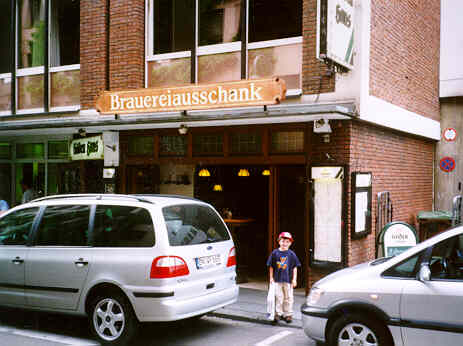
Tucked away in the background of the photos on my pub guides are family, friends, acquaitances and random blokes. Can you tell which are which?

Go to my website and take a look:

http://www.europeanbeerguide.net

There's a special prize* for whoever can spot the most.

Here's an example:


That's Alexei looking very young. He just turned 18 at the weekend.


* Special in the sense of not available in the shops, not as in school or needs.

Let's Brew Wednesday - 1956 Shepherd Neame Abbey Ale

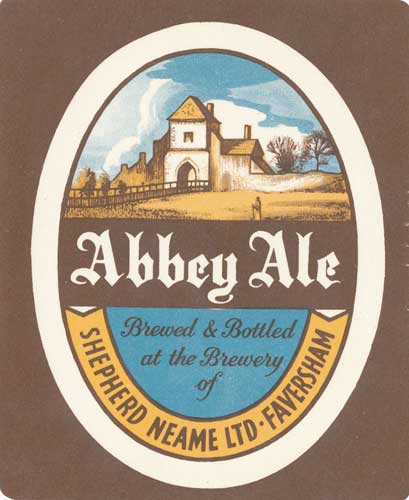
AA – what the hell does that mean? That’s what I thought when I first stumbled across this beer in Shepherd Neame’s records. Luckily, I’ve analyses for a beer of theirs called Abbey Ale. And label images.

It must have been introduced around 1953, a typical time for stronger beers to be introduced. I say that because it isn’t in their 1952 brewing book, but is in the 1956 one.

This is a difficult beer to categorise. In my gravity spreadsheet, I’ve classified it as a Pale Ale. Based mostly on its colour, which is pretty pale at around 10 EBC / 5 SRM. Which you’ll note is much paler than the calculated colour in the recipe below. That will be on account of the gyling. In reality, the proportion of No. 3 invert sugar would have been lower.

OK back to the drawing board. That’s clearly come out wrong. Abbey Ale contained very little of the second wort – only 4 of the 98 barrels. Assuming all the No. 3 went in the second copper, that drastically reduces the percentage of the sugar in Abbey Ale. From 25% to 9%.

As I was saying, a difficult one to categorise, this one. I’ve got it down as a Strong Ale in my brewing log spreadsheet. That was mainly because it was parti-gyled with a couple of Brown Ales. I’d assumed that it was darker than it was. I think I’ll standardise on Pale Ale. Though it is weird that it wasn’t parti-gyled with the Pale Ales.

Ah. I think I know why it wasn’t parti-gyled with the Bitters. Abbey Ale was a bottled beer, as were all the beers it was parti-gyled with. That probably explains it. And also the presence of wheat malt. For head retention, is my guess. Something more important in a bottled beer.

Not much else to say, other than that the attenuation isn’t great. I was going to say tank conditioning before bottling would have lowered that a bit. But having looked at the two analyses of Abbey Ale I have, I’m not so sure. The one from 1954 is, indeed, more highly attenuated at 76%. That from 1961, however, is only 67% attenuated.


1956 Shepherd Neame Abbey Ale
pale malt 7.75 lb 85.45%
wheat malt 0.50 lb 5.51%
no. 3 sugar 0.75 lb 8.27%
malt extract 0.07 lb 0.77%
Fuggles 105 mins 1.00 oz
Goldings 60 mins 0.50 oz
Goldings 30 mins 0.50 oz
OG 1044.3
FG 1016.9
ABV 3.62
Apparent attenuation 61.85%
IBU 27
SRM 8
Mash at 153º F
Sparge at 170º F
Boil time 105 minutes
pitching temp 60.25º F
Yeast a Southern English Ale yeast

Tuesday, 15 November 2016

Gold Label galore

I wasn't joking about this being Gold Label week, as you've probably noticed.

The staff at Tennant seem to have spent much of their time finding ways to surreptitiously drink Gold Label. I don’t blame them. Most of my working days would be far more pleasant with a couple of Barley Wines for breakfast.

This explains the main source of illicit Gold Label within the brewery:

“The first bottling manager that I knew was Geoff Brown - one of life's true gentlemen. His office was up a flight of stairs, overlooking the whole bottling area. Adjoining his office was a small, discrete room which became an unofficial haven for staff who were harassed or thirsty or both. Geoff kept it well stocked with Gold Label 'shorts'. These were bottles that were slightly under filled, usually through overflowing at the 'knocker', in theory, they should have been decanted individually into casks and then blown back into a tank. This was clearly time-consuming and labour intensive. It was obviously less trouble to drink them. The room was known as 'Brown's Bar' and was often patronised by brewers.”
"The Brewer's Tale" by Frank Priestley, 2010, page 27.

“It was obviously less trouble to drink them.” Well, yes. Convenient that, wasn’t it? The attitude to drinking in the brewery varies a lot today. In many new American breweries, they seem to be cracking open bottles and taking samples from tanks the whole time. While in older UK breweries drinking is often strictly limited to the sampling room. It’s become much stricter than it was a few decades back.

Under-filled bottles weren’t the only source of Gold Label:

“The charge hand in the Barm Alley was Jock McKinnon. He was a remarkable man and, not surprisingly, Scottish. I discovered that he used to drink Gold Label pressings. This was basically Gold label with a very harsh, yeasty flavour. From my time working in that department, I learned that it was quite possible to get used to drinking this foul dose. There was clearly no pleasure in the drinking of it, it was more like taking a medicine - you put up with the taste knowing that you were going to feel very much better, very quickly. Jock used to mask the smell of it on his breath by the liberal use of mouthwash from the first aid box in the department. You could always tell how much Jock had had to drink in the Course of the day. He wore a cap at work and first thing in the morning, the peak was centrally aligned above the front of his face, like that of the guardsman he once was. As the day wore on and his sobriety became eroded, the peak would progressively move round his head, like the shadow on a sun dial.”
"The Brewer's Tale" by Frank Priestley, 2010, pages 37 - 38.

Clearly Jock was getting pissed every day on that vile stuff. I’m trying to work out what they were pressings of. Hop pressings are a thing, but that’s pre-fermentation. This is obviously post-fermentation. Could it have been from the filters somehow?

Silly me. I should have read the preceding paragraph properly. It was yeast pressings:

“Because the yeast reproduced so enthusiastically, we always finished up with much more than we needed. The best of the crop was directed into a yeast room which was kept, as near as possible, in a sterile state and this yeast was used for future brews. The remainder, which was considerable, was diverted to an old yeast room in an area of the cellars known as the Barm Alley. When the yeast arrived here, it was in the form of a slurry. It was blown through a filter press which held the yeast back and the beer which had been mixed with the yeast (known as pressings) was returned to the fermenting vessels. The dried yeast was packed into old casks and sold to the food industry.”
"The Brewer's Tale" by Frank Priestley, 2010, page 37.

Jock was drinking stuff which should really have been returned to the fermenting vessel, the naughty boy.

Monday, 14 November 2016

Whitbread Gold Label is born

Gold Label, you may remember, was the only Tennant’s brand to survive the Whitbread takeover. But even that they didn’t leave alone.

Let’s face it, Whitbread were never going to keep branding Gold Label as Tennant forever. Especially when the Tennant name had been phased out elsewhere. And it wasn’t just the name on the label that Whitbread changed.

“Around this time, a new tank room was built which could be reached from the bottling hall, via a bridge across Mill Sands, the lane at the side of the brewery. The new room housed a large number of 200 barrel tanks. They were used for the maturation of Gold Label. The practice of maturing 'in wood', up the tunnel, had been discontinued. Not only that, but the maturation time was progressively reduced. So much for the retention of traditional methods, I thought. However, to be fair, the sales of Gold Label were rising phenomenally and from the volume alone, it would have been very difficult to mature the product in the old way. A newly-designed bottle label, carrying the Whitbread name, was brought in to replace the Tennant's label. This was fair enough: after all, it was no longer Tennant's Gold Label.”
"The Brewer's Tale" by Frank Priestley, 2010, pages 26 - 27.

I wish Priestley was more specific about the number of maturation tanks. Because that would have given me some idea of how much Gold Label was being produced. One 200-barrel is the equivalent of about 130 hogsheads, which is what they had used before for ageing. Even if they only had 10 such tanks, that’s the equivalent of 1,300 hogsheads. You’d need a large cellar for so many bulky casks.

It still amazes me that a beer like Gold Label could be a mainstream national brand. Heavily advertised and widely available. A sign of its popularity is that Whitbread also started brewing at their London headquarters. And in considerable quantities – 300-odd barrels a week. That’s a large volume for a beer of over 10% ABV.

I was trying to find out exactly when the Exchange Brewery closed and was digging around in old Good Beer Guides. It seems cask beer was only discontinued for a few years in the late 1970’s. And the Queen’s Ale that Priestley laments made a comeback in 1981, when it had an OG of 1044º, the same as in the 1950’s. It didn’t last long as it doesn’t appear in the 1984 guide.

It’s funny how your perspective changes with age. I always thought of Whitbread’s northern pubs as a desert, with none of their breweries there brewing any cask other than Castle Eden. Yet this was really just a short-lived feature, lasting less than a decade. It seemed to be forever to my younger self. Probably because they dropped cask just about when I started drinking.

Next I’ll be comparing the Tennant and Whitbread versions of Gold Label.

Sunday, 13 November 2016

What Whitbread did to Tennant

Those working at Tennant were generally pleased at merging with Whitbread, which was already a national brewer. At least the company hadn’t been asset-stripped. Or at least not so obviously.

Because, despite promising to let Tennant continue as before, they soon started to ring the changes. One of the obsessions of the Big Six was to have national brands. Presumably because it was easier to push just a few brands rather than having competing products. Ultimately, I think it was their downfall. Drinkers never acquired the same emotional attachment to national brands that they had to local or regional ones.

Of course, change didn’t all happen at once. It was a subtle process, with the Tennant name and its brands slowly being phased out.

“Gradually, over the next few years, changes were introduced. Most of Tennant's bottled beers disappeared. No. 1 Barley wine had already been swallowed up by Gold Label and then Don Jon, Lion Brown Ale and the prize-winning Lion Pale Ale were discontinued. Whitbread Pale Ale was tankered up from London and bottled in Sheffield. Glucose Stout was replaced by Mackeson which was now brewed and bottled in Sheffield. There was even a suggestion that Tennant's Gold Label should be replaced by Whitbread's barley wine, Final Selection. I believe it was due only to the persistence of our strong-willed Head Brewer, Harold Burkinshaw, that this wonderful product was saved.”
"The Brewer's Tale" by Frank Priestley, 2010, page 23.

It’s incredible that they should have contemplated phasing out a classic beer like Gold Label. Ultimately, it was Final Selection that got the chop. I wonder where Final Selection itself originated. I’m pretty sure it wasn’t at Whitbread’s original brewery in Chiswell Street. It doesn’t turn up in the brewing records there until 1968. Did it come from another of Whitbread’s breweries?

Whitbread Pale Ale was a big brand back then, which was heavily promoted in newspaper advertisements. While Mackeson was one of the biggest brands of all, brewed at Whitbread plants all over the country. It’s interesting that the Pale Ale was always produced in London.

There was a similar paring down of the draught range:

“Tennant's draught beers didn't fare much better. The beautiful Queen's Ale was discontinued, as was Rock Ale, which was replaced by Whitbread Best Mild. Best Bitter, after a colour adjustment, was renamed Trophy Bitter. Whitbread's policy was to advertise nationally a product that was, in effect, each regions Best Bitter. It was a good idea. A national product, brewed to satisfy local tastes. Although, when Yorkshiremen went on holiday down south, they sometimes got a bit of a surprise when they ordered their favourite brew.”
"The Brewer's Tale" by Frank Priestley, 2010, page 23.

Rebranding a brewery’s flagship Bitter as Trophy was standard Whitbread practice, even though they didn’t particularly advertise the fact. At one point in the 1970’s there were more than a dozen beers sold as Trophy. On the other hand Tankard, Whitbread’s premium keg Bitter, was the same everywhere.

I assume Queen’s Ale was replaced by Trophy. And that Best Mild was brewed in Sheffield. It’s difficult to imagine this now, but Best Mild was a big brand for Whitbread in the 1960’s. Though I’d need to look at the brewing records to confirm it was the same beer as brewed in London.

In case you’re wondering, this is what the Whitbread range looked like back then:

Whitbread beers in the early 1960's
Year Beer Style Price per pint d package OG FG ABV App. Atten-uation colour
1965 Final Selection Strong Ale 57 bottled 1079.2 1013.5 8.63 82.95% 68
1964 Forest Brown Brown Ale 22 bottled 1035.6 1011.2 3.16 68.54% 90
1961 Mackeson Stout 32 bottled 1046 1019 3.48 58.70% 250
1963 Pale Ale Pale Ale bottled 1036.5 1007.5 3.77 79.45% 21
1960 Bitter Pale Ale 17 draught 1038.5 1011 3.56 71.43% 20
1961 Tankard Bitter Pale Ale 24 draught 1038.6 1011 3.58 71.50% 18
1964 Best Ale Mild draught 1030.6 1007.5 3.06 75.49% 100
Sources:
Whitbread brewing records
Whitbread Gravity book held at the London Metropolitan Archives, document number LMA/4453/D/02/002.


Gold Label might have survived by the skin of its teeth. But what happened to it next?

Saturday, 12 November 2016

Let's Brew - 1894 Thomas Usher IPA

What makes a beer an IPA? More specifically, what makes a beer an IPA rather than a Pale Ale? It’s a question to which I’ve yet to find a satisfactory answer.

It doesn’t help that British brewers were extremely inconsistent in their use of the terms. Modern dogma would insist that, if a brewery makes both a Pale Ale and an IPA, the latter should be the stronger of the two.  But I’ve dozens of examples of British brewers where it was the other way around.  Whitbread and Barclay Perkins in London. And Usher in Edinburgh.

In the 1890’s. Thomas Usher brewed three Pale Ales: IPA at 1044º, PA at 1049º and PA 60/- at 1055º. Compared to the Pale Ales of a London brewery, they look on the weak side. 1050º was about the weakest anything got in the capital. Whitbread’s three Pale Ales in the same year were: FA at 1051.8º, 2PA at 1052.4º and PA at 1058.4º.

The recipe, as with most 19th-ccentury Scottish ones, is very simple, just pale malt and sugar. Not sure exactly what sort of sugar as I couldn’t read the brewer’s scribble. No. 1 or No. 2 invert are the obvious choices. Take your pick. I’ve gone for No. 2 for no particular reason.

The rate of attenuation is quite low, which is typical for Scottish beers, even Pale Ales. Leaving the ABV at just under 4%, a very low figure for a 19th-century Pale Ale of any kind. A English AK would have had a similar OG, but the higher rate of attenuation would have left it at 4.5% ABV.


1894 Thomas Usher IPA
pale malt 8.00 lb 86.49%
No. 2 invert sugar 1.25 lb 13.51%
Fuggles 90 min 1.25 oz
Goldings 60 min 1.25 oz
Goldings 30 min 1.25 oz
Goldings dry hops 0.25 oz
OG 1044
FG 1014
ABV 3.97
Apparent attenuation 68.18%
IBU 49
SRM 7
Mash at 150º F
Sparge at 180º F
Boil time 90 minutes
pitching temp 58º F
Yeast WLP028 Edinburgh Ale

Friday, 11 November 2016

Malt extract

Something that’s struck me as I’ve been trailing through 1950’s brewing records is a prevalence of malt extract. Lots and lots of breweries were using it. But why?

I have my own guess. Then I thought, why not just look at see what Jeffery says. And here it is:

Malt Extract.
This is prepared from a malt wort evaporated in a vacuum to give a syrup of about 80% solids. (Malt extracts are also obtainable as powders, but these are not usually used in brewing.) Non-diastatic malt extracts, or those with low diastase, are suitable for adding in the copper, and enable a larger brew to be made on occasions when perhaps the existing mash tun capacity is inadequate. However, apart from this, their regular use is of value and many brewers always include a proportion in their beers. They are of use in assisting head retention and there are special grades made in such a way as to have a high proportion of those protein products which assist in head retention. Diastatic malt extracts are also used in the mash tun if the malts are deficient in diastase, or if a high proportion of flakes is to be used. As flakes do not contribute head-retaining materials, their use tends to reduce the foam-retaining qualities of the beer; the use in the copper of the high nitrogen malt extracts, already referred to, will therefore counteract this tendency.
"Brewing Theory and Practice" by E. J. Jeffery, 1956, page 167.

Basically there were three uses of malt extract: to extend the brew length; to aid head retention; and to provide extra diastase.

I’ve just done a little survey of brewing records to check on the usage of malt extract. Of the fourteen breweries whose records I have from 1945 – 1949, seven used malt extract. As far as I can see, none employed it to extend their brew length. Four used it in the mash tun and three in the copper.

Here’s a summary:

Malt extract usage
Brewery where used % malt extract % unmalted grain name where listed
Barclay Perkins XX, LS occasionally 1 - 2% 8 - 10% malt extract with the sugars
Shepherd Neame all 1% 0% EDME with the sugars
Adnams none 0%
Whitbread none 0%
Strong all except Stout 5% 0% Diamalt with the malts
Flowers all 2.5 - 6% 0% ME with the sugars
Lees none 4 - 6%
Ushers, Trowbridge Pale ales 2% none in beers with malt extract Diamalt
Bernard none 12%
Robert Younger all 1.50% 15% malt extract with the malts
Maclay none 10 - 15%
Drybrough all 2% 7.50% ME copper sugar
Fuller none 7 - 12%
Truman none 6%
Sources:
Brewing records.


Jeffery claims that malt extract was used in grists with a high percentage of unmalted grains, yet only one of the brewers using it in the mash used any unmalted grains at all. The one exception was Robert Younger, where the proportion of unmalted grain was high at 15%.

Why did Ushers only include malt extract in their Pale Ale grists? I’d say head retention, but it was a diastatic malt extract, so that implies it was to aid mashing. Even though there was no unmalted grain.

Jeffery specifically mentions that diastatic malt syrup could be used to help avoid a stuck mash:

“The introduction of a highly diastatic malt syrup to the mash tun would be of considerable assistance in cases of a set mash owing to the presence of unconverted starch. But since the quantities of malt and sugar to be used in the brew have already been entered in the Excise book, some difficulty would be experienced in obtaining leave to add any further quantities, particularly in the middle of a brew.”
"Brewing Theory and Practice" by E. J. Jeffery, 1956, page 266.

If there hadn’t been the excise restriction, brewers might have waited until there were problems with the mash before adding malt extract. But as that was complicated, just throwing some in every time would have been a simpler solution. A sort of insurance against a stuck mash.

Those adding malt extract in the copper must have been doing it for head retention. The quantities involved are too small for it to be to extend the brew length.

I hope that’s answered your questions about malt extract. It sort of has mine.

Thursday, 10 November 2016

Malted wheat and oats

Sorry about this. I never quite finished everything in "Brewing Theory and Practice" about grains. Just got distracted, as usual.

Though in a way it’s a good thing that I was delayed. Because I’ve since got my hands on more brewing records from the 1950’s. Where malts other than from barley do show up.

But I’ll let Jeffery talk first.

Malted Wheat and Oats
In addition to malt made from various types of barley, both wheat and oats can be malted. The former is difficult to put through the process because the acrospire grows outside the skin of the grain, and thus has no protection. Consequently, the malting of wheat is not a proposition favoured by maltsters. But when properly malted and used in mild ales, it imparts a fullness of flavour to the beer and also provides valuable feeding properties for yeast.”
"Brewing Theory and Practice" by E. J. Jeffery, 1956, pages 132 - 133.

OK, I think I get that. Wheat is difficult to malt, but it fills out Mild Ales nicely. Let’s take a look at actual practice. Flowers, a later Whitbread victim, used wheat in some of their beers. In 1955 they brewed nine different beers of which four received some wheat. But it wasn’t in the Mild Ale or Brown Ale. It was in their bottled Pale Ales. The percentage was pretty small, just 3% or 4% of the grist.

Let’s try another brewery. Shepherd Neame, they also dabbled in wheat. And in 1956 they also brewed nine beers, four of which contained malt. Once again, Mild wasn’t one of them. The four were Abbey Ale (a Strong Ale), Double Brown, Brown Ale and Light Dinner Ale. Interestingly, all bottled beers again. The proportion in the grist was again below 5%.

In the 1960’s, Eldridge Pope had malt wheat flour in pretty well all their grists: Bitter, Old Ale, Mild Ale, Brown Ale and Strong Ale. Only Lager and Stout received none. And when they first brewed Hardy Ale in 1967, that too contained wheat malt flour. Quite a lot of it, at over 10% of the grist.

I can’t make any sense out of that. Two breweries seem to have used it just for bottled beers, the third for just about everything. In the case of the first two, my guess is that the main purpose of using wheat, especially given the small quantities, was head retention. At Eldridge Pope the amounts are too large for that to be the reason. In the case of Hardy Ale it may be to keep the colour pale.

Will malted oats make any more sense?

“Malted oats are used as a minor blend in the production of stout, whence comes the name 'oatmeal stout'. They certainly provide and add to the nourishing value of stout, and supply useful nutrition for yeast. Such nutrition is much needed when roasted and black malts are in use, as the latter are practically devoid of nutriment. Oat malts have an extremely low diastase, but as the proportion used is very small, this is of no great importance.”
"Brewing Theory and Practice" by E. J. Jeffery, 1956, page 133.

Let’s see if Jeffery is any more accurate in the use of malted oats. Shepherd Neame did, indeed, use it in an Oatmeal Stout. Though, because of the way they parti-gyled, that meant it also ended up in some of the PA, a Bitter. Again, it was about 4% of the grist.

When Maclay brought back their Oat Malt Stout in 1966, obviously the grist included malted oats. Maclay were pioneers of the style in the 1890’s and, just like the early versions, the grist in the 1960’s had a high percentage of oats, around 30%. Which was even more than in 1909, when it was 25%.

Whitbread brewed an Oatmeal Stout until 1950. In contained a tiny amount of malted oats, less than 1% of the grist. This was typical of London brewers who would use just a token amount of oats.

A little earlier than Jeffery, large quantities of malted oats were consumed by British brewers. But that was during WW II when they were forced to by the government after a bumper crop of oats one year. Brewers hated it and dropped it again as soon as they could.

Wednesday, 9 November 2016

1933 Drybrough P80/-

You can never have too many watery Scottish Pale Ale recipes, that’s what I say. But that’s not what you’re getting.

Instead it’s a full-strength, top-of-the-range Pale  Ale. Obviously, though, it being Scotland, Drybrough used the same recipe for all their beers.

You know how the standard line is that Scottish Ales get all their colour from either being boiled to gloop or roast barley? I’ve found fuck all evidence of this. Dark grains of any variety are rare in any Scottish beer other than Stout. So I was slightly surprised to discover Drybrough adding a touch of black malt to their beers in the 1930’s. I assume it’s there purely to add a little colour. Strange that they didn’t use caramel like everyone else.

Other than the pale and black malt, there’s also flaked maize, malt extract (very popular in the 1930’s) and a proprietary sugar called Avona. As I haven’t the foggiest what that is, I’ve substituted No. 1 invert. Though I could just as easily plumped for No. 2 invert.

As usual, there’s a good bit of guessing in the hops. All I know for sure is that they were all English. Making Fuggles and Golding a safe choice.

English Pale Ales in 1933 
Brewer Beer Price per pint d package OG FG ABV App. Attenuation
Barclay Perkins Pale Ale 7 draught 1049.1
Bass Pale Ale bottled 1055 1007 6.28 87.27%
Bass Blue Label bottled 1057.5 1014 5.66 75.65%
Charrington PA 7 draught 1048 1012.4 4.62 74.17%
Courage PA 8 draught 1057 1010.5 6.07 81.58%
Hoare PA 7 draught 1043 1007.8 4.58 81.86%
Hoare & Co Pale Ale 7 draught 1044.9
Ind Coope Draught Ale 8 draught 1056 1009 6.14 83.93%
Lees B 1047.0 1009.0 5.03 80.85%
Mann Pale Ale 7 draught 1052.6
Meux Pale Ale 7 draught 1043.9
Morgans Pale Ale 9 bottled 1048 1018.4 3.82 61.67%
Taylor Walker Pale Ale 7 draught 1044 1008.8 4.58 80.00%
Tetley Bitter 8 draught 1048 1008.6 5.14 82.08%
Truman PA 7 draught 1050 1005.7 5.80 88.60%
Watney Pale Ale 7 draught 1050 1015.7 4.44 68.60%
Whitbread PA 7 draught 1048.8 1012.2 4.75 75.00%
Sources:
Truman Gravity Book held at the London Metropolitan Archives, document number B/THB/C/252.
Whitbread Gravity book held at the London Metropolitan Archives, document number LMA/4453/D/02/001.
Thomas Usher Gravity Book document TU/6/11
Lees brewing records

Going into compare and contrast mode, P80/- looks very much like and English 7d Pale Ale, or Best Bitter. Though most of the English examples have a much higher degree of attenuation, mostly over 80%. Though you can that Bass was stronger and not that far off the classic 1065º pre-WW I OG.

1933 Drybrough P80/-
pale malt 7.50 lb 70.62%
black malt 0.06 lb 0.56%
flaked maize 1.75 lb 16.48%
No. 1 invert sugar 1.25 lb 11.77%
malt extract 0.06 lb 0.56%
Fuggles 120 min 1.00 oz
Fuggles 60 min 0.75 oz
Goldings 30 min 0.75 oz
Goldings dry hops 0.25 oz
OG 1049
FG 1015
ABV 4.50
Apparent attenuation 69.39%
IBU 31
SRM 8
Mash at 152º F
Sparge at 167º F
Boil time 120 minutes
pitching temp 59º F
Yeast WLP028 Edinburgh Ale

Tuesday, 8 November 2016

Random Dutch beers (part forty-eight)

Not quite finished with Bokbier yet. Tasting them this way is loads more fun than trying to trying the buggers blind. I'm never submitting myself to that hell again.

Turning the ignition with a beer a contract-brewed job, purchased in Deen.


Cornelis Herfstbok, 6.5% ABV
Fiarly dark brown. Nuts, malt and dark fruit aroma. Sweetish and malty, but not sickly. A straight doen the middle Dutch-style Bok.

"Do you want to try my beer, Andrew?"

"No."

"Do you want to try my beer, Dolores?"

"Yes, I suppose I can. Mm. That's quite nice. Quite buttery, isn't it?"

It's now Sunday and the roast - gammon, if you're wondering - is in the oven. Sunday Brunch is on the telly and I've just poured a dear, old favourite.


Amstel Bock, 7% ABV
I can't remember how much it cost, but it was ridiculously cheap. I doubt it was more 50 cents for 30 cl. It's a delightful red-brown colour. Malt and liquorice aroma. Sweet in the mouth, but not sugary. Balanced by liquorice and a little bitterness. Understated, balanced and totally drinkable.

"Do you want to try my beer, Lexie?"

"OK." Alexie says dubiously. "Alright. It's a bit ruddy."

"Ruddy? What do you mean, it tastes red?"

"Woody, Dad. It tastes like wood."

Don't get that myself. I just get Bocky goodness.