Tuesday, 25 January 2022

London X Ales hops 1880 - 1899

Finally, it’s time to look at the hops. Unsurprisingly, the commonest source of hops is the UK. In particular, Kent. Not so odd, really, as it’s right next door to London. There are also a few from Worcester and Surrey. And quite a few where no specific location in England is mentioned. It’s probably safe to assume that most of these came from Kent. Just statistically, given that it produced far more hops than any other region.

Even more specific than that, Mid-Kent was the most common source. With rather fewer from East Kent, where the classier hops tended to come from. While Mid-Kent and Worcester provided the more workaday hops.

The second most common supplier of hops after the UK was the USA. Again, not much of a shock as it was already one of the world’s largest producers of hops. By this point most of the US hop industry had shifted from New York State to the West Coast. In some cases, California, Washington or simply. Pacific is recorded in the brewing record.

Trailing a distant third, with only 4 examples in the table compared to the 12 of the US, is Germany. Their hops were valued rather more highly than those from the USA and are more likely to turn up in expensive beers like Pale Ale. Though mostly just recorded as Bavarian, they were most likely to have been Hallertau.

The example called Bohemian will be Saaz or something similar. No idea what variety the ones from Burgundy might have been. Nor the two simply described as “Foreign”. They could have come from anywhere.

In most cases, the hops were from either the most recent harvest or the one before that. Though one lot, the Bohemians used by Truman, were three years old. Given that I’ve seen plenty of examples of hops five years or more old being used, overall these were pretty fresh.

London X Ales hops 1880 - 1899
Year Brewer hop 1 hop 2 hop 3 hop 4
1880 Barclay Perkins MK 1879 US 1878 Bavarian 1879  
1886 Barclay Perkins MK 1883 MK 1885 California 1885  
1886 Barclay Perkins MK 1885 US 1885 MK 1884  
1887 Barclay Perkins MK 1885 MK 1886 Farnhams 1885   
1890 Barclay Perkins MK 1886 MK 1889 US 1889  
1899 Barclay Perkins MK 1899 US 1898 MK Goldings 1897  
1881 Whitbread Bavarian 1880 English 1880 English 1881  
1885 Whitbread English 1883 English 1884 Bavarian 1884  
1891 Whitbread English 1890 US 1889 US 1890 Hallertau 1890
1895 Whitbread English 1894 English 1894 Pacific 1894  
1898 Whitbread EK 1897 EK 1897 MK 1896  
1887 Fullers Kent 1884 EK 1883    
1893 Fullers Foreign 1892      
1898 Fullers Worcs. 1897 MK 1896    
1880 Truman US 1879 US 1879    
1885 Truman Kent 1884 US 1884 Bohemian 1882  
1890 Truman Kent 1889 Kent 1889 Burgundy 1889  
1895 Truman Kent 1893 Kent 1894 Washington 1893 Foreign 1893
Sources:
Barclay Perkins brewing records held at the London Metropolitan Archives, document numbers ACC/2305/1/579, ACC/2305/1/584, ACC/2305/1/583, ACC/2305/1/586 and ACC/2305/1/593.
Whitbread brewing records held at the London Metropolitan Archives, document numbers LMA/4453/D/01/047, LMA/4453/D/01/050, LMA/4453/D/01/057, LMA/4453/D/01/061 and LMA/4453/D/01/064
Fullers brewing records held at the brewery.
Truman brewing records held at the London Metropolitan Archives, document numbers B/THB/C/161, B/THB/C/166, B/THB/C/171 and B/THB/C/175.


Monday, 24 January 2022

London X Ales adjuncts and sugars 1880 - 1899

Moving on to other fermentable materials, there is a bit of a shock: that there are so few adjuncts.

Unmalted grains were first allowed as a result of the 1889 Free Mash Tun Act and it’s odd to see how long it was before breweries picked up on their use. In the 20th century, the vast majority of breweries used adjuncts, usually in the form of flaked maize.

Of this set of brewers, Barclay Perkins were the only one to have embraced adjuncts. Initially, in the form of flaked rice, later switching to flaked maize. Both Truman and Fullers would later go down the same road. Whitbread, on the other hand, other than during wartime, never did. Sticking to just malt and sugar.

Sugar, first allowed in brewing in 1847, wasn’t really used much before 1880. Very quickly after the Free Mash Tun Act it became almost universal. Only Irish brewers seemed immune to its charms.

In the 20th century the classic sugar for Mild Ales was No.3 invert. It does turn up in a couple of the beers in the table. Probably in more. It’s just impossible to know for certain, due to brewing logs mostly being vague about the type of sugar being employed. Hence most I can only describe as “other sugar”.

There’s a lot of variation in the proportion of sugar in the grist. Ranging from under 5% to over 26%. When things had settled down, 10% to 15% was the norm. It would be a mistake to assume that economy was the only reason for adding sugar to recipes. It was also used for flavour and, in the case of Mild Ale, to add colour.

London X Ales adjuncts and sugars 1880 - 1899
Year Brewer flaked maize flaked rice total adjuncts no. 3 sugar other sugar total sugar
1880 Barclay Perkins     0.00%   14.01% 14.01%
1886 Barclay Perkins     0.00% 18.18%   18.18%
1886 Barclay Perkins     0.00%     0.00%
1887 Barclay Perkins   10.43% 10.43%   11.30% 11.30%
1890 Barclay Perkins   11.44% 11.44%   12.71% 12.71%
1899 Barclay Perkins 9.47%   9.47%   18.45% 18.45%
1881 Whitbread     0.00%   8.16% 8.16%
1885 Whitbread     0.00%   7.69% 7.69%
1891 Whitbread     0.00%   4.41% 4.41%
1895 Whitbread     0.00%   6.15% 6.15%
1898 Whitbread     0.00% 16.67%   16.67%
1887 Fullers     0.00%   21.25% 21.25%
1893 Fullers     0.00%   19.14% 19.14%
1898 Fullers     0.00%   18.60% 18.60%
1880 Truman     0.00%   26.85% 26.85%
1885 Truman     0.00%   14.26% 14.26%
1890 Truman     0.00%   13.79% 13.79%
1895 Truman     0.00%   10.64% 10.64%
Sources:
Barclay Perkins brewing records held at the London Metropolitan Archives, document numbers ACC/2305/1/579, ACC/2305/1/584, ACC/2305/1/583, ACC/2305/1/586 and ACC/2305/1/593.
Whitbread brewing records held at the London Metropolitan Archives, document numbers LMA/4453/D/01/047, LMA/4453/D/01/050, LMA/4453/D/01/057, LMA/4453/D/01/061 and LMA/4453/D/01/064
Fullers brewing records held at the brewery.
Truman brewing records held at the London Metropolitan Archives, document numbers B/THB/C/161, B/THB/C/166, B/THB/C/171 and B/THB/C/175.


Sunday, 23 January 2022

Mild darkening

A quick question. How interested are you in the colour of Mild in the late 19th century? A pretty specific question, I know.

Just that I'm currently researching/writing about Mild Ale for my next book but one. Including writing loads of recipes (67 so far). The Mild recipes are giving me some more insight into its colour.

For the purposes of the book, I only need to write the recipes for a small selection of the brewing records I have. To find out what all the the beers looked like, I'd need to run the lot through my brewing software. As I try not to waste my time on research without a good reason, I might not bother. Hence asking if you're interested.

Now I think of it, there is a damn good reason for me to go ahead. It will fit really well in that putative book. Well, not quite so putative. It is 32,000 words. Mostly recipes.

I take that back. I don't need your approval. I can see the point. Why on earth didn't I see that immediately? Mild colour is a topic that's occupied my every waking thought for two decades.

Expect more on this topic. Whether you like it or not.

One teaser. One Mild recipe I have crunched through BeerSmith came out at 22.8 SRM. Properly dark brown. A typical Dark Mild colour. All from malt. No sugar to muddy the waters.

London X Ales malts 1880 - 1899

I seem to have got myself involved in Mild Ale. Don't worry. I haven't forgotten about Imperial Stout. I'm just continuing with my research in the background.

Let’s turn our attention now to the ingredients in that set of London Mild Ales. And there are quite a lot of them.

Only one example – a Barclay Perkins X Ale – was 100% malt. This also highlights something else: how variable their recipes were. None of their six X Ales has the same malts. Not even the base malt is the same in all of them. One was all white malt, one all pale malt and another a mix of the two.

The most striking omission is mild malt. It doesn’t appear in any of the set. While another supposedly style-specific malt does, PA (Pale Ale) malt. Which is an odd thing to see in a Mild Ale as it was the best-quality pale malt. The same beer also contains rather a lot of amber malt. Which must have given it a very different character to the later versions.

Two of the Barclay Perkins X Ales have considerable quantities of brown malt. The colour must have been quite a bit darker than their other versions, none of which had anything darker than a tiny bit of crystal malt.

Talking of crystal malt, there’s not as much of it as you might expect. Mild Ale is one of the styles it was created for, yet only the 1887 Fullers X Ale contains a significant quantity. I can’t see what impact 1% or 2% would have in beers as big as these.

The only other malt employed was black. In a minute quantity in the 1885 Truman X Ale. The quantity is so small in must have only darkened the beer by a tiny amount.

What do the big recipe variations over a short period of time at some breweries tell me? That the style was in a state of flux. Quite surprising in a style that was so popular. 

London X Ales malts 1880 - 1899
Year Brewer pale malt PA malt brown malt black malt amber malt crystal malt white malt total malt
1880 Barclay Perkins             85.99% 85.99%
1886 Barclay Perkins 81.82%             81.82%
1886 Barclay Perkins 66.67%   33.33%         100.00%
1887 Barclay Perkins 35.22%         2.61% 40.43% 78.26%
1890 Barclay Perkins 48.41%   26.68%     0.76%   75.86%
1899 Barclay Perkins 69.90%         2.18%   72.09%
1881 Whitbread 91.84%             91.84%
1885 Whitbread 92.31%             92.31%
1891 Whitbread 95.59%             95.59%
1895 Whitbread 93.85%             93.85%
1898 Whitbread 83.33%             83.33%
1887 Fullers   44.42%     24.23% 10.10%   78.75%
1893 Fullers 79.70%         1.16%   80.86%
1898 Fullers 74.40%             74.40%
1880 Truman 73.15%             73.15%
1885 Truman 85.56%     0.18%       85.74%
1890 Truman 86.21%             86.21%
1895 Truman 89.36%             89.36%
Sources:
Barclay Perkins brewing records held at the London Metropolitan Archives, document numbers ACC/2305/1/579, ACC/2305/1/584, ACC/2305/1/583, ACC/2305/1/586 and ACC/2305/1/593.
Whitbread brewing records held at the London Metropolitan Archives, document numbers LMA/4453/D/01/047, LMA/4453/D/01/050, LMA/4453/D/01/057, LMA/4453/D/01/061 and LMA/4453/D/01/064
Fullers brewing records held at the brewery.
Truman brewing records held at the London Metropolitan Archives, document numbers B/THB/C/161, B/THB/C/166, B/THB/C/171 and B/THB/C/175.


Saturday, 22 January 2022

Let's Brew - 1909 Truman Imperial Stout

Even in the difficult Edwardian years, Truman persisted with their top-level Imperial Stout. It wouldn’t survive the war, mind.

If you’ve been paying attention, you’ll have noticed that I keep banging on about the loyalty of London brewer to brown malt. Then Truman comes along and make me a liar. To add insult to injury, they’ve replaced it with roast barley. An Ingredient I keep saying isn’t a defining feature of Stout. The bastards. Trying to prove me wrong. I’m inclined to travel back in time and tell them exactly what I think.

The type of sugar, as is usual in this period, is just a guess. All I know for sure is that it was manufactured by Fowler.

All the hops were from the 1908 harvest. One from Oregon, the other two, I think, from Worcester. Definitely English. I’ve gone safe and plumped for Fuggles.

1909 Truman Imperial Stout
pale malt 15.25 lb 77.53%
black malt 0.50 lb 2.54%
roast barley 0.50 lb 2.54%
flaked maize 0.75 lb 3.81%
No. 3 invert sugar 2.00 lb 10.17%
caramel 0.67 lb 3.41%
Cluster 120 mins 1.50 oz
Fuggles 60 mins 2.00 oz
Fuggles 30 mins 2.00 oz
Goldings dry hops 1.00 oz
OG 1094
FG 1025
ABV 9.13
Apparent attenuation 73.40%
IBU 57
SRM 42
Mash at 157º F
Sparge at 175º F
Boil time 120 minutes
pitching temp 60.5º F
Yeast Wyeast 1099 Whitbread Ale


Friday, 21 January 2022

The darkening of Mild Ale

I'm always finding new information in brewing records. Suddenly twigging what some seemingly random squiggle means. I had this happen to me this week. When doing some research on Dark Mild for my book after next, "Free!".

I realised that there were a couple of Fullers journals that I'd never processed. Not sure why. Other than that I've thousands of photographs of brewing records and I mostly only extract information from them when needed. For some reason I was attracted to this line:


It's on the bottom right - "Tint 45º"

In the last couple of decades of the 19th century, Mild Ales began to darken. Well, some of them did. The process was very patchy and didn’t occur everywhere simultaneously. It’s also very difficult to pin down exactly when and to what degree Mild became darker.

The biggest problem is the lack of hard data. It’s tricky calculating the colour from the ingredients, especially when sugar is involved. As this is mostly only described very vaguely. There are very few records of beer colour before WW I. Occasionally chemical analyses will include a number for the colour, mostly in some weird scale that died out 100 plus years ago. Only a handful of Barclay Perkins records from the Edwardian period include the beer’s colour.

At least that’s what I thought. Until I happened to notice that line in a Fullers brewing record. That “Tint” number looked like it was in an understandable scale. The type of Lovibond used before WW II.

Having multiple examples spanning a few years, it’s possible to get an idea about what was happening with the colour of Fullers X Ale. It starts off in 1893 at 45. That’s what I’d call semi-dark, a little duskier than Newcastle Brown Ale. About 11 SRM. Well short of the colour of a modern Dark Mild. Plenty dark enough, however.to be easily distinguished form their Pale Ales.

In 1897, it became a little darker and the following year paler again. Whatever the fluctuations, it had double the colour value of its Pale Ale siblings.

My guess as to when the darkening of Mild Ale began was the 1880s or 1890s. I now know for certain that it had started in the early 1890s. At least in London. It's clear that Mild didn’t move suddenly from pale to dark in one step, but rather it was a gradual process, taking decades.

The unanswered question is why Mild Ale became darker. That’s still a mystery.


Thursday, 20 January 2022

London X Ales 1880 - 1899

In the 1870s Mild replaced Porter as London’s favourite beer. At least if Whitbread are anything to go by. Their X Ale outsold their Porter for the first time in 1875.   Within a decade it had pulled far ahead, outselling Porter almost two to one.  X Ale remained Whitbread’s best-selling beer at the start of WW II. That’s quite a stint as top dog.

The big London Porter breweries didn’t even brew Mild Ale until the 1830s. Before that, they had concentrated exclusively on Porter and Stout. This might have been for purely logistical reasons as until 1829, Beer (i.e. Porter and Stout) came in different-sized barrels to Ale. Though the beginning of a wane in Porter’s popularity might well also have played a role.

In the 1830s and 1840s, London brewers produced a full range of Mild Ales, from X to XXXX. Gradually the stronger versions, of which only modest quantities were ever brewed, were discontinued. A few stronger Milds were still around in the 1880s, but a decade later pretty much only X Ale survived. Albeit being brewed in massive quantities.

Late 19th-century X Ales look ridiculously strong to modern eyes, often weighing in at over around 1060º. Believe it or not, gravities had declined. In the 1850s, most London examples of the style had been over 1070º.

It wasn’t just in terms of gravity that these Milds differed from modern versions. The rate of hopping was much higher. Averaging around 8 lbs per quarter (336 lbs) of malt, my calculations leave some at over 50 IBU. A crazily high level of bitterness to today’s eyes.

London X Ales 1880 - 1899
Year Brewer OG FG ABV App. Atten-uation lbs hops/ qtr hops lb/brl
1880 Barclay Perkins 1060.7 1013.6 6.23 77.63% 10.29 2.69
1886 Barclay Perkins 1055.0 1010.0 5.96 81.87% 6.42 1.61
1886 Barclay Perkins 1064.0 1015.0 6.49 76.63% 8.00 1.97
1887 Barclay Perkins 1059.0 1016.1 5.68 72.77% 6.07 1.34
1890 Barclay Perkins 1058.0 1016.9 5.44 70.87% 9.06 2.19
1899 Barclay Perkins 1054.7 1009.4 5.99 82.78% 8.85 1.98
1881 Whitbread 1061.2 1015.8 6.01 74.21% 7.35 2.05
1885 Whitbread 1063.2 1019.9 5.72 68.42% 8.04 2.21
1891 Whitbread 1059.6 1016.0 5.76 73.13% 8.03 2.14
1895 Whitbread 1059.6 1016.0 5.76 73.13% 8.01 2.17
1898 Whitbread 1058.4 1017.0 5.48 70.91% 6.92 1.86
1887 Fullers 1050.7 1013.6 4.91 73.22% 6.64 1.41
1893 Fullers 1050.4 1010.0 5.35 80.22% 6.86 1.49
1898 Fullers 1049.6 1012.7 4.87 74.30% 6.58 1.42
1880 Truman 1061.8 1015.2 6.16 75.34% 10.8 3.35
1885 Truman 1059.0       8.0 2.12
1890 Truman 1058.2       8.9 2.30
1895 Truman 1056.5       7.6 2.03
  Average 1057.7 1014.5 5.72 75.03% 7.91 2.02
Sources:
Barclay Perkins brewing records held at the London Metropolitan Archives, document numbers ACC/2305/1/579, ACC/2305/1/584, ACC/2305/1/583, ACC/2305/1/586 and ACC/2305/1/593.
Whitbread brewing records held at the London Metropolitan Archives, document numbers LMA/4453/D/01/047, LMA/4453/D/01/050, LMA/4453/D/01/057, LMA/4453/D/01/061 and LMA/4453/D/01/064
Fullers brewing records hels at the brewery.
Truman brewing records held at the London Metropolitan Archives, document numbers B/THB/C/161, B/THB/C/166, B/THB/C/171 and B/THB/C/175.


Wednesday, 19 January 2022

Let's Brew Wednesday - 1915 Courage Imperial Stout

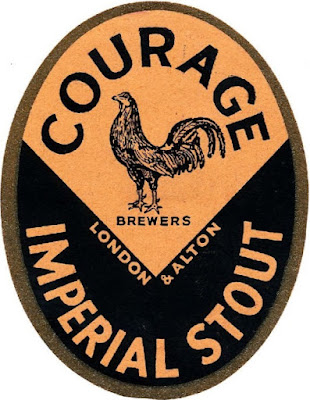
Before WW I, many London brewers had an Imperial Stout in their portfolio. Most, like that of Courage, either didn’t survive the war or stumbled on in the interwar years at a much-reduced strength. 1915 was the last years Courage Imperial Stout was brewed. A couple of years before massive cuts in gravity were enforced.

To avoid any confusion, this wasn’t the ancestor of Courage Russian Stout. That was the successor to the Imperial Stout of Barclay Perkins, a brewery bought up by Courage in the 1950s.

No surprises in the grist, which is the London holy trinity of pale, brown and black malt. As is often the case, the type of sugar wasn’t specified in the brewing record. I’ve guessed No. 2 invert. Mostly because No. 3 or No. 4 results in a beer which seems too dark. Though in 1916 Courage did use No. 4 invert in their Porter and Stout.

Two types of English hops were used, one from the 1914 harvest, the other from 1913, but cold stored. So, all pretty fresh, really, considering this beer was brewed in March. I’ve guessed for Fuggles and Goldings, as they seem the most probable varieties.

1915 Courage Imperial Stout
pale malt 12.50 lb 58.82%
brown malt 4.25 lb 20.00%
black malt 2.25 lb 10.59%
No. 2 invert sugar 2.25 lb 10.59%
Fuggles 90 mins 2.75 oz
Goldings 30 mins 2.75 oz
Goldings dry hops 1.00 oz
OG 1094
FG 1025
ABV 9.13
Apparent attenuation 73.40%
IBU 47
SRM 60
Mash at 152º F
Sparge at 165º F
Boil time 90 minutes
pitching temp 58º F
Yeast Wyeast 1099 Whitbread Ale


Tuesday, 18 January 2022

Imperial Stout in Scotland in the 19th century

I'm going to drag this out for much, much longer. Unless I get bored, of course. Not much sign of that yet.

Dipping my toes into the shallow end of the 19th century, much the same Imperial Stouts were knocking around Scotland.  Which means Combe and Barclay Perkins.

COMBE & COY.'S LONDON STOUTS.
HIGHLY RECOMMENDED BY THE MEDICAL FACULTY.
IMPERIAL STOUT    Yellow Label.
DOUBLE    Do.    Green Do.
INVALID Do.    Red Do.
A TRIAL SOLICITED. ONCE TRIED, ALWAYS PREFERRED
TO BE HAD, IN SPLENDID CONDITION, FROM
A. JACK. Grocer and Wine Merchant, 16 HIGH STREET; DINGWALL.
North Star and Farmers' Chronicle - Thursday 31 August 1899 , page 7.

Combe being well established as a Stout brand in Scotland while still an independent brewery explains why Watney persisted with the brand well into the 20th century.

Barclay Perkins likewise had more than just their Imperial Stout on offer:

ELFERT'S. BARCLAY, PERKINS’ LONDON IMPERIAL STOUT, in fine condition, 2s 3d doz, pints. BARCLAY, PERKINS’ BROWN STOUT, 1s 9d per doz. pints.
Aberdeen Press and Journal - Friday 03 April 1891, page 2.

As mentioned in a previous post, at 2.25d per bottle, those have to be reputed pints rather than Imperial pints.

The same applies to this advert: 


{BASS ALE. 

{ALLSOPP'S ALE.  
2/3 per dozen {BARCLAY PERKINS' IMPERIAL STOUT. 

{COMBE'S STOUT. 

{GLENLIVET No. 1 ALE. 


{ALLSOPP’S STOUT. 
1/9 per dozen {BARCLAY PERKINS' BROWN STOUT 

{YOUNGERS TABLE BEER (Quarts). 

These are Bottled on the Premises, and are Guaranteed PURE and in Sparkling Condition.
LEITH & CO., 212 GALLOWGATE, ABERDEEN.
Aberdeen Press and Journal - Tuesday 12 July 1898, page 1.


At least one Scottish brewery was in the Imperial Stout business:

THE CASTLE BREWERY, MARYHILL, GLASGOW.
The Celebrated "CASTLE" PALE ALES sad IMPERIAL STOUT always in Splendid Condition.
G. & J. MACLACHLAN, Town Office - 26 and 27 ST. ENOCH SQUARE GLASGOW.
Hamilton Herald and Lanarkshire Weekly News - Friday 27 May 1898, page 2.

Finally, another English Imperial Stout. And a rather odd Malt Wine:

COLEMAN'S CROWN IMPERIAL INVALID STOUT
Is a specifically brewed INVALID STOUT from Malt and Hops of the finest quality, and will be found to invigorate the system without leaving any sign of heaviness  dulness behind after drinking as is the case of most Stouts. 

Important unsolicited Testimonial from DR. A. BALFOUR.
29, Abercorn Terrace, Portobello,
April 2nd, 1890.
Gentlemen.- I beg to thank you sincerely for your kind gift of "Invalid Stout," sent to me through Mr. Carmicheal. I have already found it beneficial to my wife, who is just now convalescent from a long illness, and I will recommend it to my patients in suitable cases.
I am, Gentlemen, Yours very truly,
ANDREW BALFOUR, MD.

Recommended by the Medical Faculty as being the most nourishing Stout obtainable. 

Sold in Champagne Pint Bottles at 2/9 per dozen. Bottles charged, but allowed for when returned. 

Sole Proprietors:

COLEMAN & CO., LIMITED, 1 , NORWICH & LONDON. 

We are also Sole Proprietor of the Celebrated COLEMAN'S EXTRACT OF MEAT & MALT WINE.
Montrose, Arbroath and Brechin review; and Forfar and Kincardineshire advertiser. - Friday 20 March 1891, page 8.

A few pints of Imperial Stout tend to leave me feeling rather dull. Maybe the meaty malt wine would help liven me up. The Victorians did like to put meat into alcoholic drinks, the weird buggers. Given all the weird shit being thrown into beer nowadays, I'm surprised no-one has started adding meat.

Monday, 17 January 2022

Happy New Year!

I think we can all agree that the last couple of years have been strange and scary. Two years after the scheduled date, I still haven't published "Blitzkrieg!". What could be stranger and scarier than that? 

I'm pretty sure I'll release it this year. After several years caged up, it's getting pretty angry. No, ugly angry. I'll be glad to see that back of the bastard. Preferably, as it mauls someone else.

I blame Alexei. Had he got his arse in gear and created the covers, Blitzkrieg would be gaily cavorting in a sunlit meadow. Rather than eating its own shit in a bed of filthy straw. Alexei had some pathetic excuse about needing to study. I never bothered when I was at university. Why should he?

Plague permitting, I've a few trips planned and a couple of others pencilled in. Corona is a real blessing to travellers. The internet had made travels far too simple. The virus adds a delightful randomness to the proceedings. Like planning a European tour in the summer of 1918. 

Every time I book a flight I wonder: "What are the chance of me actually taking it?" Nothing is more thrilling than checking the internet until the second before you leave for the airport that the flight hasn't been cancelled. Or wondering if you'll be let out of the country once you reach your destination. I love the Phineas Fogg feeling the uncertainty brings.

Maybe I'll be your way pushing my latest book. Which may or may not be "Blitzkrieg!". More likely, I'll be in Thailand/Aruba/Tenerife/Malaga/Malta/Folkestone with Mikey pushing as much bacon and booze down my throat as I can physically manage.

Happy New Year!