Monday, 16 May 2016

A pint of sevens

More about the 1931 price increase

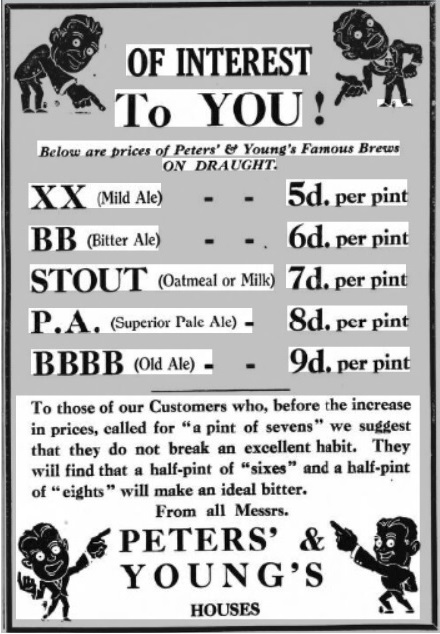
Portsmouth Evening News - Thursday 22 October 1931, page 1.

“OF INTEREST TO YOU!
Below are prices of Peters' & Young’s Famous Brews ON DRAUGHT.

XX (Mild Ale) 5d. per pint
BB (Bitter Ale) 6d per pint
STOUT (Oatmeal or Milk) 7d. per pint
P.A. (Superior Pale Ale) 8d per pint
BBBB (Old Ale) 9d per pint

To those of our Customers who, before the increase in prices, called for “a pint of sevens” we suggest that they do not break an excellent habit. They will find that a half-pint of “sixes” and a half-pint of "eights” will make an ideal bitter.

From all Messrs. PETERS’ & YOUNG’S HOUSES”

XX (Mild Ale) 5d. per pint
BB (Bitter Ale) 6d per pint
STOUT (Oatmeal or Milk) 7d. per pint
P.A. (Superior Pale Ale) 8d per pint
BBBB (Old Ale) 9d per pint
To those of our Customers who, before the increase in prices, called for “a pint of sevens” we suggest that they do not break an excellent habit. They will find that a half-pint of “sixes” and a half-pint of "eights” will make an ideal bitter.

From all Messrs. PETERS’ & YOUNG’S HOUSES”
Portsmouth Evening News - Thursday 22 October 1931, page 1.

Presumably before the 1931 budget, PA had cost 7d per pint. But mixing Ordinary and Best Bitter wasn’t going to give you a beer of the same strength. As you can see in the table below, 6d Bitter was a round 1036º and 8d Bitter around 1046º. Meaning a homemade 7d Bitter would be around 1041º. Or 5 degrees weaker than before the tax increase.

If you’re wondering about the strength of the other beers, XX Mild would be around 1030º, Stout 1040º and Old Ale in the low-1050º’s.


Bitter in 1932
Year Brewer Beer Price OG FG ABV App. Atten-uation
1932 Ind Coope Pale Ale 6d 1035.3
1932 Shepherd Neame Pale Ale 6d 1037.2
average 6d 1036.3
1932 Courage PA 7d 1040 1007 4.29 82.50%
1932 Ind Coope Pale Ale 8d 1043.9
1932 Hoare PA 8d 1044 1010.2 4.39 76.82%
1932 Taylor Walker Pale Ale 8d 1044 1011.2 4.26 74.55%
1932 Meux Pale Ale 8d 1044.2
1932 Barclay Perkins Pale Ale 8d 1046.2
1932 Whitbread PA 8d 1046.3 1013.0 4.41 71.92%
1932 Charrington PA 8d 1047 1010 4.81 78.72%
1932 Truman PA 8d 1047 1006.2 5.33 86.81%
1932 Watney Pale Ale 8d 1047 1009.5 4.88 79.79%
1932 Courage Pale Ale 8d 1048.5
1932 Mann Crossman PA 8d 1051 1008.8 5.51 82.75%
average 8d 1046.3 1009.8 4.80 78.76%
Sources:
Whitbread Gravity book held at the London Metropolitan Archives, document number LMA/4453/D/02/001.
Whitbread brewing record held at the London Metropolitan Archives, document number LMA/4453/D/01/098.
Truman Gravity Book held at the London Metropolitan Archives, document number B/THB/C/252

Sunday, 15 May 2016

The barrel

of a gun. That's what Pils is looking down.

If my tiny unrepresentative sample is anything to go by.

When a beer style loses the young, it slowly dies.

Walking past a studenty terrace on a hot day, surprisingly little Pils was being drunk. 50% at most. And 0% of the female beer drinkers were on Pils.

That's the future. Tomorrow's drinkers prefer beers other than Pils.

Pils sales: slow decine for a few years, then a rapid one. That's my prediction. Could be wrong. I once believed Newcastle cound win the league.

Saturday, 14 May 2016

Let’s brew Wednesday - 1905 Whitbread XK

It’s been another busy week. Loads more recipes written. Including this intriguing little devil.

One of the biggest remaining mysteries in beer history is when Mild became dark. And why. It seems to have been around 1890 to 1900 that the process started. It’s hard to pin down exactly, because that’s also when sugar was starting to be used in a big way. But brewing records aren’t often that specific about the type of sugar.

Often it will just say sugar or invert. The exact type of sugar will have a big impact on the colour of the finished beer. No. 3 invert is pretty dark and a reasonable amount will considerably darken a beer. While other types of sugar will add no colour at all.

Sugar use may be one of the reasons of the reasons for Mild getting darker. Dark sugars and caramel give the brewer complete control over the colour of his finished beer. It’s much easier to brew a beer with a more subtle shade, that is, not really pale or really dark.

With both brown malt and No.3 in the grist, this is darker for sure that Whitbread’s Milds in the 1870’s. Though somewhere between those dates, when they were vaguer about the type of sugar, the process could already have started.

Brown malt is pretty rare in Mild recipes. Barclay Perkins did occasionally use it in wartime. Why did Whitbread use it? Probably because it was something they were already using. Their Porter and Stout always contained brown malt.

Looks like an interesting recipe to me. I’d love to know how it tasted.


1905 Whitbread XK
pale malt 11.25 lb 88.24%
brown malt 0.375 lb 2.94%
no. 3 invert sugar 1.125 lb 8.82%
Cluster 90 mins 0.75 oz
Fuggles 90 mins 0.75 oz
Fuggles 30 mins 1.50 oz
OG 1059.8
FG 1014
ABV 6.06
Apparent attenuation 76.59%
IBU 40
SRM 13
Mash at 150º F
Sparge at 175º F
Boil time 90 minutes
pitching temp 61.5º F

Friday, 13 May 2016

Home delivery in wartime

You wouldn’t want to run out of beer at home. Especially not during wartime.


Luckily, Davenports were there to see you right:

“BEER AT HOME
IF YOU ARE FINDING IT DIFFICULT TO OBTAIN REGULAR SUPPLIES OF ALES AND STOUTS AT REASONABLE PRICES, YOU WILL BE INTERESTED TO KNOW THAT BY JOINING OUR REGISTERED CUSTOMERS SCHEME YOU WILL ENSURE REGULAR FUTURE DELIVERY.

A glance at our price list given below shows clearly that our well-known policy of QUALITY and VALUE is being continued during the war period.

Magnums Per Doz. Large Per Doz. Small Per Doz 
“C.B” BEER  6/-  4/- 
BROWN ALE  6/6  4/4 
MILD ALE  7/-  4/6 
BEST BITTER  7/6 
EXTRA STOUT  8/-  6/8  4/10 
STRONG ALE 5/6 
PALE ALE 4/10 
GUINNESS (Harp Label) 9/-  7/2  5/2 
BULMER'S CIDER  6/6  4/8  4/- 
EVANS’ CIDER  6/-  4/6  3/10 
CHAMPAGNE CIDER 7/6 
BASS 5/6 
WORTHINGTON  5/6 


DAVENPORTS
All information as to our splendid REGISTERED CUSTOMER SCHEME may be obtained on application to Mr. F. WILLIAMS, the Manager of the Lichfield Depot, at THE OLD BREWERY, SANDFORD STREET, LICHFIELD.”
Lichfield Mercury - Friday 01 December 1939, page 8.

You may be wondering why I’m bothering with this. It’s very simple: the second and third beers in the table. The story is usually that Brown Ale was just bottled Dark Mild. But that wasn’t necessarily the case before WW II. Whitbread’s Double Brown, for example, was stronger than the strongest Dark Milds and much more heavily hopped.

In this case, it’s the other way around, with the Mild being stronger than the Brown Ale. Which has got me wondering about the strength of their bottled Mild. Because an analysis from a few years earlier show Davenport Brown Ale with a very respectable gravity of 1045º.

Here’s their Brown Ale and some other beers:

Davenport's bottled beers in 1931
Beer Style Price size OG FG ABV App. Atten-uation
Bitter Beer Pale Ale 6d half pint 1036.7 1007.3 3.82 80.11%
Best Bitter Pale Ale 8d pint 1053.9 1017.9 4.66 66.79%
Brown Ale Brown Ale 6.5d pint 1044.8 1014.2 3.96 68.30%
Pale Ale Pale Ale 5.5d half pint 1055.8 1013.2 5.54 76.34%
Extra Stout Stout 7d reputed pint 1057.9 1012.3 5.94 78.76%
Strong Ale Strong Ale 6.5d half pint 1064.1 1012.4 6.76 80.66%
Source:
Whitbread Gravity book held at the London Metropolitan Archives, document number LMA/4453/D/02/001.

Thursday, 12 May 2016

25% off my Lulu print books

until the end of tomorrow (May 13th).

All you need to do is to use this code when you buy:

NURSE25


Time to complete the whole Mega Book Series  -   Porter!, Mild! plus, Bitter! and Strong! Be the first in your town with the full set.


Barclay Perkins Bookstore

Call for cheaper beer

I think that’s something we could all agree on. Who wouldn’t want cheaper beer?

But this article isn’t what it first appears to be. It’s not si much a call for cheaper beer as weaker beer. I’ll explain why after.

“CALL FOR A CHEAPER BEER
At a special meeting yesterday the board of the Licensed Victuallers’ Central Protection Society of London was agreed to recommend to the brewers the brewing of standard 6d. mild ale instead of a 7d. beer, which it was felt would generally beyond the reach of the working man.

In those areas where a lower-price beer was in demand it was recommended that Beer should brewed for sale at 5d. per pint.”
Portsmouth Evening News - Wednesday 16 September 1931, page 3.

You have to understand the context. This is just after the disastrous Snowden emergency budget of 1931. It put the price of beer up by about 1d a pint,. The strongest type of Mild Ale, which sold for 6d a pint, went up to 7d. Or would have, if brewers hadn’t cut the strength so they could still charge the old price.

Do I have any evidence of this? Of course I do. Lots of it.

This is how Milds looked in 1930:

Mild Ale in 1930
Year Brewer Beer Price OG FG ABV App. Atten-uation
1930 Leney & Co L.A. 4d 1025 1007.4 2.28 70.40%
1930 Buddon Bigg Ale 4d 1026.5
1930 Mackeson L.A. 4d 1027 1005.4 2.80 80.00%
1930 Portsmouth & Brighton Breweries L.A. 4d 1027 1001.9 3.27 92.96%
1930 Whitbread LA 4d 1027.2 1010.0 2.28 63.27%
1930 Style & Winch Ale 4d 1028.2
1930 Shepherd Neame Ale 4d 1028.5
1929 Barclay Perkins A 4d 1028.7 1007.5 2.80 73.83%
1930 Mason Ale 4d 1030.4
1930 Tamplin L.A. 4d 1031 1007.4 3.06 76.13%
1930 Isleworth Brewery RA 4d 1032 1011.2 2.69 65.00%
1930 Kemp Town L.A. 4d 1034 1006.7 3.55 80.29%
1930 Fremlin Ale 4d 1035.7
average 4d 1029.3 1007.2 2.84 75.24%
1930 Hammerton Ale 5d 1033.7
1930 Wells Watford Ale 5d 1033.7
1930 Courage X 5d 1035 1009.5 3.30 72.86%
1930 Wenlock Ale 5d 1036.1
1930 Cannon Ale 5d 1039.7
average 5d 1035.6 1009.5 3.30 72.86%
1930 Truman X 6d 1042 1008.9 4.30 78.81%
1930 Whitbread X 6d 1042.4 1010.0 4.28 76.40%
1929 Barclay Perkins X 6d 1042.6 1012.5 3.98 70.65%
1930 Mann Crossman X 6d 1044 1007.2 4.80 83.64%
1930 Taylor Walker X 6d 1044 1013.3 3.98 69.77%
1930 Watney X 6d 1044 1011 4.28 75.00%
1930 Hoare X 6d 1046 1014.4 4.09 68.70%
average 6d 1043.6 1011.0 4.25 74.71%
Sources:
Whitbread Gravity book held at the London Metropolitan Archives, document number LMA/4453/D/02/001.
Whitbread brewing record held at the London Metropolitan Archives, document numberLMA/4453/D/01/096.
Truman Gravity Book held at the London Metropolitan Archives, document number B/THB/C/252
Barclay Perkins brewing records


And this is what they were like in 1932:

Mild Ale in 1930
Year Brewer Beer Price OG FG ABV App. Atten-uation
1932 Wells Watford Ale 4.5d 1028.7
1932 Truman Ale 4d 1029.07
1932 Whitbread LA 5d 1026.0 1006.5 2.58 75.00%
1932 Watney Ale 5d 1028.8
1932 Fullers Ale 5d 1030.1
1932 Ind Coope Ale 5d 1030.7
1932 Young & Co Ale 5d 1032.8
average 5d 1029.6 1006.5 2.58 75.00%
1932 Hammerton Ale 6.5d 1032 1006.4 3.32 80.00%
1932 Whitbread X 6d 1032.6 1009.0 3.12 72.39%
1932 Cannon Brewery X 6d 1034 1012.2 2.82 64.12%
1932 Taylor Walker X 6d 1034 1013.4 2.66 60.59%
1932 Watney X 6d 1034 1010.2 3.08 70.00%
1932 Charrington X 6d 1035 1011 3.11 68.57%
1932 Courage X 6d 1035 1012.2 2.95 65.14%
1932 Mann Crossman X 6d 1035 1009.6 3.29 72.57%
1932 Meux X 6d 1035.5
1932 Barclay Perkins X 6d 1036 1009.3 3.46 74.17%
1932 Truman X 6d 1036 1008.8 3.53 75.56%
1932 Hoare X 6d 1038 1008.9 3.78 76.58%
1932 Wenlock X 6d 1038 1012.2 3.34 67.89%
1932 Mann Crossman X 6d 1041 1010.4 3.97 74.63%
average 6d 1035.4 1010.3 3.26 70.94%
1932 Whitbread XX 7d 1039.0 1012.5 3.51 67.95%
1932 Taylor Walker XXX 9d 1048 1015.4 4.22 67.92%
Sources:
Whitbread Gravity book held at the London Metropolitan Archives, document number LMA/4453/D/02/001.
Whitbread brewing record held at the London Metropolitan Archives, document numberLMA/4453/D/01/098.
Truman Gravity Book held at the London Metropolitan Archives, document number B/THB/C/252


You can see that in 1932 the average gravity of 5d Milds was virtually identical to the average gravity of 4d Milds in 1930. And a 1932 6d Mild was the same as a 1930 5d Mild.

Note how few examples there are of 7d Mild – just one. Though top marks to Taylor Walker for having a Mild almost of pre-EWW I strength.

Wednesday, 11 May 2016

Let’s brew 1837 Whitbread X!

I love early Mild recipes for a reason. No, not that they’re dead strong. (Though I certainly don’t hold that against them.) It’s that they’re really, really simple.

They’re pretty much all SMASH recipes. Just base malt and hops. That’s it. Which doesn’t leave me a huge amount to talk about.

This recipe comes from Whitbread’s first Ale brewing book. As a Porter brewer, Whitbread had exclusively brewed Beer until 1836. Porter and Stout, if you recall, being types of Brown Beer. All the big London Porter brewers took up Ale brewing in the 1830’s. Possibly in reaction to the 1830 Beer Act, which had seen the establishment of a new class of pubs which sold beer but no spirits. Ale seems to have been very popular in this class of establishment.

It’s not very much like a modern Mild. The OG is way higher. The colour much paler. The attenuation much lower. The hopping much heavier.

Not sure which style-Nazi cubbyhole it could be forced into. Not dark enough for a Scotch Ale or an Old Ale. Not strong enough for a Barley Wine. Maybe some sort of IPA. There are so many of those it must sort of fit the specs for one. Or maybe I can think up my own new IPA substyle. Mild IPA – how about that. Don’t think it’s been done yet.

Not really much more that I can say than that. Oh yes, I remember. Drink Mild!


1837 Whitbread X
mild malt 16.50 lb 100.00%
Goldings 90 mins 2.50 oz
Goldings 30 mins 2.50 oz
OG 1072.6
FG 1033.8
ABV 5.13
Apparent attenuation 53.44%
IBU 59
SRM 7
Mash at 154º F
Sparge at 165º F
Boil time 90 minutes
pitching temp 64º F
Yeast Wyeast 1099 Whitbread Ale

Tuesday, 10 May 2016

The brewery in lovely country surroundings

Have you noticed something? More Mild posts during the month of May. Seems somehow appropriate.

Trawling through the newspaper archives looking for "Mild Ale" I came upon this intriguing advert. It took me a while to work out which brewery it was for. But "A Century of British Brewers plus plus" came to my aid. It's King's of Syresham, a village in Northamptonshire.

The brewery was founded in 1854 by the Linnell family, later being in the hands of  the Kirby family before being bought by Herbert King in 1900. It closed sometime around 1940. They didn't own any pubs and only sold to the domestic trade, i.e. directly to the public*.

The wording of the advert is rather flowery:

"The brewery in lovely country surroundings

Drinks worth drinking
Prices worth studying

In addition to the above well-known Brands, we are brewing a much Stronger Ale, known as "Special Dinner Ale.”

As with all our beverages, we guarantee to use only the very best and purest materials obtainable, this and the fact that we brew in the Lovely Country account for the enormous success of all our ventures.

POST—Syresham, Brackley
PHONE- „ No. 2.
GRAMS—King, Syresham.

Our Travellers cover a very wide area and are only too pleased to take your orders."
Buckingham Advertiser and Free Press - Saturday 26 February 1927, page 4.
Here's the advert:

Buckingham Advertiser and Free Press - Saturday 26 February 1927, page 4.
The prices really are pretty cheap. 5d a pint for Bitter is cheaper than draught beer in a pub, unless it was really low gravity. The same with the Mild. Down the pub, 3% ABV MIld cost 4d, 3.5% ABV Mild 5d and 4.2% ABV Mild 6d. In the quart flagons, Bitter and Mild were even cheaper, just 3.75d per pint.
Not sure I believe the stuff about the finest materials. Everyone and his dog claimed that. No matter what muck they actually threw in.

One last thing. I love the phone numbe: 2. I wonder who had number 1?


* "A Century of British Brewers plus plus" bt Norman Barber, 2012, page 107.
Monday, 9 May 2016

20% off my Lulu print books

until the end of today (May 9th).

All you need to do is to use this code when you buy:

SOCKSAVE20


Time to complete the whole Mega Book Series  -   Porter!, Mild! plus, Bitter! and Strong! Be the first in your town with the full set.


Barclay Perkins Bookstore

Mild Ale Preferred

Drink Mild! It’s one of my favourite exclamations. But Chatham Working Men’s Club wasn’t so keen on its member drinking Mild. Because it was affecting their finances.

The problem was that the club made much more money on a pint of Bitter than on a pint of Mild.

“MILD ALE PREFERRED
But Workmen’s Club Perturbed Over Members’ Choice of Beverage
A “BITTER” RECKONING.
The Chairman of Chatham Working Men’s Club (Mr. H. N. Tozer), is becoming concerned about the members’ taste of beverage — their partiality for mild ale, which, despite increased bar sales, has resulted in diminished profits. This was one of the main reasons given for deficit for last year’s working of £153/17/0 at the 59th annual meeting of the Club on Friday evening.

In the annual report it was stated that expenditure exceeded income for the year by £153/17/0. The membership totalled 391.

Reference was made to the various activities of the Club — the Library, the Sports’ Ground, Cricket Section, the Social side, the Davies Cup, and the increasing popularity of darts and table tennis.

The winning of the Davies Cup was recalled, and mention was made of the further success of Sergt. A. Cottle, R.E., the Club’s leading billiard player, in the Army championships.

Thanks were again expressed by the Committee to the members for their cooperation in carrying out the objects of the Club, viz., social intercourse, mutual helpfulness and mental and moral improvement and rational recreation.

The Chairman invited questions and comments on the report, and it was pointed out that although there was an adverse balance, substantial cellar stock in hand had to be taken into account among the assets.

Partly explanatory of the year’s deficit were somewhat heavy expenses in repairs to the main building, and the renovation of billiard tables.

The Chairman explained decreased bar profits through a greater demand for mild ale in preference to bitter ale, the latter being twice as profitable a commodity as the former. Mr. Tozer remarked that it was not for him to say what the members should or should not have to drink, but it was becoming a matter of grave concern that the consumption of mild ale was now over three times as much as the other beverage.

Surprise was voiced that comparatively few of the members took advantage of the use of the Club’s sports ground on the Rainham-road.

The Chairman paid tribute to the officers and committees of the Club, and thanked the members for their loyalty and help.

Messrs. A. W. Stevens. W. Mepstead. C. R, Wall. W. J. Beale, E. H. Sutton, and W D. Harris were elected to the General Committee, and Messrs. A. W. Stevens, W. Harris. C. F. Curtis, A. J. Howe, J. Stead H. Cox. N. Harris and D. J. Bradshaw to the Games Committee. Messrs. G. Odder. H. Cox, J. Eccles, and N. Springate were appointed to the Social Committee. Messrs. E. N. Hill and A. P. Bays were re-appointed auditors.”
Chatham News - Friday 03 March 1939, page 7.

Back in the 19th century, Pale Ales always sold at a premium. That is, they were more expensive than beers in other styles of a similar price. The premium was eroded as the century went on, but remained until WW I. I thought it was pretty much dead and buried by the time WW II rolled around.

I was intrigued by the claim there was twice as much profit on Bitter. How could I check? Trusty old Whitbread. Because one of their brewing books has a price list with both wholesale and retail prices in it. This is what it shows:

Whitbread prices in 1934
wholesale price barrel wholesale price pint d retail price pint d mark up d % profit
Porter 94 3.92 5 1.08 27.66%
Stout 134 5.58 7 1.42 25.37%
Light Ale 76 3.17 4 0.83 26.32%
X Ale 94 3.92 5 1.08 27.66%
Pale Ale 134 5.58 7 1.42 25.37%
33 160 6.67 8 1.33 20.00%
Source:
Whitbread brewing record held at the London Metropolitan Archives, document number LMA/4453/D/09/124.


The profit was indeed greater on a pint of Bitter – 0.34d to be precise. Though the percentage profit on Mild was actually a little higher than for Bitter. But the profit on Bitter is a long way short of being double.

The Chatham Working Men’s Club is still going so perhaps the chairman did manage to persuade more members to switch to Bitter.

Sunday, 8 May 2016

Oh dear!

Mother's Day here today.

Been thinking about my Mum. As I often do. She died in 2007. Not long after this blog started.

But she's always in the back of my head. Tutting, mostly. Occasionally clapping. Or laughing. I could always make her laugh.

This beer's for you, Mum.


