Saturday, 26 March 2022

Sao Paulo to Blumenau

I rise at 8:30. Mostly to allow time to type up yesterday. I'm very diligent now with my travel reports.

At 11:00 I go downstairs and check out. And ask them to call a taxi for me. Soon I'm bouncing down Sao Paolo's streets.

I know it's going to be a long journey. To the airport, I mean. I remember how long it took to get into town from the airport. And I checked on Google Maps: 1 hour 15 minutes, it reckoned.

The roads are busy. Very busy. We come to a stop several times. That's by no means the worst bit. Many of the lorries seem to be driven by lunatics on speed. One pulls out right in front of us and only misses us by a metre or two, This while we're going 80 kph. I try not to look at the road to much. I wouldn't like to sit on the plane in soiled underwear.

I look the other way instead. The road is following the River Tiete. It's not very scenic. There's a motorway on both sides of it. The banks are concrete and every 50 metres or so there are what seem to be drains emptying into it. Some of the water coming from them looks filthy.

We're in the outside lane. Suddenly there a bloke walking in the opposite direction between us and the next lane pushing a cart. He's selling drinks and snacks. Seems like a fairly suicidal occupation. we're not going full tilt, but at least 50 kph.

It's almost 13:00 when I'm dropped off. It says 140 reals on the taximeter, but I'm charged 106 reals. Seems like a bargain for 75 minutes travel.

I've over four hours until my flight so I'm in no rush. I drop off my bag and head airside. What I need now is a bar. I wander around a bit, but it's just shops and the odd little food place. I stop at one, Doog, and get myself a hot dog. Sem mostarda. Mustard is one of the few things I really don't like. It's not great. Dry, sweetish bread and a bland sausage.

I wander some more. Surely there must be a bar here somewhere? I'm almost at the end of the pier when I spot somewhere with spirit bottles: Gendai. A Japanese place. This'll do. I order one of those seaweed ice cream cones filled with salmon. And an Eisenbahn Pilsen. And a cachaca.


It seems they have a choice of two cachacas. The friendly waiter brings over the bottles so I can decide which one I want. I go for Selecta, as it's slightly coloured rather than pale.

Occasionally nibbling at my sushi, I vaguely watch the TV. there's football on. There always seems to be football one one channel or another. I sip my cachaca, too. And order another one. And another. Not that I'm rushing. I've still got a couple of hours until my flight. I order another ice cream cone. This is my main meal of the day.

About an hour before my flight is due to leave, I pay up and check which gate it is. Luckily it's right by where I am. There are only a few seats at the gate. One is empty. Just before I get to it a bloke asks the woman sat next to it if it's free, then dumps his bag on it. What the fuck? He doesn't even want to use it. What a twat.


I'm not going to stand until boarding. I look for somewhere else to sit. Oh look, there's a TGI Friday. Time for a traditional Jack Daniels send off.

It's brilliant. I can see the gate from my seat so I'll be able to see when they start boarding. The prices are much more reasonable than in the US. The whiskey is around 6 euros a pop. At that price it would be stupid to drink just the one.


When I see boarding begin, I troll over and walk straight onto the plane. This is incredibly stress-free. Just how I like to travel. One of the (many) annoying things about travelling with anti-American Mike, was that he'd insist on turning up at the airport as late as possible. We had to sprint to the gate on more than one occasion. No way I could do that now.

The flight isn't full. The seat to my left is free. Let's see, is the bloke sitting in front of me a recliner? Of course he fucking is. What sort of twat reclines their seat on a short daytime flight? Just as well there's that empty seat next to me. I fire up the laptop and watch some more Peep Show. I don't even get through two episodes before we start our descent.

I'm at the carousel only about 10 minutes after landing, but my bag is already doing the rounds. I grab it and head outside. And there's my taxi driver holding up my name.

It all happens so quickly, I forgot to go and have a piss. Fortunately, my driver stops for petrol. Here's my chance.

"Sanitarios?" There's one handy word of Portuguese I've learnt.

On the way back from the bog, I get myself a bottle of water and a bottle of beer. This is all working out perfectly.

The light is fading as we speed along the road. As darkness falls so does the rain. Not quite as bad as on my first night in Sao Paolo, but bad enough.

At 19:30 I check into my hotel. Oh, that's handy: the bar is open. That's where I head once I've dumped my bags in my room.


I get an ice cold beer and a cachaca. the latter once again served from a little cask on the bar. For once, I'm glad the beer is that cold. It doesn't improve as it warms up. A couple more cachacas help wash away the nasty taste of the beer.

I don't make a late night of it. I vaguely point my eyes at yet more football on the TV. While Laphroaig gently laps the shores of sleep. 


My accommodation most of my food and some beer were paid for by Concurso Brasileiro de Cervejas Blumenau. All travelling expenses I paid myself.

Friday, 25 March 2022

London Porter adjuncts and sugars 1880 - 1899

You can probably tell that I'm cracking on with my book after next. More than 10,000 words over the last few days. Admittedly a lot nicked from a couple of remarkably useful old blog posts. I'd forgotten writing them and only stumbled on them by chance. Saved me hours of work.

I've been working on the London Porter section. Fairly obviously, if you've been paying attention to some recent posts. I banged together some of the tables while in the USA recently. I'm really living on the edge when I travel. Fiddling around with spreadsheets. Wild, man.

With one exception, “Black Sacc.”, none of the sugars are given a name. Chances are the unnamed sugars weren’t really pale, as that would lighten the colour too much. And people expected their Porters dark. But it’s anyone’s guess really as to what they were. Possibly some sort of invert sugar.

To call the quantity of sugar used a bit variable would be a huge understatement. From nothing in the Whitbread examples to more than a third in a one of Truman beers. While fifteen years later it was down to less than 10%. All over the place, really.

Adjuncts only pop up in one, the 1899 Truman. In the form of the brewers’ favourite: flaked maize.

London Porter adjuncts and sugars 1880 - 1899
Year Brewer Beer flaked maize Black Sacc. other sugar total sugar
1887 Fullers Porter     19.81% 19.81%
1893 Fullers Porter   20.25%   20.25%
1897 Fullers Porter     25.09% 25.09%
1880 Truman Runner     36.93% 36.93%
1890 Truman Runner     15.72% 15.72%
1895 Truman Runner     7.76% 7.76%
1899 Truman Runner 8.75%   12.50% 12.50%
1880 Whitbread P        
1885 Whitbread P        
1890 Whitbread P        
1895 Whitbread P        
  Average   8.75%     19.72%
Sources:
Fullers brewing records held at the brewery.
Truman brewing records held at the London Metropolitan Archives, document numbers B/THB/C/082, B/THB/C/092, B/THB/C/096 and B/THB/C/102.
Whitbread brewing records held at the London Metropolitan Archives, document numbers LMA/4453/D/09/075, LMA/4453/D/09/080, LMA/4453/D/09/084 and LMA/4453/D/09/090.

Thursday, 24 March 2022

London Porter malts 1880 - 1899

No surprise that everyone was sticking with the Holy Trinity of London Porter malts: pale, brown and black. Despite all the upheavals in UK brewing in the 19th century, London brewers remained faithful to their three favourite malts. It’s one of the big constants. Not just in the 19th century, but right through until after WW II.

The proportions of the three malts do vary quite a bit between the brewers and over time. Even the base malt, where the lowest is well under 50% and the highest over 80%. Though in the case of the latter, that’s partly on account of Whitbread eschewing both adjuncts and sugar.

Brown malt ranges from 8% to over 20%. Enough of a difference to have a big impact on the character of the finished beer. With black malt the variation is even greater. A factor of five divides the low of 2% and high of 10%. In general, there seems to have been a reduction in the percentage of brown malt and an increase in that of black malt as the final decades of the 19th century ticked by.

Overall, the percentage of malt in the grist was high, averaging over 85%. Whitbread brewing all-malt influenced that figure.


London Porter malts 1880 - 1899
Year Brewer Beer pale malt brown malt black malt total malt
1887 Fullers Porter 52.44% 20.98% 6.77% 80.19%
1893 Fullers Porter 55.60% 18.07% 6.08% 79.75%
1897 Fullers Porter 54.36% 18.56% 1.99% 74.91%
1880 Truman Runner 43.88% 13.71% 5.48% 63.07%
1890 Truman Runner 63.65% 12.97% 7.66% 84.28%
1895 Truman Runner 68.14% 14.96% 9.14% 92.24%
1899 Truman Runner 55.00% 13.75% 10.00% 78.75%
1880 Whitbread P 80.83% 11.67% 7.50% 100.00%
1885 Whitbread P 70.77% 19.23% 10.00% 100.00%
1890 Whitbread P 83.53% 8.24% 8.24% 100.00%
1895 Whitbread P 81.72% 8.60% 9.68% 100.00%
  Average   64.54% 14.61% 7.50% 86.65%
Sources:
Fullers brewing records held at the brewery.
Truman brewing records held at the London Metropolitan Archives, document numbers B/THB/C/082, B/THB/C/092, B/THB/C/096 and B/THB/C/102.
Whitbread brewing records held at the London Metropolitan Archives, document numbers LMA/4453/D/09/075, LMA/4453/D/09/080, LMA/4453/D/09/084 and LMA/4453/D/09/090.


Wednesday, 23 March 2022

Let's Brew Wednesday - 1901 Boddington IPA

I’m not sure where this beer fits in with modern concepts of “English IPA”. Though I’ve always considered the American definitions of that style as what they thought it should be rather than reflecting IPAs actually brewed in the UK. BeerSmith tells me that this beer is too hoppy for the style. There you go then.

To me, this is too weak to be classed with a contemporary Burton IPA. They had gravities around 1065º, a good ten points stronger. And were far more heavily hopped. So, what makes this an IPA? That’s what the brewer called it. Simple as that. Another brewery might well have called it just Pale Ale. There’s absolutely no logic to this stuff.

There’s a slight variation in the recipe here, in that the type of sugar is different. While in the Mild Ales the sugar is described as “Garton”, here it’s simply called “invert”. As this is consistent, I have to conclude that it’s a different type of sugar. I’ve plumped for No. 2. It could just as easily have been No. 1, which was mostly employed in classier Pale Ales.

Unlike in the Mild Ales, there’s no Ouchac malt, just English and Californian.

Hops came mostly from England, there types, backed up my one Californian. All undated, sadly.

1901 Boddington IPA
pale malt 11.25 lb 91.84%
No. 2 invert sugar 1.00 lb 8.16%
Cluster 130 mins 1.00 oz
Fuggles 90 mins 2.00 oz
Goldings 30 mins 2.00 oz
Goldings dry hops 0.50 oz
OG 1054.5
FG 1017
ABV 4.96
Apparent attenuation 68.81%
IBU 68
SRM 7
Mash at 154º F
Sparge at 165º F
Boil time 130 minutes
pitching temp 60.5º F
Yeast Wyeast 1318 London ale III (Boddingtons)


Tuesday, 22 March 2022

Coloured malts 1880 - 1914

Towards the end of the 19th century some coloured malts, such as brown and amber became less popular and brewers relied on other malts to mimic them. This doesn’t seem to have been a total success, leading to a resurgence in their use.

“Brown and amber malts have of late years fallen somewhat into disfavour, black being relied upon for colour, crystal for flavour. There is. however, latterly a tendency to employ an increased proportion of brown and amber malt, and without doubt such malt if really well made gives a characteristic flavour not possessed by either black or crystal. It is, indeed, by a skilful blending of the several types of coloured malt that some of the most successful black beers are produced. It is true that in such grists the total proportion of the coloured malts will often be large and the cost price of the beer as a consequence high, but the result of the adoption of such grists generally fully justifies the expenditure." 

One of the problems with brown and amber malts had been their extreme variability, both in terms of flavour and colour. A brown malt from one maltster was often very different to that from another. However, changes in the method of manufacturing such malts to a large degree eliminated these differences making their use more attractive to brewers. 

Coloured malt analyses
  Black. Brown. Amber. Crystal.
Extract per quarter (336 lbs. ) 57.75 57.12 84.33 58.26
„ per cent. . 44.3 44.04 65.02 45.07
Acidity of wort 0.29 0.23 0.19 0.17
Total proteids or albuminoids 6.11 7.13 7.62 8.71
Soluble 3.99 4.81 5.69 5.88
Insoluble ,, ,, 3.99 4.81 5.69 5.88
Mineral matter or ash 0.32 0.29 1.2 0.76
Moisture 5.37 6.23 4.14 2.12
Source:
The Brewers Analyst, by R. Douglas Bailey, 1907, page 234


Monday, 21 March 2022

Public bar fun

I've been trawling the newspaper archive again. As usual, the stuff about pubs usually recounts tales of drunkenness, violence and mayhem.

I was asked recently whether before WW I, when beer was much stronger, if people really had sessions drinking pints. The answer is: yes. Which is why people regularly got totally plastered. This much is clear from the number of incidents reported in newspapers.  

This is a fairly typical example. Drunk enters pub, is refused service and goes mental.

"PUBLIC BAR PRACTICES
Edward Carter did not appear in answer to a summons for being disorderly in the York Hotel on July 10th, and it was decided take the case in his absence. 

Mr. J. F. Foulds, the Landlord, gave evidence to the effect that about 10 p.m. on the day in question defendant was kicking up a row in the public bar. He had been refused drink, but declined to leave the premises. The whole bar was in an uproar. Witness did not know what it was about, but a general practice was for the unruly ones drink up an old man's beer. They would not try it on young man, who might retaliate. Defendant made use the language which witness had written down. As he would not leave a policeman was sent for. 

Kate Vine, the barmaid, corroborated. A fine 10s. and costs, in default 14 days, was imposed, the Chairman remarking that the language used was "something filthy.” 

Superintendent Bristow observed that the ease was no reflection at all on the York Hotel. The house happened to the last place of call for people leaving the town in that direction."
Bexhill-on-Sea Observer - Saturday 24 July 1909, page 16.

I find it slightly worrying, as an old bastard myself, that some took advantage of a ruckus to nick the beer of old men. Disgraceful behaviour.

Here's another example, with some comic undertones:

"ROW IN A PUBLIC BAR.
AT the Burgh Police Court on Monday — Provost Porteous on the bench — James Laurence, cooper, North Roadside, was charged with having on 2nd January, in Market Street, in the public house occupied by George Gordon, spirit dealer (1) assaulted William Andrew Gray, barman, residing in Albany Street, and did strike him on the face with a roll of bread, which he threw with his hands; (2) behaved in a lawless and disorderly manner, cursed, swore, and used profane language, and challenged said William Andrew Gray to tight, refused to leave the public house and committed a breach of the peace. 

Asked to plead, accused said he was guilty of swearing. 

This was accepted as a plea of not guilty, and evidence was led. 

William Andrew Gray, barman, Albany Street, first gave evidence. He deponed that he was employed in Mr Gordon's bar in Market Street, and knew the accused. On Saturday, 2nd January, accused came into the bar about 2.30. He was the worse of drink, and the man who was along with accused ordered drink. Witness refused to supply them, in comequence of accused's conduct on other occasions, and in consequence of the instructions he had received from Mr Gordon not to supply accused. Laurence was in the habit of being noisy and quarrelsome, and as he was the worse of drink, witness refused to supply him. He started swearing at witness, and then he threw a piece of roll at witness. Witness advised accused to leave the bar, but he did not do so and challenged witness to fight. He challenged everybody to fight, and created a big disturbance, so that a crowd collected. Latterly he left the public house, but witness did not follow him out. The disturbance went on for about half an hour. 


John Harper, cooper, Lower Lochside, deponed being at the Turk's Head bar on the afternoon in question. Witness went into the bar after the disturbance had begun. Accused was there, and was cursing and swearing for William A. Gray, the barman, and challenged him to fight. He was interfering with everybody in the bar. 

Mitchell White, cooper, Lower Lochside, was next called. He stated that he was in the bar before the accused came in. Accused came into the bar with another man, who ordered the drink. He said he would get none, while accused was with him, whereupon accused started swearing. He struck him with a piece of bread. He continued swearing at the barman, and was challenging everybody in the bar to fight. 

In answer to the accused, witness said it was a small piece of bread that was thrown, and it could not hare done much harm. 

Accused, in the witness-box, said he was very sorry for what had taken place, and he would promise it would not happen again. This concluded the evidence. Chief Constable Emslie reviewed the case, stating that the assault was not very serious, but the disturbance was very serious. 

Provost Porteons said that so far as the assault was concerned, the case was not serious, but his conduct in the bar was much more serious, especially the challenging to fight. 

Accused—It takes more than one man to make a row.

Provost Porteons--That may be. but your conduct on this occasion has not been very creditable. It is only the duty of the barman to refuse the drink in the circumstances, and had he done otherwise it would have been a breach of his duty, He, however, refused to supply the man, and it is to the credit of the barman that he did so. I would advise you to give up drink altogether. The penalty is - 15s, with the alternative of ten days' imprisonment. 

Accused went to jail, but paid the fine in the course of the day."
Shetland Times - Saturday 16 January 1909, page 8.

Assault with a bread roll? Not even a whole bread roll. Bit of a laugh, being charged for that. Though Laurence does sound like a nasty drunk. And quite a determined one as he was already steaming by 2:30. Must have been a heavy lunchtime.

Note that both the accused and the two other drinkers called as witnesses were all coopers. Presumably for the whisky trade as they were on Shetland.

Sunday, 20 March 2022

Brown malt 1880 - 1914

More stuff from my salvaged manuscript. So much useful information. And all I need to do is tidy it up a bit.

Not left on the withering floor as long as other malt and spread in the drying kiln no more than 1.5 inches (37.5 mm) thick. Initially the heat was moderate, but when all the moisture in the malt was gone, the heat was suddenly increased by adding oak or beech wood to the fire. The sudden heat caused the grains to swell by 25%. The smoke from the wood gave the finished malt a smoky flavour.

The deliberate addition of wood to create smoke and allowing it to come into contact with the malt is very different from 18th century practice, where every attempt was made to prevent this happening. Though with the much-reduced proportion of brown malt being used in Porter and Stout - a maximum of 20% - the smoky effect would have been much less than in a beer made from 100% brown malt.

The method of making brown malt was changing, for a variety of reasons, one of which was the high risk of a fire.

"it was formerly the custom to dry brown malt also on ordinary kilns, with wire floors, but the labour on these was of a most disagreeable and exhausting character, and brown malt is now generally dried in wire cylinders." 

The presence of diastase in older forms of brown malt is explained by the way it was produced. Diastase is much more sensitive to heat when moist. By first removing all the moisture from the malt at a low temperature, the diastase was not damaged as much by the finishing high heat.   

Other coloured malts were produced in a very different way. To get the desired aroma in the malt, it needed to be heated to 160º F while it still had a moisture content of between 12 and 15%. If the moisture content was below 7 or 8%, the aromas would not be formed and all.

Though London brewers remained loyal to the malt behind the 19th-century Porter revolution, it was rarely present in Stouts brewed outside the capital. I have seen examples of its use in other styles, such as Mild Ale and Burton Ale, but these are relatively rare.
 

Saturday, 19 March 2022

Let's Brew - 1901 Boddington XXXX

Finally, here we are at the pinnacle of the Boddington Mild pile. With XXXX, a beer with a fair bit of clout to it.

Boddington XXXX looks very similar to a London XX Ale. Except they didn’t exist anymore. Despite Mild’s huge popularity, the capital’s brewers restricted themselves to just one example, X Ale. Stronger Milds had died out in the last couple of decades of the 19th century.

At over 6% ABV and 39 (calculated) IBU, it’s not what anyone today would call a Mild. But these beers did exist up until WW I made a total mess of UK brewing. I’ll never forgive Kaiser Bill for that.

With batches of 70-odd barrels, it was brewed in decent quantities for a strong beer. I wonder who drank it? Was it a special weekend treat? Or was there a specific class of drinker that preferred it? Sadly, I have no clue.

The recipe is essentially the same as for all the other Milds: base malt and sugar, loads of different hops, mostly English.

1901 Boddington XXXX
pale malt 14.00 lb 93.33%
No. 3 invert sugar 1.00 lb 6.67%
Cluster 140 mins 0.50 oz
Fuggles 60 mins 1.50 oz
Fuggles 30 mins 1.50 oz
Fuggles dry hops 0.50 oz
OG 1068
FG 1022
ABV 6.09
Apparent attenuation 67.65%
IBU 39
SRM 10
Mash at 152º F
Sparge at 165º F
Boil time 140 minutes
pitching temp 60.5º F
Yeast Wyeast 1318 London ale III (Boddingtons)


Friday, 18 March 2022

Hops 1880 - 1914

I've a huge unfinished manuscript for my original project, a history of UK beer from 1700 to 1973. Far too big to ever be a single book. Which is why I've ended up publishing what would have been chapters as complete books. "Armistice!" and "Austerity!", for example.

I'd forgotten that, as well as containing loads of raw source material,  I'd properly written up many sections. Which is making my life far easier when writing my book after next, "Free!". Some bits I can just lift, others tweak a bit. Plus there's a shitload of raw material I can use as a basis for lots more. How on earth did I forget about this? Well, I did write it more than 10 years ago.

This is a bit I've tweaked.

By 1880, the UK was totally incapable of growing enough hops to satisfy the needs of the local brewing industry. This was the result of two factors: an increase in beer production and a decrease in hop growing.

The only solution was to import large quantities of hops. Mostly from the USA, but also from pretty much every hop-producing country in the world. This continued until WW I, when imports totally dried up. After the war, the reduction in both the strength and quantity of beer brewed meant far fewer hops were required. Hop imports continued, but at a much lower level.

The acreage given over to growing hops was in decline, dropping around 50% between 1880 and 1914. Considerable quantities of hops were imported, amounting to between 30 and 40% of the total used. Harvests were still very variable, as was the price.

In the early 1900s, brewer Mr. P. K. Lemay described five categories of English hops:

1. “Goldings, for pale ale brewing, both for copper use and hopping down;
2. Fuggles, for copper use in mild ales and stouts;
3. Colegates, as a rule a hop rich in lupulin, but rank in flavour; very good copper hops for stouts;
4. Henhams and other varieties of large coarse hops, which from a brewing point of view would be a dear hop to buy;
5. Any class of hops showing mould or aphis blight, which to a brewer would be costly at any price.”  

The first two types, Goldings and Fuggles, would continue to be used for the same purposes well past WW II, While Colegates and Henhams withered into obscurity after WW I.

Hop production and imports (cwt)
year Acreage UK production yield per acre Average price of English hops net imports of foreign hops exports of British hops
        £ s d    
1880 66,698 440,000 6.6 4 6 0 195,987 7,218
1890 53,961 283,629 5.26 10 9 4 181,698 6,164
1900 51,308 347,894 6.78 5 18 8 198,494 14,999
1910 32,886 302,675 9.2 5 6 6 172,032 8,927
1915 34,744 254,101 7.31 6 7 0 199,347 8,288
Source:
1928 Brewers' Almanack, page 119


Thursday, 17 March 2022

Sao Paolo

I get up around 8:30. Should I go downstairs for breakfast? As I'm not hungry, it seems rather pointless.

Instead, I hang around in my room. Writing emails and that sort of shit. I watch some Brazilian football. Cup games. One of the teams has a player called Lineker. I'm guessing that's not his real name.

My first destination is EAP Empório Alto de Pinheiros. It's been highly recommended and is supposedly Sao Paolo's best beer bar. I plan getting there a little after it's opening time of 11:00. I have two options for getting there: up the main road and turn left, or go through the backstreets. I choose the former, as it's far simpler.


It's hot outside. Over 30 C. Glad I put on that sunscreen as there's no shade. I checked the route on Streetview and know exactly where to turn off the main road. I spot a little shop and get myself a bottle of water. It's hot, as I already told you. Far too hot for someone as English as me.

I park my flabby arse at the bar. There are 40 draught beers. What to choose?

Croma Pow! Pow! 7% ABV
One of those new-fangled juicy IPAs. Looks like orange juice and tastes a bit like it. Quite refreshing, which is just as well given the 45 minutes walking I've just done.

I got the longest walk out of the way first. I have several stops planned on my way back to my hotel. I really can't be doing with too much walking in this heat.


I got here 30 minutes after opening. I'm the only customer. I don't care. I hate crowds.

Nothing at all planned today. Other than drink beer and eat food. It's good to have time to relax at the start of a trip.

Dogma Back to Basics V 8% ABV
An American IPA, which I guess means West Coast. Just a slight haze. Quite bitter and not a huge amount of fruitiness. Not as nice as the ones I had in the USA recently, but OK.

You may have noticed that I drink a lot of IPA on my travels. At home, I almost never touch the stuff. Perhaps, the odd pint down Butcher's Tears. Not sure why I suddenly become an IPA fan as soon as leave Holland. Perhaps it's because I travel to the USA so often.

Everyone is still masked up here. Even on the streets. In total contrast to the US. And Holland, for that matter.

Quite a few more punters now it's after midday. Most dining. Not quite that hungry yet myself. I'm saving myself for the next spot, Tank Brewpub.


Satelite Double Space Machine 8% ABV
Double NE IPA.I see that sludge beer has already caught on here. Beer trends spread so quickly nowadays. I guess that's the fault of the internet. The beer isn't as juicy as I would expect. Just looks like orange juice.

I forgot to mention, this is also a shop. They seem to have a pretty good selection, stocking St. Bernardus. but the slot where Abt should be is empty. What a disaster.


Tank isn't that far. When I'm almost there I walk past a little corner bar called Pratty. I have to take a photo. I walk on, then think: that would be a good place for a quick cachaca.

When I ask for one, the barmaid says something I don't understand. She gestures towards a little cask on the bar and to the bottles behind her. I realise that she's asking which one. I point at the cask. Never had draught cachaca before. It costs just 6 reals.

It's pretty quiet in Tank. I guess the last of the lunch trade is just drifting away. I sit at the bar again.

Dank the Tank 6.5%
West Coast IPA. Pretty nice. Fruit aroma, bitter, clear.

I get chatting with the barman. His English is pretty good, which makes things easier. We cover many beery topics. Pretty easy for me. I could speak about beer for months without running out of steam.


He shows me around the brewhouse, which is pretty compact. It has a 5 hl capacity.

I ask him to recommend a beer and he says:

Nao Me Helles 4.8%
It's OK. Quite lagery.

Following this up, I feel like something stronger and get

Double Trouble 8%
Double IPA. Nice and hoppy.

Hunger nibbles my innards. Just a bit. Enough that I ask for the menu. They don't have a physical one, just a QR code. That’s no use to me. Mr. I-can’t-work-my-phone. I have to look at it on the barman's mobile. I opt for fish tacos.


The tacos are pretty good. Not exactly Brazilian, but good. Battered fish and salad between crispy tacos.

My next planned stop is Cervejaria Nacional. But it doesn't open until 16:00 and it's 15:30. I decide to drop by Pratty for another draught cachaca. Earlier, it was packed here. Now I'm the only customer. I guess it is a lunch place.


Just before 16:00 I suddenly feel really tired. Totally knacked, to be honest. Not sure why. I haven't drunk that much. I decide to just head back to my hotel.


On my way out this morning, I noticed a 24-hour shop. I nip in and get a couple of sandwiches and a can of beer. And a bag of crisps.

The beer is Baden Baden IPA. It's not great. It tastes very pasteurised. I notice that it's fruited with maracuja. What is it with all these German beer names?

I lie in bed and watch some footie. One channel seems to be non-stop football.

Mmm. Feeling hungry again. I could get a sandwich downstairs. But the shop isn't far. I head there instead and get another sandwich and a bag of crisps. That's enough for today.

Laphroaig lifts me to my dreams.


Wednesday, 16 March 2022

Let's Brew Wednesday - 1901 Boddington XXX

Here we are at Boddington’s next to best Mild. Quite a hefty little number, weighing in at almost 1060º.

XXX must have been a popular beer. It was usually brewed in batches of 215 barrels, larger than any of the other Milds. X and XXX were mostly under 100 barrels and XX around 150 barrels.

With a higher percentage of sugar, it’s nudging up into what I’d call semi-dark country. Though falling well short of the colour of London Milds. And that’s with me assuming the sugar is the relatively dark No. 3 invert. Any sugar lighter in colour would leave it well in pale land.

There’s little more to tell. Other than the slightly different proportions of malt and sugar, the recipe is the same for the weaker Milds in Boddington’s range.

As usual, four English and one Californian type of hops graced the copper.

1901 Boddington XXX
pale malt 11.50 lb 90.20%
No. 3 invert sugar 1.25 lb 9.80%
Cluster 135 mins 0.50 oz
Fuggles 60 mins 1.25 oz
Fuggles 30 mins 1.25 oz
Fuggles dry hops 0.50 oz
OG 1059
FG 1018
ABV 5.42
Apparent attenuation 69.49%
IBU 36
SRM 11
Mash at 154º F
Sparge at 168º F
Boil time 135 minutes
pitching temp 60º F
Yeast Wyeast 1318 London ale III (Boddingtons)

Tuesday, 15 March 2022

Sao Paolo here I come (again)

I have to get up earlier than usual: 7:00. My flight is at 9:55. Wouldn't want to mis it.

A 15 bus pulls away just as I get to the end of the street. That's a bit annoying. Still, I've plenty of time. I'm luckier with the 397. One pulls up a minute or two after I get to Haarlemmermeer station.


The airport is a bit more crowded than my last visit. Still well short of normal times. Itdoesn't take long before I'm at passport control. I hand them my verblijsvergunning as well as my passport. To avoid this exchange:

"How long have you been in the Netherlands?"

"I live here."

"Can I see your verblijsvergunning?"

No point wasting any time. I won't be going through this crap much longer, now that I'm Dutch. Once I get my Dutch passport, I'll be able to sail through.

Great news in the duty free. There's an offer on Laphroiag Four Oak. Just 50 euros. I'll be having one of those.


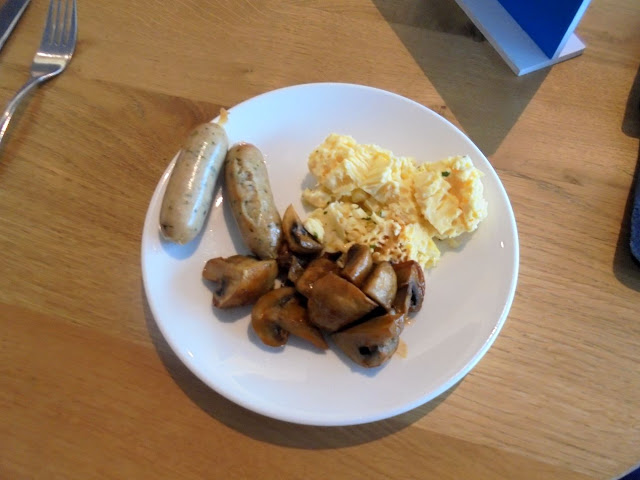
I've not much time in the lounge so I try to make the most of it. I get a sort of mini breakfast- a couple of sausages, scrambled egg and mushrooms. A few whiskies, too. It's much more crowded here. But nothing too crazy.

It's not far to my gate. I get there at the perfect time - at the tail end of priority boarding.

This time the person in front of me doesn't recline their seat before the seat belt sign goes off. They wait until 2 minutes afterwards. Brilliant. Luckily the seat to my left is vacant and I can use that space for my laptop.

Dolores loaded up all nine series of Peep Show to my laptop. I start with series 1, episode 1. I'd forgotten that Johnson turns up so early. Not that I'm complaining. He's a great character.

After watching all six episodes of season 1, I switch to the inflight entertainment for a while I watch Venom 3, despite it being pretty crap. And so dark it's hard to make out some of the action. Back to Peep Show.

There's a two or three-month old baby on the row behind. Not that you'd notice. It spends pretty much all the flight asleep on one or other of the parents.

No Time to Die is the next film. (A surprising title, given the film’s ending.) It's long, which is good. I keep dozing off in the middle section. Don't think I missed much as I can still follow the plot.

The last 90 minutes of the flight I watch one of the comedy series on the inflight entertainment: Nobodies. It passes the time. In a challenge to the traditional sitcom dogma, it does completely away with jokes.

This time they do want to see all my Covid documentation at the border. Not that they look at it that closely.

When I'm just about to walk through customs, a bloke in his forties asks me how I'm getting into town. I think he recognised that I was on the same flight by my Schiphol duty free bag.

"Are you getting the train?" he asks.

"No, I'm getting a taxi. I can't be arsed with the train."

"Could we share the taxi?"

"Of course."

Great. This is going to save me some dosh.

It turns out he's on his way to Blumenau, too. To visit relatives. He's German, by the way.

Getting money from the cash machine turns out to be problematic. Until I use my visa card. That's a relief, having some Brazilian dosh in my pocket.

The taxis from Sao Paolo airport are pretty good. They're run by a cooperative of drivers, which has a monopoly. There are set fares to various locations in the city. My new German friend will be dropped of first, for the set fare. Then the driver will continue on the meter to drop me off.

A couple of minutes outside the airport, it starts pissing it down. Really pissing it down. Full-on tropical downpour. Soon the roads are transformed into rivers. It's all a bit scary. Doesn't seem to faze the driver. I guess he's seen it all before.

I feel sorry for the German when he reaches his destination. There's a good 10 cm of water he has to wade through.


As we get closer to my hotel, there are lots of little corner bars. Mostly pretty full and noisy, sometimes with music, sometimes just voices.

I'm lucky when I disembark. It's under cover and there's no standing water. It's still pissing it down.

That's why I eat in the hotel. In a deserted restaurant, save for the staff. I'm not getting drenched for no good reason.

A draught of Laphroaig hastens my dreams, the traditional Islay way.