Monday, 10 July 2017

Boddington beers in 1901

Time to take a look at Boddington’s beers at the turn of the 20th century.

For quite a small provincial brewery, they had a surprisingly large range of beers. Especially as they didn’t parti-gyle much.  They brewed four Mild Ales, two Pale Ales, two Stouts and one Strong Ale. Not bad at all.

Especially if you compare it with what they brewed in the 1980’s: one Bitter and one Mild. That was it. Until they bought Oldham, when they added that brewery’s Bitter and Mild. Still not exactly varies. But something similar happened at many of the UK’s older breweries. When bottled beer went out of fashion, brewers dropped their Brown Ales and Stouts, buying them in instead, if needed.

I’ve been wondering recently if the London beers I’ve mostly concentrated on were typical of the country as a whole. Especially after I saw how weak some of the Adnams’ beers were. The set from Boddies has reassured me. As the gravities are pretty much in line with those in London. OK, the weakest Mild has a gravity a bit on the low side. But that wasn’t their big seller. Their two main Milds, XX and XXX, are generally similar to Whitbread’s X and XK.

The same is sort of true of the Pale Ales. Though Whitbread didn’t brew an AK-strength beer, I know 1045 is a typical gravity for this class of beer. Boddies IPA is right in the middle of Whitbread’s set of Pale Ales. The biggest differences I can see are that Whitbread brewed a larger range of Pale Ales and hopped them a bit more heavily.

Taking Boddies Single Stout as a Porter under a different name, the Manchester brewer’s beers are broadly the same as the two weakest Whitbread beers. The hopping, though, again being heavier in the London beers.

Finally, Boddies Strong Ale, BB, which has a higher OG than any of Whitbread’s Stock Ales. In this case, the hopping in Manchester is much lower than in London.

Not forgetting boil times, which were around 30 minutes longer at Boddington. Wonder why that was?

Boddington beers in 1901
Date Beer Style OG FG ABV App. Atten-uation lbs hops/ qtr hops lb/brl boil time (hours) boil time (hours) Pitch temp
3rd Dec X Mild 1045 1010 4.63 77.78% 5.62 1.01 2 60º F
11th Dec XX Mild 1052 1016 4.76 69.23% 5.67 1.20 2.17 2.25 60.25º F
2nd Dec XXX Mild 1059 1018 5.42 69.49% 5.66 1.35 2.25 2.33 60º F
5th Dec XXXX Mild 1068 1022 6.09 67.65% 5.91 1.66 2.33 60.5º F
12th Dec AK Pale Ale 1046 1013 4.37 71.74% 8.00 1.48 2.25 59.5º F
19th Dec IPA IPA 1054 1015 5.16 72.22% 9.71 2.10 2.25 60º F
12th Dec DS Stout 1067.5 1023 5.89 65.93% 5.38 1.56 2.25 60º F
6th Dec S Stout 1051 1015 4.76 70.59% 5.50 1.16 2.25 60º F
17th Dec BB Strong Ale 1086 1030 7.41 65.12% 8.42 2.63 2.75 60º F
Source:
Boddington brewing record held at Manchester Central Library, document number M693/405/125.


Whitbread beers in 1901
Date Beer Style OG FG ABV App. Atten-uation lbs hops/ qtr hops lb/brl boil time (hours) boil time (hours) Pitch temp
20th Jun XK Ale 1061.2 1017 5.85 72.24% 6.03 1.63 1.75 1.75 60º
20th Jun X Mild 1054.2 1014 5.31 74.15% 6.03 1.44 1.75 1.75 60º
25th Jun 2PA Pale Ale 1053.7 1014 5.26 73.95% 9.85 2.39 1.5 1.42 57.5º
27th Jun FA Pale Ale 1051.8 1013 5.13 74.90% 10.92 2.54 1.5 1.75 58º
15th Jun PA Pale Ale 1058.4 1017 5.48 70.91% 10.98 2.93 1.5 2 58º
31st May KK Stock Ale 1073 1030 5.69 58.91% 12.00 4.03 1.75 2 57º
31st May 2KKK Stock Ale 1078.7 1033 6.05 58.07% 12.00 4.35 1.75 2 57º
31st May KKK Stock Ale 1082.8 1036 6.19 56.53% 12.00 4.58 1.75 2 57º
11th Feb C Porter 1054.7 1015 5.26 72.60% 6.86 1.86 1.5 1.75 60º
14th Feb P Porter 1055.7 1015 5.38 73.06% 7.52 1.70 1.75 2 60º
25th Feb CS Stout 1055.5 1016 5.23 71.18% 6.91 1.79 1.75 2 60º
8th May S Stout 1072.5 1028 5.89 61.39% 8.57 3.15 1.75 1.75 57º
20th Feb SS Stout 1087.6 1033 7.22 62.31% 8.55 3.74 1.75 2.17 57º
13th Mar SSS Stout 1096.1 1042 7.16 56.29% 8.51 4.25 1.75 2 57º
Source:
Whitbread brewing records held at the London Metropolitan Archives, document numbers LMA/4453/D/01/066 and LMA/4453/D/09/095.

Sunday, 9 July 2017

Manchester again

Another Friday, another trip to Schiphol. Not something I look forward to with any great enthusiasm.

The airport is ridiculously overcrowded, though not quite as bad as in May. When it took me two hours to drop off my bag and get through security. But, I now realise that I don’t have to queue with the plebs. My silver status in KLM’s frequent flyer programme means I can go through the Sky Priority lane, which has far shorter queues. Hooray!

I’m through all the irritating formalities in less than 20 minutes. Which is a miracle.

Having plenty of time – I got here two hours before departure, as advised - I’ve time for a beer. It might only be 8:30, but different rules apply in airports. My flight departs from pier D. Which just happens to be where the Murphy’s Irish pub is located. On the way I eat the egg and bacon sandwich I picked up in the landside Albert Heijn. It cost less than half than what the robbing bastards charge airside.

I settle into a seat at the bar. I’ve been through here so often that I recognise half the bar staff. How sad is that. Soon a blandish pint of Murphy’s Stout is settling itself slowly into my stomach. I have a read of the paper while I sip.

I’m one of the three people who still subscribe to a printed daily newspaper. Mine, NRC Next, is pretty decent. Not rabidly biased like most of the UK press and with articles written by proper, named journalists. It’s also good camouflage. Who would suspect that I’m English? With all the Brexit shit, I’m not particularly proud of my nationality. Don’t want to be mocked or pitied. Not sure which of those is worse.

Half way down my pint, I get this sudden urge. “Double Jamesons, please.” It’s going to be a long day. I need some fire in my belly.

I bought that breakfast sarnie for a reason. KLM’s food service on their morning flights isn’t inspiring: a piece of cake and a little tub of water. I don’t eat the cake, as I don’t eat refined sugar. Haven’t since I was fourteen. Luckily I get a little bottle of red wine to keep up my spirits.

Last time we came to Manchester we flew with Easyjet. Whose flights arrive at Terminal 1. Which is about five miles closer to the airport’s railway station.

I’m staying at the Doubletree, handily directly opposite Piccadilly Station. But I don’t head directly there. I have a few errands. First, and most important: collecting my train ticket for tomorrow’s journey to Sheffield. Then WH Smiths to pick up a copy of Viz, a bottle of water and a bag of crisps. The essentials for a night in Girlchester.

It’s only 11:30 and my room isn’t ready. “When will it be ready?” I ask. “About one o’ clock.”

Now there’s a dilemma. I’ve a visit booked to the archives at Manchester Central Library. Should I try to fit it in before or after checking in? I inadvertently make the decision for myself. I’ve left my cameras in the luggage I’ve left at the hotel. I can’t be arsed to ask them to pull it out again, so I do the only logical thing. I head for the nearest Wetherspoons.

It’s on Piccadilly. Not one I’ve been too before. The young barmaid who serves me is obviously new. Asking colleagues a few times about how to ring stuff up on the till. But she’s friendly enough. We all have to start sometime.

It’s a bit dark inside which makes reading my Viz tricky. I change seats to somewhere with slightly more light. It helps. A bit.

Thankfully my room is ready when I return. I go up to it to quickly dump my stuff. Inside there’s a tray of Partizan beers and some chocolates. I’m a bit puzzled at first. Then remember I’d given the brewery the hotel’s address when they offered to send me some beer. And not just any beer. Most of it is their version of 1945 Tetley Mild. I’m looking forward to trying that later.


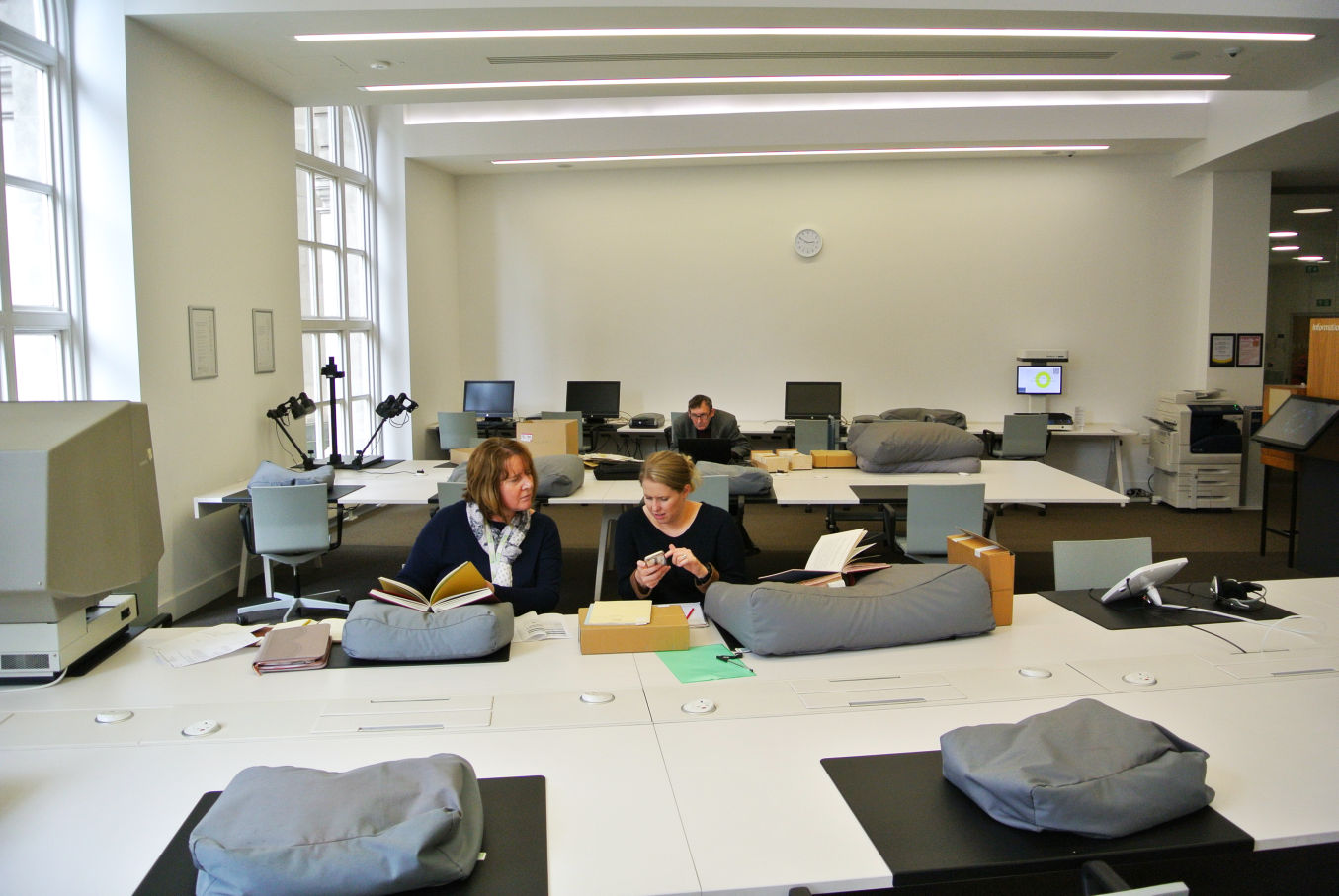
Luckily the library isn’t far and I’m there well before 2 PM. Leaving me more than three hours of frantic snapping. Should be plenty of time. I’ve only ordered a dozen or so documents.

I’ve come to love the calm inside archive reading rooms. Something very soothing about them. Though I’m anything but calm, really, as I take photo after photo, limited only by how quickly my camera resets.


“Is this the last?” I ask the nice lady who’s ladling out the brewing logs to me. “Yes, that’s it” So that’s me done. An odd anti-climax. Stupidly, I didn’t bring the list of documents I’d requested. I have a nagging feeling that I’ve missed something. Still, I’m finished more than half an hour before the archives close. And I’ve only taken 800 photos. I’m such a lightweight.

No time to rest, mind. I’ve an appointment with John Clarke at the Marble Arch pub at 5:30. It’s over the other side of town and by the time I’ve dumped my posh camera at the hotel – not taking that on a pub crawl with me – I’m running a bit late.

Funnily enough, I’ve never been to the Marble Arch before. Not sure why. The interior is impressive. And it’s pretty crowded. Though I suppose it is Friday night. I eventually manage to spot John. Then I spot something else. On the bar. A pumpclip announcing Imperial Stout. I can’t pass that up.

“A pint of Imperial Stout, please.”

“Are you sure you want a full pint?” Of course I do. I don’t do halves.


John introduces me to Jan, the owner. We chat a while and I suggest she gets her brewer to make a good old-fashioned Manchester beer. Like a C Ale. She seems quite keen.

After a second pint of Imperial Stout, me and John head over to the Hare and Hounds for a pint of Holts. It’s a gorgeous, unspoilt pub with an intact pre-war interior.


I have to admit that the evening is getting a bit hazy. Can’t think why. I’ve only had a couple of pints.


Wetherspoons
49 Piccadilly
+44 161 236 9206
https://www.jdwetherspoon.com/


The Marble Arch
73 Rochdale Rd,
Manchester M4 4HY.

Tel: +44 161 832 5914
https://marblebeers.com


Hare & Hounds
46 Shudehill
Manchester
M4 4AA

Saturday, 8 July 2017

Let's Brew 1901 Boddington Stout

Quiet my life isn’t. I try to focus my efforts, but once again I’m fiddling in the knickers of several projects simultaneously. I won’t bore you by repeating what they. Mostly because it’s pretty damn effing obvious.

I’ve been a stupid twat. Only just twigging that I can easily combine my beery UK trips with archive visits. Which is where today’s recipe originates. At the Manchester Central Library.

I almost left it too late. Officially you need to book offsite records – which the Boddies brewing records are – two weeks in advance. I was so dozy that I only asked 10 days in advance. Luckily, that was OK.

Right. You’ll need to bear with me. I have to quickly finish off my Abt. Got a blood test at the quack tomorrow for which I need to be “nuchter”, as they say in Dutch. Literally it means sober. In this case, it means without food or drink for 12 hours.

Finally, we’ve arrived at the beer in question. Boddington’s entry-level Stout from 1901.

The recipe mixed my head up a treat, I can tell you. No dark malt at all in the log. Until I got two pages further. Where a note in the margin it details the quantities of black malt added to several beers. Not mentioned in the main part of the log, because it was added in the kettle, not the mash tun.

The sugars are a total guess. I just know there were two types. The recipe just barely gets to a Stout colour with my random jabs of No. 3 and No. 4 invert. Later logs show caramel. So that may well have been added to this beer as well.

In London this would never have counted as a Stout. Standard Porter had a higher OG. But I think this is just a case of a Porter being rebranded as Stout for commercial reasons. Boddington has a stronger version called Double Stout that was closer to the real Stout deal.

Maybe I’ll pester you with that Double Stout soon. Unless some shiny thing distracts me.


1901 Boddington S
pale malt 9.25 lb 85.33%
black malt 0.25 lb 2.31%
No. 3 Invert 0.67 lb 6.18%
No. 4 Invert 0.67 lb 6.18%
Cluster 135 mins 0.50 oz
Fuggles 90 mins 1.00 oz
Fuggles 60 mins 0.50 oz
Fuggles 30 mins 0.50 oz
OG 1051
FG 1015
ABV 4.76
Apparent attenuation 70.59%
IBU 36
SRM 24
Mash at 156º F
Sparge at 165º F
Boil time 135 minutes
pitching temp 60º F
Yeast Wyeast 1318 London ale III (Boddingtons)


Friday, 7 July 2017

Pasteurisation at Carlsberg in the 1880's (part two)

I hope you're enjoying this detailed look at 19th-century pasteurisation. I know I'm not. Deathly dull stuff. You'll be pleased to know that it ends here.

Some really boring stuff about the layout of the various pipes first.

"The steam and cold water pipes join each other like the letter V. The hot water enters at right angles about a foot below this junction. The three run by a common pipe into a perforated pipe lying on the bottom of the trough below the false bottom. This pipe is 40 inches long and eight inches in circumference. It is pierce with thirty 0.5 inch holes ten on each side and so placed as to force the water against the sides at an angle of about 40º. Of course the perforated pipe being plaaced in the centre of the box causes a current through all box. These perforated pipes are placed about 6 feet apart.

The manager does not consider this arrangement the best. If he was constructing a new one he would prefer smaller pipes placed at shorter intervals. The lenth of the boxes is nearly 18 feet."
"Notes of a visit to the breweries of Messrs. Jacobsen Senr. & Junr. Copenhagen Sept 1881." held at the Scottish Brewing Archive, document number WY/6/1/1/11.
I realise now why William Younger had sent people to go out and look at Carlsberg's brewery: they'd just started brewing Pils at their Holyrood brewery. There was another trip in November and December to a Lager brewery in Plauen so obviously they were taking research very seriously. I bet you can guess what I'll be boring you with next.

It seems that pasteurising caused a lot of broken bottles. Obvious enough , really. Rapid heating and cooling of glass is likely to lead to it cracking.

"Their breakage seems mostly at the first heating and the first of the cooling. The average loss in broken bottle in 1880 was quart 2.47% pints 1.52. This is the percentage for pasteurisation only. The loss through carelessness in every other operation is 0.3%. This incidental loss is greater when the bottles are not pasteurised.

Mr. Jacobsen Sen. says that the perecenatage of bottles broken in the pasteurisation process is always larger as the glass is darker. The paler the colour of the bottle, the breakage is proportionally less and with reason. He has got bottles from various parties. Some makes give double the breakage of others. He has also got the bottle blowers to try and darken the glass like the colour of home beer bottles but whenever the colour approached the black bottle the breakage was so high they were compelled to discontinue their use. When bottling beer to be pasteurised one must be careful not to fill the bottle very full so as to leave room for an air receiver? between the cork and the beer. This is to contain the liberated gas and also to allow for the expansion of the beer when it is at its maximum temperature."
"Notes of a visit to the breweries of Messrs. Jacobsen Senr. & Junr. Copenhagen Sept 1881." held at the Scottish Brewing Archive, document number WY/6/1/1/11.
Why on earth would darker bottles be more likely to break? Seems odd.

The implication from this next passage is taht not all of Carlsberg's beeer was pasteurised.

"They never bottle beer for pasteurisation under six months and they prefer it from 9 months to one year old. They bottle it the whole year round.

Mr. Jacobsen Sen. & Dr. Hansen say that the heat is only sufficient to retard the development of yeast by lessening its normal activity and not at all by killing it. In judging of the suitability of a bottle they put great stress on the uniform thickness of the glass. The bottom being very little thicker than the side of shoulder."
"Notes of a visit to the breweries of Messrs. Jacobsen Senr. & Junr. Copenhagen Sept 1881." held at the Scottish Brewing Archive, document number WY/6/1/1/11.

I suppose they wanted the beer to be fully matured before they killed, was the reason they left it for so long before pasteurising. Though it's clear that the proceess didn't really kill all the yeast.

Which beer wasn't pasteurised? My guess would be the beer that was put into casks.

Thursday, 6 July 2017

Mild dominates Manchester

There are often handy little monthly totals (or even yearly ones, if you’re lucky) tucked away in brewing records. They’re another vital source of information.

I could see as I went through Boddington’s brewing records at the start of the 1900’s that they were brewing a lot of Mild. But the monthly total at the end of January 1902’s brews told me just how dominant it was: of 39 brews that month, 33 were for one of their four Mild Ales.

I could have made a rough approximation from just the number of brews, but luckily I have photos of all the brews for that month so I can come up with exact totals. Very exact totals: down to the gallon. Just shy of 50% of the total was XXX alone and all four Milds combined were 86% of output that month. That’s a very high percentage of what they brewed.

Compare and contrast is what I like to do. Usually it’s with Whitbread, because I have so much information about their beers. Unsurprisingly, they were brewing a much lower percentage Mild. And, being a London brewery, Porter and Stout were still important products for them.

Which doesn’t mean to say that they weren’t still brewing a shitload of Mild. It was still over 40% of their output and X Ale was their biggest seller by a long, long way. But Pale Ale was catching up fast. In 1880 1880 Mild was 53%, Pale Ale just 3%.   By 1902 Mild was down to 43% and Pale Ale up to 19%.

What does this tell us? That London and the North of England were out of phase in beer style popularity. Pale Ales were relatively much more popular in London. I can think of one possible explanation: the middle class was bigger in London. Pale Ale was, at the time, still a relatively posh drink. But I’m sure some of the explanation is just in different fashions in different places.

Seventy years later, around the time I was starting to drink, Mild was still much more popular in the North than in London. In fact, Mild was almost dead by then in London, but still a standard pub beer in most of the North and the Midlands.

The other huge difference between the two breweries is the amount of Stout being produced: marginal quantities at Boddington, more than a third of production at Whitbread. And standard Porter, which Boddington no longer brewed, was one of Whitbread’s biggest sellers. In that sense Whitbread was behind most of the rest of the UK (apart from Ireland). The Porter drinking tradition was very much alive in London.

The only area where the two breweries have similar figures is Strong Ale, it both cases just over 2%. Which just tells us the strong beer drinking was a minority pursuit.

Here are the numbers in detail:


Boddington output in January 1902
Beer Barrels %
X 478.39 15.64%
XX 552.61 18.06%
XXX 1521.83 49.74%
XXXX 78.67 2.57%
Total Mild Ale 2631.50 86.01%
BB 71.81 2.35%
Total Strong Ale 71.81 2.35%
AK 79.81 2.61%
IPA 78.89 2.58%
Total Pale Ale 158.69 5.19%
S 121.42 3.97%
DS 75.94 2.48%
Total Stout 197.36 6.45%
Total 3059.36 100.00%
Source:
Brewing record held at Manchester Central Library, document number M693/405/125.


Whitbread output year ending June 1902
Beer Barrels %
X 316,128 42.62%
XK 5,768 0.78%
Total Mild Ale 321,896 43.39%
KK 7,244 0.98%
KKK 2,590 0.35%
2KKK 5,239 0.71%
Total Strong Ale 15,073 2.03%
PA 12,714 1.71%
2PA 44,122 5.95%
FA 52,651 7.10%
IPA 34,307 4.62%
Total Pale Ale 143,794 19.38%
P 81,926 11.04%
S 8,315 1.12%
C 35,700 4.81%
CS 82,752 11.16%
SS 41,017 5.53%
SSS 11,333 1.53%
Total Stout 261,043 35.19%
Total 741,806 100.00%
Source:
Whitbread brewing records held at the London Metropolitan Archives, document numbers LMA/4453/D/01/067 and LMA/4453/D/09/096.

Wednesday, 5 July 2017

Let’s Brew 1917 Barclay Perkins Government Ale

As promised, here’s the new member of X Ale’s family, new-born younger sibling Government Ale.

This is the very first brew of GA, something Barclay Perkins would churn out in large quantities in the second half of 1917 and the beginning of 1918. Most batches were between 900 and 1,200 barrels. Meaning it was the bulk of what they brewed. X Ale brews were around 200 barrels, those of XLK, the only Bitter they brewed at this point, were 300-400 barrels.

But everything changed in April 1918, when permitted output was cut again and average gravity reduced to 1030º (everywhere except Ireland, where it was 1045º). The first price controls were also introduced: < 1030º 4d per pint, 1030 – 1034º 5d per pint.

The rule changes had an immediate impact at Barclay Perkins. Both X Ale and GA were discontinued and replaced by a new, even weaker Mild: Ale 4d, at 1027º. For the next year this was the only Mild they brewed, until April 1919 when average gravity was increased to 1040º and Barclay’s brought back X Ale (at a gravity of 1036º) . Though they continued to brew Ale 4d at the lower gravity. Amazingly, it survived right through to the next war, only being discontinued in 1941.

There’s not much really to say about GA. It’s literally a scaled down version of X Ale, having been parti-gyled with it. All the same ingredients, just slightly smaller quantities. In many ways, WW I saw the birth of modern Mild. Beers of just 3 and a bit percentage ABV and reasonably dark in colour.

Now I’ve told you all about Ale 4d, guess what recipe will come next? That’s right, a lovely watery Mild.


1917 Barclay Perkins GA
pale malt 5.75 lb 75.76%
amber malt 0.75 lb 9.88%
crystal malt 0.33 lb 4.35%
no. 3 sugar 0.75 lb 9.88%
caramel 0.01 lb 0.13%
Fuggles 120 mins 0.75 oz
Fuggles 60 mins 0.50 oz
Fuggles 30 mins 0.50 oz
OG 1036.4
FG 1008.3
ABV 3.72
Apparent attenuation 77.20%
IBU 23
SRM 12
Mash at 152º F
Sparge at 170º F
Boil time 120 minutes
pitching temp 61º F
Yeast Wyeast 1099 Whitbread Ale

Tuesday, 4 July 2017

Pasteurisation at Carlsberg in the 1880's (part one)

Pasteurisation is a process which fascinates you, I'm sure. Well, maybe not. But it is an important process at many breweries still.

From the description, it sounds quite a fiddly process:

"The pasteurisation process is conducted as a secret, with attention to strangers not being admitted. The process is conducted by one man and this in an apartment where no one but the workman and the manager have access to. The bottles to be treated after wiring are placed in cages constructed of hoop iron. This cage being enclosed in a basket also made of hoop iron. Each cage contains 20 bottles. They are carried to the door of the pasteurising room from which place the pasteurizer lifts them with a cord terminating in hooks fixed on the top ends of the basket. The cord works through a pulley which is in its turn suspended to a pulley wheel running on an inverted rail seecurely fastened to the roof and is placed exactly above the centre of the heating troughs. In this manner he can deposit the cage at any spot with little trouble. The heating boxes for the process are 3 feet 9 inches wide and any length depending on the amount of work to be done. They have a false bottom five inches deep and a total depth of 16 inches. At half an inch from the top a funnel is fixed. This teminates in a pipe 1.5 inches in diameter. This is to carry away the excess of water when not otherwise required."
"Notes of a visit to the breweries of Messrs. Jacobsen Senr. & Junr. Copenhagen Sept 1881." held at the Scottish Brewing Archive, document number WY/6/1/1/11.
Why was their pasteurisation process such a secret? Well I guess it wasn't that much of a secret if they let their visitors from William Younger observe it.

Nowadays there's no faffing around with cages and baskets. Bottles motor through the pasteuriser on a belt of some sort.

"The heating boxes are placed close to the wall and extend the whole length of the three sides of the room. These all communicate withe each other through holes bored in the adjoining ends. These holes aare stopped with wooden plugs. In operating they begin with say the left hand box. After the bottles in their baskets are in this place the water is admitted at a temperature of 16º until the bottles are nearly covered. The water is now shut off and steam at a pressure of 45 to 60 lbs. per square inch admitted as fast as it can rush in until the temperature rises to 44º. The temperature is maintained at this point constant for ten minutes. They then cool as quick as possible by admitting cold water until the heat falls to 20º. When they are removed to the packing hall again by means of the overhead rail. During the heating they have in each box a clear bottle containing a thermometer suspended in water only. This bottle is wired like the others, and if quarts are being treated it is  quart. If pints it is a pint. They vary the ten minutes a little, if this bottle does not show a predetermined heat which is always 6º lower than the heating water in the box. The reason of this is that different glasses have different specific heats and as a consequence a different conductivity from the water to the beer. They aim at carrying out the operation as quick as they are able. The quicker it can be done, the better. The whole process occupies exactly one hour. The attendant has to note the heats of the water and the test bottle every ten minutes. 44 is the standard heat but this is varied for the market. Very warm climates as aa rule are supplied with a beer that was treated at 44.8 to 45. Colder climates at 43.2."
"Notes of a visit to the breweries of Messrs. Jacobsen Senr. & Junr. Copenhagen Sept 1881." held at the Scottish Brewing Archive, document number WY/6/1/1/11.
That seems a very low pasteurisation temperature. A quick look online implies that somewhere around 60º C is the usual temperature for pasteurising beer*. Were they reall pasteurising at just 44º C?

I suppose it makes sense to pasteurise beer destined for the tropics at a higher temperature.

It seems that they kept the man on pasteurising duty pretty busy:

"During the time this box was heating the second box would be filled with bottles, and whenever they commence to cool no. 1 box the plugs are drawn and the water allowedto flow into number 2 until it is filled. When the steam is turned on as before, during the heating of No 2 and the cooling of No 1, No 3 is being filled and so on, only the water from No 3 is run to the drain pipe. During the cooling of No 1 and the heating of No 2 the communication is closed. No 1 is cold and ready for removal when no 2 is cooling and No 3 up to its heat. Working in this manner the workman is kept fully employed and can turn out a large amount of work."
"Notes of a visit to the breweries of Messrs. Jacobsen Senr. & Junr. Copenhagen Sept 1881." held at the Scottish Brewing Archive, document number WY/6/1/1/11.

Though how many bottles could he be pasteurising at once? With only 20 bottles to a cage, it doesn't sound like that many.

Next time we'll be looking at breakages during pasteurisation. WHite knuckle stuff.


* Frickir, R. (1984) The flash pasteurisation of beer in the Journal of the Institute of Brewing May-June. 1984, Vol. 90. pp. 146-152.

Monday, 3 July 2017

Caramelbier

I’m continuing my look inside the world of 1920’s German brewing. This time looking at a style which hasn’t survived, Caramelbier.

Though it does sort of still exist in the form of Doppel-Caramel, a DDR style which is still produced in a few breweries in the East. However this type of beer, although also a Vollbier (11º Plato) is only partially fermented and has a very low alcohol content. Whereas, as far as I can tell, the older form of Caramelbier was fermented in the normal way.

I wasn’t totally convinced of that last statement. So I went and had a look in the later Schönfeld book. Because I could remember seeing a table of top-fermenting styles, including ABW, in the back. Sure enough, Karamelbier is in there. And its listed as 1.1 - 2.2% ABW (1.4 - 2.75% ABV).*  So it looks like this style wasn’t fully fermented, either.

Time to start paraphrasing.

In brewing these so-called health beers, which are preferably made dark, Munich malt is used with 5% caramel malt and 2 pounds of Farbmalz per 50 kg. of malt.

Mashing in is at 35º C with a thick mash, after which the temperature is slowly raised to 70º C and held there for 35 minutes for saccharification. A third of the mash is transferred to the Lauter tun while the remaining thick mash is brought to the boil and boiled for 35 minutes. As highly dried malt is being used which takes longer to convert, don’t forget to make an iodine test. This thick mash raises the temperature of the whole mash to the mash out temperature of 75º C. Before running of the wort leave the mash to rest for 40 minutes to let it settle and for conversion to complete.

Enough water is used to give a wort of 12 to 14º Plato. As soon as the copper is full, the hops, which have been steeped in another vessel with water at 80º C, are added.

The hopping rate is 0.6 pounds of mild hops per 50 kg. of malt. The boil lasts 2 hours.

The wort is pitched with 1.25 litres of top-fermenting yeast at a temperature of 15-20º C, depending on the outdoor temperature (stronger worts require more yeast than lighter ones).

At the end of primary fermentation the beer is filled into smaller casks and from there into bottles. If the beer is already old, Kräusen is added to the barrels, the amount depending on the time of year and the type of customer.
Source: Olberg, Johannes (1927) Braunbier in Moderne Braumethoden, pp 63-64, A. Hartleben, Wien & Leipzig.

Looking in Schönfeld again, I notice that he describes something quite different. The OG is the same, but lots of sugar was added at the end of primary fermentation. The beer was bottled and after it had conditioned enough it was pasteurised to stop further fermentation.** 

I’m all confused now. Are they talking about the same type of beer? Because Olberg makes no mention of sugar or pasteurisation. Then again, he doesn’t say much about the fermentation at all, just referring to the chapter called Top fermentation. Which seems to describe a normal fermentation, not an interrupted one.


* Schönfeld, Franz (1938) Die Zusammensetzung obergäriger Biere im Vergleich zu untergärigen in Obergärige Biere und ihre Herstellung, pp 185-186, Paul Parey, Berlin.

** Schönfeld, Franz (1938) Die obergärigen Biere in Obergärige Biere und ihre Herstellung, pp 135-137, Paul Parey, Berlin.

Sunday, 2 July 2017

Saxon Braunbier

I know that Saxony was one of the regions of Germany where top fermentation hung on the longest. Also that a local speciality was Braunbier. It’s nice to have some more details about it.

Though looking at the numbers, that’s not quite so clear:

Output and no. of breweries per region in 1893
top-fermenting breweries bottom-fermenting breweries top-fermenting beer bottom-fermenting beer % top-fermenting % bottom-fermenting
Brandenburg 430 138 1,724,795 3,157,941 35 65
Königreich Sachsen 541 190 1,710,653 2,476,475 41 59
Rheinland 575 377 761,519 3,121,390 20 80
Schlesien 576 219 977,143 1,794,259 35 65
Provinz Sachsen 451 186 594,312 1,862,008 24 76
Westfalen 456 233 84,020 2,250,789 4 96
Thüringen 264 578 243,652 1,974,374 11 89
Hessen-Nassau 66 275 23,019 1,712,756 1 99
Schleswig-Holstein 582 56 247,960 1,009,047 20 80
Hannover 310 101 131,494 1,121,364 10 90
Grossherzogtum Hessen 7 183 660 1,055,851 0 100
Ostpreussen 154 55 266,334 609,050 30 70
Pommern 243 79 108,453 554,576 16 84
Hamburg 18 13 169,130 476,537 26 74
Westpreussen 33 62 133,917 463,095 22 78
Braunschweig 42 33 22,870 463,654 5 95
Posen 101 57 177,038 307,800 37 63
Mecklenburg 346 43 115,318 293,561 28 72
Anhalt 53 18 90,838 285,073 24 76
Bremen 9 10 19,778 204,697 9 91
Oldenburg 61 17 25,855 125,421 17 83
Hohenzollern 84 143 4,596 122,088 4 96
Lübeck 26 6 31,485 65,126 33 67
Total Brausteuergebiet 5,428 3,072 7,664,839 25,506,932 23 77
Sources:
“Zeitschrift für das gesammte Brauwesen 1894”, p.23
Handbuch der deutschen Wirtschafts- und Sozialgeschichte  2 vols. Stuttgart, 1971-76, vol. 2, p. 18. 


There were indeed a large number of top-fermenting breweries in Saxony, but they produced far less beer than the rather smaller number of bottom-fermenting breweries.

I’m going down the summarising rather than translating route again. It makes life much easier for me and I reckon it’s all the same to you in the end.

Braunbier is a well-liked top-fermenting beer in the province of Saxony.

It’s brewed from high-dried malt (dried at 66-70º C) with about 2 kg of Farbmalz per 50 kg.

The kettle mashing system is used with either one or two boils of the mash. OG 8-8.5º Plato, 1.5 hour boil, hopping rate 1-1.1 pounds per 50 kg of malt.

It is pitched with top-fermenting yeast at 20º C, in cold cellars 25º C. First the entire wort is transferred to a collecting tun in order to remove sediment and the yeast added. As soon as the wort displays a thin white head it is transferred to already prepared casks of 1 to 2 hl. And bung fermentation carried out.

Because the wort had been in the collecting tun for a few hours the sediment is completely removed. When the fermentation is complete the casks are stood up straight again, washed and refilled to the top. In the following days a nice cap of yeast seals the bung hole. Now the barrels are sent out to the pub, where they are stored for a few more days until the beer is almost clear. Only then is it filled into one litre stone jars sealed with new corks. After 8 to 14 days, according to the time of year, it foams strongly and is particularly thirst-quenching. The colour is cherry-red like Bockbier.

Source: Olberg, Johannes (1927) Braunbier in Moderne Braumethoden, pp 62-63, A. Hartleben, Wien & Leipzig.

The finished beer would have been 3-3.5% ABV and not very hoppy. It sounds quite different to the Berlin type of Braunbier but, like that, it was delivered to publicans pretty much at the end of primary fermentation and bottled by them.

I wonder when the last Saxon Braunbier was brewed? It sounds like it wold be pretty easy to recreate.

Saturday, 1 July 2017

Let’s Brew - 1917 Barclay Perkins X

Not knowing when to stop. That’s one of my most endearing traits. Which is why I’m stumbling on with Barclay Perkins X Ale.

We’re now getting close to beer Armageddon, when British beer was changed forever. This beer was brewed on 6th July 1917. Just a few days earlier, on July 1st the first restrictions on gravity were introduced. Half the beer a brewery made had to be no more than 1036º . And guess what? Parti-gyled with this beer was the very first batch of Government Ale, at a gravity of 1036.4º*.

There have also been changed to the recipe. Out goes the flaked maize, the sugar content is halved and in comes crystal malt. And the percentage of amber malt has increased by 50%.  Flaked maize disappeared from Barclay Perkins’ recipes in May 1917, presumably because it was no longer available. Maize wasn’t grown in the UK at the time and had to be imported, usually from the USA. I assume shortages also explain the reduction in sugar content. Only the hopping has remained unchanged.

All the changes in ingredients must have had an impact on the character of the beer. You could argue that the enforced changes have improved the recipe, as it now contains to adjuncts and a higher percentage of malt. But, as we’ll see in a few recipes’ time, as soon as it was available, Barclay Perkins went back to using flaked maize.

The OG has fallen, but only by a couple of points. However, that’s deceptive. Because after this date most of the Mild Barclay Perkins brewed was GA. For example, the batch of X Ale brewed on 2nd July was 859 barrels. This batch was just 242 barrels with 438 barrels of GA. Most drinkers would have been on GA. Though I’m sure some unscrupulous publicans sold GA as X Ale.

Next time we’ll take a look at that GA.


* Taken from "The Brewers' Almanack 1928" pages 100 - 101.


1917 Barclay Perkins X Ale
pale malt 7.50 lb 74.96%
amber malt 1.00 lb 10.00%
crystal malt 0.50 lb 5.00%
no. 3 sugar 1.00 lb 10.00%
caramel 0.01 lb 0.05%
Fuggles 120 mins 1.00 oz
Fuggles 60 mins 0.75 oz
Fuggles 30 mins 0.75 oz
OG 1046.7
FG 1012.7
ABV 4.50
Apparent attenuation 72.81%
IBU 31
SRM 17
Mash at 152º F
Sparge at 170º F
Boil time 120 minutes
pitching temp 61º F
Yeast Wyeast 1099 Whitbread Ale