Saturday, 19 September 2015

Bottled Pale Ale in 1960

I told you I’d be annoying you with more of this junk. I jumped all the way from Bitter to Pale Ale. Basically the same stuff, just from a bottle rather than a pump.

As before, we’ll be looking at the beers from both the Which? report and the Whitbread Gravity Book. I must admit that I’ve fiddled with the Which table a bit. Some of the beers just weren’t Pale Ales. Double Maxim and Younger’s No. 3 are obviously totally different styles. While White Shield and Red Triangle I have to class as IPA.

One thing immediately about the Which list: most of the examples were also keg beers. Brewmaster, Double Diamond, Red Barrel, Ben Truman and John Courage. Though the keg versions were usually weaker. It’s really weird how the OG averages out to exactly 1048º. Which makes them look rather like continental Lagers in terms of gravity and ABV.

The bitterness levels are all over the place, with the two hoppiest being more than double that of the least hoppy, Long Life. I remember that. It used to be advertised a lot. I think it was exclusively a canned beer. Can’t say I ever drank it. Looked like complete crap.

There’s not much to choose between them in terms of value for money. Other than Red Barrel Export, which is a bit worse value than the others.

As if to prove how good my collection of analyses is, I’ve ones from 1960 for every one of the Which examples except for Long Life. You can see that the gravities match pretty well from the two tables. At least now they do. I’d made a mistake transcribing the Double Diamond OG from the Whitbread Gravity Book and had it as 1038.4º.

There’s an interesting variation in colours in the Gravity Book examples. Stroud Cotswold Ale is very dark for a Pale Ale. Assuming that’s what it was. I can’t be sure, based on the name. Below 20 is on the pale side. I’d put money on Abbot being considerably darker than 19 today.

At least the prices are consistent: around 30d (2s 6d) a pint for the ones with gravities in the high 1040’s.

Bottled Pale Ale in 1960
Brewer Beer Price per pint d OG FG ABV App. Atten-uation Index of Hop Bitter price per % ABV
Charrington Toby Ale 29 1047.6 1010.7 4.80 77.52% 36 6.04
Flowers Brewmaster 30 1047.3 1011.2 4.70 76.43% 39 6.39
Ind Coope Double Diamond 30 1047.3 1011.2 4.70 76.43% 25 6.39
Watney Red Barrel 30 1048.0 1014.8 4.30 69.17% 36 6.98
Watney Red Barrel Export 36 1048.7 1014 4.50 71.25% 31 8.00
Truman Ben Truman 30 1049.3 1011.6 4.90 76.47% 37 6.12
Courage & Barclay John Courage 30 1050.3 1011.9 5.00 76.44% 39 6.00
Ind Coope Long Life 32 1045.1 1009 4.70 80.04% 19 6.81
Average 30.9 1048.0 1012 4.70 75.47% 32.8 6.59
Source:
Which Beer Report, 1960, pages 171 - 173.


Bottled Pale Ale in 1960
Brewer Beer Price per pint d Acidity OG FG ABV App. Atten-uation colour price per % ABV
Charrington Toby Ale 29 0.04 1046.5 1014.8 4.10 68.17% 23 7.07
Cheltenham & Hereford Brewery West Country Ale 30 0.03 1044.1 1011.7 4.05 73.47% 28 7.41
Cobbold Cardinal Ale 30 0.04 1048.6 1015.8 4.10 67.49% 24 7.32
Flowers Brewmaster Export 30 0.02 1047.4 1011 4.55 76.79% 17 6.59
Georges & Co. Export Port Ale 30 0.04 1043.4 1012.8 3.83 70.51% 18 7.84
Greene King Abbot Ale 30 0.03 1048.6 1006.7 5.24 86.21% 19 5.73
HE Thornley TK Pale Ale 32 0.03 1043.8 1009.5 4.29 78.31% 22 7.46
Ind Coope Double Diamond 30 0.04 1048.4 1012.4 4.68 74.38% 18 6.41
John Smith Pale Ale (sold in Belgium) 0.04 1055.5 1013.7 5.22 75.32% 17
Marston Burton Keg 21 0.05 1036 1006.8 3.65 81.11% 20 5.75
Morland Viking Ale 28 0.04 1045.1 1012 4.14 73.39% 30 6.77
Strong Special Pale Ale 0.02 1041.3 1009.7 3.95 76.51% 23
Stroud Brewery Cotswold Ale 24 0.02 1034.8 1004.3 3.81 87.64% 45 6.30
Truman Ben Truman 30 0.05 1049.4 1012.1 4.85 75.51% 17 6.19
Watney Red Barrel 30 0.05 1048.9 1015.2 4.37 68.92% 23 6.87
Average 28.8 0.04 1045.5 1011.2 4.32 75.58% 22.9 6.75
Source:
Whitbread Gravity book held at the London Metropolitan Archives, document number LMA/4453/D/02/002.


Light Ale is next on the agenda. Sometime.

Friday, 18 September 2015

Paying for take-overs

Take-overs have been very much talked about lately. You must be getting fed up with me saying this: it's nothing new.

The apparent motive may vary - acquiring brands with a cachet, expanding capacity, grabbing more pubs - but the underlying one is always the same. Making more money.

I was so happy when I found a copy of "The Brewing Industry 1950 - 1990" by Anthony Avis. Not because it's rare* as a book. But because it's a rare insider's view of the crazy consolidation of the 1950's and 1960's.

I'd almost said something above about being a materialist**. But in my, albeit fairly shallow so far, research into the whole merger thing, individuals have been more important than I expected.

Anyway, back to the topic. And a quote. Which could easily be a CAMRA text from the 1970's. But it isn't. The author was in brewery management, Hammonds to Bass Charrington.

"Take-overs and mergers had to be paid for, and this took two forms - the obvious step was an increase in the price of beer, and the other was the removal of good trading houses out of tenancy into direct management by the brewery, in order to secure both wholesale and retail profit. Increasing the price of beer enabled the brewery companies to increase the rents to tenants, on the specious argument that increased prices meant higher retail profits and therefore the tenant could afford to pay higher rent, and that too was based on the trade the tenant was doing in his house - the harder he worked and the more he increased his trade, the greater his rent. He effectively paid for his own success. By taking good trading houses under management, the brewery companies also effectively took away the incentive from a tenant to work hard to be in line for promotion to a better house. It took some years of this devious thinking on the part of brewery companies to get through to the tenants, accustomed to benevolent and paternalistic treatment by the brewery. The traditional, if unwritten, promise of a brewery to its tenant, that so long as he increased the trade of his present public house and sold ever increasing barrels of beer, he would be in line to get a bigger house when it came up for letting, and that the brewery would look after all his business problems to allow him to concentrate on the retailing, quite suddenly and within a few years vanished. A whole new ball game, with new rules, started up."
"The Brewing Industry 1950 - 1990", by Anthony Avis, 1997, page 28.

Opinions?


* My copy is no. 94 of 200.
** In the fucking philosophical sense.

Thursday, 17 September 2015

Stockholm next week

I'll be at the Stockholm Beer & Whisky Festival next week. No Borefts for me this year. I can put my imperial pint pot back into sotrage for another year.

I'll probably have some free time on Friday 25th September. Any sugegstions as to what I might do?

The nearly men

Looking at Flowers and J.W. Green got me thinking. About some of the early brewing groups attempting to go national in the 1950’s.

With hindsight, it’s easy to assume the Big Six I knew from my youth was an inevitable development. That a few large combines would come to dominate the industry was. But not which ones. Some of the early front runners fell. Few could have predicted in 1955 who would look back as winners 20 years later.

There were a few companies who managed to amass a clutch of breweries and in excess of 1,000 pubs. Some continued to grow. Others were gobbled up by even larger groups. I’m intrigued as to why. Was it purely a question of economics?  I think not. Personalities played a part, too.

Expect lots more about the nearly men: Flowers, Hammonds, John Smith, Truman and some others I’m sure I’ll remember as I go along.

As Hammonds is going to play a central role, let’s introduce you to some of the characters there:


“HAMMONDS UNITED BREWERIES LIMITED
Drop in profits
BEER DUTY THE BUGBEAR
More realistic attitude urged on Chancellor

The Annual Ordinary General Meeting was held on Monday, January 16, 1950, Bradford, the Vice-Chairman, Mr. L. S. Dumaresq, presiding in the absence of the Chairman (Mr. H. L. Bradfer-Lawrence), who was indisposed.

The following are extracts from the Chairman's circulated statement:—

Group profits amounted to £261,374 after taxation, the comparable figure for the previous year being £328,300. I made it clear in a statement last year that a drop profits would be inevitable; and when we come to deal with the difficulties with which last year was fraught, I feel sure you will agree that we have reason to congratulate ourselves that this drop is no more than £66,926, or roughly 20 per cent.”
Yorkshire Post and Leeds Intelligencer - Tuesday 17 January 1950, page 5.

You’ll be seeing the names Dumaresq and Bradfer-Lawrence much more. They were the driving force behind Hammonds’ early acquisitions.

Seeing a 20% drop in profits as a good result is an interesting viewpoint. But the next section will explain why that isn’t as far-fetched as it sounds.

“Effect of onerous Beer Duty
Beer Duty Is still fundamentally the greatest "bugbear" of our trade. Following the Budget prices all were reduced 1d. per pint to the public. The rate of duty paid by the brewer, however, was not reduced in like proportion; the effect this Duty reduction was therefore twofold, first of all we, in common with all brewers, paid 24s. per barrel on all unconsumed stocks including those held by our customers the time the price change was brought about, and secondly we lost and are still losing 3s. per barrel of our profit on every single barrel brewed since the Budget announcement.

You will appreciate that in our size the continuing cost this Budget runs Into many thousands pounds. That the reduction was inadequate was obvious when it was announced, and subsequent trading results have confirmed this opinion; had it not been for the exceptionally hot summer, there is no doubt the results now before you would have been worse than they are, and trade generally would have declined more seriously throughout the country. As it is, with trade continuing to decline, we must expect proportionately lessening results next year, unless the Chancellor of the Exchequer adopts a more realistic view.

The Catering Wages Act of 1947 and its accompanying Statutory Instruments are still with us in even more complicated form. A very great deal has been written about this Act and Its effect upon hotels, restaurants and licensed houses; and have only remind you that your Company owns number hotels and managed houses and suffers accordingly.”
Yorkshire Post and Leeds Intelligencer - Tuesday 17 January 1950, page 5.

Some classic complaining chairman there. Though he has a point. Brewers were told to cut the retail price by 1d a pint, even though the duty reduction was less than that. In April 1949 the tax per standard barrel fell from 343s 4.5d to 364s 4.5d*. On a beer of average gravity for that year, 1033.43, that comes to just over 0.5d per pint.

I must look up the Catering Wages Act to see why brewers hated it so much. Probably made them pay fair wage.

“Dividend and bonuses maintained
During the year we extended the range of qualities of draught and bottled beer offered to the public, within the restrictions enforced the Ministry of Food. Last winter we reintroduced Guards Ale, a strong bottled beer which, before the war, was marketed by one our Subsidiaries, Bentley and Shaw Ltd. This became popular Immediately.

In all the circumstances your Directors considered it only right that the dividend and bonus should be maintained this difficult year at the same rate as last year. A bonus at the same rate of 5% will also be paid salaries and wages to staff and employees.”
Yorkshire Post and Leeds Intelligencer - Tuesday 17 January 1950, page 5.

Nice he mentions a specific beer there. It was indeed a pretty strong beer, clocking in at over 7% ABV.

Hammonds bottled beers 1952 - 1964
Year Beer Style Price per pint d Acidity OG FG ABV App. Atten-uation colour
1952 Guards Ale Strong Ale 45 0.07 1073.7 1016.5 7.48 77.61% 15R + 40B
1952 Unity Ale Ale 26 0.07 1036.2 1008.2 3.63 77.35% 18 brown
1952 Prize Medal Ale Light Ale 22 0.06 1033.8 1006.9 3.49 79.59% 21 B
1952 Brown Jack Ale Brown Ale 18 0.06 1029.5 1005.8 3.08 80.34% 16R + 40B
1952 Guards Ale Strong Ale 48 0.07 1072.8 1016 7.43 78.02% 15R + 40B
1953 Guards Ale Strong Ale 45 0.10 1073 1011.9 8.02 83.70% 15 + 40
1956 Senior Sovereign Sweet Stout Stout 31 0.06 1050.4 1016.2 4.43 67.86% 300
1959 Brown Jack Ale Brown Ale 20 0.05 1034.7 1009.3 3.18 73.20% 70
1964 Brown Jack Brown Ale 20 0.03 1034.2 1013.7 2.56 59.94% 65
Source:
Whitbread Gravity book held at the London Metropolitan Archives, document number LMA/4453/D/02/002.

Time for a final moan about government restrictions:

“Controls retard development
On the manufacturing side, progress in concentrating our production centres, to which I referred in my Report a year ago, has been slow for a variety of reasons.

The upkeep and repair of properties on the scale owned by your Company, in these prolonged days of licensing and controls, are a perpetual problem. The race to complete deferred repairs continues; but although our applications for licences to carry out these deferred repairs have received sympathetic consideration from the Ministry of Works, it must be apparent to all that the postponement of their completion only increases the cost when they are finally tackled.

Our relations with our tenants and managers continue to excellent. Your Company has adopted entirely the principles the new Model Tenancy Agreement.”
Yorkshire Post and Leeds Intelligencer - Tuesday 17 January 1950, page 5.

Can you imagine having to reply for a licence just to repair a pub? It must have been frustrating if you had the money and inclination to invest in your tied estate.


* Finance Act 1949.

Wednesday, 16 September 2015

Let's Brew Wednesday - 1955 Flowers XXX

We’re approaching the finishing line with Flowers. With what was undoubtedly one of their biggest sellers.

Mild was still wildly popular in the mid-1950’s. Though that was already beginning to change. Younger drinkers were switching to Bitter. And there was a swing from draught to bottled beer, which also didn’t help Mild.

It was during the post-war period that Mild’s status as exclusively a low-gravity beer evolved. Before WW II there had still been Milds with gravities over 1040º, about the same as Ordinary Bitter. Barclay Perkins had three Milds, at 1043º. 1035º and 1031º. After the war, few breweries had more than one Mild. Some had a Best Mild, but this was usually only a couple of degrees stronger than standard Mild. Ones with gravities over 1036º were extremely rare.

Looking at lots of 1950’s Milds recently, I’ve notices a big variation in the degree of attenuation. The gravities are all much of a muchness: 1030-1033º, mostly. But because the attenuation varies from the low 60’s to high 80’s, the ABV goes from 2.7% to 3.7%. Which much have entailed very different drinking experiences. And not just in terms of intoxication.

Flowers XXX is towards the low end of the attention scale, not quite managing 3% ABV. Though, looking at the ingredients, that isn’t such a surprise. You’re never going to get a 85% attenuation with 7% lactose in the grist. The brewers was obviously aiming for body and a degree of sweetness in the finished beer.

Lactose aside, it’s an unspectacular grist. Just pale malt, No. 3 invert sugar and a touch of malt extract. Still not totally sure why malt extract was so common in the 1950’s. Especially in such small amounts.

Not much to say about the hopping. The variety is a guess. But Fuggles were the standard hop of the day. The chances are that was what was used in the original. Goldings were generally reserved for more delicate hop-oriented beers.

Almost forgot. You’ll need to add caramel to get the right colour. It won’t get anywhere close without it.


1955 Flowers XXX
pale malt 5.75 lb 82.14%
No. 3 invert 0.50 lb 7.14%
lactose 0.50 lb 7.14%
malt extract 0.25 lb 3.57%
Fuggles 90 min 0.50 oz
Fuggles 60 min 0.50 oz
Fuggles 30 min 0.50 oz
OG 1032.4
FG 1010
ABV 2.96
Apparent attenuation 69.14%
IBU 22
SRM 24
Mash at 150º F
Sparge at 160º F
Boil time 90 minutes
pitching temp 59º F
Yeast WLP007 Dry English Ale

This may well be my last post in this format. Depending on how things go at the weekend.

Tuesday, 15 September 2015

Flowers Breweries Ltd. (part two)

More on the merger of Flower & Sons and J.W. Green.

The composition of the board and the location of the company headquarters reveal who was in charge: J.W. Green.

“DIRECTORS ON NEW BOARD
The chairman of Flowers Breweries, Ltd. will Mr Bernard Dixon, chairman of J. W. Green. Ltd, and other directors the new Board will be Major J. B. S Tabor, grandson of the late Mr. J. W. Green; Mr. C. J. D. Law. grandson of the late Mr. J. W Green; Lt.-Col. H. P. J. Phillips, son-in-law of Sir Harold Wernher; Mr. P. E. Norris, who was for many years at the Luton Brewery and who is managing director of the group's Tunbridge Wells Brewery; and Mr. D. G. D. Webo, chief accountant of the group.

The secretary of the new company win be Mr. C. Holloway, who will also be secretary of J. W. Green, Ltd. Mr. Holloway as a director of a number of the companies in the group. The Flowers directors on the new Board will be Lt.-Col. Fordham Flower, chairman of Flower and Sons,  Ltd ; Mr. Dennis Flower and Mrs. E. Lloyd, directors of Flower and Sons, Ltd.

It will be seen that not only are the Headquarters of the new group to be at the Luton Brewery, but no fewer than six of the nine directors are directors or executives of J. W. Green, Ltd.”
Luton News and Bedfordshire Chronicle - Thursday 04 March 1954, page 9.


Two-thirds of the directors came from J.W. Green, as did the new chairman. It sounds as if some of the breweries they had taken over were still separate companies. This wasn’t that unusual. It was just simpler that way.

It seems that there had already been links between the two companies. Sons in brewing families were usually sent to another brewery for an apprenticeship.

“Many Lutonians will remember Mr. Dennis Flower, who received clinical training at the Luton Brewery. Another interesting link is that the father of Mr, A R. Kelsey, chairman of the Tunbridge Wells Brewery, was a pupil at Flowers Brewery at Stratford-on-Avon in 1850.

MERGER TERMS, SHARE EXCHANGE
The terms the merger are as follows: Green's will declare a bonus their Ordinary shareholders consisting of one Preference share for each 20 Ordinary shares held. Then a further bonus will be declared of one Ordinary share for every three held. These Ordinary shares will then divided into 5s units.

Flower’s shareholders are to get 16 5s. units in Green's for each three Ordinary £1 shares in Flower's. They will also get 7s. 6d cash for each Ordinary share held.

Green’s are also offering fifty 5.5 per cent Preference shares for forty-one 6 per cent Preference shares in Flower's.
Luton News and Bedfordshire Chronicle - Thursday 04 March 1954, page 9.

It doesn’t sound like a whole lot of cash was involved in the takeover. Only the 7s 6d for each Ordinary share in Flower & Son. It doesn’t look like a bad deal for Flower’s shareholders: they were getting £4 of Green’s Ordinary shares and 7s 6d cash for £3 of Flower’s shares.

Here’s a chronicle of both breweries:

J.W. Green
1857 founded by Henry and Frederick Pearson
1869 bought by J.W. Green
1897 became J.W. Green Ltd
1954 became Flowers Breweries Ltd.
1961 bought by Whitbread
1969 original brewery closed when Oakley Road brewery opened
1984 Oakley Road brewery closed
"A Century of British Breweries Plus" by Norman Barber, 2005, page 1.

Flower & Sons
1831 Founded by Edward Fordham Flower
1874 New brewery in Birmingham Rd.
1888 became Flower & Sons Ltd.
1954 bought by J.W Green
1968 Closed
"A Century of British Breweries Plus" by Norman Barber, 2005, page 142.

Here’s a table of all J.W. Green’s acquisitions over the years:

J. W. Green acquisitions
year brewery address tied houses closed
1897 Luton Brewery Co Ltd Luton Road Brewery, Luton 90 1897
1920 W & S Lucas Ltd Sun Street, Hitchin, Hertfordshire 52 1923
1926 Morris & Co. (Ampthill) Ltd Ampthill Brewery, Bedford Street, Ampthill, Bedfordshire 70 1926
1936 Adey & White Ltd St Albans Brewery, Chequer Street, St Albans, Hertfordshire 56 1936
1948 E & H Kelsey Ltd Culverden Brewery, Tunbridge Wells, Kent 84 1956
1949 J & J E Phillips Ltd Royston Brewery, Royston, Hertfordshire 150 1950
1950 George Ware & Sons Ltd Pale Ale Brewery, Frant, East Sussex 12 1950
1951 Soulby, Sons & Winch Ltd The Brewery, Alford, Lincolnshire 143 1952
1952 R. Fenwick & Co Ltd Sunderland Brewery, Low Street, Sunderland, Tyne & Wear, 101 1964
1952 Mowbray & Co Ltd Grantham Brewery, London Road, Grantham, Lincolnshire 207 1964
1952 E K & H Fordham Ltd Ashwell Brewery, Ashwell, Hertfordshire 107 1952
1954 Flower & Sons Ltd The Brewery, Brewery Street, Stratford-upon-Avon, Warwickshire 350 1969
Source:
"The Brewing Industry a Guide to Historical Records” by Lesley Richmond and Alison Turton, 1990, pages 37, 141, 144, 218 and 242.
Effects of Mergers by Ruth Cohen and P. Lesley Cook, 1958 (reprinted 2003, page 418.
"A Century of British Breweries plus" by Norman Barber, 2005, pages 56 and 138.


You can see how after WW II J.W. Green acquired more than 700 pubs through their purchases of other brewers, even before they bought Flower & Sons. And how most of the breweries were closed quickly. Only R. Fenwick and the Grantham Brewery remained open for any length of time.

I'm intrigued as to why they bought no more breweries after 1954. Had they overstretched themselves? There were another seven years before Whitbread swallowed them up. There must have been some reason for the sudden end to their purchases.

I always like to throw in a personal anecdote when I can. I remember the Soulby brewery buildings from my childhood. We used to pass through Alford on the way to our caravan at Mablethorpe. It was pretty obviously a brewery and a reasonably-sized one, as the 100-odd tied houses make clear. Alford, a pretty small market town, was an odd spot for a brewery of that size.

Monday, 14 September 2015

State run pubs

The nightmare of some. Personally, I can recall some very pleasant ones in Czechoslovakia.

A strange hangover from WW I was the State management scheme. Certain areas important for the munitions industry had their pubs, and in case of Carlisle, their breweries, too. There were some who proposed nationalising the whole of the brewing industry.

“LESS PROFIT ON STATE PUBLIC HOUSES
The net profit for the three State management districts of the liquor trade (at Carlisle, Gretna, and Cromarty Firth) for the year ended March 31 last was £145,289, according to the annual report published a White Paper to-day.

This was £42,946 less than the profit for the previous year. The total, as usual, makes provision for taxes assessed on profits.

The report states: "The increase in the beer duties imposed in the budgets of November, 1947, and April, 1948, and the consequent increase of prices, in conjunction with the maintenance of the restrictions on the gravity of the beer brewed, resulted in the State management districts, as generally throughout the country, in a reduction in the consumption of beer, which was sharply accentuated in the concluding months of the financial year."

The report showed that there were 178 State premises at Carlisle, 15 at Gretna, and 18 in Cromarty Firth.”
Gloucestershire Echo - Friday 27 January 1950, page 1.

I make that £688 11s 6d per pub. Which doesn’t sound that bad to me. Remember that a pint of Mild only cost a shilling. I suspect many privately-owned breweries would have been happy with that level of profit.

But the Carlisle scheme wasn’t the sort of nationalisation Britain saw under Labour governments after WW II. It hadn’t been introduced by socialists. It was closer to a Gothenburg scheme than British Steel.

We’ll learn more about that soon.

Sunday, 13 September 2015

Coronation Beers (part four)

The Yorkshire newspapers seem to have been keen on Coronation Ale. Because here’s a report of another West Yorkshire version.

Once again, they don’t disclose the name of the brewery. Though, having told us the name of the beer, that wasn’t hard to track down.

“Coronation ale 'strongest for 40 years'
By a Yorkshire Post reporter
The brewer had waited years to make such strong ale and when he took a sample he said, simply, "I am quite delighted with It."

Officially he described his Coronation ale as "a beautiful round, full drinking beer" which the relaxation for Coronation year of certain brewing restrictions had made possible. This I learned yesterday when I visited a West Riding brewery which is among the companies already marketing the better beer.

'Old Brown'
First I met the managing director. Mr. W. Charles Brown, who is proud that the new beer has been named after him — "Old Brown." "I don't mind being called 'Old Brown.' " said, " In another few days I shall be 74. Of course both words are familiar beer terms," he said, "and the directors decided that should be the name — after me."

Mr. Brown has been managing director of the company for 30 years and admits there are a few secrets In brewing beer. He explained that with the limit on gravity lifted they were now only regulated by the commodities they could buy.”
Yorkshire Post and Leeds Intelligencer - Saturday 21 February 1953, page 7.

If I’d just seen the name, no way I would have guessed that the beer was named after someone. As Mr. Brown himself remarked, both words are common beer terms. I hadn't even realised it was a Coronation Ale.

I’m still searching for details of the brewing restrictions mentioned. I know there was some sort of limit on gravity, I think both an upper limit and an overall average. It’s frustrating not to have pinned them down yet.

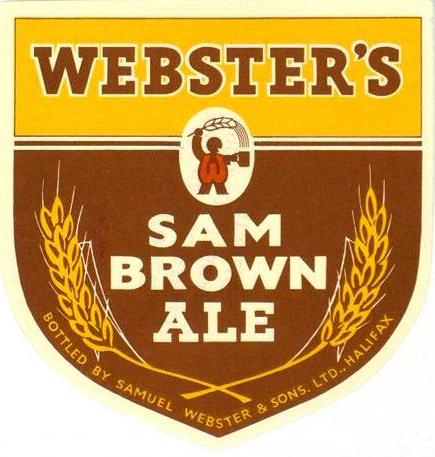
You probably want to know the brewery. It’s Samuel Webster. I drank a fair bit of their beer when I lived in Leeds.  They were based in Halifax, also in West Yorkshire, and had a tied pubs in Leeds. I can’t say it was my favourite – Tetleys was much better – but the Dark Mild was OK on cask. They were owned by Watney, but had mostly retained their identity and produced a reasonable amount of cask beer. It closed in 1996.

I can remember spending a day in Halifax in 1979. One of the Websters pubs there still had a “men only” sign above the public bar door. Even though that was illegal by then. Wonder if they still really kept women out?

“No chemicals
"Lots of people think because we employ chemists that we use chemicals." said Mr. Brown. "That is not so. We are only allowed to use certain materials. That is why beer is such good drink — nothing harmful can go into it."

The new-quality beers are being sold In "nip" size bottles containing one-third of a pint at prices varying from 1s. 4d. to 1s. 6d.

"One of the things about this beer," said Mr. Brown, "Is that it will keep longer than the ordinary beers. But we haven't brewed it to keep — we have brewed it to sell." “
Yorkshire Post and Leeds Intelligencer - Saturday 21 February 1953, page 7.

Nips seem to have the favourite package for Coronation Ales. As for the price, a pint of draught Mild would only cost you 1s in  the 1950’s. As we’ll see later.

Now it’s the turn of the head brewer to Speak:

“Mr. F. W. Bodger, the brewer there for 43 years, showed me how the gravity is varied by the malt and sugar content, and added: " This is as strong a beer as has ever been made by this company."

It had, he told me, the qualities of a barley wine and produced a warming effect on the drinker. "With this there's no back bite," he said.
Yorkshire Post and Leeds Intelligencer - Saturday 21 February 1953, page 7.

Was it really the strongest beer they’d brewed in 40 years? I suspect not. Luckily for me, Old Brown wasn’t a one off. Because they were still brewing it in 1959:

Samuel Webster beers of the 1950s
Year Beer Style Price size package FG OG ABV App. Atten-uation colour
1955 Sam Brown Ale Brown Ale 9.5d half bottled 1013 1035.7 2.93 63.59% 95
1956 Velvet Stout Stout 1/2d half bottled 1022.3 1045.1 2.93 50.55% 425
1959 Velvet Stout Stout 13d half bottled 1019.8 1040.1 2.61 50.62% 300
1959 Dukes?? Ale Pale Ale 10d half bottled 1006.8 1035.3 3.56 80.74% 19
1959 Old Brown Brown Ale 15.5d nip bottled 1023.1 1071.4 6.27 67.65% 110
1959 Velvet Stout Stout 14.5d half bottled 1019.3 1046.1 3.45 58.13% 300
1959 Old Tom Old Ale 13d half bottled 1012.5 1045.1 4.23 72.28% 150
1959 Green Label Ale Mild, Light 11.5d half bottled 1006.7 1039 4.20 82.82% 24
1959 Sam Brown Ale Brown Ale 9d half bottled 1011.1 1036.8 3.33 69.84% 95
1959 Bitter Pale Ale 16d pint draught 1004.7 1038 4.16 87.63% 22
1959 Best Mild Mild 13d pint draught 1004.4 1034.9 3.81 87.39% 20
1959 Mild Mild 12d pint draught 1005.7 1032 3.29 82.19% 50
1959 Bitter Pale Ale 15d pint draught 1005.4 1037 3.95 85.41% 20
1959 Best Mild Mild 13d pint draught 1005.9 1035 3.64 83.14% 20
1959 Mild Mild 12d pint draught 1004.8 1031.6 3.35 84.81% 55
Source:
Whitbread Gravity book held at the London Metropolitan Archives, document number LMA/4453/D/02/002.

At just a touch over 1070º, I doubt it was stronger than anything they brewed in 1914. Though they could have dropped the strength after the coronation. As you can see, at 1s 3.5d per nip, it is a little cheaper than quoted in the newspaper.

The Milds are interesting. Webster still brewed a Light and a  Dark Mild in the 1980’s. Which look direct descendants of the 1950’s Mild and Best Mild. Even the gravities are pretty similar: Dark Mild 1032º, Green Label Light Mild 1033.8º. The colours of the 1950’s Milds are interesting. It was usual for the Best Mild to pale, but the ordinary Mild isn’t that dark. Normally Dark Mild is 80 to 100 on this scale. 50 is just a bit darker than Newcastle Brown.

I think that’s me about done for Coronation Ale. Unless something else pops out of the newspaper archive.