Friday, 14 August 2015

Dutch Lager Styles 1870 - 1960 (part eleven)

WW II

The second war was even more traumatic for Dutch brewing than the first. Again the major problem was the disruption to world trade it caused, disastrous for an industry dependent on imported raw materials. The figures for beer output are deceptive, as there were successive cuts in beer gravity as the war progressed, starting in January 1941.

Heineken Lager gravities 1940 - 1942 (º Plato) 
1940 Jan 1941 Jul 1941 Aug 1941 Oct 1942
Licht Lager 9.2 7 6.5 5.5 3.9
Donker Lager 9 7 6.5 5.5 3.9
Pils 12 10 8.5 7.5 7.7
Beiersch 13 8.5 7.5 7.7
Sources:
"Het Vaderland", 16th January 1941.
Heineken brewing records held at the Amsterdam Stadsarchief, document number 834 - 1760.


Initially, Pils was reduced from 12º Balling to 10º and Lager (Light and Donker) from 9º to 7º*. By July 1941, Pils was down to 8.5º Balling and Lager 6.5º. In August 1914, Pils was 7.5º Balling and Lager 5.5º. In October 1942 Pils was 7.7º Balling and Lager a puny 3.9º Balling**.  In the last year of the war just over 1 million hectoliters of weak beer were produced.

Dutch beer output 1940 - 1945
year output (hl) year output (hl)
1940 1,764,000 1943 2,286,000
1941 2,247,000 1944 1,848,000
1942 2,076,000 1945 1,157,000
Source:
European Statistics 1750-1970 by B. R. Mitchell, 1978.


* "Het Vaderland", 16th January 1941.
** Heineken brewing records held at the Amsterdam Stadsarchief, document number 834-1760.

Thursday, 13 August 2015

Berlin

We have a leisurely start to the day. Our flight isn’t until after noon. Leaving plenty of time to make sarnies, tip the kids’ lazy arses out of bed and generally get the rusty gears of my body in motion. And to have a quick farewell St. Bernardus Abt.

Usually I’d take a bus to station Zuid then a train. But having discovered the 197 bus, Dolores wanted to take that instead. “It’s much cheaper, Ronald.” That is true. “And quicker.” Not totally sure about that. It depends on how you time it.

Security isn’t too mobbed at Schiphol. Thank god. But I still don’t have time to slip furtively up to a bar. Instead we sit sheepishly with the other sheep at the gate. At least the flight’s on time.

The flight is uneventful. Other than me struggling to keep my sandwich together. Boiled spuds and no butter isn’t a great combination. Especially when the bread’s a bit crumbly. Dolores gives me a look when the trolley comes around. A don’t-you-dare-buy-any-whisky look. As I’ve become quite attached to my grillox, I let the trolley pass me by. It chinks tauntingly on its way.


I hate buses. That’s why we’ve landed at Schönefeld, even though it’s further out of the centre than Tegel. It has a train connection to the city. Though the station is just far enough away from the terminal to be annoying. I’ve never landed here before, but I can remember speeding past (well, as speedily as Deutsche Reichsbahn trains could speed) back in what I still refer to (at least mentally) as the good old days.

We get S-Bahn tickets and jump on a train. We just have to change once to get to our destination, Warschauerstrasse. It’s quite warm. No, very warm. Too bloody warm. Which makes pulling our luggage a couple of hundred metres to our hotel great fun. We pass a Kaiser supermarket that has an encouragingly large drinks hall. I make a mental note.


We’re staying in an Ost Fresian hotel. It’s quite nice, but has no airco. Though our rooms do have fridges. Lexie suggests : “We can just leave the fridge door open all night to cool down.” “That only works in cartoons.” I reply. He still struggles with the difference between animation and reality.

As we’ve fridges, we may as well fill them. We head back to Kaiser. Lexie checks out the vintage Fanta, while I give the beer section a good look over. I ignore the Kindl Berliner Weisse and other local beers and turn my attention to the Bavarian corner. Schlenkerla Märzen and Andechs Doppelbock. That’ll do. Dolores opts for girly wine stuff. Andrew for a bizarre Bourbon and apple mix. Should put him to sleep, at least.


As always, I’ve done some interweb scouting. So I know there’s a Schwabisch pub just around the corner. With some interesting beers and reasonably priced food. It’ll save traipsing into town and save money. At least those are the – very reasonable – arguments I present to Dolores.  They must be compelling, because we’re soon sat inside Hirsch wondering what to drink.

There are around 20 bottled beers and four draught. Mostly, as you’d expect, from the Southwest of Germany. I opt for a SchlappeSeppl Kellerbier for the simple reason that I’ve never heard of it. And it’s a Kellerbier. Dolores and Andrew have Augustiner Helles (good choice). Lexie, despite being legal to drink in Germany, sticks with a soft drink. I wonder whether he’s mine, sometimes.


The food is dirt cheap. A pair of sausages and potato salad costs just over 5 euros. So cheap, we can afford to let both kids eat for a change.

Fed and beered, we head back to the hotel for a bit of a lie down. Did I mention that it’s effing hot? Luckily the Andechs I bought earlier has cooled down nicely in the fridge. A couple take the edge off the heat.

Once we’ve rested a bit, we go in search of more beer. And stumble across a little beer garden, Jägerklause, a few corners away. It’s a little rough at the edges but bustling. Everywhere you look are tattoos and beards. Though the female guests mostly only have the former.


“There’s a fiver for the first person you spot without a tattoo,” I tell the kids, “and children don’t count.”

It’s pretty dark. But Lexie is illuminated by the brainsucker he’s fiddling with. I choose something dark to fit with the lighting. And because I usually swing to the Dark Side.

We stay about an hour. Only time for five pints. Just as well there’s some more Andechs cooling in the hotel fridge.

Tomorrow I do my one geeky thing of the trip. What could that be?


Hirsch
Kopernikusstraße 3,
10243 Berlin.
Tel.: 030 29663296
http://www.hirsch-friedrichshain.de/


Jägerklause
Grünberger Str. 1
10243 Berlin
http://www.jaegerklause-berlin.de/

Wednesday, 12 August 2015

Let's Brew Wednesday - 1955 Flowers PX

You may be starting to detect a slight 1950’s theme going on in this series. There’s a reason for that. Though I’m not going to tell you it. I don’t want to ruin the mystery.

This beer comes from another brewery lucky enough to have been bought my Whitbread. Lucky for me, that is. Because they were very good at retaining all sorts of documents from those they took over. Including brewing records.

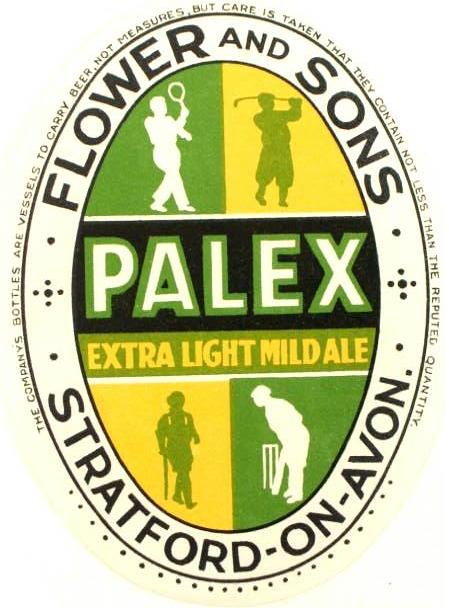
Let’s begin with the name. I’d probably be scratching my head trying to work out what the hell PX stood for – and coming up with all sorts of wild guesses – if I hadn’t seen adverts and labels for Flowers Palex. Which is obviously this beer. It had a darker sibling, which we’ll be getting to later, called Brownex.

Should you ask what style this was, I’d say Light Ale. Though the label says "Extra Light Mild Ale". And they also had a beer called LA, which I’m guessing stood for Light Ale. The gravity of the two was just a few percentage points different and the recipes identical. Seems like a bit of a waste of time.

I’m not going to claim that the recipe is particularly exciting. Basically, it’s just pale malt and No. 1 invert sugar. With a touch of wheat malt and malt extract. Not quite sure why the latter was so popular after WW II. Was it an attempt to make up for the lack of American malt with its higher diastatic power? I assume the wheat is there to improve head retention. At under 4% of the total grist it couldn’t have impacted the flavour much.

Flowers used the dropping system of fermentation. At least there’s a row called “dropped to” in the records. No more detail, than that, sadly. Not even the date and time of dropping. Though I guess no-one is likely to try to recreate that at home. It seems to have been a common method in the South. While in the Midlands and North Yorkshire squares were popular. Something even harder to recreate in your garage.

The FG is on the high side, leaving the finished beer under 3% ABV. This appears to have been deliberate as it’s similar in both examples I have. And the LA parti-gyled with this one had a longer fermentation and significantly lower FG.

The colour calculated from the ingredients came out slightly lower than the one quoted in the log, meaning there was probably some sort of colour correction with caramel. But the difference is so small – 4 SRM rather than 5.5 – that there doesn’t seem much point bothering with it on a homebrew level. It looks to me as if they deliberately aimed a little low so they could always hit the exact same shade. You can raise the colour easily enough but you try lowering it.

In such a light beer, those 27 IBUs will seem like more. Though the relatively high FG should leave it with a little body.


Time to turn you over to me for the recipe . . . . .


1955 Flowers PX
pale malt 5.25 lb 82.35%
wheat malt 0.25 lb 3.92%
no. 1 invert sugar 0.75 lb 11.76%
malt extract 0.13 lb 1.96%
Fuggles 90 min 0.75 oz
Fuggles 60 min 0.50 oz
Goldings 30 min 0.50 oz
Goldings dry hop 0.25 oz
OG 1030.3
FG 1011.5
ABV 2.49
Apparent attenuation 62.05%
IBU 27
SRM 5.5
Mash at 153º F
Sparge at 170º F
Boil time 90 minutes
pitching temp 60º F
Yeast WLP007 Dry English Ale

Tuesday, 11 August 2015

Bottled Stout in the 1950's - Standard Stouts >70% attenuation

You’d best get settled in because this is going to take a while. I’ve made up a whole load of Stout categories and I’ll be slowly crawling through them over the next weeks. Not sure exactly why I’m doing this, other than that I’ve started and I’d like to finish.

I suppose it’s all part of one of my current grand schemes. A close look at British beer and brewing in the period 1945 to 1960. With a particular emphasis of bottled beer and bottling. I know. Really dull stuff. But I see that as a challenge. And if worried about alienating readers, I’d never write anything I really want to.

I’ve arranged the beers in descending order of attenuation. You can see that not only is Guinness Extra Stout No. 1, it also occupies 9 of the top 20  positions. But there’s a fair spread amongst the Guinness examples, from 80.13% to 93.95% apparent attenuation. There are 13 examples from other breweries with a higher degree of attenuation of the least attenuated version of Guinness.

There are several beers that look quite similar to Guinness: Massey, Matthew Brown, Magee Marshall, Chesters, Holts and M & B. Though some do have a lower OG. All but M & B are from the Northwest of England. Is that a coincidence, or were drier Stouts more popular in that part of the country?

Looking more closely, there are almost no Southern breweries in the list. Just these ones: Watney, Hunt Edmunds, Starkey, Knight & Ford, Shrewesbury & Wem, Truman and Flowers. And most of those are towards the bottom end of the list. Not sure what that tells us, but I find it interesting.

Judging by its price, Guinness was a premium product. The average price per pint of the whole set is  26.2d. For Guinness it’s 30.5. But that makes sense, if you think about it. Two breweries – Guinness and the bottling/reselling brewery – both needed to make a profit from it.

I was surprised to see a beer described as a Sweet Stout (Chesters) in this set and one containing lactose (Hydes). Especially as the latter had a 75% rate of attenuation. There can’t have been that much lactose added or the FG would be higher.

I originally had two examples of Mackeson in this set. But I removed them because I’d taken the details from brewing records and they were for the beer as brewed, before the addition of lactose at the end of primary fermentation.

Bottled Stout in the 1950's - Standard Stouts >70% attenuation
Year Brewer Beer Price size Acidity OG FG ABV App. Atten-uation colour
1953 Guinness Extra Stout 1/- nip 0.18 1046.3 1002.8 5.70 93.95% 1 + 8
1959 Massey Prize Stout 12.5d halfpint 1040.8 1004.2 4.78 89.71% 475
1959 Matthew Brown Lion Oatmeal Stout 13d halfpint 1040.4 1005.2 4.59 87.13% 150
1954 Guinness Extra Stout 1/3.5d half pint 0.05 1047.5 1006.6 5.34 86.11% 200
1954 Magee Marshall Extra Stout 11d half pint 0.04 1043.5 1006.4 4.84 85.29% 200
1954 Guinness Extra Stout 1/2d half pint 0.05 1047.4 1007.1 5.26 85.02% 1 + 13
1954 Chester Brewery Extra Stout 1/- half pint 0.11 1042.7 1006.5 4.72 84.78% 250
1951 Guinness Extra Stout 1/3d half pint 0.05 1049.1 1007.5 5.43 84.73% 1 + 8
1952 Guinness Extra Stout 1/2d half pint 0.07 1047.4 1007.5 5.20 84.18% 1 + 8
1957 Matthew Brown Lion Oatmeal Stout 1/- half pint 0.09 1041.4 1006.7 4.52 83.82% 250
1959 Holt, Joseph Brown Stout 13.5d halfpint 1045.2 1007.5 4.91 83.41% 325
1953 Mitchell & Butler Extra Stout 1/- half pint 0.05 1049 1008.2 5.32 83.27% 1 + 11
1951 Guinness Extra Stout 1/3.5d half pint 0.08 1047.7 1008.1 5.16 83.02% 1 + 8.5
1952 Bent's Brewery Imperial Stone Stout 11.5d half pint 0.07 1041.3 1007.1 4.45 82.81% 1R + 8B
1951 Mitchell & Butler Nourishing Stout 1/5d pint 0.04 1042.8 1007.4 4.61 82.71% 1 + 10
1951 Mitchell & Butler Nourishing Stout 1/6d pint 0.07 1042.1 1007.3 4.53 82.66% 1 + 12
1950 Guinness Extra Stout 1/11d pint 0.06 1048.6 1008.6 5.21 82.30% 1 + 8
1957 Guinness Extra Stout 1/5d half pint 0.05 1047.3 1008.6 5.04 81.82% 150
1953 Guinness Extra Stout 1/3.5d half pint 0.05 1047.4 1008.7 5.04 81.65% 1 + 11
1959 Hey's White Rose Stout 14d halfpint 1046.6 1008.7 4.94 81.33% 325
1951 Mitchell & Butler Extra Stout 10.5d half pint 0.04 1048 1009 5.08 81.25% 1 + 9
1952 Matthew Brown Oatmeal Stout 11.5d half pint 0.07 1041.1 1007.8 4.33 81.02% 1 + 11
1959 Robinson Unicorn Black Stout 14.5d halfpint 1041.8 1008.1 4.38 80.62% 240
1954 Watney Reids Special Stout 12.5d half pint 0.04 1043.3 1008.5 4.53 80.37% 1 + 15
1951 Courage Sturdy Extra Stout 12d half pint 0.05 1043.6 1008.6 4.55 80.28%
1958 Guinness Extra Stout 1/4.5d half pint 0.07 1046.3 1009.2 4.83 80.13% 200
1951 Watney Special Stout 12d half pint 0.06 1045.3 1009.1 4.71 79.91% 1 + 12
1959 Hewitt Bros. Oatmeal Stout 10d halfpint 1042.3 1008.8 4.36 79.20% 300
1954 JW Lees Archer Stout 1/- half pint 0.06 1040.7 1008.5 4.19 79.12% 225
1950 Watney Reids Special Stout 12d half pint 0.06 1045.9 1009.6 4.72 79.08% 1 + 11
1953 Mitchell & Butler Extra Stout 1/- half pint 0.05 1046.2 1009.8 4.74 78.79% 21 B
1950 Watney Reids Stout 17d pint 0.06 1042.9 1009.1 4.39 78.79% 1 + 10
1953 Camerons Sovereign Stout 1/1d half pint 0.05 1044.3 1009.6 4.51 78.33% 1R + 17B
1957 Watney Special Stout 13d half pint 0.05 1042.3 1009.4 4.28 77.78% 200
1951 Hancocks 77 Export Stout 1/2d half pint 0.06 1045.9 1010.3 4.63 77.56% 1 + 12
1954 Mitchell & Butler Extra Stout 1/- half pint 0.05 1049 1011.2 4.92 77.14% 1 + 14
1951 JW Lees Archer Stout 1/1d half pint 0.14 1041.7 1009.6 4.17 76.98%
1952 Leicester Brewing & Malting Milk Stout 1/2.5d half pint 0.17 1044.2 1010.2 4.42 76.92% 1 + 15.5
1959 Threlfalls Extra Stout 13d halfpint 1044.4 1010.5 4.40 76.35% 175
1951 JW Lees Archer Stout 1/1d half pint 0.06 1040 1009.5 3.96 76.25%
1953 Stroud Brewery Cottswold Stout 1/- half pint 0.06 1043.3 1010.4 4.27 75.98% 1R + 14B
1959 Lion Brewery Lion Prize Stout 14d half pint 0.06 1046.3 1011.3 4.38 75.59% 175
1954 Threlfalls Extra Stout 1/1d half pint 0.04 1046.9 1011.5 4.60 75.48% 225
1954 Hydes Special Stout (Lactose present) 1/1d half pint 0.04 1043.2 1010.9 4.19 74.77% 225
1952 Nimmo Nimmo's Stout 1/- half pint 0.05 1045 1011.4 4.36 74.67% 1R + 7B
1952 Mardens Mylki Extra Stout 1/3d half pint 0.06 1043.9 1011.2 4.24 74.49% 1R + 1 B
1957 Watney Reids Special Stout 18d half pint 0.06 1045.2 1011.8 4.33 73.89% 225
1959 Hunt Edmunds Country Stout 12d halfpint 1043.3 1011.7 4.10 72.98% 225
1952 Marston Extra Stout 1/3d half pint 0.06 1042.1 1011.4 3.98 72.92% 1R+13.5B
1952 Greenall Whitley Wilderspool Extra Stout 1/1d half pint 0.07 1040.4 1011 3.81 72.77% 1 R + 9 B
1959 Ardwick Brewery Chesters Special Sweet Stout 15d halfpint 0.04 1045.5 1012.5 4.28 72.53% 200
1954 Mardens Mylki Stout 1/2d half pint 0.04 1043.1 1012 4.03 72.16% 250
1950 Stone, Wm. Samson Stout 1/- half pint 0.07 1043.1 1012.1 4.02 71.90% 1 + 18
1952 Shrewesbury & Wem Extra Stout 1/2d half pint 0.08 1041 1011.8 3.78 71.22% 1R + 18B
1950 Truman Black Ben Stout 14.5d half pint 0.07 1048.8 1014.2 4.49 70.90% 1 + 9
1950 Truman Black Ben Stout 14.5d half pint 0.07 1049 1014.3 4.50 70.82% 1 + 10
1953 Starkey, Knight & Ford Super Stout 1/2d half pint 0.04 1045.9 1013.4 4.21 70.81% 1 + 16
1954 Flowers Table Stout 0.07 1046.4 1013.6 4.25 70.69% 350
1959 Chesters Special Sweet Stout 14d halfpint 1044.6 1013.2 4.07 70.40% 200
1954 Thwaites Cream Stout 1/1d half pint 0.04 1044.3 1013.2 4.03 70.20% 200
1959 Cornbrook Brewery Barley Stout 12.5d halfpint 1046.3 1013.8 4.21 70.19% 250
1953 Worthington XX Stout 1/- half pint 0.05 1040 1012 3.63 70.00% 1R + 16B
Source:
Whitbread Gravity book held at the London Metropolitan Archives, document number LMA/4453/D/02/001.


What’s next? Standard-strength Stouts with not such good attenuation.

Monday, 10 August 2015

1990 Schlotheim and Leinefelde pub guide

If you though the last installments of this guide were useless, this one is even more so. As it covers a couple of small places you're almost certainly never going to get within 50 km. of. Why the hell have I been to Leinefelde? Dolores grew up there.


Schlotheim
Fifteen kilometers north-east of Mühlhausen, reached either by road or a single-track branch line, is the small town of Schlotheim. Again, the impatient ones amongst you can refresh themselves on the way in the village of Korner, which has a Gaststatte in an attractive old detached building.

In Schlotheim itself is the Schloß Gaststatte (10-22; Fri, Sat 10-24; Mon closed), a baroque palace dating from 1772 which has been converted into a community centre. The palace was built on the foundations of an older, fortified castle, of which you can see traces, and is still surrounded by a dry moat. One section of the building is used as a restaurant, containing three diversely and surprisingly pleasantly decorated rooms. The first, the Bauernstube (farmer's room) is in rustic style with plain wooden furniture. The second is more like a standard restaurant. The third, the Spiegelzimmer (mirror room), is in a palatial baroque style with ornate furniture, chandeliers and, of course, whole walls of mirrors. All in all, the conversion has been very well done, making it stylish and interesting, without being at all intimidating. It's used mostly by locals and is surprisingly uncrowded. Try to visit before the W. Germans discover it and spoil all of that.


Leinefelde
30 km north of Muhlhausen, on the edge of the Eichsfeld, an exposed and intemperate hilly area, is Leinefelde. Formerly a large village, it became a town in 1969 with the development of a local textile industry. The town reflects this, having a relatively small centre of typically Thuringian houses, surrounded by large estates of mid-rise flats.

On the main street, at the opposite end of town to the railway station, is the Eichsfelder Hof (10 - 23; Sun closed). Housed in a large detached building next to the Catholic church (the Eichsfeld is one of the few Roman Catholic areas of the DDR), its expansive interior contains numerous rooms. Downstairs are a basic taproom in the Czech plain pine style and a more comfortable restaurant. Upstairs are various function rooms. Usually available are draught Neunspringe Pils and bottled Braugold Angerbrau Pils. Draught Wernesgruner Pils has also been known to make an appearance here, but you'll have to be on particularly good terms with the waiter to get a taste of it, as it's kept for the regulars.

On the Centraler Platz, a modern shopping precinct that immediately conjures up images of Hounslow, Peterlee, or Corby, is the inspiringly-named Stadt Leinefelde restaurant (10 - 18; Sat, Sun closed). From the outside it looks like a 60's community centre, but once inside this image is immediately dispelled - it's more like a school assembly hall set out with tables for an examination. Large, modern - in the most depressing architectural meaning of the word - and spartan, it's not outwardly the most welcoming place to go for a meal. However the food is good and cheap and the service excellent, as this is where trainee catering staff receive their practical experience. The beer, Braugold Pils, is also top class.


One of the pubs mentioned is still open. The Place my father-in-law used to work:


Eichsfelder Hof
Heiligenstädter Str. 1,
37327 Leinefelde-Worbis.
Tel: +49 3605 512329

Sunday, 9 August 2015

Dutch Lager Styles 1870 - 1960 (part ten)

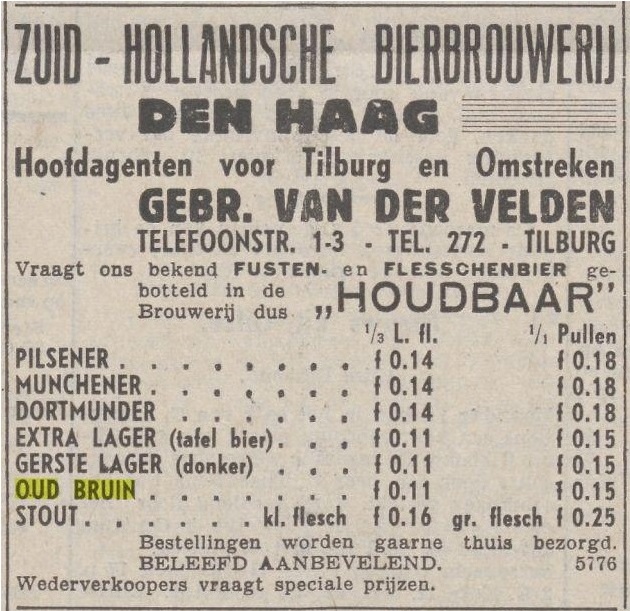
ZHB beers in 1937


Nieuwe Tilburgsche Courant, 27th October 1937, page 4.

Brewed some different styles to Heineken: Oud Bruin, Stout and Dortmunder. But most were the same: Pilsener, Munchener, Extra Lager (the equivalent of Heinken’s Licht Lager) and Gerste Lager (equivalent to Heineken’s Donker Lager). It looks like all but the Stout were in two strength bands: 12º and 9º Plato. The Stout was probably 16.5º Plato.

Märzen
In the 1930’s there was a plan to introduce Märzen as a Spring seasonal. Tax increases in 1935 put the project on hold, but it was revived in 1939. The original idea had been for a beer with a gravity of around 16º Plato with a “Vienna colour” which would be available for a short time in the spring, possibly May.

When the idea was revived in early 1939, it was intended to release the beer just before Easter to help boost sales. The first date set was 24th March 1940. The price to be the same as for Bokbier, 40 guilders per hl, which implies a gravity of around 16º Plato.  It was to be pale in colour. In the first year, Bond van Nederlandsche Brouwerijen reckoned its members would sell around 5,000 hl each, a little less than the 6,000 – 7,000 hl they each sold of Bokbier.


Meibier
It was defined by Bond van Nederlandsche Brouwerijen as a beer of 15.5 – 16.5º Plato, colour 3-6 on Brandt’s colour scale, 40 guilders per hectoliter. It was produced by members in 1939, but was dropped in 1940 because of poor sales in 1939.  It looks like a forerunner of modern Dutch Meibok.