Thursday, 28 June 2012

Fullers Pale Ales 1914 - 1920

Time for part two of my series on Fuller's beers during WW I. And yes, it is their Pale Ales. All three of them.

Funnily enough, Fullers started the war with only two, PA and one of my favourite obsessions, AK. As you can see, there was quite a gap in gravity between the two, with PA at 1054º and AK at 1044º. In the late 19th century they had made four Pale Ales. In descending order of strength IPA, XK, AK and KA. Sometime between 1902 and 1910 IPA was renamed PA and XK and KA were phased out.

At the outbreak of war, AK was the lowest-gravity beer Fullers brewed, 5 points lower than X Ale and 1 lower than Porter. As with X Ale a few points were knocked off the gravity in the early war years, but the biggest changes were in April 1917 and April 1918. First reducing the gravity to around 1036º and then to 1026º. After April 1917, its gravity was pretty much identical to X Ale, even though before the war it had been lower. By 1920 both X Ale and AK were around 1030.

In a similar way to the introduction of XX Ale, in 1919 a slightly stronger Pale Ale called XK was introduced. And while AK remained around 1030º, XK had risen to the dizzying height of 1037º by 1920. AK limped along through the 1920's and 1930's, being brewed in quantities so small that you wonder why they bothered. Sometimes it was as little as two barrels. Too small for any of the normal fermenters as it was fermented in puncheons. It disappeared for good early in WW II (unless I can persuade Fullers to brew it as a Past Masters beer).

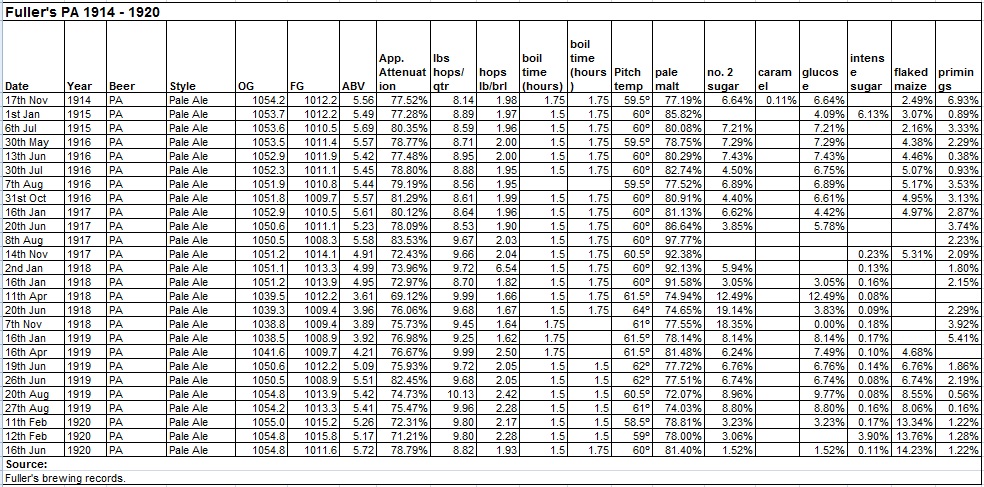
PA came through the war almost unscathed. It was over 1050º right up until April 1918. No mean feat, that. What it looks as if they did was to drive down the gravity of AK as far as possible so that they could keep up the strength of PA. In 1918 the average gravity of all beer produced in a brewery had to average no more than 1030º. To be able to brew PA in the high 1030's there had to be a considerable amount of beer with a gravity well below 1030º. Even in early 1919, it was still around 1039º - a very respectable strength for that time. And by the end of the year it was back up to its pre-war strength.

Now let's look at the recipe. I won't say recipes, because all of the Pale Ales were parti-gyled together. The flaked maize disappeared, too. The pre-war recipe was pretty typical: pale malt, sugar and flaked maize. If you've been paying attention you'll remember that crystal malt was rarely found in a Pale Ale before WW I. Fullers first used it in theirs some time between 1962 and 1968.

As with X Ale, there was a big change in the recipe in 1917, presumably as a result of difficulties in obtaining ingredients. For a while they were all malt, except for the primings. In 1920, the same main ingredients were being used as pre-war, but in different proportions. Pale malt remained at 78% to 80%, but the amount of flaked maize had more than doubled at the expense of No. 2 invert sugar and glucose.

Fullers were big fans of glucose. Between the wars all their beers except Porter and Stout contained it. Of course, that includes OBE. Which is how come I got to taste glucose. They'd bought some in for the Past Masters brew of OBE. It's a very different beast to invert sugar. While No. 2 and No. 3 invert have lots of dark fruit flavours glucose is just, well, sugary. Straight sweetness without much anything else.


Fuller's AK 1914 - 1920
Date Year Beer Style OG FG ABV App. Attenuation lbs hops/ qtr hops lb/brl boil time (hours) boil time (hours) Pitch temp pale malt no. 2 sugar glucose intense sugar flaked maize primings
20th Nov 1914 AK Pale Ale 1044.3 1009.1 4.65 79.38% 7.33 1.34 1.5 1.75 60.5º 78.89% 5.84% 5.84% 0.17% 5.84% 3.40%
8th Dec 1914 AK Pale Ale 1044.1 1009.4 4.58 78.63% 7.35 1.36 1.5 1.75 58.5º 81.38%
5.56% 5.56% 6.26% 1.23%
2nd Jul 1915 AK Pale Ale 1044.5 1009.7 4.61 78.22% 7.84 1.42 1.5 1.75 59.5º 78.96% 6.68% 6.68%
6.27% 1.40%
1st Jun 1916 AK Pale Ale 1043.9 1009.7 4.53 77.93% 8.20 1.54 1.5 1.75 60º 79.27% 6.61% 6.61%
4.95% 2.56%
3rd Aug 1916 AK Pale Ale 1042.7 1008.9 4.47 79.23% 8.13 1.46 1.5 1.75 60º 82.40% 4.85% 4.85%
4.85% 3.06%
26th Oct 1916 AK Pale Ale 1041.0 1006.6 4.54 83.78% 8.44 1.43 1.5 1.75 59.5º 80.05% 6.47% 8.09%
4.85% 0.55%
3rd Nov 1916 AK Pale Ale 1041.7 1005.8 4.74 86.04% 8.18 1.46 1.5 1.75 60º 80.16% 5.73% 5.73%
5.73% 2.67%
12th Jan 1917 AK Pale Ale 1041.8 1007.8 4.50 81.44% 8.17 1.40 1.5 1.75 59º 80.82% 5.26% 5.26%
5.91% 2.76%
19th Jan 1917 AK Pale Ale 1040.7 1007.5 4.40 81.63% 8.48 1.44 1.5 1.75 59º 82.98% 5.40% 5.40%
6.07% 0.16%
13th Apr 1917 AK Pale Ale 1041.5 1008.3 4.39 79.99% 8.49 1.41 1.5 1.75 59.5º 83.03% 5.40% 5.40%
6.08% 0.10%
20th Jun 1917 AK Pale Ale 1038.6 1006.4 4.27 83.51% 8.53 1.45 1.5 1.75 60º 86.64% 3.85% 5.78%

3.74%
8th Aug 1917 AK Pale Ale 1035.4 1006.4 3.84 82.00% 9.67 1.43 1.5 1.75 60º 97.77%


2.23%
1st Nov 1917 AK Pale Ale 1035.9 1007.8 3.73 78.41% 9.64 1.47 2
60º 92.36%

0.17% 5.23% 2.25%
14th Nov 1917 AK Pale Ale 1036.1 1008.3 3.68 76.98% 9.66 1.43 1.5 1.75 60º 92.38%

0.23% 5.31% 2.09%
2nd Jan 1918 AK Pale Ale 1035.5 1007.5 3.70 78.92% 9.72 2.24 1.5 1.75 60º 92.13% 5.94%
0.13%
1.80%
16th Jan 1918 AK Pale Ale 1036.1 1011.1 3.32 69.35% 8.70 1.28 1.5 1.75 60º 91.58% 3.05% 3.05% 0.16%
2.15%
11th Apr 1918 AK Pale Ale 1026.1 1005.5 2.73 78.81% 9.99 1.10 1.5 1.75 60.5º 74.94% 12.49% 12.49% 0.08%

20th Jun 1918 AK Pale Ale 1026.2 1005.5 2.73 78.84% 9.68 1.11 1.5 1.75 60º 74.65% 19.14% 3.83% 0.09%
2.29%
7th Nov 1918 AK Pale Ale 1025.7 1005.0 2.74 80.60% 9.45 1.09 1.75
60º 77.55% 18.35%
0.18%
3.92%
16th Jan 1919 AK Pale Ale 1026.1 1006.1 2.64 76.62% 9.25 1.10 1.75
60.5º 78.14% 8.14% 8.14% 0.17%
5.41%
15th Apr 1919 AK Pale Ale 1026.0 1004.4 2.86 82.98% 9.04 1.08 1.75
61.5º 74.21% 6.06% 8.08% 0.26% 4.54% 6.85%
19th Jun 1919 AK Pale Ale 1028.2 1004.7 3.10 83.28% 9.72 1.14 1.5 1.5 62º 77.72% 6.76% 6.76% 0.14% 6.76% 1.86%
25th Jun 1919 AK Pale Ale 1028.0 1005.3 3.01 81.21% 9.72 1.16 1.75
61.5º 78.01% 8.00% 6.00% 0.27% 6.00% 1.72%
27th Aug 1919 AK Pale Ale 1030.5 1006.9 3.12 77.31% 9.96 1.28 1.5 1.5 60º 74.03% 8.80% 8.80% 0.16% 8.06% 0.16%
11th Feb 1920 AK Pale Ale 1030.6 1007.5 3.06 75.59% 9.80 1.21 1.5 1.5 62º 78.81% 3.23% 3.23% 0.17% 13.34% 1.22%
Source:
Fuller's brewing records.

 
Fuller's PA 1914 - 1920
Date Year Beer Style OG FG ABV App. Attenuation lbs hops/ qtr hops lb/brl boil time (hours) boil time (hours) Pitch temp pale malt no. 2 sugar caramel glucose intense sugar flaked maize primings
17th Nov 1914 PA Pale Ale 1054.2 1012.2 5.56 77.52% 8.14 1.98 1.75 1.75 59.5º 77.19% 6.64% 0.11% 6.64%
2.49% 6.93%
1st Jan 1915 PA Pale Ale 1053.7 1012.2 5.49 77.28% 8.89 1.97 1.5 1.75 60º 85.82%

4.09% 6.13% 3.07% 0.89%
6th Jul 1915 PA Pale Ale 1053.6 1010.5 5.69 80.35% 8.59 1.96 1.5 1.75 60º 80.08% 7.21%
7.21%
2.16% 3.33%
30th May 1916 PA Pale Ale 1053.5 1011.4 5.57 78.77% 8.71 2.00 1.5 1.75 59.5º 78.75% 7.29%
7.29%
4.38% 2.29%
13th Jun 1916 PA Pale Ale 1052.9 1011.9 5.42 77.48% 8.95 2.00 1.5 1.75 60º 80.29% 7.43%
7.43%
4.46% 0.38%
30th Jul 1916 PA Pale Ale 1052.3 1011.1 5.45 78.80% 8.88 1.95 1.5 1.75 60º 82.74% 4.50%
6.75%
5.07% 0.93%
7th Aug 1916 PA Pale Ale 1051.9 1010.8 5.44 79.19% 8.56 1.95

59.5º 77.52% 6.89%
6.89%
5.17% 3.53%
31st Oct 1916 PA Pale Ale 1051.8 1009.7 5.57 81.29% 8.61 1.99 1.5 1.75 60º 80.91% 4.40%
6.61%
4.95% 3.13%
16th Jan 1917 PA Pale Ale 1052.9 1010.5 5.61 80.12% 8.64 1.96 1.5 1.75 60º 81.13% 6.62%
4.42%
4.97% 2.87%
20th Jun 1917 PA Pale Ale 1050.6 1011.1 5.23 78.09% 8.53 1.90 1.5 1.75 60º 86.64% 3.85%
5.78%

3.74%
8th Aug 1917 PA Pale Ale 1050.5 1008.3 5.58 83.53% 9.67 2.03 1.5 1.75 60º 97.77%


2.23%
14th Nov 1917 PA Pale Ale 1051.2 1014.1 4.91 72.43% 9.66 2.04 1.5 1.75 60.5º 92.38%


0.23% 5.31% 2.09%
2nd Jan 1918 PA Pale Ale 1051.1 1013.3 4.99 73.96% 9.72 6.54 1.5 1.75 60º 92.13% 5.94%

0.13%
1.80%
16th Jan 1918 PA Pale Ale 1051.2 1013.9 4.95 72.97% 8.70 1.82 1.5 1.75 60º 91.58% 3.05%
3.05% 0.16%
2.15%
11th Apr 1918 PA Pale Ale 1039.5 1012.2 3.61 69.12% 9.99 1.66 1.5 1.75 61.5º 74.94% 12.49%
12.49% 0.08%

20th Jun 1918 PA Pale Ale 1039.3 1009.4 3.96 76.06% 9.68 1.67 1.5 1.75 64º 74.65% 19.14%
3.83% 0.09%
2.29%
7th Nov 1918 PA Pale Ale 1038.8 1009.4 3.89 75.73% 9.45 1.64 1.75
61º 77.55% 18.35%
0.00% 0.18%
3.92%
16th Jan 1919 PA Pale Ale 1038.5 1008.9 3.92 76.98% 9.25 1.62 1.75
61.5º 78.14% 8.14%
8.14% 0.17%
5.41%
16th Apr 1919 PA Pale Ale 1041.6 1009.7 4.21 76.67% 9.99 2.50 1.75
61.5º 81.48% 6.24%
7.49% 0.10% 4.68%
19th Jun 1919 PA Pale Ale 1050.6 1012.2 5.09 75.93% 9.72 2.05 1.5 1.5 62º 77.72% 6.76%
6.76% 0.14% 6.76% 1.86%
26th Jun 1919 PA Pale Ale 1050.5 1008.9 5.51 82.45% 9.68 2.05 1.5 1.5 62º 77.51% 6.74%
6.74% 0.08% 6.74% 2.19%
20th Aug 1919 PA Pale Ale 1054.8 1013.9 5.42 74.73% 10.13 2.42 1.5 1.5 60.5º 72.07% 8.96%
9.77% 0.08% 8.55% 0.56%
27th Aug 1919 PA Pale Ale 1054.2 1013.3 5.41 75.47% 9.96 2.28 1.5 1.5 61º 74.03% 8.80%
8.80% 0.16% 8.06% 0.16%
11th Feb 1920 PA Pale Ale 1055.0 1015.2 5.26 72.31% 9.80 2.17 1.5 1.5 58.5º 78.81% 3.23%
3.23% 0.17% 13.34% 1.22%
12th Feb 1920 PA Pale Ale 1054.8 1015.8 5.17 71.21% 9.80 2.28 1.5 1.5 59º 78.00% 3.06%

3.90% 13.76% 1.28%
16th Jun 1920 PA Pale Ale 1054.8 1011.6 5.72 78.79% 8.82 1.93 1.5 1.75 60º 81.40% 1.52%
1.52% 0.11% 14.23% 1.22%
Source:
Fuller's brewing records.


Fuller's XK 1919 - 1920
Date Year Beer Style OG FG ABV App. Attenuation lbs hops/ qtr hops lb/brl boil time (hours) boil time (hours) Pitch temp pale malt no. 2 sugar glucose other sugar flaked maize primings
15th Apr 1919 XK Pale Ale 1028.3 1005.5 3.00 80.39% 9.04 1.17 1.75
60º 74.21% 6.06% 8.08% 0.26% 4.54% 6.85%
19th Jun 1919 XK Pale Ale 1030.2 1005.5 3.27 81.67% 9.72 1.22 1.5 1.5 62º 77.72% 6.76% 6.76% 0.14% 6.76% 1.86%
25th Jun 1919 XK Pale Ale 1030.2 1006.1 3.19 79.84% 9.72 1.25 1.75
61.5º 78.01% 8.00% 6.00% 0.27% 6.00% 1.72%
27th Aug 1919 XK Pale Ale 1033.8 1010.2 3.11 69.67% 9.96 1.42 1.5 1.5 61º 74.03% 8.80% 8.80% 0.16% 8.06% 0.16%
11th Feb 1920 XK Pale Ale 1034.0 1008.6 3.36 74.74% 9.80 1.34 1.5 1.5 64º 78.81% 3.23% 3.23% 0.17% 13.34% 1.22%
16th Jun 1920 XK Pale Ale 1036.8 1006.6 3.98 81.91% 8.82 1.29 1.5 1.75 62.5º 81.40% 1.52% 1.52% 0.11% 14.23% 1.22%
Source:
Fuller's brewing records.


That's it for this time. Next it definitely is Porter and Stout.

Wednesday, 27 June 2012

Let's Brew Wednesday - 1948 Portsmouth and Brighton United Breweries Pompey Royal

Bit of a long title this time. As you can see from the label, the brewery themselves branded it just United.

First a word of thanks. This recipes isn't based on a record that I excavated with my own bare hands from the archives. Someone else did the mining work this time. David at Quaffer. This is turning out to be an easy day for me, because he's also written about the history of Pompey Royal. I'm feeling all superfluous.

Looking at the label, you'll notice that the brewery described this beer as a Golden Ale. What a modern term. One I'd have associated with just the last 20 years. But, as I've often told you before, there's very little that's genuinely new in the beer world.

Don't expect me to come up with any specific style for this. Strong Ale will do for me. Nice and vague.

The modern version of Pompey Royal doesn't have much in common with this. More a strongish Pale Ale. It's also moved around several breweries of the former Whitbread group over the years.

1948 is an odd date to introduce a strong beer. Average gravity was it its nadir in 1947 and 1948, under 1033º. While it crept back up a little, but got stuck at 1037º in 1951 and stayed there until 1993. The late 1940's were a pretty grim time in Britain. Shortages, rationing, smashed up cities and the camaraderie of the war years fading. I'm glad I didn't grow up then.

I've put the sexiest numbers from the period into a little table for you:


British beer 1946 - 1947
UK 1946 1947 1948 1949 1950
Production (bulk barrels) 32,650,200 29,261,398 30,408,634 26,990,144 26,513,997
Exports (bulk barrels) 187,418 109,680 205,098 254,147 221,210
Exports (standard barrels) 150,099 85,660 179,120 226,215
Imports (bulk barrels) 929,028 860,161 863,855 875,548 1,018,603
Average OG 1034.72 1032.59 1032.66 1033.43 1033.88
Net excise receipts (pounds) 295,305,369 250,350,829 264,112,043 294,678,035 263,088,673
Source:
Brewers' Almanack 1955, pages 50 and  57.

In case you're wondering about the beer imports, that's pretty much all Guinness from the Irish Republic. Bugger all from anywhere else.


Like I said, most of my work has been done for me today.  That's me done. I think I can see Kristen just coming around the corner  . . . . . yes, there he is . . . . .


Kristen’s Version:
Notes: This one has been around since the forties but has changed quite a bit. This version is much higher in everything than the current one brewed by Oakleaf. They used the same pale malt from two different lots so feel free to use a single malt or two. Maris otter and golden promise would work lovely here. You’ll also notice the malt extract. They used a mix of EDME and Fiona diastatic malt extracts they added to the mash tun to help the mash along. For us, we don’t need the enzymes but I would suggest something amber in color. You can completely replace it with more malt if you’d like. Shouldn’t make a difference at the low levels you see. The hops were pretty much all Kentish Goldings, all very fresh, with a butte loade going into the dry hop.

Tuesday, 26 June 2012

My hols

Just back from Germany. Eleven days of drinking that liquidy stuff with the foam on top. And that alcoholly thing going on. Beer, that's the word.

A series of posts, recounting in tedious detail every last beer and impulse schnapps a poured into my poor tormented body, were planned. I even took notes.

But there's been a technical hitch. I hadn't screwed on the top of that bottle of impulse Obstler I grabbed in Salzburg station before getting on the train to Munich. I noticed the stain when I put my bag on the seat in Weisses Brauhaus. Then the smell. The heart-wrenching smell of spilled alcohol. I sobbed quietly through two beers.

Giving me an eau de pisshead air wasn't the only downside of my top-attachment laxity.

I'm an old-fasioned sort of chav. I wear spats, drink laudanum and have an aspidistra in my front window. Before every expedition into the Urwald of Lager, I prepare a printed guide. All the information -  pub adresses, maps, bus timetable - in one place. The spaces inbetween I use for notes. None of this ticky-tacky digital shit for me.

I wouldn't put valuable information on a phone or tablet. Especially not when I'm hanging around in pubs. Too likely to get lost, broken, stolen, drenched in beer. Good old-fashioned paper is far safer. What can happen to that? No-one's going to nick it. And it can't get broken.

Not unless you drench it in schnapps.

I'll be working from memory. Poor fallible, distorted, fading memory.

Another brewery fire

I'm starting to believe that just about every brewery has been ravaged by fire at some point. And that's despite many of them having their own fire brigade.

Of course, there are lots of hot things in a brewery, fires, steam. Then there's the malt dust, which can explode in the right circumstances (that's what happened at Barclay Perkins). Not to mention maltings. They seem to have been a major cause of fires.

A fire at Maclay's Thistle Brewery was particularly dangerous, given its position in the narrow streets of the town centre. And its proximity to George Younger's Candlerigg's Brewery.

"ALARMING AND DESTRUCTIVE FIRE. THISTLE BREWERY
BURNED DOWN. ESTIMATED DAMAGES £30,000

The most alarming and destructive fire which has taken place in Alloa since Springfield Mills were burned to the ground some 14 years ago occurred early on Sunday morning. During the previous evening a disagreeable smell was felt in various parts of the town but although the circumstance was remarked upon by more than one Mill Street merchant and by the Constable on duty in the central part of the burgh, as there were no evidences of smoke coming from any particular direction nothing more was thought of the matter. Shortly after midnight a messenger from the East Vennel called at the Police Office and informed the Constable in charge that fire had broken out in the Thistle Brewery. No time was lost in summoning the Brigade and getting ready the two steamer fire engines. When Fire-Master Mackie and his men arrived it was discovered that the seat of the outbreak was the mash-house, a two-storey building situated immediately to the rear of the firm's large counting-house, closely adjoining the tun room and hop store, and in the very heart of valuable property - the back premises of several Mill Street merchants being on the north side, and buildings connected with Messrs Younger's Brewery and Messrs Paton's factory being on the south and west sides. The flames had secured a firm hold of the mash-house, and at an early stage it was feared that a very extensive area would be involved. Fortunately, there was no wind to accelerate the outbreak, but in spite of that the flames shot up high into the air, and with continuous showers of sparks the district was lit up for miles around. Two sets of bore pipes from Messrs Paton's factory and one set from Messrs Youngers' brewery were brought into operation from the south side of the burning building, while the seven sets of hose attached to the two steamers were worked from the north side. Not withstanding the strenuous exertions of the Brigade to confine the fire to the seat of the outbreak, the flames spread to the adjoining three-storey building, which comprised tun room, coolers, maltings, hop store, engine room and boiler house. The firemen were, however, successful in preventing them from reaching the properties on the north and west sides, which included the oil store of Mr A Cairns, ironmonger, as well as the buildings on the south side, and the other work's departments in the brewery yard. It was fully two hours before the firemen mastered the flames, and by this time the mash-house and the adjoining three-storey building were completely wrecked, and all the valuable plant. machinery and engines destroyed. The damage caused is estimated between £20,000 and £30,000. There is no question that but for the strenuous exertions of the firemen in preventing the flames from extending beyond the fire area the result would have been very much more disastrous. In this connection mention ought to be made of the invaluable assistance rendered by the fire brigades of Messrs Paton and Messrs Younger under the direction of Mr W T Proctor (one of the partners of Kilncraigs) and Mr W G Storrier (Manager of Messrs Younger) respectively. Although the outbreak occurred at an early hour in the  morning hundreds of people flocked lo the scene, and the Police Force, under Chief Constable Johnston, had no little difficulty in keeping back the crowds. Mr Fraser (the proprietor of the Brewery) was telephoned for, and arrived by motor car from Dunfermline when the fire was at its height. It was not known definitely how the outbreak occurred. Throughout Sunday the firemen poured water on the smouldering ruins and from morning till evening an almost continuous stream of people visited the scene of the disastrous conflagration."
The Alloa Advertiser, 16th July 1910, page 2.
There's a great Dutch word for people who flock to look at disasters: ramptoeristen ("disaster tourists"). I guess nothing draws the crowds like a tragedy. It's as true now as it was then.

This time the fire broke out in the mash room. I'd love to know exactly how, because it's not the biggest fire hazard in brewery. Though if it was really the brew house then it would have contained the coppers as well. They are a much more likely source of a fire.

It's no surprise that people from George Younger's brewery should have helped fight the fire. It was right next door. Self interest, really. And naturally there would be plenty of water in a brewery.

£20,000 to £30,000 seems a reasonable estimate for the damage, considering the brewery was totally destroyed. When Maclay became a limited company in 1897 the brewery buildings and fixed plant were valued at £13,000 and the moveable plant at £7,000.

You can tell that we're entering the modern era, with the owner being alerted by telephone and arriving by car. 


Monday, 25 June 2012

Another technical one. Just ignore this.


Technical post. Nothing to see here.


What is a glass of beer?

It sounds a very philosophical question. Whereas in fact it's far more prosaic. About short measures, really. A recurring theme in British pub life.

I was quite surprised at the first sentence in this article. I'd thought that draught beer could only be sold in a third, half or pint or quart measure.

"What is a Glass of Beer?
"It is the custom to go into a public-house and ask for 'a glass' of beer or bitter, and, in that case, the publican entitled to serve what he likes and charge what he likes, but the point at issue is this, that if anyone asks for a set quantity, they must have it, and it must be in a stamped glass."

This was the explanation by Mr. Albert Edward Waller, Inspector of Weights and Measures, when he appeared to prosecute at Oundle Petty Sessions, last month, against Walter Dixon, publican, of Harringworth, who was summoned for selling, by his servant, or agent, Elizabeth Dixon, intoxicating liquor of less measure than was purported to be sold.

Mr. Waller said that on Tuesday, April 17th, he went into the public-house, and Mrs. Dixon came into the bar. He asked for two half-pints of bitter. He poured the drinks into some half-pint measures that were there, and pointed out to Mrs. Dixon how much short they were. The glasses actually held 8 oz., whereas a half-pint was 10 oz., so that, in serving a quart, there would be five of those glasses required instead of four.

Mrs. Dixon said : "I am sorry if I made an error, but I was unaware that it was an error at the time."

The Chairman (Mr. G. H. Capron): There is no doubt that an offence has been committed. You did not serve half-pints when you were asked in properly marked glasses. At the same time, we do not think you had any intention to defraud."

A fine of 5s, was imposed.
Brewers' Journal 1934, page 343.

I bet they loved those Weights and Measures inspectors calling by, trying to catch them out. Do you think that he was just in that pub by chance, or that he had been tipped off? I bet someone had told him they served short halves.

Getting back to the glass of beer, I know that pubs served beer in that highly indeterminate measure in WW I. And that there were five to a quart, around 8 fluid ounces per glass. I'd assumed it was one of those weird WW I practices. Now I can see it did exist in peacetime, too.

Now I think about it, the title is incorrect. It should be What is a Half-pint of Beer?

Sunday, 24 June 2012

Soldiers drinking

Jesskidden very kindly sent me some photos culled from the US Brewers' Association Year Book for 1915. Photos of soldiers - British and German - drinking beer.

It's all a bit odd because they bear no relationship to any of the articles in the book. I suppose they were making some sort of anti-prohibition point.

Here's one:


I was able to pick up a few things from the picture. First off, I can see "AFX" written on one of the barrels facing the camera. I think I can guess what that stands for: Armed Forces X. Or Mild specially brewed for the military. The casks side on to the camera look like barrels, the ones facing the camera kilderkins.

Then there's the beer itself. Despite being in a tiny glass it looks pitch black. My guess is that it's Porter or Stout. As we've already learned, there was a long tradition of Porter following the British army around the world. And though it wasn't as popular as it had been in the 19th century, there was still plenty of Porter drunk in London.

On a non beer-related matter, the soldier on the left looks like he's got goggles pushed up on his hat. Motor cyclist, perhaps?

Saturday, 23 June 2012

Making summer beer drinking safe

This seems very appropriate as I'm in Germany drinking in beer gardens right now.

I'd often wondered why many German steins and glasses had those little tin hats. All about stimulating local industry:


"MAKING SUMMER BEER-DRINKING SAFE.
A novel health edict has recently been issued in Germany. The Bavarian Ministry of Public Health has announced that open beer tankards (steins) are not hygienic for use during the summer in open air, dust-swept beer-gardens, and that they should be exchanged for containers with solid tin-covers. This appeal, which has been made to stimulate the long-established tin-manufacturing industry in Bavaria, is meeting with a ready response."
Brewers' Journal 1934, page 340.

I assumed the lids were there to stop wasps of shit falling off trees getting into your beer. Seems I was wrong.