Thursday, 26 June 2008

Brussels

Don't ask me why I hadn't been to Brussels for so long. I have no explanation. The EBCU constitution signing/reception was a good excuse to put that right.

Brewers of Europe house, where the event was held, is in the European quarter of Brussels . An area filled with various Commission offices and embassies to the EU. To be honest, it's pretty dismal architecturally. Lots of concrete and glass. One of the few exceptions is the Brewers of Europe gaff, a rather classy old house.

They'd already started on the beer when I arrived. There was certainly plenty of it. Between 70 and 100 different types, is my guess. From several different countries: Austria, Czech Republic, Denmark, Norway, Poland, Sweden, the UK, Holland. Not a bad little beer festival. And it was all free. Exactly the type of beer I like best.

The only formal part of the gathering was the signing of the EBCU constitution. The chair of each of the constituent member organisations put their scribble on the bottom. Fourteen scribbles, to be exact. Each of the 13 member groups got a document, plus one for the EBCU itself. It took a while. But not only were you allowed to take your beer along, you were reminded to do so.

Once that was over, I had a chance to look around the building. It's decorated with some interesting memorabilia. A painting of the City of London Brewery. (It's one of the breweries that shows up in the Truman and Whitbread Gravity Books.) But obviously this poster attracted my attention most. Good to know The Brewers of Europe understand the importance of Barclay Perkins, too.

Being an obsessive, I even took notes on most of the beers I tried. And photographed the bottles. I really am rather sad. Even my fellow geeks were giving me pitying looks. But I need to fill this blog every day. The material doesn't create itself.

As hard as I tried, I couldn't get through all the beers. There were just too many. The most unusual was Diamond Beer, from Trumer of Austria. A vintage wheat beer. An intriguing concept. The concept was good. The beer couldn't quite match it. One for Mike. I've really gone off aged beers since I drank my way through the out-of-date bottles in my beer cellar. Now aged beers always remind me of three year old Alfa Super Dortmunder.

I mostly stuck to Stouts because, well, I could. Wasn't that impressed with the British one (Stoodly Stout from Little Valley), which tasted like slightly dodgy homebrew. Sourish in a not good way. Though that could have been because of the package, which was one of these big tin things. The Danish ones were better. I had a few of those. Kinterkongens Stout from Stevns Bryghus was entertainingly roasty. Hornbeer Russian Imperial Porter was a roasted bridge too far, for me. But I did drink more than one bottle. Knark Imperial Stout from Duellund Bryglade was so nice I brought one home with me.

And a Carlsberg. A Bock from their Semper Ardens series. Brøckhouse Esrum Kloster was another good Dane. Spiced in a very subtle way. I could only pick out aniseed. Laurent Mousson reckoned he could identify a couple of others.

I really liked the treacly-sweet Grand Porter from Polish brewer Amber. Very nice. I limited myself to just one. The Czech beers were all gone by the time I got around to them. Pity.

A special mention for the Saint Croix ESB from Switzerland. Also served from one of those big cans. Citrusy from the simcoes in it, but not overpoweringly bitter. Enjoyable. Even with those evil hops in it.

After 18:00 was the reception. Evidently there were several MEPs there. Can't say that I noticed. But I'm not the most observant. Especially when there's free beer about. That tends to monopolise my attention.

What I still haven't worked out is why I was invited. The others all seemed to be delegates from one of the member organisations or EBCU officials.I was neither, last time I looked. Don't get me wrong. I'm not complaining. Just curious.

Wednesday, 25 June 2008

Balls Brothers

Last weekend I returned to the Truman Gravity Book. I hadn't transcribed anything from it for months. I'll be honest, the format is a pain in the arse. The Whitbread Gravity Book is far easier to work with. And it contains more details. That's why I'd been concentrating on that.

Saturday morning, I decided to give the Brown Ale entries a go. Most are for the the late Twenties and early Thirties, about when most breweries starting producing one. So pretty interesting. Some of the beers still exist, even. Mann's, Newcastle Brown. But that wasn't what made me stop in my tracks. No. It was one at the very bottom of the first page. For Balls Brothers.

Who are Balls Brothers? A wine merchant based in the East End. If you look carefully you can spot their warehouse on the train from Stanstead to Liverpool Street. Fascinating, eh? But why did I feel a frisson when I saw their name in the Truman Gravity Book?

Because of my mate Pete. It's the firm owned and run by his family. He isn't involved himself. I always found the distance he put between himself and a warehouse full of booze a little strange. He must have his reasons. I'd be stocktaking the whole time. That's stocktaking in the sense of taking stock away, of course.

Tuesday, 24 June 2008

Augsburg method of decoction

I told you that I hadn't forgotten about lager. Distracted. That's what I was. Time for the Summer of Lager again.

This is another decoction method, loosely translated from pages 125 to 127 of "Handbuch der Chemischen Technologie: Die Bierbrauerei" by Dr. Fr. Jul. Otto, published in 1865.
For 100 pounds of malt 600-700 pounds of water are used.

Einteigen occurs with cold water. Very often, though, another method is used. Some hops are sprinkled on the bottom of the mash tun and the grains put over them. The cold water is then poured onto the grains without being worked in. The hops are to stop the smaller parts of the crushed grain falling through the holes in the bottom of the tun and to prevent souring.

After Einteigen, the mash is left to stand for 4 or 5 hours. The liquid which has gathered below the false bottom of the mash tun is drawn off. This liquid, called Satz [sediment or deposit], contains loose parts from the malt, including protein. When the water in the kettle boils a few Maaß of Satz are added to the kettle and the water is boiled for another half hour or so, depending on how hard or soft it is. The protein from the Satz helps remove impurities. The scum is removed.

The purified water is added to the mash and mashed. The temperature should now be 60-62.5º C. The mash is left to stand for 15 minutes.

The water is added slowly to the grains so that the temperature doesn't rise too quickly. Many brewers take a break at thus point to allow the grains to soften completely.

When enough water has been drawn off from the kettle for the first mash, the remainder of the cold Satz is put into the kettle.

The first wort is drawn off into the Grand [no idea what this is] and from there put in the kettle.

Of the clear wort, about 15 to 20 Maas isn't boiled, but quickly cooled. The wort, called the warm Satz, is later, before the boil with hops, reunited with the rest of the wort. The use of warm Satz makes the finished beer milder and clearer by encouraging a more powerful fermentation. The quality of the warm Satz determines the quality of the beer. It should be crystal clear and have a pure, sweet taste. The quality of the malt can be judged very precisely from the Satz.

Usually only about two thirds of the wort is drawn off and slowly brought to the boil. Any scum is skimmed off. (Lautermeisch.)

The boiled wort is put back into the mash tun and mixed with the grains, raising the temperature to 62.5 - 65º C. The mash is stirred vigourously to ensure a gradual rise in temperature.

After mashing, the thick part of the mash is transferred to the kettle. The Dickmeisch is brought quickly to the boil, whilst being stirred continuously so that it doesn't burn. It is simmered for one hour. Signs that it has simmered for long enough are: when no more scum is formed, when a test sample of the liquid quickly clears.

After sufficient simmering, the Dickmeisch is added back to the remaining thin wort in the mash tun and mixed well. Constant agitation helps separate the large and small particles and so helps obtain a clear wort.

If there is a second Lautermeisch, which is unnecessary and not usually done, the wort is drawn off immediately after the Dickmeisch is added back to it. This clear mash is brought to the boil and then immediately added back to the mash tun, where it is left to rest for 60 - 90 minutes.

The Satz is put into the kettle and the hops added to it. The wort is slowly drawn off (so that it is perfectly clear) and added to the hops and and Satz in the kettle. This is slowly brought to the boil.

To extract the remaining sugars from the grains, cold or hot water is poured over them. The wort so extracted is not usually used in Sommerbier, but used instead to make a weak beer. Some of this weak wort is used in Winterbier.

This method is most used in Schwaben, though quite often without warm Satz. Brewers fear problems with unboiled wort in warm weather.
Next is the Franconian method. After that, who knows. I may go modern, if the latest version of Kunze I just ordered has arrived.

Monday, 23 June 2008

What a relief

Watch the football over the weekend? My family were greatly relieved by Holland's defeat. They'd read my plan for a Dutch semi and final.

"Dad, is it safe to drink that much jenever?"

"Perfectly. I'll be able to use that glass you bought me." Andrew brought me a shot glass back from his school camp last week. What does he expect me to use a glass that only holds 5 cl for? "You can't use it to drink milk, can you?" Taking this as a challenge, Andrew started knocking back shots of semi-skimmed. I'm not quite sure what this reveals about my parenting skills.

No need to buy a bottle of jenever. A shame, as Gall & Gall have an offer this week. Two litres for just 18 euros. That's just 9 euros per game. I guess it must have been for the football.

Holland played poorly enough on Saturday for St. Bernardus to suffice. Not even exclusively the Abt. I was able to slip in a few Priors, Russia were so much on top. In a Chimay glass, of course. Someone asked why I don't buy a St. Bernardus glass. That's simple. Because I drink everything out of either a Chimay glass or a straight pint glass. There's a St. Bernardus glass gathering dust in a cupboard. Life's confusing enough without using different glasses.

Sunday, 22 June 2008

My beers (part 3)

From reports trickling in, it appears that my beers are finally hitting the shelves in the US. Great news.

If you've been one of the lucky ones to get hold of some, let me know what you think.

Of course, for the intended educational experience, you need to try both beers. Preferably Porter followed by SSS. Did I mention this before?

My choice of beers wasn't random. They are meant to answer the question: "What was the difference between London Porter and London Stout?" I should know the answer. I've drunk a couple of dozen bottles of each. But it's better if you discover it for yourself.

Saturday, 21 June 2008

What did you do this weekend, dad?

"What did you do this weekend, dad? "

"I copied stuff from an old book."

"I love you, dad."

"Andrew. Do you want to to join in the stuff-copying fun?"

"No, dad. I don't love you that much."

Aren't children great?

Barclay Perkins draught beers 1939-1957 I did today. You can see one of the pages to the right.

I spent my Saturday morning doing this. Am I strange?

Truman's draught beers 1926 - 1956

Many pubs in London still carry Truman's livery. Truman's London Stout is still advertiserd on many, though it hasn't been brewed for decades. Ever wondered what Truman's beers were like? Now's your chance to find out.

I was shocked (in a pleasant way) to discover that some of you actually quite like this sort of stuff. Here are Truman's draught beers plus bottled Stout:


Here's an explanation of what some of the beers are:
  • X is the standard Mild
  • Ale is a cheap, low-gravity Mild that had its origins in the $d Government Ale of WW I
  • PA is the standard Bitter
  • Strong Ale is Burton, a dark beer
The others are, I think, self-explanatory. Notice that Truman were still brewing two draught Stouts in the late 1930's.

The prices are per pint in the public bar. There's a very logical and structured pricing system that you see repeated across the London brewers. Cheap ale at 4d, Porter at 5d, standard Mild at 6d, Bitter at 7d, Burton and Stout at 8d. It's a much more varied range of draught beers, in terms of both style and strength, than British brewers manage today.

The tax increase of April 1931 and its reversion in April 1933 had an uneven effect. The Mild gravity was dropped to leave the retail price unchanged at 6d a pint. Bitter and Burton remained the same strength, but increased by 1d a pint. Draught Stout increased in price, but bottled Stout dropped in strength. As a result, the difference in strength between Mild and Bitter became larger than ever before. When the tax was dropped back to its old rate, rather than go back to the old strength, Mild was reduced to 5d a pint.

Friday, 20 June 2008

Time Travel Tours

Beer guides for time travellers. That's what I'm creating.

As soon as the first practical time machine is available, I'll book a weekend break in London 1926. I'm not sure about the summer hols. Perhaps one week in Bavaria 1880 and another Bohemia 1900. For Easter, Dublin 1870 is a near certainty. New Year has to be New York 1910.

What would be your time-travel tours?

Whitbread Porter and Stout 1805 - 1937

As promised, far more details than you could possibly want, courtesy of the Whitbread and Truman Gravity Books and the Whitbread brewing logs. I'm sure you wanted to know how strong SS was in 1844.

Below are the gravities of the Whitbread Porter and the main Whitbread Stouts. Like all the big London Porter breweries, they produced several Stouts. Pre-WW I, it was fairly simple - S (Single Stout), SS (Double Stout) and SSS (Triple Stout). During the war, only Porter and a new strong Stout, Imp (Imperial, I guess) were brewed. Postwar, there were Porter, draught LS (London Stout), bottled LS and bottled ES (Extra Stout).


In case you're wondering, none of these were Sweet Stouts. All had 65-70% apparent attenuation. Not as attenuated as Guinness (that was 70-75% at this time), but by no means sickly sweet. No Sweet Stout was produced at Whitbread's Chiswell Street brewery in London until after Mackeson was taken over. Mackeson Milk Stout seems to have been brewed at most Whitbread breweries during the 1950's.

See how handy my Mega-Gravity Book is? How much more useful it would be with a few more recent decades included.

I keep including vaguely-hidden plugs for my two beers, SSS and Porter. Here's another. (I'm not quite sure why I bother, given the tiny amounts of each. I could drink the lot, if need be. That would be pretty cool, drinking most of it myself. Mmmm. 100 more boxes of SSS. Nearly 6 months supply.) You can see them in the table. Now you can see how they fit into Whitbread's range in terms of strength and time. It was the end of the road for SSS after nearly 100 years.

British beer has been particularly affected by history. The Napoleonic Wars spurred technoligical advances. The two World Wars decimated gravities. Little proper beer was brewed in Germany in the 1940's. But in the 1950's, as soon as they were able, they went back to pretty much the pre-war gravities. Why is that?

Thursday, 19 June 2008

Gravity Project

Wondering why I haven't been my usual prolific self the last few days? I've been too busy with my Gravity Project. No, it's got nothing to do with the force that stops us floating off into space. It's my push to merge all the beer gravities I have into a single spreadsheet.

It's progressing nicely. There are already more than 3,000 rows in the table. Another couple of days and I should be able to start playing with it. My first job is to produce a graph demonstrating the slow but inexorable decline in Mild gravities over the period 1850 - 1950. It should prove fascinating for me and the other three people interested in this sort of stuff.

Not just British beers, but ones from all over thje world will be included. Though obviously I have the greatest quantity of data on Britain. I've already assembled all my information on lagers into one table. And much more will follow. As and when I find it.

Now here's where you come in. I'm making the spreadsheet publicly available. It took several weeks of work to put together. I'm a bit of a nutter when it comes to collecting information but there are limits to what even I can do. As it is now, with about 3,500 entries, it's pretty useful. With your cooperation it could become an essential reference. If a couple of dozen of you chipped in and contributed, say, 100 entries each, it would be a great help.

I suggested transcribing complete editions of the Good Beer Guide. That could be quite a lot of work, so how about just doing breweries starting with the letters C, D and E? If we start at the 2007 Good Beer Guide and work backwards, it should be easy enough for me to coordinate. Go on, pick a couple of letters. If everyone posts their choice as a comment here, it will be easy simple to see which are still free.

Here's an example of both my table and what you could fill in from the Good Beer Guide.

Here's an example of what you can discover. I've put together a table showing the change in Barclay Perkins X Mild over the course of almost a century.

(Note: the OG's for 04/1918 and 04/191g are for 4d Ale. In this period no X Ale was brewed. Up until it was discontinued, it had been their biggest seller. It was replaced by 4d Ale, so-called Government Ale, a price-controlled product.)

Fascinating stuff, I think you'll agree. The impact of the two world wars on Mild gravity is clear. You'll note how gravities fell sharply during both and then recovered after the war ended, but not quite back to the pre-war level. There was a similar dramatic fall in 1931, when there was a substantial increase in the tax on beer and brewers cut gravities to leave the retail price unchanged.

I haven't forgotten about lager. Summer's only just begun. I just can't be arsed to do any translations at the moment.

Wednesday, 18 June 2008

New Amsterdam beer pub

I like to think that I've got my finger on the pulse of Amsterdam. But I think lots of things. So it was a bit of a shock to discover a beer pub that I knew nothing about. How embarrassing.

John Clarke tipped me off (thank you, John). The report was confirmed by a colleague of Will's. Am I the last to find out? Actually, I blame Mike. He was supposed to have investigated the islands. So it's him who missed it, really. Not that I'm pointing the finger at him, but it was totally his fault.

Now I've finished distributing praise and retribution, maybe we can discuss the pub itself, Westerdok. I'd walked past it before, many years ago. It had never been open. Then again, it had been 6 o' clock in the morning. Not many pubs open at that time.

You'll have to excuse me if I'm parsimonious with facts and details. Me and Mike hit Westerdok a good way into the afternoon. We started off with a couple in Wildeman (the delicious Hummel Räucherator), then continued on to Wijnand Fockinck to sit in the wonderful garden. And drink jenever, obviously.

By the time we reached Westerdok we were already quite cheerful. When we left, we were positively euphoric. Let's see what I can remember about it. It's located on the Westerdok (what a surprise) just over the road from the Silo. (I may, one day, tell you some of my Silo stories. You can just about see the Silo in the background of the picture to the left.)

The pub is on the corner a row of 19th century houses. The interior is charmingly downbeat. Just my sort of place. I can't remember how many draught beers they had. Between 6 and 8. I do recall that there were around 50 bottled beers. In Amsterdam that qualifies it as a fully-fledged beer pub.

I seem to remember eating bitterballen. That must have been Mike's idea. He's always eating, not that you'd think it to look at him. Must have a tapeworm.

Next thing in my memory is waking up with the football on. I guess there were a couple of events inbetween, like walking back to the Nieuwezijds Voorburgwal, getting on a tram, eating my tea. They don't seem to have left any impression on my mind. I'm even a bit hazy about the score in the football.

And my coat seems to have gone missing. I suspect Dolores may have just taken the opportunity to throw it away. She's been on at me to replace it for a couple of years. It had just about fallen apart. But buying clothes is such a chore. I try to limit the experience to once every two or three years.

Reading it back, this isn't my most informative post ever. But, hey, there are facts to spare in the posts that straddle it. Just borrow a few from one of those, if you feel shortchanged.


Café Westerdok
Westerdoksdijk 715/A,
1013 BX Amsterdam.
Tel: 020 - 428 9670
Email: cafe-westerdok@xs4all.nl
http://www.westerdok.eu/

Opening times:
Mon closed
Tue - Thur 16:00 - 00:00
Fri - Sat 16:00 - 01:00
Sun 16:00 - 00:00

Tuesday, 17 June 2008

Sources

Not all sources are created equal. I was trying to explain this to my son Andrew at the weekend. My explanation involved a fair deal of waving around of two books. Important tools for concretising my argument.

In one hand I held "Die Herstellung Obergähriger Bier", in the other the "Vienna/Märzen" in the Brewers' Publications series. Both are books, both are about beer. Are they equally trustworthy? (If you answered that question with a "yes", eff off and leave by blog at once, Homebrew Twat.) I would say obviously not.

(Just the title "Vienna/Märzen" is enough to raise serious doubts. The two aren't synonymous. Not all Vienna lagers are Märzens and neither are all Märzens Vienna lagers.)
I always ask myself these questions:

  1. Who wrote the text?
  2. Where did they get their information from?
  3. Was the author an expert?
  4. What was the intended audience for the text?
  5. Where was the text published?
  6. When was the text published?
In arguments (I have plenty of those) it's often clear that my opponent lacks the ability to gauge the relative value of different sources. The dodgy material they use to back up their points are mostly modern and English-language, homebrewing books and the like. Most amusing was the use of the Wyeast catalogue as a reference on German beer. I prefer technical manuals. Though you have to be careful with those, too.

The lack of academic rigour in the beer world can be disheartening. What am I saying, "can be". It is disheartening.

Private sources. I have a couple of those. Archive stuff. There's a project with them I've partly finished. Combining the information from the Truman and Whitbread Gravity Books. They give the OG of British beers for the period 1926-1966. There are literally thousands of entries, from dozens of breweries. It will be an invaluable resource for researching the development of British beer in the 20th century. I'll also include details from the brewing logs of Whitbread, Barclay Perkins and Truman. Then it will span 1815 - 1966. Pretty handy, eh?

Crazy, generous fool that I am, I'm considering making the finished spreadsheet available on the web. Good idea? Or just shouting in a deaf school?

There's something that could make my super OG table even more supertastic. The OG's of beers for that last 25 years, taken from the Good Beer Guide. Does anyone have this in electronic form. Copying it all would take a long time. As a card-carrying member of the Sloth Club, I'd rather not do it if I don't have to.

Perhaps there are some public-spirited souls out there? Who am I kidding? But should there be, what about this: transcribe the OG's from one year of the Good Beer Guide. Just pick one year (my advice would be to go for the early 1980's when there were fewer breweries) and copy the details into a spreadsheet.

Here's an example of both my table and what you could fill in from the Good Beer Guide. Call be an optimist.

Monday, 16 June 2008

Courage Mild, PA and Burton 1939 - 1966

Time to continue with another of the large, not-originally-Porter breweries of London. Courage, in this case. Though it hasn't brewed for a couple of decades the Courage brewery, well most of it, is still standing. It's on the south bank of the Thames right next to Tower Bridge.

You probably asking yourself "Why does he keep publishing this stuff? Who's interested?" If just one person finds this useful or intriguing, then it's worth it. That's what I reckon. If I don't publish it, who will?

Courage is a good example because, in addition to Bitter and Mild, I have a few analyses of Burton.


Courage PA was a pretty decent strength - over 1050 - at the start of WW II. Though the gravity was whittled away a bit during hostilities, it was still a very respectable 1044 in 1945. One phenomenon is particularly apparent with Courage - the big gap in gravity between Bitter and Mild in the 1940's. At the beginning of the decade Courage Bitter was 1051.4 and Mild just 1033.5. That's a gap of around 18 points. Put another way, the gravity of Bitter was 54% higher than Mild. By 1945 the gap had closed a little, but not much. Bitter's gravity then was still 47% higher.

But in the 1950's that differential was much smaller. In 1950 Mild was 1032.4 and Bitter 1035.1. That's much more like the relationship I remember from the 1970's and 1980's. What has happened? Whereas in WW I Mild bore the brunt of gravity reductions, in WW II and the postwar austerity years it was the turn of Bitter. Though, to be honest, with a gravity already in the low 1030's, there was little room for a further large reduction in Mild gravities.

In 1939 Mild had a gravity of around 1036. Postwar it was around 1033. Not much change there. In fact, not much change right up until the present. It's a different story with Bitter. Before the war that had a gravity of 1048-1050. By the 1950's it was 1036-1038, a reduction of around 25%.

For the sake of completeness, here's an accompanying table of the price per pint in a public bar over the same period:


The difference in price remained pretty steady at 3d to 4d per pint. The cost of Mild nearly tripled (6d to 15d) while Bitter merely doubled in price (9d to 18d).

It's interesting to note that Burton seemed to dodge the trend and retained a relatively high gravity into the 1950's. This was reflected in the price which was 2d to 4d more per pint than Bitter.

So which beer was best value for money? Well, it varied. The following table shows how many gravity points you got for an old penny:


For most of the war, Bitter was better value. Postwar, Mild was better. Fascinating, isn't it?

The source of all information is, again, the Whitbread Gravity Book.

Sunday, 15 June 2008

Charrington's Mild and Bitter 1939 - 1969

It's time to take a closer look at one of the other great London breweries, Charrington's. A rather different beast to the Porter brewers I've concentrated on until now.

Established on the Mile End Road in the East End of London in the middle of the 18th century, Charrington's was principally an Ale brewer. They experienced a rapid growth in the second half of the 19th century when public taste shifted away from Porter. Theirs was reckoned to be the best Mild Ale brewed in London.

Charrington's merged with Bass in 1967 to form Bass Charrington. The brewery closed in 1975 and only the office (and the front right corner of the photo) and front enclosing wall are still standing. When I first lived in London, although the brewery had disappeared, Charrington's IPA (brewed elsewhere in the Bass empire) was still one of the commonest draught beers. I suppose revisionists wouldn't class it as a "real IPA" as it was in the London style. Consulting my 1983 Good Beer Guide, I see that at that time it was brewed at M & B Springfield in Wolverhampton and had an OG of 1039.

First is a graph showing the gravity of Charrington Mild, PA (Bitter) and Best PA (Best Bitter) from the outbreak of WW II until the 1960's. You'll notice that the curve for Mild is shallower than for the Bitter. Also that the two are slightly out of sync.


The second graph shows the price per pint in a public bar. During the course of WW II the cost of a pint of Mild more than doubled, rising from 5d in 1939 to 11d in 1945. Still, not as bad as WW I.

The source of this information is, as usual, the Whitbread Gravity Book.

Saturday, 14 June 2008

Austro-Hungarian beer production 1887-1893

Yesterday was very exciting. The postman delivered more books. You can never have enough books. I'm not sure Dolores agrees.

Three books came. One is a particular favourite of mine: "Zeitschrift für das gesammte Brauwesen". The 1889 edition. It never disappoints. Just quickly flicking through I found half a dozen tables of enthralling statistics. Stuff very relevant to one of my summer themes: Lager.

That's no coincidence, of course. I deliberately ordered the book because I knew it would be packed with bottom-fermenting delights. It's a wonderfully information-rich source for a period (the end of the 19th century) when central European brewing techniques were starting to conquer the world.

I've always had a fascination for the Austro-Hungarian Empire. Probably connected with the way in which one of the largest countries in Europe disappeared overnight at the end of WW I. Or how its legacy refuses to disappear.

Judging by the wonderfully detailed figures, the Austro-Hungarian beer taxation system must have been based on gravity. Lucky for me. And you. It means we can see exactly how much of each strength of beer was brewed. You think that's dull? Then I think you're reading the wrong blog. Try Stonch's. He has more populist stuff about strippers and Hollyoaks.

So just us serious saddoes left. I won't count how many of us there are. Let's just say we won't need to rent a bus.

The vast majority - 95% - of beer produced was in the range 10-13º Balling (1040 - 1052). Over 50% was 10º Balling. What does that tell us? That not much has changed in the strength of beer brewed in the Czech Republic over the last 120 years. The situation today is remarkably similar. It might surprise some that the classic gravity of 12º is so poorly represented.
Here are the raw numbers. This is for the hardcore only.


While this is typical for central Europe, a similar table for Britain would look very different. In the 19th century, little British-brewed beer had a gravity below 1052 (13º Balling). A Pale Ale of the period would have been 1060-1065 (16º Balling). In 1900, the average gravity of all beer brewed in Britain was almost 14º Balling, a hefty 3º Balling higher than in Austria-Hungary.

The original figures are broken down by province. Which is why I can now focus in on two specific parts of the Austro-hungarian Empire: Bohemia and Moravia (the Czech Lands or the modern Czech Republic) and modern Austria. The latter is only an approximation, as part of Tirol is now in Italy.


The preponderance of 10º is even greater in the Czech lands - 72%. The tiny amount of 12º brewed is a surprise. Remember Pilsen is in Bohemia and 12º is the classic Pilsener gravity. As you can see from the table below, the situation is still quite similar today.

Beer production by beer type
beer type 2004 2005
výcepní (10º)
61.3% 59.8%
ležák (11-12º)
34.4% 35.8%
specialní (13º +)
1.05%
non-alcoholic beer 1.1% 1.25%
Source:
Český svaz pivovarů a sladoven

The distribution by gravity is quite different for Austria:


Here almost as much 12º and 13º was brewed as 10º. There's also considerable variation between the different Austrian provinces. In Steiermark almost two thirds of production was 13º or higher. In Niederösterreich (which included Vienna) little other than 10º and 14º was brewed.

How does that compare to modern Austrian beer production. Well let's have a look:


There's been a dramatic shift towards the middle. Whereas in 1888 the most popular gravity was below 11º, today 85% of beer is between 11º or 12º.

Ten Amsterdam pubs to visit this summer

Here's a list of Amsterdam's essential pubs. According to me, at least. Places you shouldn't miss if you're in the city this summer.

Wildeman
One of the world's top beer pubs. And they have loads of quality German lagers, perfect for cooling you down on a hot day. There's a no-smoking room, too, but that won't matter after July 1st, when smoking will be banned in Dutch pubs. Will that affect my sitting habits?


Arendsnest
The world of Dutch beer at your fingertips. The canalside tables are very pleasant at this time of year. Perhaps an ice-cold jenever might go down nicely, too. When the smoking ban arrives, drinking inside may bceome a possibility, too.


Blijburg
Hang out with the hippies at Amsterdam's coolest beach. If the weather's good, you could almost be in Negril. Get there this year, because the kill-joy council plan closing it forever at the end of the summer. Just love that driftwood bar with the Buddha head. Shame about the dogs, though.


Scharrebier
Another pub with a relaxing canalside terrace. Handy for NeMo, too. I would have also included a mention of the Scheepvartsmuseum, but that's currently undergoing renovation (like many myuseums in the city). A recent cheerful correspondent told me my Amsterdam pub guide was a bunch of tourist hellholes, with the exception of Scharrebier and Druif. See if you agree.


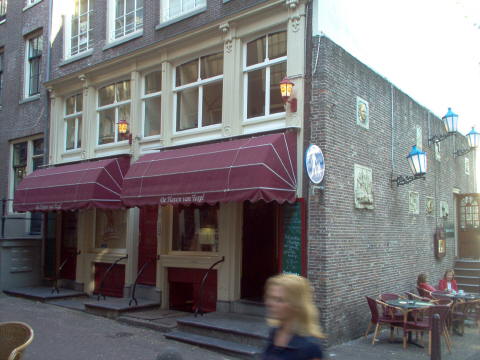
Haven van Texel
A full range of microbrewery Texelse beers and a terrace with some of the best views in town. When the sun goes down or it gets chilly, it's just a few steps to Olofspoort. Shit, that's eleven pubs now. Can't be arsed to change the title, mind.


Wijnand Fockink
The garden has reopened! This unique outdoor space is a real summer treat. Don't miss it. The perfect place for pickling yourself in jenever. Ever wonder what's around the back of the 17th century houses in the centre of Amsterdam? This is your chance to find out.


Wildschut
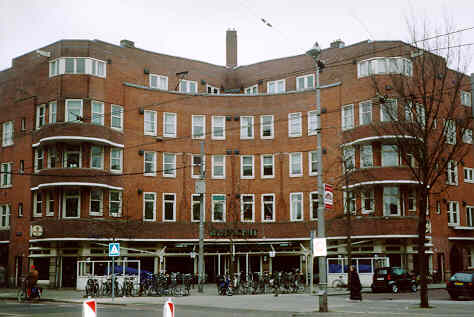
Located on Amsterdam's most beautiful square. Wonder at Boterenbrood's wilful asymmetricity. Wonder at the Rutger's curving brick balconies. The Van Gogh and Rijksmuseum are close by, too. There's plenty of space indoors and out in this substantial 1930's pub. The art deco interior matches the Amsterdamse School exterior perfectly.


Dopey's Elixir
Nothing particularly summery about Dopey's. I just thought it deserved a mention. And you wanted an excuse to visit De Pijp, didn't you? No? Well, you should do. It's full of all the ethnic and trendy stuff I imagine my readers going for. Don't know why. Imagine you like that sort of thing. You're probably a bunch of fat old blokes like me.


Brouwerj Het Ij
On a warm summer afternoon, nothing's more soothing than hiding inside Het Ij while everyone else mobs the beer garden. Dirt cheap, too. See if you can spot the join where the bar was recently extended.


Alverna
One of the few places in Amsterdam West where you can enjoy a beer outside and not be crammed on the pavement next to a main road. They have a few decent beers to make the experience extra special.


(This has been a post in the series "Get More Hits for my Website" and "Keep Mike Happy".)

Friday, 13 June 2008

Decoction mashing in the DDR

I own a few East German brewing manuals. They were some of the first technical books I obtained. My mother-in-law got them from some of her many contacts back in the days when the DDR was still a country. Until now, I'd not paid much attention to the sections on decoction mashing.

Wolfgang Kunze's "Technologie für Brauer und Mälzer" is a wonderful book. It describes in minute detail how to run a VEB brewery. He's pretty good on the technical stuff. Which explains why a later version of this book, produced after reunification, is still a standard text.

This information comes from pages 198 and 199 of the 1961 edition.

It's always the Dickmaische which is boiled. The Dunnmaische or Lautermaische is very enzyme rich as the enzymes are soluble.

The amount of the mash to be boiled (Kochmaische) is one third and two thirds of the total. [There then follows a series of formulae for calculating the exact amount]

hl Kochmaische = (desired rise in temperature * hl total mash)/(90 - Restmaische hl)

Restmaische = total mash - Kochmaische

Example: you've got 130 hl of mash at 50º C that needs to be heated to 64º C

hl Kochmaische = (14 * 130)/40 = 45.5 hl


The time the mash should be boiled varied, depending on the type of beer:

pale beer - 10-20 minutes
dark beer - 20-30 minutes
adjunct mashing - 30 - 40 minutes

The Kochmaische should be pumped into the Restmaische (and not the other way around) so that the temperature of the Restmaische rises slowly and the enzymes aren't destroyed.

Triple decoction
This is the oldest method of decoction.

einmaischen 35º C
1st Kochmaische 50º C
2nd Kochmaische 65º C
3rd Kochmaische 72-74º C

Triple decoction is very intensive, time-consuming and requires much more energy than double or single decoction. The gains are very small in comparison to the extra effort and consequently is no longer much practised.


Double decoction

einmaischen 50º C
1st Kochmaische 65º C
2nd Kochmaische 72-74º C

You may have noticed that the triple decoction is very similar to the Munich method I told you about earlier. Don't worry about all the entries for this series looking very similar. The Augsburg method is very different. That makes use of Saz. Never heard of Saz? Don't worry. Neither had I before yesterday.

Self-censorship

One of the most effective methods of censorship is to scare writers into avoiding topics you don't want discussed. Not just oppressive governments employ the tactic. It's a favourite of religions and large corporations, too.

This particular form of bullying stifles debate, which is, of course, the idea. There are plenty of organisations that don't want an open discussion of their beliefs, their finances, their actions or their secrets.

Why am I bringing this up in a beer blog? Something happened this week that made me realise I've been bullied into abandoning a full expression of my views. And it's rather disheartening.

I'd wondered why my post "Is Kölsch an Ale?" had suddenly received a couple more comments. They immediately struck me as a little strange, especially as it was apparent that at least one of those commenting hadn't read the related posts. He wouldn't have put in all that technical stuff if he had.

A link to "Is Kölsch an Ale?" had been placed in RBPMail. Someone had then copied my article and posted it as a new thread on BeerAdvocate. Slightly annoying, because there was no reference to me or this blog. (On my request, the inital post quoting the whole article has been replaced by a link to my blog post.)

I'll be honest with you. I haven't read through the whole thread. Depressingly - since my article tried to explain my rationale behind not referring to Kölsch as an Ale - the conversation followed very similar lines to the one on RateBeer. Basically that top-fermenting yeast = Ale yeast, ergo Kölsch is an Ale. Either that or abuse.

The discussion (if you can call it that) was disheartening enough first time around. I can live without a repeat. Head and brick wall situation. Last time it did feel really good when I stopped, but that isn't enough to get me banging again.

It's no wonder that conversations on beer forums are limited to "Watcha drinkin'?", "what's your favorite barrel-aged German Quadrupel?" or "Is XXXXX over-/underrated?". Anyone trying to make a serious point that doesn't agree with current homebrewing orthodoxy is likely to be greeted with a stream of hatred and abuse. At least, that's why I don't bother any more. You need either a very thick skin or to conform. A bit sad, really.

Am I the only one who's been driven away? Maybe I'm just a sensitive soul. Is it inevitable that a small clique of verbal bullies will come to dominate any forum?

In avoiding discussion I'm censoring myself. And, in doing so, helping to reinforce ideas which I beleive to be false by not challenging them. It's a sobering thought.

Thursday, 12 June 2008

Salvator

The Summer of Hate, sorry, Summer of Lager continues with a look at Salvator. One of the most famous beeers of the 19th century. Today, it's a trademark of Paulaner, but back then it was used as a generic term for all Doppelbocks.

Because of its fame, I've plenty of hard evidence about Salvator. I collect numbers. I can't help it. Occasionally, like now, it does come in handy. If I weren't such a saddo, I wouldn't all the fascinating figures with which I'm about to regale you. So don't mock me.


The first data I have comes from the 1850's. The beer was brewed by Zacherl, the forerunner of Paulaner, so it's the real deal. It has a massive OG of 23.5º Balling (approx. 1095), but a relatively puny alcohol content of just over 6% ABV. Let's be honest, the attenuation is crap. Less than 50% apparent. With an FG higher than the OG of most beers today, it must have been pretty thick and sweet. No wonder they used it as a meal substitute.

The 1858 version (not sure if it's from Paulaner or another Munich brewery) has a substantially lower gravity (19.8º Balling, or around 1080) , but almost as high an ABV (5.74%). As a consequence, the apparent attenuation has increased from a pathetic 46% to a still unimpressive 53%.

By 1870, the gravity has dropped further, to 18.5º Balling (approx 1074), but the ABV has remained about the same (5.64%). Apparent attenuation has again increased and is 56%.

Unfortunately for me, I have no idea which breweries the 1930's samples come from. However, the first in the list looks rather like a Doppelbock to me. Assuming that it is, we can see a further slight reduction in the OG (17.99º Balling, approx 1072), but a similar ABV (5.8%). Consequently, apparent attenuation is up to 60%.

Finally we see the present incarnation of Salvator. This has a much higher alcohol contente - 7.5% ABV - than any of the older versions. Which has a big impact on the apparent attenuation, which is now a respectable 75%.

So how does modern Salvator compare with the 19th century versions? It has a 22% lower OG, but a 25% higher ABV. The difference in body is enormous. The FG in the 1850's was more than double what it is now. To sum up, modern Salvator is less full-bodied, less sweet and sticky, but more alcoholic.

Another difference is the colour. Though I don't have enough numbers to do a precise analysis, I know from personal observation that Salvator has become paler over the last 15 years. And generally pretty crap, but that's a subjective opinion.

I suppose I should try and dig out an old description of Salvator brewing. My guess would be that the 19th-century method was a triple decoction Dickmeisch. If you've been paying attention you should know all about that. Don't tell me you've forgotten already? Really.


(Published as part of my one-interesting-to-one-boring_post initiative.)