I chat with Dann and Martha about brewing in the USA and Yorkshire. And pissing on your own chips.








-
I chat with Dann and Martha about brewing in the USA and Yorkshire. And pissing on your own chips.
Our next destination is over the river. And up a dirty great hill. Luckily only halfway up it. The Forest, an unlikely brewpub.
The cask Mild is very tempting, but instead I opt for the Stout. An even rare style to find in cask form. It’s nice and roasty. As a Stout should be.

Dann and I discuss a new beer project. He fancies a WW II beer, but is worried that means something watery.
I reassure him: “There were still some pretty strong beers in the early war years. Then there’s the session Russian Stout.”
“That sounds interesting.”
Dann gets talking to the brewer at the bar. And they both come over to our table. The brewer seems a nice bloke.
I’m relieved that we won’t need to climb any further up the hill. As we’re headed back down it to the Gardeners Rest. It’s another pub with an impressive pork pie offering. In which we, naturally, indulge.

We sit in the garden at the rear, perched above the River Don. A much more pleasant prospect than it would have been a couple of decades ago. “It used to be orange.” One of Dann’s friends remarks.
A bit more climbing is involved getting to the next pub, the Crow. A slightly cavernous and rather spartan space. I’m starting to tire. What do I mean, starting? My knackerdness began a good few pubs back. I blame the hills.
“The posts about your travel with the kids are hilarious.” Dann says. “But I’m sure 95% of it isn’t true.”
“It’s the other way around. 95% is true.”
“Really?”
“Yes. Just the odd ‘improvement’ here and there.”

We exit the Crow about 25 minutes before our train is due to leave, Martha leading the way. Google Maps says it’s a 17-minute walk. We should have plenty of time. But does that take into account the gradients? Sheffield is very hilly.
It starts off downhill. Not for long, mind. Soon we’re toiling up a hill and I start lagging behind. Before we get to the final downhill run to the station, we’ve been over a few hills. I’m knacked. Being built for an Amsterdam-level of hilliness.
We’re getting the Transpennine Express. So, inevitably, it’s late. We’ve enough time to nip into a shop for provisions. A cheese and onion sarnie for me. Lager and cider for the kids.

The train finally rolls up.
A rather drunk young woman almost falls out. Followed by another. We move to step in, but another merry girl appears. We attempt entering a few times, with another tottering lass appearing each time. How many of them are there?
It’s just a short dash to Doncaster. But, as we’re in a crappy DMU, it’s not a particularly quick dash. We arrive in Doncaster, just in time to miss our connecting train. How often did that happen to me in the past?
“This is absolutely typical. I was always having to hang around in Doncaster station.”
“Are you about to tell us one of your boring stories about the oldie times?” Alexei interrupts. “Because we don’t want to hear it.”
“When I was studying . . .”
“Didn’t you hear what I just said? Read you magazine and shut up.”
OK, you miserable git. I’ll tell my readers instead.
When I was studying in Leeds, there were no direct trains from Newark. Despite trains between London to Leeds passing through Newark. To get back to Newark, I needed to get a crappy little DMU to Doncaster, where I changed to a mainline service.
All very good. But the train from Leeds was scheduled to arrive five minutes after the departure of an express to Newark. With an 80-minute wait until the next connection. Sometimes the connection was delayed and I could catch it. But not always.
The buffet in the station was crap. So, I’d wander into town, where a fairly decent Tetley’s pub awaited me. A couple of pints there, and then back to the station.
Not much of a story, I know. But it did include me drinking some Tetley’s Mild.
The train we’re getting is the last we can get. Best make sure we get on it.
I’m feeling quite sleepy by the time it screeches to a halt.
A confused young man without luggage stumbles off the train and asks:
“Is this Doncaster?”
“Yes.” Alexei replies, before we get on. He wanders off, legs stuttering. I guess that was the answer he wanted.
When we’re seated, Alexei says: “We should have told him it was Grantham.”
“That’s mean, Lexie.”
“It would have been funny, though, watching him panic.”
I was slightly concerned about what the taxi situation would be at Newark Northgate. Luckily there’s one there. But just the one. Lucky that we were first off the train.
Dave is still up. Though not for that long. The kids are still smashing their slab of cider when I trail upstairs to my bed.
The Forest
Rutland Street,
Sheffield S3 9PA.
Gardeners Rest
105 Neepsend Ln,
Neepsend,
Sheffield S3 8AT.
https://www.thegardenersrest.co.uk/
The Crow Inn
33 Scotland St,
Sheffield S3 7BS.
https://www.thecrowinn.co.uk/
I wanted to get up to Sheffield. To see Dann and Martha. And Jules (of Hop Hideout). That the city has lots of great pubs is another attraction. But there’s a massive downside for me. One I’d forgotten.
It’s the same brekkie drill. Grill some bacon, cut some bread, assemble sandwich.
I like my tea strong. Dave makes it super-strong. The colour of dark chocolate. Even when loaded up with milk.
We’re taking the same train as on Friday. It’s on time, but even more packed. There’s an announcement that all the seats are reserved and that if you don’t have a reservation, you’ll have to stand.
Luckily, we have reservations. Of course, our seats are occupied. Who would leave seats empty on a train so packed?
We’re changing at Doncaster again. Not onto another fast train, as for Leeds. But a crummy DMU. It’s another pretty short ride.

Our train pulls in on platform 1. Conveniently, right next to the Sheffield Tap, where we’ve arranged to meet. We have to walk no more than a few feet.
We’re the first to arrive, so I get us some drinks. Jaipur for me. Girly Lager for the kids. Andrew will drink just about anything. Sometimes cask, sometimes cider, sometimes evil keg. He’s annoyingly cosmopolitan that way.
It’s not long until Dann arrives, followed by a couple of his friends. We agree that the next stop should be the Three Tuns.
While we’re climbing the hill into town, Alexei asks: “Can I get some food? I didn’t have breakfast.”
I spot a café-type place where he gets himself a bacon and egg sandwich. I get a chance to catch my breath while he’s inside. I’d forgotten how hilly Sheffield is. Far too hilly for my crappy lungs.

Over another couple of hills and we’re there. It’s a triangular building and we go and sit in its point. Not before getting pints, obviously.
After a while Jules (of Hop Hideout) turns up with her extremely cute daughter, Ivy. Followed by Martha and dog Grimbold.
It’s all very jolly. Other than the TV. Which is tuned to GBNews and is discussing the Lucy Letby case endlessly.
“All this baby-murdering stuff is a bit depressing. They could have selected a less miserable channel.” Someone says.
“Or a less fascist one.” Alexei adds.
With the gang all assembled we can move on. The consensus is Shakespeares. Which, fortunately, is downhill.
As we approach, I see that it has some grand Wards Fine Malt Ales windows. Cool. I can remember their beers. That’s how old I am. They had quite a nice Dark Mild. Though it was difficult to find in Sheffield itself.

As we’re huddling around the bar, Dann points out a unique feature: a dedicated pork pit fridge. With the temperature set to a perfect 13º C.
The multiroom layout has been preserved, which is cool. Though we don’t take advantage, as we sit in the garden. Which is fairly pleasant. As is the pork pie I’m munching on. The weather is atypically sunny and there’s a nice mix of sun and shade in the garden.
Ivy is remarkably quiet and well-behaved. Quite unlike mine were at her age.
Next on itinerary is the Kelham Island Tavern. I think I’ve been here before. Though I probably wouldn’t have recognised it, as the context has changed completely. The pub is now surrounded by modern flats. At least they left the pub intact.

I can’t resist getting a pint of Acorn Barnsley Bitter. It was the first good cask bee I ever drank, in 1973 or so. This does remind me of it. Quite dark, dry and quite bitter. A lovely drink, really.
The vagaries of brewery takeovers left Newark with many pubs served by the Barnsley Brewery. This was the result of John Smith buying Warwick & Richardson, one of the Newark breweries. It was pretty well immediately closed and their beer replaced by Barnsley, another of John Smith’s purchases.
After Courage bought John Smith, Barnsley was gradually phased out and replaced by Courage-branded beers from the other Newark brewery, Holes. By 1974, the Wing Tavern was the last pub in town offering Barnsley Bitter.
We sit out the back in the garden again. It’s pretty busy considering it’s 15:30.
Our next destination is a pub I’ve definitely visited before. Albeit quite a while ago: the Fat Cat.

We sit outside again. Because of Ivy, I think. These crazy UK laws that make life difficult for parents. Particularly annoying for anyone whose kids are as well-behaved as Ivy. Or has lived on the continent.
“People keep asking us to rebrew the 1832 Mild Ale.” Martha says.
“The first brew was one of my favourite beers of all time. All those whole leaf Goldings were amazing.” I reply. “A shame they nearly broke the brewery.”
Sheffield Tap
Sheffield Station,
1b Sheaf St,
Sheffield City Centre.
https://sheffieldtap.com/
Three Tuns
39 Silver Street Head,
Sheffield City Centre,
Sheffield S1 2DD'
Shakespeares
146-148 Gibraltar St,
Sheffield S3 8UB.
Kelham Island Tavern
62 Russell St,
Sheffield S3 8RW.
http://www.kelhamtavern.co.uk/
The Fat Cat
23 Alma St,
Sheffield S3 8SA.
http://www.thefatcat.co.uk/

| 1955 Tennant's No. 1 | ||
| pale malt | 17.25 lb | 77.53% |
| crystal malt 60 L | 0.50 lb | 2.25% |
| black malt | 0.50 lb | 2.25% |
| flaked maize | 1.50 lb | 6.74% |
| No. 2 invert sugar | 2.50 lb | 11.24% |
| Goldings 210 mins | 4.00 oz | |
| Goldings 40 mins | 0.75 oz | |
| Goldings 20 mins | 0.75 oz | |
| Hallertau dry hops | 0.50 oz | |
| OG | 1101 | |
| FG | 1027.5 | |
| ABV | 9.72 | |
| Apparent attenuation | 72.77% | |
| IBU | 61 | |
| SRM | 25 | |
| Mash at | 149º F | |
| Sparge at | 165º F | |
| Boil time | 210 minutes | |
| pitching temp | 57º F | |
| Yeast | Wyeast 1099 Whitbread ale | |

"The difficulties that have confronted us during the year have been immeasurably greater than any previous year, not excepting the war years. Our tenants and managers also have done their utmost to carry out wishes of the Justices, and have considered on every occasion the public interest.The price of everything was going, the government had reduced the quantity of materials available for brewing and reduced gravities by 10%. Though at least excise duty wasn't increasing. That remained at 286s 5.5d per standard barrel from 1944 to 1948.
There has been, in spite of climatic and economic conditions no relaxation in the demand for our products. The compulsory 15 per cent reduction in brewing materials was not completely offset by the fall of 10 per cent, in gravity brought about by Government order in August, 1946, and the combined effect was a considerable contraction in permitted output compared with the basic year. Brewings had to be further curtailed, due to the electricity cuts and coal shortage Unfortunately, the rationing of our customers had to be strictly enforced throughout the period. The effect of full employment and high wages coincident with a shortage of beer and spirits — particularly spirits — has made the position doubly difficult. Furthermore.
we have already been warned that there will be increases in the price of malt and coal and, in addition, costs of freight, carriage, rates and overheads generally, will tend to rise."
Nottingham Journal - Wednesday 15 October 1947, page 2.

| 1956 Tennant's Gold Label | ||
| pale malt | 14.75 lb | 67.82% |
| enzymic malt | 0.25 lb | 1.15% |
| flaked maize | 4.00 lb | 18.39% |
| No. 1 invert sugar | 2.75 lb | 12.64% |
| Fuggles 230 mins | 2.50 oz | |
| Goldings 230 mins | 0.75 oz | |
| Goldings 60 mins | 3.25 oz | |
| Hallertau dry hops | 0.67 oz | |
| OG | 1103.5 | |
| FG | 1020 | |
| ABV | 11.05 | |
| Apparent attenuation | 80.68% | |
| IBU | 72 | |
| SRM | 9 | |
| Mash at | 147º F | |
| Sparge at | 165º F | |
| Boil time | 230 minutes | |
| pitching temp | 56º F | |
| Yeast | Wyeast 1099 Whitbread ale | |

"The history of Richdale's clubs arose out of an idea they had after the First World War of closing poor trading pubs, de-licensing them, and then letting them to groups of people wanting to start up a workingmen's club. It was a good solution so long as the brewery did not press any tie for the supply of beer, which could not be enforced under the law as it then stood. Whilst the original founders were in control of the club the understanding prevailed, namely, to buy all their needs from the brewery; they passed from the scene over the years. After the Second World War Richdale held on to their trade just as long as there was a shortage of beer. With the rise of a new generation of club committeemen not bound by the morality of personal undertakings, and being aware of their legal position, and with supplies becoming more plentiful, the clubs went off to their favourite breweries. Mr Morris felt this all to be bitterly unfair, especially when he had let the clubs have supplies in times of shortage. His approach to the problem was one of passionate and reproachful historical argument with committees; which got him nowhere, and which inflamed him the greater. As mentioned, Hammonds, believing him to be well in with Sheffield club trade, made him free trade sales manager for the area, which he took as a sign that he had been appointed to carry the gospel into the territory of the heathen, and if necessary, to suffer a glorious death and transfiguration. It was not what Hammonds had in mind at all; it was also not what Mr Morris really had in mind either, as he thought he was to be brewing director of a combined BOB and Richdale, as Canklow Brewery had been closed soon after the take-over. However, he put their mistake down to a fundamental misunderstanding of his abilities and prepared to face the enemy. It was into this boiling cauldron that I was dropped, in an attempt to persuade the citizens of Sheffield to drink Hammonds' beer."
"The Brewing Industry 1950 - 1990", by Anthony Avis, 1997, page 46.
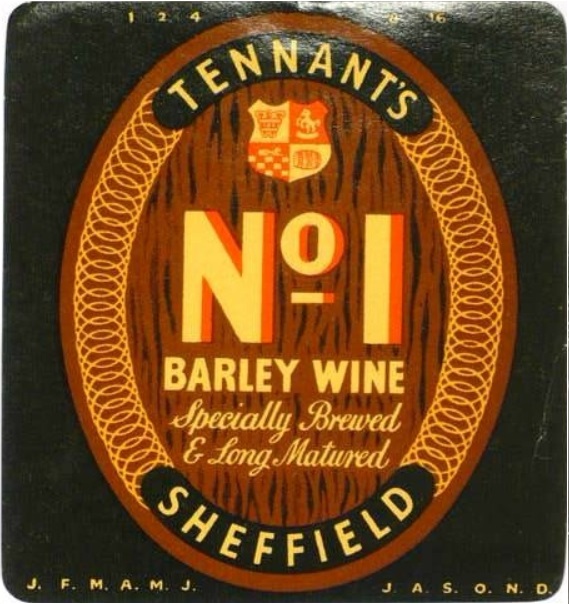
| 1956 Tennant's No. 1 | ||
| pale malt | 16.75 lb | 75.28% |
| crystal malt 60 L | 0.50 lb | 2.25% |
| black malt | 0.50 lb | 2.25% |
| enzymic malt | 0.25 lb | 1.12% |
| flaked maize | 1.50 lb | 6.74% |
| No. 2 invert sugar | 2.75 lb | 12.36% |
| Goldings 240 mins | 3.00 oz | |
| Goldings 120 mins | 1.75 oz | |
| Goldings 60 mins | 1.75 oz | |
| Hallertau dry hops | 0.75 oz | |
| OG | 1101 | |
| FG | 1023.5 | |
| ABV | 10.25 | |
| Apparent attenuation | 76.73% | |
| IBU | 78 | |
| SRM | 25 | |
| Mash at | 149º F | |
| Sparge at | 165º F | |
| Boil time | 240 minutes | |
| pitching temp | 57º F | |
| Yeast | Wyeast 1099 Whitbread ale | |

| 1956 Tennant's Glucose Stout | ||
| pale malt | 5.50 lb | 63.18% |
| crystal malt 60 L | 0.33 lb | 3.79% |
| black malt | 0.125 lb | 1.44% |
| amber malt | 0.50 lb | 5.74% |
| glucose | 1.00 lb | 11.49% |
| No. 2 invert sugar | 0.25 lb | 2.87% |
| caramel 1000 SRM | 1.00 lb | 11.49% |
| Fuggles 90 mins | 1.75 oz | |
| OG | 1040 | |
| FG | 1019 | |
| ABV | 2.78 | |
| Apparent attenuation | 52.50% | |
| IBU | 29 | |
| SRM | 48 | |
| Mash at | 152º F | |
| Sparge at | 165º F | |
| Boil time | 90 minutes | |
| pitching temp | 60º F | |
| Yeast | Wyeast 1099 Whitbread ale | |

| 1956 Tennant's Lion Brown Ale | ||
| pale malt | 4.00 lb | 57.60% |
| crystal malt 60 L | 0.25 lb | 3.60% |
| enzymic malt | 0.25 lb | 3.60% |
| flaked maize | 1.75 lb | 25.20% |
| malt extract | 0.07 lb | 1.01% |
| No. 2 invert sugar | 0.50 lb | 7.20% |
| caramel 2000 SRM | 0.125 lb | 1.80% |
| Fuggles 95 mins | 1.00 oz | |
| Goldings 95 mins | 0.25 oz | |
| Fuggles 40 mins | 0.25 oz | |
| Goldings 20 mins | 0.25 oz | |
| OG | 1031 | |
| FG | 1010 | |
| ABV | 2.78 | |
| Apparent attenuation | 67.74% | |
| IBU | 26 | |
| SRM | 20 | |
| Mash at | 148º F | |
| Sparge at | 165º F | |
| Boil time | 95 minutes | |
| pitching temp | 60º F | |
| Yeast | Wyeast 1099 Whitbread ale | |

| 1956 Tennant's BB | ||
| pale malt | 5.00 lb | 70.52% |
| enzymic malt | 0.125 lb | 1.76% |
| crystal malt 60 L | 0.25 lb | 3.53% |
| flaked maize | 0.50 lb | 7.05% |
| No. 2 invert sugar | 1.00 lb | 14.10% |
| lactose | 0.09 lb | 1.27% |
| malt extract | 0.125 lb | 1.76% |
| Fuggles 90 mins | 0.50 oz | |
| Goldings 90 mins | 0.125 oz | |
| Fuggles 40 mins | 0.33 oz | |
| Goldings 20 mins | 0.33 oz | |
| Goldings dry hops | 0.125 oz | |
| OG | 1033 | |
| FG | 1006.5 | |
| ABV | 3.51 | |
| Apparent attenuation | 80.30% | |
| IBU | 17 | |
| SRM | 7 | |
| Mash at | 147º F | |
| Sparge at | 165º F | |
| Boil time | 90 minutes | |
| pitching temp | 60º F | |
| Yeast | Wyeast 1099 Whitbread ale | |

| 1956 Tennant's Lion Pale Ale | ||
| pale malt | 4.25 lb | 60.41% |
| crystal malt 60 L | 0.33 lb | 4.69% |
| enzymic malt | 0.125 lb | 1.78% |
| flaked maize | 1.00 lb | 14.21% |
| malt extract | 0.33 lb | 4.69% |
| No. 2 invert sugar | 1.00 lb | 14.21% |
| Fuggles 90 mins | 0.25 oz | |
| Goldings 90 mins | 1.50 oz | |
| Goldings 40 mins | 0.25 oz | |
| Goldings 20 mins | 0.25 oz | |
| OG | 1034 | |
| FG | 1009 | |
| ABV | 3.31 | |
| Apparent attenuation | 73.53% | |
| IBU | 34 | |
| SRM | 6 | |
| Mash at | 146º F | |
| Sparge at | 165º F | |
| Boil time | 145 minutes | |
| pitching temp | 60º F | |
| Yeast | Wyeast 1099 Whitbread ale | |

"Tennant's produced four draught been and five bottled beers. The draught beers were: Bitter Beer (BB), Best Bitter Beer (BBB), Rock Ale, which was a dark, mild ale and Queen's Ale. Rock Ale probably originated at the Nottingham Brewery (see later). The Nottingham cellars had been excavated out of the solid rock on which the old town stood. Beers stored in the cellars were known as Rock Ales."
"The Brewer's Tale" by Frank Priestley, 2010, page 11.
| 1956 Tennant's Rock Ale | ||
| pale malt | 5.50 lb | 76.44% |
| enzymic malt | 0.25 lb | 3.47% |
| malt extract | 0.07 lb | 0.97% |
| No. 2 invert sugar | 0.125 lb | 1.74% |
| No. 3 invert sugar | 1.00 lb | 13.90% |
| caramel 500 SRM | 0.25 lb | 3.47% |
| Fuggles 90 mins | 0.50 oz | |
| Goldings 40 mins | 0.25 oz | |
| Fuggles 40 mins | 0.25 oz | |
| Goldings dry hops | 0.125 oz | |
| OG | 1033 | |
| FG | 1006 | |
| ABV | 3.57 | |
| Apparent attenuation | 81.82% | |
| IBU | 15 | |
| SRM | 16 | |
| Mash at | 148º F | |
| Sparge at | 165º F | |
| Boil time | 90 minutes | |
| pitching temp | 60º F | |
| Yeast | Wyeast 1099 Whitbread ale | |

“Queen's Ale was a premium draught beer. It was a pale, hoppy beer with a good body. Its perfect balance of malty sweetness and the bitterness of the finest hops ensured that it was the best draught beer that I have ever tasted (and that is saying something).”
"The Brewer's Tale" by Frank Priestley, 2010, page 11.
| 1956 Tennant's Queen's Ale | ||
| pale malt | 6.25 lb | 67.57% |
| enzymic malt | 0.25 lb | 2.70% |
| flaked maize | 1.25 lb | 13.51% |
| No. 1 invert sugar | 0.50 lb | 5.41% |
| No. 2 invert sugar | 0.75 lb | 8.11% |
| lactose | 0.25 lb | 2.70% |
| Fuggles 90 mins | 0.75 oz | |
| Goldings 90 mins | 0.25 oz | |
| Goldings 40 mins | 0.50 oz | |
| Goldings 20 mins | 0.50 oz | |
| Goldings dry hops | 0.125 oz | |
| OG | 1044 | |
| FG | 1009 | |
| ABV | 4.63 | |
| Apparent attenuation | 79.55% | |
| IBU | 26 | |
| SRM | 6 | |
| Mash at | 148º F | |
| Sparge at | 165º F | |
| Boil time | 95 minutes | |
| pitching temp | 60º F | |
| Yeast | Wyeast 1099 Whitbread ale | |

Buy a signed paperback edition of the Homebrewer's Guide to Vintage Beer. For locations inside Europe.

Buy a signed paperback edition of the Homebrewer's Guide to Vintage Beer. For the USA, Canada, Australia and other locations outside Europe.


 Posts
All Comments


