I explain the history of a rare survivor of Germany's pre-Lager beer culture.

"In the meantime (from 1900 onwards) a new type of beer in the form of sugar-sweetened and pasteurized Malzbier (Karamelbier) had appeared, giving top fermentation a considerable boost, which has also recently involved the top-fermented, light bitter Lagerbier which was already brewed in the Rhineland.
Otherwise, the old local beers are mostly forgotten. Even famous beers. Such as Danziger Jopenbier, Einbecker beer. The widely spread Porter. Münsterländer Altbier, of which only remnants of inferior quality remain.
A few have managed to survive into the present day, such as Broihan (Hannover)*, which is brewed using wheat malt and has a sweet taste; the dark and weakly sweet brown beer brewed in the Kretschmerei in Breslau, Hamburger "Beer", Lichtenhainer beer and Gose, the wheat malt beer of Bavaria, especially the Berliner Weissbier, and to a lesser extent the non-sour Weissbier of northern Germany. Grätzer beer has saved itself - as a miserable leftover. Rhenish top fermentation, however, has survived the times in improved condition.
* Brown beer with a schnapps (caraway) has been a well-known popular drink in Hamburg as in Hanover under the name "Lüttge Lage"."
"Obergärige Biere und ihre Herstellung" by Dr. Franz Schönfeld, 2nd edition, Verlag von Paul Parey, Berlin, 1938, page 132.

"In other countries too, top fermentation was pushed away more and more. However, there are still a number of breweries in Holland and France which produce light LAgerbier in a top-fermenting manner to a not inconsiderable extent. In Belgium, top fermentation still remains in the production of old sour beers.Of course, there was far more than sour brown beers being top-fermented in Belgium before WW II. And there was bottom-fermenting beer produced in the UK. Just not very much of it.
A very special exception is England. Only top fermentation is known here. Hundreds of years ago, English beers had a well-founded reputation. They were all strong beers with great durability and characteristic taste and fragrance. They have remained so to this day. Bottom fermentation was unable to gain a foothold. National characteristics and habits have allowed the old method of preparation to hold on."
"Obergärige Biere und ihre Herstellung" by Dr. Franz Schönfeld, 2nd edition, Verlag von Paul Parey, Berlin, 1938, pages 132 - 133.


“Döllnitzer (Leipziger) Gose.
Original wort: 7-8% B. Infusion procedure.
One uses air-dried malt and 2 parts air-dried malt with well-modified kilned malt, but lower quality will also do, as it works just as well.
The Gose is a cloudy, slightly acidic beer and was already mentioned as an export beer in 1755, but originally came from Goslar and was later produced in Döllnitz. Nowadays it is produced in the Leipzig area by a number of breweries, but the yeast is taken from the distillery Libertwolkwitz.
Hopping rate: 125 g per Zentner [50 kg.] malt.
The yeast is pitched immediately. Degree of saccharification 45%. Secondary fermentation in bottle. Before filling, add 1/3 of water and 1 gram of salt (dissolved in water) per litre; if foam is forced out of the bottle, insufficient salt has been added.
Cardamom-liquorice is also added.- "Genuine" Gose should taste full-bodied and oily. Gose is not filled into barrels, not even stoppered, but it has a plug of yeast.
The yeast is repeatedly skimmed off and only the last covering left.
For Gose do not take red, yellow, brown, etc. bottles, otherwise the light splits the fine proteins, creating ammonia and muddying the beer.
This also applies to other beers!”
"Die Fabrikation obergäriger Biere in Praxis und Theorie" by Braumeister Grenell, 1907, page 74. (My translation.)

"Grodziskie/Gose/Lichtenhainer
Sour wheat beers were common in many parts of medieval and early Industrial Europe. Two styles – lambic and Berliner weisse – survived, but many others did not. Gose, Grodziskie and Lichtenhainer are historic styles of sour wheat beer, each a unique style of its own. Gose is seasoned with salt, Grodziskie and Lichtenhainer contain smoked malt. Historical sources are mixed about Lichtenhainer containing wheat, so modern interpretations may vary. Grätzer is an alternative name for Grodziskie. All three will be relatively low alcohol, tart, with a strong wheat character, but will be distinct from classic examples of Berliner Weisse or lambic. As all we have are historical recreations, substantial differences may exist between interpretations."
"Under the influence of the supposedly excellent well water, to whose qualities until recently the excellent quality of the beer was erroneously attributed, it was possible to brew a beer of far-reaching fame from pure wheat, which has maintained its reputation through the centuries, as a highly sophisticated beverage which because of its smoke and hop bitter taste was not only earlier highly appreciated, but even now is counted among the best top-fermented beers."
"Die Obergärige Biere und ihre Herstellung" by Schönfeld, 1938, page 162.
"3. Grätzer Bier, a rough, bitter beer, brewed from 100% wheat malt with an intense smoke and hop flavour. The green malt undergoes smoking during virtually the whole drying process, is highly dried and has a strong aroma in addition to the smoked flavour. An infusion mash is employed. Hopping rate: for 1 Zentner (100 kg) of malt, 3 kg hops. Gravity just 7º [Balling]. Fermentation is carried out in tuns at a temperature of 15 to 20º C. Since the beer in the tun, as a result of the expulsion of great quantities protein and resin, doesn't break, it is mixed with isinglass and pumped into barrels. After two or three days it is completely clear and ready to be filled into delivery casks or bottles with the addition of 2 to 5% Krausen."
“Bierbrauerei" by M. Krandauer, 1914, page 301.
"1. Low alcohol content, so easy to digest, an Ausstossbier or filled with krausen into bottles, as free as possible from bacteria, carbon dioxide-rich (Lübbener, Werder'sches, Cölner, Bremen, Hamburg, Grätzer, Munich Weissbier, etc.);Grodziske is put in the same group as Munich Weissbier and is supposedly as free of bacteria as possible. Doesn't sound like a sour beer to me.
2. the same properties, with a higher lactic acid content (Berliner Weissbier, Broyhan, Calenburger Weissbier, Lichtenhainer, Gose beer);
3. more or less rich in alcohol, poorly carbonated, beers with large amounts of lactic acid (Dortmunder Altbier, called Malzweine);
4. low-alcohol, extra-rich, sweet beers (Braunschweiger Mumme, Danziger Jopenbier, Frauenburger Mumme, etc.)."
"Jahresbericht über die Fortschritte in der Lehre von den Gährungs-Organismen" by Professor Dr. Alfred Koch, 1896, pages 160-161.
"Sour-tasting beers are Berliner Weißbier and Lichtenhainer, brewed from smoked barley malt, even more so Gose, which is also seasoned with cooking salt. Grätzer Bier, brewed from smoked wheat malt, heavily hopped but of a low gravity, also tastes smoky."I'll admit this last one is open to different interpretations. I think it says that Grätzer is another smoky beer.
"Encyklopädisches Handbuch der technischen Chemie, Volume 4, Part 1", 1915, page 210.
1. Beers that were lightly-hopped and soured during primary fermentation. Berliner Weisse, Gose and Lichtenhainer were in this group.
2. Heavily hopped beers that only soured during a long secondary fermentation Adambier and Münster Alt were about the only beers in this category.
"Brewing Gose according to Hermbstädt
This is what they call a Weißbier similar to Broyhahn, which is particularly well-brewed in Goslar and which gets its name from a river of the same name, from whose water Gose is brewed in Goslar.
For a brew of 2000 Berlin quarts [2,290 litres] is required:
1) 12 Berlin bushels (960 pounds) [480 kg] pale wheat malt.
2) 10 Berlin bushels (600 pounds) [300 kg] pale barley malt.
3) 5 pounds [2.5 kg] of the best hops.
The grist is doughed in with 2400 Berlin quarts [2,748 litres] of water at 36° R. [45º C], well worked out and then left to rest for an hour in a covered vessel. The second infusion takes place with the same amount of boiling hot water, being well mashed for 1 hour before the mash is to rest for one hour in a covered vessel. The wort is gently boiled until it has reduced to 2000 Quarts [2,290 litres], strained through straw, mixed with the hop extract and cooled in the coolship down to 14° R. [17.5º C].
The cooled, hopped wort is put into the fermentation vessel with 10 quarts [11.5 litres] of yeast, and when finally the resulting head of yeast has collapsed, the yeast on the top is removed, the fermented wort drawn into the storage barrels in the cellar, and like Broyhahn allowed to ferment out, during which the barrels must be well bunged. The hops are infused twice, the first time with 50 quarts [57 litres], the second time with 40 quarts [46 litres] of water, and finally squeezed. To use the spent grains for Kovent, they are immersed 1000 quarts of boiling hot water, the wort so obtained is boiled for half an hour with the pressed hops and finally pitched with 4 quarts of yeast.
"Grundsaetze der Bierbrauerei nach den neuesten technisch-chemischen
Entdeckungen" by Christian Heinrich Schmidt, 1853, pages 447-448.
"German top-fermenting beers can be divided into four large goups (according to Schönfeld): Süß- or Einfachbier, smoky bitter beers (Grätzer), Bitterbier similar to Lagerbier and sour beers (Berliner Weißbier).
Most German top-fermenting beers are in the group Süß- or Einfachbier. They are as varied in name as they are in colour, brewing methods and flavour. The majority of these beers (Weißbier, Weizenbier, Malzbier, Doppelbier, Kraftbier, Broyhan, Werdersches Bier, Hamburger „Beer" etc.) are, through the use of Farbmalz or Couleur, coloured dark and are to a greater of lesser degree sweet in flavour, which derives partlt from the addition of sugar. The orignal gravity of varies between 5º and 7º Balling for many Einfachbier to 20º Balling for some Doppel- and Kraftbieren. The worts are prepared from barley malt, wheat malt or a mixture of the two. In many, up to 20% of the grist is made up of sugar. Fermentation takes place in tuns or barrels of widely varying sizes and lasts for two or three days at a temperature of 18º-20º C; for secondary fermentation some beer is filled into transport casks from the tun and sold after being briefly bueged up, other beer is put unbunged (ungespundet) into small casks in which it will be later transported and left to condition. A strong, foamy head is demanded of all these beers, the degree of attenuation is usually low. Sugar is added to many of these beers just before bottling and their shelf-life is increased by pasteurisation at 55 to 60º C."
"Encyklopädisches Handbuch der technischen Chemie, Volume 4, Part 1", 1915, page 303. My translation.
"Bottom-fermenting beer types. First in line amongst dark beers is the Munich type of dark beer. It tastes malty, full-bodied, lightly-hopped and not greatly attenuated. Munich Export Beers are more highly attenuated and consequently differ in taste from the local beers. Nürnberger beer - also Salvator and Bockbier - are darker than Munich beer. Märzenbier is usually paler than the standard dark Schankbier and Lagerbier.Beers with a middle colour are represented by Wiener Beer, which however no longer always retains its former character of a golden to red-brown pithy-tasting beer, and which is less malty and full-bodied than Munich beer.
Amongst pale beers there can be differentiated beers of the Pilsen or Bohemian type which are yellow, with little malt flavour but a strong, pleasant hop aroma and the paler Dortmunder and Berlin or north German beers. Dortmunder is more highly attenuated than Pilsner, has more alcohol and a higher starting gravity. Hop flavour is not particularly strong, the flavour noble and full-bodied, the head less lasting than with Pilsener. Berlin beers are halfway between Pilsner and Dortmunder: they are mostly yellow to dark yellow powerful-tasting beers without such a prominent hop flavour as Pilsener.
Top-fermenting beer types. In Germany lightly-hopped Malzbier, Süßbier and Braunbier are brewed that vary greatly in original gravity. Only beers sold under the name of Malzbier have to contain a minimum amount of malt according to the Brausteuergesetz of 15. Juli 1909 for the North German Brausteuergebiet. These beers are sometimes light and sweetened with sugar, sometimes heavy (Malzkraftbier, Malzextraktbier, etc.).
Sour-tasting beers are Berliner Weißbier and Lichtenhainer, brewed from smoked barley malt, even more so Gose, which is also seasoned with cooking salt. Grätzer Bier, brewed from smoked wheat malt, heavily hopped but of a low gravity, also tastes smoky.
Apart from sweet, sour and smoky top-fermenting beers, there is another bitter-tasting type, mostly found in thge West of Germany. These beers are pale in colour, heavily-hopped and are lagered in cold cellars."
"Encyklopädisches Handbuch der technischen Chemie, Volume 4, Part 1", 1915, pages 209-210. My translation.
A cross-cultural constant is that water, whether it comes from the Colorado, the Ganges or the Seine, can just get so -- I don't know -- boring? That's why beer has been a favorite beverage since the heyday of Ancient Egypt, and why -- somewhere between then and now -- some creative beer drinkers in Liepzig and Goseler, Germany decided to add to the usual hops, barley, yeast and water two interesting ingredients: coriander and salt. The result was "Gosebier," which became hugely popular, especially in Liepzig. It also became popular to add different fruit and nut-flavored extractions to this tart, refreshing and somewhat acidic wheat beer. Raspberry and almond-flavored Gosebier joined the plain version at tables all over Germany, and there was much rejoicing. Unfortunately, Gosebier was literally knocked out of existence around the year 1516 with the amalgamation of Eastern Europe and the adoption of the German Purity Law, which demanded that beer only be brewed using variations on its four base ingredients.
History seems to illustrate that even basic good beer can get boring, and eventually the desire for different flavors overtook the German purity law. Gosebier began to make a comeback. Just as this unique beer was regaining popularity, however, the Communist Party took over East Germany. People had a helluva lot more to worry about than, "what neat, fun ingredients we can throw into our bier now?"
Four Peaks is glad to report that, since the dissolution of Communism in that part of the world, Gosebier has certainly made its comeback in Liepzig and even in Goseler -- and that it has finally arrived at our brewery. Brewmaster Andy Ingram -- who was the source for all of this information -- describes the Four Peaks Gosebier as a combination of a Belgian white beer (wittbier) and a Berliner wheat (weisse) beer. "The Gosebier is a wheat beer with a mild spiciness from coriander and a tartness from yeast and lactic acid," said Ingram. "It's refreshing. Many people can get turned off by the idea of adding salt," he said, "but in this case, the addition of salt in just the right quantity does what salt is supposed to do -- enhance the flavors of the beer and give it a big, round mouth-feel." The upcoming beer dinner in March will also feature the three different, traditional Gosebiers as part of the dessert course: raspberry, almond liquer-flavored and regular. Four Peaks Gosebier, which is on tap now at the brewery, weighs in at a light, drinkable 4% alc./vol. Ahh . . . just in time for Spring drinking. Prost!http://www.fourpeaks.com/Brewsletters/BrewsletterFeb2004.htm
Where do I start? Almost everything in the first paragraph is total crap. The Reinheitsgebot didn't apply to the places where Gose was brewed until the 20th century. Gose wasn't the result of "creative beer drinkers" adding stuff to their beer. It's called Gose not Gosebier. The town is Goslar, not Goselar. And Gose is brewed from wheat as well as barley.
Now leat's consider paragraph two. Gose wasn't making a comeback before the communists took over, it was in decline after WW I. Gose was brewed during the DDR period.
I suppose as American brewers who probably can't read German, they may have an excuse. The author of the following disinformation can make no such claim. This was written by German-born Horst Dornbusch and can be found on his "German Beer Institute" website.
In the 20th century, with its wars and dictatorships, Leipziger Gose slowly faded into oblivion. The air raids of the Second World War wreaked havoc and destruction on the brewing facilities, which the planned economy of the Communists proved incapable of rebuilding. The division of Germany during the Cold War (starting in 1949) into a "workers' and farmers' paradise" in the Soviet East and a "revengist, bourgeois" hellhole of "exploitation" in the capitalist West — separated from each other since 1961 by a the Berlin Wall and a death zone with barbed wire, search lights, and a brain-washed, trigger happy "people's army" — not only kept the East Germans in their socialist prisonThere's barely a true word in the first paragraph. The only brewery producing Gose in the 1940's was not destroyed in the war. It was on a country estate and survived intact. It never restarting brewing after the war. Gose was revived in 1949 (after the communists had taken over) at the newly-founded Friedrich Wurzler Brauerei in Leipzig. They were never short of grain for bread-making in the DDR. In any case, the bread was mostly made from rye, with a little wheat and certainly no barley . The last pre-unification Gose was not brewed in the 1950's. The Friedrich Wurzler Brauerei closed in 1966 after the owner died. It was so small and primitive that it wasn't worth nationalising and just shut down. Gose was revived by Lothar Goldhahn in 1986 and brewed at the Schultheiss Weissbier brewery on Schönhauserallee in Berlin until 1988.but also caused their beers to wither. Gose was still a local specialty in Leipzig, when the Communist regime in East Germany decided it had better uses for its feeble economy's precious grain. This was because food shortages that resulted from the forced collectivization of agriculture turned bread-making, not beer-making, into the almost sole purpose of the precious grains. Not surprisingly, all brewing suffered under the Communist regime and, by the late 1950s, the last pre-unification Gose was brewed in Leipzig.
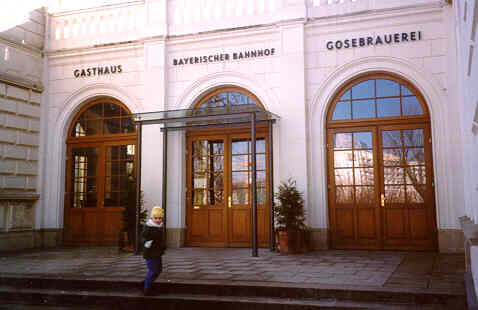
Only after the Wall came down on November 9, 1989, could this traditional beer style make a comeback; and many craft breweries in and around Leipzig started to brew it again. One of the driving forces behind the modern Gose-Renaissance has been the Gosebrauerei Bayerischer Bahnhof (Gose Brewery Bavarian Station), wich opened its doors in 2000. It is located in the historic downtown train station dating from 1842 that linked Leipzig with Munich.
http://www.germanbeerinstitute.com/Gose.html

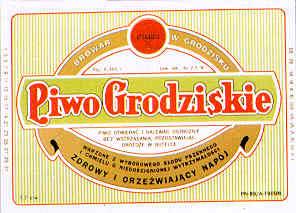 Talking of "Leitfaden Für den Brauer und Mälzer", while flicking through it looking for the bit about Porter just now, I spotted a reference to Grätzer. The book was published in Leipzig in 1953. The mention was in a description of Rauchmalz (smoked malt). This is what says: "The best known Rauchbier is Grätzer." The malt for Grätzer was dried over beechwood fires, it explains.
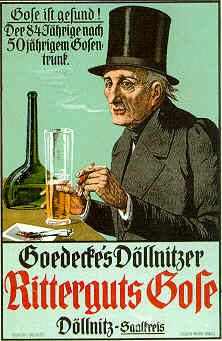 A source from 1927 says the following: "Gose is a Leipzig speciality. It is similar to Berliner Weisse, but sourer and not to everyone's taste. (Pour the bottle slowly.)" Now, Berliner Weisse can be mouth-puckeringly sour and most modern drinkers can't stomach it straight. I think that gives you an idea of just how sour Gose must have been.
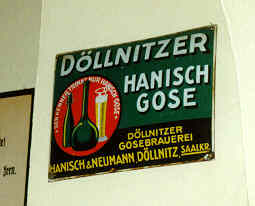 Unlike most of their modern counterparts, the Rittergutsbrauerei Döllnitz were happy to put a limit on the expansion of their business. For most of the second half of the 19th century they were producing "around a million bottles" of Gose a year. I make this an annual output of between 7,500 and 10,000 hl (I'm not sure how big the bottles were); not exactly mass production. To put this figure in its historical context, around 1890 the largest Munich breweries were pushing half a million hl a year, and even the smallest could manage 20,000 hl.
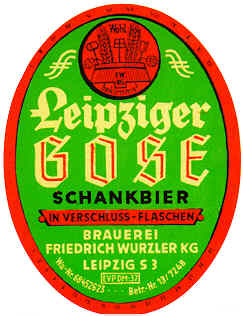 Friedrich Wurzler had worked before the war in the Döllnitzer Rittergutsbrauerei. After landing in Leipzig during the war, he was able to start his own brewery, mostly based on the handwritten notebook in his possession, which explained the secret of brewing Gose. Before his death in the late 1950's, he handed on the secret to his stepson, Guido Pfnister. Brewing of Gose continued in the small private brewery, though there appears to have been little demand. By the 1960's there were no more than a couple of pubs in Leipzig and possibly one in Halle that were still selling it.
 Goldhahn's intentions to have his beer brewed locally in Leipzig were soon frustrated. None of the local breweries had either the technology or the inclination to brew such an odd top-fermenting beer, so he had to look further afield for a producer. Eventually, a test batch of Gose was brewed in 1985, at the Schultheiss Berliner-Weisse-Brauerei in East Berlin. At a tasting held in Goldhahn's flat, a group of experienced Gose drinkers came to the conclusion that it was a "real" Gose. The first production batch followed in 1986 and Leipzig had Gose once more, if only in a single pub.
 Gose Today
Buy a signed paperback edition of the Homebrewer's Guide to Vintage Beer. For locations inside Europe.

Buy a signed paperback edition of the Homebrewer's Guide to Vintage Beer. For the USA, Canada, Australia and other locations outside Europe.


 Posts
All Comments
Posts
All Comments