Showing posts with label German Porter. Show all posts

Monday, 20 January 2025

Beer in the DDR in he 1980s (part three)

Just a short post today. Where we take a look at top-fermented beer in the DDR.

Which, in this book, means mostly Berliner Weisse. Because Porter, which could include Brettanomyces, had a primary bottom fermentation. It's a bit odd that it talks of Leipziger Gose as something belonging to the past, even though it had been revived when the book was written. Though Lichtenhainer, arguably a more obscure style, is spoken of as a living type.

Top-fermented beer should also be mentioned here. It used to play a leading role, but today it is produced less and less. Examples include the former Leipzig “Gose” and “Berliner Weiße”. In top-fermented beer, fermentation takes place at temperatures between 20 and 25 degrees, and the yeast, which sits at the bottom of bottom-fermented beer and is ultimately “harvested” there, rises to the surface and is top-fermented.

What would otherwise take ten days or more is done in three to four days with this beer. “Top-fermented” beer has a slightly sour and refreshing taste, which can be further refined with a “shot” of raspberry juice in “Berliner Weisse”. This characteristic taste is caused by lactic acid bacteria that are added to the wort along with the yeast. The best-known representative of top-fermented beers is the “Berliner Weisse”. Weissbier is also still brewed in Jena-Wöllnitz and is very popular as a local specialty. It is bottled but also served in neighbouring pubs.
"Rund ums Bier" by Emil Ulischberger, Leipzig, 1986, pages 51 - 52.

And, finally, we have a nice table. I do love me a table. 

Types of beer OG (in %) Characteristics Minimum shelf life
Einfachbier 2.9-3.1  nutritious, malty 6 days
(Jung- und Braunbier, Malzbier) 5.9-6.2 beer, especially for sick people and expectant mothers (Doppelkaramel)  
Schankbier (Weißbier) 8.7-9.3 top-fermented beer, only as “Berliner Weisse” 8 days
Vollbier (Hell, Schwarzbier, Diabetiker-Pils, Deutsches Pilsner, Deutsches Pilsner Spezial, Märzenbier) 11-14.3 forms the main part of beer production, with Pilsner the alcohol content is 3 to 4 percent, Exportbier is usually more heavily hopped 8 days for Hell, 10 days for Pilsner and 90 days for Spezial
Starkbier (Weißer Bock, Bockbier dunkel, Deutscher Porter) 15.7-18.3 strong beer, which has recently been preferred as a dark bock with a malty note; Porter is rarely on offer and combines the taste of malt with the bitterness of hops 10 days

Tuesday, 26 July 2022

1980 DDR beer strength

The 1980 version of TGL 7764 doesn't list the alcohol content  of the beers. But, as it does give the OG and rate of attenuatio0n, it's pretty easy to work it out. Especially if, like me, you already have all the necessary calculations plugged into spreadsheet.

It's all much what you would expect. With Berliner Weisse around 3% ABV, Hell a bit over 4%, Pilsner around 5%, and Bock 6-6.5%. Compared to the West, the Hell and Weizenbier are slightly weaker. The other styles, however, are roughly in line with what occurred on the other side of the Inner German Border.

The bottom limit for Vollbier was lower in the DDR - in the West it was 11º Plato. A beer at the lower DDR limit of 10.5º Plato wouldn't have been allowed in West Germany, nor would extra. Beers weren't permitted to be brewed to gravities between the top limit for Schankbier (8º Plato) anf the lower limit for Volbier (11º Plato).

1980 DDR beer strength
Type min OG Plato max OG Plato app. Atten-uation min ABV max ABV
Dunkel (Einfachbier) 5.8 6.2 65 1.93 2.06
Weißbier 7 8 75 2.70 3.10
Extra 8.5 9.3 75 3.30 3.63
Hell 10.5 11 75 4.13 4.33
Edel-Bräu Hell 10.5 11 75 4.13 4.33
Dunkel (Vollbier) 10.5 11 75 4.13 4.33
Schwarzbier 11.7 12.3 70 4.32 4.56
Deutsches Pilsner 12 12.5 75 4.75 4.97
Deutsches Pilsator 12 12.5 78 4.94 5.16
Deutsches Pilsner Spezial 12 12.5 78 4.94 5.16
Märzen 13.7 14.3 70 5.11 5.36
Weizenbier 11.5 12 75 4.54 4.75
Weißer Bock or Bockbier Hell 15.7 16.3 75 6.35 6.61
Dunkler Bock or Bockbier Dunkel 15.7 16.3 72 6.10 6.35
Deutscher Porter 17.7 18.3 64 6.18 6.41
Source:
1980 TGL 7764, pages 9 - 10.


Monday, 25 July 2022

1980 DDR beer ingredients

We continue our trundle through the 1980 version of TGL 7764 with a look at the ingredients allowed.

The hopping specifications are very different owing to the introduction of hop extract.  Meaning that the hopping rate can't be given in gm/hl any more. Instead, active bitter substances are specified. Not really sure what that means. But at least the relative hopping rates are still obvious.

Several new ingredients have been added, notably amongst the adjuncts, where rice grits and maize grits have appeared. 

On the sour side, there much of interest. Dekkera bruxellensis - Brattanomyces to you and me - is specifically mentioned. Also, that it was only for Porter. Interestingly, no restriction was placed on the use of Lactobacillus. You would have thought that was only appropriate for Berliner Weisse.

What was lactic acid being used for? Was it as a souring shortcut for Berliner Weisse? Or did it have some other use?

Berliner Weisse had to have a minimum of 30% wheat malt. While Weizenbier had to include at least 20%.

1980 DDR beer ingredients
Category Type kg malt per hl Hops, hop extract expressed in active bitter substances g/hl
Alkoholfreies Bier Aubi 11 9
Einfachbier Dunkel 9 1.9
Schankbier Weißbier 11.5 4.2
Vollbier Extra 14.5 9.7
  Hell 16.2 8.5
  Edel-Bräu Hell 17.2 8.5
  Dunkel 17.2 8.5
  Doppe1-KarameIbier 10.5 1.8
  Schwarzbier 19 10
  Deutsches Pilsner 19.2 11.5
  Diabetiker-Pils 18 15
  Deutsches Pilsator 19.2 16
  Deutsches Pilsner Spezial 20.2 16
  Märzen 24 10
  Weizenbier 18 4.5
Starkbier Weißer Bock or Bockbier Hell 26 8
  Dunkler Bock or Bockbier Dunkel  26 8
  Deutscher Porter 34 22
Source:
1980 TGL 7764, page 2.

Here's the full list of permitted ingredients.

4. RAW MATERIALS AND ADDITIVES
All raw materials and additives must comply with food law regulations,
Brewing malt according to TGL 17756
Hops for brewing according to TGL 26778/01
Hop extract according to TGL 34097
Unmalted barley according to TGL 25709/01
Rice grits for brewing according to TGL 23219
Sugar (sucrose) according to TGL 3070/01
Caramel according to TGL 36604
caramel
maize grits
Saccharin according to the 2nd pharmacopoeia of the GDR (2nd AB - GDR)
brewing water

Fermentation organisms:
Saccharomyces uvarum (carlsbergensis)
Saccharomyces cerevisiae
Dekkera bruxellensis
Lactobacterium delbrückii 

Enzyme preparations:
Brewery enzyme according to TGL 29166/01
amylases
proteases
ß-glucanases

Organic acids:
Lactic acid according to TGL 24132
Adipic acid according to TGL 6964

Salts
Calcium chloride according to 2. AB - DDR
Calcium sulphate according to 2. AB - DDR
Cooking salt B according to TGL 21020/03
or rock salt according to TGL 21020/02

Stabilizing agent
tannin
silica gel preparations
tannin adsorbents
pepsin concentrate
papain
1-ascorbic acid according to TGL 20130
bentonites
1980 TGL 7764, pages 2 - 3.


Monday, 11 July 2022

1960 DDR beer ingredients (part two)

A little more on the ingredients in East German beers.

One massive difference with West Germany was the absence of a Reinheitsgebot in the DDR. But it should be remembered that it had never been in force very long in this part of Germany. The law was only applied to the whole of Germany in 1906. Take out the two World Wars and you're only left with around 30 years.

Which doesn't mean all sorts of wacky ingredients were allowed. As we've already seen, sugar was only allowed in one type of beer, Doppel-Caramel. The non-Reinheitsgebot compliance was mostlu manifested through the use of unmalted grain.

"The barley rate refers to the exclusive use of barley malt. When using raw grain, this should be compared with the average amount of air-dried extract. The normal values ​​for the air-dry extract are 75% malt, 80% rice and 65% barley. This results in the following application factors:

Rice 0.94 = 94% of the replaced amount of malt
Barley 1.15 = 115% of the replaced amount of malt.

Up to 25% of brewing malt can be replaced by raw grain, whereby the proportion is determined by instructions from the state planning commission. Rice or a milled product made from barley is understood as raw grain.

The composition of the barley brewing malts is left up to the manufacturer. Wheat malt must be used for Weissbier.

Water must comply with the requirements of § 2 of the regulation on the treatment of foodstuffs in the food trade of August 25th, 1956 (GBL.I, 1956, page 780). The manufacturer is free to decide how much cultured beer yeast to add according to the type of beer.

In the case of "Deutsches Porter", in addition to cultured beer yeast, Saccharomyces Brettanomyces is also permitted, for wheat beer, a type of cultured beer yeast and the bacterium Delbruckii. Biological acidification - mash or wort - with bacterium Delbruckii is permitted."
1960 TGL 7764, page 2.

Important there is the "Up to 25%". From evidence I've seen from a specific small brewery, it was usually no more than 20%. In posh styles like Pilsator, less than that. And a few beers intended for export - such as Wernesgrüner and Radeberger - were brewed all-malt.

I found the grains used slightly surprising. Well, one of them: rice. Which seems a bit exotic to me. Though, quickly polling a former DDR citizen (Dolores) revealed that rice was always available in the shops. She has no idea where it came from.

The final paragraph is dead interesting. Confirming the use of Brettanomyces in Porter and Lactobacillus delbruckii in Berlier Weisse. The latter also had to include wheat malt, which wasn't the case in West Berlin. 

Almost forgot. Souring of the "mash or wort". That sounds like like souring and fermentation souring. Very interesting that kettle souring was specifically allowed.

Sunday, 10 July 2022

1960 DDR beer ingredients

As promised, the ingredients used in those wacky DDR styles.

You'd imagined it more exciting, I'm guessing. It really does just list malt and hops. There's nothing specific at all. Just the total quantities of malt and hops.

Obviously, the stronger styles like Bock and Porter needed more malt than Hell. The hopping rate is more useful. Quite a lot more in the Porter than any of the other types.

I've calculated the hop rate per 100 kg of malt. It takes the strength of the beer out of the equation, allowing a true comparison of the hopping rates. The size of Porter's victory over Deutsches Porter is much reduced by this measurement.

1960 DDR beer ingredients per hl
Category Type kg malt per hl Hops gm per hl kg hops/100 kg malt
      min max min max
Einfachbier Jung- und Braunbier 4.5 40 60 0.89 1.33
  Dunkel 9 100 120 1.11 1.33
  Malzbier 9 40 70 0.44 0.78
  Hell 9 120 150 1.33 1.67
Schankbier Weissbier 14.5 80 100 0.55 0.69
Vollbier Hell 17 180 240 1.06 1.41
  Dunkel 17 150 210 0.88 1.24
  Doppel-Caramelmalzbier 10.5 40 80 0.38 0.76
  Malznahrbier 18 40 80 0.22 0.44
  Kostritzer Schwarzbier 19 230 250 1.21 1.32
  Deutsches Pilsner 20 250 350 1.25 1.75
Starkbier Weisser Bock or Bockbier Hell 26 180 220 0.69 0.85
  Dunkler Bock or Bockbier Dunkel 26 150 200 0.58 0.77
  Deutsches Porter 32 500 650 1.56 2.03
Source:
1960 TGL7764 page 2.

But, the fun isn't quite over. Because there are a few other ingredients. One of which is a bit of a shock.

Rather surprisingly, sugar was only allowed in one type of beer: Doppel-Caramel. Though caramel for colour was to be found in many different styles. 

1960 DDR other beer ingredients
Type sugar kg/ hl max caramel max artificial sweetener  450-times sweetness g/hl max table salt g/hl max
Junng- und Braunbier - 0.2 8 -
Einfachbier Dunkel - 0.2 - -
Malzbier - 0.2 8 -
Doppel-Caramel-malzbier 6 0.2 - -
Malznahrbier - 0.2 - -
Deutsches Porter - 0.2 - 100
Source:
1960 TGL7764 page 3.

 Quire surprised to see salt in there. But only in Porter. And artificial sweetener. Though that was allowed for certain types of beer in West Germany, too. Still is, for that matter.

Tuesday, 28 June 2022

Porter in the DDR

How common was Porter in the DDR? Not that common, to be honest. I think i saw it in a shop once. Almost certainly in Berlin. Because that's where all the nice things went.

That said, it was sufficiently widespread for it to feature in all the standards documents. The one on ingredients specifically mentions Brettanomyces. Which a 1950s DDR brewing textbook suggested should be pitched in Porter for secondary conditioning.

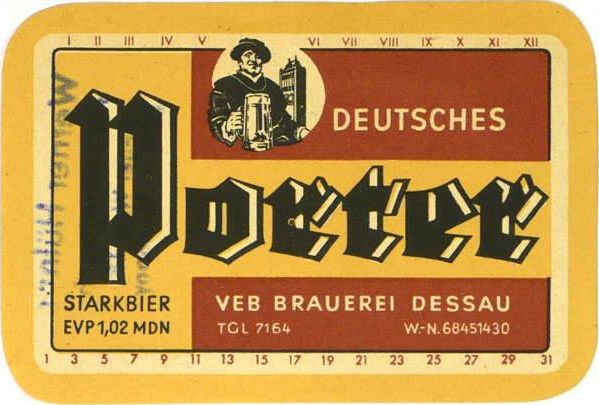
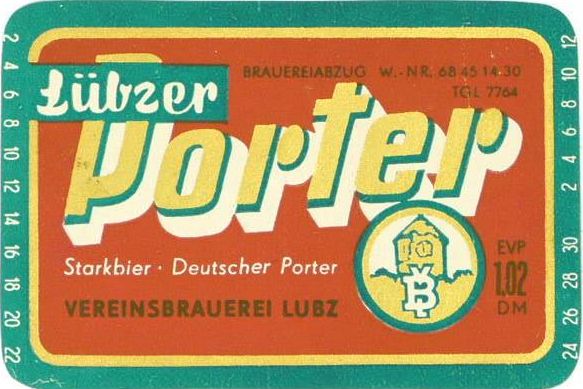
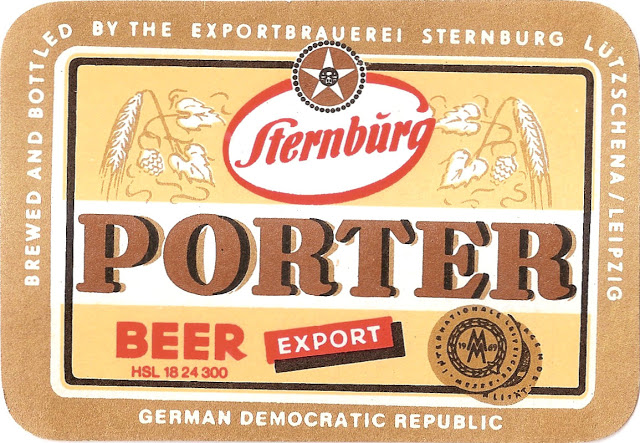
The quantities produced was probably pretty small. But a surprising number of breweries made one. I know that from my DDR label collection. At least 15. That's how many I have labels from. I'm sure that there more quite a few more than that.

These are the 15:

Berliner Kindl
Braugold
Dessau
Eberswalder
Eibauer
Grabower
Greussen
Meisterbräu Halle
Lübzer
Magdeburg
Riebeck
Rose-Brauerei Grabow
Sternburg
Hochschul
Meininger 

It's weird how Deutscher Porter as a style seems to have been almost totally forgotten. Even though it was brewed until around 30 years ago. They all seem to have been discontinued soon after reunification. Either that, of the breweries simply closed. A few did reintroduce beers called Porter, but they were totally different in style. Much weaker and really sweet. Pretty awful, the ones I've tried.

Here are the labels:


Thursday, 19 October 2017

Deutscher Porter

I was most surprised when I discovered that Porter was brewed in the DDR. Excited, too, when I got to drink some.

While you couldn't find it in every corner shop, it was brewed in small quantities by a large number of breweries. Which is sort of what I'm trying to prove here.

These are just the labels I own. I've seen lots of others from different breweries. There must have been at least 25-30 producing it in the DDR. As far as I'm aware, it was usually top-fermented. I wonder why they all disappeared after reunification?


Tuesday, 1 September 2015

DDR Beer Styles (part two)

I realised there’s lots more information in TGL 7764 that’s interesting. Well, to me. I can’t speak for anyone else.

We’ll be looking at some of the more technical aspects. Such as which ingredients, and in which quantities, were required for each style. And stuff like packaging, shelflife and pasteurisation.

Beginning with the ingredients, I can now see a difference between Deutsches Pilsator and Deutsches Pilsner Spezial: the latter contained slightly more malt. Unsurprisingly, low-alcohol beers like Einfachbier and Doppel-Karamelbier have minimal hopping, considerably lower than even Berliner Weisse. The Pilsners and Porter had the heaviest level of hopping. Again, not really a surprise.

The other ingredients are more intriguing. Quite a bit of white sugar in Doppel-Karamelbier. Sugar colouring – I guess some sort of caramel – in Einfachbier, Doppel-Karamelbier and Porter. Plus artificial sweetener in Einfachbier. Don’t think the latter is a particularly DDR thing. They did exactly the same in the West in that class of beer. Unlike in the West, Berliner Weisse had to contain at least 30% wheat malt in the DDR.

I can’t believe this is the first time that I’ve noticed the bit about Dekkera bruxellensis (another name for Brettanomyces bruxellensis) in Porter. In "Leitfaden für den Brauer und Mälzer" (Dickscheit , 1953) has a description of Porter brewing that includes a secondary Brettanomyces fermentation in wood. It says this isn’t necessarily how Porter was brewed in the DDR, but was the proper method for the style. That caveat had me doubting whether Brettanomyces was ever used. This seems to confirm that it was.

DDR beer styles
lagering time (days)
label colour shelf life (days) pasteurised? standard minimum
Einfachbier brown 6 N
Weissbier dark green not specified N
Hell yellow 8 N 20 12
Schwarzbier red and black 15 N
Doppel-Karamelbier blue 30 Y
Deutsches Pilsner light green 10 N 25 15
Diabetiker-Pils white 30 Y
Deutsches Pilsator anything 18 N 50 30
Deutsches Pilsner Spezial anything 90 Y 50 30
Märzen light grey 30 Y
Weißer Bock oder Bockbier Hell wine red 10 N 30 18
Dunkler Bock oder Bockbier Dunkel wine red 10 N 30 18
Deutscher Porter carmine red 24 N
Source:
"Technologie für Brauer und Mälzer" by Wolfgang Kunze, 1975, pages 419 -  425.

Now some mostly packaging-related stuff. I love the way labels were colour-coded by style. If you think this is just a totalitarian thing, try taking a look at some modern beer labels. Pilsner ones are often green.

The life expectancy of bottled beer was pretty short. I can remember Eisenacher Hell being particularly unstable. Best to drink it on the way back from the shop. It didn’t matter too much because most beer was consumed close to where it was produced. And, as in the Czech Republic, people didn’t leave beer lying around at home.

The exception to this were the types that were pasteurised. And Berliner Weisse, for which there was no sell by date. As a naturally-conditioned beer, it could last pretty much forever. I’ve had bottles that were over 30 years old and still perfectly drinkable.

The lagering times look very short to me. Though I’m sure they’re longer than most industrial breweries now bother with. 30 days doesn’t seem long for Bock. Personally, I’d go for at least double that, preferably four times.

DDR beer styles
malt kg/hl max min hops g/hl white sugar kg/hl max sugar colouring kg/hl max crystal sweetener g/hl max salt g/hl max special ingredients
Einfachbier 4.5 40 0.2 8
Weissbier 14.5 80 Min. 30% wheat malt, Lactobacillus delbruckii
Hell 17 180
Schwarzbier 19 230
Doppel-Karamelbier 10.5 40 6 0.35
Deutsches Pilsner 20 250
Diabetiker-Pils 18 300
Deutsches Pilsator 20 300
Deutsches Pilsner Spezial 21 300
Märzen 24 240
Weißer Bock oder Bockbier Hell 26 180
Dunkler Bock oder Bockbier Dunkel 26 150
Deutscher Porter 34 500 0.45 100 Dekkera bruxellensis
Source:
"Technologie für Brauer und Mälzer" by Wolfgang Kunze, 1975, pages 419 -  425.


Finally, I love this little note about what couldn’t go on a label:

"Fantasy names, which suggest a higher quality, such as:

Edel, Doppel (with the exception of Doppel-Karamelbier), Extra, Exquisit, das Feinste, aus bestem Malz und Hopfen bereitet, are not allowed."
"Technologie für Brauer und Mälzer" by Wolfgang Kunze, 1975, page  426.

There are lots of labels today that would fall foul of that rule.