Thursday, 18 July 2019

Parti-gyling in the 1950s

A technique much-beloved of UK breweries, for a whole variety of reasons. The most obvious being efficiency. It was a way of using every last drop of wort.

Parti-gyling was also a very convenient and economical way of producing low-volume beers. Fullers, for example, with a brew length of 200-300 barrels, produced OBE, their Burton Ale, in batches as small as 10 barrels. This was only possible because it was parti-gyled with a much larger quantity of Mild Ale.

Here’s an example of one of those Fullers parti-gyles of OBE with Mild:

1958 Fullers OBE
barrels OG
21.75 1059.5
4.25 1013.1
1.25 1002.8
27.25 1049.6
Source:
Fullers brewing record held at the brewery


1958 Fullers Hock
barrels OG
79.25 1059.5
117.5 1013.1
2.25 1002.8
199 1031.4
Source:
Fullers brewing record held at the brewery

The three worts were hopped and boiled separately then blended post-boil to hit the required volumes and gravity for the two beers.

In Scotland, virtually everything was parti-gyled. Most breweries had a single recipe from which they produced three separate Pale Ales (60/-, 70/- and 80/-) and a Strong Ale.


This is an exceprt from my excellent book on brewing after WW II.


http://www.lulu.com/content/paperback-book/austerity/23181344


Wednesday, 17 July 2019

Let's Brew Wednesday - 1944 Fullers X

I'm still not done with 1944. This time we have a lovely watery Mild.

To complement their stronger XX Mild, Fullers also brewed the weaker X. The war hadn’t been kind to X, dropping it to minimum OG, down from a more respectable 1033º in 1939. At least it wasn’t going to get any weaker. Though, at just 2.5% ABV, it wasn’t really an intoxicating beverage.

You won’t be surprised that it was parti-gyled with XX, hence the grists are identical. As are the hops, which were all English from the 1943 harvest. So reasonably fresh.

Though X was Fullers biggest seller, they dis brew considerable quantities of XX. In this particular parti-gyle there were 225 barrels of X and 155 barrels of XX.


1944 Fullers X
pale malt 5.00 lb 83.33%
flaked barley 0.75 lb 12.50%
glucose 0.125 lb 2.08%
caramel 1000 SRM 0.125 lb 2.08%
Fuggles 90 min 0.50 oz
Fuggles 30 min 0.50 oz
OG 1026
FG 1007
ABV 2.51
Apparent attenuation 73.08%
IBU 15
SRM 12
Mash at 147º F
After underlet 150º F
Sparge at 168º F
Boil time 90 minutes
pitching temp 62º F
Yeast WLP002 English Ale

Tuesday, 16 July 2019

Public House Hours

Much as in WW I, a patchwork of local restrictions on pub opening hours emerged during WW II.

Though in the latest conflict, these restrictions had no basis in law, but were informal arrangements agreed to by the interested parties. That is, the breweries owing the pubs and the publicans.

This is how it went in Hull.

"PUBLIC HOUSE HOURS
IN this column on August 26 we suggested that a general agreement for the opening of public-houses for two hours at lunch time, with a final closing at 9.30, should meet the needs of all reasonable people. Later came advice from certain brewery companies that houses in the centre of the city should close at 9 o'clock, leaving licensees in the suburbs to please themselves up to 10 o'clock. Yesterday all the breweries with interests in the city issued a combined instruction that every house within the city boundary shall close at 9.30. Those in the centre may close at 9.0 if the licensee or manager so decides.

It is sensible and commendable decision, for it places all tenants and customers on the same footing. Previously centre city houses had to close at 9.0. Now they may. All, whether in the city or suburbs, must close at 9.30. The order comes into force on Monday, and lasts the end of March next. It is a voluntary giving up of certain rights in the interest of the trade and population alike, and will, we think, meet with the approval of those who frequent licensed premises and those who do not. Admittedly it is something in the nature of a curfew, but it will not be enforced by armed bands as is the case in Oslo, and now Paris."
Hull Daily Mail - Friday 19 September 1941, page 4.
The pre-war closing time in Hull had probably been 1030 PM. In earlier posts I've written about how pubs in city centres - especially those, like Hull, where there was a high likelihood of bombing - closed earlier than usual. But mostly suburban ones seem to have been left alone. In Hull, all pubs had the same restrictions imposed. Which does seem fairer.

Though a few days later a disgruntled drinker made a rather valid point about clubs.

"PUBLIC HOUSE HOURS
Sir, —I observe that the brewers and bottlers at a meeting had ordered that licensed houses within the city boundary shall close at 9.30 p.m. They further empowered a certain class of licensee to close at 9 p.m. No mention, I notice, is made as clubs.

May I ask whether this order means that licensees are instructed to turn everyone (whether alcoholic drinkers or otherwise) off their premises when the hour of 9.30 p.m. arrives?
A BEER DRINKER."
Hull Daily Mail - Tuesday 23 September 1941, page 6.

Did the restricions apply to clubs? I've no idea.

The reference to the curfew in the first piece was explained by another article on the same page. It relates how the Germans had introduced a 9 PM curfew in Paris diue to attacks on German soldiers. Anyone caught breaking the curfew would be taken hostage. Leaving them likely to be shot in retaliation for further attacks on Germans

Makes you realise things in the UK weren't that bad.

Monday, 15 July 2019

London Brown Ale during WW II

Yes, I am still working on my new book. After lots of interruptions due to travelling like a crazy thing. Hopefully, I'll have the bastard done by next year.

By 1944, most London Brown Ales were lucky to hit even 3% ABV. Looking at the beers in the table below, most look like bottled Ordinary Mild. Many gravities clearly just fell along with the general fall in gravity. 

To put the gravities into context, in 1939 average OG was 1040.93 and in 1944 1034.63. That's not really so bad a drop, when you think about what happened in WW I. Though if you compare this set to the pre-WW II one, you’ll see that most examples have moved down a class. From a Best Mild type gravity in the low 1040ºs, to an Ordinary Mild type strength of around 1030º.

All are reasonably dark. On this colour scale, a typical post-WW II Dark Mild would be 8-100. But in this period, Mild was often pale than that. Darker than Bitter, but not truly dark. In the 40-60 range on this scale.

The attenuation is a bit on the low side. Quite possibly the result of primings added before bottling. As, unlike with cask Mild, which would undergo a secondary fermentation, Brown Ale was a brewery-conditioned beer. Before bottling, it was chilled and filtered to prevent a secondary fermentation.


London Brown Ale during WW II
Year Brewer Beer OG FG ABV App. Atten-uation colour
1940 Barclay Perkins Doctor Brown Ale 1036.8 1010 3.47 72.82% 70
1944 Barclay Perkins Doctor Brown Ale 1034 1010.9 2.99 67.94% 105
1944 Beasley Dark Brown Ale 1033.1 1012.4 2.67 62.54% 85
1944 Charrington Brown Ale 1029.2 1011.6 2.27 60.27% 95
1944 Hammerton Nut Brown Ale 1028.7 1006.8 2.84 76.31% 68
1942 Mann Brown Ale 1035.6 1009.4 3.40 73.60% 77
1941 Watney Brown Ale 1034.3 1009.9 3.16 71.14% 87
1944 Watney Brown Ale 1031.6 1010.4 2.74 67.09% 80
Sources:
Whitbread Gravity book held at the London Metropolitan Archives, document number LMA/4453/D/02/001.
Barclay Perkins brewing record held at the London Metropolitan Archives, document number ACC/2305/01/623.

Sunday, 14 July 2019

Army rule dims Brussels Gaiety

The newpaper archive is such a great resource. I keep finding fascinating insights into various aspects of WW II.

Like this little article about British troops on the town in Brussels. They certainly hadn't wasted any time. This article was published on 29th September, just a couple oif weeks after the liberation of Brussels on 4th September.

""11.20 bed” Army rule dims Brussels Gaiety
From HILDE MARCHANT Brussels, Thursday.
THE great call in Brussels last night was "Teem, gentlemen, plees," for by order of the supreme military command all cafes, restaurants and night clubs are to close sharp at eleven o'clock.

This order came into force last night, with a heavy penalty for troops who broke it and were not back in billets at 11.20 p.m.

So this capital, which normally has the gayest night life of any in Europe, goes quietly to bed at an hour when it would usually be just getting lively.

The proprietors of these night life places are quite angry at the order, mainly because they make money hand over fist on any of our boys who want a night's leave dancing and drinking.

For this town, like Paris, is enjoying a glorious, dizzy drunk on the franc. Prices are incredibly inflated, and in spite of the kindness and hospitality, one of the embarrassments of being a liberating army in this area is that you pay three and four times the normal price.

Our boys on leave have little enough money to spend and it does not go very far when you consider the franc at 175 to the pound and a glass of inferior, vinegary wine at 43 francs.

I was not surprised, when last night met two boys from Durham — Sergeant Fred Young and Private George Tomkinson - rather disillusioned about the bright night life of the continent. Said Fred Young: “When I was in Durham I always wanted to come to these places over here. And now I'm here I want to be Durham.”

But take the day these boys have had on leave. They got twelve hours. They queued for hour to check in with the military police. Then they queued for two and a half hours at the Paymaster's office in a bank to draw a few francs to get about.

This is one of the troops greatest irritations. There is one clerk to handle hundreds of men who want leave money.

I went to the bank myself  yesterday and saw battle-weary and stained men standing for two hours or more get to the counter.

I have seen British troops counting out their money before they could go into a cafe for a beer. They have their pay all right, but it costs them five shillings for a couple of glasses of beer that an English pub would be ashamed to call lager.

Something must done about the rate of exchange, for while the boys appreciate the flowers and fruit that were pelted on them when they entered the town, they would now appreciate a reasonable rate of exchange to cover the inflated prices they meet everywhere.

So for the most part twelve-hour leave from the front in Brussels means walking round the town, looking at sights, buying few souvenirs and little beer and then returning happily to camp.

I understand that this problem prices and exchange being considered the military authorities, and it is likely that troops will be able exchange their pay for a much higher rale, unless prices are brought down to near normal.

This would mean that military personnel could get a better rate in order to meet the dizzy scale of charges."
Daily Mirror - Friday 29 September 1944, page 5.
 Typical that the British introduced a closing time of 11 PM. Just like back in the UK.

The prices really do look outrageous. 5 shillings for a glass of crap wine is really taking the piss. There probably wasn't much beer around, and what there was wouldn't have been very strong. By late 1944 very late brewing was going on on German occupied territory due to a shortage of raw materials.

Saturday, 13 July 2019

Lets's Brew - 1944 Barclay Perkins BS

We're still in 1944. As no-one has insisted that I stop yet. Not that I pay any attention to readers' requests.

In the early 19th century, I’m sure that BS stood for “Brown Stout”. By the 1940s, while the brew house designation remained BS, it was marketed as “Best Stout”. Whatever. It was Barclay Perkins main Stout brand.

From wartime price lists, I know that Best Stout was both a bottled and draught product. On draught, it was in the same price class as Burton, 1s 5d per pint. And about as strong a draught beer as you’d find.

It has a relatively complex grist, with three malts and roast barley. The latter is an interesting one. London brewers generally preferred black malt. But, in this case, it seems that Barclay Perkins was using it as the unmalted grain portion of the grist. A clever one, that. Their other beers all contained flaked barley.

What I love about the Barclay Perkins logs is that they list the hop variety. Unlike most other breweries. Meaning that I know for certain all the kettle hops were Fuggles and the dry hops EKG. The latter being from the 1944 harvest, while the other were from 1941 and 1943. As this beer was brewed in December, the kettle hops were quite old.


1944 Barclay Perkins BS
mild malt 6.00 lb 59.26%
brown malt 0.50 lb 4.94%
amber malt 1.00 lb 9.88%
crystal malt 60 L 0.50 lb 4.94%
roast barley 1.00 lb 9.88%
No. 3 invert sugar 1.00 lb 9.88%
caramel 1000 SRM 0.125 lb 1.23%
Fuggles 90 mins 1.00 oz
Fuggles 60 mins 0.50 oz
Fuggles 30 mins 0.50 oz
Goldings dry hops 1.00 oz
OG 1044.5
FG 1017.5
ABV 3.57
Apparent attenuation 60.67%
IBU 26
SRM 32
Mash at 143º F
After underlet 147º F
Sparge at 165º F
Boil time 90 minutes
pitching temp 60º F
Yeast Wyeast 1099 Whitbread ale

Thursday, 11 July 2019

Sunday in Boston

I awake feeling quite knacked. The last few days have taken their toll. Way too much standing around.

There’s still no wifi. This is starting to get really annoying.

I drag my bags up to Providence Station. A group of young Russian men overtakes me. I really am becoming a feeble old twat. Especially if hills are involved. Really can’t cope with inclines no more. I genuinely have no inclination to climb. I blame the Dutch for being too cheap to build any hills.

The station surprisingly crowded. I try to buy a ticket.

"A one way to South Station, please."

"Is that on the MBTA?"

"Yes."

"Then you need to get the ticket on the train."


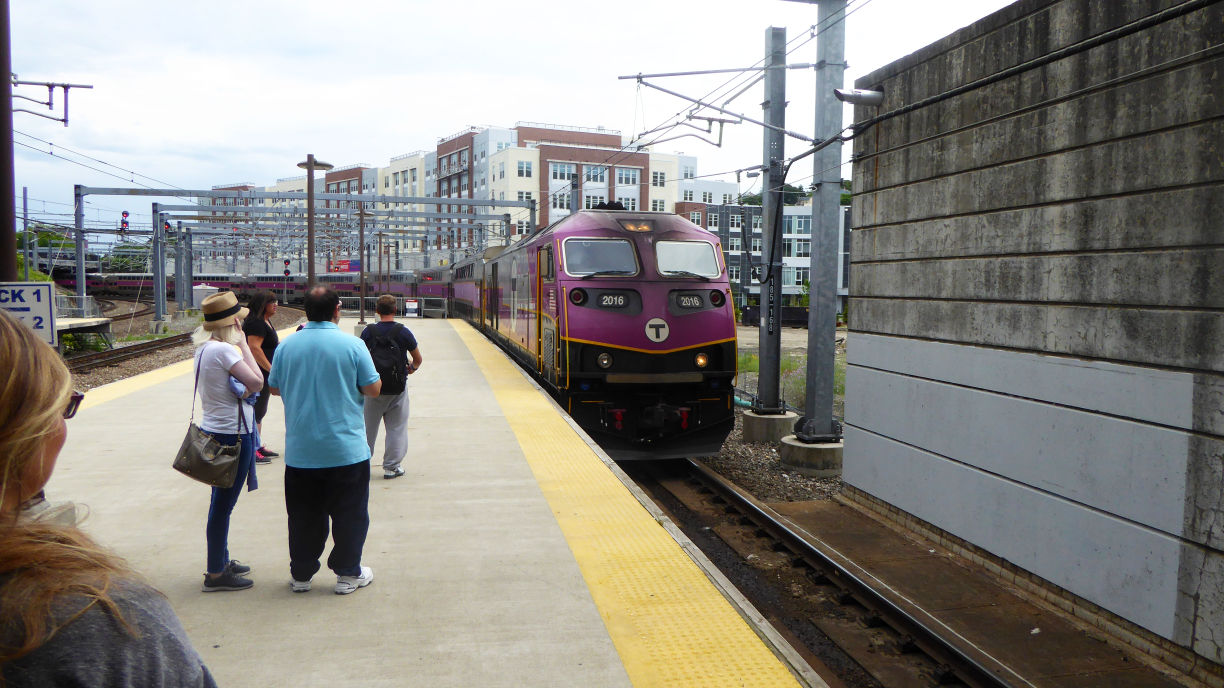
When the train comes in, it's half a dozen double-decker cars. Which seems a bit overkill, given how few people were on the train out. And that was a weekday.

How wrong I was. The train is mobbed. I'm lucky to get a seat. Who are all these people? I can spot some who had obviously been at the conference, based on their T-shirts or Briess bags. But there are also lots who look like students.

I’m an early boarder and can grab myself a seat and space for my bags. Others aren’t so lucky. There’s a constant back and forth of seat seekers.

Why are passengers only allowed to board via a couple of doors on US trains? Seems a crazy way to operate. Especially on a crowded train like this one. Makes it much more difficult to distribute everyone evenly. And longer to board. Much about American train travel seems weird to European eyes. Not just the skeletal service and ancient rolling stock.

The ticket costs me $10, while on the way out it was $11.50. I’m going slightly further, too.

There's a reason I'm headed to South Station: there's a direct connection on the T to Kendall station. Which is right next to my hotel. I don't want to take a taxi here if I can avoid it. Boston taxi drivers angry me up something crazy.


I check in and rest up a little in my room. And drink some of the beer I've accumulated. My plan for later? Mead Hall and maybe CBC. They're the reason I chose this hotel. No point making your life more complicated than necessary.

I wander along to Mead Hall. There’s some Jaque D’Or artwork on the wall still. Cool – Pretty Things aren’t forgotten.

I’ve started with a session beer:

Captain Lawrence Cookie O’Puss Imperial Stout
It’s black as fuck, but just 8% ABV. Just barely a Double Stout, really.

So glad to be here again. One of my favourite US beer bars. Sorry. I should be telling you about the beer. Thick and roasty, as black as Trump’s stubbed toenail. Not bad at all. If that appears faint praise, it isn’t.

This is a decompressing day. Calming down on my own after a hectic conference. Which was fun, but involved way too much standing.

Since passing 60, I’ve noticed my body can’t take as much craziness as even when I was a spritely 50-something. Listening to my body’s complaints and slowing down are important if I want to hit 70 in good nick, let alone 80.

Not sure I want to do so many US trips in such a short space of time again. Knackering and I’m not sure that I appreciated them all. Though I still probably wouldn’t change anything.

I’ve not eaten anything today so far and it’s 5 PM.  Unless you count beer as food. I really should have something solid. The wild boar meatballs are tempting. So I order them.


They aren’t joking when they write “small plates”. I’m fine with it, mind. Don’t want to occupy too much valuable beer space with useless ballast.

I was fascinated to learn that the wild boar in the USA were originally domesticated European pigs that escaped and reverted to feral form.  How does that work?

I had been thinking that bringing my coat was a waste of time. But it’s been raining here today and the temperature has fallen quite a lot. It’s actually quite pleasant at the moment. Though it hasn’t been that bad anywhere so far. Not like the hell that was North Carolina.

The bloke next to me chomping on a burger just dropped some of his cutlery on the floor. And didn’t bother picking it up. He wasn’t using it, but I would never have let it lie like that. Been raised better than that.

The wild boar meatballs were very nice, but a bit skimpy for $15. I’m tempted to order more food.


Schilling Fall of Babylon 9% ABV
Stronger, but in a smaller measure. Wings and throundabouts. More burnt and less rich than the last one. Odd, as it’s stronger.

I get another one. Probably my last here. I’m starting to fade, though it isn’t late. The disadvantage of being an old twat.


The list is very heavy on IPA and sour beers. I’ve seen much worse, though. How dangerous must it be to update that draught beer blackboard? It’s up pretty high. And it doesn’t look as if it’s detachable.

I don't stay out that late. I have just the three beers. Though they are all Imperial Stouts.

I start feeling a bit peckish. Rather than get room service, I run down to the hotel's restaurant and get a carry out pulled pork sandwich. It comes with a big pile of chips. That's OK. I've eaten fuck all while I've been over here. I've only had a handful of proper meals.

Enough of a whisky sledgehammer remains to pat me into deep sleep.


Meadhall
4 Cambridge Center,
90 Broadway,
Cambridge,
MA 02142.
Tel: +1 617-714-4372
https://themeadhall.com/

Whitbread Double Brown 1939 - 1945

Back to Whitbread Double Brown during the war year. This time looking at alll the fun ingredients: adjuncts, sugar and hops.

There wasn’t quite so much variation in the adjuncts and sugars employed by Whitbread. Pre-war, all of their beers had been brewed from malt and sugar only. Making them one of the small number of UK brewers who totally eschewed unmalted grains. This changed a couple of years into the war when, like everyone else, Whitbread was compelled to first oats and later flaked barley.

The proportion of sugar in the Double Brown Varied considerably. Presumably dictated by it availability, rather than out of choice. I suspect that what is listed as “Albion” in the early war years was really No. 3 invert. Though I can’t be sure of that. It’s with this that most of the variation in the percentage used occurred. Sometimes it was around 5%, others 20%.

What’s listed in the brewing record as “Hay” was a type of caramel. Probably a specific proprietary brand called Hay’s M, which was a favourite of Whitbread’s and which they were still using in the 1960s.

Located nearby in London, Whitbread had always used large quantities of Kent hops. Though they did also employ hops from other English regions and abroad.

In 1940 and 1941, some New Zealand hops found their way into Whitbread’s beers. Given their age, it’s safe to assume that these were old stock that they had lying around and which were used in times of shortage.

By the end of the war, the hops were 100% English. No real surprise, as hop imports had almost ground to a complete halt. Between 1940 and 1945, just 16,668 cwt were imported, compared to 44,056 cwt in the single year of 1939.


Whitbread Double Brown adjuncts and sugar 1939 - 1945
Date Year OG flaked barley no. 3 sugar Albion Hay total sugar
21st Sep 1939 1054.5 19.57% 0.54% 20.11%
11th Apr 1940 1054.1 4.23% 0.53% 4.76%
14th Aug 1940 1049.3 10.53% 0.66% 11.18%
20th Nov 1940 1047.3 5.17% 1.78% 6.95%
31st Jan 1941 1046.1 5.38% 1.85% 7.23%
13th Oct 1944 1044.2 14.63% 6.50% 0.81% 7.32%
24th Aug 1945 1043.3 12.66% 16.89% 0.79% 17.68%
Sources:
Whitbread brewing records held at the London Metropolitan Archives, document numbers LMA/4453/D/01/107, LMA/4453/D/01/108, LMA/4453/D/01/111 and LMA/4453/D/01/112.


Whitbread Double Brown hops 1939 - 1945
Date Year OG hops
21st Sep 1939 1054.5 Worcester (1938), MK (1937 CS), EK (1937 CS), Sussex (1936 CS)
11th Apr 1940 1054.1 MK Whitbread (1937 CS, 1938 CS, 1939), MK (1938)
14th Aug 1940 1049.3 MK Whitbread (1937 CS, 1938 CS), EK (1938 CS, 1939)
20th Nov 1940 1047.3 MK (1938, 1939, 1940), Kent (1938), New Zealand (1936)
31st Jan 1941 1046.1 Worcester (1939), Kent (1938), New Zealand (1936)
13th Oct 1944 1044.2 MK (1943) EK (1943)
24th Aug 1945 1043.3 MK (1944), Worcester (1944)
Sources:
Whitbread brewing records held at the London Metropolitan Archives, document numbers LMA/4453/D/01/107, LMA/4453/D/01/108, LMA/4453/D/01/111 and LMA/4453/D/01/112.

Wednesday, 10 July 2019

Let's Brew Wednesday - 1944 Barclay Perkins KK (trade)

The draught Burton of Barclay Perkins had seen some changes since the outbreak of war. Most obviously, to its strength.

The gravity was down about 20% on its pre-war level, more the fall in average OG which was about 15%.  In general, strong beers suffered heavily from gravity cuts. That’s if they were still brewed at all. Little over 5% ABV was brewed in the later war years.

The effective OG would have been a point or two higher on account of the primings added at racking time: 2 quarts per barrel of a sugar solution with a gravity of around 1150º.

The grist isn’t hugely different from pre-war. The base malt has been simplified, with the mild malt and pale malt being dropped in favour of 100% SA malt. For which I’ve substituted mild malt. Confusing, I know. And flaked barley replaces flaked rice. Bizarrely, there’s a small amount of lager malt. I’m guessing because they had some spare lying around.

The hops were Kent Fuggles from the 1941 and 1943 harvests and Mid-Kent Fuggles from 1943. The dry hops were East Kent Goldings from 1944.


1944 Barclay Perkins KK (trade)
mild malt 6.50 lb 68.10%
amber malt 0.75 lb 7.86%
crystal malt 60 L 0.50 lb 5.24%
lager malt 0.25 lb 2.62%
flaked barley 0.67 lb 7.02%
No. 3 invert sugar 0.75 lb 7.86%
caramel 1000 SRM 0.125 lb 1.31%
Fuggles 90 mins 0.75 oz
Fuggles 60 mins 0.75 oz
Fuggles 30 mins 0.75 oz
Goldings dry hops 0.50 oz
OG 1043.5
FG 1015
ABV 3.77
Apparent attenuation 65.52%
IBU 30
SRM 17
Mash at 147º F
After underlet 152º F
Sparge at 165º F
Boil time 90 minutes
pitching temp 60º F
Yeast Wyeast 1099 Whitbread ale

Tuesday, 9 July 2019

Conference end

I rise earlier today. But I'm not in any rush. No point making my life unnecessarily stressful.

I have the leftover crisps from yesterday's sarnie for breakfast. A suitably healthy start to the day.

I'm already planning my next US trip. How crazy is that? Michigan in October. I'll be talking at EMU again. Was lots of fun last time. That'll be trip number five to the US this year. Maybe Dolores is right about my travel schedule.


A large pall of smoke hanging over the city when I head to the offie. Looks like something is on fire somewhere. Thankfully not that close by. There are more dead bottles under the motorway interchange. Odd tastes these drinkers have.

The wifi connection suddenly disappears just before I'm about to head for the conference. That's annoying. Just as well I've nothing important that requires internet access.

Bump into Pablo again. He's from Argentina. I tell him how much I'd like to visit there.


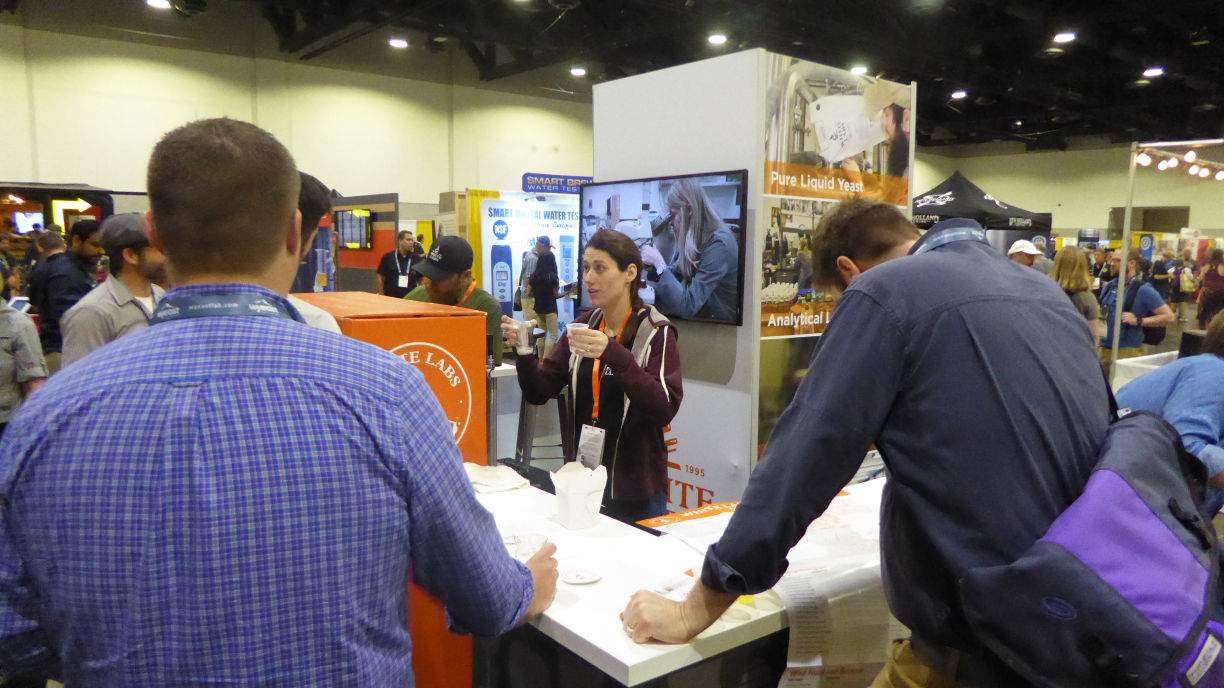
The nice lady serving at the White Labs stand clearly remembers me "090 and a full glass?", she asks.

She knows me better than I know myself. "Yes, please." I'm a polite bastard, if nothing else.

I take a seat. My feet are shot. Way too much standing the last few days. My poor old bones aren’t up to standing around for hours on end. I need to have a good sit down regularly.

Brad Smith is giving out raffle prizes. It’s quite entertaining.

Last event of the weekend is the home brewing awards. I sit at a random seat for the ceremony. One of my neighbours says: "Hello Ron, would you like some beer?"

"Hell, yes." It's a Stout.

One of the club members wins an award. "You've brought us luck, Ron."

I'd like to think that was true. But I'm not going to argue. It's sometimes weird being me. Obviously, as you aren't me, you don't know what it's like. Odd, humbling, disconcerting, fun, crazy, and strangely satisfying. And tiring, feety aching. But I wouldn't swap my life for anyone else's. Unless they were 18 and dead fit. Then I'd strangle the bastard and dump the body in the nearest canal.

They give me a couple of bottles of leftover competition beers. Always handy to have some hotel beers.

After the awards, there's a buffet. I grab some clams and shit and take them back to my room. I need some rest.


I nip out in the evening to Union Station for a beer. Now I twig why the station is in such a funny spot and sparkly new. This used to be the station: closer to the town centre and a much more attractive building.


After a couple of beers, I trail over to Subway for a sarnie. I'm such a flash bastard.

There's still no wifi connection in my room. It's fine. I'm only here a few more hours. And there’s still whisky to help ease me into oblivion.


Union Station Brewery
36 Exchange Terrace,
Providence,
RI 02903.
Tel: +1 401-274-2739
https://www.johnharvards.com/locations/providence-ri/

Monday, 8 July 2019

Conferencing

No hurry today. I rise late and take my time showering and shaving.


I need some bourbon for the lads and wander down to the nearest offie. Not the best selection in the world, but I find something. For $20-something. Which is how much I love my kids: $20-odd. That's one less thing to worry about.

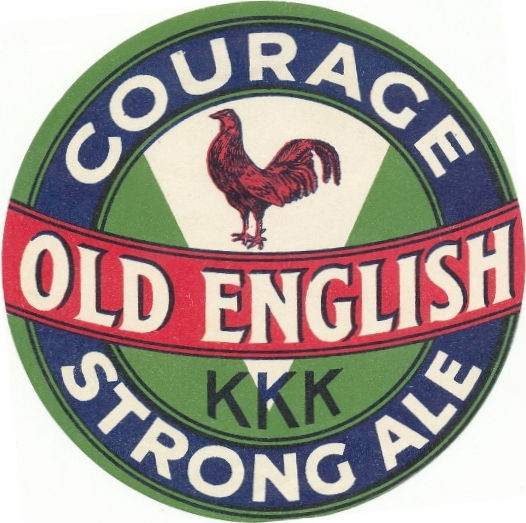
The first part of the walk to the offie is a bit weird, going under a huge motorway intersection. Don’t know what goes on here, but there are loads of empty fag packets and beer bottles. Including this classic:


It's after midday by the time I troll along to the convention centre. My only real plan is to watch Stan's talk on hops. A subject I realise I know bugger all about, really.

But before he's on, I've time to stroll around the exhibition and drink some beer. I have a particularly good home-brewed Imperial Stout.

Stan's talk is fascinating and I learn loads. When he's done I go up and chat with him. Then David Lavery turns up and we head off for some more beer.


I realise that I completely forgot my book signing. Bum. Totally went out of my mind.


Based on my North Carolina trip last month, many beer pubs mostly sell sludge IPA, sour beers with fruit and all sorts of other shit in them, and Imperial Stouts with all sorts of other shit in them. Truly a golden age for beer consumers. If they like drinking beer that's either half fruit juice, full of sludge or effectively a milk shake. The kids seem to love this shit. Stupid bastards.

The home-brewed beers at the conference, are often better. Not so much crazy shit. Even the occasional Dark Mild. I have one that’s so nice, I go back for a second.


I try to get into the Imperial Stout talk with David, but it's full. That's a bummer. Just have to drink more beer.

When the conferencing is done we go in search of food. Not that far, just to the Union Station brewpub, which is almost next door to the hotel. Much less crowded than yesterday. As it’s a pleasant evening, we sit outside. I have my first proper food of the day: a sandwich with a few chips. It’ll do. For the moment.


Sated, we return to the convention centre. It's Club Night and lots of people are in fancy dress. Very colourful and slightly surreal. I feel rather underdressed. I could claim I’ve come as a fat English beer writer.

Again, I keep bumping into people. Like Jack Horzempa, whom I know from BeerAdvocate. And Hopfenunmalz, also from BeerAdvocate. After a while, I need to sit down I'm feeling knacked and my feet are killing me.

I seem to have forgotten to eat properly again. When I'm back in my room, I order a room-service sandwich. That'll do.

Whisky whisks me away to slumbertown again.


Union Station Brewery
36 Exchange Terrace,
Providence,
RI 02903.
Tel: +1 401-274-2739
https://www.johnharvards.com/locations/providence-ri/

Sunday, 7 July 2019

Providence express

I don’t get up too late. I’m speaking at 15:15.

A train from Back Bay station at 10:30 will get me to Providence by 11:40. Sounds perfect. I should be checked into my hotel and have my bags dumped by 13:30.

I risk another taxi. The station is close enough for there to be little scope for cheating. And it’s virtually in a straight line. But you never know in Boston.

Getting to Back Bay station 45 minutes before the train leaves me time for a breakfast sandwich just down the street. At a health foody sort of snack place called B.GOOD. But they have exactly what I’m after: an egg, bacon and cheese sandwich. A suitably bacony start to the day.


Back Bay station is a bit gloomy, being underground. Which isn’t unusual in the US. Especially city stations. They do have some nice old photos of stations in the region. While I’m waiting an Amtrak train rolls in on the opposite platform. Looking exactly like all the other Amtrak trains I’ve ever seen. They must have built a shitload of those carriages.


The carriage of the MBTA train I’m taking looks 50 years old. At least. And is virtually deserted. Neither good signs for the future of public transport here. It’s not the oldest and tattiest carriage I’ve ridden in the US. That honour goes to a New Jersey Transit train I took with the family some years back. Totally fucked, that was, with big splits in the upholstery..


Unlike the New York to Philadelphia route, there is at least some stuff that passes for countryside. Not just rotting factories interspersed by the odd patch of trees.

Providence station is a modern, but dreadfully bland, concrete affair. Located reasonably centrally. Unlike Atlanta’s Amtrak station, which is two states over. It’s only a few minutes’ walk to my hotel. All downhill. I’d forgotten how hilly Providence is. Especially compared to Amsterdam. Though even Newark is hilly compared to Amsterdam.

I get checked in and stroll over to the convention centre. People start coming up to say hello before I've even registered.

As soon as I have my lanyard and glass, I head into the main hall in search of beer. It doesn’t take much effort to find some. Surprise, surprise: it’s an IPA of some description.


I’ve time for a few more beers before showtime. And to chat with various random people.

It’s one of the biggest audiences I’ve spoken to. I get some pretty good laughs. And do quite a bit of swearing. I bash it out in exactly 45 minutes. Hurrying along at breakneck speed. 58 slides is a lot to get through in under an hour.

David Lavery comes up to chat when I’m done. I met him a few years back in Colonial Williamsburg and we’ve been corresponding by email. I’ve brought along a couple of books for him.


Back in the exhibition hall Kristen England rumbles noisily up and is his usual snarky self. The personality might still be neon, but his socks toned have down 40 or 50 shades since Chile. That’s a relief. I wouldn’t want to be blinded.

Stan Hieronymus joins us. He missed my talk because he was judging. Rather him than me. Three full days of judging in Chile took the shine off it for me.

I bump into more people: Doug Piper, Brad Smith, Pablo from White Labs and many others.

I notice Horst Dornbusch seated nearby. I don't go up and say hello. What could I say? “Hi, you fucking charlatan.” That wouldn’t get me anywhere. And I prefer to avoid unnecessary conflict. Even on the internet, nowadays.

We watch the keynote speaker. The audience is ginormous.

David, Stan and I decide to climb College Hill towards Brown University to get some food. On the way we pass the Union Station brewpub, which is, unsurprisingly, totally mobbed with a queue of conference attendees queueing to get in.

Climbing the hill isn’t great fun. I’m really unused to hills. Still, it’s more pleasant than last time I came this way, when I was here with the family. That time it was freezing cold and snowy.


There are some lovely mansions on the way up. Some in typically ornate late Victorian style. Others which look considerably older.

Finally, we get to the top. Where we plump for a Mexican place, Baja's Taqueria. I order a rather nice burrito with some sort of roasted pork. Dead tasty. I don't eat it all, saving half for later.


Final event for today is for pro night. Where I meet loads of other people I know. Averie Swanson, James Czar (who hosted me in Cincinnati last year), John Mallett, Chris from Maryland Homebrew. It’s good to see Averie again. We met in Chile in 2017. I’d been expecting to see her when I was at Jester King earlier this year, but she’s moved on.

John Mallett suggests I do something at Bells in Kalamazoo. I'm up for that. Crazy name, dead cool brewery, someone I really like. That's a whole stack of wins.

I don’t stay out too late. Back in my room, I finish off my burrito. It still tastes ace.

Even the aching of my feet can’t stop me running headlong into sleep. Especially with a following wind of whisky.


B.GOOD
131 Dartmouth St,
Boston,
MA 02116.
Tel: +1 617-424-5252
https://www.bgood.com/


Baja's Taqueria
229 Thayer St.,
Providence,
RI 02906.
Tel: +1 401-808-6141
https://www.bajasrestaurants.com/

Saturday, 6 July 2019

Let's Brew - 1944 Adnams Double Stout

Yet another 1944 recipe. Not sure why I keep posting these, other than it's 75 years ago. And I'm writing a book about brewing in WW II.

The war seems to have barely brushed Adnams beers. A slight fall in gravity and hopping rate, but barely noticeable compared to the changes in London beers. That’s the advantage of kicking off the war with an unusually weak range.

After a couple of years of war, Adnams was down to just three beers: Bitter, Mild and Stout. That’s a pretty thin range, even for a brewery out in the sticks.

The only difference to the 1939 grist is the addition of flaked barley, which replaces some of the base malt and No. 3 invert. The grist remains quite rich, with three different coloured malts: amber, crystal and chocolate. Adnams were early adaptors of chocolate malt, substituting it for black malt in 1914.

There were two types of hops, both English, from the 1942 and 1943 harvests.

 
1944 Adnams Double Stout
mild malt 6.00 lb 66.08%
crystal malt 80 L 0.50 lb 5.51%
amber malt 0.50 lb 5.51%
chocolate malt 0.50 lb 5.51%
flaked barley 1.00 lb 11.01%
No. 3 invert sugar 0.33 lb 3.63%
caramel 2000 SRM 0.25 lb 2.75%
Fuggles 120 mins 0.75 oz
Fuggles 60 mins 0.50 oz
Fuggles 30 mins 0.50 oz
OG 1039
FG 1011
ABV 3.70
Apparent attenuation 71.79%
IBU 23
SRM 38
Mash at 148º F
After underlet 150º F
Sparge at 165º F
Boil time 120 minutes
pitching temp 59º F
Yeast WLP025 Southwold