Tuesday, 13 January 2009
Assessing beer quality
It occupied my thoughts as I sat on the sneltram this morning. How to convert those descriptive terms into a simple number. Eventually, I had an idea. A simple one, as mine usually are. I don't have the brain for complexity. Anyway, here's my idea. I'll give each of the descriptions a number. Zero is the level of just acceptable. Here's a slightly more graphic representation:
+3 v good
+2 v fine
+1 fine
0 moderate
-1 poor
-2 v poor, going off
-3 nasty, sour, foul, gone off
I'll be able to work out average scores for each beer type from a brewery and for a brewery overall. Any score below zero will be an indication of poor quality. Simple, eh?
Yesterday evening I quickly scanned the Gravity Book entries for a couple of breweries. I'm pretty sure I spotted a couple of patterns. But let me get some real numbers together before I spin any hypotheses.
Monday, 12 January 2009
Bear with me
I already started yesterday. Quickly scanning the pages for early 1920's Porter entries. There seem to be a lot of poor-quality Porter samples. At least on the pages I've looked at so far. I suppose I ought to go about things a bit more scientifically than that. I need to analyse the entries for several London breweries. See:
- what proportion of the Porter samples were below par
- if the proportion of poor samples is the same as for other beer types
Then I should have a better idea as to whether Porter was generally in worse condition than the other beers on sale. Exciting, isn't it? I never thought I'd be able to get any evidence about stuff like this. It should also provide evidence about which breweries were selling the best-quality beer.
But, before I can do that, I need to transcribe the relevant Gravity Book entries. And that will take some time. You're going to have to bear with me for a little while. Until it's all done.
Sunday, 11 January 2009
Why beer styles disaappear: Porter
This morning it was the turn of the Cannon Brewery. Stonch should be interested in this, because their brewery was in St. John Street, Clerkenwell. Bought by Taylor Walker in 1930, they stopped brewing in 1955 (thank you Norman Barber).
Many of the Gravity Book entries for the early 1920's include comments on the quality of the beer sampled. Very revealing, they are. Take a look:

See the comments for Porter? Every single one is negative. "Poor", "Sour" and my personal favourite: "Nasty". What is this telling us? That Cannon's draught Porter was usually in poor
condition. Sounds to me like it was in a negative spiral of falling sales, casks taking too long to be sold, poor beer, drinkers moving on to something else.It's also clear that Porter was still a standard draught beer. There are sets of samples for PA, KK, X and Porter. These must have been the usual handpulled beers in Cannon pubs.
Judging by the overall negative tone of the comments, Cannon had probles with the quality of all their beers. Though there are a few positive comments for PA and KK.
What do reckon, was the declining quality of Porter on sale partly responsible for uts disappearance?
Saturday, 10 January 2009
Ind Coope and Allsopp beers 1921 - 1938
More from volume 1 of the Whitbread Gravity Book today. IPA. Another interesting topic. There seem to have been two quite different types of beer called IPA between the wars.There's the weak but quite hoppy version made by London brewers. That had an OG of 1037-1045º. Weaker than standard draught Bitter, which was 1048 - 1055º. Both Whitbread and Barclay Perkins made this type of IPA. The attenuation was about the same as Bitter, between 70 and 80%.
IPA's brewed in Burton were quite different. Again, they were bottled beers. But a good bit stronger, around 1055º. I showed you the Worthington version a few days ago. Burton IPA's had an extremely high degree of attenuation, over 80% and sometimes over 90%.
Allsopp was another Burton brewery. Let's have a look at their beers:

You'll see that their IPA is very similar to Worthington's. It's a shame there's just the one sample, but it gives you the idea. It's strength wasn't much lowwer than in 1901, when it had an OG of 1062.
I've included some Ind Coope beers for no real reason other than that the two breweries merged in 1934. Ind Coope's brewery was in Essex. I'm surprised that the Arctic Ale wasn't stronger. I thought it was ridiculously strong.
So you can compare them properly, here are some London IPA's:
Friday, 9 January 2009
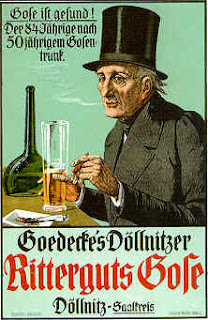
Fantasy beer history: Gose
My very personal relationship with Gose explains why I get so upset when I read total rubbish about it on the web. Today I'm going to discuss a couple of shockingly inaccurate histories of Gose.
The first is from the website of Four Peaks Brewing:
A cross-cultural constant is that water, whether it comes from the Colorado, the Ganges or the Seine, can just get so -- I don't know -- boring? That's why beer has been a favorite beverage since the heyday of Ancient Egypt, and why -- somewhere between then and now -- some creative beer drinkers in Liepzig and Goseler, Germany decided to add to the usual hops, barley, yeast and water two interesting ingredients: coriander and salt. The result was "Gosebier," which became hugely popular, especially in Liepzig. It also became popular to add different fruit and nut-flavored extractions to this tart, refreshing and somewhat acidic wheat beer. Raspberry and almond-flavored Gosebier joined the plain version at tables all over Germany, and there was much rejoicing. Unfortunately, Gosebier was literally knocked out of existence around the year 1516 with the amalgamation of Eastern Europe and the adoption of the German Purity Law, which demanded that beer only be brewed using variations on its four base ingredients.
History seems to illustrate that even basic good beer can get boring, and eventually the desire for different flavors overtook the German purity law. Gosebier began to make a comeback. Just as this unique beer was regaining popularity, however, the Communist Party took over East Germany. People had a helluva lot more to worry about than, "what neat, fun ingredients we can throw into our bier now?"
Four Peaks is glad to report that, since the dissolution of Communism in that part of the world, Gosebier has certainly made its comeback in Liepzig and even in Goseler -- and that it has finally arrived at our brewery. Brewmaster Andy Ingram -- who was the source for all of this information -- describes the Four Peaks Gosebier as a combination of a Belgian white beer (wittbier) and a Berliner wheat (weisse) beer. "The Gosebier is a wheat beer with a mild spiciness from coriander and a tartness from yeast and lactic acid," said Ingram. "It's refreshing. Many people can get turned off by the idea of adding salt," he said, "but in this case, the addition of salt in just the right quantity does what salt is supposed to do -- enhance the flavors of the beer and give it a big, round mouth-feel." The upcoming beer dinner in March will also feature the three different, traditional Gosebiers as part of the dessert course: raspberry, almond liquer-flavored and regular. Four Peaks Gosebier, which is on tap now at the brewery, weighs in at a light, drinkable 4% alc./vol. Ahh . . . just in time for Spring drinking. Prost!http://www.fourpeaks.com/Brewsletters/BrewsletterFeb2004.htm
Where do I start? Almost everything in the first paragraph is total crap. The Reinheitsgebot didn't apply to the places where Gose was brewed until the 20th century. Gose wasn't the result of "creative beer drinkers" adding stuff to their beer. It's called Gose not Gosebier. The town is Goslar, not Goselar. And Gose is brewed from wheat as well as barley.
Now leat's consider paragraph two. Gose wasn't making a comeback before the communists took over, it was in decline after WW I. Gose was brewed during the DDR period.
I suppose as American brewers who probably can't read German, they may have an excuse. The author of the following disinformation can make no such claim. This was written by German-born Horst Dornbusch and can be found on his "German Beer Institute" website.
In the 20th century, with its wars and dictatorships, Leipziger Gose slowly faded into oblivion. The air raids of the Second World War wreaked havoc and destruction on the brewing facilities, which the planned economy of the Communists proved incapable of rebuilding. The division of Germany during the Cold War (starting in 1949) into a "workers' and farmers' paradise" in the Soviet East and a "revengist, bourgeois" hellhole of "exploitation" in the capitalist West — separated from each other since 1961 by a the Berlin Wall and a death zone with barbed wire, search lights, and a brain-washed, trigger happy "people's army" — not only kept the East Germans in their socialist prisonThere's barely a true word in the first paragraph. The only brewery producing Gose in the 1940's was not destroyed in the war. It was on a country estate and survived intact. It never restarting brewing after the war. Gose was revived in 1949 (after the communists had taken over) at the newly-founded Friedrich Wurzler Brauerei in Leipzig. They were never short of grain for bread-making in the DDR. In any case, the bread was mostly made from rye, with a little wheat and certainly no barley . The last pre-unification Gose was not brewed in the 1950's. The Friedrich Wurzler Brauerei closed in 1966 after the owner died. It was so small and primitive that it wasn't worth nationalising and just shut down. Gose was revived by Lothar Goldhahn in 1986 and brewed at the Schultheiss Weissbier brewery on Schönhauserallee in Berlin until 1988.but also caused their beers to wither. Gose was still a local specialty in Leipzig, when the Communist regime in East Germany decided it had better uses for its feeble economy's precious grain. This was because food shortages that resulted from the forced collectivization of agriculture turned bread-making, not beer-making, into the almost sole purpose of the precious grains. Not surprisingly, all brewing suffered under the Communist regime and, by the late 1950s, the last pre-unification Gose was brewed in Leipzig.
Only after the Wall came down on November 9, 1989, could this traditional beer style make a comeback; and many craft breweries in and around Leipzig started to brew it again. One of the driving forces behind the modern Gose-Renaissance has been the Gosebrauerei Bayerischer Bahnhof (Gose Brewery Bavarian Station), wich opened its doors in 2000. It is located in the historic downtown train station dating from 1842 that linked Leipzig with Munich.
http://www.germanbeerinstitute.com/Gose.html
Sorry to come across all negative, but this sort of unresearched "history" drives me nuts. It's not hard to find the correct information, if you can be arsed. Even wikipedia gets it right. Then again, it was me who wrote the section on the history of Gose.
If you're interested, I've an accurate history of Gose here:
http://www.europeanbeerguide.net/leippubs.htm
Sources:
"Gose Häppchen:100 Jahre Gosenschenke Ohne Bedenken", 1999, pages 13 - 63
"Die Biere Deutschlands" Höllhuber & Kaul, 1988, pages 342 - 344.
Thursday, 8 January 2009
Worthington Beers 1921 - 1936
Here they are:
Because yesterday's image is acting a bit weird, here's another version:
Interestingly, the early 1920's version of Worthington IPA has almost exactly the same OG as the 1949 one. Very unusual. Most beers lost 25% or so in gravity over that period. Even weirder,
the 1955 versions (shown as White Shield and Green Shield) were over 1060. That's probably about the same as in the 19th century. Then in the late 1950's it dropped back to the low 1050's.Such a small drop in gravity was over the period 1900 - 1960 is really, really, really unusual. Very odd. Bleedin' weird. Most PA's/IPA's went from 1065 to 1037 over the same period. Apart from the weak, London-style IPA's. They started only started around 1050.
Of course, not having any numbers on pre-WW I Worthington IPA, I could be talking out of my arse here. I'm taking the very rash step of making an assumption. That Worthington and Bass had similar OG's in the late 1800's. Then again, despite what some may think, IPA wasn't a particularly strong beer. I've yet to find one over 1070.
Wednesday, 7 January 2009
News (good)
Tuesday, 6 January 2009
Worthington bottled beers 1944 - 1967 (again)

You'll have to wait till I have time for the pre war ones.
Monday, 5 January 2009
Bass bottled beers 1921 – 1938
There are a few that I haven't seen postwar: Amber Ale and No.5 Burton Ale. Others, like Barley Wine (No.1 Ale, I assume) and Imperial Stout (P2, I guess) are more familiar. Anyway, here are the numbers:
As for the resemblance between Bass and Worthington beers after their merger (as mentioned by Zythophile): you'll have to wait until I get around to transcribing the Worthington entries from the Gravity Book. Probably later this week.
Before I forget, I wanted to point out the high degree of attenuation of all the beers, epart from Imperial Stout. It's also worth noting that the gravity of Bass No. 1 doesn't appear to have been reduced at all during the 20th century. Very unusual. Even Barclay's Russian Stout (the doemstic version) was significantly weaker in the 1930's than it had been pre WW I.
Sunday, 4 January 2009
Bass Pale Ale 1951 - 1993
The gravity of draught Bass was gradually whittled away after 1950, falling from 1049.9 to 1043 in 1993. However, for a standard PA, it was still pretty strong compared to other brewery's efforts.
A word about the two bottled Pale Ales, Red Triangle and Blue Triangle. These were essentially the same beer, except Red Triangle
I had a question yesterday about the high attenuation of 1901 Dog's Head brand Bass (exported to Asia). Whether this was the result of a bottle-conditioned beer attenuating on a long export voyage. I would suspect that the beer was deliberately fermented out as far as possible before export. One of the advantages of hard, gypsum-rich Burton water was that it enabled brewers to ferment their beers further. High attenuation was seen as a very useful asset to extend a beer's shelf life, there being little fermentable material left for any nasties to start feeding on.
If anyone is interested, the Whitbread Gravity Book volume I has details of many Bass bottled beers, including Princess Ale, Barley Wine (No. 1 Ale) and Imperial Stout (P2). If you want, I could post those tomorrow.
Saturday, 3 January 2009
Bass Pale Ale 1887 - 1950
It's not such a big jump as it might seem. Both Guinness and Bass were extensively bottled by other brewers for sale in their tied houses.
If you've been paying attention when I've been hammering away about British beer gravities in the 20th century, you'll notice that Bass suffered less from gravity cuts than most other beers. And there's the very high degree of attenuation - often well over 80%. I guess that's the Burton water for you.
Friday, 2 January 2009
British Stouts in the 1950's
The selection of beers for inclusion in the table wasn't random. I've just picked out beers with an apparent attenuation of more than 80%.
As you can see, there are examples from all over the country. Some have a very similar profile to Guinness, Mitchell & Butler's Extra Stout, for example.
Thursday, 1 January 2009
Guinness 1940 - 1966
Today's numbers are to demonstrate the sudden change in the degree of attenuation of Guinness around 1950. Is this when "Irish Dry Stout" was born?
change in book plans
Just a few hours into 2009 and I'm already fiddling with things. My Mini Book Series, to be precise.As I write, eight are complete: Amsterdam Pub Guide, Can we go home now?, Mild!, Decoction!, Brown Beer, War!, Trips!, and Trips! (South). The remaining three books will now be entitled Trips! (East), Trips! (North) and Numbers!
Not exactly the same titles as my original plan. But I did warn you that they were liable to change. I assume it will be easy to guess the themes of the remaining books.
Wednesday, 31 December 2008
Volume II and III arrive

I was disturbed while writing my first post today by the ringing of the doorbell. It was the postman with two packages. The next two volumes of my Mini Book Series. "Mild!" and "Can we go home now?".
The two books have a very different target audience. "Mild!" is full of stuff about, well . . . Mild. Not exactly most people's idea of bedtime reading. Lots of statistics. A few recipes, too. "Can we go home now?" is much more personal. Travels tales from my journeys with the family.
My first task of the New Year will be sending them out. I think I can remember who's getting a copy.
Even more Guinness between the wars
I'll start with Guinness in the 1920's and 1930's. Until 1917, Guinness Extra Stout had the same gravity as Foreign Extra Stout: 1074º. Like all other UK beers, government legislation drastically reduced its gravity as the war progressed. Though, due to the somewhat laxer rules applied to Ireland, not as drastically as English beers. The nadir was 1049º in 1918. Not that bad when you think Mild was mostly 1027º. And higher than the gravity of Guinness today.
Between the wars, the gravity of Guinness Extra Stout was pretty constant at 1055º. Take a look:


Whitbread also brewed a beer called Extra Stout. Which too had an OG of 1055º. And attenuation of about 75%. It has a profile very similar to Guinness. Though the grists are different. Whitbread Extra Stout had this grist:
pale malt 73%
brown malt 7%
oats 0.5%
chocolate malt 7%
sugar 14%
Guinness Extra Stout used a combination of pale, amber and roast malt. I think. Or maybe just pale and roast malt. Definitely no brown or chocolate.
Tuesday, 30 December 2008
Guinness and Whitbread in the 1930's
It's unfortunate that I don't have individual figures for Bass and Guinness. It would be nice to see if the proportion of the sales of those two varied as well. For the period where I do have them (ending in 1916), it was 75% Guinness and 25% Bass. Anyway, here are the figures I do have:
You'll notice that LS (London Stout) has sales at least double those of Guinness and Bass combined for every single year. The meteoric rise of Mackeson (MS) is striking. In just the third year it was brewed at Chiswell Street, it was second only to London Stout.
The figures demonstrate the long, slow decline of established beers like Porter and London Stout and the move to sweeter Milk Stout like Mackeson. These trends continued in the 1940's and 1950's, with the disappearance of Porter and Mackeson becoming the main Stout. But these were lengthy processes which took decades to play out. Not sudden changes brought about by events like WW I.
Monday, 29 December 2008
Guinness in the 1930's
It's great having such detailed information for Whitbread. It means I can check whether Guinness was replacing Whitbread's out Porter and Stout. Let's compare the sales of Whitbread's own beers with their resales of Guinness and Bass.
Whitbread's output of Porter and Stout was very stable from 1933 onwards. As was the amount of Bass and Guinness Whitbread was selling, which hovered around 25%. I can see no evidence of Guinness replacing Whitbread products.
Though the overall quantity of Porter and Stout brewed was pretty stable, the quantities of each specific beer made varied considerably. The decline of Porter continued and in 1936 a newcomer arrived that began eating into London Stout's share: Mackeson. Whitbread had acquired the brewery in 1929 and the fact that they began brewing Mackeson Milk Stout at Chiswell Street shows the importance the product was acquiring.
But more about that tomorrow. I need to crack on with "Trips!".
Sunday, 28 December 2008
Guinness and WW I
Nope, still haven't finished kicking this one around yet. The "everyone stopped brewing Stout in Britain during WW I and drank Guinness instead" theory. The one really irritatingly repeated in the introduction of the 2008 Good Beer Guide.
It's not that difficult to check. I've got figures for Guinness sales in Britain for the relevant period. Tell me if I'm making a false assumption here, but, if Guinness had taken over pretty much the whole Stout market in Britain, you'd expect their sales to have increased significantly after 1920. Wouldn't you? Let's see what actually happened.
In absolute terms, Guinness sales in Britain only increased slightly post WW I, from just over 1 million barrels a year to 1.2 - 1.3 million. In terms of the beer consumed in Britain, the percentage did indeed increase, from just under 3% to between 4% and 5%. But their market share had already been increasing pre war. In fact, between 1900 and 1912 their share of the British market doubled. As you can see below.
What happened after 1914 was just a continuation of trend of increasing sales that started well before hostilities. If anything, WW I and its aftermath put Guinness at a disadvantage in the British market. Irish independence left Guinness's Dublin brewery outside the UK and its beer liable to import duty. This was what prompted Guinness to build the Park Royal brewery in London in the 1930's.
To put Gunness's 4-5% share into perspective, between the wars 25-30% of Whitbread's output was Porter and Stout. The market for black beer was considerably larger than the output of Guinness.
Saturday, 27 December 2008
Deventer today
We don't even need to go into town. To get to Deventer. Lack of capacity at Cetraal Station has prompted an upgrade to Amsterdam Zuid. Just a short busride away from our gaff.
Hopefully lots of chaotic jocularity will occur and I'll have something new to write about tomorrow. Or you'll have to put up with lots of numbers. Like Whitbread's bottled beer sales by type, 1902 - 1916. Or Guinness exports to the UK.