Monday, 13 April 2015

Beer, scientifically and socially considered (part three)

Now we’re onto fun stuff. About the filth tipped into beer in Liverpool.

Adulteration is another favourite topic of mine. Getting to the bottom of how common it was and what was really used is quite tricky. There are stories of all sorts of nasty stuff being added. Things like opium are often mentioned – including in the 1816 Act that enforced a sort of Reinheitsgebot in Britain. But I’ve never seen any real evidence of its use.

What I like about this text is that someone has gone to the trouble to chemical analyse pub samples to see what they contained.

“There now remain to be considered — 1st, how beer is injuriously affected during or subsequent to its manufacture; and 2nd, what social results follow from its adulteration or abuse. Those who have mixed much with artisans know well that they seldom drink the fine Burton ale, and if they do, it is often adulterated after it leaves the brewery ; but, with a view to ascertain what they really do drink, I have obtained from my friend, Mr. Norman, F.C.S., analytical chemist of Liverpool, who has interested himself deeply in this question, a report upon the Liverpool beer, which is as follows:

“The results of the examination of twenty-five samples of beer of the kinds known as ‘sixpenny' and ‘eightpenny,’ purchased in the ordinary way from public-houses in different parts of Liverpool, showed that the quantity of alcohol varied in these samples from 2.2 per cent, (by weight) to 5.62 per cent, the per centage in fourteen specimens being under 4, very little difference being observable in this respect between the sixpenny and eightpenny. The general results convinced me that fully half the samples were not genuine preparations of malt and hops. One undoubtedly contained tobacco; another, of dark colour and a rather hard, unpleasant taste, gave unmistakable evidence of the presence of sulphate of iron whilst two others contained such a quantity of common salt as could not be accounted for by the presence of that ingredient the water used for brewing, or by any other ordinary cause. Sugar also appeared to have been added in one case, and in another carbonate of soda. I did not find in any of these specimens indications of cocculus indicus, or picric acid, said be frequently used for adulterating beer (I have found picrotoxin, the active principle of cocculus indicus on a previous occasion), but that other matters, such as liquorice, gentian, and other drugs, not of an injurious character, but nevertheless adulterants, were present I have not the least doubt. Several of the samples were of objectionable character owing to bad brewing or bad keeping, and, in one or two instances, the quality was so bad that is difficult to imagine how any persons can be found to drink such vile stuff. Only eleven out of the twenty-five were what I consider really good quality. One of these was a sample which I purposely obtained, knowing it to be brewed by a leading firm at Burton, and to have been kept with great care by the person from whom I procured it."
Liverpool Daily Post - Tuesday 05 July 1870, page 6.

Sixpenny and Eightpenny would have been differing strengths of Mild Ale. Doubtless based on the price per quart. 2.2% ABW – 2.75% ABV – is way, way too weak for any type of beer back then, other than Table Beer. 5.62ABW (7.1% ABV) sounds a bit more like it.

Here are Whitbread’s Mild Ales of the period for comparison purposes:

Whitbread Mild Ales in 1869
Beer OG FG ABV App. Atten-uation
X 1054.3 1016.1 5.06 70.41%
XL 1062.0 1018.3 5.79 70.54%
XX 1078.7 1024.9 7.11 68.31%
Source:
Whitbread brewing record held at the London Metropolitan Archives, document number LMA/4453/D/01/035.

I’d say that anything under 4% ABW (5% ABV) – and 14 of 25 samples were – had been watered in some way. That’s pretty bad.

Norman found some odd stuff – why on earth would you add tobacco to beer? Sugar and salt are obvious enough. Sugar to provide extra fermentable to cover up watering, Salt obviously to encourage a healthy thirst amongst customers. Though surely that must have been noticeable.

It’s interesting that he didn’t find any containing cocculus indicus, which is widely quoted as an adulterant. Gentian was a hop substitute and liquorice usually used in Porter or Stout, not Mild Ale.

I like the comment about some of the trouble being down poor brewing or handling in the pub. The latter is a recurring theme across the ages when it comes to cask beer.

Bitter, it seems, wasn’t so badly messed about:

"With regard to bitter beers I obtained somewhat better results, as far as general quality is concerned, with the exception, however, that the use of other bitters than hops seemed to be rather the rule than the exception. Although it is difficult or even impossible always to detect these bitters by distinct chemical tests, yet my experience of such drugs has made me so familiar with their taste that I have no hesitation in saying that quassia, wormwood, gentian, rue, camomile, and orange-peel had been used. Quassia  and wormwood, however, seemed to me to be the bitters in most general use, the quantity of the latter in one case being so great as to make the beer positively nauseous. One sample, which appeared to me flavoured with orange-peel, possessed a warm, somewhat spicy taste, which was very apparent in the residue after evaporation, indicating the addition of something more than the ordinary ingredients.”
Liverpool Daily Post - Tuesday 05 July 1870, page 6.

That’s an intriguing list of hop substitutes. Quassia and gentian are the ones most commonly mentioned. Camomile, wormwood and orange peel are new to me. Orange peel doesn’t sound so bad. Not sure I’d want to consume the others.

The question is: why were they using hop substitutes? Purely to save money on hops? It sounds as if this adulteration must have occurred in the brewery. Because what would be the point in the pub?

Next time we’ll be taking a closer look at adulterants.

Sunday, 12 April 2015

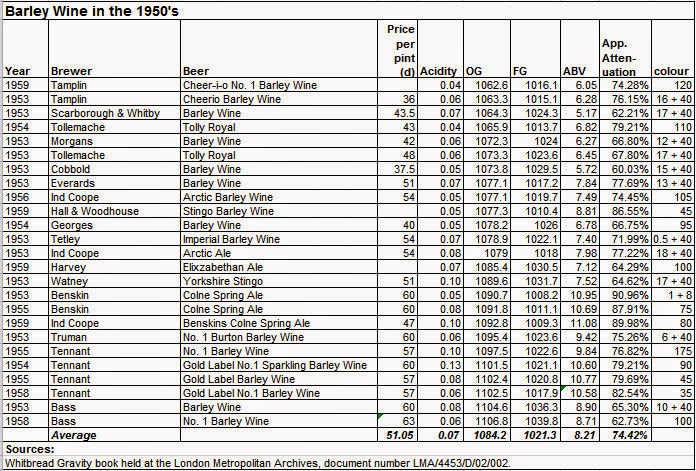
Barley Wine in the 1950's

Nope. Still can’t face Mild. A glance at Brown Ale revealed that’s almost as bad. When will I be in an arsing situation? Probably no time soon.

Right time for some of my bullshitty type stuff. God, I’m eloquent today.  Barley Wine? What sensible to I have to say about it? Well, to a great extent the use of the name was arbitrary. You’ll notice that pretty well all the beers have Barley Wine in their name. If they didn’t, I’d probably have classes them as Old Ale or Strong Ale.

You’ll see that I’ve two originals in there: Bass No. 1 and Tennants Gold Label. The former is the first beer to call itself Barley Wine, the latter the first of a new breed of Pale Barley Wines. One of my early beer style theories, which hurled itself from the top storey once I got my hands on real data, was based on Barley Wine being pale. Because I considered Gold Label the archetypal Barley Wine.

It’s a great shame that Bass No. 1 no longer exists. I can remember drinking it in a Bass pub in Mablethorpe in the 1970’s. I wonder when it was discontinued? I’m trying to remember what colour it was. I’m pretty sure it wasn’t dark, but I could be wrong.

Let’s kick of with colour, seeing as I’ve already mentioned it. All of the set are dark, except for Gold Label and Hall & Woodhouse Stingo. The others are all dark. Some very dark. But that’s what was expected of the style back then. It’s only in the 1960’s that the balanced started to tip towards pale interpretations.

There are some classic beers in there, in addition to the two I’ve already highlighted. Ind Coope’s is the descendant of Allsopp’s Arctic Ale, probably the most powerful beer of the 19th century.  Then there’s Benskins Colne Spring Ale. There’s been some discussion about the presence of Brettanomyces in it. A glance at the level of attenuation – around 90% - tells me it was almost certainly in the mix. Whether deliberately pitched or picked up.

Barley Wine in the 1950's
Year Brewer Beer Price per pint (d) Acidity OG FG ABV App. Atten-uation colour
1959 Tamplin Cheer-i-o No. 1 Barley Wine 0.04 1062.6 1016.1 6.05 74.28% 120
1953 Tamplin Cheerio Barley Wine 36 0.06 1063.3 1015.1 6.28 76.15% 16 + 40
1953 Scarborough & Whitby Barley Wine 43.5 0.07 1064.3 1024.3 5.17 62.21% 17 + 40
1954 Tollemache Tolly Royal 43 0.04 1065.9 1013.7 6.82 79.21% 110
1953 Morgans Barley Wine 42 0.06 1072.3 1024 6.27 66.80% 12 + 40
1953 Tollemache Tolly Royal 48 0.06 1073.3 1023.6 6.45 67.80% 17 + 40
1953 Cobbold Barley Wine 37.5 0.05 1073.8 1029.5 5.72 60.03% 15 + 40
1953 Everards Barley Wine 51 0.07 1077.1 1017.2 7.84 77.69% 13 + 40
1956 Ind Coope Arctic Barley Wine 54 0.05 1077.1 1019.7 7.49 74.45% 105
1959 Hall & Woodhouse Stingo Barley Wine 0.05 1077.3 1010.4 8.81 86.55% 45
1954 Georges Barley Wine 40 0.05 1078.2 1026 6.78 66.75% 95
1953 Tetley  Imperial Barley Wine 54 0.07 1078.9 1022.1 7.40 71.99% 10.5 + 40
1953 Ind Coope Arctic Ale 54 0.08 1079 1018 7.98 77.22% 18 + 40
1959 Harvey Elixzabethan Ale 0.07 1085.4 1030.5 7.12 64.29% 100
1953 Watney Yorkshire Stingo 51 0.10 1089.6 1031.7 7.52 64.62% 17 + 40
1953 Benskin Colne Spring Ale 60 0.05 1090.7 1008.2 10.95 90.96% 1 + 8
1955 Benskin Colne Spring Ale 60 0.08 1091.8 1011.1 10.69 87.91% 75
1959 Ind Coope Benskins Colne Spring Ale 47 0.10 1092.8 1009.3 11.08 89.98% 80
1953 Truman No. 1 Burton Barley Wine 60 0.06 1095.4 1023.6 9.42 75.26% 6 + 40
1955 Tennant No. 1 Barley Wine 57 0.10 1097.5 1022.6 9.84 76.82% 175
1954 Tennant Gold Label No.1 Sparkling Barley Wine 60 0.13 1101.5 1021.1 10.60 79.21% 90
1955 Tennant Gold Label Barley Wine 57 0.08 1102.4 1020.8 10.77 79.69% 45
1958 Tennant Gold Label No.1 Barley Wine 57 0.06 1102.5 1017.9 10.58 82.54% 35
1953 Bass Barley Wine 60 0.08 1104.6 1036.3 8.90 65.30% 10 + 40
1958 Bass No. 1 Barley Wine 63 0.06 1106.8 1039.8 8.71 62.73% 100
Average 51.05 0.07 1084.2 1021.3 8.21 74.42%
Sources:
Whitbread Gravity book held at the London Metropolitan Archives, document number LMA/4453/D/02/002.

Have you noticed something about the dates? The earliest is 1953. That’s not a random date. Many breweries produced their strongest beers in more than a decade last year to celebrate the coronation. In some ways it marked the end of post-war austerity.

It’s a set of very strong beers for the period. There were probably no beers anywhere else in the world topping 10% ABV back then.

What might come as a surprise is that these were mostly drunk in the pub. To round off the night or to warm the blood on a cold winter’s night. It was the same with Hardy Ale. The vast majority was drunk in Eldridge Pope tied houses. When the brewery lost its tied estate, that’s when Hardy Ale first disappeared. The odd American geek wasn’t enough to keep it going.

That’s all I’m going to tell you. Look at the numbers and come to your own conclusions about the rest. I’m off to toast a breakfast crumpet.

What next? Light Ale probably. It’s another small set.

Saturday, 11 April 2015

Brewing in the 1950’s – coolers

Back with coolers again time for more ranting.

I just want to get one thing off my chest before we start. Coolship is not an English word. It’s a translation of the German or Dutch – Kuhlschiff or koelschip. It’s really irritating when people don’t use the correct English word.

Though by the 1950’s coolers were no longer widely used. In the early 19th century coolers had been the only devices used to cool wort. After the development of refrigerators – a system of pipes through which flowed cold water or brine and over which the wort flowed – these were used in conjunction with coolers rather than replacing them. Partly because coolers still had an important auxiliary role in precipitating out gunk from the wort.

“Wort Receiver. If the brewery is suitably arranged, the wort can pass by gravitation to the wort receiver and thence to the refrigerators. Some brewers consider that the use of a pump between hop-back and refrigerator has an undesirable effect upon the colloidal matter in the wort, dispersing it into smaller particles which may affect the yeast in the fermentation: undeniably, if hop-back filtration is poor, insoluble particles in the wort may get broken up in the pump; but such insoluble matter from the hop-back is objectionable in any case, whether or not its adverse effects are increased if it is in smaller particles. Be that is it may, the amount of such insoluble matter in a wort should be negligible; if it is not, the remedy is to be found in improved hop-back filtration. The present author considers that this objection to pumping is without foundation, and the fact of the matter is that many, if not most, modern breweries pump their wort, either to raise it to a wort receiver on a higher floor, or for the purpose of obtaining sufficient pressure for use with an enclosed refrigerator to get an adequate throughput. “
"Brewing Theory and Practice" by E. J. Jeffery, 1956, page 47.

It sounds here as if the hop-back had replaced the cooler in the function of removing crap from the wort.


Here’s a little more about coolers:

“At one time the wort would have been discharged into a large shallow cooler. The latter was undeniably necessary before the advent of refrigerators. Exposure of the wort to the air, in a shallow vessel, was the only means of cooling in those days. But during that time the wort could pick up innumerable bacteria and wild yeast, a most undesirable feature. The extensive exposed surface of wort was open to infection from any local sources which might exist. In many cases where receivers were substituted for coolers there was an immediate improvement in the quality of the beer. Open coolers are now hardly ever used in top fermentation breweries. A few breweries however still use them, on the grounds that they provide conditions of cooling and an opportunity for sedimentation that are beneficial to the wort. Lager breweries still use them extensively and they are usually housed in enclosed rooms supplied with sterile air.”
"Brewing Theory and Practice" by E. J. Jeffery, 1956, pages 47 - 48.

That’s interesting about Lager breweries still retaining coolers. I guess if they were placed in a closed room, much of the risk of infection with wild yeast was removed. Though the operational coolers I’ve seen in Germany weren’t housed this way. They were just parked next to the copper. Unlike the open fermenters, which were in sealed, refrigerated rooms.

“A receiver is only an intermediate vessel between the hop-back and the refrigerator, and it does not act as a cooler, since it is usually a fairly deep vessel. It must be of sufficient capacity to ensure a regular flow and delivery of wort to the refrigerator. If a spreader in the shape of a dished circular metal plate is fixed at the mouth of the inlet pipe, a certain amount of hot aeration may be effected at this point. Alternatively, the same result may be obtained by discharging at the delivery end into a trough of perforated copper which splits up the wort. This hot aeration is most beneficial towards the subsequent fermentation. Adequate aeration can however usually be effected at the hot end of the refrigerators.”
"Brewing Theory and Practice" by E. J. Jeffery, 1956, page 48.

Hot-side aeration - isn’t that one of the things home brewers go on about endlessly? About how bad it is. While professional brewers have spoken to say that’s bollocks. I see Jefferey is firmly in the pro hot-side aeration camp.

Not sure what will come next. Maybe fermenters.

Friday, 10 April 2015

Beer, scientifically and socially considered (part two)

We’re back again with that very long article about adulteration and how great Lager is.

Before going through adulterants in detail, the author tells us about non-adulterants: the ingredients which beer is supposed to contain. Just to remind you that very little was legally allowed to be used in beer at the time. Just water, malt, hops, yeast and sugar.

“We shall presently have an opportunity to consider scientifically the character of those precious ingredients, grains of paradise, cocculus indicus, and other substances not mentioned by the candid brewer whose remarks I have just quoted, with which the poor man’s beer is drugged ; but, before doing so, I propose to give a short account of the materials which ought to be used in the production of wholesome beer. Those are, or should be, water, malt (barley), hops, and yeast, and these substances possess not only practical value for the brewer, but many special points of interest for the chemist and the student of botany. There has long been, to the uninitiated, a mystery connected with the water of Burton-on-Trent, the prevalent notion being that it is the river water which possesses some special virtue for brewing purposes. The fact is, however, that it is the spring-water of the district which is well adapted for the manufacture of beer ; and although the effect is not yet clearly understood the cause has long been well known chemists. It arises from the presence in the water of “earthy sulphates and carbonates,” and the absence of organic matter which is fatal to the brewing process. Analysis has shown the Burton water to contain nearly 19 grains of sulphate and 15 grains carbonate of lime to the imperial gallon (besides sulphates of potassa and magnesia) ; and the theory is that these alkalies combine with the acid of the malt extract, and, in the form of insoluble salts, are precipitated and carry down with them the nitrogenous substances which it is desirable to get rid of in the brewing process ; so, for the same reason that the presence of salts of lime and potash in the Burton water is advantageous, that of organic matter would be injurious, and the freedom of the water from the latter is therefore very advantageous to the brewer. Should any of readers desire further information on this subject for practical purposes, they may obtain it in the able article "Beer,” in Dr. Muspratt’s "Dictionary of Chemistry,” or in those the same subject in Ure’s "Dictionary of Arts,” and Watt’s "Dictionary of Chemistry" while Mr. Molyneux’s work, already named, also contains an excellent chapter on the "Waters of Burton,” and the effect upon them of the strata through which they percolate. “
Liverpool Daily Post - Tuesday 05 July 1870, page 6.

Give the author his due, he’s as equally enthusiastic about Burton Pale  Ale as he is about Lager.

Is that really what the minerals in Burton water do, help precipitate out nitrogenous substances? It sounds dead scientific the way he explains it. But I still suspect its bollocks.

“These are the materials which should be employed in the brewing of good ale. Water, free from organic matter and containing sulphate and carbonate of lime; barley, in the form of malt; hops and yeast; and although the reader will have gathered from the preceding short account of these substances, what leading principles are involved in their use and treatment, I propose briefly to recapitulate the changes which occur in the brewing process, before attempting to describe the practical operation. In the malting or germination of barley the albumen in the grain becomes converted into diastase, the property of which is to change the starch (also constituent in the barley) into soluble dextrin of gum and sugar, and, consequently, the malt possesses a sweet taste which is not present in the grain previous to malting. In the mashing process, this sweet substance is washed out of the malt, and with the water employed for the purpose goes to form the wort, or stock of the beer. This "wort” is subsequently boiled with hops, which contain a bitter principle, lupulite, and an essential oil, of which the effect is to impart a bitter aromatic flavour to the beer, at the same time the chief organic constituents of the wort are removed. And finally through the introduction of yeast, a minute plant, the cells of which multiply with incredible rapidity, fermentation is set up, the chemical effect of which is to convert the sugar contained in the “wort” into carbonic acid and alcohol. The brewer takes care, however, to stop the fermentation at a certain stage, so that a portion of the sugar may remain unconverted ; and the chemical change is then completed in the cask or bottle, the carbonic acid being held in solution until the beer is drawn or otherwise exposed to atmospheric action. This gives good beer its brisk sparkling appearance, and puts a head upon it; in no case is the effect so conspicuous in the bottled German beer, and English and Scotch pale ales, which continue to effervesce and sparkle like champagne, long after the liquid is poured into a tumbler.”
Liverpool Daily Post - Tuesday 05 July 1870, page 6.

I’ve only included this paragraph for one reason. I’m sure you already understand the concept behind the fermentation of beer. It was the last sentence that grabbed me. Because you rarely get many descriptions.

The author tells us that British Pale Ales were as highly carbonated as German bottled beer and continued to fizz in the glass. I assume he means bottled Pale Ales. But that’s still an impressive degree of carbonation. Especially as it was produced by natural carbonation. And the bottles were only sealed with corks.

Next time we’ll see what muck went into beer in Lverpool.

Thursday, 9 April 2015

Atlanta venue settled

The venue is now fixed for my Atlanta event. Hop to see you there.


Wednesday April 15th at 6PM
6215 Bells Ferry Rd
Acworth, GA 30102
404-981-BREW (2739)
http://dogwoodgrowlers.com


Buy my book:


The Home Brewer's Guide to Vintage Beer
http://www.amazon.com/Home-Brewers-Guide-Vintage-Beer/dp/1592538827
 

Brewing in the 1950’s – how to lay out your brewery (part two)

We’re looking at the cooling end of the brewing operation this time. It’s so exciting. I can barely stop myself from weeing my pants.

Remember that we’d got as far as wort receiver. This is what came below that:

“Directly below, again, will be the refrigerators. In an up-to-date brewery, these will almost certainly be of the totally enclosed type. Where refrigerators of the older, open type are used they should be housed in a completely enclosed room supplied with purified air. Means will have to be provided, in these cases, for getting rid of the steam.”
"Brewing Theory and Practice" by E. J. Jeffery, 1956, page 23.

In old-style refrigerators the wort flowed over the top of the cooling pipes, totally exposed to the air. That’s why Jeffery recommends placing them in a sealed room with the air flow controlled. Otherwise there would be a risk of infection.

It seems that back before WW I, brewers relied on high ABV and high hopping to quite a degree. Doubtless they had to tidy up their practices after gravity and hopping rates fell because of the war. I can imagine that the transition was a difficult one.

Here’s an explanation of how cooler and refrigerator worked in tandem to cool the wort to pitching temperature.

“A word of explanation may be added here as to the terms 'cooler' and 'refrigerator' as used in a brewery. The old type of shallow vessel into which the wort was discharged from the hop-back, was called the 'cooler'; in it the wort cooled from the nearly boiling temperature (say 180°-190° F.) at which it left the hop-back, to a moderate temperature, say 120°-140º F. The wort was cooled here simply by loss of heat to the air and to the vessel. The wort then passed to the 'refrigerator' by which it was cooled by water to the required final temperature of 60ºF. This piece of plant, therefore, is not what is popularly understood, as a refrigerator. With the elimination of the open 'cooler' the 'refrigerator' is responsible for the whole cooling operation.”
"Brewing Theory and Practice" by E. J. Jeffery, 1956, page 23.

Remember the word is “cooler” not “coolship”. And that a refrigerator in a brewery isn’t a fridge.
I love the detail with which Jeffery describes the fermenting equipment:


“Finally come the fermenting vessels and racking backs.”
"Brewing Theory and Practice" by E. J. Jeffery, 1956, page 23.

Next time it will be more ranting about coolers.

Wednesday, 8 April 2015

Yet another US tour

Yes, I'm just about to head off to the USA again. I fly on Friday and almost immediately the fun begins.

Well, really the fun will start before I even get out of Schiphol. I always like to have a drink or two before being strip searched.

This is my schedule - a whirlwind tour of Houston, Birmingham, Atlanta and Asheville. Come along, chat, feed me beer, buy my book.


Saturday 11th of April 12:00 at:
Defalcos
9223 Stella link Rd.
Houston, TX 77025
http://www.defalcos.com/

4 historic beers:

Whitbread X
1885 younger XP
1900 graetzer
1867 Barclay EL


Sunday 12th April 15:00
Cahaba Brewing Company
2616 3rd Ave S,
Birmingham, Alabama 35233
http://www.cahababrewing.com

6 beers on tap, me talking about historic brewing.

1855 Barclay Perkins EI Porter
1879 Younger No. 3
1933 Kidd AK
1914 Fullers  AK
1924 Barclay Perkins RNS "Royal Navy" Stout
1952 Lees Best Mild
1955 Whitbread Double Brown Ale

https://www.facebook.com/events/1526505290950810/

https://www.reddit.com/r/bamabeer/comments/2sy2t8/vintage_engish_beer_night_with_ron_pattinson/


Tuesday 14th April at 21:00
5 Seasons Westside
1000 Marietta St NW #204
Atlanta, GA 30318
http://www.5seasonsbrewing.com/

1853 Younger XP


Wedesday 15th April at 18:00
venue not set
Atlanta


Friday April 17th at 18:30
Green Man Brewery
23 Buxton Ave, Asheville.
http://www.greenmanbrewery.com/

Talk by me plus four historic beers in pins:

1860 Truman XXX
1910 Fuller's X
1950 Whitbread Best Mild
1840's East India Porter


Obviously, the point of the trip is to shift a few copies of my book:


The Home Brewer's Guide to Vintage Beer
http://www.amazon.com/Home-Brewers-Guide-Vintage-Beer/dp/1592538827


Let's Brew Wednesday - 1955 Fullers Old Harry

While I'm on my whole 1950's thing, I thought I'd throw in some recipes, too. It's thirsty work doing all this number shuffling.

This is an odd beer. On the label, it's billed as a "Extra Brown Ale". Which I suppose it sort of is. Though it could equally be called a Burton. The base brew is X Ale, or Hock, Fullers standard Mild. Because obviously this was a parti-gyle. That's just the way Fullers operated. And the quantity of Old Harry being brewed was quite small - just 60 barrels, along with 480 barrels of X. Still, that's a huge volume compared to OBE in the 1930's. I don't think I've seen a batch bigger than five or six barrels.. The smallest are only one or two barrels.

I was a bit surprised by the lack of crystal malt in the recipe. I would have expected that. Instead it's just pale malt, flaked maize and sugar.

A word about the sugar. The original is No. 2 Invert, PTX and Intense. I'm not totally sure what the composition of the latter two was. I know Intense was pretty dark, probably a mix of invert sugar and caramel. PTX I haven't a clue about. So I've specified No. 3 invert and caramel as a substitute. It should get you somewhere in the right area.

There are no details of the hops, other than that they are English. A Fuggle's/Goldings combination seems a fair enough guess. Feel free to use any English hops that take your fancy.

Brown Ale is another one of those terms used inconsistently. As you'll see when I finally get my arse in gear and look at my Brown Ale analyses. There a couple of pretty different variations.


Right, time to pass you over to . . . me, again . . . . .


1955 Fullers Old Harry
pale malt 7.75 lb 73.81%
flaked maize 1.00 lb 9.52%
No.2 invert 1.25 lb 11.90%
No.3 invert 0.50 lb 4.76%
caramel 1.00 oz
Fuggles 90 min 0.75 oz
Goldings 60 min 0.75 oz
Goldings 30 min 0.75 oz
OG 1051
FG 1015
ABV 4.76
Apparent attenuation 70.59%
IBU 30
SRM 24
Mash at 150º F
Sparge at 166º F
Boil time 90 minutes
pitching temp 61º F
Yeast Wyeast 1968 London ESB or 
White Labs WLP002 English Ale