
"Our progress downward next brought us to the great racking cellar, which covers two-thirds of the entire ground floor of the brewhouse. It contains three slate racking or settling tanks, each holding 200 barrels,from which the beer is racked into the casks; also four vats of great capacity for receiving running ales. We found the floor, which is asphalted throughout, strewn with hundreds of barrels, either filled or in the process of being filled; and waiting outside was a train, composed of an engine and some eight or ten trucks, ready to convey them to their respective destinations. In the centre of this cellar there is fixed an endless chain barrel elevator, for lifting the stock ales from the cellars below to this level, to be rolled away on to the loading-out stage, which runs parallel with this room. The forwarding clerks' office is situated at the entrance to the loading-out department ; and opposite is the yeast store-house, containing a Johnsons press.I'm a bit confused as to the purpose of the settling tanks and the vats for running ales. I don't understand why you would need both. Surely the settling tanks would be filled with running ales from the fermenters immediately before they were racked.
Through an archway we reached the vat-house, a spacious building 85 feet long and 45 feet high, used for storing old ales. Here, rising to a great height, are to be seen sixteen store vats, the two largest among them holding some 400 barrels each, and all containing old Dorchester beer, so much approved of in the West of England."
"Noted Breweries of Great Britain and Ireland, vol III", by Alfred Barnard, 1890, pages 138 - 139.
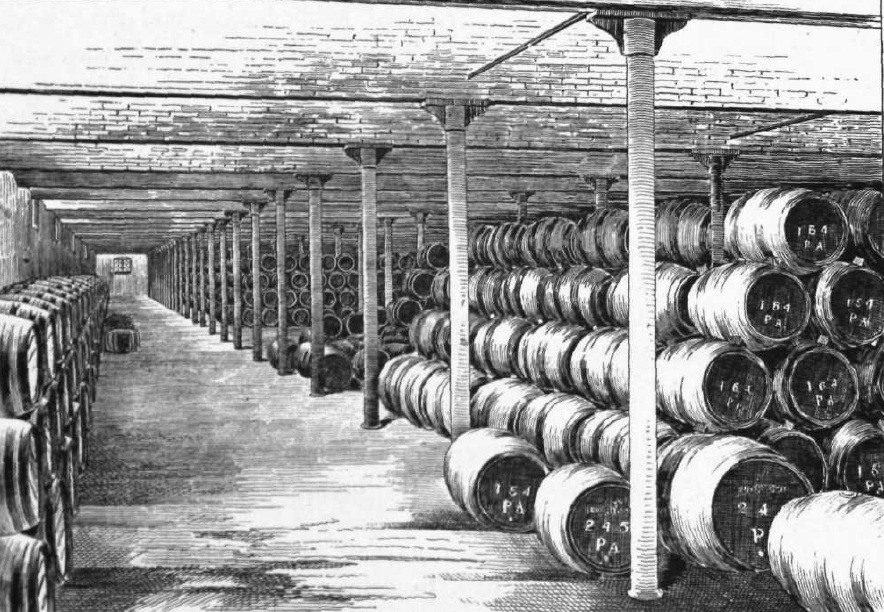
Pale ale cellar.
Time for some brewhouse maths. Assuming an average vat size of 300 barrels, that would give a storage capacity of 4,800 barrels. Quite an amount. But without knowing how long they stored the beer for before sale, it's hard to estimate how much Old Ale they were selling.
Time to move on again.
"Descending by a lift to the basement, we walked through two spacious paved cellars, one used for storing stock ales, the other for running beers, and then reached a sunken passage leading to a tunnel 200 feet in length, which gives access to the largest cellar on the premises. It is situated beneath the malthouse, is 140 feet long, 50 feet broad, and contained about 3,000 barrels of pale ale. The roof of this cellar is very remarkable, as it is arched with tiles "three deep," set in cement The cellar itself is dug out of the solid chalk, with a natural floor of hard chalk, and forms one of the most perfect pale ale stores we have ever inspected.Our patience has been rewarded with a quick description of some of Eldridge Pope's beers. It's a bit confusing when he talks about AK and Crystal as separate beers, but I think I understand it. If you remember the details of the beers from previous posts you'll know that Crystal was a form of AK. BAK, or bottling AK, to be precise.
The sampling and bottling cellars, afterwards visited, are beneath the counting-house. We tasted several of the firm's brews during our visit, among them being the Dorchester pale ale, the "A.K." and the "Crystal" ale. The Dorchester pale ale is of great merit, and challenges comparison. It is an exhilarating beverage, and possesses all those characteristics which insure its keeping sound. The "Crystal" ale suited our tastes for a general drink, it being light, delicate, and sparkling; as also did the Burton ale, a nourishing, hop-flavoured, sound beverage, as clear as champagne. All of them compare favourably with the ales of London and Edinburgh, and the demand for them in the former city is sufficient proof of their popularity. Near the sampling room there is a large wine and spirit store, for supplying the firm's numerous hotels and public-houses, and their private trade in the town and district. It contains seven large spirit vats, and a row of wine bins 50 feet in length; also a cellar for storing wines in the wood, and every convenience for bottling. In close proximity is a bottle-washing yard, 100 feet square, covered with a corrugated iron roof and laid with Staffordshire bricks."
"Noted Breweries of Great Britain and Ireland, vol III", by Alfred Barnard, 1890, pages 139 - 140.
I've repeated my table of Eldridge Pope beers from the 1890's for your reference. Looking at the stronger beers, I wonder which is the old Dorchester beer and which the Burton. XXXX looks the right gravity for a Burton. To be honest, it looks to weak to be the Old Ale. But if it isn't, which beer is?
| Eldridge Pope beers in 1896-1897 | ||||||||||||||
| Year | Beer | Style | OG | FG | ABV | App. Atten-uation | lbs hops/ qtr | hops lb/brl | boil time (hours) | boil time (hours) | boil time (hours) | Pitch temp | max. fermentation temp | length of fermentation (days) |
| 1896 | AK | Pale Ale | 1048.5 | 1011.6 | 4.87 | 76.00% | 7.33 | 1.50 | 2.5 | 2.5 | 2.5 | 60º | 71.25º | 8 |
| 1896 | AK | Pale Ale | 1048.5 | 1011.9 | 4.84 | 75.43% | 7.03 | 1.44 | 2.5 | 2.5 | 2.75 | 59.5º | 69º | 8 |
| 1896 | BAK | Pale Ale | 1048.5 | 1011.9 | 4.84 | 75.43% | 7.03 | 1.44 | 2.5 | 2.5 | 2.75 | 59.5º | 69.75º | 8 |
| 1896 | PA | Pale Ale | 1057.6 | 1014.4 | 5.72 | 75.00% | 10.50 | 2.56 | 2.5 | 2.75 | 59.5º | 70.25º | 7 | |
| 1896 | XX | Mild | 1049.0 | 1011.6 | 4.95 | 76.27% | 4.36 | 0.91 | 2.5 | 2.75 | 60º | 70.5º | 7 | |
| 1896 | S | Stout | 1061.5 | 1026.9 | 4.58 | 56.31% | 9.43 | 2.50 | 2.5 | 59º | 70.5º | 8 | ||
| 1896 | LTS | Stout | 1051.2 | 1019.4 | 4.21 | 62.16% | 10.37 | 2.23 | 2.5 | 60º | 70º | 8 | ||
| 1897 | XXX | Mild | 1065.1 | 1018.6 | 6.16 | 71.49% | 6.25 | 1.75 | 2.5 | 2.5 | 2.75 | 60º | 74.25º | 9 |
| 1897 | XX | Mild | 1048.8 | 1013.9 | 4.62 | 71.59% | 6.25 | 1.31 | 2.5 | 2.5 | 2.75 | 60º | 69º | 8 |
| 1897 | XXXX | Strong Ale | 1074.8 | 1023.8 | 6.74 | 68.15% | 8.95 | 2.82 | 2.5 | 2.5 | 2.5 | 60º | 74º | 9 |
| 1897 | KK | Pale Ale | 1051.5 | 1014.1 | 4.95 | 72.58% | 6.81 | 1.50 | 2 | 2.5 | 60º | 69.5º | 4 | |
| 1897 | XX | Mild | 1049.6 | 1012.5 | 4.91 | 74.86% | 6.23 | 1.33 | 2 | 2.5 | 60.25º | 70.5º | 4 | |
| Source: | ||||||||||||||
| Eldridge Pope brewing records | ||||||||||||||

Why are Eldridge Pope's beers compared with those of London and Edinburgh? Because those two towns were renowned for the quality of their Ales.









 Posts
Posts


