Saturday, 26 November 2016

1894 Thomas Usher XX 60/-

Here’s a type of beer that was already becoming a rarity in the 1890’s – a genuine Scottish Mild Ale.

I should probably be more specific. It was draught Scottish Mild that was a rarity. There were still plenty of Shilling Ales, the bottled form of Mild that was specific to Scotland. Though the popularity of these beers was on the wane, as increasing amounts of Pale Ale were brewed. The situation south of the border was very different. Mild was the favourite style and becoming ever more popular, mostly at the expense of Porter.

Like most Scottish beers of this period, it had a very simple grist, just pale malt and sugar. It’s not clear exactly what sort of sugar it was. I’ve guessed at No. 1 invert.

To put this beer into its historical context, I’ve put it in a table together with the X Ale from three London breweries:

Mild Ales of the 1890's
Date Year Brewer Beer OG FG ABV App. Atten-uation lbs hops/ qtr hops lb/brl
6th Aug 1891 Barclay Perkins X 1058.0 1015.0 5.69 74.21% 8.32 2.07
13th Jul 1894 Whitbread X 1058.4 1016.0 5.62 72.62% 8.23 2.09
7th Jul 1894 Truman X Ale 1056.5 9.0 2.19
28th Jul 1897 Fuller X 1049.6 1012.2 4.95 75.42% 6.58 1.44
13th Apr 1894 Thomas Usher XX 60/- 1055 1015 5.29 72.73% 10.00 2.77
Sources:
Barclay Perkins brewing record held at the London Metropolitan Archives, document number ACC/2305/1/587
Whitbread brewing record held at the London Metropolitan Archives, document number LMA/4453/D/01/060
Truman  brewing record held at the London Metropolitan Archives, document number B/THB/C/175
Thomas Usher brewing record held at the Scottish Brewing Archive, document number TU/6/1/2
Fullers brewing record held at the brewery.


Usher’s beer is surprisingly similar to the London ones, though a little more heavily hopped. Isn’t that a shock? Didn’t the Scots use almost no hops? Oh, I remember. That story is total bollocks. The hops themselves are just listed as Kent and Columbia in the brewing record. Cluster and Fuggles seem fair enough guesses for the varieties.


1894 Thomas Usher XX 60/-
pale malt 11.50 lb 93.88%
No. 2 invert sugar 0.75 lb 6.12%
Cluster 105 min 1.25 oz
Fuggles 90 min 1.50 oz
Fuggles 60 min 1.50 oz
Fuggles 30 min 1.50 oz
OG 1055
FG 1015
ABV 5.29
Apparent attenuation 72.73%
IBU 78
SRM 7
Mash at 150º F
Sparge at 170º F
Boil time 105 minutes
pitching temp 58º F
Yeast WLP028 Edinburgh Ale

Friday, 25 November 2016

Advertising Gold Label (part two)

As promised, a second set of 1950’s Gold Label adverts.

First, an interesting pairing with Gold Label:

“In Leamington Spa everyone in the know is taking it home!

We’ll tell you why...


As port goes with Stilton cheese, so Tennants Gold Label Barley Wine goes with TV. It's a drink that will accompany you through a whole evening's programmes without its flavour going stale. And what a flavour Gold Label has! Clean to your palate, not cloying, clean, mellow and deeply satisfying. It's brought about by months of careful maturing in tempered-with-age casks. Slowly Gold Label develops its clear amber colour, its palate-tickling sparkle. And when it's reached perfection Gold Label is ready for you to take home. Some people prefer their Gold Label straight, without television - but decide that for yourself.

Gold Label can stand alone — just as it stands apart.

It's a special brew of good wholesome beer!

Local Distributor:
R. M. BIRD & CO,
32 BRIDGE STREET, STRATFORD-ON-AVON.
Tel : Stratford-on-Avon 2595.”
Leamington Spa Courier - Friday 29 October 1954, page 3.

Though it’s a pairing with TV rather than food. If they were writing this advert today, no doubt there would be some poncey food match suggested. Spending the whole evening drinking Gold Label while you watch the telly doesn’t sound like a great idea. Five or six bottles and you’d be well on your way. I’d recommend something longer and weaker for a long evening in.

They really did like to emphasise the ageing in casks. I’d probably be quite cynical about this process if I hadn’t read Frank Priestley’s description of it. Though the claim that the colour developed during this ageing does sound like total bollocks. I guess they’re trying to make it sound like whisky, which does pick up its colour from the casks it’s aged in. I know Gold Label didn’t get darker because I’ve colour numbers at racking time and at point of sale.

Leamington Spa is quite a distance from Sheffield: about 100 miles due South. I’m surprised that they were selling Gold Label that far away.

The advert writers liked to draw comparisons between Gold Label and other classy drinks. This time it’s champagne:

“In Leamington Spa everyone in the know is drinking it!

We’ll tell you why . .


Take a look at glass of Tennants Gold Label Barley Wine. Notice its inviting clear amber colour, its equal-to-champagne sparkle - they give a clue to Gold Label's flavour. It's clean to your palate, not cloying, clean. And the welcoming glow you see deep in the heart of a Gold Label spreads right through you! Long months of careful maturing in mellow old casks enrich this deeply satisfying barley wine, and only when Gold Label has reached the peak of perfection, is it sold. Now that are 'in the know' try a Gold Label for yourself. You'll feel better for drinking it, and you'll make it a regular pleasure.

It's special brew of good wholesome beer!

Local Distributor:
R. M. BIRD & CO,
32 BRIDGE STREET, STRATFORD-ON-AVON.
Tel: Stratford-on-Avon 2595.”
Leamington Spa Courier - Friday 15 October 1954, page 3.

If you remember, Priestley mentioned that Gold Label was more highly carbonated than Tennant’s other bottled beers. I don’t particularly remember it being that fizzy when I drank it. Then again, I usually knock most carbonation out of bottled beer. I like my beer nice and flat.

I’ve still got quite a bit more of this stuff.

Thursday, 24 November 2016

Pleasing all palates (part two)

This next section of the article is very revealing. Because it discusses why certain groups of people pick a particular drink.

Starting with a look at the preferences of the young:

“This diversity of habit is influenced by the younger generation. They tend to prefer bottled beer: perhaps because it is widely advertised, perhaps because it is "packaged goods." Moreover, draught beer is "what Dad drinks" and, presumably, he cannot be right. Also there is the intriguing snobbery of pub drinking — the desire if you are a leader in a pub community to cut a dash and be different or, if you are merely a hero-worshipper, to be the same as someone you admire. And so the brewer has to contend with astonishing permutations and combinations of his own beers. How often he hears a licensee say, "Oh, yes, they call for that mixed with half-a-pint of bitter." "That" is probably one of the bottled beers the brewer has brewed with extreme trouble to be drunk on its own. One of the most successful mixed drinks in recent years — lager and lime-juice, of obscure origin and drunk mostly by the young—accounts largely for the increased sales of lager. It is by no means a sweet drink, which is an interesting point, because in many parts of the country the drinking of bitter beers is on the increase. Traditionally bitter is looked on as the bosses' drink. Any man reckons to-day he's as good as his boss. So he chooses bitter.”
"Beer in Britain", 1960, pages 96 - 97.

When I was young, with the exception diet Lager and Newcastle Brown, no-one under 30 drank bottled beer. By that time the bottled-beer supping youngsters of the 1950’s had become Dads themselves, so who would want to follow their choice of drink? Brown Ale, Light Ale, Mackeson – all were old men’s drinks.

The phenomenon is something I’ve noted before. I keep repeating that when Lager becomes associated with old men its fall from favour will be spectacular.

Brewers were perfectly well aware that their bottled beers were being mixed with draught. A common practice amongst those who might like to drink bottled beer, but couldn’t afford to. In 1958, a pint of draught Mild was 15d, a pint of bottled Brown Ale 19d. It was the same story with Pale Ales: draught Ordinary Bitter 17d a pint, bottled Light Ale 21d a pint.

I’m not so sure brewers really worried about their beers not being drink on their own. The Light and Bitter mixed in the public bar might well have been the same basic beer, just packaged differently Ditto with Mild and Brown Ale, another popular combination.

I’m disappointed that the author has no explanation for the appearance of Lager and lime. A combination which has largely disappeared since. Was it just alliteration behind the craze? And was it really responsible for the surge in Lager drinking? This was a key period in the history of British Lager. After decades of pootling along as a very niche product, Lager began to spread its wings and take to the air. Many regional brewers introduced their own Lagers around this time.

I’ve seen several references to the effect of television on drinking habits. And it would be hard to argue against it having encouraged home drinking.

“Television is another influence in establishing a new trend—drinking at home. Wines and spirits have probably benefited most, though beer has had its share, too. Continental holidays have resulted in a greater interest in, and taste for, wines. The heavy rate of tax on beer and the great influx of excellent cheap wine from abroad have narrowed the difference in cost to the consumer. It is too early to say whether the advent of the can is going to increase the sale of beer for home consumption. Price at present helps to keep sales of canned beer in check. On the other hand, the neat and generally attractive appearance of a beer-can and the absence of a deposit charge are strong selling points.”
"Beer in Britain", 1960, page 97.

I always think of mass foreign tourism as a development of the 1960’s. Clearly it started earlier. Did it really encourage people to drink wine? I’ve often seen foreign travel cited as a reason for the increase in popularity of Lager.

I’ve never found cans particularly attractive myself. But, yes, when their price came down, it did help increase home drinking.

We really will be looking at the types of beer in more detail next. Promise.

Wednesday, 23 November 2016

1956 Shepherd Neame PA

I sometimes wonder what my least popular recipes have been, Ones that no-one could be arsed to brew.

I suspect that a few of the post-WW II austerity beers fall into that category. Including this one. Because it’s one of those perennially dull styles, Ordinary Bitter.

Though, in PA’s defence, it is basically all-malt. I’m not going to count the tiny amount of malt extract as adjuncting it up. Which makes it more unusual than you might suspect. British brewers didn't really do all-malt in the 20th century. Almost everything, with the exception of Guinness, contained sugar.

It’s such a simple recipe that it’s scarcely worth writing down. Pale malt and classic English hops. The hop varieties are I guess. All I know is that they came from Shepherd Neame’s own hop farms in Kent.

Looking at analyses from the Whitbread Gravity Book, it looks as if the colour was corrected to a slightly darker shade of around 6 SRM. Probably not worth bothering with on a homebrew level.

Er, and that’s. The recipe is so simple, it’s left me lost for words.


1956 Shepherd Neame PA
pale malt 9.00 lb 99.01%
malt extract 0.09 lb 0.99%
Fuggles 120 mins 0.75 oz
Goldings 60 mins 0.50 oz
Goldings 30 mins 0.50 oz
Goldings dry hops 0.25 oz
OG 1035.5
FG 1011.6
ABV 3.16
Apparent attenuation 67.32%
IBU 24
SRM 4
Mash at 152º F
Sparge at 170º F
Boil time 120 minutes
pitching temp 62º F
Yeast a Southern English Ale yeast

Tuesday, 22 November 2016

Scotland! vol. 2

is becoming a reality. It's so exciting.

I've assembled a mighty army of recipes, several hundred strong. And I'm starting to occupy the chapters - last weekend my forces conquered most of the ingredients and beer styles sections of the first and third.

Obsession. A dead handy trait. How else could I remember so much bollocks about brewing in the land of Irn Bru? Without all that crap stewing in my brain, I'd be frantically flicking through files every five seconds. Luckily it's all lurking in some lobe or other.

"Why are you writing this book, Ronald?"

See above. I'm an obsessive. And I want to wangle a wander of the wild ways of the USA with a book to tart. Just about worn out the last one.

Plus no-one else has done it yet. Uncharted territory is so beguiling. Scottish brewing has, like the Western Isles, been neglected by cartographers surprisingly long. Mapping it accurately is my goal.

On the way, overloading you with way, way too many recipes. But which captain complains of maps too accurate?


I've no publisher. Though I'm writing it as a "proper" book. If you feel like saving me from the shame of self-publishing my Meisterwerk, get in touch.

Pleasing all palates

“Beer in Britain” is a fascinating little book, providing a snapshot of British drinking culture in the late 1950’s.

But the name is slightly deceptive, because there’s little material about beer itself. The vast majority of the book is dedicated to pubs and the people drinking in them. It’s useful stuff, but at the same time the lack of detail on the beers being drunk is frustrating. Though it’s revealing how central the pub was considered to beer-drinking.

“PLEASING ALL PALATES
MORE than ever now the brewer has to cater for the different tastes of the customers who use his houses. He has to contend with palates that are sweet or bitter, that demand the high gas-content of bottled beer or the lower gas-content of draught beer, or that are influenced surprisingly by mere colour. In the old days, before women and that large ephemeral body so unkindly described by the planners as "Higs" began to invade the pubs, the brewer's life was easier because he knew with greater certainty which types of beers and stouts were needed. Nowadays the market is more complex, and so his answer is to brew a wide range of beers and thus hope to satisfy as many people as possible.”
"Beer in Britain", 1960, page 94.

I’m not convinced that’s true that the beer market was more diverse after WW II. My experience of looking through brewing records tells me many brewers reduced their ranges during the war and never brought back most of the beers discontinued. And the range of draught beers fell. Outside London and Ireland draught Stout had disappeared and Burton was on its way out.

But note that the assumption is being made that beer is drunk in pubs. And that women only began drinking beer when they started visiting pubs. Not sure if that is completely true, but that’s the assumption,

“This is both a strength and a weakness. A strength, because if public taste changes the brewer knows at once how to change his production. Thus, after the war, when materials became free, the brewing trade was able to help provide the extra sugar content that the nation by its own decision (rather than that of the man in Whitehall) knew it wanted. Sweet stouts and ales were the order of the day. These had been produced before the war, and brewers could therefore cope with the new demand. Equally they could deal with any swing away from sweetness that might appear once the nation had made up for the wartime lack of sugar.”
"Beer in Britain", 1960, page 94.

There was certainly a surge in popularity of sweet styles of beer like Milk Stout and Brown Ale after WW II. Perhaps this was partly a reaction to the lack of sugar and sweet foods during the war. Because these types of beer fell into serious decline in the 1970’s.

A notable feature of British pubs has always been selling multiple different beers. Whereas on the Continent (Belgium excepted) offering just a single beer wasn’t unusual. It still isn’t in much Germany.

“Thus the industry's strength lies in its ability to adapt itself to the ebb and flow of taste. Its weakness is shown up by the way in which American and Continental brewers have coped with their markets. Many now brew and market only one beer, in one size of container. By this concentration, particularly on the marketing side, they have achieved far greater successes than when they tried to cater for several tastes. Many British companies, by contrast, brew 10 or more beers, and the irreducible minimum is probably two draught and four bottled beers. The temptation for the British brewer is to listen to the siren song of "one brewery — one beer" — especially as the public, influenced by advertising and merchandising in other commodities, becomes more brand-conscious. For the small brewer contending with the big firms' advertising policies, or the large one first picking and then backing his marketing fancy, the basic need remains to brew the irreducible minimum of beers.”
"Beer in Britain", 1960, page 94 – 96.

I think here the author is betraying that he isn’t an industry insider (the article isn’t credited, unlike most of the others). Because breweries might have marketed 10 beers, but would have brewed fewer. For example, Brown Ale and Mild were often essentially the same beer. As might Light Ale and Ordinary Bitter.

What do you think the irreducible minimum of two draught and four bottled beers would be? My guess: draught Bitter and Mild; bottled Brown Ale, Light Ale, Stout and Pale Ale or Strong Ale.

This is an interesting point:

“This immense diversity of public taste creates the fascinating pattern of the brewing industry. However hard any company may try to make people buy one particular brand of beer, customers will nevertheless exercise the right to choose for themselves. An outstanding sign of the limitations of advertising has been the post-war recovery of draught beer in the South. Nor have sales been seriously affected in the Midlands, North, and Scotland—all in spite of the emphasis of advertising on bottled beers.”
"Beer in Britain", 1960, page 96.

I’d thought that the surge in popularity of bottled beer in the 1950’s was due to pent up demand, suppressed by wartime restrictions. I’d never considered the influence of advertising. Possibly because when I first noticed beers adverts in the 1960’s, they were mostly for draught or keg beers. Guinness being a notable exception.

Next time we’ll be looking at the different types of beer in more detail (though not much more).

Monday, 21 November 2016

Pub layout

This is a short post for David Boshko who was having trouble visualisingthe layout of British pubs.

This is from The Pub and the People and shows the layout of a Bolton pub in the 1930s. Though when I started drinking uin the 1970's, this sort of arrangement was still very common in the North.

Note that the taproom has no window.

Here's a more complex layout from the 1950's (Courtesy of Beer in Britain):


I've just noticed that the cellar is shown as being overground. Bit weird, that. And a very unusually-shaped pub, but it does give a good idea of a multi-room pub with a single srving area.

Sunday, 20 November 2016

Gold Label - Tennant vs Whitbread

Was Gold Label the same beer when brewed away from the Exchange Brewery in Sheffield? Luckily, I’m in the enviable position of being able to answer that question.

Because I’ve got Gold Label brewing records from both the Exchange Brewery and Chiswell Street. They’re almost two decades apart, so it’s possible that Tennant-brewed versions had changed by the time Whitbread started brewing it in London.

One thing that struck some commenters about my Tennant Gold Label recipe was the high percentage of flaked maize in the grist. I assume this was as much to keep the colour pale as it was to keep costs down. One of the unusual features of Whitbread was that they didn’t use adjuncts, other than when forced to during wartime. Their grists were 100% malt and sugar. Except for Gold Label.

But let’s not get ahead of ourselves. We’ll look at the specs of the two beers first. To be honest, in most respects they look pretty similar. The OG and FG are a little higher in the Tennant version and the attenuation a little lower. But it’s not a huge difference. Remember as well that in 1955 Gold Label spent 6-12 months in wood. That would have knocked down the FG a bit.

The boils times are identical: three hours for both the first and second coppers. They’d need to this to hit the target gravity, as both were brewed single-gyle. Three hours is exceptional long after WW II. About half that was the norm. The colour for the two versions are also pretty close, with the Whitbread version being a little paler.

I was going to say that there was a big difference in the hopping rate. But I was forgetting that Whitbread’s version contained hop extract. Taking that into account the hopping is quite similar.

Gold Label - Tennant vs Whitbread
Date Year Brewer OG FG ABV App. Atten-uation lbs hops/ qtr hops lb/brl boil time (hours) boil time (hours) Pitch temp colour
8th Nov 1955 Tennant 1109.0 1022.5 11.44 79.36% 7.47 2.99 3 3 º 35
23rd Feb 1972 Whitbread 1101.8 1016.6 11.27 83.69% 5.90 2.60 3 3 68º 30
Sources:
Whitbread brewing record held at the London Metropolitan Archives, document number LMA/4453/D/09/141.
Tennant brewing records.

Now it’s time for the grists. There are rather more differences here, including the base malt. Whitbread used lager malt, presumably for colour reasons, while Tennant went with more traditional pale malt. Whitbread used a different sugar, SLS as opposed to No. 1 invert, and rather more of it. What does SLS mean? Special Liquid Syrup? On the other hand, Tennant’s beer had almost triple the percentage of flaked maize.

Finally the hops. At Tennant it was a very traditional combination of Fuggles and Goldings. Though it should be borne in mind that in 1955 the UK was self-sufficient in hops and only imported tiny quantities. MK (Mid Kent), KT (Kent) and Worcester hops were probably Fuggles.

Gold Label - Tennant vs Whitbread the grist
Date Year Brewer pale malt lager malt no. 1 sugar St. Neots SLS flaked maize hops
8th Nov 1955 Tennant 68.44% 10.65% 0.38% 20.53% Fuggles, Goldings
23rd Feb 1972 Whitbread 72.49% 19.62% 7.89% Hallertau, Styrian, MK, KT and Worcester hops. Hop extract.
Sources:
Whitbread brewing record held at the London Metropolitan Archives, document number LMA/4453/D/09/141.
Tennant brewing records.

I realise Gold Label week is becoming more like a month. Enjoy it while you can.

Saturday, 19 November 2016

Caption competition

With some sort of book as prize. Maybe my new attempt at literary coherence, depending on how far I've got with it. Just the chapter introductions and a couple of hundred recipes so far.

But that's beside the point. Come up with a witty enough caption to the photo below and I may even send you one of my expensive books of your choice*.

What could these two gentlemen be saying to each other?


* I'll need to spray my screen with beer in mirth for you to get Numbers! Guffaws will suffice for the others.


1894 Thomas Usher Export Stout

Stout never seems to have enjoyed the same popularity in Scotland as it did South of the border. Consequently there are far fewer recipes for the style than there are for various strengths of Pale Ales.

I’m sure the reason is historical. Scotland never experienced a Porter boom the same way London did, where it was totally dominant for nigh on 100 years. Porter and Stout were popular in Scotland, but never pre-eminent. And the appeal of Brown Beer started to fade after 1850.

Usher’s Export Stout is a funny beer. It doesn’t look like an Export Stout to me. Not even a Stout, really. At just 5% ABV this would have been considered a Porter in London. And it has a classic mid-19th-century London Porter grist: a combination of pale, brown and black malt. Though a London Porter would have contained more pale malt and less brown. One of the weird things is that while Scottish brewers rarely used dark malts in other styles, their percentage was often very high in Stouts.

Here’s a London Porter for comparison purposes:

1894 Whitbread P
pale malt 83.33%
brown malt 7.58%
black malt 9.09%
OG 1056.8
FG 1018
ABV 5.13
Apparent attenuation 68.31%
Source:
Whitbread brewing record held at the London Metropolitan Archives, document number LMA/4453/D/09/089.


The boil is quite long at 3.5 hours. Long boils weren’t unusual for London Porters in the early part of the 19th century. Especially for the later, weaker worts. But by the end of the century shorter boils were the order of the day – 1.5 to 2 hours – except for the strongest Stouts. I would wonder if the long boil here was designed to add colour, but with 30% dark malts in the grist, I don’t think that would have been necessary.

It looks like a very pleasant drinking Porter to me. A beer I’d rather like to try.


1894 Thomas Usher Export Stout
pale malt 9.50 lb 70.37%
brown malt 2.25 lb 16.67%
black malt 1.75 lb 12.96%
Cluster 210 min 1.25 oz
Cluster 120 min 1.25 oz
Cluster 90 min 1.25 oz
Cluster 30 min 1.25 oz
OG 1055
FG 1016
ABV 5.16
Apparent attenuation 70.91%
IBU 98
SRM 46
Mash at 148º F
Sparge at 170º F
Boil time 210 minutes
pitching temp 58º F

Friday, 18 November 2016

Advertising Gold Label

If you’ve been paying attention, you’ll remember that Tennant introduced Gold Label in 1951. I’ve found evidence that a couple of years later they really started to push it.

Because in the final months of 1954 I’ve found lots of adverts from different regional newspapers for Gold Label. I’m dead pleased I came across them. Because they tell me all sorts of things. If nothing else they give an indication of where it was sold.

It’s no surprise, Tenant being located in Sheffield, that Gold Label was distributed in Yorkshire:

“In Yorkshire everyone ‘in the know’ is asking for it!
We’ll tell you why...

Even to look at Tennants Gold Label Barley Wine does you good ! The flavour's clean, not heavy, not cloying, but clean to the palate. And as your Gold Label goes down its cheering glow puts new heart into you! For months Gold Label lies lazily maturing in selected casks. It is released to us only when it has reached the peak of perfection. To maintain its goodness, sparkle and delicate flavour. Gold Label is bottled with extreme care and is then supplied to selected local houses and off-licences. Now that you are ‘in the know’ ask for Tennants Gold Label Barley Wine - and take one home for the wife.

It's a special brew of good wholesome beer!

Local Distributor:
ACME BOTTLING CO. LTD,
WELLINGTON MILLS, MILL GREEN, LEEDS. 11.
Tel: Leeds 22008.”
Yorkshire Post and Leeds Intelligencer - Saturday 25 September 1954, page 7.

The name of the distributor implies to me that Tennant were allowing third parties to bottle Gold Label. An arrangement that wasn’t unusual in the 1950’s.

As we go through the adverts you’ll see that Tennant emphasised a couple of points. First the flavour and body of Gold Label. The word clean is used multiple times. What they seem to be implying is that Gold Label isn’t heavy and cloying like other strong beers. It’s sparkle – presumably from the heavy carbonation – is also mentioned several times.

Unusually, they also mention the maturation process, stressing that Gold Label was aged for months in casks. Which we know from Frank Priestley’s book was the case. At least in the 1950’s before Whitbread took over.

Love the throwaway line at the end about taking one home for the wife. Not sure it would please Dolores if I brought her home a Gold Label.

Rather more surprising is that Tennant were also advertising Gold Label far from their Yorkshire home:

“In Leamington Spa everyone ‘in the know’ is keeping warm with it!
We’ll tell you why...

Having Tennants Gold Label Barley Wine is wonderful way of keeping out the cold and keeping up your spirits! You can see that Gold Label will do you a power of good and when you taste it, comforting things happen. A delicious warming glow starts centrally - then spreads. You're hundred per-cent winter-weatherproof! For months Gold Label lies lazily maturing in mellow old casks, slowly colouring to a rich clear amber, slowly taking on its sparkle and clean flavour. Only when it’s judged ‘perfect’ is it sold. Now that you are ‘in the know’ there's no need for you to be left out in the cold. Join the Gold Labellers!

It's a special brew of good wholesome beer!

Local Distributor:
R. M. BIRD & CO,
32 BRIDGE STREET, STRATFORD-ON-AVON.
Tel : Stratford-on-Avon 2595.”
Leamington Spa Courier - Friday 12 November 1954, page 8.

I’d go along with Gold Label as a way of keeping out the cold. Pretty sure you wouldn’t be allowed to say that today. The description of a warming glow tallies very closely with Frank Priestley’s report about the effects of Gold Label.

More Gold Label advert fun to come.

Thursday, 17 November 2016

Pub room names

This sort of thing happens to me quite often. I was rummaging through a pile of books looking for something. I didn’t find the book I sought, but tripped over another. One I’d forgotten I had. But very relevant to my current area of focus.

The book was “Beer in Britain”, a book based on a supplement which appeared in The Times newspaper in 1958. It’s a series of short articles on the subject of beer. I’ve owned it for a few years yet never really looked at it. That’s pretty typical of me. I buy books which I think might come in handy some day and then forget about them. Pretty sure I’ve still got a couple of books on bottling that I need to process.

I’ll be pestering you with plenty from “Beer in Britain”, starting with a useful guide to the terminology of pub rooms.

Sadly, most of these terms have disappeared along with the rooms that they designated. Few pubs retain the multiple-room layout. Those that do rarely have more than two these days. But even before the ravages of crap refurbishments in the 1960’s and 1970’s the number of rooms in pubs was being eroded. Pubs built before WW I, unless they were tiny, always had several rooms. Ironically, the larger “improved” pubs of the interwar years had fewer rooms. While those built after WW II were usually limited to just a Public Bar and a Lounge.

What isn’t mentioned in the list is a feature that was common in the North and the Midlands: a drinking corridor. The classic 19th-century design was to have a central serving area. The front of this was the bar counter for the taproom, the back faced onto a corridor, off which were all the other rooms. It’s not really a room in the sense of a Lounge or Public Bar, but was used for vertical drinking.

The names used for different rooms varied considerably from region to region. “Beer in Britain” rationalised that down to just northern and southern usage, using the River Trent as the dividing line. You may recall that I grew up in Newark, which is on the Trent. But on its southern bank. However, it was definitely a northern usage town.

Let’s take a look at those names in detail, starting with the South. 

Pub room names - Southern Usage
Public Bar Where prices are lowest and furnishings simple.
Saloon Bar A saloon was originally a spacious reception room in a private mansion, then in an inn; applied c. 1835 to the better-furnished room of a public house.
Lounge Originally the hotel residents' sitting room. Now a superior saloon bar, often with waiter service and with no sale of draught beer.
Lounge Bar / Saloon Lounge Midway in status between the saloon and the lounge.
Private Bar Midway in status between public bar and saloon, intended for customers wishing to conduct private conversations, or for men accompanied by women: sometimes deputizing for a Ladies' Bar.
Ladies' Bar Self-explanatory.
Bar Parlour An inner room, without a street entrance, reserved traditionally for regular customers or the landlord's intimates. Now rare.
Four-Ale-Bar Colloquial term for the public bar; so named because mild ale. the working man's drink, used to be sold at fourpence a quart.
Buffet Bar A refreshment bar (1869). Modern equivalents are the Lunch Bar and the Snack Bar, of saloon bar status.
Tap Room Originally (1807) a room where beer was tapped or drawn from a cask. Now an old-fashioned name for the public bar of an hotel or country alehouse. Not found in London.
Hotel Bar A saloon bar in a hotel, without a street entrance, mainly for residents.
Shades A basement bar. Rare.
Dive Originally an illegal drinking den located underground (United States, 1882). now usually a basement Snack Bar.
Cocktail Bar / American Bar Hotel bars, now tending to spread into public houses, sometimes taking over the place of the lounge under the title of Cocktail Lounge.
Source:
"Beer in Britain", The Times, 1960, page 69.

It’s incredible how long the term Four-Ale-Bar continued to be used. Mild hadn’t been 4d a quart since 1914, yet the expression was still in use almost half a century later.

I always considered names like Saloon Bar, Lounge Bar, Private Bar, etc. just to be synonyms for Lounge. Probably because the specific function of these rooms had fallen into misuse and been forgotten by the time I started drinking. There may have been different names on the door, but everyone just treated the rooms as part of the Lounge.

Next it’s the turn of the North:

Pub room names - Northern usage
Bar, Public Bar As in the South.
Vaults Originally a cellar for storing food or liquor; now on the ground floor—equivalent to the public bar. (Vault in Lancashire.)
Smoke Room Northern and Midland equivalent of the saloon bar. There may be two: one for men only, the other (mixed) for both sexes.
Tap Room A public bar. Sometimes a room reserved for playing games, without counter service.
Lounge / Parlour / Public Parlour / Bar Parlour The best-furnished room.
Best Room / Best End Colloquial names for the lounge.
Snug / Snuggery Equivalent of the Southern bar parlour, but much more common. (Ireland only: one of a series of half-enclosed compartments within a bar.) Obsolescent.
News Room An old-fashioned name for Tap Room, dating from the period when newspapers were supplied to customers.
Office Bar (Midlands) An inner room without counter service, equivalent to the Southern bar parlour, generally located behind the scrvery or the hotel office.
Buffet Bar North-Eastern variant of the lounge.  Not a snack bar.
Sitting Room North-Eastern variant of the saloon bar.
First Class / Second Class (Men's, Women's, Mixed.) Variants of the saloon and public bars, peculiar to the Carlisle State Management District.
Source:
"Beer in Britain", The Times, 1960, page 70.

I’m intrigued to see that the Carlisle State pubs had their own system of naming rooms. Not so surprising, as the scheme made radical changes to pub layouts, reducing the number of rooms and making decorations simpler.

You’ll note that there are considerable differences with southern practice. About the only names in common are Public Bar and Lounge. A couple of those terms I’ve never come across: News Room and Office Bar. And snug I only really know from Coronation Street.

The room names tally pretty well with what Mass Observation noted in 1930’s Bolton:

Vault — Vault, Public Bar, Saloon Bar.
Tap Room — News Room, Commercial Room.
Best Room — Music Room, Concert Room, Lounge, Parlour, Saloon, Commercial Room, Snug.
"The Pub and the People" by Mass Observation, 1943 (reprinted 1987), pages 92 - 94.

Odd that Music Room and Concert Room aren’t mentioned in “Beer in Britain” as I have seen those names etched into pub glass.

I was rummaging through my brain trying to think of other names for pub rooms. I’m sure the list above isn’t exhaustive. Let me know if you can think of any.

Wednesday, 16 November 2016

Christmas quiz

I like in jokes. That's why I built my secret family album.

Tucked away in the background of the photos on my pub guides are family, friends, acquaitances and random blokes. Can you tell which are which?

Go to my website and take a look:

http://www.europeanbeerguide.net

There's a special prize* for whoever can spot the most.

Here's an example:


That's Alexei looking very young. He just turned 18 at the weekend.


* Special in the sense of not available in the shops, not as in school or needs.

Let's Brew Wednesday - 1956 Shepherd Neame Abbey Ale

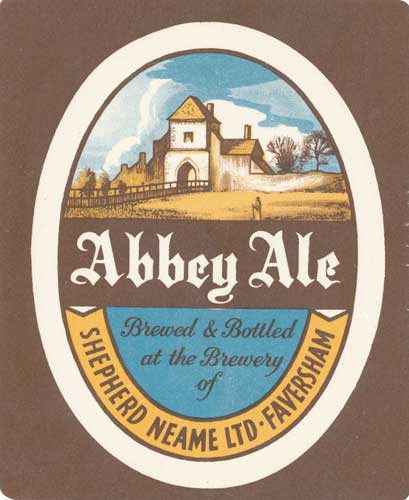
AA – what the hell does that mean? That’s what I thought when I first stumbled across this beer in Shepherd Neame’s records. Luckily, I’ve analyses for a beer of theirs called Abbey Ale. And label images.

It must have been introduced around 1953, a typical time for stronger beers to be introduced. I say that because it isn’t in their 1952 brewing book, but is in the 1956 one.

This is a difficult beer to categorise. In my gravity spreadsheet, I’ve classified it as a Pale Ale. Based mostly on its colour, which is pretty pale at around 10 EBC / 5 SRM. Which you’ll note is much paler than the calculated colour in the recipe below. That will be on account of the gyling. In reality, the proportion of No. 3 invert sugar would have been lower.

OK back to the drawing board. That’s clearly come out wrong. Abbey Ale contained very little of the second wort – only 4 of the 98 barrels. Assuming all the No. 3 went in the second copper, that drastically reduces the percentage of the sugar in Abbey Ale. From 25% to 9%.

As I was saying, a difficult one to categorise, this one. I’ve got it down as a Strong Ale in my brewing log spreadsheet. That was mainly because it was parti-gyled with a couple of Brown Ales. I’d assumed that it was darker than it was. I think I’ll standardise on Pale Ale. Though it is weird that it wasn’t parti-gyled with the Pale Ales.

Ah. I think I know why it wasn’t parti-gyled with the Bitters. Abbey Ale was a bottled beer, as were all the beers it was parti-gyled with. That probably explains it. And also the presence of wheat malt. For head retention, is my guess. Something more important in a bottled beer.

Not much else to say, other than that the attenuation isn’t great. I was going to say tank conditioning before bottling would have lowered that a bit. But having looked at the two analyses of Abbey Ale I have, I’m not so sure. The one from 1954 is, indeed, more highly attenuated at 76%. That from 1961, however, is only 67% attenuated.


1956 Shepherd Neame Abbey Ale
pale malt 7.75 lb 85.45%
wheat malt 0.50 lb 5.51%
no. 3 sugar 0.75 lb 8.27%
malt extract 0.07 lb 0.77%
Fuggles 105 mins 1.00 oz
Goldings 60 mins 0.50 oz
Goldings 30 mins 0.50 oz
OG 1044.3
FG 1016.9
ABV 3.62
Apparent attenuation 61.85%
IBU 27
SRM 8
Mash at 153º F
Sparge at 170º F
Boil time 105 minutes
pitching temp 60.25º F
Yeast a Southern English Ale yeast

Tuesday, 15 November 2016

Gold Label galore

I wasn't joking about this being Gold Label week, as you've probably noticed.

The staff at Tennant seem to have spent much of their time finding ways to surreptitiously drink Gold Label. I don’t blame them. Most of my working days would be far more pleasant with a couple of Barley Wines for breakfast.

This explains the main source of illicit Gold Label within the brewery:

“The first bottling manager that I knew was Geoff Brown - one of life's true gentlemen. His office was up a flight of stairs, overlooking the whole bottling area. Adjoining his office was a small, discrete room which became an unofficial haven for staff who were harassed or thirsty or both. Geoff kept it well stocked with Gold Label 'shorts'. These were bottles that were slightly under filled, usually through overflowing at the 'knocker', in theory, they should have been decanted individually into casks and then blown back into a tank. This was clearly time-consuming and labour intensive. It was obviously less trouble to drink them. The room was known as 'Brown's Bar' and was often patronised by brewers.”
"The Brewer's Tale" by Frank Priestley, 2010, page 27.

“It was obviously less trouble to drink them.” Well, yes. Convenient that, wasn’t it? The attitude to drinking in the brewery varies a lot today. In many new American breweries, they seem to be cracking open bottles and taking samples from tanks the whole time. While in older UK breweries drinking is often strictly limited to the sampling room. It’s become much stricter than it was a few decades back.

Under-filled bottles weren’t the only source of Gold Label:

“The charge hand in the Barm Alley was Jock McKinnon. He was a remarkable man and, not surprisingly, Scottish. I discovered that he used to drink Gold Label pressings. This was basically Gold label with a very harsh, yeasty flavour. From my time working in that department, I learned that it was quite possible to get used to drinking this foul dose. There was clearly no pleasure in the drinking of it, it was more like taking a medicine - you put up with the taste knowing that you were going to feel very much better, very quickly. Jock used to mask the smell of it on his breath by the liberal use of mouthwash from the first aid box in the department. You could always tell how much Jock had had to drink in the Course of the day. He wore a cap at work and first thing in the morning, the peak was centrally aligned above the front of his face, like that of the guardsman he once was. As the day wore on and his sobriety became eroded, the peak would progressively move round his head, like the shadow on a sun dial.”
"The Brewer's Tale" by Frank Priestley, 2010, pages 37 - 38.

Clearly Jock was getting pissed every day on that vile stuff. I’m trying to work out what they were pressings of. Hop pressings are a thing, but that’s pre-fermentation. This is obviously post-fermentation. Could it have been from the filters somehow?

Silly me. I should have read the preceding paragraph properly. It was yeast pressings:

“Because the yeast reproduced so enthusiastically, we always finished up with much more than we needed. The best of the crop was directed into a yeast room which was kept, as near as possible, in a sterile state and this yeast was used for future brews. The remainder, which was considerable, was diverted to an old yeast room in an area of the cellars known as the Barm Alley. When the yeast arrived here, it was in the form of a slurry. It was blown through a filter press which held the yeast back and the beer which had been mixed with the yeast (known as pressings) was returned to the fermenting vessels. The dried yeast was packed into old casks and sold to the food industry.”
"The Brewer's Tale" by Frank Priestley, 2010, page 37.

Jock was drinking stuff which should really have been returned to the fermenting vessel, the naughty boy.

Monday, 14 November 2016

Whitbread Gold Label is born

Gold Label, you may remember, was the only Tennant’s brand to survive the Whitbread takeover. But even that they didn’t leave alone.

Let’s face it, Whitbread were never going to keep branding Gold Label as Tennant forever. Especially when the Tennant name had been phased out elsewhere. And it wasn’t just the name on the label that Whitbread changed.

“Around this time, a new tank room was built which could be reached from the bottling hall, via a bridge across Mill Sands, the lane at the side of the brewery. The new room housed a large number of 200 barrel tanks. They were used for the maturation of Gold Label. The practice of maturing 'in wood', up the tunnel, had been discontinued. Not only that, but the maturation time was progressively reduced. So much for the retention of traditional methods, I thought. However, to be fair, the sales of Gold Label were rising phenomenally and from the volume alone, it would have been very difficult to mature the product in the old way. A newly-designed bottle label, carrying the Whitbread name, was brought in to replace the Tennant's label. This was fair enough: after all, it was no longer Tennant's Gold Label.”
"The Brewer's Tale" by Frank Priestley, 2010, pages 26 - 27.

I wish Priestley was more specific about the number of maturation tanks. Because that would have given me some idea of how much Gold Label was being produced. One 200-barrel is the equivalent of about 130 hogsheads, which is what they had used before for ageing. Even if they only had 10 such tanks, that’s the equivalent of 1,300 hogsheads. You’d need a large cellar for so many bulky casks.

It still amazes me that a beer like Gold Label could be a mainstream national brand. Heavily advertised and widely available. A sign of its popularity is that Whitbread also started brewing at their London headquarters. And in considerable quantities – 300-odd barrels a week. That’s a large volume for a beer of over 10% ABV.

I was trying to find out exactly when the Exchange Brewery closed and was digging around in old Good Beer Guides. It seems cask beer was only discontinued for a few years in the late 1970’s. And the Queen’s Ale that Priestley laments made a comeback in 1981, when it had an OG of 1044º, the same as in the 1950’s. It didn’t last long as it doesn’t appear in the 1984 guide.

It’s funny how your perspective changes with age. I always thought of Whitbread’s northern pubs as a desert, with none of their breweries there brewing any cask other than Castle Eden. Yet this was really just a short-lived feature, lasting less than a decade. It seemed to be forever to my younger self. Probably because they dropped cask just about when I started drinking.

Next I’ll be comparing the Tennant and Whitbread versions of Gold Label.