Showing posts with label cooling. Show all posts

Saturday, 11 March 2023

Coolers and coolships

There's a brilliant article on coolers (what mot people call coolships nowadays) and their uses by my good friend Martha. Extremely informative and well-researched by someone who, unlike me, is a proper scientist.

Cooling is, like everything beer-related, way more complicated than it at first appears. Both in terms of the equipment used and the processes performed with them. The article taught me lots of things I hadn't realised that I needed to know. If you get what I mean. I need to review the section on cooling in "Free!".

Do take a look. I love the mixture of personal and technical. The theoretical and practical. One of the best long articles I've read in ages.

https://beerofsmod.co.uk/blogs/news/the-koelship-a-flat-cooler-for-all-occasions 


Friday, 8 April 2016

Guinness’s Park Royal Brewery in 1949 – the Cooperage Shops and Refrigerating Plant

It’s taken a while, this series, but the end is in sight. Almost.

We’ve already visited the most interesting bits of the brewery. Well, the bits most are interested in. Me, I have a fascination for the auxiliary bits of a brewery. Like the cooperage shop. And the cooling system.

Breweries of any size repaired – and often made – all their own wooden casks. It made sense, as casks were one of the biggest capital expenditures a brewery made. A brewery like Bass or Guinness owned millions of casks, which needed to be kept in good order and, when necessary, replaced. Landlords weren’t always as careful with casks as they should have been, resulting in damaged or filthy casks.

Making and repairing casks was a labour-intensive business and the cooperage department was often one of the largest in terms of numbers employed.

“The Cooperage Shops.—The cooperage shops are located adjacent to the cask cleansing shed, the machinery and equipment being of more or less standard type. The shops are laid out to cope with all repairs and new casks required for the Park Royal trade.”
Journal of the Institute of Brewing Volume 55, Issue 5, 1949, page 286.

There’s plenty that needs cooling in a brewery. Some of it obvious, like cooling the wort after boiling and before pitching yeast.

“The Refrigerating Plant.—In common with all breweries the demand for cooling facilities at Park Royal is heavy, the maximum demand in summer being of the order of 5,000,000 B.T.U. per hour, occasioned principally by wort and beer cooling.”
Journal of the Institute of Brewing Volume 55, Issue 5, 1949, page 288.

I’ve no idea what 5,000,000 B.T.U. means, but it sounds like a lot. Just cooling the 3,000 barrels of wort produced every day must have taken a fair bit of energy.

They had two different types of cold water, at different temperatures.

“There are two sections of the refrigerating plant, one being the chilled water services at 45° F. for wort and beer cooling, and the other a brine service at 25° F. for yeast and gyle cooling. The machines are CO2 compressors of the high-speed single acting vertical totally-enclosed type. The choice of a CO2 system was made on the grounds that in the event of a leakage it would be less harmful than in an ammonia system, although it was appreciated that its higher vapour-pressure characteristic would require a considerably higher operating pressure—1,300 p.s.i.g., in fact; and also that it would be slightly less efficient from the thermo-dynamic point of view than ammonia.”
Journal of the Institute of Brewing Volume 55, Issue 5, 1949, page 288.

Brine was used in the wort refrigerators or attemperators. Though if you remember, unusually, Guinness’s fermenters weren’t fitted with attemperators.

“The plant for the chilled water services comprises five machines, two of which are capable of eliminating 2,000,000 B.T.U. per hour each when cooling water from 65 to 45° F. with condensing water at 70° F. which is the summer temperature of the direct water. The remaining three machines are capable of eliminating 1,000,000 B.T.U. each under similar conditions. The condensers are of the submerged type, while the evaporators are of the enclosed type, both of steel casings. There is one condenser and three evaporators to each unit. The compressors are direct-coupled to variable-speed motors, those for the large machines being of 200 h.p. and the small machines 100 h.p.”
Journal of the Institute of Brewing Volume 55, Issue 5, 1949, page 288.

I make that a total capacity of 7,000,000 B.T.U., well more than the peak demand of 5,000,000 B.T.U.

Finally, the brine machines.

“The brine machines are similar to the chilled water plant excepting that there are three machines each of 250,000 B.T.U. per hour capacity, direct-coupled to 50 h.p. motors. Each machine, however, has one condenser and one evaporator. Three brine pumps are provided for the circulation of brine to various sections of the brewery. For charging the installation with CO2 gas, a charging station has been erected outside the main engine room which enables six flasks of CO2 to be charged into the plant at the same time. The charging lines are so inter-connected throughout the plant that gas can be drawn from another machine to assist in the charging of another if necessary, so that during overhaul work it is not necessary to lose any gas as it can easily be transferred to one of the other machines.”
Journal of the Institute of Brewing Volume 55, Issue 5, 1949, pages 288 - 289.

They’ve lost me there. Why do you need to charge the installation with CO2? I really don’t understand that.

There’s not much left. And pretty obscure stuff at that. Anyone interested in pipes and valves?

Monday, 16 February 2015

German brewing in the 1970’s - cooling

We’re gradually getting through this article. Though I’ll admit I’m already becoming distracted by other shiny things.

Cooling is a pretty dull but essential part of the brewing process. As is the removal of sludge.

“Cooling and Preparation of Wort for Fermentation
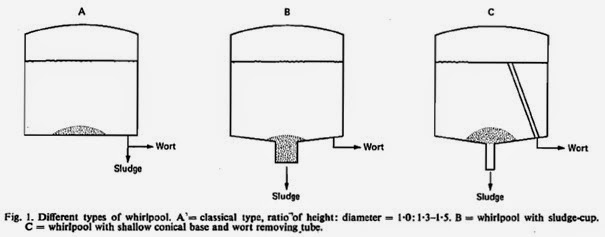
The whirlpool will separate hot break and hop sludge satisfactorily when the vessel has an adequate diameter. The ratio of height of wort in vessel to diameter should be 1:1.3-1.5. Fig. 1 shows the different types of whirlpools, presently found in German breweries. The classical type is widely distributed but it needs a lot of water to remove the sludge. A sludge-cup is frequently incorporated in order to allow sludge removal with a smaller amount of water. In order to shorten the rotation time in the whirlpool and so prevent an increase in the colour of the hot wort, some vessels contain a removing lube. With this device the amount of water needed to remove the sludge is low and has advantages when the sludge is added back to the lauter tun or mash filter.”
Journal of the Institute of Brewing, Volume 83, Issue 1, March-April 1977, page 75.

Sludge removal probably wasn’t such an issue when breweries still had the classic shallow open coolers. Precipitating out sludge was one of their main functions, along with cooling, obviously. Adding sludge back to a subsequent mash doesn’t sound a great idea. Surely all that gunk is exactly what you don’t want in your wort. Still, I guess it’s one step up from re-using ullage.

“Most breweries use whirlpool sludge for the next brew and add it to the finished mash in the mash copper, to the mash tun, or to the lauter tun after running-off the first wort. The smaller the amount of water needed to transport the sludge the smaller the danger of cooling the mash. Only a few breweries are of the opinion that re-use of the sludge diminishes the quality of the beer and so reject it although re-use saves at least 5% of the added a-acids and increases brewhouse yield.”
Journal of the Institute of Brewing, Volume 83, Issue 1, March-April 1977, page 75.

Desperately trying to use every bit of wort I thought was typical of British brewers because of the tax system. Back in the days when there was a fixed 6% wastage assumed by the taxman. If your real wastage was lower, then you got some untaxed beer. The German tax system didn’t work that way so I’m not sure why breweries would be so keen on re-using dodgy wort.

Conical fermenters. I must admit that I feel uneasy about them. In particular, really big ones. Though I have mellowed in my attitude. If only because pretty much everyone uses them, especially in North America.

“I will now discuss removal of cold break from the cooled wort in the context of the use of cylindro-conical fermentation vessels and the possibility of simplifying the process by using these vessels for both fermentation and maturation of the beer. More than 50 years after its invention, the Nathan cylindro-conical fermentation vessel has led to a new epoch in fermentation technology.”
Journal of the Institute of Brewing, Volume 83, Issue 1, March-April 1977, page 75.

Which puts their invention back in the 1920’s. But what about the Pfaudler vacuum system? Isn’t that similar? It dates from the 19th century. I can see the attraction of using a conical for both fermentation and lagering. But doesn’t lagering work better with a horizontal vessel?

This technique is new to me:

“The classical cold-pitching method whereby the cold wort stands in a vessel 1.2—1.5 m deep for 20 hours after addition of yeast and is then pumped to the fermentor is now rarely used. The flotation procedure, which involves intense aeration of wort by the use of aeration tubes, so that the cold break is transported by the air bubbles to the surface of the wort has now successfully replaced the classical pitching method, with the added advantage that yeast growth is accelerated. In this method the wort must be pumped from one vessel to another to separate it from the cold break. By using kieselguhr filtration this additional draw-off can be avoided but this is expensive and many breweries now try to transfer the cold wort immediately to a cylindro-conical fermentation vessel and separate the cold break from the unaerated wort by sedimentation. This method is not widely used in West Germany so that it is not possible at present to judge its influence on the flavour quality of bottom-fermented lager beers. The economics of this procedure would be very advantageous.”
Journal of the Institute of Brewing, Volume 83, Issue 1, March-April 1977, page 76.

I assume the purpose of sitting for 20 hours was to allow cold break to settle out. I assume that’s why the vessel was so shallow. Leaving the cold break in the primary fermenter doesn’t seem like a great idea. But I guess it saves money.

Fermentation next time.

Thursday, 22 January 2015

Brewing in Canada in the 1960’s – mashing and boiling

We’re still ambling along the winding country lanes of Canadian brewing. This time it’s dead exciting as we’re starting to look at the brewing process itself.

We begin with mashing. It’s a bit lacking in specifics – like temperatures or mashing techniques – but it does tell us something.

“Mashing: In the mashing process, the malt enzymes break down the starch to sugar, and the complex proteins of the malt to simpler nitrogen compounds. The mashing takes place in a large round tank called a "mash mixer" or "mash tun", and requires careful temperature control. Sometimes at this point, depending on the type of beer desired, the malt is supplemented by starch from other cereals such as corn, wheat or rice.

Lautering: When mashing is finished the mash is transferred to a draining or "lautering" vessel, usually cylindrical, with a slotted false bottom 2" or 3" above the true bottom. The liquid extract drains through the false bottom and is run off to the brew kettle. Water is "sparged" or sprayed through the grains to wash out as much of the extract as possible.”
"Brewing in Canada", Brewers Association of Canada, 1965, page 30.

My guess is that in many cases the adjunct weren’t added to the main mash but that during a cereal mash before the main mash began. That’s what you have to do if you’re using non-gelatinised adjuncts like corn grits, which were very popular in North America.

You can see that they were using continental-style brewhouses with a mash tun, a lauter tun and a copper rather than British-style brewhouses with just a mash tun and a copper.

This happens the world over:

“The "spent grains" are then removed and sold, for they are in great demand by farmers for cattle feed. They are either dried and placed in bags or sold wet.”
"Brewing in Canada", Brewers Association of Canada, 1965, page 30.

Though I’ve only heard of British breweries selling the grains wet.

Now boiling:

“Boiling and Hopping: The liquid in the brew kettle is called "wort". It is not yet beer. The brew kettle, a huge cauldron holding up to 15,000 or 20,000 gallons and made of shiny copper or stainless steel, is probably the most striking sight in a brewery. It is fitted with coils or a jacketed bottom for steam heating and is designed to boil the wort under carefully controlled conditions.

During the boil, which usually lasts about two hours, the green, aromatic hops are added. (Hops are the flowers of a climbing plant; in Canada they are grown in British Columbia.) The hop resins contribute flavor, aroma and bitterness to the brew. Boiling serves to concentrate the wort to the desired specific gravity, to sterilize it and to obtain the desired extract from the hops. Undesirable protein substances which have survived the journey from the mash tun are destroyed, leaving the wort pure and sterile.”
"Brewing in Canada", Brewers Association of Canada, 1965, pages 30 and 32.

If those are US barrels, that’s between 500 and 650 barrels. If they’re imperial barrels, 400 to 550. Approximately. Whichever is the case, that’s brewing on quite a scale.

Two hours seems a long time for the boil. I wouldn’t have expected more than 90 minutes.

“Hop Separation and Cooling: After the beer has taken on the flavor of the hops they must be removed. The wort is passed through a "hop jack" or separator to remove both the hops and a large amount of the protein which was precipitated during the boil. This protein is known by the short and expressive name of "trub".

The wort itself proceeds from the hop jack to the "hot wort tank", where most of the remaining trub is removed by settling. The wort is then cooled, usually in a deceptively simple looking apparatus called a "plate cooler". As the wort and a coolant flow past each other on opposite sides of stainless steel plates the temperature of the wort drops from boiling to about 50°F. — a drop of more than 150°F. — in a few seconds.”
"Brewing in Canada", Brewers Association of Canada, 1965, page 32.

Surely that’s a hop back rather than a hop jack. Just looked it up. It seems “hop jack” is the North American term for hop back. I wonder how that name came about? Is it a corruption of hop back?

The hot wort tank seems to be fulfilling one job of a cooler – for settling out gunk from the wort. Though “tank” implies something deeper than a shallow cooler. With the efficiency of the plate cooler in dropping the wort temperature quickly, the hot wort tank didn’t really need to cool the wort, so from that point of view could be as deep as you liked. Though one advantage of having a shallow vessel like a cooler was that the muck would settle out more quickly.

You can probably guess what’s coming next: fermentation.

Sunday, 28 December 2014

German brewing in 1966 – boiling and cooling

I thought I’d best hurry through the rest of this article before I forget about it again. Also because it’s expanding the horizons of my book “Decoction!”.

The book now covers more than 150 years of German brewing, from the early 19th century right through to the 21st. Which reminds me that I’ve another unfinished series: German beer styles in 2014.

But on with the Journal of the Institute of Brewing article, in which we’ve now reached the section  on boiling:

“Wort boiling still requires 90-100 min. if one intends to isomerize the hop bitter substances completely and to obtain coagulation of the protein components. Higher temperatures have not yet been used and hop extraction with special solvents is not permitted. Outside Bavaria, on the other hand, hop extracts such as Horst, Hopulux and Hopcon etc. may be used. Nevertheless, the percentage of fresh hops used in Pilsener beers is still very high. In some breweries hops are milled before use, thereby saving up to 10%, although occasionally the bitter ness of the beer is not so fine. This method is often used in connection with the cloth trub filter.”
Journal of the Institute of Brewing, Volume 72, Issue 1, January-February 1966, page 19.

That’s interesting: a minimum of 90 to 100 minutes boiling is need to get the hot break. Mmm. I’ve definitely seen boiling times shorter than that in British breweries. Both world wars saw boiling times cut to save fuel. After 1942, Whitbread almost never boiled for as long as 90 minutes. Mostly it was 45 to 65 minutes, occasionally as long as 85 minutes. These short boiling times continued until the Chiswell Street brewery closed in the early 1970’s.

Clearly the stricter Reinheitsgebot that applied in Bavaria prevented the use of hop extracts. Pretty sure that’s no longer the case as I’m sure I’ve seen Bavarian beers with hop extract listed in the ingredients. I’m not a fan, myself. I’ve had too many beers ruined by a horrible musty hop aroma.

“One can see that the brewhouse work is still being carried out according to the old principles, although wet grinding or steam grinding and shorter lautering times have introduced genuine improvements. The heating of the coppers is now very seldom carried out directly with a coal fire; it is mostly carried out with oil burners in specially constructed heating units with 68-70% efficiency. In larger breweries hot water, fresh steam, or waste steam from machines or turbines is used.”
Journal of the Institute of Brewing, Volume 72, Issue 1, January-February 1966, page 19.

British breweries had started using steam coils to boil wort as far back as the 19th century. It seems as if German brewers were much slower in taking the practice up. The little Franconian breweries I’ve visited mostly have direct-fired coppers, though the fuel is wood not coal.

“Wort cooling.—A fundamental change has occurred in wort cooling systems since pre-war years. With the old method of the coolingship, followed by an open upright cooler, and the use of a special fermenter for the first 24 hr., first class beers were produced. Nevertheless, when breweries were reconstructed or increased capacity was required, one did not wish to provide the large areas necessary for the conventional system, as these were often poorly utilized. As a result, numerous closed systems are being used. The changeover was not always easy, as difficulties occurred in providing sufficient oxygen for yeast reproduction, but by intensive aeration units or air-suction at the centrifuge, sufficient aeration could be guaranteed.”
Journal of the Institute of Brewing, Volume 72, Issue 1, January-February 1966, pages 19 - 20.

Don’t think I’ve seen the term “coolingship” before. A slight variation on the usual direct translation of “coolship”. There was a special fermenter used for the first day of the fermentation? How odd. I can’t remember seeing one of those anywhere. Then again, I wasn’t looking for one and wouldn’t have known what one looked like.

There’s an explanation of this vessels function next:

“With the coolship the amount of cooler sludge depends on temperature. The higher the temperature of the wort, the more important is the subsequent removal of the cold trub. Frequently one still finds the use of a starting fermenter in which the cooled, pitched wort remains for 12-36 hr. This type of unit is wasteful in labour and a certain amount of useful yeast is lost; this can result in the slowing down of the subsequent main fermentation. Useful results have been obtained with cold sedimentation of the wort in closed units. During this process the hot trub often removes, or assists the removal of, the cold trub by a fining action. Following the 8 hr. of sedimentation, intensive aeration is necessary. Cold trub can also be removed by centrifuges and filters: both of these methods have been perfected. For normal bottom fermentation it is considered that only a portion of the cold trub should be removed; on the other hand, quick maturing of the beer can only be carried out with worts free of cold trub.”
Journal of the Institute of Brewing, Volume 72, Issue 1, January-February 1966, page 20.

It was all about removing the cold break from the wort. You know what it reminds me of? The dropping system as interpreted by Fullers. They generally only kept the fermenting wort in the upper round for a day before dropping to the settling square. Weird that something similar was done in Germany. Though rather than a shallow settling square, I assume German brewers used a standard fermenter.

Next it’s the turn of fermentation.

Wednesday, 27 July 2011

James Eadie, Cross Street Brewery (part two)

We're back in 1890's Burton. One of my favourite places. Looking inside one of the town's less well-known breweries.

We'll begin with boiling.

Before proceeding to the boiling department, we paid a visit to the hop room, adjoining the brewer's office. It is situated over the engineers' shop and general store house, is 50 feet long, and will hold 500 pockets of hops. As this place is not large enough to warehouse all his purchases, Mr. Eadie allows the bulk of his stock to remain in the London warehouses. Retracing our steps to the mashing stage, our guide pointed out to us, in the centre of the floor, the pull-up holes, by which means the malt trucks, on the railway beneath, are emptied under shelter in wet weather, instead of by the hoist cages outside.

"Passing through a wide doorway, we descended a few steps to the copper-stage, another room as large as the mashing stage, noting as we progressed, that the water tanks occupy the remainder of the mashing floor, and are separated from the mill room by 14-inch walls, carried on iron girders. The copper house is also a fire-proof building, open to the roof, and contains two eighty-barrel coppers, of the newest form manufactured by Morton. It is worthy of notice, that in front of these splendid vessels, there is a pathway 10 feet wide, for the use of the coppermen, when engaged superintending the boiling worts, to prevent them being scalded when in attending to their duties. On this wide passage are placed the bags of hops for each day's supply to the coppers, and here we may remark that, having witnessed every process throughout. we can safely state that the ale, in this establishment, is brewed from malt and hops alone.

Bearing round in a westerly direction, and ascending some steps, we reached the hop-back room, abutting on to the copper hearth, which contains a hop-back with a capacity of 120 barrels, and is fitted with gun-metal draining plates. At one end are the hop presses, adjacent to a platform on which the pressed hops are wheeled away from the presses into the farmers' carts. From the hop-back, the wort is pumped up to the top of the brewery, whither we followed it; and this is the first, as well as the last time, that a pump is required in connection with the ale ; as, with this exception, the work in this brewery is done entirely by gravitation."
"Noted Breweries of Great Britain and Ireland, vol. 2", Alfred Barnard, 1889, pages 229 - 230.

That's unusual. The hops weren't stored at the brewery, but in a warehouse in London. Doesn't sound very practical. 500 pockets of hops is, hang on, let me work that out. A pocket is 1.5 cwt., or 168 lbs. 500 pockets then is 84,000 lbs. Truman's Pale Ale of around this time contained 4.75 lbs of hops per barrel. For simplicity's sake, let's say 5 lbs per barrel. So sufficient hops for 16,800 barrels.

Beers "brewed from malt and hops alone". Unlike brewers in most of England, those in Burton often stuck to just malt and hops, with perhaps the odd dash of sugar. I've never heard of them using maize or rice like some London brewers. The only other place where the use of adjuncts and sugar was virtually unknown was Ireland. Here's something to ponder: none of the three biggest breweries in the UK at this date - Bass, Guinness and Allsopp - seem to have used sugar. I wonder if there's any significance in that?

All that fireproofing wasn't a bad idea. Breweries quite often went up in flames. Barclay Perkins, for example.

Let's move on to cooling.

"On our way to the cooling department, we passed through a brick-built room, the remaining relics of the old brewhouse building, containing an ancient copper, and an old-fashioned mash tun. Here was laid the foundation of Mr. Eadies fortune : and our guide mentioned, with pride, that by working these vessels day and night, he had turned out 800 barrels per week, in a little building.

We were glad to rest in the cooling room, which is situated at the top of the brewery, after climbing such a number of staircases. This admirable chamber is 60 feet square, with an open roof, lined with stained wood; the principals, which are constructed of wrought-iron, being painted a light blue. Two sides of the room are lined with white glazed bricks, the others louvred from top to bottom, consequently this is a breezy place in a north-east wind. The open cooler does not rest on the level asphalted floor, but on massive iron girders, elevated 2 feet above it, thus allowing room for a man to get underneath, for the purpose of frequently washing the place down, which is highly necessary to keep it sweet and clean. This splendid cooler is the only one we have seen of its kind in Burton. On the same floor, but placed at a lower level, are two of Morton's refrigerators, cooling sixty barrels per hour.

A few steps, down on the half-landing, there is a large tank for receiving the waste water from the refrigerators, which is there heated by steam coils, and afterwards runs by gravitation through a main pipe alongside the railway to the cask-washing department, situated in the maltings enclosure, where it is utilized. Opposite this vessel, on the same landing, is Mr. Melbourne's private room, neatly fitted up and furnished, and used for receiving travellers, customers, and visitors ; and it is an open secret, that a "wee drappie" of Mr. Eadie's own blend of Scotch whisky is here dispensed to a favoured few. Mr. Eadie is the fortunate possessor of a recipe, bequeathed to him by his father, for a particular blend of whisky, and it was to taste this ancient Scotch mixture, that we rested awhile, before proceeding to the next and following departments.
"Noted Breweries of Great Britain and Ireland, vol. 2", Alfred Barnard, 1889, pages 230 - 231.

Sounds like Fullers, keeping some of the old equipment in the brewery.

Morton's refrigerators. We've discussed those before. One of those pipe and cold water contraptions for cooling wort. There were variations on this theme, but the principal remained the same: cold water cooling pipeds through which the wort ran. Even after refrigerators had been installed, breweries often retained their old-fashioned cool ship, as was the case here. Presumably because coolers performed a dual purpose. They didn't just cool the wort, but also retained the sludge that settled out of it.

Barnard liked his whisky. "Noted Breweries" wasn't his first book. He'd already toured and described distilleries for an earlier work. I wouldn't have turned down a dram from Mr. Eadie's personal stash, either. All that walking up and down stairs is knackering.

That's enough for now. I'll save the treat of the fermentation department for the next installment.

Thursday, 6 November 2008

Boiling and cooling 1880-1914

I'm really enjoying "Principles & Practice of Brewing" by Walter J. Sykes & Arthur R. Ling, published in 1907. That's why I'll be pestering you with lots more from it in the coming days.

Today it's the turn of boiling and cooling. Exciting, eh? I was thrilled to discover the method of calculating what proportion of the hops needed to go into the different strength worts. A bit sad, aren't I?

It's interesting to see that heat exchangers ("refrigerators") hadn't totally replaced open coolships, as you might have expected. It seems coolships performed other vital tasks, apart from the mere cooling of the wort.


Boiling
There were several reasons for boiling:

- sterilising the wort
- destroying disatase
- coagulating and precipitating out proteins (the "break")
- concentrating the wort
- extracting flavour and tannins from the hops


The wort was brought to the boil as quickly as possible to destroy any remaining disatase which would cause the creation of more maltose if left unchecked. The boil was vigourous and varied in length between one hour and more than two. Around 2 hours was commonest.

Whitbread boiled their strong worts for 80 to 105 minutes and their weak worts for 2 hours. Fullers boiled their worts for between 80 and 120 minutes.

Dome coppers had the advantages of aerating the wort and preventing it from boiling over. The disadvantage was that the hops could disintegrate to such an extent that they no longer opperated as a filter for the wort.

There were many different opinions about the best time to add hops to the wort. Some brewers added them as soon as the wort was put into the copper. Others waited until the wort had begun to boil. Sykes & Ling reckoned that it was best to wait until 15 to to 20 minutes into the boil before adding any hops. Their reasoning was that, some proteins already having been precipitated, this helped the precipitative action of tannins in the hops.

They were also proponents of two hop additions: one 15 or 20 minutes after the start, the second 20 to 30 minutes before the end. In this way not all of the volatile oils would be boiled off. The coarser hops were added first and the finer hops, whose flavour would be better preserved, last. A system of three hop additions was also practised, again with the best-flavoured hops added last.

The brewing logs, unfortunately, only give details about the total length of the boil and do not specify when hop additions took place. Based on what appears in brewing manuals, it's probably safe to assume that two additions were commonplace. When hops of different ages were being used, which was usually the case, it would make sense to have used the freshest hops last, as these would contain the greatest quantity of volatile oils. The older hops would have been used as a source of hop resins and tannins, which would not have been lost to such a great extent as the volatile oils during storage.

Though long boiling also extracted some of the less desirable elements of the hops, it was necessary to dissolve hop resins, which acted as a preservative. "The preservative power of hops is dependent on the soft resins they contain, and these, on excessive boiling, undergo a chemical change and are converted into bodies of a less soluble nature; hence hops should never be boiled a second time. It is highly probable that the long periods which hops are often boiled at the present time might be shortened with advantage."

When worts were boiled sepatately, each was hopped in proportion to its volume and gravity. Let's take as an example a brew of 100 barrels of beer, with a gravity of 21 pounds per barrel (1058º) and 250 pounds of were to be used in the whole batch. The total extract would be 100 * 21, or 2100. A first wort of 67 barrels at 24 pounds per barrel, would have an extract of 67 * 24, or 1608. So the amount of hops to be boiled in it would be 250 (total hops) * 1608/2100, or 191.4. The second wort would have the remainder of the hops: 58.6 pounds.

A patented device called a "hop separator", divided hops into leaves, stalks and lupulin. The leaves were added at the start of the boil, the stalks 15 minutes before the end and the lupulin 10 minutes before the end. The inventor claimed between 10 and 25% fewer hops were needed when using this method.

At the end of the boil, the wort was "turned out", that is run into the hop back. The hops settled onto the false bottom and formed a natural filter so that the wort was drawn off perfectly clear. The spent hops were sparged to release any wort retained in them.


Cooling
Form the hop back, the wort moved on to the coolers. Whilst spread thinly in the shallow coolers, the wort not only rapidly lost heat, but also absorbed oxygen. This oxygen combined chemiccally with some of the contents of the wort. This aeration was vital for the later clarity of the beer.

Whilst in the cooler, the wort deposited a sediment known as "cooler sludge", which was not allowed to get into the fermenting tun. The wort was not allowed to drop below 140º F in the coolers as this would damage the finished beer and make it less stable.

As soon as the wort had dropped in temperature to 140º F, it was run through the refrigerator. Here more oxygen was absorbed, though only in solution, not chemical combination. The wort was cooled to the required pitching temperatuure, usually 58 to 60º F.