Showing posts with label Kulmbach. Show all posts

Monday, 10 October 2022

Kulmbach

After a bit of a deliberation, we bought breakfast when we checked in. Let’s see what it’s like.

Dolores goes first. She’s disappointed.

“They only have a couple of different sorts of meat and cheese. Not worth the money.”

But I can smell bacon. Around the back of the breakfast bar there’s one of those stainless-steel hot food thingies. In it are scrambled egg, bacon and sausages. I pile my plate with the first two.

“Where did you find that?”

“Around the back.”

For me, the breakfast is OK. Not great, but good enough. Dolores is distinctly less happy.


We trundle our trolley bags down to the station in time for a quick visit to Lidl. To take back some empties and stock up for the journey. Dolores is very well organised. I wait and guard the luggage. Luckily, seated in one of the few benches.

Our train is a fairly small diesel. And quite full. Just as well Dolores is with me to grab seats. She’s such a helpful travelling companion.

I’ve prepared a train drink. Cheap bourbon and diet cola. In a half litre cola bottle. Mmm. Warming.

“Don’t go crazy with that, Ronald. It’s strong.”

“When did I ever go crazy?”

You can guess what happened next.

The railway follows the Pegnitz. I’ve been down this way before. Years ago with Anti-American Mike.

“Look at that castle, Dolores.” It is dead impressive. It looks familiar. Then I spot the Kaiser brewery. In know where this is. It’s Neuhaus. Home to a Zoigl that isn’t called Zoigl. Doesn’t have a name at all, actually.

I say “is” home. Was would be more accurate. The communal brewhouse has been converted into a house. A shame, because it was a really good and distinctive beer. Though the flies in the beer garden were dead annoying.

We’re changing in Bayreuth. We arrive a little late, still with plenty of time to make the connection. The platform is packed with schoolkids. Who all tip onto the slightly larger diesel with us. I’m lucky to get a seat.

“Out in the sticks, the buses are mostly run for schoolchildren. Often me and Anti-American Mike were the only adults on the bus.”

“That must have been weird.”

“Well, I did feel a little self-conscious tucking into impulse Schnapps.” It didn’t stop me, though.


Picking the wrong way to walk to the hotel, we have to sprint over a main road with our bags. More excitement than I need. The hotel is over the road from the huge conical fermenters of the Kulmbacher Brauerei.

No matter hard we try, we can’t connect to the wifi network. Dolores has a word with the bloke on reception. Who gets a colleague to do some resetting. It doesn’t help. We give up and head into town.

It doesn’t take long. Kulmbach isn’t a large town. Dolores is slightly disappointed, despite it being fairly scenic.

“I expected it to be older.”

I can’t see what she’s complaining about. From the compact market place there’s a great view of the castle literally towering over the town. 


“Every town in Franconia has a castle.” I remark. At least that’s how it seems.

Pubs are thin on the ground. Fortunately, the bloke in the hotel gave Dolores a map, on which he marked the town’s few pubs.

One just off the market square, Zum Petz, is open. A couple of smokers are sitting outside. Inside, a couple of people are on the Stammtisch. Not very lively.


It’s a small, old-fashioned looking place, Like a miniature beer hall with leaded windows, panelled walls and pine-topped tables. Small, but perfectly formed.

Inevitably, the beer is from Kulmbacher Brauerei. In the form of Monschof. They do have Kellerbier, though. We order two. It tastes very fresh and the heavy carbonation creates an almost banked head. Better than I expected.

A tourist couple wanders in and orders food. Now we’re not totally alone, other than the landlord’s mates. Which is nice.

Dolores being keen to see a bit more of the town, we leave after just the one. Heading in the direction of another pub marked on the map. Off the market place, the streets are pretty empty. Scenic, but rather lifeless.

The town centre is mostly sort-of pedestrianised. It all looks like pavement, except occasional cars roll past. That’s nice and confusing.
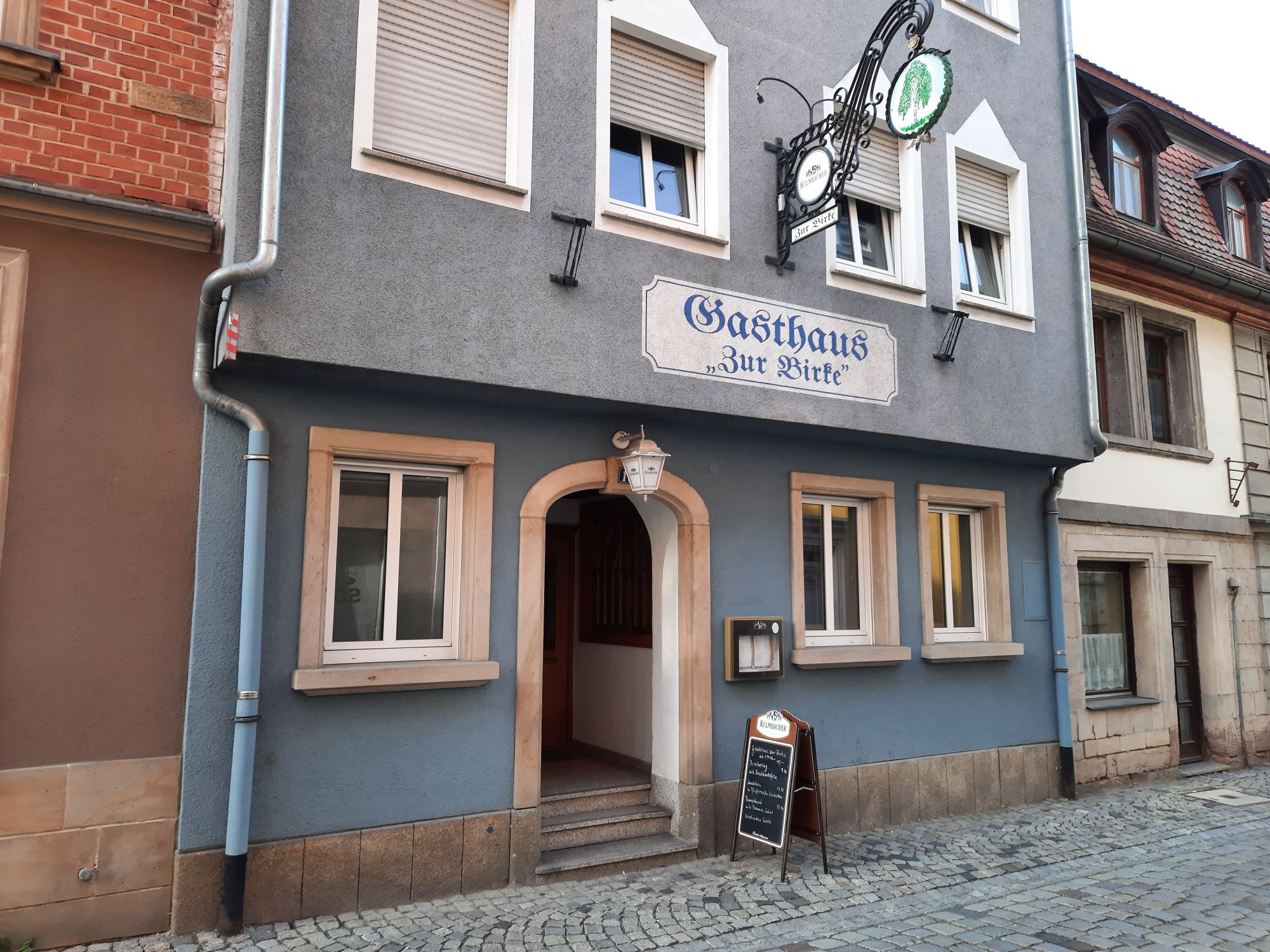


Halfway down a somnolent street is another small pub, Zur Birke. It’s in a similar style to the last place. Not quite so worn in, mind. The wood hasn’t had time to turn to that lovely shade of dark brown. “Nappy brown” as our ancestors would have so colourfully described it.

The sign outside proclaims Kulmbacher, totally unsurprisingly. But when I ask the friendly waitress what they have on draught, she tells me that they have a Dunkles from Krug Bräu, a small brewery in the Fränkische Schweiz. Oooh, that sounds good.


It’s a seductive dark amber, with a fat fluffy head. It certainly looks the part. And it is. Packed with deep malt flavours.

“I’m pretty sure I’ve had this before, Dolores. Good, isn’t it?”

“Lovely.” Dolores is drinking the same as me for once. She does like a good beer. She is German, after all.

With an early evening appointment, there’s no time for a second beer. Which is a shame.


Restaurant Zum Petz
Langgasse 3,
95326 Kulmbach.


Gasthaus zur Birke
Fischergasse 17,
95326 Kulmbach.
https://www.zur-birke-kulmbach.de/


Wednesday, 19 August 2020

Kulmbacher Export 1878 - 1929

A quick post in Kulmbacher, prompted by a Twitter discussion.

First, some hard facts:

Kulmbacher Export 1878 - 1929
Year Brewer Beer OG FG ABV App. Atten-uation
1878 Aktien-Brauerei Export 1072.9 1022.0 6.61 69.82%
1878 Export-Brauhaus Export 1059.0 1016.0 5.59 72.88%
1878 Puszta Export Dunkel 1053.2 1018.2 4.53 65.79%
1879 Eberlein Export 1070.5 1024.0 6.03 65.96%
1879 Export-Brauhaus Export 1062.8 1019.3 5.64 69.24%
1879 Kulmbacher Aktien-Br. Export 1054.5 1017.4 4.80 68.07%
1879 Pätz Export 1067.5 1021.4 5.98 68.27%
1879 Rizzi Export 1065.5 1013.2 6.84 79.85%
1879 Sandler Export 1064.9 1018.2 6.08 71.96%
1884 Aktien-Export-Brauhaus dunkeles Export 1067.6 1025.9 5.39 61.69%
1884 Export-Brauhaus Export 1063.5 1023.0 5.24 63.78%
1884 Kulmbacher Actien Export 1068.1 1025.1 5.39 61.56%
1884 Unknown Export 1052.6 1020.2 4.19 61.60%
1884 Unknown dunkeles Export 1061.9 1024.0 4.90 61.23%
1885 Kulmbacher Export 1072.3 1029.8 5.48 57.10%
1887 Kulmbacher Export 1062.3 1017.5 5.81 70.59%
1890 Aktienexportbierbrauerei Dunkles 1080.4 1029.2 6.63 63.67%
1890 Kulmbacher Export 1062.6 1022.8 5.00 63.58%
1891 Aktien-Brauerei Export 1062.7 1015.5 6.15 75.28%
1891 Aktien-Brauerei Export 1068.6 1026.2 5.48 61.81%
1891 Unknown dunkeles Exportbier 1067.6 1023.0 5.78 65.98%
1893 Aktien-Export-Brauerei dunkeles Exportbier 1076.9 1025.8 6.63 66.45%
1898 Erste Kulmbacher Export-Bierbrauerei Exportbier 1077.1 1033.6 5.61 56.42%
1898 Unknown, Kulmbach Dunkles Kulmbacher 1072.3 1029 5.58 59.86%
1929 Kulmbacher Sandlerbraeu Dunkles 1062.6 1015.8 6.05 74.76%
Sources:
König, J (1903), Bier in Chemie der menschlichen Nahrungs- und Genussmittel by Joseph König, 1903, pp 1101 - 1156, Julius Springer, Berlin.
Wahl & Henius, pages 823-830
Handbuch der chemischen technologie by Otto Dammer, Rudolf Kaiser, 1896, pages 696-697
Brockhaus' konversations-lexikon, Band 2 by F.A. Brockhaus, 1898 
Beer from the Expert's Viewpoint by Arnold Spencer Wahl and Robert Wahl, 1937, page 166.

Now a recipe that was brewed for the Urban Chestnut historic Lager Festival:

1879 Kulmbacher Export
Munich malt 20L 15.25 lb 96.83%
Carafa III 0.50 lb 3.17%
Hallertau 60 mins 3.50 oz
Hallertau 30 mins 3.50 oz
OG 1065
FG 1018
ABV 6.22
Apparent attenuation 72.31%
IBU 80
SRM 30
Mash Kulmbach method  
Boil time 90 minutes
pitching temp 48º F
Yeast WLP830 German Lager

The Kulmbach method of decoction
Another Bavarian method of decoction from Otto (("Handbuch der Chemischen Technologie: Die Bierbrauerei" by Dr. Fr. Jul. Otto, published in 1865, page 128).

As soon as the water in the kettle reaches 50º C, as much as is needed is put into the mash tun to dough in.

After an hour, when the rest of the water has come to the boil in the kettle, this is added to the mash. The temperature of the mash should be 53.75 - 56.25º C. A small amount of water should remain in the kettle so that the temperature of the mash is correct. Or a small amount of cold water is added to the mash. When, after resting, the wort in the mash tun has cleared, this is run off and boiled in the kettle. After just a few minutes boiling, this Lauter mash is added back to the tun and mashed for 45 minutes. The temperature of the mash should be 71.25 - 72.5º C.

Usually a small quantity of wort is left in the kettle and boiled with all the hops for 10 to 12 minutes (hopfenrösten).

The mash in the tun is left to rest for 90 minutes, then it is drawn off and added to the kettle where it interrupts the rösten.

The wort from the first lot of cold water poured over the grains is usually used for topping up the kettle.


Saturday, 22 July 2017

Let's Brew - 1879 Kulmbacher Export

You may have noticed that I've been busy with a new book. And when I say new, I don't mean just a bunc of blog posts stapled together.

Yes, it does contain some blog material. But also a whole load of new stuff. In particular, lots of new Lager recipes, around forty in all. They're a mixture of reconstuctions from brewing text books and analyses and ones taken from real brewing records. This is one of the former

In the early days of Lager brewing outside its traditional central European home, several regional Bavarian styles were imitated abroad. One of these was Kulmbacher.

Even Heineken used to brew this style of strong, hoppy and very dark Lager. But for some reason it quickly fell out of fashion and is today virtually unknown as a style. Which is a shame as I’m sure its bold flavours would go down well with modern drinkers. You could think of it as a Münchener on steroids.

The Kulmbach method of decoction

This is the description of the Kulmbach method of decoction from Otto (("Handbuch der Chemischen Technologie: Die Bierbrauerei" by Dr. Fr. Jul. Otto, published in 1865, page 128).

As soon as the water in the kettle reaches 50º C, as much as is needed is put into the mash tun to dough in.

After an hour, when the rest of the water has come to the boil in the kettle, this is added to the mash. The temperature of the mash should be 53.75 - 56.25º C. A small amount of water should remain in the kettle so that the temperature of the mash is correct. Or a small amount of cold water is added to the mash. When, after resting, the wort in the mash tun has cleared, this is run off and boiled in the kettle. After just a few minutes boiling, this Lauter mash is added back to the tun and mashed for 45 minutes. The temperature of the mash should be 71.25 - 72.5º C.

Usually a small quantity of wort is left in the kettle and boiled with all the hops for 10 to 12 minutes (hopfenrösten).

The mash in the tun is left to rest for 90 minutes, then it is drawn off and added to the kettle where it interrupts the rösten.

The wort from the first lot of cold water poured over the grains is usually used for topping up the kettle.
 
1879 Kulmbacher Export
Munich malt 20L 15.25 lb
Carafa III 0.50 lb
Hallertau 60 mins 3.50 oz
Hallertau 30 mins 3.50 oz
OG 1065
FG 1018
ABV 6.22
Apparent attenuation 72.31%
IBU 80
SRM 30
Mash Kulmbach method
Boil time 90 minutes
pitching temp 48º F
Yeast WLP830 German Lager

Wednesday, 15 October 2014

Kulmbach area Export 1878 - 1893

I'm back with analyses from "Chemie der menschlichen Nahrungs- und Genussmittel" by Joseph König. Sorry about the delay. There's a good reason.

I've been out in the internet fields harvesting modern beer details. Lots of them. Because I want to make some comparisons between 19th-century and 21st-century Lagers. And because I enjoy collecting data. It's addictive.  I'm building up an impressive set. Which I'm sure we'll have loads of fun with in future.

There's a decent set of beers from Kulmbach and nearby Kitzingen in "Chemie der menschlichen Nahrungs- und Genussmittel". Enough to handle them separately.

I'll start with a note on colour. Some are specified as being Helles or Dunkles, but most aren't. However, it being Kulmbach, I'd assume most were dark. Kulmbacher was one of the early Lager styles which was imitated abroad (one of Heineken's early Lagers was a Kulmbacher). From what I can gather, it was darker and bitterer than Münchner.

Let's take a look at the 19th-century samples first.

Kulmbach area Export 1878 - 1893
Year Brewer Town Beer Style OG FG OG Plato ABV App. Atten-uation lactic acid % CO2 %
1878 Puszta Kulmbach Export Hell Helles Export 1049.9 1015.3 12.40 4.49 69.34% 0.170 0.227
1878 Gebr. Christ Kulmbach Export Hell Helles Export 1050.4 1015.1 12.52 4.58 70.04% 0.180 0.232
1884 Unknown Kulmbach Export Export 1052.6 1020.2 13.04 4.19 61.60% 0.120 0.130
1878 Puszta Kulmbach Export Dunkel Dunkles Export 1053.2 1018.2 13.18 4.53 65.79% 0.130 0.201
1884 Aktien-Export-Brauhaus Kulmbach helles Export Export Helles 1053.6 1013.3 13.27 5.24 75.19% 0.132 0.140
1879 Kulmbacher Aktien-Br. Kulmbach Export Export 1054.5 1017.4 13.49 4.80 68.07% 0.198
1885 Ehemann Kitzingen Export Export 1056.3 1017.0 13.91 5.10 69.80% 0.210
1878 Export-Brauhaus Kulmbach Export Export 1059.0 1016.0 14.54 5.59 72.88% 0.302
1893 Aktien-Export-Brauerei Kulmbach Monopol-Kulmbacher Export 1059.2 1013.1 14.59 6.01 77.87% 0.203
1884 Unknown Kulmbach dunkeles Export Export Dunkles 1061.9 1024.0 15.22 4.90 61.23% 0.153
1893 Aktien-Export-Brauerei Kulmbach helles Exportbier Export Helles 1062.5 1014.1 15.35 6.31 77.44% 0.150
1891 Aktien-Brauerei Kulmbach Export Export 1062.7 1015.5 15.40 6.15 75.28%
1879 Export-Brauhaus Kulmbach Export Export 1062.8 1019.3 15.41 5.64 69.24% 0.200
1891 Aktien-Brauerei Streitberg Streitberg "Löwenbier" (nach Art des Münchener Exportbieres) Export Dunkles 1064.2 1013.5 15.75 6.63 78.97%
1879 Ehemann Kitzingen Export Export 1064.4 1017.5 15.79 6.10 72.83% 0.230
1879 Sandler Kulmbach Export Export 1064.9 1018.2 15.91 6.08 71.96% 0.230
1879 Rizzi Kulmbach Export Export 1065.5 1013.2 16.05 6.84 79.85% 0.270
1891 Unknown Kulmbach dunkeles Exportbier Export Dunkles 1065.7 1027.9 16.09 4.88 57.53% 0.137
1879 Pätz Kulmbach Export Export 1067.5 1021.4 16.50 5.98 68.27% 0.260
1884 Aktien-Export-Brauhaus Kulmbach dunkeles Export Export Dunkles 1067.6 1025.9 16.53 5.39 61.69% 0.180 0.189
1891 Unknown Kulmbach dunkeles Exportbier Export Dunkles 1067.6 1023.0 16.53 5.78 65.98% 0.142
1891 Aktien-Brauerei Kulmbach Export Export 1068.6 1026.2 16.76 5.48 61.81%
1879 Eberlein Kulmbach Export Export 1070.5 1024.0 17.20 6.03 65.96% 0.280
1878 Aktien-Brauerei Kulmbach Export Export 1072.9 1022.0 17.75 6.61 69.82% 0.300
1878 Unknown Kitzingen Export Export 1074.4 1025.0 18.09 6.41 66.40%
1893 Aktien-Export-Brauerei Kulmbach dunkeles Exportbier Export Dunkles 1076.9 1025.8 18.65 6.63 66.45%
Average 1062.7 1019.3 15.38 5.63 69.28% 0.188 0.213
Source:
Chemie der menschlichen Nahrungs- und Genussmittel by Joseph König, 1903, pages 1102 - 1156

There'a a big spread of gravities. The weakest would only just about count as Export today. While the strongest are at Doppelbock level. Mmmm... not sure I can make any sense out of that.

Attenuation isn't as bad as it could have been. With a couple of examples even pushing 80%. The samples identified as Dunkles have a worse than average attenuation - 65.38%. Interesting, but I'm not sure how significant as I don't know how many of the others were also dark.

The lactic acid level is high again. I can't believe any modern Lager would be over 0.05% acidity. I've still not ween enough CO2 measurements to say anything sensible about them. Maybe I should start studying up on carbonation levels. What I can see is considerable variation, from 0.13% to 0.30%.

Now the modern Lagers. Again, they're from Kulmbach and environs.

Kulmbach area beers in 2014
Year Brewer Town Beer Style OG FG OG Plato ABV App. Atten-uation bitterness
2014 Brauerei Reblitz Bad Staffelstein Reblitz-Räucherl Rauchbier 1049.1 1012.1 12.2 4.80 75.33%
2014 Arnsteiner Brauerei Seinsheim Landbier Export 1049.5 1009.6 12.3 5.20 80.70%
2014 Distelhäuser  Tauberbischofsheim Kellerbier Kellerbier 1049.5 1010.3 12.3 5.10 79.18% 25
2014 Kulmbacher Brauerei Kulmbach Mönchshof Naturtrübes Kellerbier Kellerbier 1049.9 1008.5 12.4 5.40 82.96%
2014 Privatbrauerei Kesselring Marktsteft Urfränkisches Landbier Landbier 1049.9 1009.2 12.4 5.30 81.56%
2014 Göller Zeil am Main Dunkel Dunkles 1050.3 1010.4 12.5 5.20 79.43%
2014 Privatbrauerei Gessner Sonneberg Alt-Sumbarcher Dunkel Dunkles 1050.3 1010.4 12.5 5.20 79.33%
2014 Privatbrauerei Kesselring Marktsteft Urtyp Export Export 1050.3 1009.7 12.5 5.30 80.82%
2014 Distelhäuser  Tauberbischofsheim Landbier Export 1050.3 1011.1 12.5 5.10 77.94% 22
2014 Distelhäuser  Tauberbischofsheim Export Export 1050.3 1010.4 12.5 5.20 79.33% 22-23
2014 Kulmbacher Brauerei Kulmbach Kulmbacher Export Export 1050.3 1008.9 12.5 5.40 82.31%
2014 Kulmbacher Brauerei Kulmbach Mönchshof Landbier Landbier 1050.3 1008.9 12.5 5.40 82.31%
2014 Brauhaus Leikeim Altenkunstadt Landbier Landbier 1050.3 1008.9 12.5 5.40 82.31%
2014 Göller Zeil am Main Kaiser Heinrich Urstoff Spezial 1050.3 1010.4 12.5 5.20 79.43%
2014 Kulmbacher Brauerei Kulmbach EKU Export Export 1050.7 1009.4 12.6 5.40 81.57%
2014 Püls-bräu Stadtsteinach Weismainer 1798er Kellertrunk Kellerbier 1051.2 1011.2 12.7 5.20 78.11%
2014 Seinsheimer Kellerbräu Seinsheim Kellerbier Kellerbier Dunkel 1051.2 1013.4 12.7 4.90 73.81%
2014 Seinsheimer Kellerbräu Seinsheim Rauchbier Rauchbier 1051.2 1013.4 12.7 4.90 73.81%
2014 Kulmbacher Brauerei Kulmbach Tradition Dunkles 1051.6 1011.6 12.8 5.20 77.51% 24
2014 Göller Zeil am Main Rauchbier Rauchbier 1053.7 1010.8 13.3 5.60 79.98%
2014 Braugasthof Grosch Rödental Grosch Fuhrmannstrunk Dunkles 1054.1 1011.9 13.4 5.50 78.02%
2014 Distelhäuser  Tauberbischofsheim Spezial Spezial 1054.6 1013.8 13.5 5.30 74.71% 26
Average 1050.9 1010.6 12.6 5.2 79.11% 24.3
Source:
Relevant brewery websites

You can see not many are actually called Export. There's Dunkles, Landbier, Spezial, Rauchbier and Kellerbier in there. The ones called export cover a very narrow gravity range, from 12.5 to 12.6º Plato. Basicaly I've put together a set of beers stronger than Helles or Pils, but weaker than Märzen. That's not so unreasonable, is it?

As you'd expect, the attenuation is better than in the 19th-century samples, around 10 points higher at 79%. There's not one under 70%.

There's a fair mix of different-sized breweries represented. Kulmbacher being pretty big - 2,259,000 hl in 2013* - Braugasthof Grosch pretty small - 3,000 hl in 2013**.

People take the piss out of British cask beer all being in the range 3.6% to 4.2% ABV. But German Lager isn't any better. That's mostly between 4.8% and 5.4% ABV.

More Exports to come. Obviously.


* Brauerei-Addressbuch 2014/15, page 101.
** Brauerei-Addressbuch 2014/15, page 137.