Showing posts with label Calder. Show all posts

Sunday, 20 December 2020

Scottish Stout during WW II

If my information for pre-war Scottish Stout was limited, for the war itself it’s nigh on non-existent. With the one exception of William Younger, for whom I have data aplenty.

I have analyses from just two breweries, and all are from 1939.

Not sure that tells us much. I’ll move quickly on to William Younger.

Over the course of the war, DBS suffered multiple cuts to its gravity. Between 1939 and 1944 its OG fell from 1066º to 1051º - a reduction of almost 25%.

The surprise is in the hopping. In 1939, it was 6 lbs per quarter (336 lbs) of malt. Which for Scotland was pretty high.

During the war, brewers were told to reduce their hopping rate various times. Having become totally dependent on domestically-grown hops, once the size of the harvest was known, brewers were told how many they could use in the coming year as a percentage of their pre-war use.

It’s unusual to see a hopping rate almost unchanged in by 1943. Having looked at the situation with other Younger beers, this wasn’t the case across the board. The reduction in other styles is greater. Even though Younger, who was hopping at a rate below 1 lb per standard barrel, were exempt from the cuts.

Don’t pay too much attention to the FGs in the table. Younger’s brewing records only list the cleansing gravity, not the racking gravity. The real FG would have been several degrees lower.


Scottish Stout during WW II
Year Brewer Beer Price per pint (d) OG FG ABV App. Atten-uation
1939 Calder Alloa Milk Stout 10 1052.5 1021 4.06 60.00%
1939 Younger, Wm. Milk Stout (Monk Export Brand)   1065.8 1023.9 5.42 63.68%
1939 Younger, Wm. Milk Stout 12 1065.5 1019 6.04 70.99%
Sources:
Thomas Usher Gravity Book held at the Scottish Brewing Archive, document number TU/6/11.
Whitbread Gravity book held at the London Metropolitan Archives, document number LMA/4453/D/02/001.


William Younger DBS Btlg  1939 - 1944
Date Year OG FG ABV App. Atten-uation lbs hops/ qtr hops lb/brl
14th Nov 1939 1066 1023 5.69 65.15% 6.06 1.59
11th Oct 1940 1061 1024 4.89 60.66% 6.06 1.45
27th Aug 1941 1060 1022.5 4.96 62.50% 5.45 1.32
4th Mar 1942 1056 1021.5 4.56 61.61% 5.48 1.25
31st Mar 1942 1053 1019 4.50 64.15% 5.48 1.22
5th May 1942 1051 1018 4.37 64.71% 5.50 1.17
27th Jan 1943 1053 1019 4.50 64.15% 5.83 1.26
2nd Nov 1943 1053 1017 4.76 67.92% 5.83 1.28
9th Nov 1943 1053 1019 4.50 64.15% 5.83 1.25
18th May 1944 1051 1021 3.97 58.82% 5.83 1.22
Source:
William Younger brewing records held at the Scottish Brewing Archive, document numbers WY/6/1/2/76, WY/6/1/2/77, WY/6/1/2/78, WY/6/1/2/7 and WY/6/1/2/81.


Thursday, 17 December 2020

Scottish Strong Stout before WW II

You can probably guess which part of my next book I'm working on currently. Yes, it Scottish beer during WW II.

I've only recently acquired the data needed to write it. After finally finishing off William Younger's records after what seemed like several years transcribing, I had everything I needed. Or just about. I'm missing the Abbey Brewery's records for 1945. I do have those from the Holyrood Brewery, but they mostly only brewed Pale Ales there, along with some No. 3.

Good research is very time-consuming. Just as well I'm unemployed and have plenty of time on my hands.

In addition to watery, super-sweet Stouts, there were also a few which resembled more those brewed in England. These had OGs over 1050º and a more reasonable rate of attenuation. Which left some well over 6% ABV. Which is stronger than most Stout brewed in England, other than a few oddities like Russian Stout.

Note that most of these beers are also called Milk Stout, despite not being all that sweet, judging by the FG. I know that in the case of William Younger, the quantity of lactose employed was quite small – less than 5% of the total fermentables.

For colour, William Younger relied on a little roast barley and crystal malt, plus a big dollop of caramel. I don’t know if other brewers employed similar materials. For those brewers conjuring up Stout from a Pale Ale brew, various sugars would have been their only option.


Scottish Stout before WW II
Date Year Beer Price per pint (d) OG FG ABV App. Atten-uation
1937 Calder  Milk Stout   1055.8 1022.3 4.32 60.09%
1936 McEwan Milk Stout 12 1064.4 1013.1 6.70 79.66%
1933 Younger, Wm. Stout 8 1052.6      
1936 Younger, Wm. Milk Stout 10.5 1063 1014.7 6.30 76.67%
1937 Younger, Wm. Milk Stout   1068 1020 6.24 70.59%
Sources:
Truman Gravity Book held at the London Metropolitan Archives, document number B/THB/C/252.
Thomas Usher Gravity Book held at the Scottish Brewing Archive, document number TU/6/11.
Whitbread Gravity book held at the London Metropolitan Archives, document number LMA/4453/D/02/001.


Saturday, 24 May 2014

The Pfaudler vacuum system

Not sure why I never posted this before. I'd used the rest of the article discussing American brewing.

Maybe because this section is about Lager, though it does have a British connection. In fact it's connected to a couple of my obsessions.

First, confirmation that American brewers didn't decoct their Lagers:

"Although the manufacture of lager beer must necessarily be of less interest to the English brewer than that of the high fermentation ale, I may perhaps be permitted to call your attention to a few modifications -which the Americans, with their accustomed originality, have introduced into the time-honoured continental methods. In the first place, one is struck by the almost complete abandonment of the decoction mash. Nearly all the lager in America is brewed by the infusion process, either as we know it, or by a system of gradual elevation of temperature in the mash-tun. The boiling of the "thick mash" is practically unknown.

The method of fermentation of lager, as generally adopted, differs but very little from that of continental breweries. The primary fermentation is carried on at from 40° to 41° F., and lasts from 14 to 20 days. The beer is then passed on to tall vats, which are known as the ruh casks, and here it remains from one to four months. It is then run into the "chips-casks," where it is at once kräusened with fermenting wort, to the extent of from 15 to 20 per cent., and bunged down tight. Finings are sometimes added at this stage, and when the beer is nearly brilliant it is passed through a Stockheim or Enzinger filter, and racked into the trade casks. The primary and complementary fermentations together last from 2 to 5 months, so that the space and plant required for a brewery doing a good trade are very considerable, and of course the working capital is correspondingly large."
Journal of the Federated Institutes of Brewing, Volume 3, Issue 6, November-December 1897, page 475.
That's very much the classic method of fermenting Lager: a slow, cool primary fermentation, a long lagering,  kräusening and bunging to carbonate the beer. Though I'm not sure Continental breweries would have used finings. Two  to five months is a pretty decent lagering time. Interesting that the use the German word "ruh", meaning rest. And, like Budweiser, they were adding wood chips to the lagering vessels.

Obviously that was an expensive and time-consuming process. No surprise that there were attempts to shorten and simplify it.

"An attempt has been made within the last few years to materially lessen the time required for the complete fermentation of lager, and thus to reduce its cost of production.

The process is known as the "F. F." or Pfaudler vacuum system, and as it is one which is attracting a good deal of attention in America and elsewhere at the present time, it will doubtless be of some interest to you to hear something about it.
. . . . .

Briefly stated, the principle of the process depends on three conditions:—(1) The temperature of fermentation is much higher than that-usually employed in lager beer brewing; (2) there is a certain amount of aeration during the process which admits of strict regulation; and (3) the fermentation is carried on under low pressure conditions which admit of the carbonic acid being removed as fast as it is produced. Under these three combined influences the fermentation runs through a very rapid course, and the beer is ready for the chips-casks in from 10 to 11 days. If the process of krausening in the chips-casks is adopted the beer is ready for racking in about three weeks from the time of brewing, a time which may be further reduced to 11 or 12 days if the chips-cask stage is avoided by carbonating the beers."
Journal of the Federated Institutes of Brewing, Volume 3, Issue 6, November-December 1897, pages 475 - 476.
Remember where we've heard of the Pfaudler vacuum system before? It's the system that Allsopp installed in Burton in 1899 when they decided they wanted to brew Lager. And which was taken by Calder up to Alloa.

It's nice to learn exactly what the Pfaudler vacuum system was.

"The following is a brief description of the vacuum process of fermentation :—

The worts are first run into "starting tubs" at about 50—51° F., and the yeast is added at the rate of about 1 lb. per barrel. After 24 hours it is transferred to the vacuum vessels, which are large cylinders, built up of steel sections, rivetted together and coated inside with a special enamel which is burnt on to the cylinders. The bottoms of these cylinders are conical, and they resemble somewhat in general appearance very large pure-yeast cultivators.


The top of the cylinder is closed, and arrangements are made for pumping out the carbonic acid and for reducing the pressure in the apparatus to any desired extent by means of an air-pump. The carbon dioxide can, if desired, be collected and liquefied by pressure in ordinary gas cylinders, and then used directly for carbonating the ale when it is finished. There is an air inlet in the conical bottom, connected inside with a perforated loop of pipe, through which air (previously well filtered through cotton wool) can be passed into the fermenting wort. This air passes through a "sight feeder" on its way to the vacuum vessel, so that the amount which passes can be easily regulated.

During this part of the process the temperature is not allowed to exceed about 49° F., by means of an attemperator in the vacuum vessel, and the fermentation is complete in from five to seven days. The Phoenix Brewery at Pittsburg has 26 of these vacuum vessels, each holding 110 American barrels, and they are sufficient for turning out 100,000 barrels per annum."

After the primary fermentation is over, the beer is of course in an extremely flat state, and is either passed on to chips-casks and kräusened, or is at once filtered and carbonated before being put into the trade casks.
Journal of the Federated Institutes of Brewing, Volume 3, Issue 6, November-December 1897, pages 476 - 477.
So the primary fermentation was around 10º F warmer and one or two weeks quicker than the classic Lager method. I can see how that would save a brewery dosh. It sounds like minimal lagering was taking place. Which would have been an even bigger economy.

The vessels themselves, apart from the vacuum bit, sound very much like conical fermenters. Though much smaller than modern conicals usually are.

The system was quicker, but did the finished beer taste as good as that produced by the classic method?

"The Pfaudler vacuum system is certainly able to produce a lager beer much more rapidly than the old system, but what proportion of capital outlay in required to construct a brewery of given out-turn on the old and the new system respectively I am not at present in a position to say. Assuming, however, that the balance, as regards initial cost, is in favour of the new system, and that the much more rapid turnover is taken into account, the final verdict must after all turn on the relative quality of the beer produced by the two processes. That a perfectly sound and saleable article can be produced by the vacuum system is an undeniable fact, but whether the longer storage and maturation of the beer brewed on the old system does not produce certain high class qualities which are lacking in the more quickly made and loss matured vacuum beers can only be determined by a lengthy trial and by the competition of trade, which can alone decide which of the two is the fitter for survival. At present I hold my judgment on this question in suspense."
Journal of the Federated Institutes of Brewing, Volume 3, Issue 6, November-December 1897, page 478.

I take that as a definite maybe. My personal experience tells me that a couple of months lagering definitely improves a beer. If it didn't why would anyone still bother?

Monday, 15 July 2013

The tax increase that changed British beer

The budget in 1931 had a huge impact on British beer. It was an attempt by the British government to raise more cash in response to the worldwide slump that follwed th stock market crash of 1929. It didn't work out anything like chancellor Snowden hoped.

The tax on a standard barrel of beer (36 gallons of beer with an OG of 1055º) had been 80 shillings since 1924. Quite a long period, by modern standards. In 1931 it was increased to 114 shillings, which raised the average price of a pint from 6d to 7d. At a time of high unemployment and stagnant or even falling wages, what happened is no surprise. Consumption fell.

"BIG DROP BRITISH BEER PRODUCTION
Decrease of Three-quarters of a Million Barrels in Six Months.
A decrease of over three-quarters a million standard barrels of beer produced in the first half of this year, compared with the first half 1930, is indicated in a written answer to the Chancellor of the Exchequer in a written answer to a question put by E. Winterton (Lab., Loughborough).

Mr Snowden states : The number of standard and bulk barrels of beer produced in Great Britain and Northern Ireland during the half-years ended June 30, and 1931, respectively, and during the months of July and August, in the years 1930 and 1931, was as follows


Standard Barrels.  Bulk Barrels.
Six months ended—  

June 30, 1930 9,115,427 11,685,770
June 30, 1931  8,314,279 10,733,878
July, 1930  1,918,455 2,523,103
July, 1931  1,777,613 2,347,465
August, 1930  1,577,375 2,055,363
August, 1931 1,464,800* 1,921,700*

* Approximate."
Western Daily Press - Thursday 08 October 1931, page 9.
Two things buggered the amount of tax collected: a fall in consumption and a fall in gravity. Rather than increase the price of mass consumption beers such as Mild, brewers simply lowered the gravity so they sould sell it at the same price. The average gravity of Mild dropped from 1043º to 1037º.

After two years the government reversed the increase, but the damage had been done. Rather than raise the gravity of Mild back to the 1930 level, brewers merely reduced the price from 6d to 5d. Which meant that the tax generated fell even more in 1934.

By 1938 production levels had returned to a similar level to in 1930, but, because of the fall in average gravity, tax receipts were still lower. It was only when the tax was increased in 1940 to 104 shillings a standard barrel that the sum generatedexceeded that of 1930.


UK beer production and tax receipts 1930 - 1940
Total Tax £ bulk barrels  standard barrels average OG
1930 71,254,674 25,061,956 19,550,867 1042.9
1931 69,269,299 23,900,213 1042.54
1932 68,710,020 20,790,812 15,514,209 1041.04
1933 67,097,581 17,950,303 12,658,324 1039.52
1934 53,884,405 20,182,308 15,043,120 1040.99
1935 53,582,335 20,864,814 15,577,836 1041.06
1936 55,451,926 21,969,763 16,386,985 1041.02
1937 57,318,585 22,724,450 16,985,231 1041.1
1938 61,241,404 24,205,631 18,055,539 1041.02
1939 62,370,034 24,674,992 18,364,156 1040.93
1940 75,157,022 25,366,782 18,738,619 1040.62
Sources:
1955 Brewers' Almanack
Brewers' Society Statistical Handbook 1988, p.7
Brewers' Society Statistical Handbook 1973, p.11

Brewers had been perfectly aware of the likely impact of the tax increase and had warned the government. Here's one from a favourite character of mine, Calder, the canny Scot who rescued Allsopp:

"THE BEER TAX
BREWER DECLARES IT "GIGANTIC BLUNDER"
A striking speech on the injury to the revenue and to British trade by the additional beer duty imposed by the Supplementary Budget was made last night by Mr. J. J. Calder, managing director of Allsopps Brewery Company, at the annual dinner of the Nottingham and Nottinghamshire Licensed Victuallers and Beer and Wine Trade Association Nottingham.

Mr. Calder declared that a gigantic mistake had been made, and that the tax, while it will fail to yield additional revenue, will seriously affect the employment brewery workers, ruin the market for barley and hops, and injure every industry which depends on the brewery trade.

The sale of beer had gone down by a percentage which was disastrous from the point of view of the revenue, of the brewer, and particularly of the licence-holder."
Western Morning News - Thursday 26 November 1931, page 8.
Slumping prioduction also had a knock-on effect on brewery profits and share prices:


"BREWERIES' SLUMP
MARKET DISAPPOINTED BY BUDGET
The outstanding feature of the Stock Exchange was the sharp set-back to Breweries, the market being very disappointed at the maintenance of the beer duty.

Courages and Guinness both lost over 5/-, while Watney deferreds and Meuxs both shed 4/9. Hoares slipped back to 40/-, while Benskins, Bass, Barclays, Allsops, Ind Coopes, and Taylor Walkers all showed appreciable losses."
Gloucester Citizen - Wednesday 20 April 1932, page 12.

How did the tax rise change British beer forever? It created modern Dark Mild. For the first time standard Mild fell below 4% ABV. A place it's been ever since.

Friday, 14 September 2012

James Calder causing trouble again

I'm just back from a trip to Glasgow which, obviously, included a visit to the Scottish Brewing Archive.

This is from one of the documents I looked at. Not deliberately. It's one that was brought out by mistake. I wanted production records and got what looked like the minutes of board meetings. Mostly handwritten, but with a few typed sheets pasted in. I'm not sure of the exact date, but it seems to be from the period 1900 to 1905.

It seemed a waste not to give it a look through. I'm glad I did. Because I came across this gem about James Calder. Remember he's the man who attacked his partner with a shovel. I don't think I'd want to get on the wrong side of him.

This time he was just threatening rather using actual physical violence. To be honest, he must have been too old to get involved in a fight. The shovel incident was in 1870.


"To be inserted in Minutes

The Chairman (J.C. King) and Mr. John King reported that last week at the Company's Offices in Glasgow they had received a visit from Mr. James Calder, Brewer, Alloa, and that Calder had pursued a policy of gross and flagrant intimidation with the object of forcing either or both of the Directors into buying back at a stated price, and one very much higher than the current Market quotation, his entire holding of preference Shares in Archd. Campbell, Hope & King Ltd., and thus free and relieve Calder of his existing interest, in the Company; further that Calder threatened - in fact emphatically and deliberately declared - that unless his terms and conditions were agreed to there and then he would forthwith institute legal proceedings in the Court of Session to compel the Company to pay a dividend on his (Calder's) Shares.

That the Chairman firmly resented the attitude assumed; directly accused Calder of intimidation; censured his conduct and warned him that his words were being carefully noted by two witnesses.

That the chairman further reminded Calder of the fact, that Calder was not an original Shareholder, that he had bought the Shares in the open Market at a discount; and that the recommendation of the Directors that no dividend be paid, was carried out unanimously at the Annual General Meeting of the Shareholders of the Company."
Document CHK1/6/1/1/1 held at the Scottish Brewing Archive.
As control of the brewery had passed to his son John Calder, James Calder must have been acting in a private capacity. Both Calders seem to have been particularly hard-nosed businessmen, even amongst Victorian Scots. Though this sounds more like straightforward blackmail.

I don't know what ultimately happened, but it doesn't sound like the Campbell, Hope & King board were in any mood to give in.


Thursday, 23 August 2012

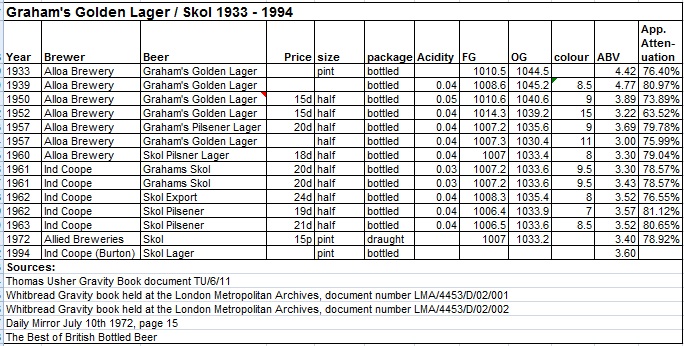
Graham's Golden Lager / Skol 1933 - 1994

I never dreamt when I first got interested in beer seriously in the 1970's that one day I'd be writing about Skol. Stuff I wouldn't have baited a slug trap with.

The beer had a far more interesting history than I could have imagined. And one that winds in and out of a few obsessions of mine.

Where does the story begin? At the end of the 19th century in Burton, of all places. Allsopp, deciding that Lager was going to be the next big thing, bought a state of the art Lager brewery from the USA. It opened in 1899, just as Allsopp was starting to get into serious financial difficulties. They did have a degree of success with their Lager, especially in export markets, but their Pale Ale trade collapsed. Between 1900 and 1910 Allsopp's sales fell by 40%. By 1911 a receiver had been appointed to run the business.

In 1912, John Calder of Calder's Brewery in Alloa was brought in to run Allsopp. This forged a link between Allsopp and Alloa that was to play a key role in the later formation of Allied Breweries. It also brought Lager brewing to Alloa, for in 1921 Allsopp's Lager plant, which had lain idle in Burton, was moved to Arrol's Brewery, where John Calder was also a director. In 1927 a new beer was brewed in Arrol's Lager brewery - Graham's Golden Lager.

It was a big success. As Arrol's were brewing all their Lagers, it's no surprise that Allsopp's took a controlling interest in the company in 1930, even before their 1934 merger with Ind Coope. Arrol's was completely bought out in 1951 and the brewery converted to a Lager-only plant.

In 1959, Graham's Golden Lager was rebranded ads Skol, though for a while it had the ungainly name of Graham's Skol Lager. It became the main Lager of Ind Coope and later the whole Allied Breweries group. Allied Breweries set up an international consortium in 1964 to brew Skol abroad and soon it was being made in more than a dozen countries. And, though British Skol went to the great cellar in the sky, it's still brewed in several countries.

That's got the history out of the way. Now we can get onto the beer itself. Luckily, I've quite a few analyses from across the years.


Graham's Golden Lager / Skol 1933 - 1994
Year
Brewer
Beer
Price
size
package
Acidity
FG
OG
colour
ABV
App. Atten-uation
1933
Alloa Brewery
Graham's Golden Lager

pint
bottled

1010.5
1044.5

4.42
76.40%
1939
Alloa Brewery
Graham's Golden Lager


bottled
0.04
1008.6
1045.2
8.5
4.77
80.97%
1950
Alloa Brewery
Graham's Golden Lager
15d
half
bottled
0.05
1010.6
1040.6
9
3.89
73.89%
1952
Alloa Brewery
Graham's Golden Lager
15d
half
bottled
0.04
1014.3
1039.2
15
3.22
63.52%
1957
Alloa Brewery
Graham's Pilsener Lager
20d
half
bottled
0.04
1007.2
1035.6
9
3.69
79.78%
1957
Alloa Brewery
Graham's Golden Lager

half
bottled
0.04
1007.3
1030.4
11
3.00
75.99%
1960
Alloa Brewery
Skol Pilsner Lager
18d
half
bottled
0.04
1007
1033.4
8
3.30
79.04%
1961
Ind Coope
Grahams Skol
20d
half
bottled
0.03
1007.2
1033.6
9.5
3.30
78.57%
1961
Ind Coope
Grahams Skol
20d
half
bottled
0.03
1007.2
1033.6
9.5
3.43
78.57%
1962
Ind Coope
Skol Export
24d
half
bottled
0.04
1008.3
1035.4
8
3.52
76.55%
1962
Ind Coope
Skol Pilsener
19d
half
bottled
0.04
1006.4
1033.9
7
3.57
81.12%
1963
Ind Coope
Skol Pilsener
21d
half
bottled
0.04
1006.5
1033.6
8.5
3.52
80.65%
1972
Allied Breweries
Skol
15p
pint
draught

1007
1033.2

3.40
78.92%
1994
Ind Coope (Burton)
Skol Lager

pint
bottled


3.60

Sources:
Thomas Usher Gravity Book document TU/6/11
Whitbread Gravity book held at the London Metropolitan Archives, document number LMA/4453/D/02/001
Whitbread Gravity book held at the London Metropolitan Archives, document number LMA/4453/D/02/002
Daily Mirror July 10th 1972, page 15
The Best of British Bottled Beer

The first thing that strikes me is the gravity. Up until 1952, the gravity is above the average for all beer brewed in the UK. Soon after the complete takeover of Arrols by Ind Coope (coincidence?), the gravity drops below the average and remains around 11% below it.


Skol OG and average OG
year
Skol OG
average OG
difference
1933
1044.5
1039.52
11.19%
1939
1045.2
1040.93
9.45%
1950
1040.6
1033.88
16.55%
1952
1039.2
1037.07
5.43%
1957
1035.6
1037.42
-5.11%
1957
1030.4
1037.42
-23.09%
1960
1033.4
1037.25
-11.53%
1961
1033.6
1037.41
-11.34%
1961
1033.6
1037.70
-12.20%
1962
1035.4
1037.70
-6.50%
1962
1033.9
1037.70
-11.21%
1963
1033.6
1037.70
-12.20%
1972
1033.2
1036.90
-11.14%
Sources:
Brewers' Almanack 1955, p. 50
Brewers' Almanack 1962, p. 48
Brewers' Almanack 1971, p. 45
Statistical Handbook of the British Beer & Pub Association 2005, p. 7


To give some idea of just how bad value for money Skol was, in 1962 a half pint bottle of Double Diamond cost 15d, 4d less that Skol though its gravity was 13 points higher at 1047º. remeber that Double Diamond was a heavily-promoted, premium product. A pint of Ind Coope Mild Ale, with a gravity almost exactly the same as Skol, cost just 14d that year. Or less than half the price for the same amount of alcohol. It makes you realise why large breweries pushed Lager and neglected Mild.

Which has prompted me to think of another reason beer styles decline and die. When a style becomes the most popular, it's very difficult to keep selling it as a premium price. It's new types of beer, fashionable ones, that can demand a higher price. So there's a clear financial incentive for brewers to push the new at the expense of the old.