Showing posts sorted by relevance for query grodziskie. Sort by date Show all posts

Thursday, 25 April 2013

Grodziskie - I wish they just wouldn't bother

Over at RateBeer they've added a new style category. Or rather a combined one to include Grodziskie, Gose and Lichtenhainer.

Hang on, I hear you say, how can they lump together Grodziskie with Gose and Lichtenhainer? The latter two are extremely sour while Grodziskie is smoky and bitter.

Well, according to RateBeer Grodziskie is sour:

"Grodziskie/Gose/Lichtenhainer

Sour wheat beers were common in many parts of medieval and early Industrial Europe. Two styles – lambic and Berliner weisse – survived, but many others did not. Gose, Grodziskie and Lichtenhainer are historic styles of sour wheat beer, each a unique style of its own. Gose is seasoned with salt, Grodziskie and Lichtenhainer contain smoked malt. Historical sources are mixed about Lichtenhainer containing wheat, so modern interpretations may vary. Grätzer is an alternative name for Grodziskie. All three will be relatively low alcohol, tart, with a strong wheat character, but will be distinct from classic examples of Berliner Weisse or lambic. As all we have are historical recreations, substantial differences may exist between interpretations."

Here we go again. Didn't I have to argue against a dodgy Grodziskie/Grätzer definition just a few weeks ago? Now here's someone else defining the style incorrectly. What's that emotion I'm feeling? Frustration? Despair? Irritation? A bit of all three.

I'm not sure where they got the stuff about Grodziskie being sour from. The man I trust most when it comes to German top-fermenting styles, Schönfeld, says something very different:

"Under the influence of the supposedly excellent well water, to whose qualities until recently the excellent quality of the beer was erroneously attributed, it was possible to brew a beer of far-reaching fame from pure wheat, which has maintained its reputation through the centuries, as a highly sophisticated beverage which because of its smoke and hop bitter taste was not only earlier highly appreciated, but even now is counted among the best top-fermented beers."
"Die Obergärige Biere und ihre Herstellung" by Schönfeld, 1938, page 162.

Smoky and bitter. No mention of sourness and Schönfeld was an expert in sour beers, having studied and written extensively about Berliner Weisse.

Here's another usually reliable source, confirming an intense hop and smoke flavour as being the defining characteristics of Grodziskie:

"3. Grätzer Bier, a rough, bitter beer, brewed from 100% wheat malt with an intense smoke and hop flavour. The green malt undergoes smoking during virtually the whole drying process, is highly dried and has a strong aroma in addition to the smoked flavour. An infusion mash is employed. Hopping rate: for 1 Zentner (100 kg) of malt, 3 kg hops. Gravity just 7º [Balling]. Fermentation is carried out in tuns at a temperature of 15 to 20º C. Since the beer in the tun, as a result of the expulsion of great quantities protein and resin, doesn't break, it is mixed with isinglass and pumped into barrels. After two or three days it is completely clear and ready to be filled into delivery casks or bottles with the addition of 2 to 5% Krausen."
“Bierbrauerei" by M. Krandauer, 1914, page 301.

Here's a classification of German top-fermenting beers where Grodziskie is placed in a different group to Lichtenhainer and Gose:

"1. Low alcohol content, so easy to digest, an Ausstossbier or filled with krausen into bottles, as free as possible from bacteria, carbon dioxide-rich (Lübbener, Werder'sches, Cölner, Bremen, Hamburg, Grätzer, Munich Weissbier, etc.);

2. the same properties, with a higher lactic acid content (Berliner Weissbier, Broyhan, Calenburger Weissbier, Lichtenhainer, Gose beer);

3. more or less rich in alcohol, poorly carbonated, beers with large amounts of lactic acid (Dortmunder Altbier, called Malzweine);

4. low-alcohol, extra-rich, sweet beers (Braunschweiger Mumme, Danziger Jopenbier, Frauenburger Mumme, etc.)."
"Jahresbericht über die Fortschritte in der Lehre von den Gährungs-Organismen" by Professor Dr. Alfred Koch, 1896, pages 160-161. 
Grodziske is put in the same group as Munich Weissbier and is supposedly as free of bacteria as possible. Doesn't sound like a sour beer to me.

Another smoky and heavily hopped confirmation:

"Sour-tasting beers are Berliner Weißbier and Lichtenhainer, brewed from smoked barley malt, even more so Gose, which is also seasoned with cooking salt. Grätzer Bier, brewed from smoked wheat malt, heavily hopped but of a low gravity, also tastes smoky."
"Encyklopädisches Handbuch der technischen Chemie, Volume 4, Part 1", 1915, page 210.
I'll admit this last one is open to different interpretations. I think it says that Grätzer is another smoky beer.

I can't find any description of Grodziskie in an old text that unambiguously describes it as sour. What everyone agrees on is that it was smoky and hoppy.

In addition, there's a practical consideration. How is a heavily-hopped beer soured? Hops will kill lactic acid bacteria. That's why beers soured with it, like Berliner Weisse, usually contain minimal amounts. There were heavily-hopped German beers that were sour. Dortmunder Altbier, or Adambier is a good example. As is Münster Alt. But they were brewed a different way.

Schönfeld classified sour German styles in two groups:

1. Beers that were lightly-hopped and soured during primary fermentation. Berliner Weisse, Gose and Lichtenhainer were in this group.

2. Heavily hopped beers that only soured during a long secondary fermentation Adambier and Münster Alt were about the only beers in this category.

I don't see how a heavily-hopped beer which was sold relatively young like Grodziskie could have been soured. There were too many hops for it to sour during primary fermentation and there was no long secondary fermentation.

I find the evidence overwhelming that Grodziskie was not sour.

I'm not just doing this because I'm scared the Grodziskie and Grätzer I was involved with will be considered "not true to style". I actually find it amusing when cretins erroneously write that in beer reviews.

The real reason is I don't want history to be perverted and Grodziskie to be lost forever. Because if everyone starts thinking it has to be sour and making versions that way, the authentic style will disappear. And that's something I'd hate to see.


I did bring this up on RateBeer itself first. The admins engaged in a dialogue, but haven't changed the dodgy definition.

Thursday, 5 December 2013

Why do I bother

spending so much time researching beer history, when lazy idiots keep undoing my work?

Currently my greatest fear is that Grodziskie/Grätzer is going to get classified as a sour beer, when there's not a shred of evidence that it ever was. Type "Grätzer" and "sour" into Google and see how many hits you get.

This is the commercial description of Dr. Fritz Briem's Lichtenhainer, sorry, Grätzer:

"Grodziskie or Grätzer is a Sour Smoked Wheat Ale that was brewed in the 1900s in East Prussia and dates back to as early as the 15th century. It was named after the Polish town of Grodzisk Wielkopolski or Grätz in German. Our historic version is brewed according to the German Purity Law with air-dried barley malt and beech smoked wheat malt and hopped with Perle and Saaz. A sour mash is created using the old and forgotten technique called “Digerieren.” Finally a three month aging and maturation process creates a complex sour, smoky and heavily hopped wheat ale."
 That's an almost Dornbusch level of mistakes.

1. Grodziskie/Grätzer wasn't sour.
2. It isn't a fucking Ale.
3. Grodzisk is not East Prussia. When German, it was in the region of Posen. Grodzisk is approximately 300 km from the closest point in East Prussia.
4. Grodziskie/Grätzer was 100% wheat malt.
5. Grodziskie/Grätzer was 100% wheat malt smoked over oak not beech.
6. The Reinheitsgebot was in force in Posen from 1906* until Polish independence in 1919.

"The beer is not without controversy, however. Do a bit of googling and you’ll soon discover incredibly heated debates about the style. “Is it a sour beer? How much oak-smoked wheat should be used? What sort of yeast should you ferment with?” BrewLab was intrigued, and so was the rest of the SF beer community."
San Francisco Brewers' Guild Blog.
http://sfbrewersguild.org/blog/historic-gratzer-beer-recreated-by-team-of-san-francisco-brewers

There has been no controversy over whether Grodziskie/Grätzer is sour. Just some people who've ignored (or not bothered to look for) the historical and guessed it was a sour beer. That's not a controversy, just poor scholarship.


* http://www.brauer-bund.de/bier-ist-rein/reinheitsgebot/rechtsentwicklung.html

Thursday, 20 December 2007

Grodziskie/Grätzer


Good news from Poland: Grodziskie might be making a comeback. The last brewery producing it closed in the mid-1990's. I've had a report that it's been purchased by a local businessman who intends resuming production. The original yeast strain - preserved by the last head brewer - is available for use.

A little background
Grodziskie was the only truly ingidenous Polish beer style to survive in the second half of the 20th century. It was a top-fermented, smoked wheat beer. It was the last survivor of a style called Grätzer (derived from Grätz, the German name for Grodzisk) and was once popular across northern Germany.

This is the earliest mention I've found of the style:
"Pohlnische Biere. Pohlen liebet besonders die weißen Biere, die es auch
verschieden, und sehr vortrefflich, hat; z. E. das Gräzer und Lobsenzer,
vornehmlich aber das Waretsker Bier, welches leztere, wenn es alt geworden, an
Klarheit und Farbe dem Weine gleichet.""Polish beers. Poland especially likes
white beers, of which it has several excellent ones, for example Gräzer and
Lobsenzer, but mostly Waretsker Beer, of which the latter, when aged, resembles
wine in colour and clarity
.""Oeconomischen Encyclopädie“ of 1773

Grodziskie (or Grätzer as it was called in German) seems to have been quite common pre WW 1, as the name crops up quite a bit. I recently found this:

"Nach den vorliegenden Angaben sind beim Verkauf in Fässern von den
Brauereien abgesetzt worden: gewöhnliche obergärige Biere bis zu 12 M., bessere
Sorten in der Regel zu 12 - 18 M. (Grätzer Bier 12 M.), untergärige Schankbiere
zu 14-18 M., Lagerbier meist 17-25 M. für 1 hl
."
Zeitschrift für das gesammte Brauwesen 1894, p.31


It’s talking about the wholesale price of draught beer in the Brausteuergebiet (all of German territory at the time, except Bavaria, Baden, Württemburg, Alsace Lorraine and Luxemburg):

  • ordinary top-fermening beer up to 12 M. per hl
  • better types of top-fermenting beer 12-18 M. per hl (Grätzer Bier 12 M.)
  • bottom-fermenting Schankbier (I guess 10° Plato or less) 14-18 M. per hl
  • Lagerbier mostly 17-25 M.
What’s interesting is:

  • Grätzer is the only specific style named;
  • even the weakest bottom-fermenting beer is the same price as the best top-fermenting beer.
I think it’s safe to assume that at this time Grätzer was pretty well-known.

In 1894 the district Posen (now the Polish Poznañ) had 158 breweries of which 101 were top-fermenting, producing between them 177,038 hl in the brewing year 1892/93. The 57 bottom-fermenting breweries produced much more - 307,800 hl. Which made the proportions 37% top-fermenting, 63% bottom-fermenting. The only region producing a higher percentage of top-fermenting beer was the Kingdom of Saxony at 41%. (Over the whole Brausteuergebiet the percentage of top-fermenting beer was 23%.) (Source: Zeitschrift für das gesammte Brauwesen 1894, p.23)

In "Ksiêga Piw i Browarow Polskich" ("Book of Polish Beer and Breweries"), Tadeusz Kaczmarek, 1994 dedicates pages 266 to 274 to Grodziskie. Here’s a summary of the most interesting bits.
  • It’s thought that it was first brewed sometime in the 14th century.
  • It was related to German Weissbier, but had its own specific taste from the use of smoked wheat malt.
  • It was brewed using an infusion mash.
  • It was bottle-conditioned.
In the 1990’s 3 variations were produced:
  • Grodziskie 7.7° Plato, 2.5% ABV
  • Grodzisz 12° Plato, 3.5% ABV
  • Bernadyñskie 14° Plato, 3-5% ABV

Wednesday, 17 October 2012

Grätzer comes alive

Remember me making some comments in my post about Grätzer Breweries that I was looking at Grätzer again for a reason? I'm going to tell you what the reason was.

It's another one of my projects. In fact the day I'm going to write about sort of included two of my projects, but more of that later. Let's take it one project at a time. The Grätzer project is what I'd started on. It's a collaboration between Michel Ordeman (of Jopen), Alice van der Kuijl, Sebastian Sauer, Evan Rail and me. We've brewed up (the brewers at Jopen have to be completely accurate) brewed up not just a Grätzer but also a Grodziskie. I know, same thing, different language. But we have made a disticntion between the two.

This is starting to get like a memory test. Do you remember me posting about Grätzer containing white willow bark? It sounded too good an idea to pass up. We were already wondering whether we should call the beer Grätzer or Grodziskie. The solution was simple: brew one with willow bark and the other without. Then we get to see what effect the willow bark has, and we can have both a Grätzer and a Grodziskie.

I'm going to go out on a limb here. I think they're the most authentic Grätzer/Grodziskie to have beeb brewed commercially since the brewery in Grodzisk closed in 1993. Why? Because we managed to put together all the key elements of the beer. The recipe is pretty simple. 100% smoked wheat malt and 100% Lublin hops. Now here's the really important bit: fermented with the real Grodzisk yeast strain.

When the brewery in Grodzisk closed in 1993, the head brewer was farsighted enough to send a sample of the yeast to a lab in Poland to be preserved. Somehow, Pivovarský Dům in Prague (a brewing institute as well as a brewpub) got hold of the yeast, too. They have samples of all sorts of yeast, so it isn't that odd. Evan Rail arranged for them to culture up enough to brew several batches and drove from Prague to Haarlem with 3 kegs of yeast in the boot of his car.

The beers have been brewed to the classic 8º Plato strength, with a good dose of hops to balance out the smoke. I can't wait to try them. I'm still kicking myself for never tracking Grodziskie down in the early 1990's when it was still being brewed in Groszisk. This should make up for that terrible ommission.

Exciting, isn't it? The beers were brewed the first weekend in October. Being low gravity, they'll be ready pretty soon. Just another couple of weeks. It'll be a very special day when I take my first sips. Knowing me, gulps more like. I'll be sure to let you know they taste.

That other project? While we were at the Jopenkerk for the brewing, we tried some Porters brewed from historic types of brown malt. I've been working with Ben Heaven for a while on the3 malts. I say working with, but really he does all the work. Kilning the malt (using straw as a fuel sounds pretty scary) and brewing beer with it. I just cheer from the sidelines. He seems to have cracked making diastatic straw-kilned brown malt. Do you know what that means? For the first time in a couple of hundred years it's possible to brew an 18th-century London Porter. What could be more thrilling than that?

Monday, 29 June 2026

Breweries, judging and a beer fest

I manage to drag myself out of bed around 8:00. As planned. There’s a win to start the day. It’s going to be a busy one.

Breakfast is a pretty decent buffet. With fried eggs and bacon. Though the bacon is rather undercooked. I accompany my fried egg with cheese and tomato instead. Probably healthier.

A red brick stable building with dormer windows.

At 9:30 a bus takes us to an estate on the edge of the village of Wąsowo. Where, in addition to the numerous other activities, a small brewery recently opened on the site. Called, logically enough, Browar Wąsowo.

After a quick tour around the various former farm buildings, we dive into the brewery. Housed in a red brick structure. It’s all very new and shiny inside. As you would expect for a brewery that only opened in 2025.

Wasowo brewery exterior, a two-storey, red brick building.

We’re taken around the various rooms in the brewery, which is two storeys with cellars. Before returning to the fermentation room for samples. Beginning with a Grodziskie which has only just finished primary fermentation. “A bit raw still.” We’re told. It takes perfectly fine to me. With the smoke and hops in good balance.

Wasowo brew house: two stailess-steel cylindrical vessels with tiled walls behind.

Next is a Pilsner. Which is clean and decently bitter. Very drinkable.

A man with a beard and glasses pour samples of beer into small glasses direct from the fermenter.

We roll over to the onsite restaurant. Which is also a sort of taproom for the brewery, serving seven of their beers on draught. Today, that’s: Berliner Weisse, APA, Witbier, Lager, Black IPA, Hazy IPA and Saison. A pretty decent variety of styles. Not just IPA variants.

There are bits of food for us. And samples of the draught beers. Which, just as they were in the brewery, are very good. I kick off with a Black IPA. Mostly because you never see them anymore. Maybe a bit on the roasty side, but pleasant enough. The Hazy IPA I follow it up with is also fine.

A barmaid pulling a beer from a row of eight taps.

It’s getting on for 13:00 when we drive off in the bus to return to Grodzisk. For a bit more judging. The second round. But there’s time for a quick beer outside. It is pretty hot, after all. I wouldn’t want to dehydrate.

Yesterday I judged “straight” Grodziskie. Today it’s the category for beers with additional ingredients. Some interesting ideas, not all of which work for me. But a couple where they really do.

Only eleven beers. No need to fill out score sheets, either. I just scribble a few notes. I really mean scribble. I struggle to read them a few minutes later. There’s a lively discussion. Which is resolved without resorting to physical violence.

A row of numbered small glasses partially-filled with beer. In the background are water bottles and in the foreground a sheet of paper and a pencil.

Our table is one of the last to finish. And the lunch buffet is running a little thin. Just about enough left for a decent meal. I wash it down with some Grodziskie. I’m not missing any chance I get to drink it here in Grodzisk.

Lunch. a piece of meat, potatoes and salad on a paper plate with a plastic cup of beer next to it. In the background are two other plates of food.

Once lunch is chomped and Grodziskie has been drunk. we return to the malt house for a tour. Working from the bottom up. Much of it hasn’t been fully renovated. Some isn’t even slightly done up. With the top floor not being safe to enter.

Malting floor. A large room with a low roof supported by wooden columns and beams. In the background are two small windows.

The brew house is just across the yard. It has a pretty traditional layout. Though the equipment is all shiny stainless steel. There’s even a baudelot cooler. Which seems to be in use.

Mash tun at Bowar Grodzisk, al arge stainless stelel vessel with a manhole.

The open fermenters are hard to see, with their tops far overhead. They look pretty big.

Browar Grodzisk fermentation room. What looks like a stainless-steel wall painted with large numbers and manholes.


It’s about a 15-minute walk from the brewery to the festival, Grodziskie Piwobranie. I’m glad that the sun isn’t out. On the way, we walk past some random old Soviet military equipment parked next to a building.

A field gun Old Soviet military hardware. A field gun with behindan APC and an IFV. Behind them, the wall of a posh old house.

The festival is quite a modest affair, held in a town park. With lots of families. There are half a dozen brewery stands, each selling a range of beers. At pretty reasonable prices: 3 to 4 euros for a half litre.

I get myself a half-litre of Lager. Well, someone else gets it for me as my credit card won’t work. It’s a pleasant enough beer.

All the judges climb onto the stage for the competition results. Which I don’t understand, as they’re in Polish. Once that’s done, we trail off the stage again. To make way for a Queen cover band.

Beer stall at the festival. A man in a singlet and folded arms stands behind the counter. There's a beer tap and a row of bottle on the counter. "Piwa tradycyjne EDI browar niepasteryzowane".

As a storm is forecast, I find a seat under an umbrella. I wouldn’t want to get drenched. Noticing a stall with an old bloke selling what look like bottles of spirits, I wander over there. 

I buy a half litre of some fruit-based spirit. It’s little rough. Let’s be honest, it’s very rough. I mix it with some beer to make it more palatable. Which is successful to some degree.

I chat for a while with the Finnish judge. And share s shot of my dodgy fruit stuff. He seems perfectly normal. 30 minutes later, he’s flat on his back. I didn’t think the fruit stuff was that strong. But his legs seem to have stopped working.

Peopl;e sitting at two tables underneath an umbrella. In the background people are walking and there are beer stalls.

As everyone is feeling a bit tired, we arrange to be collected by the bus an hour earlier at 21:30. Of which I’m mightily pleased. I’m feeling pretty knacked. 

Raindrops start to fall when we’re halfway to the bus. I’m a bit wet when I climb aboard. It’s a bit of a drive back to Grodzisk. But it’s not straight to bed back at the hotel.

A gaggle of judges crowd into a room. Where football is watched and beer is drunk. Though I’m not drinking beer. I’ve brought myself a stiff whiskey down from my room.

Germany are surprisingly losing. Though have pulled things back by the time I retire to my room. I’m too old to stay up past midnight. And don’t.


Browar Wąsowo
Poznańska 2, 
64-314 Wąsowo, 
Poland.


Folwark Wąsowo
ul. Poznańska 2, 
64-316 Wąsowo, 
Poland.
http://folwarkwasowo.pl/


Browar w Grodzisku Wielkopolskim
Poznańska 16B, 
62-065 Grodzisk Wielkopolski, 
Poland.
http://browargrodzisk.com/


Here's a video of the day:


Friday, 30 August 2013

Grätzer/Grodziskie analyses

Nothing very long today. It really is just a couple of analyses of Grätzer and nothing else.

Thanks to Marcus Schmitz for going to the trouble to transcribe these from a handwritten laboratory manual of 1936 by a former Engelhardt-Brauerei Brewmaster.

What's particularly pleasing is that there are examples from both Poland and Germany. In fact, the examples are from all the breweries brewing Grätzer/Grodziskie after WW I. Which was one in Poland and two in Berlin.

Unfortunately, there was no measurement of the level of acidity. Probably the detail that I would most have liked to see. I really want to kill the myth of Grätzer/Grodziskie being a sour beer once and for all. Though I fear I may already be too late. Once a piece of shit information gets out there, it's repeated endlessly until the end of time. Or at least that's what it feels like. I suspect I'm going to be arguing about this one for decades.

I was slightly disappointed, having read that 7.9º Plato was the standard gravity for Grätzer/Grodziskie, to discover that two of the samples were lower than that. The Hochschulbrauereiversion was bang on 7.9º Plato, but Vereinigte Grätzer Bierbrauerei's was only 7.36º Plato and Monopolbräu's only 7.03º Plato. Due to the reasonably high level of attenuation, all come out close to 3% ABV.

I'd love to know how that colour measurement relates to any scale I can understand. As it is, the colour numbers only tell me one thing: that the Hochschulbrauerei version was darker than the other two.

Grätzer in 1936
Year Brewer country Beer Style OG FG Colour ABV Apparent attenuation
1936 Vereinigte Grätzer Bierbrauerei Poland Echt Grätzer Bier Grätzer 1029.1 1007.7 0.45 2.77 73.56%
1936 Hochschulbrauerei Berlin Germany Hochschl. Grätzer Grätzer 1031.3 1006.8 0.9 3.13 78.40%
1936 Monopolbräu Berlin Germany Mon. Grätzer Rauchb. Grätzer 1027.7 1005.7 0.45 2.84 79.60%
Source:
handwritten laboratory manual by a former Engelhardt-Brauerei Brewmaster

I told you I was going to be brief today. Not worry, I've got a real monster of a post coming up. I'd wondered what the maximum size of a post might be. I think I've found out.

Thursday, 25 June 2026

I fly to Poznan

A quick report of a short trip I made last weekend.

I trail over to Schiphol a little after 09:00. Which leaves me time to warm up for the flight a little in the lounge. 

The food isn't too bad in the lounge this time. It's the non-Schengen one that I don't visit often.  Not been impressed with the food in the past. The rostis are really nice. Scrambled egg could do with some seasoning.

A breakfast of scrambled egg, two rostis and two mushrooms.
 

But there's free-pour whisky. Of which I take advantage. Though don't abuse. It's a thin line that you need to walk when you're an enthusiastic drinker like me.

I bump into Ferry at the gate. He's judging in Grodzisk, too. Though we both live in Holland, we first met in Brazil.

When my boarding pass is checked before getting on the bus, there's a beep and I'm given a slip of paper. I've been upgraded to business class. I guess because the flight is overbooked. Now there's a win.

After waiting on the tarmac for a while the bus return to the gate. Two vehicles have collided close to our plane. We have to wait for that to be sorted out. We depart quite late. 

A KLM Cityhopper plane sitting on the tarmac at Schiphol airport. Stairs lead to the front door. A sevice vehicle is parked close to the wing. Behind are some airport buildings.

The food is definitely better than the usual KLM slop. And I get a couple of whiskies to wash it down. Which also helps. 

A glass of whisky and an empty miniature of Johnny Walker Black Label sit on an airline table.

After landing in Poznan, we're whisked off in a bus to our hotel Along with other just-arrived judges. It takes a while to get to Nowy Tomyśl. After just about enough time to drop of our bags, it's back on the bus to go to Grodzisk.

Where we're judging in the former malt house of the last brewery to make Grodziskie before the style's extinction in the early 1990s. Which is pretty cool. And it's right next to the brewhouse of Browar Grodzisk. Current brewer of Grodziskie

Four judges sit around a table looking at their laptops. The room has a low, vaulted brick ceiling with supporting metal pillars.

We don't have to judge a stupid number of beers - my table has 17. Just as well, as the judging kicks off in the early evening. There are some pretty good examples in the ones we judge. And a few not so good ones. But there are always a few duds, whenever you judge.

I'm judging with two Polish men, Michal Kopik and Jan Lepek and a German/Greek woman, Dafne Peppa_boy. We have some robust discussions about some beers. Which is part of the fun of judging. If everyone 100% agreed, int would be a pretty dull process.

For those of you that haven't experienced the Grodziskie style, here's an overview of its characteristics.

colour: very pale
grist: 100% oak-smoked wheat malt 
hops:  Polish varieties
yeast: top fermenting
OG: 7.7º Plato
ABV: 3.1%

The last two I've taken from the Classic version brewed by Browar Grodzisk. It's also usually bottle-conditioned.

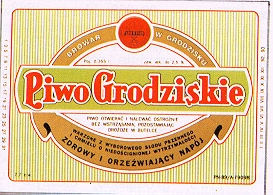
A poster with a bust of a man wearing a tie holding up a foaming tall, slender glass of beer with the text "Piwo Grodziskie".

I like versions where the hops and smoke are in balance. Combined with a light body, making them very drinkable. Quite a few of the beers I judge fit those parameters perfectly. And are a pleasure to drink.

I already know quite a few of the other judges. Which makes things easier. Catching up with Evan Rail after many years is fun. Great to learn that U Rotundy remains a s wonderful as ever. Plus lots of other great stuff about beer in Czechia.

Judging is scheduled to end at 21:00. It's a while after that when all the tables are done  And it's pushing 10:00 when we hit the restaurant Schabowy & Salata.

Our, quite late, evening meal is very decent. What I expect in Poland, where the food is usually pretty good. I do like a good Schnitzel. One made out of actual meat. Unlike the shttty ones made from reconstituted gunk they sell in the supermarkets in Holland.

A white plate with a Kotlet schabowy, a small piece of potato and a knife and fork.

(I was wondering about the name of the restaurant: Schbowy & Salata. I could get the second bit But what about the first? Kotlet schabowy turns out to be what I called a Schnitzel. It's the Polish version of a fried, thin, breaded piece of pork. Like I said earlier, it was excellent.)

Of course, there's also Grodziskie to drink. From the beautifully elegant, slender glasses. 

It's after midnight when I get my head down Aiming for an 8:00 start tomorrow. A gulp or two of hotel whisky whisks me off rapidly to sleep. 


Browar Grodzisk
Poznańska 16B, 
62-065 Grodzisk Wielkopolski, 
Poland.
https://browargrodzisk.com 


Schabowy & Salata
Osiedle Wojska Polskiego 18D, 
62-065 Grodzisk Wielkopolski, 
Poland.

Here's a video report of my trip:


Tuesday, 23 June 2026

Grodziskie

Now there's another bucket list item crossed off. I finally got to drink Grodziskie in Grodzisk.

Last weekend I was in Grodzisk to judge, well, Grodziskie. And what fun it was.

The entrance to Browar Grodzisk

One of my big regrets, beer-wise, at least, was not getting tro try Grodzisk when I was in Poland in the early 1990s. When the original Grodzisk brewery was still active. And I assumed that was my chance gone to experience the style.

Thankfully, the style has been brought back to life in its home town. And is even brewed in the building as the original. How cool is that? And the judging was in the malthouse of original brewery.\

Fermenting vessels at Browar Grodzisk.

It was quite a short trip for me. Only a short hop of a flight. And just two days away. Almost no effort at all, really.

Lots of fun people there, too. Some I already knew. Some I was meeting for the same time. It's great to still be meeting new people at my age. Which is why I'm going to continue to travel as long as I can. 

Friday, 5 April 2019

Austin day one

The day starts as all good days do. With an accompanying smell of bacon.

Just what I need after a very long day of travel yesterday. OK, it’s a self-service job with paper plates and plastic cutlery. But there is bacon, scrambled egg and those potato cubes Americans love including in their breakfasts. Waffles are available, too, but I’ve no interest in those.

I’m in no rush. Nothing is planned until 7 PM, when I’ve a dinner appointment with some of the Jester King brewing crew. What to do until then? Maybe they have breweries here or something. It is quite warm. Might be nice to have a cooling beer somewhere.

Lazing around in my room for a while, gazing at crap TV lets the bacon settle. Is ten rashers excessive? They were those tiny little US ones. Ten of them is barely one thick-cut-slice of back bacon.

I haven’t mentioned what I’m doing in Texas, have I? Back in January I received an invitation from the Texas branch of the MBAA. Did I want to present my German sour beers talk at their spring conference? Sure, I’d be delighted. But I’d need my expenses paid. The organisers hadn’t realised just how far away I live.

They couldn’t come up with an offer big enough to satisfy Dolores. Then I had an idea. Austin is quite close to San Antonio, isn’t it? I’d been meaning to visit my mate* Jeff Stuffings, one of the owners and founders of Jester King. If they chipped in maybe this could work. I was quite surprised when everything fell into place.

Which is a long way of explaining why I had a printout of the Jester King short guide to Austin beer. With lists of recommended breweries and beer bars. Where to go? I have a few options.

My choice is based on a couple of factors. Recommendations of other drinkers. And proximity. I don’t want to spend too much on taxis. (Dolores has made her opinions very clear on my travel expenses.) It’s all so complicated. Eventually I settle on Live Oak. Mostly because I’ve heard that they brew good Lagers. And I do love me a good Lager.


Soon a cab has bounced me all the way there. To quite a rural location, the brewery is set in what looks like several acres of low-density forest. Very nice. A beer garden with real trees. Which is appropriate given the brewery’s name.

Being quite early, it’s pretty empty inside the fairly cavernous tap room. Oh look – they’ve a Doppelbock on draught. The perfect morning beer. I order myself one.

Live Oak Liberator 7.8% ABV
Nice dark brown colour. Full of malty goodness. Rather good. There’s a little touch of smoke, which is fine.

They’re playing The Specials, which is pretty cool. Though the weather isn’t – it’s like summer. A Dutch summer, at least. Doubt this even counts as particularly nice spring weather here.

This will be a pretty laidback trip. Now I get to the US so often, I feel less of a need to rush around like a demented dervish. Only two towns on the itinerary: a couple of days in Austin then down to San Antonio for a couple more.


Should tell them who I am? Being English, I’m reluctant to say: “Hi, I’m renowned beer historian Ron Pattinson.” Way too presumptuous. Sounds like I’m touting for free beer. Plus there’s always the chance that they’ll reply “Ron who?”

Opening so early on weekdays is a surprise, given how out of the way they are. Far from any human habitation. It isn’t exactly mobbed. OK for me, boring old twat that I am. Quiet is my exciting. (That’s not particularly to do with age. I’ve never cared for crowds. Or maybe it’s just people I hate.)

I don’t quite understand how places like this can operate. How the hell would you get here? You’d have to drive. But then how can you drink? I keep coming across pubs in the US that make no sense to European eyes. Locations that seem insane for somewhere whose main business is serving alcohol.

I’ll ponder that while drinking my next beer.

Live Oak Grodziskie 3% ABV

Yeah – a pint of Grodziskie. Ordered with a little trepidation. I hope it isn’t one of those sour abominations. It’s served with a delightful ice-cream head and the colour is suitably pale. But how does it taste? Smoky and bitter – fucking right. None of that sour shit. It’s very pleasant, with all the features I’d expect from a Grodziskie. Almost as good as the Jopen one. But I am biased.

The trees outside look a bit weird. More like giant bushes, with their multiple stems. As there are a couple outside, I’m going to go crazy apeshit and guess they’re Live Oaks. I have heard that as a tree name. always thought it was a bit weird as a name. Surely all oaks, other than the dead ones, are live?

They’re playing Setting Sons by The Jam. I’d forgotten how good an album it is. I can still hum all the bass parts. Down in the Tube Station at Midnight – no-one else here has lived that.


The food truck, Black Forest, is now open so I troll over there. It’s very much German-oriented, which is fine by me. Something snack-like and German is exactly what I fancy. A bratwurst fits the bill perfectly. Quite a good one, too. And not expensive. Important, as Dolores will be going over all my expenses when I return. “We could have bought both of the kids shoes with what you spent in that bar.” That’s her catchphrase.

People drift in in drabs, then mostly drift right on out again to sit in the garden. I prefer it inside. Wouldn’t want that spiky sun getting too closely acquainted with my skin. Which has a lovely healthy pallor. (Dolores’s mum thought I had a vitamin deficiency the first time we met. That’s how pale my skin is.)

Eton Rifles is on now – does anyone here understand the anger behind that song? Or how appallingly relevant it still is in the UK?

Don’t get yourself all riled up, Ronald. Drink some beer and chill the hell out. It’s a lovely day, I’m in a brewery, have the whole day free and there’s money in my pocket.

Time for another beer:

Baltik 8% ABV
Another perfect lunch beer, at just 8% ABV. Pleasantly Lagery (my tasting notes just keep on improving),. Not quite dark enough, if I’m going style Nazi.

I’m being very restrained this afternoon. Just the three beers, then I leave into the next cab and roll on back to my hotel. To catch my breath before the evening. When I’ve a dinner date with two of the Jester King folks, Sean and Luis.

After an afternoon whisky to accompany some dreadful TV, I stroll over to reception and ask them to call me a cab. I’ve 30 minutes until my appointment. Should be plenty of time. It can’t be more than a 10-minute drive to the Odd Duck.

I stand outside and wait. And wait. Then I wait some more.


After 20 minutes the cacti outside the hotel are losing their fascination. 30 minutes in, I go back to reception and ask them to enquire where the fuck my taxi is. Though not in quite those words. I am English, after all. We never reveal the seething anger in our heads.

After just three-quarters of an hour, a taxi does arrive. And soon drops me at the Odd Duck. I’m embarrassingly almost an hour late.

I’ve never met either Sean or Luis before. How will I spot them? No problem. As soon as I get through the door Sean comes over and introduces himself. Then we tuck into some nosh.

It’s rather nice. Quite sophisticated and with an emphasis on local. We order various bits and nibble away on them. With accompanying beer, obviously. Especially as they sell some decent stuff.


When we’re done eating, we decant to The ABGB, a brewpub a little down the road, for more beer. In the darkness, lit only by a neon blur, we kick the last of the evening to pieces.

Back in my room, as I sip and slip from consciousness, sleep steals in through the window.


* We’re pisco sour friends after a week in Santiago in 2016.


Live Oak Brewing Company
1615 Crozier Ln,
Del Valle,
TX 78617.
Tel: +1 512-385-2299
https://liveoakbrewing.com


Odd Duck
1201 S Lamar Blvd,
Austin,
TX 78704
Tel: +1 512-433-6521
https://oddduckaustin.com/


The ABGB
1305 W Oltorf St,
Austin,
TX 78704.
Tel: +1 512-298-2242
https://theabgb.com/

Thursday, 11 June 2026

My travel videos

A Grodziskie beer advert, in Polish, where a smiling man in a jacket and tie looks lovingly at a tall, slender, effervescent glass of pale beer.
Does any of you like them? I'm not sure I can be arsed to continue taking video. 

Maybe I'll continue with the pure beer stuff. Like next week, when I'll be doing some Grodziskie judging in, er, Grodzisk. I can see how that might have some historical value. If I make an effort and interview people. 

The more I think about it, that's exactly what I should do. Not just video my breakfast.

Thanks for that. It's really cleared that up in my head. And given me a plan for next week in Grodzisk. 

 Not been to Poland for 30 years. I'm guessing it might have changed a little bit. 

Friday, 15 March 2013

Grätzer guidelines update

Now there's a surprise. I hadn't bothered commenting to the Brewers' Association on their Grätzer* guidleines, for the simple reason I didn't expect them to pay me any attention. But someone did**.

And blow me if they didn't change them. Take a look and see what you think:
"Grätzer
Grätzer (also Grodziskie) is a Polish-Germanic pre-Reinheitsgebot style of straw to golden colored ale. Chill haze is allowable at cold temperatures. The distinctive character comes from 100% oak wood smoked wheat malt. The overall balance is a sessionably medium to medium-high assertively oak-smoky malt emphasized beer. Aroma is dominated by oak smoke notes. They have a medium low to medium perceived clean hop bitterness. European noble hop flavor notes are very low to low, and low ester may also be present. Body is low to medium low. A Kölsch-like ale fermentation and aging process lends a crisp overall flavor impression and low degree of ester fruitiness. Sourness, diacetyl, and sweet corn-like DMS (dimethylsulfide) should not be perceived. Historic versions were most often bottle conditioned to relatively high carbonation levels.

Original Gravity (ºPlato) 1.028-36 (7-9 ºPlato) ● Apparent Extract/Final Gravity (ºPlato) 1.006-1.010 (1.5-2.5 ºPlato) ● Alcohol by Weight (Volume) 2.1-2.9% (2.6-3.6%) ● Bitterness (IBU) 15-25 ● Color SRM (EBC) 3-6 (6-12 EBC)"

Are they an improvement? Yes. A bit. It's nice that the classic 7.7º Plato version is now included. But unfortunately that's at the expense of the stronger versions brewed in the 1980's and 1990's. I don't seee why the strength range couldn't have been set to include both.

I'm pleased that it says 100% smoked wheat malt, though after all the discussion in the comments, I was starting to come around to the idea of  a percentage of barley malt being acceptable.

Some things are still just plain wrong. "A Kölsch-like ale fermentation and aging process", for example. I'm not even sure what the first half of that means, but Grätzer definitely wasn't lagered like Kölsch. And the classic version was a good bit hoppier than 15-25 IBU, more like 30-40 IBU. And I still don't get what "pre-Reinheitsgebot" means in this context. As Grodzisk/Gratz was only briefly submitted to it, the Reinheitsgebot is pretty irrelevant.

Overall, a slight improvement, but there's still some way to go. At least the Jopen version I was involved with is now just about to style. I can sleep easily.


* I'm using the word Grätzer for reasons of simplicity. It could just as well have been Grodziskie.
** Zafra Whitcomb

Monday, 13 May 2013

Berlin-brewed Grodziskie

Now this is getting confusing. Because I've evidence that Grosziskie was brewed outside Poland.

Here's the evidence:
"Grätzer Bier is brewed in relatively small quantities by just two breweries in Berlin, namely the Monopolbrauerei and the Hochschulbrauerei."
"Die Herstellungobergäriger Biere und die Malzbierbrauerei Groterjan A.G. in Berlin", by Braumeister A. Dörfel, page 31 (my translation).

The original text:
"Grätzer Bier wird in Berlin nur in zwei Brauereien, nämlich der Monopolbrauerei und der Hochschulbrauerei in verhältnismässig kleinen Mengen hergetstellt."
When it was first brewed in Berlin, I don't know. I wouldn't be surprised if it was after Grodzisk became part of the reformed Poland in 1919*. But I've no evidence to back that up. I could just be talking out of my arse.

What to call Grodziskie brewed in Berlin? I think we can all agree that Berlin is definitely in Germany and has been (or in Prussia) for a considerable length of time. Is it fair enough to call it Grätzer? Though obviously it wasn't brewed in the town the style is named after. It's got me scratching my head.

What do you reckon?


* That was a shit guess. The Josty brewery was already brewing a beer called Grätzer in Berlin in 1900. (Thanks Robbie.)

Wednesday, 20 February 2008

Grätzer, Bitterbier

As promised, more about old German top-fermenting styles. The passages I'll be quoting are quite short. Remember I have to translate these things myself. And they are printed in a horrible Gothic typeface. Just as well "Fachwörterbuch der Brauerei- und Abfüllpraxis" arrived last week. It's a great help with the more specialised vocabulary.

First up, to use transatlantic terminology, Grätzer. Brewed in the now Polish town of Grodzisk (Grätz in German) , this smoked wheat beer is one of the brewing world's most recent style extinctions. The last Grodziskie was brewed in the mid-1990s. Though I've heard a rumour that production is about to restart. It's another of my obsessions. You can read more about Grätzer/Grodziskie here and here.
"3. Grätzer Bier, a rough, bitter beer, brewed from 100% wheat malt with an intense smoke and hop flavour. The green malt undergoes smoking during virtually the whole drying process, is highly dried and has a strong aroma in addition to the smoked flavour. An infusion mash is employed. Hopping rate: for 1 Zentner (100 kg) of malt, 3 kg hops. Gravity just 7º [Balling]. Fermentation is carried out in tuns at a temperature of 15 to 20º C. Since the beer in the tun, as a result of the expulsion of great quantities protein and resin, doesn't break, it is mixed with isinglass and pumped into barrels. After two or three days it is completely clear and ready to be filled into delivery casks or bottles with the addition of 2 to 5% Krausen."
“Bierbrauerei" by M. Krandauer, 1914, page 301.

According to this description, Grätzer had an unusual combination of 100%, very smoky wheat malt and heavy hopping. The gravity - approximately 1028º - was very low by modern standards, but fairly typical of German top-fermenting styles of the period. Pumping the beer from the gyle-tun into a barrel after a couple of days primary fermentation sounds very much like the British technique of "cleansing". It was designed to remove as much excess yeast and other gunk as possible.

Next is Bitterbier:
"4. Lager-like Bitterbier, a beer made from a 9º [Balling] wort. The wort is pitched with yeast at 10º C, after 6 to 7 days fermentation with a good break it is filled into lager lagering barrels and undergoes secondary fermentation at 6 to 7º C. It is cleared with [wood] chips and after sufficient bunging pours clear gold through the filter. This beer possesses a strong hop flavour, which comes from the fact that the wort is boiled with many hops and in addition boiled hops along with the water they were boiled in are added to the lagering barrel."
“Bierbrauerei" by M. Krandauer, 1914, page 301.

I've found a few tantalising references to Bitterbier or Rheinländische Bitterbier. Golden in colour and heavily-hopped, it sounds very much like an ancestor of Kölsch. Though the other source I have (Franz Schönfeld, 1904) gives the gravity as 12º Balling. Other interesting features are the low fermentation temperature and the addition of extra hops to the lagering barrel. It's not exactly dry-hopping, as the hops have been boiled. Wet-hopping, you could call it, I suppose.

Einfachbier and Berliner Weisse should be next. If I get my translating hat on again. Or maybe more Grätzer.

Sunday, 21 June 2026

A dream come true

 Piwo Grodziskie.

Drinking Grodziskie in Grodzisk.


Monday, 14 November 2022

Judging day two

I just have fruit for breakfast. Mr Healthy, that's me. I eat with Thomas Sjöberg. We always seem to have lots to talk about.

Another day, another table. It's quite a fun table, with some well-qualified judges: Katia Jorge, one of the country’s first craft brewers, Kjertil Jikiun and Claudio Ebert. Makes my life easy. Which is what I like. As I keep telling you, I’m a deeply lazy person.

An odd combination of beers this morning: Grodziskie, Quadrupel and Dark Mild. All specialist subjects for me. Hunting down Grodziskie was obsession of mine for a while. Then I got to collaborate on brewing one with Jopen. Quadrupel is what I drink every day at home. And Dark Mild? Well, that’s my first beery love.

These are all final rounds. Meaning, we’re awarding medals. Lots of beer nerds don’t seem to get the way medals work, given the weird fuss about Allagash White being awarded a silver when there was no gold. It’s very simple: a beer has to be an outstanding example of the style to get a gold. Not just the best of a bad bunch.

Three bronzes and one silver are what we award. Nothing anywhere near the standard of a gold. The Quadrupels are all way too sweet. I’m guessing they were brewed all malt. Something no Belgian brewer would do.

A buffet lunch again - surprise, surprise. I go with vegetables, meat and a tiny amount of potato salad. Hopefully it will keep me going for the rest of the day. How many calories in the beer I’ve consumed in the course of judging? 5 cl here, 10 cl there adds up over twenty samples. Especially when half are Quadrupels.

Just two sets in the afternoon: Oatmeal Stout and British Imperial Stout. The first is a final round and for the first time we award a full set of medals. What a generous bunch we are.

I don’t take judging lightly. I realise that brewers have put a lot of effort into making the beers and I always try to do them justice.

We’re finished by 5 pm. That’s good. Time to relax a little back in my room. Which is what I do. Before the evening activity.

Tonight's destination is Bodebrown, the taproom of a brewery from another state. We've got six free halves each. I'm not going to argue with that.

Hanging around outside the hotel, I’m offered a lift. Not going to turn that down. And I get to ride shotgun. Another plus for being an oldie person.

The driver seems to be having a little trouble locating our destination. When we get there his struggle is explained. Weirdly, it's in a shopping mall. 


Quite a cosy place. By which I mean small. In a single-storey shack sort of thing, with a roofed terrace around it.

A swarm of judges has turned up. Doubtless lured by the bait of free beer. Just like me. I’m not going to turn down free beer.

Only one problem: ordering those beers is chaotic. With the weird Brazilian thing of having to order from waiting staff stood at the bar rather than those serving behind it. Getting each beer isn't quick.

I start with an IPA. And stick with it, as the beer menu is in two small a typeface for me to read. This is becoming a theme. Getting old, I think it’s called. Or, why don’t you always have your specs with you, you idiot.

The IPA is fine. Next round I order two. To save on hanging around pointlessly without a fucking drink time. That’s the time, that’s the time, I hate most.


 Of the free charcuterie, only a few grapes remain by the time I arrive. The others on my table order food. But I don't feel hungry to justify the outlay. I nick a few onion rings after they've finished their burgers. When they're not looking, of course.

I get an Uber back with Dick Cantwell and a couple of others. Feeling pretty knacked, though it’s not that late, just a little after 9 PM.

Back at the hotel, we have a Caipirinha outside the pizza place downstairs. It seems Dick and a few other judges have been night-capping here with caipirinhas. I can think of worse ways to end the day. I join them for one, then go back to my room. Don't want to be too late.

In the goodie bag hanging on the handle of my door was, along with a can of coke and a can of bitter lemon, a bar of chocolate. A year ago, that would have been useless to me. What could I do with chocolate?

But, oddly enough, I just started eating chocolate after a gap of 50 years. Not huge amounts. Just now and again. I’m getting on. How many more chances will I have to eat chocolate? So why not enjoy some now? (I do realise that I could apply the same logic to murder or genocide.)

A couple of pieces of chocolate are my dinner. Followed by a Jura lullaby.


Bodebrown Floripa

SC-401,
Km 05 - Loja 32,
Saco Grande,
Florianópolis. 


Brasil Beer Cup paid for my accommodation during the judging, as well as some food and drink.

Friday, 23 November 2012

Grätzer lives!

Finally. I finally got to try Grätzer. A proper one brewed from the right malt, hops and yeast. I wasn't disappointed.

Last night was the launch of the Grätzer and Grodziskie I've been involved with. It all hapeened remarkably quickly, this project that's so dear to me. It's just a few months ago that the idea of brewing an historic beer together popped up at a chance meeting in Bierkoning between me, Michiel (of Jopen) and Sebastian (of Freigeist and Monarchy of Musselland). And now here they are. Real living, frothing beers.

I couldn't be more happy with them. The Grätzer combines smoke and hop in just the way the old texts describe. Light and refreshing, but full-flavoured, too. A knockout session beer that you can drink and drink and drink. You'd never think it was just 3.3% ABV from the taste. The Grodziskie is ismilar, but the willow bark somehow cancels out part of the smoke, making it seem hoppier. But another great slurper.

 The launch in Wildeman yesterday was a lot of fun. Especially the drinking bit. Lots of familiar faces showed up. I even got a round of applause for my talk, all 6 minutes of it. Yes, just 6 minutes. That's uncustomarily brief for me. (Anything under an hour is brief. I'm very hard to stop, once I get going.)

You'll have to be quick if you want to try them. There wasn't a great deal brewed and all of it has already been sold to shops and distributors. Wildeman currently has both on tap, but I've no idea how long they will last.


Disclosure time. Obviously, as I was involved in the making of this beer, I have an interest in it. I had a few free beers at the launch; one free beer and a hamburger at Jopen when it was brewed. 

Sunday, 5 May 2013

A Polish view of Grodziskie

A really good Polish view of Grodziskie. I really am going to have to stop calling it Graetzer.

Friday, 11 August 2017

Tränenpalast

We’re up pretty early for a busy day. Lots of stuff planned. Starting with brekkie.

Breakfast is one of the main reason we stay at Opstalboom. They have a good buffet spread. Fried stuff for me, herring and cake for Dolores. Though obviously she doesn’t eat the two together.

The weather isn’t as hot as some previous years here. But it has been for the last couple of weeks. Leaving the hotel pretty warm inside. So we leave our room’s windows wide open when we set off for Friedrichstrasse.

I was dead excited when I heard Tränenpalast had reopened as a museum. It’s a place I spent many a miserable hour in the 1980’s. Being where customs and passport controls were carried out for those leaving East Berlin via Friedrichstrasse station. Something I did a few dozen times.*


It’s was pretty weird. First you put tour bags on a table for the customs people to look through. Often very thoroughly. After which you were confronted by a wall of doors made from cheap laminated wood. You’d be directed through one of these to a narrow corridor, on one side of which was a border guard behind glass. Who’d really check your passport and visa.


Once you got past him, you were through into the station itself. Or at least the two westbound platforms. You were hermetically sealed off from the platforms serving the east. The photo of a model of the layout below should give you some idea of how it looked.


As well as the building itself, there’s an exhibition about the wall and the people who crossed over it. Hard to imagine today what an impenetrable barrier it was. Being in Berlin with Dolores was always weird. With the wall never far away. Being able to see, sometimes just 50 metres away, parts of the city she couldn’t visit.

I’m glad to be reminded of what it all looked like. Because obviously I couldn’t take photos. That would have got you into all sorts of shit.

But Tränenpalast only tells half the story. There was a similar hall for those entering East Berlin. That was in the main part of the station and has totally disappeared. There you left through a single windowless door. With no handle on the East Berlin side. Dolores would wait, staring at a blank wall, until I popped through the door without warning. Strange days.

Our original plan was to head up to Prenzlauerberg yet. But time is running short. We’re meeting Joe Stange at 13:00 at the beer festival. No way we’ll make that if we go first to Prenzlauerberg. So we head back to Friedrichshain.

We’re supposed to be meeting Joe at lamppost number 27. Which fortunately isn’t too much of a walk.


I love the Biermeile. Or the International Berlin Beer Festival, to give it its proper English name. It’s the least pretentious festival I know. Every type of beer, including mass-market beers, like Newcastle Brown, Carlsberg and Desperados. Lots of very, very unfashionable beers. Plus some craft shit.

I go for just one thing: Lager. Because there’s always some interesting Easter European Lager to be had. Everyday Czech and Polish drinking Lagers. The type of beer you won’t find in a geek beer bar.


No sign of Joe at lamppost 27. I wander around a bit looking for him. No luck. I go back and sit with Dolores. And we both drink some nice Czech stuff. I even took some notes. Starting with a beer brewed just outside Berlin:


Bernauer Torwächter Dunkel (12º Plato, 4.9% ABV)
Nice dark colour, but a bit bland. Not nasty, mind, and good for unthirsting me. (According to their website, it uses Munich malt as base.)

The table we're sitting at is a lovely old Schultheiss barrel. Which looks like it was in use until the late 1960's, judging by the inspection marks:


There are plenty of tattoos on display. That’s the joy of summer, seeing all the shitty leg and back tattoos people have disfigured themselves with. Lots of facial hair, too. But more moustaches and mullets than beards and buns.


Bernauer Torwächter Kellerbier (12º Plato, 4.9% ABV)
Pleasant spicy hop aroma. Bit yeasty. Not bad at all.


Bauer Schwarzbier (4.9% ABV)
Pleasantly roasty aroma and flavour. Very nice.

“That’s a bit odd, Dolores.”

“What is?”

“I thought Bauer closed several years ago. Yet they have their beers here.”**


I get all excited when I go past the stand of a polish brewery. They’ve got Grodziskie. Never had a Polish-brewed example before.


Złoty Pies Grodziskie
Yeah, it’s actually pretty right for the style: smoky and bitter. Only slight minus – not totally clear. Then again, neither was the one I collaborated on at Jopen. It tastes pretty similar to that beer, which we tried to make as authentic as possible.


Złoty Pies Setter Stout
Looks the part – pitch black, tan head. Pretty nice Stout – roasty, malty and a bit bitter. Not a bad attempt.


We stay and slowly sup for a couple of hours. Then take the tram M10 to Prenzlauerberg. Dolores wants to see an exhibition in Kulturbrauerei about everyday life in the DDR.

“Can’t you remember what it was like?” I quip. “Very funny, Ronald.”

It’s sad in a way, coming to an exhibition here. Because I can remember when this was a functioning brewery, operating as Schultheiss.

There’s a mockup of a DDR kitchen.


“Oh look, they’ve got the same egg cups as us, Dolores.”

“Everyone had them.” That makes me feel a bit less special.

When we’re done, it’s time to find somewhere to eat. A Vietnamese place. Had some nice Vietnamese food around this way last year. And I do love me some Vietnamese food.


Rather than us both trudge around, I stay and look after our stuff in Zum Schusterjungen while Dolores goes searching. May as well have a beer while I’m here. I go for Märkisches Landsman, a Schwarzbier.

I remember this pub from the 1980’s. It features in my very first beer article, a guide to pubs in East Berlin that was published in What’s Brewing in 1989. A random reserved sign on one table really brought back memories of the DDR days. There were always a few spread around, effectively putting out of service half the tables. Just because the staff couldn't be arsed to work them.


“I’m trying to remember if this was a communist pub or a Nazi pub in the 1930’s. It was one of the two.”*** Amazingly, Dolores can’t remember the place. I thought I was the one with the bad memory.

Dolores isn’t gone long. There’s a place a block and a half away.  I finish my beer and off we go.

Dolores gets a Pho. I have a beef noodle dish. To which I add a load of chili. Yum. Even better, they have bottled Augustiner Helles. I let Dolores try it. “Tastes like beer.” Praise, indeed, from Dolores. She likes her beer to taste like beer.


It’s not that late when we get to our hotel. So we go and sit on the roof terrace. Gazing out towards the Fernseherturm as the sun begins to set, colouring the clouds first orange then purple then finally inky black. The beer festival, despite being 400 metres away and there being plenty of large buildings inbetween, is audible. Glad we’re not staying on Karl-Marx-Allee.

“Did you ever go up the Fernseherturm?”

“Are you joking? They charged 5 marks. It took me two hours to earn that. A ridiculous price.”

Putting that into my sort of context, a half litre of draught beer was 1 mark at the time in East Berlin. I can see her point.

We don’t stay out late. Loads more to do tomorrow.


* While we were waiting to be married, I travelled to Berlin to see Dolores two or three weekends a month. Sometimes to sort out some of the documentation we needed to wed. Mostly just to meet. Jumping on a train in Amsterdam in the evening, I’d arrive at Friedrichstrasse at some ungodly early hour. 7 am or so. Then I’d have the fun of getting through the deliberately obstructive border regime. Dolores would be waiting behind the blank door for me. In Berlin you could get a 24-hour visa on the border. I needed two for the weekend. At 11:59 I’d go through Tränenpalast and join the queue to enter East Berlin again. An indeterminate time later, I’d pop through the door and (thankfully) always find Dolores waiting for me. Sunday evening, I’d take the night train back to Amsterdam. And go straight into work from the station. Neither of the trains had any sort of sleeper accommodation. Just compartments. When I was lucky, I got a whole bench to stretch out on. Otherwise, it was sleeping sitting up. Like being on a plane. But without the free drinks. After a while, I got to recognise people who were doing the same as me. Crossing straight back on a day visa. Dolores started to see the same faces every night her side of the border. Happy days? Ones I didn’t fully understand. And where I didn’t realise how fragile everything was. It all came crumbling down 18 months after our marriage.
** Bauer beers are currently brewed at Brauhaus Hartmannsdorf.
*** Zum Schusterjungen was the communist pub. Zum Hackepeter opposite (which no longer exists) was the Nazi pub.


Tränenpalast  
Reichstagufer 17,
10117 Berlin.
https://www.hdg.de/traenenpalast/


International Berlin Beer Festival
http://www.bierfestival-berlin.de/index%20eng.html

Bernauer Torwächter
Rollberg 4,
16321 Bernau
Tel: +49 33 38 / 38 151
info@bernauer-torwaechter.de
http://www.bernauer-torwaechter.de

Brauhaus Hartmannsdorf
Chemnitzer Straße 5
09232 Hartmannsdorf.
Tel.: +49 (0)3722 - 71 91 - 0
Email: info@braha.eu
http://www.braha.de/

Browar Złoty Pies
Wita Stwosza 1-2,
11-400 Wrocław,
Poland.
zlotypies.com
Tel: +48 570 221 212
http://www.zlotypies.com/

Zum Schusterjungen
Danziger Str. 9,
10435 Berlin.
Tel.: +49 30 4427654
http://www.zumschusterjungen.com/

Red Dragon
Danziger Str. 29,
10435 Berlin.
Tel.: +49 30 4429965
https://www.reddragon-berlin.de/