Thursday, 12 November 2020

Water in WW II

Rousing my naturally extremely lazy arse, I've been getting stuck into the sections of my next book I've been avoiding working on. For, oh, just about a year or so.

I'm clearing out the marker source material and replacing it with something resembling coherent text. Something I should really have hot on with  a very long time ago. And now I've started, It's much less daunting than idle me feared.

The section on ingredients is coming along nicely. And includes this little section on water which I've just written.

One ingredient of which there was an abundant local supply was water. Just as well, as importing would have been enormously impractical.

Once the importance of water chemistry had been twigged in the middle of the 19th century, brewers stated to fiddle with their water if it didn’t fit the profile for the type of beer they wanted to brew.

Initially, treatment was all about mimicking Burton water. There was huge incentive to recreate Burton water. The alternative being to build, or buy, a brewery where that water profile was naturally available.

With the essential elements of what made Burton water so suited for Pale Ales identified, brewers began to “Burtonise”. Which, essentially, entailed dumping a load of gypsum into it.

It didn’t stop there. The more sophisticated breweries began treating the water for all their beers, leaving some with no beer brewed from liquor which hadn’t been tweaked.

A good example is Barclay Perkins. Who treated the brewing water for all of their beers, whatever, the style, except for Lager.

You’ll note that each class of beer had its own, distinctive, treatment. Not all breweries were quite as pernickety, but pretty well everyone, outside Burton, treated the water for their Pale Ales.

Barclay Perkins water treatment in 1941
Mild Ale Company's liquor, treated cold. 2/3 oz. salt and 7/12 oz gypsum per barrel in hot liquor back. Heated to 170º F, allow to drop to mashing heat. Half hour before mashing add 1/8 pint per barrel bi-sulphate of lime. Salt in copper: 3 ozs per barrel.
Burton Ales Company's liquor, treated cold. 3 ozs. salt and 3 ozs. gypsum per barrel in hot liquor back. Boil overnight. Half hour before mashing add 1/8 pint per barrel bi-sulphate of lime. Salt in copper: 1 oz per barrel.
Bitters and DB Company's liquor, treated cold. 1.5 oz3. salt and 4 ozs gypsum per barrel in hot liquor back. Heated to 170º F, allow to drop to mashing heat. Salt in copper: 2 ozs per barrel. DB nil
Porter and Stout Company's liquor boiled for 30 minutes, allow to drop to mashing heat. 2 ozs. Salt and 1 oz gypsum per barrel of liquor used over the goods added to grist. Salt in copper: 3 ozs per barrel.
PA Ex Company's liquor, treated cold. Boiled 5 minutes, allow to drop to mashing heat. 5 ozs CaS04 and 1 oz MgS04 per barrel in liquor backs.
Source:
Barclay Perkins brewing record held at the London Metropolitan Archives, document number ACC/2305/01/624.


Wednesday, 11 November 2020

Let's Brew Wednesday - 1858 William Younger XS

William Younger produced a crazily large range of very strong beers. And these weren’t limited to their Shilling Ales. They also brewed a set of Stock Ales.

They’re as insanely strong as the Shilling Ales, but more heavily hopped as they were intended to be aged. I’m not sure why Younger switched to using the English system of X’s for these beers. Though they weren’t used in quite the same way. XS is way stronger than an English X Ale.

Base malt remains the only element in the grist. The hops are different. All English: Kent., East Kent and Farnham. Mostly Farnham. As they were some of the most expensive hops, it’s a sign that this was aa high-class beer.

I forgot to mention the yeast. Younger at this point seemed to rarely use their own yeast. All of the beers so far were fermented using the yeast of Drybrough, another Edinburgh brewery. Swapping yeast seems to have been common in Edinburgh. It was simplified by the fact that so many breweries were located close to one another in the Old Town.


1858 William Younger XS
mild malt 23.00 lb 100.00%
Goldings 90 min 3.75 oz
Goldings 60 min 3.75 oz
Goldings 30 min 3.75 oz
Goldings dry hops 0.50 oz
OG 1102
FG 1032
ABV 9.26
Apparent attenuation 68.63%
IBU 101
SRM 9
Mash at 152º F
Sparge at 190º F
Boil time 90 minutes
pitching temp 55º F
Yeast WLP028 Edinburgh Ale


This recipe is in my two new books, Strong! vols. 1 & 2 and Strong! vol.2.


Tuesday, 10 November 2020

Brewing ingredients in WW II

When the dust had settled at the end of WW I, things didn’t totally revert to the way they had been pre-war. UK brewing still wasn’t self-sufficient in raw materials, though it was less dependent than it had been. Not because UK production of materials had expanded, but because less beer was being brewed and it was of the lower gravity and hence required fewer ingredients.

Considerable quantities of barley continued to be imported, and all of the maize employed came from overseas. As well as considerable quantities of cane sugar. Between 1930 and 1938, on average, about 15% of the hops used in UK brewing were imported.

Difficulties in sea transport greatly limited – or entirely suppressed – the importation of most brewing materials. This wasn’t as big a problem as in WW I, as percentage of foreign ingredients in 1939 than it had been in 1914. But it still required brewers to adapt their grists.

The war made people do many things that they wouldn’t usually do. Brewing was no exception. Brewers being forced to use ingredients they wouldn’t usually have considered.

Flaked maize, for which there was no domestic source, was the first for the chop. Though, as it was only really used as a cheap substitute for malt, rather than for any inherent characteristics which had little impact on the character of the beer, replacing it wasn’t such a problem.   Several alternatives were employed at various points of the war: rice, oats and flaked barley.


Brewing materials 1938 - 1950 (%age)
year malt Un-malted corn rice, maize, etc sugar hops per bulk barrel (lbs) hops per standard barrel (lbs) Hops per quarter (lbs)
1938 78.31% 0.12% 5.75% 15.82% 1.28 1.71 7.8
1939 78.35% 0.08% 5.82% 15.75% 1.25 1.67 7.61
1940 83.81% 0.07% 3.09% 13.03% 1.19 1.62 7.58
1941 86.90% 0.09% 1.95% 11.05% 1 1.43 6.68
1942 85.54% 0.41% 2.99% 11.06% 0.84 1.31 5.87
1943 79.34% 0.31% 9.55% 10.80% 0.87 1.39 6
1944 78.88% 1.06% 9.22% 10.83% 0.87 1.38 6.09
1945 75.63% 1.78% 9.65% 12.93% 0.86 1.36 5.96
1946 76.53% 1.06% 8.69% 13.73% 0.82 1.29 5.83
1947 80.37% 0.79% 5.22% 13.61% 0.81 1.37 6.22
1948 81.75% 0.60% 5.22% 12.42% 0.9 1.52 6.69
1949 82.94% 0.55% 4.61% 11.89% 0.98 1.61 7.15
1950 83.50% 0.52% 4.17% 11.81% 1.03 1.67 7.19
Source:
my calculation from figures in 1955 Brewers' Almanack, page 62
Notes:
assumes a quarter = 336 lbs


Monday, 9 November 2020

The Outlook for Hops

Throughout the war brewers worried where their hops would be coming from. Emergency stocks which many brewers sensibly had, helper ease the situation in the first year or two. But when these had been used up, UK brewers were 100% dependent on the local hop harvest.

Unfortunately, the UK crop fell short of brewers' needs.

"The Outlook for Hops
With the picking of the 1943 crop nearing its conclusion, there seems to be a general feeling that the quantity available will not be less than last year, and may show a slight increase. However this may be, the fact remains that last year’s crop fell far short of a full year’s requirements of the brewing industry, and it is quite certain that this year it will also fall substantially short of that desirable target. Consequently brewers cannot expect to receive the full quantity of their contracts, which again will have to be scaled down by a percentage which cannot be determined until the total number of pockets available has been ascertained. It is clear, therefore, that the average brewery, which to-day has enough hops to last until about the end of the present year, will receive only enough of the 1943 crop to carry on until perhaps early November next year. There is no reason to hope that the supply will improve next season, and by the autumn of 1945 the position will, indeed, become serious. There may be cases where a greater reduction than the present 20% as compared with pre-war hop rates is practicable, and indeed some few breweries have been able to show a greater reduction, but breweries by and large are finding that a reduction in the neighbourhood of 20% is about the limit to which they can go without danger to the stability of their beers."
The Brewing Trade Review, October 1943, page 306.

A 20% reduction in hopping rate already had some brewers struggling. If you remember, there was a minimum hopping level of 1 lb per standard barrel, under which they were not compelled to fall. Though some did voluntarily. Some brewers, such as William Younger, had been under that minimum rate before war erupted.


Even if shipping were available for the importation of hops, where would you find them? Pre-war, Germany, Bohemia or the USA would have been the obvious choices. But the first two were in enemy hands and the last was experiencing a shortage of its own.

"There is the prospect in view, therefore, that before the end of next year shortage of hops will bring about an enforced curtailment in the quantity of beer brewed unless some means can be found of easing the position. That means can only consist in bringing in from overseas additional supplies of hops in some form. There has continued to be some quantity of hop oil imported, but it is quite infinitesimal, and although useful in maintaining flavour it is doubtful whether it is of much assistance from the point of view of preservative value, and it is from the point of view of preservative value that the brewer is most anxiously watching the hop position. There is a world shortage of hops. For five seasons the supply from the Continent has been cut off, and America, which normally exports a large quantity annually, is now herself short of hops. Other countries, such as South Africa and New Zealand and Canada, which grow hops do not do so on a scale which would admit of any exportable surplus, in fact in at least two of the three they are not self-supporting. Nevertheless, America is the only possible source from which it may be hoped to obtain some relief of the position. Hops as such are bulky and occupy too much shipping space to leave any likelihood that this space can be spared at the present time, but there is some, hope that it may prove possible to bring over a quantity in concentrated form. Brewers have been given an opportunity of bespeaking a share in this supply if it can be obtained, and if the necessary permission is accorded to import it."
The Brewing Trade Review, October 1943, page 306.

 That's the first I've heard of a shortage of hops in the USA during WW II. I wonder what caused it? With exports impossible, I would have rather expected a glut.

The collapse of brewing in Nazi territory at the end of the war meant that there were plenty of Bohemian hops available for export as soon as the war ended. And they turm up it lost of UK brewing records in the late 1940s

Sunday, 8 November 2020

Beer for the Forces

Churchill was very insistent that the armed forces be adequately supplied with beer. He was no idiot. A reliable supply of beer was obviously good for morale. But, at a time where the demand for beer was higher than the supply, finding enough to satisfy both the military and civil population wasn't easy.

"The Society was doing its best to see that the supply of beer to canteens, and particularly to the Forces through NAAFI and otherwise, was at a satisfactory level. In many cases breweries asked to supply canteens and messes had replied that they had no surplus beer available, with the result not only that beer had to be brought from considerable distances but also that the distant brewers supplying were only able to do so by reducing the supplies to their own customers. It had to be realised that the supply of canteens with reasonable quantities of beer was most desirable and the Committee recommended that brewers should be urged to consider carefully applications made to them for such supplies and to see whether a limited quantity could not be made available even if it involved some reduction in the supply of beer available for their own houses."
The Brewing Trade Review, October 1943, page 301.

Most brewers were struggling to supply their own tied houses.  It wasn't surprising that there was an increased demand for beer. Large numbers of young men from all over the world had been brought into the UK. Many for the planned invasion of France the following year.

Recognising this, the government had allocated extra raw materials specifically to brew beer for the forces.

"Beer for the Forces
There is an aspect of the activities of the Brewers’ Society which is seldom referred to in these columns, but it is one which engages the Society’s constant attention and is a material contribution to the war effort. This is the arrangement of supplies of beer for the large number of canteens and messes established throughout the country for our own troops and those from overseas. Last year the Society set up a special Committee to deal with this matter, and among other things it was necessary for the Society to depart from its usual course so far as to act as a merchant for the distribution of materials specially made available for this purpose. The Committee has been gratified at the ready response met with from brewers, large and small, the majority of those approached having been ready to cooperate wholeheartedly in seeing that the soldiers, sailors and airmen quartered in this country and proceeding overseas do not go short of a reasonable supply of beer. Nevertheless, there has been difficulty in many districts in finding sufficient supplies. The exigencies of war put down large numbers of men in areas where in normal times there is not a very large demand for beer and which are therefore not sufficiently equipped with breweries close at hand. In such cases it becomes necessary to send beer into the district from breweries further afield.

It should be said that this provision of beer for canteens and so forth is not done without a good deal of sacrifice on the part of breweries of the reasonable demands of their regular customers and of the calls upon them by their own licensees. It is a sacrifice which we believe most brewers are ready to make in the National interest, but it is one which cannot in the nature of things be evenly spread because the demand for beer for this purpose is subject to a good deal of variation as between district and district. But the Society endeavours to be as fair as possible in calling upon the various breweries to assist the forces as occasion arise, and it is hoped that it may continue to rely upon receiving the willing help of every brewery concerned."
The Brewing Trade Review, October 1943, page 307.

The forces gathering in the UK weren't spread evenly across the country. There were proportinally far more in the South of England, were D-Day forces were being assembled and in the East of England, where most of bomber command was based.

Saturday, 7 November 2020

Let's Brew - 1941 William Younger No. 1

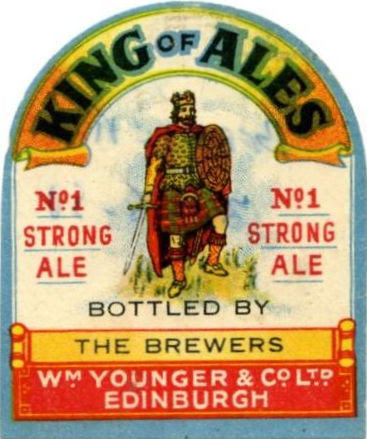
The most surprising thing about No. 1 is just how little it has changed after a few years of war. And the fact that they were still churning it out in quite large quantities.

I’d love to know where No. 1 was consumed during the war. As there were few beers this strong. Was it sipped as a nightcap in their pubs? Or was most distributed as off sales?

You’ll notice grist have reappeared in this recipe. Alongside some rice. I’m still not 100% certain about my current interpretation. But, as there’s a column clearly marked “grits”, it’s reasonable to assume that there are some in there. It’s all pretty confusing, to be honest.

The presence of two adjuncts has knocked down the malt percentage, but it’s still higher than in the mid-1930s, when Younger’s beers were typically 45% grits and 55% malt. One other change is a reduction in the amount of lactose.

Just a single type of hops this time, Kent from the 1939 harvest.

1941 William Younger No. 1
pale malt 11.25 lb 59.21%
crystal malt 120L 1.50 lb 7.89%
grits 2.00 lb 10.53%
flaked rice 3.75 lb 19.74%
lactose 0.50 lb 2.63%
Fuggles 150 min 1.00 oz
Fuggles 60 min 1.00 oz
Fuggles 30 min 1.00 oz
Goldings dry hops 0.25 oz
OG 1081
FG 1027
ABV 7.14
Apparent attenuation 66.67%
IBU 30
SRM 16
Mash at 156º F
Sparge at 160º F
Boil time 150 minutes
pitching temp 59º F
Yeast WLP028 Edinburgh Ale

Friday, 6 November 2020

Sugar in WW II

Sugar had been a standard ingredient in British beer for almost 100 years when WW II erupted. Ever since it was first allowed in 1847, sugar has been used as a source of fermentable material, to colour, to prime and to flavour beer. It was an essential ingredient in some styles, such as Dark Mild, whose typical character couldn’t be achieved with malts alone.

 Unfortunately, unlike some other beer ingredients, such as hops, sugar was also useful as a human food. Which meant supplies to brewers were limited. A bad harvest in the West Indies in 1940 didn't help.   This prompted a cut in both the domestic sugar ration and the quantities allocated for industrial use. 

In 1940, the UK had 1.25 million tons of sugar of imported sugar to play with. It came from all over the British Empire. Wonder how much of that was used in brewing? Of course, you do. And what better way to convey the information than a nice table. 

Brewing sugar (tons)
year sugar
1938 94,739
1939 99,324
1940 76,639
1941 69,882
1942 70,571
1943 70,029
1944 72,932
1945 89,203
1946 89,501
Source:
1955 Brewers'Almanack, page 62

Around 70,000 tons of sugar were used in brewing in 1940 and 1941. That was about 25% less than in 1939. And about 5 or 6% of all that sugar coming in from the West Indies, South Africa and the Pacific. Not that big a proportion, really. Then again, there were all those cakes, biscuits and cups of tea that needed sugar.

It’s worth noting that the 1.25 million tons wasn’t the total sugar supply. That’s just cane sugar. There was also UK-produced sugar from sugar beet.

The average amount of sugar used in beer fell during the war. From around 15% in the late 1930s to 10 or 11% after 1940. What the hell. Here's another table showing that:

Proportion of sugar in grists 1938 - 1946
year sugar
1938 15.82%
1939 15.75%
1940 13.03%
1941 11.05%
1942 11.06%
1943 10.80%
1944 10.83%
1945 12.93%
1946 13.73%
Source:
my calculation from figures in 1955 Brewers' Almanack, page 62


Thursday, 5 November 2020

The price of invert sugar

Brewers faced large increases in the price of all their ingredients. The price of barley got so out of hand that the government stepped and and took control in 1942, setting fixed prices. 

Sugar was also getting dearer. This is a letter from the MD of a manufacturer of brewing sugars.

"INVERT SUGAR.
To the Editor of The Brewers' Journal.


Dear Sir,—The present high price of invert sugar is almost entirely due to the advance in Duty which has taken place since the outbreak of war, and unfortunately constitutes another burden for the brewer; as Duty is again charged on the wort, to which sugar has been added, it is a case of Duty being charged twice—a principle to which, I understood, the Government was opposed.

It is, I believe, the only case of a double tax on a particular product, and as I have been asked on several occasions how to-day’s price of invert sugar can be reconciled, I think your readers would be interested to see the corresponding price of standard granulated sugar over different periods of the current year, which must be a guide and indication to them that to-day’s prices of invert are not in conflict with existing conditions: —

  Standard Granulated Sugar.  No. 2 Invert.
January 20/1.5 20/-
March 20/3 20/-
June 20/3 23/
August  23/ 23/-
September 27/6 28/5.5
November 36/10 36/4
December 36/10 36/4

Yours faithfully,
A. E. Berry, Chairman and Managing Director, Manbré and Garton, Ltd. 19/12/39.
Brewers' Journal 1940, page 63 (published January 17th, 1940).

That's an 82% increase in the cost of No. 2 invert in a space of just 8 months.And all due to an increase in the tax on it.

He has a point about the double taxation of brewing sugar.I hadn't realised that there was a tax on sugar.  Pre-1880 there was a duty on it when used for brewing purposes, but I thought that had been abolished when the Free Mash Tun Act came into force. I need to look this up. There's bound to be something in the Brewers' Almanack.

New numbers

If you've been paying the very vaguest of attention to my writings, you'll have spotted that I'm a bit number obsessed. A book called "Numbers!" which is pretty much all numbers is a bit of a clue.

I don't harvest numbers as aggressively as I once did. Partly because I've already netted many of the relevant ones.

Those I found today, probably don't sound so impressive. UK imports in terms of standard barrels*. I already had the bulk barrel numbers. Which is just the straight volume. Combined, however, they let me calculate the average OG of beer imported into the UK. Which was remarkably constant at a shade under 1053º.

No surprise there. As the vast majority came from Ireland in the form of Guinness Extra Stout. Which, at the time, was 1055º. Other imports were overwhelmingly continental Lager. Logically, that must have been weaker than Guinness to get the average OG down.

Looking at the ludicrous number of beer analyses I have, I see that one import, Carlsberg Pilsener, was just 1045º.

The past was such a different place.

But at least they still had our friends numbers to guide us.

UK beer imports 1930 - 1939
Year bulk barrels standard barrels Average OG imports Average OG UK beer
1930 1,522,906 1,464,082 1052.9 1042.9
1931 1,602,322 1,541,385 1052.9 1042.5
1932 1,373,450 1,320,171 1052.9 1041.0
1933 1,203,063 1,157,186 1052.9 1039.5
1934 1,276,270 1,220,877 1052.6 1041.0
1935 1,332,277 1,277,957 1052.8 1041.1
1936 1,392,457 1,335,982 1052.8 1041.0
1937 1,385,833 1,330,266 1052.8 1041.1
1938 1,163,046 1,112,737 1052.6 1041.0
1939 838,269 793,516 1052.1 1040.9
Sources:
Brewers' Almanack 1955, p. 50.
Brewers' Journal 1940, page 51 (published January 17th, 1940).


* As explained yesterday, 36 gallons with an OG of 1055º.

Tuesday, 3 November 2020

Let's Brew Wednesday - 1940 William Younger XXPS

Younger’s wartime records are a bit of a nightmare to interpret. I’ve changed my mind several times about what they actually mean.

It’s all to do with the adjuncts. And the confusing columns and what exactly does the underlining of some numbers mean? I’m just going with my best guess.

One thing I know for certain is that this iteration contained rice. Presumably, in the form of flakes. And I’m almost certain that it also contained grits. But I could be wrong about the latter. I am right, then they must have still been performing a cereal mash. As it’s a bit essential when brewing with grits.

The barley for the malt came from England, Scotland and somewhere I can’t make out. But the chances are it was domestic rather than imported. All just pale malt, obviously, as this was a Scottish beer.

Just two types of Kent hops, one from the 1938 season and the other from 1939.

1940 William Younger XXPS
pale malt 6.50 lb 63.41%
grits 1.75 lb 17.07%
flaked rice 2.00 lb 19.51%
Fuggles 105 min 0.75 oz
Fuggles 30 min 0.50 oz
Goldings dry hops 0.25 oz
OG 1044
FG 1013
ABV 4.10
Apparent attenuation 70.45%
IBU 15.5
SRM 4
Mash at 153º F
Sparge at 160º F
Boil time 105 minutes
pitching temp 61º F
Yeast WLP028 Edinburgh Ale

Book discount

15% off all my Lulu print books with this code:

FRIENDS15

Ends November 6th at 11:59 PM UTC


Excise duty

After 1880, the way of calculating exvise duty on beer wad an odd one. It was charged per "standard barrel" rather than by the actual volume of liquid.

This text explains it:

"From 1880 to 1933 the unit of charge was the "standard barrel," viz., 36 gallons at the standard specific gravity, which was 1057 deg. until 1889 and 1055 deg. thereafter. In 1923 the duty was reduced by a rebate of 20s. (or less on beer of very low gravity) per "bulk barrel," viz., 36 gallons whatever the gravity. This method was adopted in order to facilitate a uniform reduction in the retail prices of practically all beer, and the rebate was continued concurrently with subsequent increases in the charge."
Brewers' Journal 1940, page 49 (published January 17th, 1940).

But in the early 1930s, there was a subtle change to the system.

"In 1933 the duty was reduced and remodelled. Before the Budget of that year the Excise duty was £6 14s. per standard barrel minus the rebate referred to. This was altered to £1 4s. per barrel of a specific gravity up to and including 1027 deg., plus a further 2s. for every degree of gravity over 1027 deg. Thus the unit of charge was shifted from the standard barrel to the bulk barrel, and the charge was made to vary with the gravity of the latter. The reduction was calculated to be sufficient, in most cases, to permit of a fall in retail prices of 1d. per pint and to leave a margin to cover a rise in gravity."
Brewers' Journal 1940, page 49 (published January 17th, 1940).


This new system was a huge disincentive to brewing anything under 1027º. Because whether your beer had an OG of 1010º or 1027º, you still paid £1 4s. per barrel. Sure enough, I don't think I've come across a single beer with an OG below 1027º after 1933. While in WW I, there were beers as weak as 1010º.

"The Customs duty on imported beer exceeds the Excise duty by 1s. 3d. per bulk barrel, of which 5d. is to countervail the cost, to the home brewer of the licence duty and the Excise restrictions to which he is subject, and l0d. to countervail the Customs duty on imported hops. On imports of non-Empire beer, which consists largely of lager beer, there is also a surtax of £1 per bulk barrel imposed in 1936 as a measure of protection to the British lager beer industry."
Brewers' Journal 1940, page 49 (published January 17th, 1940).

I'd seen an extra tax on imported beer suggested for the purpose of helping Lager brewing in the UK. But I hadn't realised that it had been implemented. As mentioned in the article, UK beer imports, other than those from Ireland, were almost exclusively in the form of Lager.

And finally, a little mention for Black Beer, that weird and obscure stuff:

"On black beer, which is a special high gravity product, exceeding 1200 deg., in the nature of a syrup, the duties and rebates have remained unaltered since 1923. There have been no imports for many years, and the home production is small, having been 378 bulk barrels in 1938-39, equivalent to 1,668 standard barrels."
Brewers' Journal 1940, page 49 (published January 17th, 1940).

With only 378 bulk barrels produced, it was just about extinct.

Monday, 2 November 2020

Average Gravity

During both world wars, there were limits on the strength of bee, But it seems to have wirked in a subtly different way.

I'm still struggling to find all the WW II rules. It's very frustrating. Whereas those from WW I I have in full. I recently bought "The Brewers' Almanack 1961-52" hoping that it would at least summarise them. As editions for the 1930s had those from WW I. No such luck.

I'm still scratching around for fragments like this.

"Average Gravity:
The Society had been asked to deal with the case of a brewery who, having failed to keep within their permitted average gravity, as reduced by 15% below their 1939 figure, proposed to brew a certain amount of very weak beer not for sale.

The Committee unanimously recommended that the Council should condemn such a proposal, which was directly contrary to the national interest in wartime. The brewery in question had stated that beer was coming into their district at considerably higher gravity than they were permitted to brew, and that this was having" an adverse effect on their trade. All brewers, however, were subject to the 15% reduction in average gravity and it necessarily followed that, if strong beer were coming into the area now, it was also coming in before the war. The Committee had observed that the average gravity of the brewery in question was not unduly low and there were a great many breweries whose permitted average was considerably lower."
The Brewing Trade Review, November 1943, page 325. 

In WW I, the same average gravity applied to all breweries, where as in WW II it was on a brewery by brewery basis. So if your average had been high pre-war, it would remain relatively high.

The 15% reduction in OG was implemented because of the allocation of materials ti brewing. 15% fewer than used in 1939, without a reduction in the volume if beer brewed. As you can see in this tavle:

UK beer production and strength 1939 - 1946
Year Production (bulk barrels) Production (standard barrels) Average OG
1939 24,674,992 18,364,156 1040.93
1940 25,366,782 18,738,619 1040.62
1941 26,203,803 18,351,113 1038.51
1942 29,860,796 19,294,605 1035.53
1943 29,296,672 18,293,919 1034.34
1944 30,478,289 19,193,773 1034.63
1945 31,332,852 19,678,449 1034.54
1946 32,650,200 20,612,225 1034.72
Source:
Brewers' Almanack 1955, p. 50 and 57

Brewing weak beer that you weren't going to sell just to get your average OG down was taking the piss. And a waste of the materials used.


Sunday, 1 November 2020

Effects of alcohol (propaganda)

The teetotallers in parliament were at it again. Thankfully, the government told them to shut the fuck up.

"3rd November.
EFFECTS OF ALCOHOL (PROPAGANDA)
Dr. Little (Down, Ulster Unionist) asked the Minister of Information whether he will use all the means of propaganda at his disposal to impress on people, young and old alike, that indulgence in alcoholic liquors is not only harmful to the individual but also a serious hindrance to the war effort and that national sobriety is essential for achieving the best work towards a speedy victory ?

Mr. Thurtle (Parliamentary Secretary, Ministry of Information) : No, Sir. It is no part of the duty of the Ministry of Information to lecture the public on the good or evil effects of alcohol.

Dr. Little : Will my hon. Friend cause regular statements to be made to the public through the Ministry of Information that persons under 18 cannot be served with alcoholic liquor in public houses and that it is illegal for adults to treat such persons ?

Mr. Thurtle : I suggest to my hon. Friend that it is no part of the function of the Ministry of Information to give lectures on the use or abuse of alcohol. I do not think the House would wish it to do so.

Viscountess Astor (Sutton, Plymouth, Cons.) : It is not true that no Government since the world began have ever" cared less about temperance than this Government ?

Sir Richard Acland (Devon, Barnstaple, Common Wealth) : As the Ministry of Information is advising the public to curtail the consumption of all sorts of things, such as fuel and water, might it not consider advising it to curtail the consumption of beer ?

Mr. Thurtle : The duty of the Ministry of Information is to give information to the public, but it is not the duty of the Ministry of Information to indulge in propaganda on contentious subjects."
The Brewing Trade Review, December 1943, page 374.

 Good on you Mr. Thurtle for putting those temperance twats in their place: 

"It is no part of the duty of the Ministry of Information to lecture the public on the good or evil effects of alcohol."

The Ministry of Information being the propaganda arm of the UK government. So, fuck off with your temperance propaganda.

With legendary piss-head Churchill in charge, the temperance lobby never stood a chance.


Saturday, 31 October 2020

Discount on my books

20% off all my Lulu print books with this code:

BIGTREAT20

Ends November 1st at 11:59 PM UTC.