Tuesday, 13 February 2024
Guinness in the 1970s
Because they owned no pubs and had a bottle-conditioned beer in every pub, Guinness mostly escaped the ire of CAMRA. And weren’t considered part of the evil Big Six, despite having a market share as large as that of Courage.
The company operated two European breweries: St. James Gate in Dublin and Park Royal in London. The latter was opened in the 1930s in reaction to trade friction between the UK and the newly-founded Irish Free State. In General, the North of England and Scotland received beer from Dublin and the South from London.
Before 1970, the vast majority of Guinness sold in UK pubs was in bottle-conditioned format. Most of which wasn’t bottled by Guinness themselves, but by other brewers or third-party bottlers. For example, in Leeds, all the Guinness in Tetley’s pubs was bottled by Musgrave & Sagar, a former brewery in the town.
In 1970, a satellite racking facility was built in Runcorn. This seems to have been mostly dedicated to filling Draught Guinness into 50-litre kegs. The beer came from both their Dublin and London breweries. It had an annual capacity of 500,000 barrels and was intended only to supply the North of England.
Guinness needed the facility after signing agreements with 19 of the 20 largest breweries to sell draught Stout in their pubs. At Park Royal, where kegging had taken place up until then, there was insufficient space for expansion.
For home brewers, Guinness Extra Stout was an excellent source of a very active yeast. Me and my brother used it often.
Monday, 12 February 2024
Who drank what in 1970
"It was found that on average, a consumer drinks between 2 and 3 types of drink per day. The highest duplication occurs on Friday and Saturday and the lowest on Monday and Tuesday. Also the under 25’s and the AB social class consume a greater variety of drinks than other informants."
Brewers' Guardian, Volume 99, March 1970, page 87.
I think what they're saying there is that people went out drinking more at the weekend than at the start of the week. Now there's a surprise. And the young and the wealthy drank more different drinks than the average. Not much of a shock, either.
"U.G. say that men drink an average of 79 fl. oz. per day compared to the 59 fl. oz. consumed by women. The difference is least marked at the beginning of the week but the gap widens considerably towards the week-end when the consumption of beer amongst males rapidly increases. Conversely, women do tend to drink less at weekends it was found. Further details of the survey are available on application to the market research manager, United Glass Ltd."
Brewers' Guardian, Volume 99, March 1970, page 87.
Again, nothing really shocking. Men drank more than women and drank more beer at the weekend. I think I could have guessed that.
What did surprise me is the difference in beer drinking between men and women - 36% of men but just 7% of women. That's a huge difference. I wonder what the numbers would be now? My guess would be that the overall average would be something similar to 21%, but that the split between men and women would be more even.
One big change from today would be regards to tea. I'm sure the percentage of people making tea with teabags would be much higher than 5%.
I'm shocked to see only 10% of people drank water. Barely more than the 9% who drank hot chocolate.
| Type of drink X proportion drinking | |||||||||||
| Total | Sex | Age | Social Class | ||||||||
| Male | Female | 16-24 | 25-34 | 35-44 | 45-64 | AB | C1 | C2 | DE | ||
| All Respondents | 2107 | 1052 | 1055 | 421 | 378 | 423 | 885 | 253 | 415 | 806 | 633 |
| % | % | % | % | % | % | % | % | % | % | % | |
| Tea | 90 | 91 | 89 | 84 | 87 | 90 | 94 | 89 | 87 | 91 | 91 |
| Instant Coffee | 57 | 51 | 62 | 64 | 68 | 57 | 48 | 71 | 61 | 58 | 46 |
| Beer | 21 | 36 | 7 | 27 | 24 | 18 | 19 | 26 | 20 | 12 | 21 |
| MiIk | 13 | 11 | 15 | 22 | 13 | 8 | 11 | 16 | 16 | 11 | 13 |
| Water | 10 | 9 | 11 | 13 | 10 | 8 | 10 | 13 | 12 | 9 | 10 |
| Hot Chocolate | 9 | 7 | 11 | 12 | 12 | 8 | 8 | 11 | 11 | 9 | 8 |
| Squash | 9 | 7 | 10 | 15 | 12 | 5 | 6 | 10 | 8 | 9 | 7 |
| Milk Drinks | 7 | 6 | 9 | 4 | 8 | 7 | 9 | 8 | 10 | 6 | 7 |
| Ground Coffee | 7 | 7 | 7 | 6 | 8 | 5 | 9 | 15 | 13 | 6 | 2 |
| Spirits and Fortified Wine | 7 | 6 | 7 | 5 | 8 | 5 | 8 | 19 | 9 | 5 | 3 |
| Tea made with tea-bags | 5 | 4 | 5 | 6 | 5 | 5 | 4 | 9 | 5 | 4 | 3 |
| Others | 21 | 17 | 22 | 29 | 19 | 18 | 17 | 27 | 25 | 21 | 15 |
| Duplication | 156 | 152 | 155 | 187 | 174 | 134 | 143 | 214 | 177 | 150 | 126 |
| Source: | |||||||||||
| Brewers' Guardian, Volume 99, March 1970, page 87. | |||||||||||
Sunday, 11 February 2024
Cask tank beer
"Over the past few years many traditional, locally-brewed beers have fallen by the wayside because of the economies offered by nationally distributed brands. But one smaller brewing concern, John Joule & Sons Ltd., a Bass Charrington subsidiary, are managing to retain their traditional beers by cashing in on the savings afforded by bulk tank distribution to pub cellars.
To cater for the increased demand for this tank beer they have recently opened a new £25,000 department at the Stone brewery. Beer which is used in the tanks is naturally conditioned but, instead of being racked into casks, it is racked into Porter Lancastrian tanks, conditioned for 48 hours and then chilled to about 52-54° F before being sent out to trade."
Brewers' Guardian, Volume 99, April 1970, page 60.
Instead of being racked into casks, the beer was transferred to tanks where it was conditioned for 48 hours at 58° F while being roused. The beer was centrifuged on the way into the tank, but not all the yeast was removed, as its presence helped extend the shelf-life to three to four weeks. Before transfer to delivery tankers by compressed air, the beer was chilled to 52-54° F.
Pubs were fitted with five-barrel tanks, either Fairey and Grundy. Before each delivery a team from the brewery cleaned and sterilised the tanks. After filling, the beer was fined for clarity, left for 48 hours and presumably served by electric pump.
It sounds basically like cask beer, just in a larger container. I wonder what it tasted like? Could drinkers tell it apart from true cask?
Saturday, 10 February 2024
Let's Brew Wednesday - 1890 Adnams XXXX
As with most 19th-century beers, there’s not a great deal to the recipe. Just base malt, sugar and a dash of caramel. I’ve no real idea what the sugar was. No. 2 invert is my conservative guess. As there’s no indication whatsoever of its type in the brewing record, it could be anything.
Owing to a fairly sparse brewing record, there are lots of guesses. Like the FG, mashing temperature and boiling time.
The hopping rate is fairly robust, consisting of Kent and Bavarian hops. No age is given for the hops.
| 1890 Adnams XXXX | ||
| pale malt | 8.50 lb | 71.85% |
| No. 2 invert sugar | 3.25 lb | 27.47% |
| caramel 1000 SRM | 0.08 lb | 0.68% |
| Fuggles 90 mins | 3.00 oz | |
| Hallertau 90 mins | 0.75 oz | |
| OG | 1062 | |
| FG | 1016 | |
| ABV | 6.09 | |
| Apparent attenuation | 74.19% | |
| IBU | 43 | |
| SRM | 16 | |
| Mash at | 154º F | |
| Sparge at | 170º F | |
| Boil time | 90 minutes | |
| pitching temp | 59º F | |
| Yeast | WLP025 Southwold | |
Friday, 9 February 2024
Spying with beer
Published in 1949, just a few years after the end of the war, the conflict was clearly still in the author's mind. There are some passages which layout the attitude and goals of the C.B.K. (Centraal Brouwerj Kantoor), the Dutch brewers' organisation.
"We have just mentioned two fundamental aspects of the C.B.K. However, the practical side of the unity of the brewing world vis-à-vis the occupying forces must also be emphasized. Initially, the requisitioning of brewery staff took place on an individual basis. Due to the intervention of the management of the C.B.K. However, it has been achieved that such individual actions will not be taken. Afterwards, the C.B.K. also led the Germans to classify the brewery staff and beer merchants as indispensable. Furthermore, the C.B.K. took action when the occupiers took the position of allowing some breweries to continue working and forcing others to close: it was possible to manage that all breweries were allowed to continue working. In order to arrive at this result, reference was made to the mandatory deliveries to the "Wehrmacht", which, however, never amounted to more than 8 percent of the total turnover and guaranteed that sales to Dutch customers, which were always seriously threatened, would continue. It could also be averted by invoking those mandatory deliveries by pointing to Hitler's demand "Bier soll sein" and so too could the threat of copper requisitioning. This was of great significance. In the previous war the copper requisitioning in Belgium had fatal consequences for the brewing industry of our southern neighbors and the consequences for our breweries would certainly have been even more serious in connection with the serious shortage of materials that existed after the Second War."
Korte Geschiedenis der Heineken's Bierbrouwerij Maatschappij N.V. 1873-1948, H. A. Korthals, 1949, pages 390-391.
The primary aim of the C.B.K. was to keep all Dutch breweries open until the end of the war.Specifically, they wanted to avoid the fate og Belgium's breweries in WW I, when most were stripped of their copper by the Germans. Many never to reopen. They managed to convince the Germans that all breweries needed to stay open in order to supply the Whrmacht. Even though only 8% of production was needed. Leaving plenty of beer for Dutch civilians.
Unwisely, the Germans let the C.B.K. organise beer deliveries to German units.
"It is worth mentioning that the regulation of deliveries to the "Wehrmacht" proposed by the C.B.K. enabled the agency to determine almost exactly the strength of the troop concentrations in the various parts of our country. This information was also passed on to the English spy service. The leadership of the C.B.K. had, however, anticipated the possibility of "passing on" the figures when setting up the scheme and, when submitting the proposals in the accompanying letter, it had pointed out - otherwise unspecified - dangers associated with the scheme. When Mr. Stikker was called to account, he was able to point out to the Germans that he had alerted them to possible dangers and furthermore he argued that he could hardly be held responsible for the "leak" in the C.B.K. where no fewer than 70 people worked!"
Korte Geschiedenis der Heineken's Bierbrouwerij Maatschappij N.V. 1873-1948, H. A. Korthals, 1949, page 391.
It seems that the Germans were so keen to let someone else organise their beer for them, that they didn't worry about the information about their troops that was being given away. I wonder exactly how the information was passed on to British intelligence? It's not like they could just call them on the phone.
(My translation.)
Thursday, 8 February 2024
Pseudo-Lager
Let's look at the hops. Most of which are English. Which is dead authentic for the style. At least London Lager has continental hops, in the form of Styrian. Though even they were descended from English hop varieties. Given how few hops went into the Drybrough and Truman examples, it probably didn’t really matter what type they were.
We’ll now have a chance to see how authentic the fermentations were.
Not much really to say about the boil times. Other than that, the two hours for Elgood’s is a bit on the long side. But not stupidly so.
The Elgood fermentation profile looks just like those for its other beers. And way too warm for a Lager. But, as they were using their standard top-fermenting yeast, they couldn’t really have fermented cold.
Truman did pitch their Lager cooler, but not as low as in proper bottom-fermentation. Based on a fermentation length of just six days, I can’t imagine the Continental was fermented cold. From what I can make out in the brewing record, it looks as if they were using their standard yeast.
Elgood used the same underlet mash as for all their beers. While Truman employed a modified version of theirs, with the initial infusion a good bit cooler and the underlet quite warmer. Details are too scarce to tell what exactly what was going on at Drybrough. It certainly looks like a more complicated process than for their other beers. A mash with four steps, possibly.
Overall, not very authentic Lagers, then. Pseudo-Lagers, really. Which isn’t much of a surprise as none of the three breweries had a dedicated Lager kit.
| Lager hops 1969 - 1975 | ||||
| Year | Brewer | Beer | hop 1 | hop 2 |
| 1970 | Drybrough | Continental | English | English |
| 1975 | Elgood | Lager | English (1974) | |
| 1969 | Truman | London Lager | Styrian | |
| Sources: | ||||
| As in the table above. | ||||
| Lager boiling and fermentation 1969 - 1975 | ||||||
| Year | Brewer | Beer | boil time (hours) | Pitch temp | max. fermen-tation temp | length of fermen-tation (days) |
| 1970 | Drybrough | Continental | 6 | |||
| 1975 | Elgood | Lager | 2 | 60º F | 69.5º F | 8 |
| 1969 | Truman | London Lager | 1.5 | 53º F | 60º F | 8 |
| Average | 1.8 | 57º F | 65º F | 7.3 | ||
| Sources: | ||||||
| As in the table above. | ||||||
Wednesday, 7 February 2024
Let's Brew Wednesday - 1975 Elgood Lager
Which is exactly what we have here. The recipe is very simple: lager malt, flaked rice and a tiny bit of malt extract. I assume that rice has been chosen as the adjunct in order to keep the colour as pale as possible. There’s really not a lot more to say about the grist.
In reality, this is a Golden Ale, just artificially carbonated, stuck into kegs and served cold.
A typical underlet mashing process was employed. Nothing even vaguely resembling a decoction mash. Though much the same as the scheme used for their other beers.
There was a single type of English hop from the 1973 harvest.
| 1975 Elgood Lager | ||
| lager malt | 6.50 lb | 87.60% |
| flaked rice | 0.67 lb | 9.03% |
| malt extract | 0.25 lb | 3.37% |
| Fuggles 95 min | 0.50 oz | |
| Fuggles 60 min | 0.50 oz | |
| Fuggles 30 min | 0.50 oz | |
| OG | 1034 | |
| FG | 1008 | |
| ABV | 3.44 | |
| Apparent attenuation | 76.47% | |
| IBU | 20 | |
| SRM | 2.5 | |
| Mash at | 151º F | |
| Sparge at | 170º F | |
| Boil time | 95 minutes | |
| pitching temp | 59º F | |
| Yeast | WLP007 Dry English Ale | |
| action | barrels | strike heat | initial heat | mins stood |
| mash | 16 | 147º F | 144º F | 20 |
| underlet | 3 | 200º F | 151º F | 100 |
| sparge 1 | 20 | 170º F | ||
| sparge 2 | 15 | 160º F |
Tuesday, 6 February 2024
Who was drinking Lager in the 1970s?
I could make all sorts of prejudiced guesses and assumptions. But, thankfully, someone bothered to do research at the time. Not exactly disinterested research, as it was at the behest of Lager brewers themselves.
Let's start with a brewer close to home: Heineken.
"The company have also carried out an extensive research project into the market for draught lager and they have found that most draught lager drinkers tend to be in the younger age group, half of the present drinkers being under 35, and three quarters under 45."
Brewers' Guardian, Volume 99, March 1970, page 44.
I'm amazed that 25% of Lager drinkers were over 45. Had they been drinking Lager for years or were they new converts, too? Or, perhaps, Scottish?
There was a downside, though. These new Lager drinkers had little brand loyalty:
"Heineken's view on the annual 30 per cent increase in this market is that one-bird of the present draught lager drinkers started drinking it in the last year. It was also found that brand preferences are low - nine out of ten people would willingly accept another brand if their usual one was not available."
Brewers' Guardian, Volume 99, March 1970, page 44.
What had these new Lager drinkers been drinking before?
"Heineken say that most people who do not drink draught lager have not tried it because they regard it as too expensive. In view of this they strongly recommend that the retail price for Draught Heineken should be at 2s. lOd. per pint. Finally, although many licensees appear to think that the introduction of draught lager will hit bottled lager sales, it seems to Heineken that a sizeable proportion of the present draught lager drinkers are drawn from the ranks of previous draught bitter and keg drinkers - hence the promotion of Draught Heineken as a new draught beer."
Brewers' Guardian, Volume 99, March 1970, page 44.
What a surprise - cask and keg Bitter. Though I'm sure there must have been some converts from Mild, too.
Another Lager brewer found a similar age profile:
"Since lager is increasing in popularity each year, who is drinking it? According to a market survey conducted recently for Skol, it is men and women between the ages of 20 and 40 who find lager their favourite tipple. People generally have more money in their pockets these days and are prepared to spend it on more “sophisticated” drinks providing they offer value for money."
Brewers' Guardian, Volume 99, March 1970, page 46.
Young people with too much money. That's who's to blame. As always.
Monday, 5 February 2024
Bass Charrington dominate Lager
Despite many smaller brewers plunging into the Lager pool, large and international concerns dominated the market. In 1970, 92% of sales were in the hands of five companies.
With 34%, Bass Charrington were very much in the driving seat. They were the largest brewery, but held nowhere near as much as a third of the total beer market. Both of their Lagers were also brands which they owned 100%. Of the Big Six, only Allied, with Skol, was in a similar situation.
It’s indicative of the scale of Lager sales in Scotland that Tennents, a regional brand not available in most of the country, was the second biggest seller.
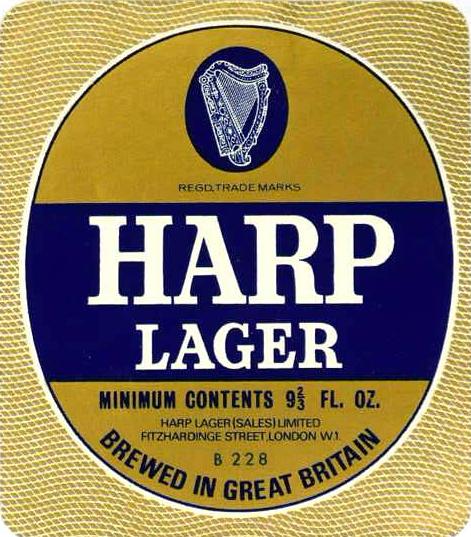
The Harp Lager consortium was originally owned 50% by Guinness, 22.5% by Courage, 22.5% by Scottish & Newcastle and 5% by Bass Charrington. Given the success of their own Lager brands, it's no surprise that Bass Charrington sold off their share in Harp early in 1970. As a result, the percentage owned by Courage and Scottish & Newcastle rose to 25% each.
Outside of the big boys, everyone else had to be happy with just 8% between them. Demonstrating that the growth of Lager was disproportionately exploited by the larger brewers, giving them yet another advantage.
| Lager market shares in 1970 | |
| Harp | 26% |
| Bass-Charrington | |
| Tennents | 21% |
| Carling | 13% |
| Allied Breweries | |
| Skol | 16% |
| Carlsberg | 12% |
| Heineken | 4% |
| Remainder | 8% |
| Source: | |
| Brewers' Guardian, Volume 99, March 1970, page 39. | |
Sunday, 4 February 2024
Lager boom
At least, that's what I thought a week ago. But, since I started trawling through The Brewers' Guardian, I've changed my mind. There's so much I realise that I'd missed. Just as well I'm not in a rush to publish.
I'm reminded of a quote about putting together electronic tracks (something I did myself way back in the 1990s). Knowing when to stop was the thing. Resisting the desire to further tinker and say: "That's done". It's advice I think I should have carried over into my writing.
In the march 1970 issue of The Brewers' Guardian there's a feature on Lager made up of several articles. And they've given me a great insight into exactly why brewers were so keen on Lager in the 1970s. This pretty much sums up the motivation:
"While the beer market as a whole is only expanding by three per cent, the sales of lager have been leaping forward at a 30 per cent increase every year for the last four years."
Brewers' Guardian, Volume 99, March 1970, page 39.
I'd been thinking that Lager really took off in the mid-1970s, but it seems the process started a good bit earlier. Which brewer wouldn't be attracted by the possibility of 30% growth every year?
People today have mostly forgotten that, initially, Lager didn't appear very manly An important factor in its growth was a change in its image:
"Socially, the image of lager has undergone substantial change in recent years. It used to he regarded as a rather fancy expensive drink for women and young people served in an overdressed bottle at a foreign temperature. What put paid to that view was the arrival of draught lager on a large scale in the middle sixties. From being a socially exclusive drink it became, for some, the ordinary man's regular pint."
Brewers' Guardian, Volume 99, March 1970, page 39.
In the 1960s, then, Lager moved from being a niche product to one firmly in the mainstream. And what was one of the reasons for this change in perception? The growth of draught Lager.
"The key growth point is the sale of draught lager which is shooting away at a rate of growth of 50 per cent a year.
By 1975, it is estimated that 75 per cent of all lager sold will be draught. In Scotland three out of four bars have draught lager dispensers. Lager is becoming well entrenched in the great clubs of the North and Midlands and the trend is moving south fast."
Brewers' Guardian, Volume 99, March 1970, page 39.
The future for Lager was looking very rosy.
"If anything in life can be assured, the demand for lager in Britain appears definite enough. Nobody knows what the percentage of the whole beer market it may be in 1980, perhaps 15 per cent, possibly nearer 20. The factors favouring growth appear convincing. In the first place, the growing number of dispensing fonts in pubs, clubs and hotels where draught is served. Even though it costs the breweries at least £65 a time to put in the whole plant and cooler, once established they tend to draw customers. Lager, as we mentioned at the beginning, is now accepted as a masculine pint, and there is an untapped market in the South of Britain waiting to be exploited. A generation of youngsters weaned on lager, perhaps first on foreign holidays, are growing up with adult thirsts. So by AD 2000 ale may well be an old man's drink."
Brewers' Guardian, Volume 99, March 1970, page 40.
Did Lager manage to achieve a market share of 20% by 1980? It smashed way past, hitting 30.7%.* And Ale, at least the sort that was around in the 1970s, is now an old man's drink.
* “The Brewers' Society Statistical Handbook 1988” page 17.
Saturday, 3 February 2024
Hear me talking about beer history
On the podcast We Are Beer People.
This is the podcast:
and here's a link to it.
This Youtube version:
and a link to it.
Let's Brew - 1917 Barclay Perkins XLK (crate)
At first I wondered what the hell they meant with crate. Surely all bottled beer was delivered in crates? Then I remembered some old adverts. Where they show a four-quart crate. It’s always cheap and cheerful beer being marketed that way. It looks to me like a transitional thing, when having a cask was going out of fashion, but people still wanted to buy in relative bulk.
Which explains a fairly low OG. Weirdly, the type of quart screw-topped bottles they used for crate beer were still around when I lived in Leeds in the later 1970s. I can remember buying Whitbread beer in bottles like that from Mr. Fisher, the bloke who ran the open all hours grocery and offie opposite 97 Brudenell Road. A house I lived in several times.
A forerunner of Light Ale is how I’d describe this. Light Ale being the low-gravity bottled Pale Ale that was all the rage between 1930 and 1970.
| 1917 Barclay Perkins XLK (crate) | ||
| pale malt | 7.25 lb | 91.66% |
| No. 2 invert sugar | 0.33 lb | 4.17% |
| No. 3 invert sugar | 0.33 lb | 4.17% |
| Fuggles 120 mins | 1.00 oz | |
| Fuggles 60 mins | 0.75 oz | |
| OG | 1036 | |
| FG | 1008 | |
| ABV | 3.70 | |
| Apparent attenuation | 77.78% | |
| IBU | 25 | |
| SRM | 6 | |
| Mash at | 152º F | |
| Sparge at | 170º F | |
| Boil time | 120 minutes | |
| pitching temp | 60.5º F | |
| Yeast | Wyeast 1099 Whitbread Ale | |
The above is one of almost 300 recipes in this wonderful book.
There's also a Kindle version.
Friday, 2 February 2024
Lager grists in the 1970s
All are very simple beers, in terms of recipe, with no more than three ingredients. In the case of Drybrough Continental, it’s just two.
You probably could have guessed, given the pale colour required for the style, that there’s just a single malt: lager. And it makes up a fair percentage in all three, peaking at 91% in Drybrough Continental.
All three examples contain a single adjunct. Three different flaked grains: maize, rice and barley. In each case making up 9% to 10% of the total fermentables. They would help keep the colour pale, but I doubt that was the only reason for their use. Given that the brewers’ other beers also contained adjuncts, including the dark ones.
There’s unexpectedly little sugar. None at all in Continental. Just a small amount of malt extract in Elgood Lager and some cane sugar in London Lager. Quite a bit less than in most other styles, as the average for all UK-brewed beer was around 15%. Though that would have included primings as well as copper additions of sugar, which is what we’re seeing in the table.
| Lager malt, adjuncts and sugars 1969 - 1975 | ||||||||
| Year | Brewer | Beer | lager malt | flaked maize | flaked rice | flaked barley | malt extract | cane sugar |
| 1970 | Drybrough | Continental | 90.91% | 9.09% | ||||
| 1975 | Elgood | Lager | 88.24% | 8.82% | 2.94% | |||
| 1969 | Truman | London Lager | 82.76% | 10.34% | 6.90% | |||
| Sources: | ||||||||
| As in the table above. | ||||||||
Thursday, 1 February 2024
Inside 1970s Lager
I'm feeling really energised by all the new information that's been flooding over me. The last two weeks I've been happily wallowing in it. And I haven't even got to the 1970 Brewers' Guardian six-page Lager special.
Time to have a look at what went into 1970s Lager. Only three examples, but from quite an interesting range of brewers. Big Six (Drybrough), national (Truman) and small (Elgood). As Truman was still independent in 1969.
Typical of the era, is such a small brewer as Elgood, who only owned 65 pubs, brewing their own Lager. Many brewers wanted to be the source of all the draught beer in their tied houses. Making producing small quantities of Lager totally logical. Not many still bother (other than Sam Smith), serving instead a national or international brand.
At first glance, all three beers look very similar: OG 1034º. 3.4% ABV, 75% attenuation. Which was about standard for a 1970s Lager.
The hopping and colour are another matter. Elgood’s beer is far more heavily hopped than the other two. Both of which have only had a few hops waved at them’ Leaving them with pathetically low bitterness levels.
In terms of colour, it’s Truman’s beer that stands out. It’s a good bit darker than the others and isn’t that much paler than Truman’s standard-strength Bitter, which was 21. Was London Lager deliberately darker than most Lagers? Or was that just an accident?
| Lager 1969 - 1975 | ||||||||||
| Year | Brewer | Beer | OG | FG | ABV | App. Atten-uation | lbs hops/ qtr | hops lb/brl | colour | IBU |
| 1970 | Drybrough | Continental | 1032.8 | 3.18 | 0.41 | 12 | 14 | |||
| 1975 | Elgood | Lager | 1034.3 | 1008.9 | 3.37 | 74.19% | 5.22 | 0.68 | 10 | 20 |
| 1969 | Truman | London Lager | 1034.6 | 1008.9 | 3.41 | 74.40% | 2.30 | 0.36 | 16 | 11.5 |
| Average | 1033.9 | 1008.9 | 3.39 | 74.30% | 3.57 | 0.49 | 12.7 | 15.2 | ||
| Sources: | ||||||||||
| Drybrough brewing record held at the Scottish Brewing Archive, document number D/6/1/1/9. | ||||||||||
| Elgood brewing record held at the brewery. | ||||||||||
| Truman brewing record held by Derek Prentice. | ||||||||||
| Note: | ||||||||||
| Colour values marked with * were taken from brewery sources rather than calculated. | ||||||||||